Odd-Parity Magnons
Pith reviewed 2026-06-28 21:34 UTC · model grok-4.3
The pith
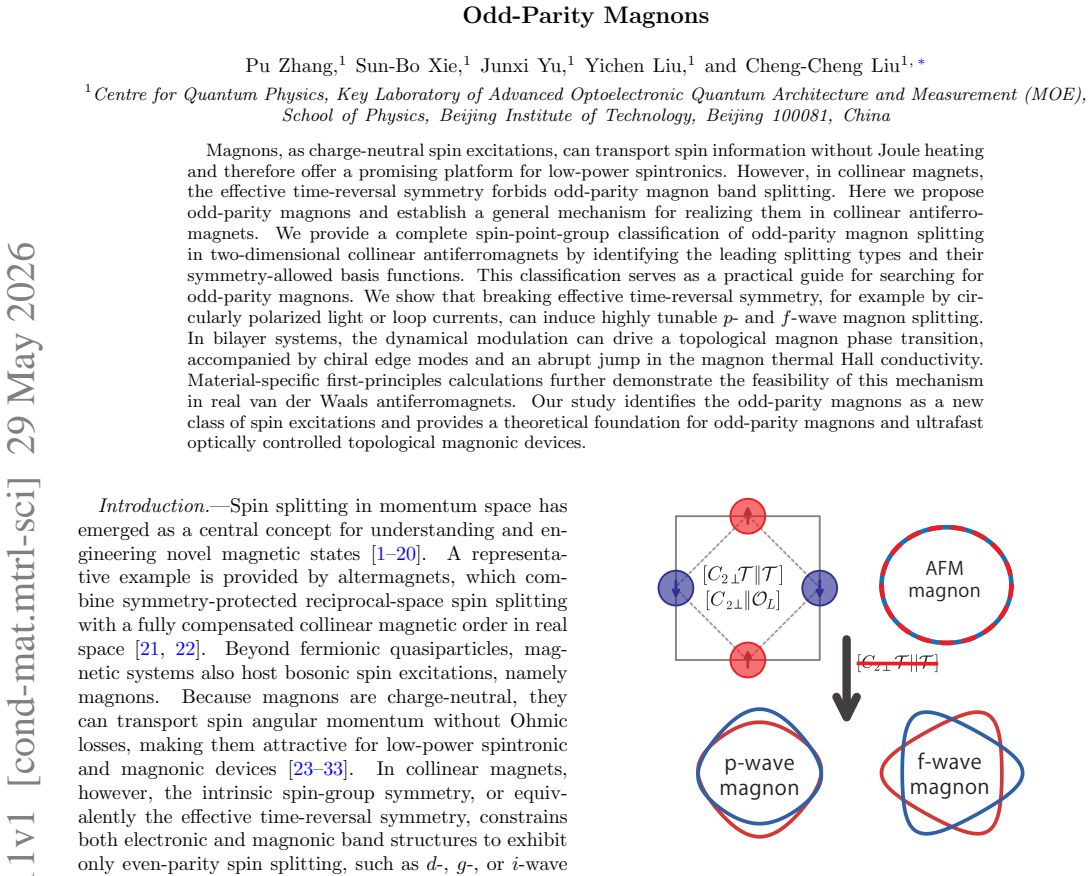
Odd-parity magnons arise in collinear antiferromagnets once effective time-reversal symmetry is broken by external drives such as circularly polarized light.
A machine-rendered reading of the paper's core claim, the machinery that carries it, and where it could break.
Core claim
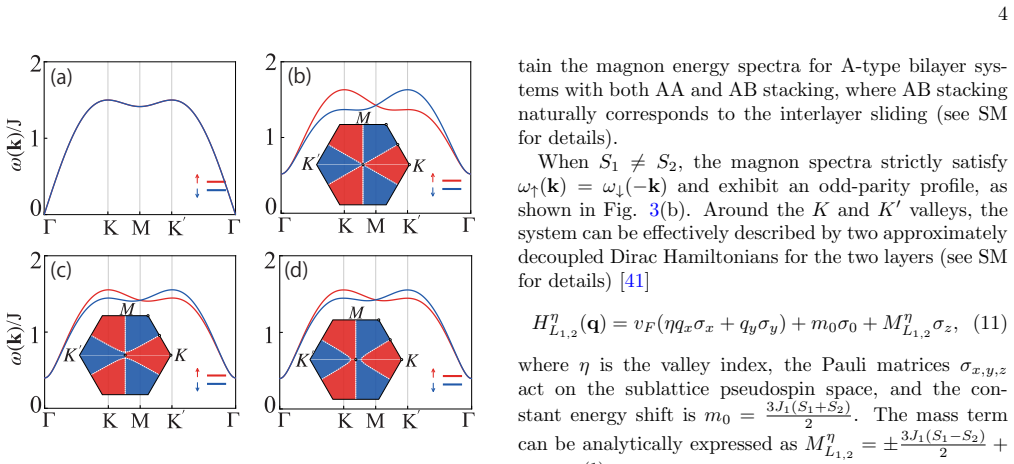
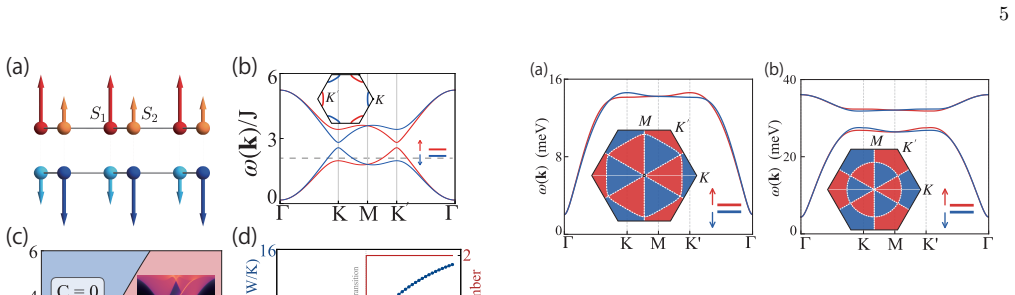
Odd-parity magnons are proposed as a new class of spin excitations in collinear antiferromagnets. A general mechanism is established whereby breaking effective time-reversal symmetry, for instance via circularly polarized light or loop currents, induces highly tunable p- and f-wave magnon splitting. A complete spin-point-group classification identifies the leading splitting types and symmetry-allowed basis functions in two-dimensional collinear antiferromagnets. In bilayer systems, dynamical modulation drives a topological magnon phase transition with chiral edge modes and an abrupt jump in the magnon thermal Hall conductivity. Material-specific first-principles calculations demonstrate feas
What carries the argument
Odd-parity magnon splitting realized by breaking effective time-reversal symmetry in collinear antiferromagnets using external perturbations like circularly polarized light or loop currents.
If this is right
- Highly tunable p- and f-wave magnon band splitting occurs in collinear antiferromagnets.
- Bilayer systems show a dynamical modulation-induced topological magnon phase transition accompanied by chiral edge modes.
- An abrupt jump appears in the magnon thermal Hall conductivity during the transition.
- The spin-point-group classification serves as a practical guide for identifying odd-parity magnons in two-dimensional systems.
- First-principles calculations confirm the mechanism is feasible in real van der Waals antiferromagnets.
Where Pith is reading between the lines
- The mechanism could support optically driven control of magnon-based spin information transport at low power.
- Similar symmetry-breaking drives might induce odd-parity features in other neutral quasiparticles such as phonons or photons in magnetic systems.
- Detection of the thermal Hall jump or chiral modes in bilayer van der Waals materials would offer a direct experimental test.
- The classification approach may generalize to three-dimensional collinear antiferromagnets or other magnetic orders.
Load-bearing premise
Effective time-reversal symmetry is the only barrier to odd-parity magnon splitting in collinear magnets, and its breaking by external drives produces the claimed p- and f-wave splitting types without additional constraints from spin-point-group analysis.
What would settle it
Absence of p- or f-wave magnon splitting in first-principles calculations or experiments on a collinear antiferromagnet under circularly polarized light, or lack of the predicted jump in magnon thermal Hall conductivity in a bilayer, would falsify the mechanism.
Figures
read the original abstract
Magnons, as charge-neutral spin excitations, can transport spin information without Joule heating and therefore offer a promising platform for low-power spintronics. However, in collinear magnets, the effective time-reversal symmetry forbids odd-parity magnon band splitting. Here we propose odd-parity magnons and establish a general mechanism for realizing them in collinear antiferromagnets. We provide a complete spin-point-group classification of odd-parity magnon splitting in two-dimensional collinear antiferromagnets by identifying the leading splitting types and their symmetry-allowed basis functions. This classification serves as a practical guide for searching for odd-parity magnons. We show that breaking effective time-reversal symmetry, for example by circularly polarized light or loop currents, can induce highly tunable $p$- and $f$-wave magnon splitting. In bilayer systems, the dynamical modulation can drive a topological magnon phase transition, accompanied by chiral edge modes and an abrupt jump in the magnon thermal Hall conductivity. Material-specific first-principles calculations further demonstrate the feasibility of this mechanism in real van der Waals antiferromagnets. Our study identifies the odd-parity magnons as a new class of spin excitations and provides a theoretical foundation for odd-parity magnons and ultrafast optically controlled topological magnonic devices.
Editorial analysis
A structured set of objections, weighed in public.
Referee Report
Summary. The manuscript proposes odd-parity magnons as a new class of spin excitations in collinear antiferromagnets, forbidden by effective time-reversal symmetry but inducible by breaking this symmetry via external drives such as circularly polarized light or loop currents. It supplies a complete spin-point-group classification of odd-parity magnon splitting in two-dimensional collinear antiferromagnets, identifying leading splitting types and their symmetry-allowed basis functions. The work demonstrates that such drives produce highly tunable p- and f-wave magnon splitting, and in bilayer systems the dynamical modulation induces a topological magnon phase transition featuring chiral edge modes and an abrupt jump in the magnon thermal Hall conductivity. Material-specific first-principles calculations on van der Waals antiferromagnets are presented to establish feasibility.
Significance. If the central claims hold, the identification of odd-parity magnons and the drive-induced mechanism would open a route to ultrafast optical control of topological magnonic devices and expand the toolkit for low-power spintronics. The spin-point-group classification is presented as a practical search guide, and the explicit first-principles results on real materials constitute a concrete strength that grounds the proposal in existing compounds.
major comments (2)
- [spin-point-group classification and drive-induced splitting sections] The central claim that breaking effective time-reversal symmetry is sufficient to produce the listed p- and f-wave splittings rests on the spin-point-group classification; however, the manuscript must explicitly verify that the drive Hamiltonians (circularly polarized light, loop currents) transform under the same irreps as the target basis functions and are not forbidden by any residual symmetries preserved by the drive. This mapping is load-bearing and should be shown with the classification tables.
- [bilayer systems and topological transition] In the bilayer dynamical-modulation analysis, the appearance of chiral edge modes and the claimed jump in magnon thermal Hall conductivity requires explicit computation of the magnon spectrum under the time-periodic drive; without showing how the effective Floquet or time-averaged Hamiltonian respects the required symmetries while opening the topological gap, the phase-transition claim cannot be assessed.
minor comments (2)
- Notation for the basis functions of the splitting types should be defined once at first use and used consistently thereafter.
- [first-principles calculations] The first-principles section would benefit from a brief statement of the computational parameters (exchange-correlation functional, k-mesh, etc.) to facilitate reproducibility.
Simulated Author's Rebuttal
We thank the referee for the detailed and constructive report. The two major comments identify important points where the manuscript's claims require more explicit supporting analysis. We address each below and will revise the manuscript to incorporate the requested verifications and computations.
read point-by-point responses
-
Referee: [spin-point-group classification and drive-induced splitting sections] The central claim that breaking effective time-reversal symmetry is sufficient to produce the listed p- and f-wave splittings rests on the spin-point-group classification; however, the manuscript must explicitly verify that the drive Hamiltonians (circularly polarized light, loop currents) transform under the same irreps as the target basis functions and are not forbidden by any residual symmetries preserved by the drive. This mapping is load-bearing and should be shown with the classification tables.
Authors: We agree that the explicit mapping of the drive Hamiltonians to the spin-point-group irreps is essential and was not presented with sufficient detail. In the revised manuscript we will add a dedicated subsection (with an accompanying table) that lists the transformation properties of the circularly polarized light and loop-current terms under each relevant spin point group, confirming that they belong to the same irreps as the p- and f-wave basis functions and are allowed by any residual symmetries. This will directly substantiate the classification-based claims. revision: yes
-
Referee: [bilayer systems and topological transition] In the bilayer dynamical-modulation analysis, the appearance of chiral edge modes and the claimed jump in magnon thermal Hall conductivity requires explicit computation of the magnon spectrum under the time-periodic drive; without showing how the effective Floquet or time-averaged Hamiltonian respects the required symmetries while opening the topological gap, the phase-transition claim cannot be assessed.
Authors: The referee correctly notes that the topological transition claim needs explicit spectral evidence. While the manuscript derives an effective Floquet Hamiltonian and states the resulting chiral edge modes and thermal Hall jump, we will expand the bilayer section to include the computed magnon band structures (both bulk and ribbon geometries) under the time-periodic drive, together with the symmetry analysis of the effective Hamiltonian and the calculated thermal Hall conductivity as a function of drive amplitude. These additions will make the phase transition fully verifiable. revision: yes
Circularity Check
No circularity: symmetry classification and drive-induced splitting derived from external group theory, not self-referential inputs
full rationale
The abstract and reader's summary describe a spin-point-group classification of odd-parity magnon splitting in 2D collinear AFMs, with explicit identification of leading splitting types and symmetry-allowed basis functions. Breaking effective TRS via drives (circularly polarized light or loop currents) is presented as inducing p- and f-wave terms, followed by material-specific first-principles calculations. No equations, fitted parameters, or self-citations are quoted that would reduce any claimed prediction or basis function to an input by construction. The classification is framed as a practical guide derived from symmetry analysis, and the mechanism is supported by external first-principles results rather than internal redefinition. This matches the default expectation of a self-contained derivation without load-bearing self-referential steps.
Axiom & Free-Parameter Ledger
axioms (1)
- domain assumption Effective time-reversal symmetry forbids odd-parity magnon band splitting in collinear magnets.
invented entities (1)
-
odd-parity magnons
no independent evidence
Forward citations
Cited by 2 Pith papers
-
Chiral Magnons and Cycloidal Phonons in Altermagnetic CuF$_{2}$ Monolayer
Monolayer CuF2 exhibits directionally complementary chiral magnons and cycloidal phonons under P2_1/c symmetry with quantized magnon Chern numbers ±2.
-
Odd-parity magnons in the Haldane-Hubbard model from topological exciton condensation
Topological exciton condensation in the Haldane-Hubbard model produces a Néel state with odd-parity magnons showing f-wave splitting and topology changes tied to electron bandgap closing.
Reference graph
Works this paper leans on
-
[1]
Yamada, M
R. Yamada, M. T. Birch, P. R. Baral, S. Okumura, R. Nakano, S. Gao, M. Ezawa, T. Nomoto, J. Masell, Y. Ishihara, et al., A metallic p-wave magnet with com- mensurate spin helix, Nature646, 837 (2025)
2025
-
[2]
A. B. Hellenes, T. Jungwirth, R. Jaeschke-Ubiergo, A. Chakraborty, J. Sinova, and L. ˇSmejkal, P-wave mag- nets, arXiv:2309.01607 (2023)
Pith/arXiv arXiv 2023
- [3]
-
[4]
Ezawa, Third-order and fifth-order nonlinear spin- current generation in g-wave and i-wave altermagnets and perfectly nonreciprocal spin current in f-wave magnets, Phys
M. Ezawa, Third-order and fifth-order nonlinear spin- current generation in g-wave and i-wave altermagnets and perfectly nonreciprocal spin current in f-wave magnets, Phys. Rev. B111, 125420 (2025)
2025
-
[5]
Brekke, P
B. Brekke, P. Sukhachov, H. G. Giil, A. Brataas, and J. Linder, Minimal models and transport properties of unconventional p-wave magnets, Phys. Rev. Lett.133, 236703 (2024)
2024
-
[6]
Y. Yu, M. B. Lyngby, T. Shishidou, M. Roig, A. Kreisel, M. Weinert, B. M. Andersen, and D. F. Agterberg, Odd- parity magnetism driven by antiferromagnetic exchange, Phys. Rev. Lett.135, 046701 (2025)
2025
-
[7]
Q. Song, S. Stavri´ c, P. Barone, A. Droghetti, D. S. An- tonenko, J. W. Venderbos, C. A. Occhialini, B. Ilyas, E. Erge¸ cen, N. Gedik, et al., Electrical switching of a p-wave magnet, Nature642, 64 (2025)
2025
-
[8]
Z.-Y. Zhuang, D. Zhu, D. Liu, Z. Wu, and Z. Yan, Odd- Parity Altermagnetism Originated from Orbital Orders, arXiv.2508.18361 (2025)
Pith/arXiv arXiv 2025
-
[9]
M. Pan, F. Liu, and H. Huang, Orbital Altermagnetism, Phys. Rev. Lett. 10.1103/l8fc-dp36 (2025)
-
[10]
Huang, Z
S. Huang, Z. Qin, F. Zhan, D.-H. Xu, D.-S. Ma, and R. Wang, Light-Induced Odd-Parity Magnetism in Con- ventional Antiferromagnetism, Phys. Rev. Lett.136, 126703 (2026)
2026
-
[11]
T. Zhu, D. Zhou, H. Wang, S.-H. Wei, and J. Ruan, Floquet Odd-Parity Collinear Magnets, Phys. Rev. Lett. 136, 126704 (2026)
2026
-
[12]
Li, D.-F
B. Li, D.-F. Shao, and A. A. Kovalev, Floquet spin split- ting and spin generation in antiferromagnets, Phys. Rev. Lett.136, 166701 (2026)
2026
-
[13]
Liu, Z.-Y
D. Liu, Z.-Y. Zhuang, D. Zhu, Z. Wu, and Z. Yan, Light- induced odd-parity altermagnets on dimerized lattices, Phys. Rev. B113, L060409 (2026)
2026
-
[14]
X. Zhu, X. Huo, S. Feng, S.-B. Zhang, S. A. Yang, and H. Guo, Design of altermagnetic models from spin clus- ters, Phys. Rev. Lett.134, 166701 (2025)
2025
-
[15]
K. Wu, J. Dong, M. Zhu, F. Zheng, and J. Zhang, Magnon splitting and magnon spin transport in alter- magnets, Chinese Physics Letters42, 070702 (2025)
2025
-
[16]
Z. Jin, Z. Zeng, J. Liu, T. Gong, Y. Su, K. Chang, and P. Yan, Interaction-driven altermagnetic magnon chiral splitting, Phys. Rev. Lett.136, 086703 (2026)
2026
-
[17]
Q. Cui, B. Zeng, P. Cui, T. Yu, and H. Yang, Efficient spin seebeck and spin nernst effects of magnons in alter- magnets, Phys. Rev. B108, L180401 (2023). 7
2023
-
[18]
X. Chen, Y. Liu, P. Liu, Y. Yu, J. Ren, J. Li, A. Zhang, and Q. Liu, Unconventional magnons in collinear mag- nets dictated by spin space groups, Nature640, 349 (2025)
2025
-
[19]
M. J. Karaki, A. E. Fahmy, A. J. Williams, S. Haravi- fard, J. E. Goldberger, and Y.-M. Lu, High-throughput discovery of perturbation-induced topological magnons, npj Computational Materials11, 216 (2025)
2025
-
[20]
H. Yu, F. Zheng, and Y. Yao, Sliding-driven spin- polarized transport of magnon orbital moments in an al- termagnet, Phys. Rev. B113, 174401 (2026)
2026
-
[21]
ˇSmejkal, J
L. ˇSmejkal, J. Sinova, and T. Jungwirth, Emerging Re- search Landscape of Altermagnetism, Phys. Rev. X12, 040501 (2022)
2022
-
[22]
Mazin and The PRX Editors, Editorial: Altermagnetism—A New Punch Line of Fundamental Magnetism, Phys
I. Mazin and The PRX Editors, Editorial: Altermagnetism—A New Punch Line of Fundamental Magnetism, Phys. Rev. X12, 040002 (2022)
2022
-
[23]
A. V. Chumak, V. I. Vasyuchka, A. A. Serga, and B. Hillebrands, Magnon spintronics, Nature Phys11, 453 (2015)
2015
-
[24]
Khitun, M
A. Khitun, M. Bao, and K. L. Wang, Magnonic logic cir- cuits, Journal of Physics D: Applied Physics43, 264005 (2010)
2010
-
[25]
S. Bao, J. Wang, W. Wang, Z. Cai, S. Li, Z. Ma, D. Wang, K. Ran, Z.-Y. Dong, D. L. Abernathy, S.-L. Yu, X. Wan, J.-X. Li, and J. Wen, Discovery of coexisting Dirac and triply degenerate magnons in a three-dimensional anti- ferromagnet, Nature Communications9, 2591 (2018)
2018
-
[26]
Zhang, J
L. Zhang, J. Ren, J.-S. Wang, and B. Li, Topological magnon insulator in insulating ferromagnet, Phys. Rev. B87, 144101 (2013)
2013
-
[27]
Shindou, R
R. Shindou, R. Matsumoto, S. Murakami, and J.-i. Ohe, Topological chiral magnonic edge mode in a magnonic crystal, Phys. Rev. B87, 174427 (2013)
2013
-
[28]
A. Mook, J. Henk, and I. Mertig, Edge states in topolog- ical magnon insulators, Phys. Rev. B90, 024412 (2014)
2014
-
[29]
Y.-M. Li, J. Xiao, and K. Chang, Topological magnon modes in patterned ferrimagnetic insulator thin films, Nano Letters18, 3032 (2018)
2018
-
[30]
Lu, J.-L
Y.-S. Lu, J.-L. Li, and C.-T. Wu, Topological phase tran- sitions of dirac magnons in honeycomb ferromagnets, Phys. Rev. Lett.127, 217202 (2021)
2021
-
[31]
R. R. Neumann, A. Mook, J. Henk, and I. Mertig, Ther- mal hall effect of magnons in collinear antiferromagnetic insulators: Signatures of magnetic and topological phase transitions, Phys. Rev. Lett.128, 117201 (2022)
2022
-
[32]
Z. Hu, L. Fu, and L. Liu, Tunable magnonic chern bands and chiral spin currents in magnetic multilayers, Phys. Rev. Lett.128, 217201 (2022)
2022
-
[33]
Y. Bai, B. Yuan, Z. Chen, Y. Dai, B. Huang, X. Wang, and C. Niu, Ferroelectrics drive topological magnon tran- sitions and valley transport, Physical Review Letters 136, 046602 (2026)
2026
-
[34]
Oka and S
T. Oka and S. Kitamura, Floquet engineering of quantum materials, Annual Review of Condensed Matter Physics 10, 387 (2019)
2019
-
[35]
C. Bao, P. Tang, D. Sun, and S. Zhou, Light-induced emergent phenomena in 2d materials and topological ma- terials, Nature Reviews Physics4, 33 (2022)
2022
-
[36]
Bourges, D
P. Bourges, D. Bounoua, and Y. Sidis, Loop currents in quantum matter, Comptes Rendus. Physique22, 1 (2021)
2021
-
[37]
R. R. Neumann, R. Jaeschke-Ubiergo, R. Zarzuela, L. ˇSmejkal, J. Sinova, and A. Mook, Odd-parity-wave magnons and nonrelativistic thermal edelstein effect, arXiv:2603.05415 (2026)
arXiv 2026
-
[38]
Aharonov and A
Y. Aharonov and A. Casher, Topological Quantum Ef- fects for Neutral Particles, Phys. Rev. Lett.53, 319 (1984)
1984
-
[39]
S. A. Owerre, Floquet topological magnons, Journal of Physics Communications1, 021002 (2017)
2017
-
[40]
Vinas Bostr¨ om, M
E. Vinas Bostr¨ om, M. Claassen, J. McIver, G. Jotzu, A. Rubio, and M. Sentef, Light-induced topological magnons in two-dimensional van der Waals magnets, Sci- Post Physics9, 061 (2020)
2020
-
[41]
[38, 45, 46, 48, 49, 55–62]
See Supplemental Material for detailed information on (1) Aharonov-Casher Effect, (2) Effective Floquet anti- ferromagnetic Heisenberg model, (3) Holstein-Primakoff transformation, (4) Nambu Representation, (5) Ellipti- cally Polarized Light, (6) Square Lattice Model, (7) A- type AFM Magnon Model, (8) Material Calculations De- tails, which includes Refs. ...
-
[42]
Katsura, N
H. Katsura, N. Nagaosa, and P. A. Lee, Theory of the Thermal Hall Effect in Quantum Magnets, Phys. Rev. Lett.104, 066403 (2010)
2010
-
[43]
Matsumoto and S
R. Matsumoto and S. Murakami, Theoretical Prediction of a Rotating Magnon Wave Packet in Ferromagnets, Phys. Rev. Lett.106, 197202 (2011)
2011
-
[44]
Onose, T
Y. Onose, T. Ideue, H. Katsura, Y. Shiomi, N. Nagaosa, and Y. Tokura, Observation of the Magnon Hall Effect, Science329, 297 (2010)
2010
-
[47]
Sivadas, S
N. Sivadas, S. Okamoto, X. Xu, C. J. Fennie, and D. Xiao, Stacking-dependent magnetism in bilayer cri3, Nano Letters18, 7658 (2018)
2018
-
[48]
S. Pan, Y. Bai, J. Tang, P. Wang, Y. You, G. Xu, and F. Xu, Growth of high-quality CrI3 single crystals and en- gineering of its magnetic properties via V and Mn doping, Journal of Alloys and Compounds908, 164573 (2022)
2022
-
[49]
X. He, N. Helbig, M. J. Verstraete, and E. Bousquet, TB2J: A python package for computing magnetic inter- action parameters, Computer Physics Communications 264, 107938 (2021)
2021
-
[50]
Z. Liu, M. Ozeki, S. Asai, S. Itoh, and T. Masuda, Chiral Split Magnon in Altermagnetic MnTe, Phys. Rev. Lett. 133, 156702 (2024)
2024
-
[51]
Z. Liu, H. Kikuchi, Z. Wei, S. Asai, M. Enderle, U. B. Hansen, V. O. Garlea, M. D. Le, G. J. Nilsen, I. A. Zal- iznyak, et al., Observation of switchable chiral magnons in an altermagnet, arXiv:2605.14124 (2026)
Pith/arXiv arXiv 2026
-
[52]
Pimenov, A
A. Pimenov, A. A. Mukhin, V. Yu. Ivanov, V. D. Travkin, A. M. Balbashov, and A. Loidl, Possible evidence for elec- tromagnons in multiferroic manganites, Nature Physics 2, 97 (2006)
2006
-
[53]
T. Luo, H. Ning, B. Ilyas, A. Von Hoegen, E. Vi˜ nas Bostr¨ om, J. Park, J. Kim, J.-G. Park, D. M. Juraschek, A. Rubio, and N. Gedik, Terahertz control of linear and nonlinear Magno-phononics, Nature Commu- nications16, 6863 (2025)
2025
-
[54]
Q. Du, Z. Z. Y. Jin, R. Li, H. Xie, J. Lu, Z. Wang, Z. Jiang, L. Zhang, and J. Ni, Odd-parity chi- 8 ral magnons in collinear antiferromagnetic multifer- roics: Symmetry classification and ferroelectric switch- ing, arXiv:2605.22294 (2026)
Pith/arXiv arXiv 2026
-
[55]
Kresse and J
G. Kresse and J. Furthm¨ uller, Efficient iterative schemes for ab initio total-energy calculations using a plane-wave basis set, Phys. Rev. B54, 11169 (1996)
1996
-
[56]
J. P. Perdew, K. Burke, and M. Ernzerhof, Generalized Gradient Approximation Made Simple, Phys. Rev. Lett. 77, 3865 (1996)
1996
-
[57]
Grimme, J
S. Grimme, J. Antony, S. Ehrlich, and H. Krieg, A con- sistent and accurate Ab Initio parametrization of den- sity functional dispersion correction (DFT-D) for the 94 elements h-pu, The Journal of Chemical Physics132, 154104 (2010)
2010
-
[58]
A. A. Mostofi, J. R. Yates, Y.-S. Lee, I. Souza, D. Van- derbilt, and N. Marzari, Wannier90: A tool for obtain- ing maximally-localised Wannier functions, Computer Physics Communications178, 685 (2008)
2008
-
[59]
G. Long, H. Henck, M. Gibertini, D. Dumcenco, Z. Wang, T. Taniguchi, K. Watanabe, E. Giannini, and A. F. Morpurgo, Persistence of Magnetism in Atomically Thin MnPS3 Crystals, Nano Letters20, 2452 (2020)
2020
-
[60]
Huang, G
B. Huang, G. Clark, E. Navarro-Moratalla, D. R. Klein, R. Cheng, K. L. Seyler, D. Zhong, E. Schmidgall, M. A. McGuire, D. H. Cobden, W. Yao, D. Xiao, P. Jarillo- Herrero, and X. Xu, Layer-dependent ferromagnetism in a van der Waals crystal down to the monolayer limit, Nature546, 270 (2017)
2017
-
[61]
Z. Sun, Y. Yi, T. Song, G. Clark, B. Huang, Y. Shan, S. Wu, D. Huang, C. Gao, Z. Chen, M. McGuire, T. Cao, D. Xiao, W.-T. Liu, W. Yao, X. Xu, and S. Wu, Giant nonreciprocal second-harmonic generation from antifer- romagnetic bilayer CrI3, Nature572, 497 (2019)
2019
-
[62]
Basic Splitting
S. L. Dudarev, G. A. Botton, S. Y. Savrasov, C. J. Humphreys, and A. P. Sutton, Electron-energy-loss spec- tra and the structural stability of nickel oxide: An LSDA+U study, Phys. Rev. B57, 1505 (1998). END MA TTER We provide a complete spin-point-group classifica- tion of odd-parity magnon spin splitting in 2D Bril- louin zones. This classification assum...
1998
-
[63]
Substituting these into the decomposition results yields the respective low-energy two-dimensional effective Dirac models for the two layers H η L1(q) =v F (ηqxσx +q yσy) +m 0σ0 +M η 1 σz,(S106) H η L2(q) =v F (ηqxσx +q yσy) +m 0σ0 +M η 2 σz,(S107) whereηis the valley index, and the constant shift term ism 0 = 3J1(S1+S2) 2 . The mass terms are, respective...
-
[64]
Aharonov and A
Y. Aharonov and A. Casher, Topological Quantum Effects for Neutral Particles, Phys. Rev. Letters53, 319 (1984)
1984
-
[65]
Kresse and J
G. Kresse and J. Furthm¨ uller, Efficient iterative schemes forab initiototal-energy calculations using a plane-wave basis set, Phys. Rev. B54, 11169 (1996)
1996
-
[66]
J. P. Perdew, K. Burke, and M. Ernzerhof, Generalized Gradient Approximation Made Simple, Phys. Rev. Lett.77, 3865 (1996)
1996
-
[67]
S. L. Dudarev, G. A. Botton, S. Y. Savrasov, C. J. Humphreys, and A. P. Sutton, Electron-energy-loss spectra and the structural stability of nickel oxide: An LSDA+U study, Phys. Rev. B57, 1505 (1998)
1998
-
[68]
Grimme, J
S. Grimme, J. Antony, S. Ehrlich, and H. Krieg, A consistent and accurate Ab Initio parametrization of density functional dispersion correction (DFT-D) for the 94 elements h-pu, The Journal of Chemical Physics132, 154104 (2010)
2010
-
[69]
A. A. Mostofi, J. R. Yates, Y.-S. Lee, I. Souza, D. Vanderbilt, and N. Marzari, Wannier90: A tool for obtaining maximally- localised Wannier functions, Computer Physics Communications178, 685 (2008)
2008
-
[70]
X. He, N. Helbig, M. J. Verstraete, and E. Bousquet, TB2J: A python package for computing magnetic interaction parameters, Computer Physics Communications264, 107938 (2021)
2021
-
[71]
Lee, K.-Y
S. Lee, K.-Y. Choi, S. Lee, B. H. Park, and J.-G. Park, Tunneling transport of mono- and few-layers magnetic van der Waals MnPS3, APL Materials4, 086108 (2016)
2016
-
[72]
G. Long, H. Henck, M. Gibertini, D. Dumcenco, Z. Wang, T. Taniguchi, K. Watanabe, E. Giannini, and A. F. Morpurgo, Persistence of Magnetism in Atomically Thin MnPS 3 Crystals, Nano Letters20, 2452 (2020)
2020
-
[73]
S. Pan, Y. Bai, J. Tang, P. Wang, Y. You, G. Xu, and F. Xu, Growth of high-quality CrI3 single crystals and engineering of its magnetic properties via V and Mn doping, Journal of Alloys and Compounds908, 164573 (2022)
2022
-
[74]
A. Cole, A. Streeter, A. O. Fumega, X. Yao, Z.-C. Wang, E. Feng, H. Cao, J. L. Lado, S. E. Nagler, and F. Tafti, Extreme sensitivity of the magnetic ground state to halide composition in fecl 3−xbrx, Phys. Rev. Mat.7, 064401 (2023)
2023
-
[75]
Huang, G
B. Huang, G. Clark, E. Navarro-Moratalla, D. R. Klein, R. Cheng, K. L. Seyler, D. Zhong, E. Schmidgall, M. A. McGuire, D. H. Cobden, W. Yao, D. Xiao, P. Jarillo-Herrero, and X. Xu, Layer-dependent ferromagnetism in a van der Waals crystal down to the monolayer limit, Nature546, 270 (2017)
2017
-
[76]
Z. Sun, Y. Yi, T. Song, G. Clark, B. Huang, Y. Shan, S. Wu, D. Huang, C. Gao, Z. Chen, M. McGuire, T. Cao, D. Xiao, W.-T. Liu, W. Yao, X. Xu, and S. Wu, Giant nonreciprocal second-harmonic generation from antiferromagnetic bilayer CrI3, Nature572, 497 (2019). 20 .O 1 4 * $S B C D E F G H I 'F #S $S 7 * FIG. S5. Schematics of the crystal structures and spi...
2019
discussion (0)
Sign in with ORCID, Apple, or X to comment. Anyone can read and Pith papers without signing in.