Twin Phases: Phase Transitions Without Hidden Symmetry Breaking
Pith reviewed 2026-06-28 20:46 UTC · model grok-4.3
The pith
Twin phases defined by shared generalized charges under a symmetry allow direct transitions without hidden symmetry breaking even after gauging.
A machine-rendered reading of the paper's core claim, the machinery that carries it, and where it could break.
Core claim
Twin phases for a symmetry S are inequivalent phases whose order parameters form part of the same generalized charge under S. Stable direct transitions between such twin phases are never spontaneous-symmetry-breaking transitions, even after partially gauging the initial symmetry S: they are phase transitions without hidden symmetry breaking. This is illustrated with an anomalous finite group symmetry in 1+1d which exhibits such intrinsically beyond Landau transitions.
What carries the argument
Twin phases, the relation in which inequivalent phases have order parameters that form part of the same generalized charge under symmetry S, which blocks hidden symmetry breaking in their direct transitions.
If this is right
- Direct transitions between twin phases never qualify as spontaneous symmetry breaking.
- The absence of hidden symmetry breaking survives partial gauging of the original symmetry.
- Twin-phase transitions supply concrete examples of intrinsically beyond-Landau transitions.
- Such transitions appear in systems with anomalous finite group symmetries in one plus one dimensions.
Where Pith is reading between the lines
- The twin-phase construction may classify certain transitions between topological phases that share symmetry charges but differ in other data.
- It suggests a search for analogous charge-sharing relations in models with continuous or higher-dimensional symmetries.
- Lattice realizations could be tested by monitoring whether gauged transitions between candidate twin phases remain free of emergent order parameters.
Load-bearing premise
That two phases count as twin phases precisely when their order parameters share the same generalized charge under symmetry S, and that this shared charge property alone rules out hidden symmetry breaking in any direct transition even after gauging.
What would settle it
An explicit model or numerical simulation of twin phases whose transition, after partial gauging of S, displays order-parameter behavior or topological signatures characteristic of hidden spontaneous symmetry breaking.
Figures
read the original abstract
We introduce the concept of twin phases for a symmetry $\mathcal{S}$, defined as inequivalent phases, whose order parameters are part of the same generalized charge under $\mathcal{S}$. Stable, direct transitions between such twin phases are never spontaneous-symmetry-breaking transitions, even after (partially) gauging the initial symmetry $\mathcal{S}$: they are phase transitions without hidden symmetry breaking. We illustrate this with an (anomalous) finite group symmetry in 1+1d, which exhibits such intrinsically beyond Landau transitions.
Editorial analysis
A structured set of objections, weighed in public.
Referee Report
Summary. The manuscript introduces the concept of twin phases for a symmetry S, defined as inequivalent phases whose order parameters form part of the same generalized charge under S. It claims that stable direct transitions between twin phases are never spontaneous-symmetry-breaking transitions, even after (partially) gauging S, and illustrates the idea with an anomalous finite group symmetry in 1+1d that exhibits intrinsically beyond-Landau transitions.
Significance. If the central claim can be substantiated with explicit derivations and examples, the twin-phase construction would identify a class of phase transitions that remain free of hidden symmetry breaking even under gauging, offering a concrete route to beyond-Landau physics in systems with anomalous symmetries.
major comments (2)
- [Abstract] Abstract: the assertion that transitions between twin phases 'are never spontaneous-symmetry-breaking transitions, even after (partially) gauging' is presented as following directly from the shared generalized-charge definition, yet no derivation, order-parameter construction, or explicit gauging calculation is supplied; without these steps the claim cannot be verified.
- [Abstract] Abstract: the 1+1d illustration with anomalous finite-group symmetry is referenced but not developed (no lattice model, no anomaly cocycle, no explicit transition, no check of hidden breaking after gauging), leaving the central claim without supporting evidence.
Simulated Author's Rebuttal
We thank the referee for their careful reading of the manuscript and for highlighting the need for explicit substantiation of the central claims. We address each major comment below and will revise the manuscript accordingly.
read point-by-point responses
-
Referee: [Abstract] Abstract: the assertion that transitions between twin phases 'are never spontaneous-symmetry-breaking transitions, even after (partially) gauging' is presented as following directly from the shared generalized-charge definition, yet no derivation, order-parameter construction, or explicit gauging calculation is supplied; without these steps the claim cannot be verified.
Authors: The definition of twin phases as inequivalent phases whose order parameters form part of the same generalized charge under S is constructed precisely so that S cannot distinguish the two phases via their order parameters; any putative order parameter for the transition would therefore be neutral under S, precluding spontaneous breaking of S (or its gauged version). We agree, however, that an explicit derivation of the order-parameter construction together with a partial-gauging calculation would make the implication transparent. We will add a dedicated subsection deriving this property from the generalized-charge condition. revision: yes
-
Referee: [Abstract] Abstract: the 1+1d illustration with anomalous finite-group symmetry is referenced but not developed (no lattice model, no anomaly cocycle, no explicit transition, no check of hidden breaking after gauging), leaving the central claim without supporting evidence.
Authors: The 1+1d example is offered only as an existence proof that anomalous finite-group symmetries admit twin phases. We acknowledge that the manuscript does not supply the concrete lattice Hamiltonian, the explicit 3-cocycle realizing the anomaly, or the post-gauging analysis. We will expand the illustration to include these elements and verify the absence of hidden symmetry breaking. revision: yes
Circularity Check
No significant circularity; definition is self-contained with independent claim
full rationale
The abstract defines twin phases explicitly as inequivalent phases whose order parameters share the same generalized charge under symmetry S, then states that direct transitions between them are never SSB transitions even after gauging. This is presented as following from the definition without any equations, fitted parameters, self-citations, or reductions shown in the provided material. No load-bearing step reduces to its own inputs by construction, and the 1+1d illustration is referenced only at a high level. The derivation chain is self-contained against external benchmarks with no evidence of the enumerated circularity patterns.
Axiom & Free-Parameter Ledger
axioms (1)
- domain assumption Order parameters of inequivalent phases can belong to the same generalized charge under symmetry S
invented entities (1)
-
Twin phases
no independent evidence
Reference graph
Works this paper leans on
-
[1]
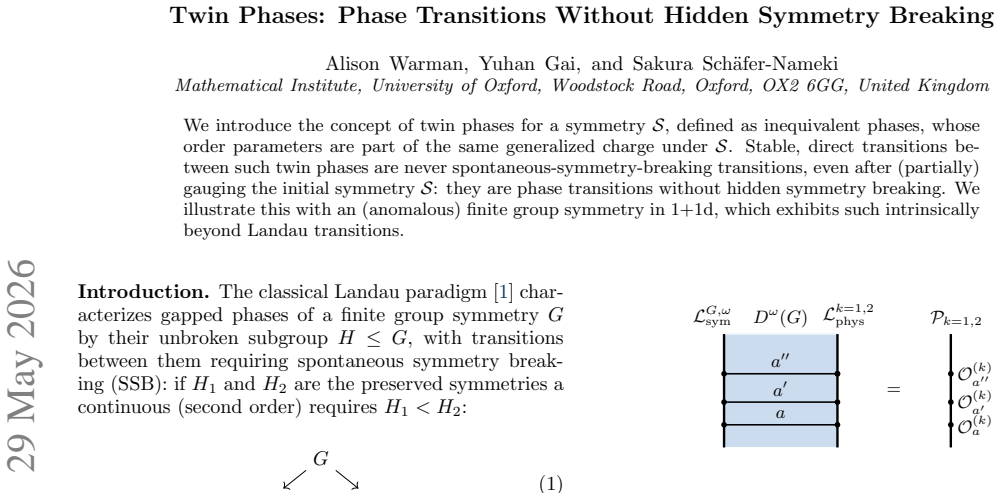
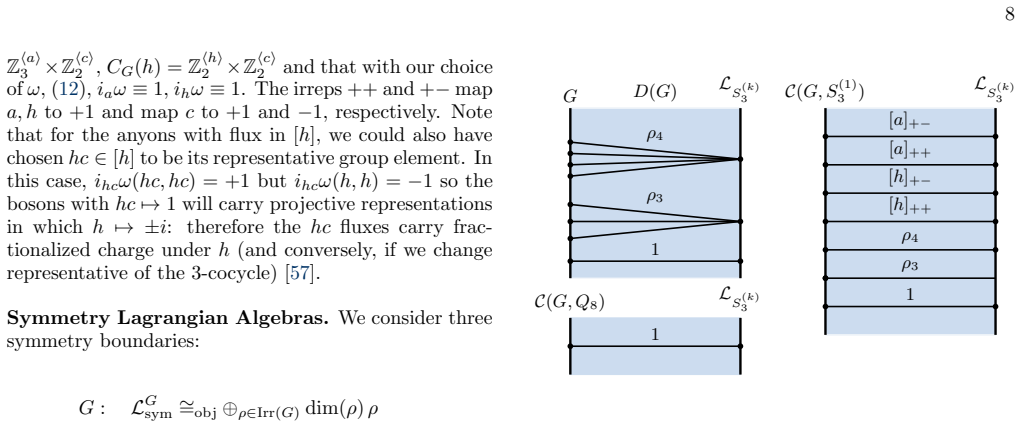
Similarly, the electric anyonse 1 and e2 are both mapped toρ 4: ρ4 [h]++ Dω(G) LG,ω sym A(H, N) DωII(Z2 2) e1, e 2 m1, m 2 Lphys (16) The complete map is provided in (A6)
labeled by the subgroup H diag =⟨(h, m 1),(hc, m 2),(a,id)⟩ ⊂G×Z 2 2 .(15) Note that, sincehandhcare in the sameG-conjugacy class [h], both anyonsm 1 andm 2 will be mapped to the same anyon [h] ++. Similarly, the electric anyonse 1 and e2 are both mapped toρ 4: ρ4 [h]++ Dω(G) LG,ω sym A(H, N) DωII(Z2 2) e1, e 2 m1, m 2 Lphys (16) The complete map is provi...
-
[2]
that get mapped to the twin alge- bras inD ω(G) are: L⟨m1⟩ ∼= 1⊕m 1 ⊕e 2 ⊕m 1e2 7→ L S(1) 3 L⟨m2⟩ ∼= 1⊕m 2 ⊕e 1 ⊕m 2e1 7→ L S(2) 3 , (17) which we label by the preserved subgroup ofZ 2
-
[3]
Generalized Symmetries in Quantum Field Theory and Quantum Gravity
By im- puting a (Z 2 2)ωII symmetric phase transition CFT Z2 2,ωII (e.g. thec= 1 compact boson CFT with mixed-anomaly between shift and winding symmetries [45]) and mapping through the SymTFT interface [10, 30], we obtain a sec- ond order phase transition between the twin phasesPS(1) 3 andP S(2) 3 for the groupG=GL(2,3) with anomalyω: CFTG,ω PS(1) 3 PS(2)...
-
[4]
On the theory of phase transitions,
L. D. Landau, “On the theory of phase transitions,” Zh. Eksp. Teor. Fiz.7(1937) 19–32
1937
-
[5]
Categorical Landau Paradigm for Gapped Phases,
L. Bhardwaj, L. E. Bottini, D. Pajer, and S. Schafer-Nameki, “Categorical Landau Paradigm for Gapped Phases,”Phys. Rev. Lett.133no. 16, (2024) 161601,arXiv:2310.03786 [cond-mat.str-el]
-
[6]
Essay: Generalized Landau Paradigm for Quantum Phases and Phase Transitions,
X. Chen, “Essay: Generalized Landau Paradigm for Quantum Phases and Phase Transitions,”Phys. Rev. Lett.135no. 25, (2025) 250001,arXiv:2511.19793 [hep-th]
-
[7]
Hidden Z2×Z2 symmetry breaking in Haldane-gap antiferromagnets,
T. Kennedy and H. Tasaki, “Hidden Z2×Z2 symmetry breaking in Haldane-gap antiferromagnets,”Phys. Rev. B45no. 1, (1992) 304
1992
-
[8]
Hidden symmetry breaking and the haldane phase in s= 1 quantum spin chains,
T. Kennedy and H. Tasaki, “Hidden symmetry breaking and the haldane phase in s= 1 quantum spin chains,”Communications in mathematical physics147 (1992) 431–484
1992
-
[9]
Exactly Solvable Model for a Deconfined Quantum Critical Point in 1D,
C. Zhang and M. Levin, “Exactly Solvable Model for a Deconfined Quantum Critical Point in 1D,”Phys. Rev. Lett.130no. 2, (2023) 026801,arXiv:2206.01222 [cond-mat.str-el]
-
[10]
Analogs of deconfined quantum criticality for noninvertible symmetry breaking in one dimension,
Y.-H. Chen and T. Grover, “Analogs of deconfined quantum criticality for noninvertible symmetry breaking in one dimension,”Phys. Rev. B112no. 19, (2025) 195129,arXiv:2506.01131 [cond-mat.str-el]
-
[11]
ICTP Lectures on (Non-)Invertible Generalized Symmetries
S. Schafer-Nameki, “ICTP lectures on (non-)invertible generalized symmetries,”Phys. Rept.1063(2024) 1–55,arXiv:2305.18296 [hep-th]
work page internal anchor Pith review Pith/arXiv arXiv 2024
-
[12]
What's Done Cannot Be Undone: TASI Lectures on Non-Invertible Symmetries
S.-H. Shao, “What’s Done Cannot Be Undone: TASI Lectures on Non-Invertible Symmetry,” arXiv:2308.00747 [hep-th]
work page internal anchor Pith review Pith/arXiv arXiv
-
[13]
Hasse Diagrams for Gapless SPT and SSB Phases with Non-Invertible Symmetries,
L. Bhardwaj, D. Pajer, S. Schafer-Nameki, and A. Warman, “Hasse Diagrams for Gapless SPT and SSB Phases with Non-Invertible Symmetries,”SciPost Phys.19(2025) 113,arXiv:2403.00905 [cond-mat.str-el]
-
[14]
Illustrating the categorical Landau paradigm in lattice models,
L. Bhardwaj, L. E. Bottini, S. Schafer-Nameki, and A. Tiwari, “Illustrating the categorical Landau paradigm in lattice models,”Phys. Rev. B111no. 5, (2025) 054432,arXiv:2405.05302 [cond-mat.str-el]
-
[15]
Lattice Models for Phases and Transitions with Non-Invertible Symmetries
L. Bhardwaj, L. E. Bottini, S. Schafer-Nameki, and A. Tiwari, “Lattice Models for Phases and Transitions with Non-Invertible Symmetries,”SciPost Phys.20 (2026) 134,arXiv:2405.05964 [cond-mat.str-el]
work page internal anchor Pith review Pith/arXiv arXiv 2026
-
[16]
Quantum phases and transitions in spin chains with non-invertible symmetries,
A. Chatterjee, ¨O. M. Aksoy, and X.-G. Wen, “Quantum phases and transitions in spin chains with non-invertible symmetries,”SciPost Phys.17no. 4, (2024) 115,arXiv:2405.05331 [cond-mat.str-el]
-
[17]
Categorical Symmetries in Spin Models with Atom Arrays,
A. Warman, F. Yang, A. Tiwari, H. Pichler, and S. Schafer-Nameki, “Categorical Symmetries in Spin Models with Atom Arrays,”Phys. Rev. Lett.135 no. 20, (2025) 206503,arXiv:2412.15024 [cond-mat.str-el]
-
[18]
Construction of a Gapless Phase with Haagerup Symmetry,
L. E. Bottini and S. Schafer-Nameki, “Construction of a Gapless Phase with Haagerup Symmetry,”Phys. Rev. Lett.134no. 19, (2025) 191602,arXiv:2410.19040 [hep-th]
-
[19]
Spontaneous breaking of non-invertible symmetries and duality to beyond-Landau transitions
X. Chen, S. Liu, D.-c. Lu, and N. Tantivasadakarn, “Spontaneous breaking of non-invertible symmetries and duality to beyond-Landau transitions,” arXiv:2605.27672 [cond-mat.str-el]
work page internal anchor Pith review Pith/arXiv arXiv
-
[20]
"Deconfined" quantum critical points
T. Senthil, A. Vishwanath, L. Balents, S. Sachdev, and M. P. A. Fisher, “Deconfined Quantum Critical Points,”Science303no. 5663, (2004) 1490–1494, arXiv:cond-mat/0311326
work page internal anchor Pith review Pith/arXiv arXiv 2004
-
[21]
Deconfined quantum critical points: a review,
T. Senthil, “Deconfined quantum critical points: a review,”arXiv:2306.12638 [cond-mat.str-el]
-
[22]
Twin Algebras (to appear)
Y. Gai, S. Schafer-Nameki, and A. Warman. “Twin Algebras (to appear)”
-
[23]
W. Ji and X.-G. Wen, “Categorical symmetry and noninvertible anomaly in symmetry-breaking and topological phase transitions,”Phys. Rev. Res.2no. 3, (2020) 033417,arXiv:1912.13492 [cond-mat.str-el]
-
[24]
D. Gaiotto and J. Kulp, “Orbifold groupoids,”JHEP 6 02(2021) 132,arXiv:2008.05960 [hep-th]
-
[25]
Symmetry TFTs from String Theory
F. Apruzzi, F. Bonetti, I. n. G. Etxebarria, S. S. Hosseini, and S. Schafer-Nameki, “Symmetry TFTs from String Theory,”arXiv:2112.02092 [hep-th]
work page internal anchor Pith review Pith/arXiv arXiv
-
[26]
Topological symmetry in quantum field theory
D. S. Freed, G. W. Moore, and C. Teleman, “Topological symmetry in quantum field theory,” arXiv:2209.07471 [hep-th]
work page internal anchor Pith review Pith/arXiv arXiv
-
[27]
Equivalently, there are twin module categories that are equivalent as linear categories but inequivalent as module categories over any symmetry related by gauging
-
[28]
L. Bhardwaj and S. Schafer-Nameki, “Generalized charges, part II: Non-invertible symmetries and the symmetry TFT,”SciPost Phys.19no. 4, (2025) 098, arXiv:2305.17159 [hep-th]
-
[29]
A. Chatterjee and X.-G. Wen, “Holographic theory for continuous phase transitions: Emergence and symmetry protection of gaplessness,”Phys. Rev. B108no. 7, (2023) 075105,arXiv:2205.06244 [cond-mat.str-el]
-
[30]
Topological Holography: Towards a Unification of Landau and Beyond-Landau Physics,
H. Moradi, S. F. Moosavian, and A. Tiwari, “Topological Holography: Towards a Unification of Landau and Beyond-Landau Physics,” arXiv:2207.10712 [cond-mat.str-el]
-
[31]
Topological holography, quantum criticality, and boundary states,
S.-J. Huang and M. Cheng, “Topological holography, quantum criticality, and boundary states,” arXiv:2310.16878 [cond-mat.str-el]
-
[32]
Gapped phases with non-invertible symmetries: (1+1)d,
L. Bhardwaj, L. E. Bottini, D. Pajer, and S. Sch¨ afer-Nameki, “Gapped phases with non-invertible symmetries: (1+1)d,”SciPost Phys.18no. 1, (2025) 032,arXiv:2310.03784 [hep-th]
-
[33]
The club sandwich: Gapless phases and phase transitions with non-invertible symmetries,
L. Bhardwaj, L. E. Bottini, D. Pajer, and S. Schafer-Nameki, “The club sandwich: Gapless phases and phase transitions with non-invertible symmetries,”SciPost Phys.18no. 5, (2025) 156, arXiv:2312.17322 [hep-th]
-
[34]
A local operatorO a ∈Hom Z(S) (a,L sym)
The precise statement for general fusion categories is that the vector space of local operators is HomZ(S) (Lphys,L sym) =⊕ a∈LphysnaHomZ(S) (a,L sym). A local operatorO a ∈Hom Z(S) (a,L sym)
-
[35]
Detection of symmetry-protected topological phases in one dimension,
F. Pollmann and A. M. Turner, “Detection of symmetry-protected topological phases in one dimension,”Physical Review B86no. 12, (2012)
2012
-
[36]
Bogomolov multiplier, double class-preserving automorphisms and modular invariants for orbifolds
A. Davydov, “Bogomolov multiplier, double class-preserving automorphisms, and modular invariants for orbifolds,”J. Math. Phys.55(2014) 092305,arXiv:1312.7466 [math.CT]
work page internal anchor Pith review Pith/arXiv arXiv 2014
-
[37]
Soft symmetries of topological orders,
R. Kobayashi and M. Barkeshli, “Soft symmetries of topological orders,”arXiv:2501.03314 [cond-mat.str-el]
-
[38]
Projective representations, bogomolov multiplier, and their applications in physics,
R. Kobayashi and H. Watanabe, “Projective Representations, Bogomolov Multiplier, and Their Applications in Physics,”arXiv:2507.12515 [cond-mat.str-el]
-
[39]
See [19, 51] for the complete equivalence relations
Algebras labeled by non-conjugate subgroups are inequivalent. See [19, 51] for the complete equivalence relations
-
[40]
In GAP [50]G:= SmallGroup(48,29)
-
[41]
For reference the standard Clifford gates are H= 1√ 2 1 1 1−1 , X= 0 1 1 0 , P=diag(1, i), Z=P 2
-
[42]
The group⟨H,(HP) 8, M⟩has infinite order
Explicitly, as a subgroup of the Clifford group, GL(2,3) =⟨H,(HP) 8⟩and the operator exchanging S(1) 3 =⟨e 3πi/4HP X, H⟩andS (2) 3 =⟨e 3πi/4HP X,−H⟩ is the non-Clifford gateM= 1√ 3 −eiπ/4 √ 2i√ 2e iπ/4 . The group⟨H,(HP) 8, M⟩has infinite order
-
[43]
Correspondences of ribbon categories
J. Frohlich, J. Fuchs, I. Runkel, and C. Schweigert, “Correspondences of ribbon categories,”Adv. Math. 199(2006) 192–329,arXiv:math/0309465
work page internal anchor Pith review Pith/arXiv arXiv 2006
-
[44]
The witt group of non-degenerate braided fusion categories,
A. Davydov, M. M¨ uger, D. Nikshych, and V. Ostrik, “The witt group of non-degenerate braided fusion categories,”Journal f¨ ur die reine und angewandte Mathematik (Crelles Journal)2013no. 677, (2013) 135–177
2013
-
[45]
Anyon condensation and tensor categories,
L. Kong, “Anyon condensation and tensor categories,” Nucl. Phys. B886(2014) 436–482,arXiv:1307.8244 [cond-mat.str-el]
-
[46]
Classification of 1+1D gapless symmetry protected phases via topological holography,
R. Wen and A. C. Potter, “Classification of 1+1D gapless symmetry protected phases via topological holography,”arXiv:2311.00050 [cond-mat.str-el]
-
[47]
The full 3-cocycle data, computed with GAP [50, 52–54] is provided inGL23-om-data.txt
-
[48]
Fusion category symmetry. Part II. Categoriosities at c = 1 and beyond,
R. Thorngren and Y. Wang, “Fusion category symmetry. Part II. Categoriosities at c = 1 and beyond,”JHEP07(2024) 051,arXiv:2106.12577 [hep-th]
-
[49]
There are also other OPs coming fromρ 3, but these are identical in both phases
-
[50]
P. Etingof, S. Gelaki, D. Nikshych, and V. Ostrik, Tensor categories, vol. 205 ofMathematical Surveys and Monographs. American Mathematical Society, Providence, RI, 2015. https://doi.org/10.1090/surv/205
-
[51]
TheL 3 is given by LD12 = 1⊕ρ 3 ⊕2[h] ++ ⊕[a] ++ ⊕[c]⊕[c]ρ 3 ⊕[ca]
-
[52]
Schafer-Nameki, A
S. Schafer-Nameki, A. Warman, and R. Wen. Work in progress
-
[53]
GAP – Groups, Algorithms, and Programming, Version 4.15.1,
“GAP – Groups, Algorithms, and Programming, Version 4.15.1,” 2025.https://www.gap-system.org
2025
-
[54]
On the equivalence of module categories over a group-theoretical fusion category,
S. Natale, “On the equivalence of module categories over a group-theoretical fusion category,”Symmetry, Integrability and Geometry: Methods and Applications (June, 2017)
2017
-
[55]
HAP, Homological Algebra Programming, Version 1.73
G. Ellis, “HAP, Homological Algebra Programming, Version 1.73.”https://gap-packages.github.io/hap. GAP package
-
[56]
Morita equivalence of pointed fusion categories of small rank
M. Mignard and P. Schauenburg, “Morita equivalence of pointed fusion categories of small rank,” 2017. https://arxiv.org/abs/1708.06538
work page internal anchor Pith review Pith/arXiv arXiv 2017
-
[57]
Computing modular data for pointed fusion categories,
A. Gruen and S. Morrison, “Computing modular data for pointed fusion categories,”Indiana University Mathematics Journal70no. 2, (2021) 561–593, arXiv:1808.05060 [math.QA]
-
[58]
Topological Gauge Theories and Group Cohomology,
R. Dijkgraaf and E. Witten, “Topological Gauge Theories and Group Cohomology,”Commun. Math. Phys.129(1990) 393
1990
-
[59]
A. Coste, T. Gannon, and P. Ruelle, “Finite group modular data,”Nucl. Phys. B581(2000) 679–717, arXiv:hep-th/0001158
work page internal anchor Pith review Pith/arXiv arXiv 2000
-
[60]
The characters ofC G(hc) can also be computed from those ofC G(h) by means of [54, equation (2.10)]
-
[61]
Module categories over the Drinfeld double of a finite group,
V. Ostrik, “Module categories over the Drinfeld double of a finite group,”arXiv Mathematics e-prints(Feb.,
-
[62]
math/0202130,arXiv:math/0202130 [math.QA]. 7
work page internal anchor Pith review Pith/arXiv arXiv
-
[63]
Bulk-to-boundary anyon fusion from microscopic models,
J. C. M. de la Fuente, J. Eisert, and A. Bauer, “Bulk-to-boundary anyon fusion from microscopic models,”J. Math. Phys.64no. 11, (2023) 111904, arXiv:2302.01835 [quant-ph]
-
[64]
Interacting anyons in topological quantum liquids: The golden chain
A. Feiguin, S. Trebst, A. W. W. Ludwig, M. Troyer, A. Kitaev, Z. Wang, and M. H. Freedman, “Interacting anyons in topological quantum liquids: The golden chain,”Phys. Rev. Lett.98(2007) 160409, arXiv:cond-mat/0612341 [cond-mat.str-el]
work page internal anchor Pith review Pith/arXiv arXiv 2007
-
[65]
Collective states of interacting Fibonacci anyons
S. Trebst, E. Ardonne, A. Feiguin, D. A. Huse, A. W. W. Ludwig, and M. Troyer, “Collective states of interacting Fibonacci anyons,”Phys. Rev. Lett.101 (2008) 050401,arXiv:0801.4602 [cond-mat.stat-mech]
work page internal anchor Pith review Pith/arXiv arXiv 2008
-
[66]
Collective States of Interacting Anyons, Edge States, and the Nucleation of Topological Liquids
C. Gils, E. Ardonne, S. Trebst, A. W. W. Ludwig, M. Troyer, and Z. Wang, “Collective States of Interacting Anyons, Edge States, and the Nucleation of Topological Liquids,”Phys. Rev. Lett.103(2009) 070401,arXiv:0810.2277 [cond-mat.str-el]
work page internal anchor Pith review Pith/arXiv arXiv 2009
-
[67]
Topology driven quantum phase transitions in time-reversal invariant anyonic quantum liquids
C. Gils, S. Trebst, A. Kitaev, A. W. W. Ludwig, M. Troyer, and Z. Wang, “Topology driven quantum phase transitions in time-reversal invariant anyonic quantum liquids,”Nature Phys.5(2009) 834, arXiv:0906.1579 [cond-mat.str-el]
work page internal anchor Pith review Pith/arXiv arXiv 2009
-
[68]
Translation invariance, topology, and protection of criticality in chains of interacting anyons
R. N. C. Pfeifer, O. Buerschaper, S. Trebst, A. W. W. Ludwig, M. Troyer, and G. Vidal, “Translation invariance, topology, and protection of criticality in chains of interacting anyons,”Phys. Rev. B86no. 15, (2012) 155111,arXiv:1005.5486 [cond-mat.str-el]
work page internal anchor Pith review Pith/arXiv arXiv 2012
-
[69]
Microscopic models of interacting Yang-Lee anyons
E. Ardonne, J. Gukelberger, A. W. W. Ludwig, S. Trebst, and M. Troyer, “Microscopic models of interacting Yang-Lee anyons,”New J. Phys.13(2011) 045006,arXiv:1012.1080 [cond-mat.str-el]
work page internal anchor Pith review Pith/arXiv arXiv 2011
-
[70]
Anyonic quantum spin chains: Spin-1 generalizations and topological stability
C. Gils, E. Ardonne, S. Trebst, D. A. Huse, A. W. W. Ludwig, M. Troyer, and Z. Wang, “Anyonic quantum spin chains: Spin-1 generalizations and topological stability,”Phys. Rev. B87(2013) 235120, arXiv:1303.4290 [cond-mat.str-el]
work page internal anchor Pith review Pith/arXiv arXiv 2013
-
[71]
Topological Defects on the Lattice I: The Ising model
D. Aasen, R. S. K. Mong, and P. Fendley, “Topological Defects on the Lattice I: The Ising model,”J. Phys. A 49no. 35, (2016) 354001,arXiv:1601.07185 [cond-mat.stat-mech]
work page internal anchor Pith review Pith/arXiv arXiv 2016
-
[72]
Anyonic Chains, Topological Defects, and Conformal Field Theory
M. Buican and A. Gromov, “Anyonic Chains, Topological Defects, and Conformal Field Theory,” Commun. Math. Phys.356no. 3, (2017) 1017–1056, arXiv:1701.02800 [hep-th]
work page internal anchor Pith review Pith/arXiv arXiv 2017
-
[73]
Lattice Realizations of Topological Defects in the critical (1+1)-d Three-State Potts Model,
M. Sinha, F. Yan, L. Grans-Samuelsson, A. Roy, and H. Saleur, “Lattice Realizations of Topological Defects in the critical (1+1)-d Three-State Potts Model,” arXiv:2310.19703 [hep-th]. Appendix A: Details on the SymTFT forGL(2,3) In this appendix we provide details of the SymTFT, anyons, algebras and other structures related to the ex- ample ofG=GL(2,3)
-
[74]
Character table for the groupGL(2,3)
[c] [a] [ac] [h] [iz] [hiz] [h(iz) 3] 1 1 1 1 1 1 1 1 1 ρ1− 1 1 1 1−1 1−1−1 ρ2 2 2−1−1 0 2 0 0 ρ2+ 2−2−1 1 0 0 √ 2i− √ 2i ρ2− 2−2−1 1 0 0− √ 2i √ 2i ρ3 3 3 0 0 1−1−1−1 ρ3− 3 3 0 0−1−1 1 1 ρ4 4−4 1−1 0 0 0 0 Table I. Character table for the groupGL(2,3)
-
[75]
Let us first focus on anyons with trivial fluxg= id, for whichC G(id) =Gandρis a representation ofG
Anyons and Algebras Notation for Anyons.We denote anyons inD ω(G) by ([g], ρg), where [g] ={f gf −1 :f∈G}is a conjugacy class ofGandρ g is a (projective) representation of the centralizerC G(g) ={f∈G|gf=f g}. Let us first focus on anyons with trivial fluxg= id, for whichC G(id) =Gandρis a representation ofG. The characters (i.e. the traces of the represen...
-
[76]
Denote theRep(Q 8) symmetry generators by 1,1 iz,1 xz,1 iz1xz, m.(A7) Here 1g is the unique non-trivial one-dimensional repre- sentation onQ 8 such that 1 g(g) = 1,g∈ {iz, xz}
Symmetry Categories from GaugingQ 8 orS 3 GaugingQ 8.The symmetry categoryC(G, Q 8) ∼= Rep(Q8)⋊S 3, has thirty symmetry operators. Denote theRep(Q 8) symmetry generators by 1,1 iz,1 xz,1 iz1xz, m.(A7) Here 1g is the unique non-trivial one-dimensional repre- sentation onQ 8 such that 1 g(g) = 1,g∈ {iz, xz}. The invertible symmetry operators 1,1 iz,1 xz,1 i...
discussion (0)
Sign in with ORCID, Apple, or X to comment. Anyone can read and Pith papers without signing in.