REVIEW 1 major objections 1 minor 27 references
SentimentLens: Reconciling Sentiment and Ratings via Dual-Modality in the Hospitality Sector
T0 review · 1 major / 1 minor · reviewed 2026-06-30 · grok-4.3
Pith's one-line read SentimentLens reconciles textual sentiment from hotel reviews with numerical ratings to detect service inconsistencies.
desk verdict SentimentLens is a straightforward application of ABSA plus standard analyses to hotel reviews, with the reconciliation step left unvalidated. read the letter →
The pith
A machine-rendered reading of the paper's core claim, the machinery that carries it, and where it could break.
The reading
What carries the argument
Cross-modal reconciliation of textual sentiment and numerical ratings, which flags mismatches to reveal service quality issues.
What would settle it
Apply the system to a collection of hotel reviews that contain independently documented service failures and check whether the reconciliation step fails to flag the known sentiment-rating mismatches.
Extended reading notes
Core claim
SentimentLens integrates aspect term extraction, aspect sentiment classification, semantic category assignment, and multi-level analytical modules, then uses cross-modal reconciliation with importance-performance and entropy-based analyses to identify latent operational conflicts, structural inconsistencies in service quality, and high-impact improvement opportunities from over 10,000 hotel reviews.
Load-bearing premise
The cross-modal reconciliation accurately identifies latent operational conflicts and structural inconsistencies without external ground-truth labels or human validation of the detected mismatches.
Editorial extensions
If this is right
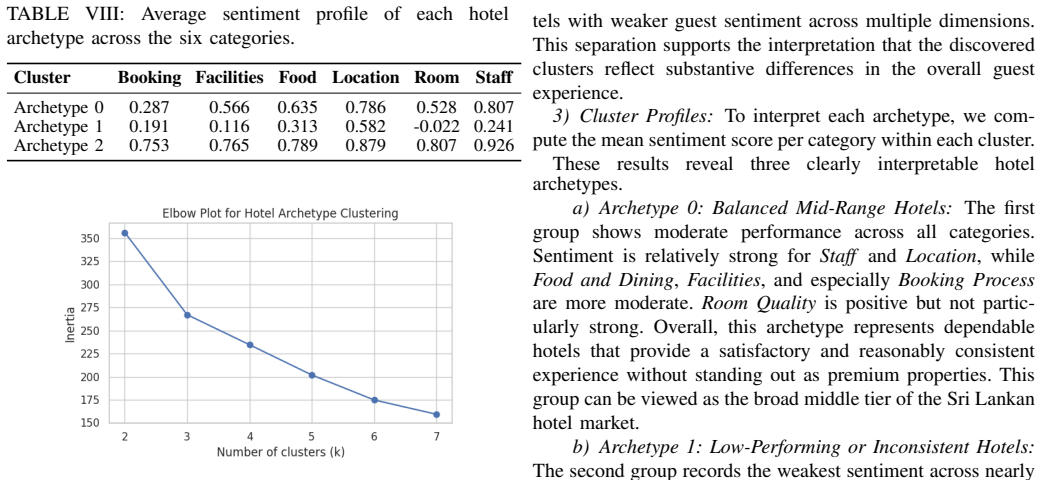
- Traveler sentiment can be compared across regions, service categories, and hotel archetypes.
- Importance-performance analysis surfaces high-impact improvement opportunities from the reconciled data.
- The system supports evaluation at region, hotel, and category levels simultaneously.
- The framework is presented as generalizable to other destinations and review-driven service domains.
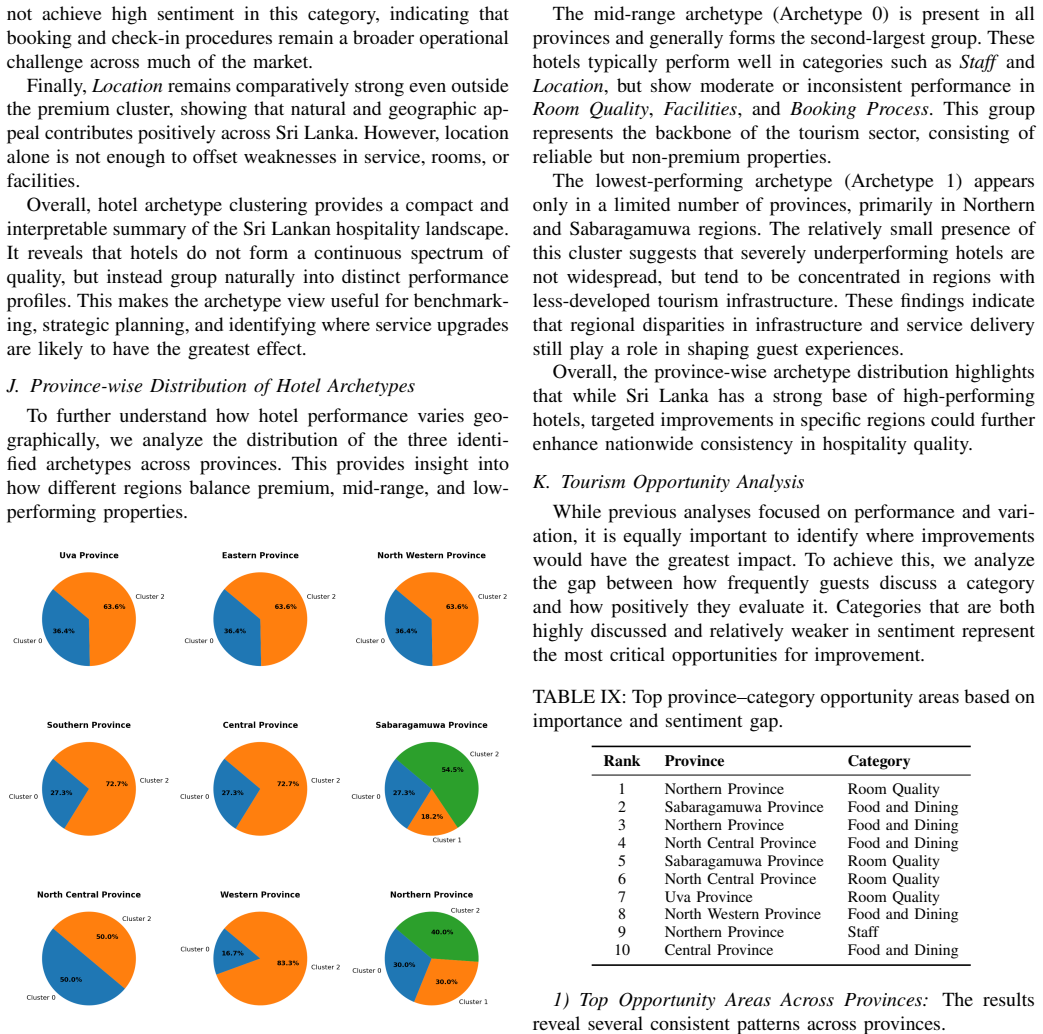
Reading between the lines
- Aggregated outputs could serve as an ongoing monitor for tourism authorities tracking destination quality.
- The same pipeline might transfer to non-hospitality domains such as restaurant or airline feedback.
- Reduced reliance on separate surveys could lower costs for service quality assessment.
- Extending the reconciliation to time-series data could reveal how inconsistencies evolve after management changes.
Editorial analysis
A structured set of objections, weighed in public.
Referee Report
Summary. The manuscript introduces SentimentLens, a framework for aspect-based sentiment analysis (ABSA) on hotel reviews that extracts aspect terms, classifies sentiments, assigns semantic categories, and conducts multi-level (region/hotel/category) evaluations. A central component is the cross-modal reconciliation step that combines textual sentiment with numerical ratings via importance-performance analysis and entropy-based methods to detect latent operational conflicts, structural inconsistencies, and high-impact improvement opportunities. The system is applied to a dataset of over 10,000 hotel reviews in a national case study and claims to produce actionable intelligence for hospitality management and tourism policy while being generalizable to other domains.
Significance. If the reconciliation module were externally validated, the dual-modality approach could provide a scalable, label-free method for turning large-scale unstructured reviews into service insights, addressing a practical gap in hospitality analytics. The scale of the demonstration and the integration of ABSA with importance-performance/entropy analyses represent a potentially useful engineering contribution in information retrieval applied to user-generated content.
major comments (1)
- [Cross-modal reconciliation module (methods/results)] The headline claim that SentimentLens produces 'actionable intelligence' by identifying 'latent operational conflicts' and 'structural inconsistencies' rests on the cross-modal reconciliation (importance-performance + entropy analyses) correctly surfacing verified mismatches. However, the methods and results sections report no human validation of the detected mismatches, no comparison against known service issues or external ground-truth labels, and no quantitative assessment of precision for the flagged conflicts. This is load-bearing for the central contribution.
minor comments (1)
- [Abstract] The abstract states that 'extensive analysis' reveals how sentiment varies across regions and categories but provides no quantitative metrics, tables, or specific findings from the reconciliation step.
Simulated Author's Rebuttal
We thank the referee for the constructive feedback and positive assessment of the manuscript's potential. We respond to the single major comment below.
read point-by-point responses
-
Referee: [Cross-modal reconciliation module (methods/results)] The headline claim that SentimentLens produces 'actionable intelligence' by identifying 'latent operational conflicts' and 'structural inconsistencies' rests on the cross-modal reconciliation (importance-performance + entropy analyses) correctly surfacing verified mismatches. However, the methods and results sections report no human validation of the detected mismatches, no comparison against known service issues or external ground-truth labels, and no quantitative assessment of precision for the flagged conflicts. This is load-bearing for the central contribution.
Authors: We agree that the manuscript reports no human validation, external ground-truth comparison, or quantitative precision assessment of the flagged mismatches. The cross-modal step applies established importance-performance analysis and entropy methods to surface discrepancies between sentiment scores and ratings as candidate insights; the manuscript presents these as exploratory outputs rather than verified operational facts. To address the concern, we will revise the manuscript to (1) explicitly qualify the reconciliation results as candidate patterns, (2) add a limitations subsection noting the absence of external validation, and (3) include selected qualitative examples with supporting review text. These changes will be made without altering the core technical contribution. revision: partial
Circularity Check
No circularity: system applies standard ABSA and heuristic analyses to external review data
full rationale
The paper describes SentimentLens as a pipeline of aspect extraction, sentiment classification, category assignment, and then importance-performance plus entropy analyses on >10k reviews. No equations, fitted parameters, or self-citations are shown that define outputs in terms of themselves or rename known results as novel derivations. The reconciliation step uses established heuristics on observed data rather than any self-referential construction. The derivation chain is therefore self-contained against external benchmarks and receives the default non-circularity finding.
Assumptions & free parameters
Cite this review
Pith. "Pith review of SentimentLens: Reconciling Sentiment and Ratings via Dual-Modality in the Hospitality Sector." pith.science (2026). https://pith.science/paper/D5WG7CLZ
@misc{pith2026260600084,
  author       = {Pith},
  title        = {Pith review of: SentimentLens: Reconciling Sentiment and Ratings via Dual-Modality in the Hospitality Sector},
  year         = {2026},
  howpublished = {\url{https://pith.science/paper/D5WG7CLZ}},
  note         = {Machine review of arXiv:2606.00084}
}
read the original abstract
Online travel platforms generate vast volumes of user-generated hotel reviews, offering rich opportunities to understand traveler experiences at scale. However, transforming unstructured textual feedback into structured, actionable insights remains a challenging task. This paper presents SentimentLens, a scalable analysis system based on Aspect-Based Sentiment Analysis that performs knowledge extraction from unstructured hotel reviews and organizes them into interpretable service categories. SentimentLens integrates aspect term extraction, aspect sentiment classification, semantic category assignment, and multi-level analytical modules to support region-level, hotel-level, and category-level evaluation. The system is designed to operate across different geographic contexts and hospitality settings. To demonstrate its practical utility, we apply SentimentLens to a large real-world dataset of over 10,000 publicly available hotel reviews. Through extensive analysis, the framework reveals how traveler sentiment varies across regions, service categories, and hotel archetypes. We further implement a cross-modal reconciliation of textual sentiment and numerical ratings to identify latent operational conflicts, structural inconsistencies in service quality, and high-impact improvement opportunities using importance--performance and entropy-based analyses. The results show that SentimentLens effectively transforms large-scale unstructured reviews into actionable intelligence, supporting data-driven decision-making for hospitality management and tourism policy. While demonstrated using a national case study, the proposed system is generalizable to other destinations and review-driven service domains.
Figures


Figures from the paper (7 more)




Reference graph
Works this paper leans on
-
[1]
Y . Chen, Y . Zhong, S. Yu, Y . Xiao, and S. Chen, “Exploring bidirectional performance of hotel attributes through online reviews based on senti- ment analysis and kano-ipa model,”Applied Sciences, vol. 12, no. 2, p. 692, 2022
work page 2022
-
[2]
A survey on aspect-based sentiment analysis: Tasks, methods, and challenges,
W. Zhang, X. Li, Y . Deng, L. Bing, and W. Lam, “A survey on aspect-based sentiment analysis: Tasks, methods, and challenges,”IEEE Transactions on Knowledge and Data Engineering, vol. 35, no. 11, pp. 11 019–11 038, 2022
work page 2022
-
[3]
Aspect-based sentiment analysis tech- niques: A comparative study,
D. Jayakody, K. Isuranda, A. Malkith, N. De Silva, S. R. Ponnamperuma, G. Sandamali, and K. Sudheera, “Aspect-based sentiment analysis tech- niques: A comparative study,” in2024 Moratuwa Engineering Research Conference (MERCon). IEEE, 2024, pp. 205–210
work page 2024
-
[4]
J. Shin, J. Joung, and C. Lim, “Determining directions of service quality management using online review mining with interpretable machine learning,”International journal of hospitality management, vol. 118, p. 103684, 2024
work page 2024
-
[5]
An fsQCA analysis of service quality for hotel customer satisfaction,
V . Perdomo-Verdecia, P. Garrido-Vega, and M. Sacrist ´an-D´ıaz, “An fsQCA analysis of service quality for hotel customer satisfaction,” International Journal of Hospitality Management, vol. 122, p. 103793, 2024
work page 2024
-
[6]
W. Xu, Z. Yao, Y . Ma, and Z. Li, “Understanding customer complaints from negative online hotel reviews: A BERT-based deep learning approach,”International Journal of Hospitality Management, vol. 126, p. 104057, 2025
work page 2025
-
[7]
R. A. Charisma, N. A. P. Masaling, A. Maulina, F. R. Tambunan, L. A. Y . Caesar, and R. C. Chow, “A comparative study of transformer- based models for aspect-based sentiment analysis on indonesian hotel reviews,” in2025 8th International Seminar on Research of Information Technology and Intelligent Systems (ISRITI). IEEE, 2025, pp. 221–226
work page 2025
-
[8]
I. C. Sahin and C. Eyupoglu, “Aspect-based sentiment analysis for hos- pitality industry applications:: A systematic literature review,”Applied Computer Systems, vol. 30, no. 1, pp. 53–67, 2025
work page 2025
Show all 27 references
-
[9]
Aspect-based sentiment analysis in ho chi minh city hotel reviews using aspect-conditioned bilstm with cross- aspect attention and ordinal regression,
T. K. Tran and P. Tran, “Aspect-based sentiment analysis in ho chi minh city hotel reviews using aspect-conditioned bilstm with cross- aspect attention and ordinal regression,”IEEE Access, 2026
2026
-
[10]
Revealing hotel similarities via aspect- based sentence embedding of guest reviews,
A. C. ¨Ozt¨urk and F. Soygazi, “Revealing hotel similarities via aspect- based sentence embedding of guest reviews,”PeerJ Computer Science, vol. 12, p. e3713, 2026
2026
-
[11]
Cross-language hotel review sentiment analysis via multi- agent federated learning with heterogeneous graph attention networks,
X. Han, “Cross-language hotel review sentiment analysis via multi- agent federated learning with heterogeneous graph attention networks,” Scientific Reports, 2026
2026
-
[12]
Apify web scraping platform,
“Apify web scraping platform,” https://apify.com/, accessed: 2026-04
2026
-
[13]
Google reviews,
“Google reviews,” https://www.google.com/maps, accessed: 2026-04
2026
-
[14]
Tripadvisor,
“Tripadvisor,” https://www.tripadvisor.com, accessed: 2026-04
2026
-
[15]
Instruct-deberta: A hybrid approach for aspect-based sentiment analysis on textual reviews,
D. Jayakody, A. Malkith, K. Isuranda, V . Thenuwara, N. de Silva, S. R. Ponnamperuma, G. Sandamali, and K. Sudheera, “Instruct-deberta: A hybrid approach for aspect-based sentiment analysis on textual reviews,” The International Journal on Advances in ICT for Emerging Regions,...
2025
-
[16]
GISTembed: Guided in-sample selection of train- ing negatives for text embedding fine-tuning,
A. V . Solatorio, “GISTembed: Guided in-sample selection of train- ing negatives for text embedding fine-tuning,”arXiv preprint arXiv:2402.16829, 2024. APPENDIX VI. MODEL ANDDATAINITIALIZATION A. Dataset Collection and Geographic Coverage The dataset used in this study consist...
2024
-
[17]
Category Importance:Insight:Guest discussions are dominated byStaff,Food, andRoom Quality, highlighting that human interaction and core comfort elements are central to the traveler experience
-
[18]
Category Sentiment:Insight:WhileStaffandLocation consistently receive high sentiment,Room QualityandBook- ing Processrepresent key areas for improvement. B. Province-Level Sentiment Analysis To understand geographic variations in traveler satisfaction, we aggregate aspect-leve...
-
[19]
The elbow pattern shows a clear reduction in within-cluster variance up to three clusters, after which the improvement becomes much smaller
Selection of the Number of Archetypes:To determine the appropriate number of hotel archetypes, we inspect the elbow curve over a range of cluster counts. The elbow pattern shows a clear reduction in within-cluster variance up to three clusters, after which the improvement beco...
-
[20]
The visualization shows meaningful separation between the three groups
Visualization of the Archetypes:To visually inspect the learned grouping structure, the hotel representations are projected into two dimensions and plotted according to their assigned cluster. The visualization shows meaningful separation between the three groups. One cluster ...
-
[21]
These results reveal three clearly interpretable hotel archetypes
Cluster Profiles:To interpret each archetype, we com- pute the mean sentiment score per category within each cluster. These results reveal three clearly interpretable hotel archetypes. a) Archetype 0: Balanced Mid-Range Hotels:The first group shows moderate performance across ...
-
[22]
Several patterns are especially notable
Interpretation of the Archetypes:The clustering analysis highlights a clear three-tier structure in Sri Lanka’s hotel landscape: a premium tier, a mid-range dependable tier, and a weaker inconsistent tier. Several patterns are especially notable. First,Staffis a major discrimi...
-
[23]
Room Qualityemerges as the most critical opportunity area, particularly in Northern, Sabaragamuwa, North Central, and Uva Provinces
Top Opportunity Areas Across Provinces:The results reveal several consistent patterns across provinces. Room Qualityemerges as the most critical opportunity area, particularly in Northern, Sabaragamuwa, North Central, and Uva Provinces. In these regions, guests frequently disc...
-
[24]
It highlights that not all weaknesses are equally important; instead, priority should be given to areas that guests care about most
Overall Interpretation:The opportunity analysis pro- vides a strategic perspective on where improvements can yield the highest returns in guest satisfaction. It highlights that not all weaknesses are equally important; instead, priority should be given to areas that guests car...
-
[25]
The result was statistically significant, indicating a strong association between geographic location and traveler composition
Chi-Square Analysis: Province vs Trip Type:To exam- ine whether traveler types are distributed differently across provinces, we conducted a Chi-square test of independence betweenprovinceandtrip type. The result was statistically significant, indicating a strong association be...
-
[26]
TABLE XIV: Top significant province pair differences in trip- type distribution (Chi-square post-hoc)
Post-hoc Analysis of Province Differences:To identify which provinces differ most in traveler composition, pairwise Chi-square tests were conducted with Bonferroni correction. TABLE XIV: Top significant province pair differences in trip- type distribution (Chi-square post-hoc)...
-
[27]
This indicates that geography plays a central role in shaping tourism demand patterns
Overall Interpretation:Taken together, these results show that while hotel ratings remain consistent across traveler types, thecomposition of travelers varies significantly by province. This indicates that geography plays a central role in shaping tourism demand patterns. Regi...
Reviewed June 30, 2026 · model on record in the stance chip above.
Discussion (0). Sign in to comment.