Phase separation seeded by Z2 and U(1) topological defects from holography
Pith reviewed 2026-06-28 21:39 UTC · model grok-4.3
The pith
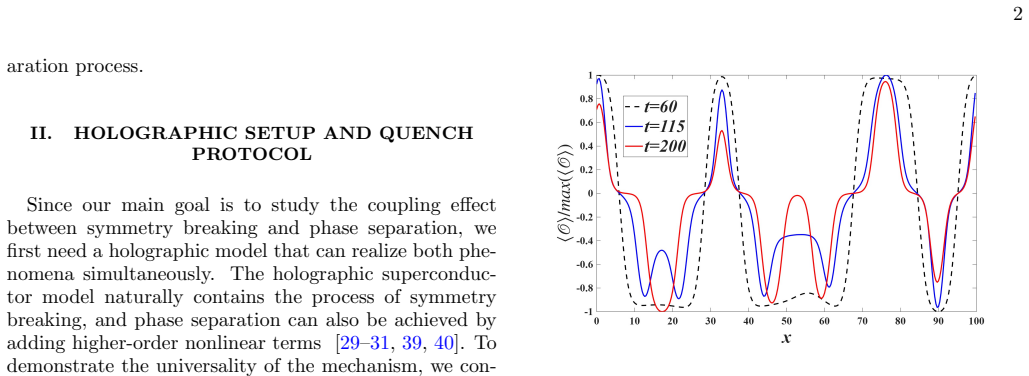
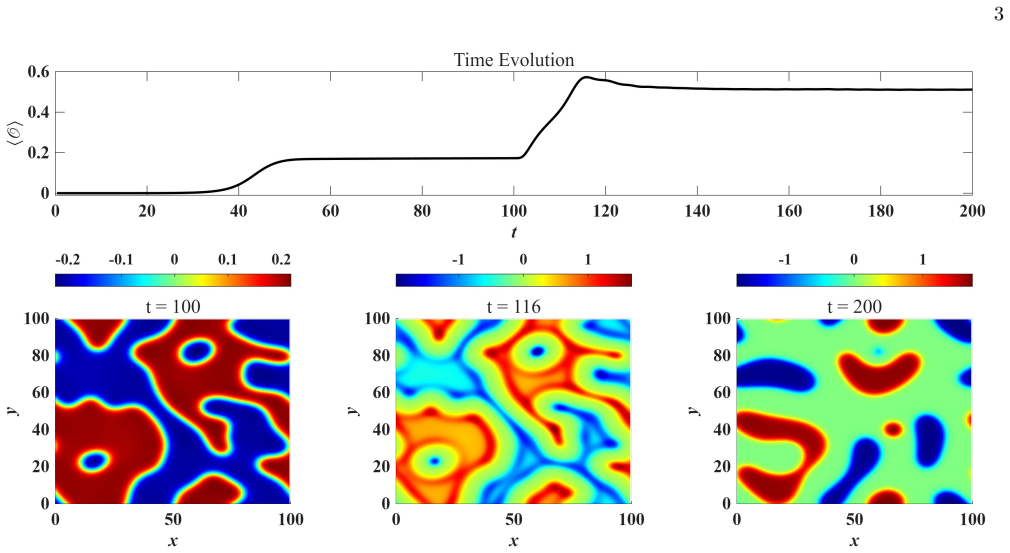
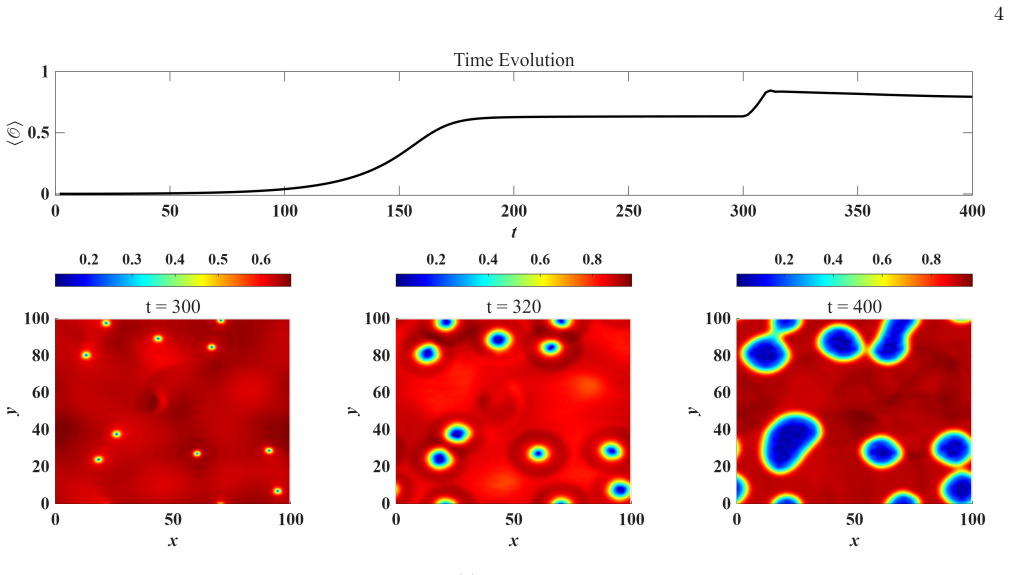
Topological defects from symmetry breaking seed phase separation in holographic models.
A machine-rendered reading of the paper's core claim, the machinery that carries it, and where it could break.
Core claim
In holographic models with a double-quench protocol, topological defects generated during the initial symmetry-breaking quench serve as nucleation sites for phase separation triggered by the subsequent quench into the spinodal regime. The defect cores expand into macroscopic domains, and this behavior is universal across Z2 and U(1) systems despite their different topological properties.
What carries the argument
Topological defects (domain walls or vortices) created by the first quench, which expand during spinodal decomposition to form phase-separated domains.
If this is right
- Nucleation sites of phase separation are fixed by the locations of defects formed in the first quench.
- Macroscopic domains grow directly by expansion of the defect cores rather than by random fluctuations.
- The same dynamical sequence occurs for both Z2 and U(1) defects.
- Topological defects serve as universal seeds for phase separation across different symmetry classes.
Where Pith is reading between the lines
- The result suggests that engineering initial defect density could control the pattern of phase separation in analogous non-holographic models.
- Similar seeding by defects may occur in real condensed-matter systems such as binary fluids or magnetic materials undergoing multiple quenches.
- The universality across symmetries implies the mechanism could be tested in effective field theories without gravity duals.
Load-bearing premise
The double-quench protocol in the holographic model accurately isolates the role of topological defects as the dominant nucleation seeds without other dynamical factors dominating the phase separation process.
What would settle it
A holographic simulation in which phase separation nucleates at locations unrelated to the initial defect positions, or in which defect cores do not expand into the domains, would falsify the seeding claim.
Figures
read the original abstract
We study the interaction between spontaneous symmetry breaking and phase separation dynamics in holography. Using a double-quench protocol, the system first rapidly crosses the critical point and generates topological defects, while a second quench drives the system into a nonlinear unstable regime with spinodal decomposition. We investigate both $\mathbb{Z}_2$ and $U(1)$ symmetric systems, where different types of topological defects emerge during symmetry breaking. We show that topological defects dynamically determine the nucleation sites of phase separation. As the instability grows, the defect cores expand into macroscopic phase-separated domains. Despite the distinct symmetries and topological properties of these defects, both systems exhibit the same universal dynamical behavior, indicating that topological defects can universally serve as dynamical seeds for subsequent phase separation.
Editorial analysis
A structured set of objections, weighed in public.
Referee Report
Summary. The paper studies the interaction of spontaneous symmetry breaking and phase separation in holographic models via a double-quench protocol. The first quench generates Z2 or U(1) topological defects; the second drives the system into a spinodal regime. The central claim is that defect cores expand into macroscopic phase-separated domains and that both symmetries exhibit the same universal dynamical behavior, implying topological defects universally seed phase separation.
Significance. If the numerical results are robust, the work supplies concrete holographic evidence that topological defects can act as dominant nucleation sites for spinodal decomposition, independent of the underlying symmetry. This offers a dynamical mechanism that may apply to strongly coupled non-equilibrium systems and is supported by direct time evolution rather than fitted parameters.
major comments (1)
- [Protocol and numerical setup (likely §3)] The double-quench protocol description leaves open whether control runs (defect-free states after the first quench, or varied second-quench amplitudes) were performed to show that phase separation is suppressed or relocated in the absence of pre-existing defects. Without such controls, it is unclear whether the second quench itself triggers widespread spinodal nucleation from homogeneous regions or numerical fluctuations, which directly affects the claim that defects are the dominant seeds.
Simulated Author's Rebuttal
We thank the referee for the careful reading of our manuscript and the constructive comment on the double-quench protocol. We address the point below and will revise the manuscript accordingly to strengthen the presentation of our numerical evidence.
read point-by-point responses
-
Referee: [Protocol and numerical setup (likely §3)] The double-quench protocol description leaves open whether control runs (defect-free states after the first quench, or varied second-quench amplitudes) were performed to show that phase separation is suppressed or relocated in the absence of pre-existing defects. Without such controls, it is unclear whether the second quench itself triggers widespread spinodal nucleation from homogeneous regions or numerical fluctuations, which directly affects the claim that defects are the dominant seeds.
Authors: We agree that explicit control simulations would provide stronger confirmation that defects are the dominant nucleation sites. In the present work the first quench is spatially uniform and crosses the critical point, generating topological defects via the Kibble-Zurek mechanism as the only source of inhomogeneity; the second quench is likewise uniform. Our simulations across multiple realizations consistently show that spinodal domains nucleate and expand from the defect cores rather than appearing randomly. Nevertheless, we acknowledge that the manuscript does not report dedicated runs with a modified first quench (e.g., adiabatic or symmetry-preserving) that would leave the system defect-free after the first stage. We will therefore add a new subsection in §3 describing (i) the evolution under a slower first quench that suppresses defect formation and (ii) the effect of varying the amplitude of the second quench. These additional results will be included in the revised manuscript to demonstrate that phase separation is indeed relocated or suppressed when pre-existing defects are absent. revision: yes
Circularity Check
No circularity: claims rest on numerical holographic evolution
full rationale
The paper's central claim—that topological defects from a first quench seed phase separation after a second quench—is advanced via direct numerical solution of the holographic equations of motion under the described double-quench protocol. No equations, ansatze, or uniqueness theorems are quoted that reduce the reported dynamical behavior to fitted parameters, self-citations, or definitional identities. The derivation chain is therefore self-contained and independent of the enumerated circularity patterns.
Axiom & Free-Parameter Ledger
Reference graph
Works this paper leans on
-
[1]
W. H. Zurek, Nature317, 505 (1985)
1985
-
[2]
A. J. Bray, Adv. Phys.43, 357 (1994), arXiv:cond- mat/9501089
arXiv 1994
-
[3]
L. E. Sadler, J. M. Higbie, S. R. Leslie, M. Vengalattore, and D. M. Stamper-Kurn, Nature443, 312 (2006)
2006
-
[4]
T. W. B. Kibble, J. Phys. A9, 1387 (1976)
1976
-
[5]
A. Polkovnikov, K. Sengupta, A. Silva, and M. Vengalat- tore, Rev. Mod. Phys.83, 863 (2011), arXiv:1007.5331 [cond-mat.stat-mech]
Pith/arXiv arXiv 2011
-
[6]
W. H. Zurek, Phys. Rept.276, 177 (1996), arXiv:cond- mat/9607135
arXiv 1996
-
[7]
S. Digal, R. Ray, and A. M. Srivastava, Phys. Rev. Lett. 83, 5030 (1999), arXiv:hep-ph/9805502
Pith/arXiv arXiv 1999
-
[8]
M. E. Dodd, P. C. Hendry, N. S. Lawson, P. V. E. Mc- Clintock, and C. D. H. Williams, Phys. Rev. Lett.81, 3703 (1998), arXiv:cond-mat/9808117
Pith/arXiv arXiv 1998
-
[9]
Carmi, E
R. Carmi, E. Polturak, and G. Koren, Phys. Rev. Lett. 84, 4966 (2000)
2000
-
[10]
A. del Campo and W. H. Zurek, Int. J. Mod. Phys. A29, 1430018 (2014), arXiv:1310.1600 [cond-mat.stat-mech]
Pith/arXiv arXiv 2014
-
[11]
J. Sonner, A. del Campo, and W. H. Zurek, Nature Commun.6, 7406 (2015), arXiv:1406.2329 [hep-th]
Pith/arXiv arXiv 2015
- [12]
-
[13]
H.-B. Zeng, C.-Y. Xia, and A. del Campo, Phys. Rev. Lett.130, 060402 (2023), arXiv:2204.13529 [cond- mat.stat-mech]
arXiv 2023
-
[14]
A. del Campo, F. J. G´ omez-Ruiz, and H.-Q. Zhang, Phys. Rev. B106, L140101 (2022), arXiv:2202.11731 [cond-mat.stat-mech]
arXiv 2022
-
[15]
C.-Y. Xia, H.-B. Zeng, A. Grabarits, and A. del Campo, Nature Commun.17, 3668 (2026), arXiv:2406.09433 [cond-mat.stat-mech]
Pith/arXiv arXiv 2026
- [16]
-
[17]
P. Yang, C.-Y. Xia, S. Grieninger, H.-B. Zeng, and M. Baggioli, Phys. Rev. Lett.136, 051602 (2026), arXiv:2508.05964 [cond-mat.stat-mech]
arXiv 2026
-
[18]
C.-X. Wang, A. Grabarits, J.-M. Cui, H.-B. Zeng, Y.- F. Huang, C.-F. Li, and A. del Campo, (2025), arXiv:2507.01087 [quant-ph]
arXiv 2025
-
[19]
B. Ko, J. W. Park, and Y. Shin, Nature Physics15, 1227–1231 (2019)
2019
-
[20]
R. Monaco, J. Mygind, and R. J. Rivers, Physical Review Letters89(2002), 10.1103/physrevlett.89.080603
-
[21]
C. N. Weiler, T. W. Neely, D. R. Scherer, A. S. Bradley, M. J. Davis, and B. P. Anderson, Nature455, 948–951 (2008)
2008
-
[22]
J. W. Cahn and J. E. Hilliard, The Journal of Chemical Physics28, 258 (1958)
1958
-
[23]
J. W. Cahn, Acta Metallurgica9, 795 (1961)
1961
-
[24]
P. C. Hohenberg and B. I. Halperin, Rev. Mod. Phys.49, 435 (1977)
1977
-
[25]
E. Nicklas, H. Strobel, T. Zibold, C. Gross, B. A. Malomed, P. G. Kevrekidis, and M. K. Oberthaler, Physical Review Letters107(2011), 10.1103/phys- revlett.107.193001
-
[26]
S. Franco, A. Garcia-Garcia, and D. Rodriguez-Gomez, JHEP04, 092 (2010), arXiv:0906.1214 [hep-th]
Pith/arXiv arXiv 2010
-
[27]
R. Gregory, S. Kanno, and J. Soda, JHEP10, 010 (2009), arXiv:0907.3203 [hep-th]
Pith/arXiv arXiv 2009
-
[28]
X.-K. Zhang, C.-Y. Xia, Z.-Y. Nie, and H. Zeng, Phys. Rev. D105, 046016 (2022), arXiv:2105.14294 [hep-th]
arXiv 2022
-
[29]
Z.-Q. Zhao, X.-K. Zhang, and Z.-Y. Nie, JHEP02, 023 (2023), arXiv:2211.14762 [hep-th]
arXiv 2023
-
[30]
X. Zhao, Z.-Y. Nie, Z.-Q. Zhao, H.-B. Zeng, Y. Tian, and M. Baggioli, JHEP02, 184 (2024), arXiv:2311.08277 [hep-th]
arXiv 2024
- [31]
-
[32]
R. A. Janik, J. Jankowski, and H. Soltanpanahi, Phys. Rev. Lett.117, 091603 (2016), arXiv:1512.06871 [hep- th]
Pith/arXiv arXiv 2016
-
[33]
R. A. Janik, J. Jankowski, and H. Soltanpanahi, Phys. Rev. Lett.119, 261601 (2017), arXiv:1704.05387 [hep- th]
Pith/arXiv arXiv 2017
- [34]
-
[35]
L. Bellantuono, R. A. Janik, J. Jankowski, and H. Soltanpanahi, JHEP10, 146 (2019), arXiv:1906.00061 [hep-th]
arXiv 2019
- [36]
-
[37]
Q. Chen, Y. Liu, Y. Tian, X. Wu, and H. Zhang, Phys. Rev. D108, 106017 (2023), arXiv:2211.11291 [hep-th]
arXiv 2023
-
[38]
Q. Chen, Y. Liu, Y. Tian, X. Wu, and H. Zhang, Sci. China Phys. Mech. Astron.68, 260414 (2025), 6 arXiv:2408.09679 [hep-th]
arXiv 2025
-
[39]
Z.-Q. Zhao, Z.-Y. Nie, J.-F. Zhang, and X. Zhang, (2026), arXiv:2604.00690 [hep-th]
arXiv 2026
-
[40]
Z.-Q. Zhao, Z.-Y. Nie, J.-F. Zhang, and X. Zhang, (2026), arXiv:2604.13104 [cond-mat.stat-mech]
Pith/arXiv arXiv 2026
-
[41]
S. A. Hartnoll, C. P. Herzog, and G. T. Horowitz, Phys. Rev. Lett.101, 031601 (2008), arXiv:0803.3295 [hep-th]
Pith/arXiv arXiv 2008
-
[42]
S. A. Hartnoll, C. P. Herzog, and G. T. Horowitz, JHEP 12, 015 (2008), arXiv:0810.1563 [hep-th]
Pith/arXiv arXiv 2008
-
[43]
C. P. Herzog, Phys. Rev. D81, 126009 (2010), arXiv:1003.3278 [hep-th]. Appendix A: Full equations of motion The formulas for the nonequilibrium evolution of a system withZ 2 symmetry are ∂zψf ′ 2 + ψf ′ 2z − 1 4 αψz2eαψ2z2 f ∂zAx 2 +f ∂ zAy 2 −2∂ tAx∂zAx −2∂ tAy∂zAy + 2∂xAt∂zAx +∂ xAy 2 −2∂ xAy∂yAx +2∂yAt∂zAy +∂ yAx 2 −∂ zAt 2 + f ∂z∂zψ 2 − f ψ z2 −λψ 3 −...
Pith/arXiv arXiv 2010
discussion (0)
Sign in with ORCID, Apple, or X to comment. Anyone can read and Pith papers without signing in.