REVIEW 1 major objections 1 minor 25 references
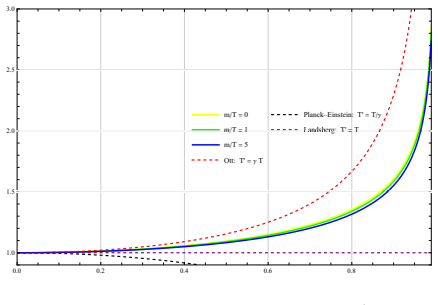
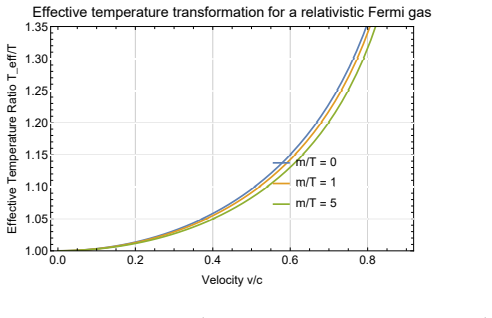
Effective temperature of photon, ideal, and electron gases rises with velocity, showing temperature is observer-dependent.
Reviewed by Pith at T0; open to challenge. T0 means a machine referee read the full paper against a public rubric. the ladder, T0–T4 →
T0 review · grok-4.3
2026-06-28 18:32 UTC pith:NO2ZX6I5
load-bearing objection The paper calculates Teff from boosted energy density for three gases and finds an increase with velocity, but this follows from defining temperature that way rather than from entropy or the four-vector. the 1 major comments →
Relativistic transformation of temperature revisited
The pith
A machine-rendered reading of the paper's core claim, the machinery that carries it, and where it could break.
Core claim
Starting from the energy-momentum tensor of an isotropic system and defining Teff as the temperature inferred by a moving observer from the transformed energy density, analyses of a photon gas, a relativistic ideal gas and an electron gas show that Teff consistently increases with velocity, supporting the Ott-Eddington interpretation while depending on the system's equation of state. These results indicate that temperature is not a Lorentz-invariant scalar but an observer-dependent quantity. A consistent relativistic description emerges when temperature is related to the inverse-temperature four-vector beta, linking operational and invariant viewpoints within a unified thermodynamic framewor
What carries the argument
Effective temperature Teff defined as the temperature a moving observer infers from the Lorentz-transformed energy density of an isotropic system.
Load-bearing premise
The operational definition of Teff from transformed energy density matches the thermodynamic temperature that would be read by standard thermometers in the moving frame.
What would settle it
A laboratory measurement of the temperature of a gas (photon, ideal, or electron) in a frame moving at relativistic speed, compared directly against the Teff predicted from its boosted energy density.
If this is right
- Temperature transformation laws differ according to the equation of state of the system under study.
- The Ott-Eddington result is recovered for the three gases examined rather than the Planck-Einstein result.
- Temperature cannot be regarded as a Lorentz-invariant scalar quantity.
- A unified framework is obtained by expressing temperature through the inverse-temperature four-vector beta.
Where Pith is reading between the lines
- The same energy-momentum approach could be applied to other thermodynamic variables such as pressure or chemical potential in boosted frames.
- High-energy collider data on boosted particle distributions might provide indirect checks on the predicted rise in Teff.
- The dependence on equation of state suggests that different relativistic fluids will exhibit quantitatively different temperature transformations.
Editorial analysis
A structured set of objections, weighed in public.
Referee Report
Summary. The manuscript reexamines the relativistic transformation of temperature by starting from the energy-momentum tensor of an isotropic system and defining an effective temperature Teff as that inferred by a moving observer from the Lorentz-transformed energy density. Explicit calculations are performed for a photon gas (yielding Teff ~ u'^{1/4}), a relativistic ideal gas, and an electron gas; in each case Teff increases with velocity, supporting the Ott-Eddington interpretation while depending on the equation of state. The paper concludes that temperature is not a Lorentz scalar but observer-dependent, and proposes a unified description via the inverse-temperature four-vector β^μ that reconciles operational and covariant viewpoints.
Significance. If the operational definition of Teff is shown to coincide with standard thermodynamic temperature, the explicit multi-system calculations would constitute a concrete contribution to resolving the long-standing controversy, by demonstrating both velocity dependence and equation-of-state sensitivity while linking to the covariant β^μ formalism. The provision of results for three distinct systems (photon, ideal, and electron gases) is a positive feature that allows direct comparison across different equations of state.
major comments (1)
- [Abstract] Abstract (paragraph on energy-momentum tensor approach) and the subsequent definition of Teff: the central claim that the calculations support the Ott-Eddington interpretation rests on identifying the temperature inferred from the boosted energy density u' with the thermodynamic temperature. The manuscript does not demonstrate that this Teff reproduces the temperature obtained from the maximum-entropy condition or from a comoving thermometer in the boosted frame; without this equivalence the observer-dependence conclusion does not follow from the energy-density transformation alone.
minor comments (1)
- The abstract states that temperature 'depends on the system's equation of state' but does not indicate whether this dependence is derived from the functional form T(u) or from an additional assumption about how the EOS transforms under Lorentz boosts.
Simulated Author's Rebuttal
We thank the referee for the careful reading of our manuscript and the constructive feedback. We address the major comment below.
read point-by-point responses
-
Referee: [Abstract] Abstract (paragraph on energy-momentum tensor approach) and the subsequent definition of Teff: the central claim that the calculations support the Ott-Eddington interpretation rests on identifying the temperature inferred from the boosted energy density u' with the thermodynamic temperature. The manuscript does not demonstrate that this Teff reproduces the temperature obtained from the maximum-entropy condition or from a comoving thermometer in the boosted frame; without this equivalence the observer-dependence conclusion does not follow from the energy-density transformation alone.
Authors: We appreciate the referee highlighting the need to clarify the status of Teff. Our definition is explicitly operational: Teff is obtained by applying the standard rest-frame relation between energy density and temperature (via the equation of state) to the Lorentz-transformed energy density u' measured by the moving observer. This is the temperature an observer would infer from an energy-density measurement in their own frame. Because the energy-momentum tensor is covariant and the three chosen systems span different equations of state, the resulting velocity dependence directly supports the Ott-Eddington picture within this operational framework. We agree, however, that an explicit demonstration that the same Teff also satisfies the maximum-entropy condition in the boosted frame would strengthen the link to conventional thermodynamics. We will add a short clarifying subsection and a brief discussion of this point in the revised manuscript. revision: yes
Circularity Check
No significant circularity; derivation uses external Lorentz transformations and explicit operational definition
full rationale
The paper begins from the standard energy-momentum tensor and Lorentz transformations (external inputs) and explicitly defines Teff as the temperature inferred by a moving observer from the boosted energy density. It then applies the respective equations of state for photon, ideal, and electron gases to compute the velocity dependence. This produces the claimed observer dependence by direct application of the chosen definition rather than by any reduction of a derived result back to a fitted input or self-citation. No load-bearing self-citations, uniqueness theorems, or ansatzes imported from prior author work are present in the abstract or described chain. The central result follows from the operational starting point without circular self-reference.
Axiom & Free-Parameter Ledger
axioms (2)
- standard math The energy-momentum tensor of an isotropic system transforms under Lorentz boosts in the standard way.
- domain assumption Effective temperature is defined as the temperature inferred by a moving observer from the transformed energy density.
read the original abstract
The relativistic transformation of temperature has long remained controversial, with the classical laws of Planck-Einstein, Ott-Eddington-Moller and Landsberg yielding conflicting results. We reexamine this issue from a relativistic thermodynamic and statistical perspective, starting from the energy-momentum tensor of an isotropic system and defining the effective temperature Teff as that inferred by a moving observer from the transformed energy density. Analyses of a photon gas, a relativistic ideal gas and an electron gas show that Teff consistently increases with velocity, supporting the Ott-Eddington interpretation while depending on the system's equation of state. These results indicate that temperature is not a Lorentz-invariant scalar but an observer-dependent quantity. A consistent relativistic description emerges when temperature is related to the inverse-temperature four-vector beta, linking operational and invariant viewpoints within a unified thermodynamic framework.
Figures
Reference graph
Works this paper leans on
-
[1]
R. C. Tolman, Relativity, Thermodynamics and Cosmology , Oxford, Clarendon Press (1934)
1934
-
[2]
¨Uber das Relativit¨ atsprinzip und die aus demselben gezoge nen Fol- gerungen
A. Einstein, “ ¨Uber das Relativit¨ atsprinzip und die aus demselben gezoge nen Fol- gerungen”, Jahrbuch der Radioaktivit¨ at und Elektronik 4 (1907) 411
1907
-
[3]
Zur Dynamik bewegter Systeme
M. Planck, “Zur Dynamik bewegter Systeme”, Annalen der Phys. 26 (1908) 1
1908
-
[4]
Ott, ”Lorentz transformation of heat and temperature ”, Zeitschrift Phys
H. Ott, ”Lorentz transformation of heat and temperature ”, Zeitschrift Phys. 175 (1963) 70
1963
-
[5]
A. S. Eddington, The Mathematical Theory of Relativity , Cambridge University Press (1924)
1924
-
[6]
P. T. Landsberg, ”Does a moving body appear cool?”, Nature 214 (1967) 903
1967
-
[7]
P. T. Landsberg and G. E. A. Matsas, ”The impossibility of a universal relativistic temperature transformation”, Physica A 340 (2004) 92
2004
-
[8]
N. G. van Kampen, ”Relativistic thermodynamics of movin g systems”, Phys. Rev. 173 (1968) 295
1968
-
[9]
Israel, ”Nonstationary irreversible thermodynamic s: A causal relativistic theory”, Ann
W. Israel, ”Nonstationary irreversible thermodynamic s: A causal relativistic theory”, Ann. Phys. 100 (1976) 310
1976
-
[10]
G. L. Sewell, ”Quantum fields on manifolds: PCT and gravi tationally induced thermal states”, Ann. Phys. 141 (1982) 201
1982
-
[11]
T. K. Nakamura, ”Lorentz Transform of Black Body Radiat ion Temperature”, Euro- phys. Lett. 88 (2009) 20004
2009
-
[12]
Cubero et al
D. Cubero et al. , ”Thermal equilibrium and statistical thermometers in spe cial rela- tivity”, Phys. Rev. Lett. 99 (2007) 170601
2007
-
[13]
J. Dunkel and P. H¨ anggi, ”Relativistic Brownian motio n”, Phys. Rep. 471 (2009) 1 (arXiv: 0812.1996 [cond-mat.stat-mech])
work page internal anchor Pith review Pith/arXiv arXiv 2009
-
[14]
Mareˇ s, P
J. Mareˇ s, P. Hub ´ ık and V.ˇSpiˇ cka, ”On relativistic transformation of temperature” , Fortschr. Phys. 65 (2017) 1
2017
- [15]
- [16]
-
[17]
Wallace, ”On relativistic thermodynamics”, Philos
D. Wallace, ”On relativistic thermodynamics”, Philos. Sci. 92 (2025) 688 (arXiv: 2307.00354 [cond-mat.stat-mech])
-
[18]
N. Sato, ”Kinetic theory of relativistic temperature i n self-gravitating systems”, (arXiv: 2411.19405 [gr-qc])
-
[19]
Far ´ ıas, V
C. Far ´ ıas, V. A. Pinto and P. S. Moya, ”What is the temperature of a moving body?”, Sci. Rep. 7 (2017) 17657 15
2017
- [20]
-
[21]
Hakim, ”Relativistic Stochastic Processes”, J
R. Hakim, ”Relativistic Stochastic Processes”, J. Math. Phys. 9 (1968) 1805
1968
-
[22]
Hakim, ”Remarks on Relativistic Statistical Mechan ics
R. Hakim, ”Remarks on Relativistic Statistical Mechan ics. I”, J. Math. Phys. 8 (1967) 1315
1967
-
[23]
V. E. Ambrus and I. I. Cotaescu, ”Maxwell-Juttner distr ibution for rigidly-rotating flows in spherically symmetric spacetimes using the tetrad f ormalism”, Phys. Rev. D 94 (2016) 085022 (arXiv: 1605.07043 [hep-th])
work page internal anchor Pith review Pith/arXiv arXiv 2016
-
[24]
Livadiotis, ”Modeling anisotropic Maxwell–J¨ uttn er distributions: derivation and properties”, Ann
G. Livadiotis, ”Modeling anisotropic Maxwell–J¨ uttn er distributions: derivation and properties”, Ann. Geophys. 34 (2016) 1145
2016
-
[25]
Das Maxwellsche Gesetz der Geschwindigk eitsverteilung in der Rela- tivtheorie
F. J¨ uttner, “Das Maxwellsche Gesetz der Geschwindigk eitsverteilung in der Rela- tivtheorie”, Annalen der Phys. 339 (1911) 856 16
1911
discussion (0)
Sign in with ORCID, Apple, or X to comment. Anyone can read and Pith papers without signing in.