Bayesian estimation of spectral parameters of the 6.7-GHz methanol maser G339.884-1.259 from GRAO observations
Pith reviewed 2026-06-28 18:01 UTC · model grok-4.3
The pith
Bayesian fitting shows the Voigt profile best describes the 6.7 GHz methanol maser G339.884-1.259 with seven velocity components.
A machine-rendered reading of the paper's core claim, the machinery that carries it, and where it could break.
Core claim
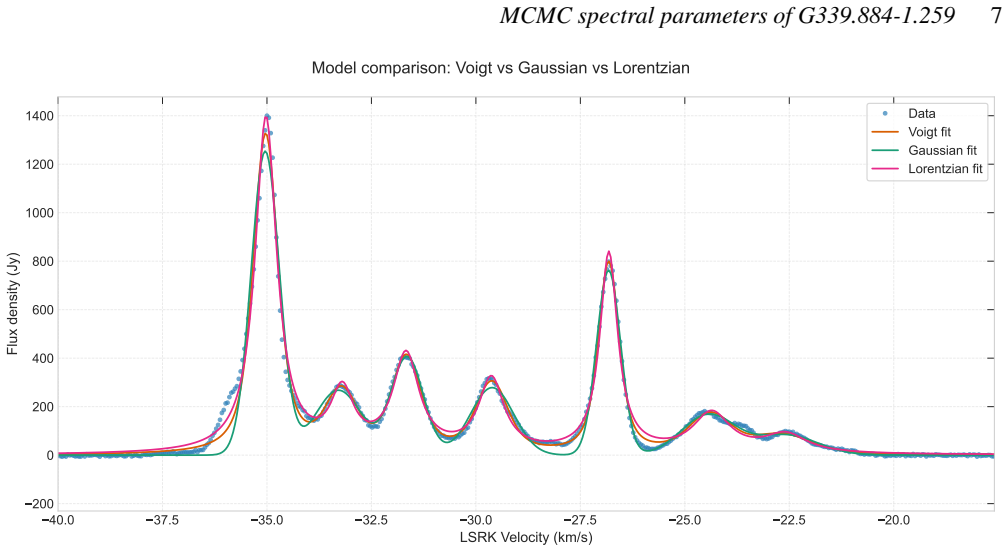
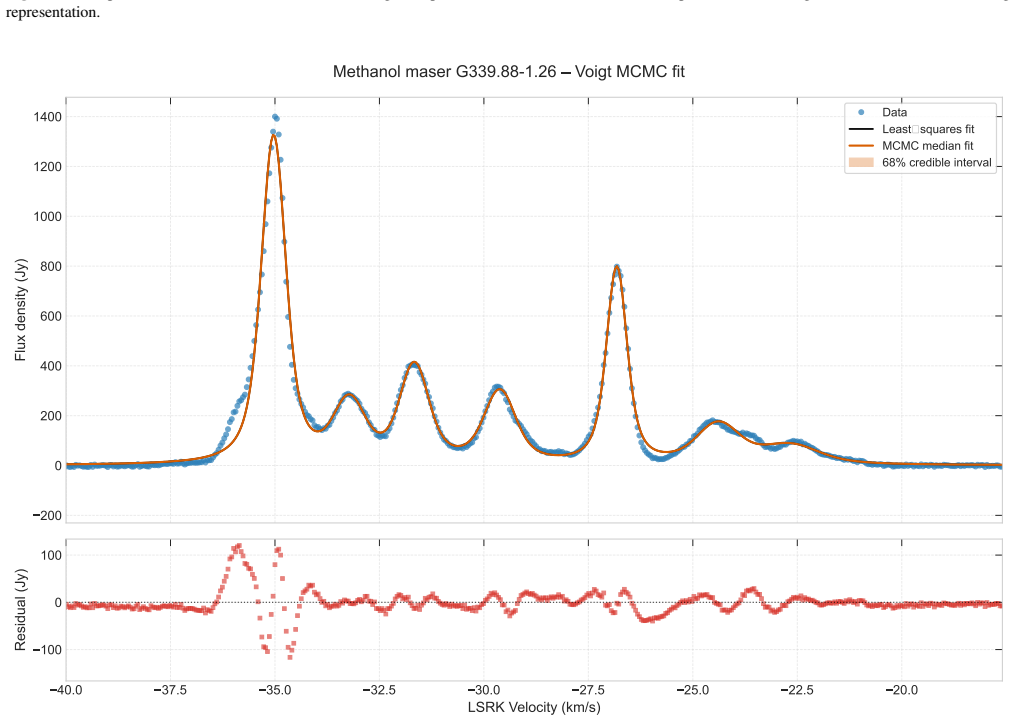
Applied to GRAO observations of G339.884-1.259, the Voigt model yields the lowest AIC and BIC (approximately 1.98 times 10 to the 4 and 1.99 times 10 to the 4), the smallest RMSE (approximately 11.1 Jy), and the highest R-squared (0.985), while identifying seven velocity-coherent components; purely Gaussian or Lorentzian models leave systematic residuals.
What carries the argument
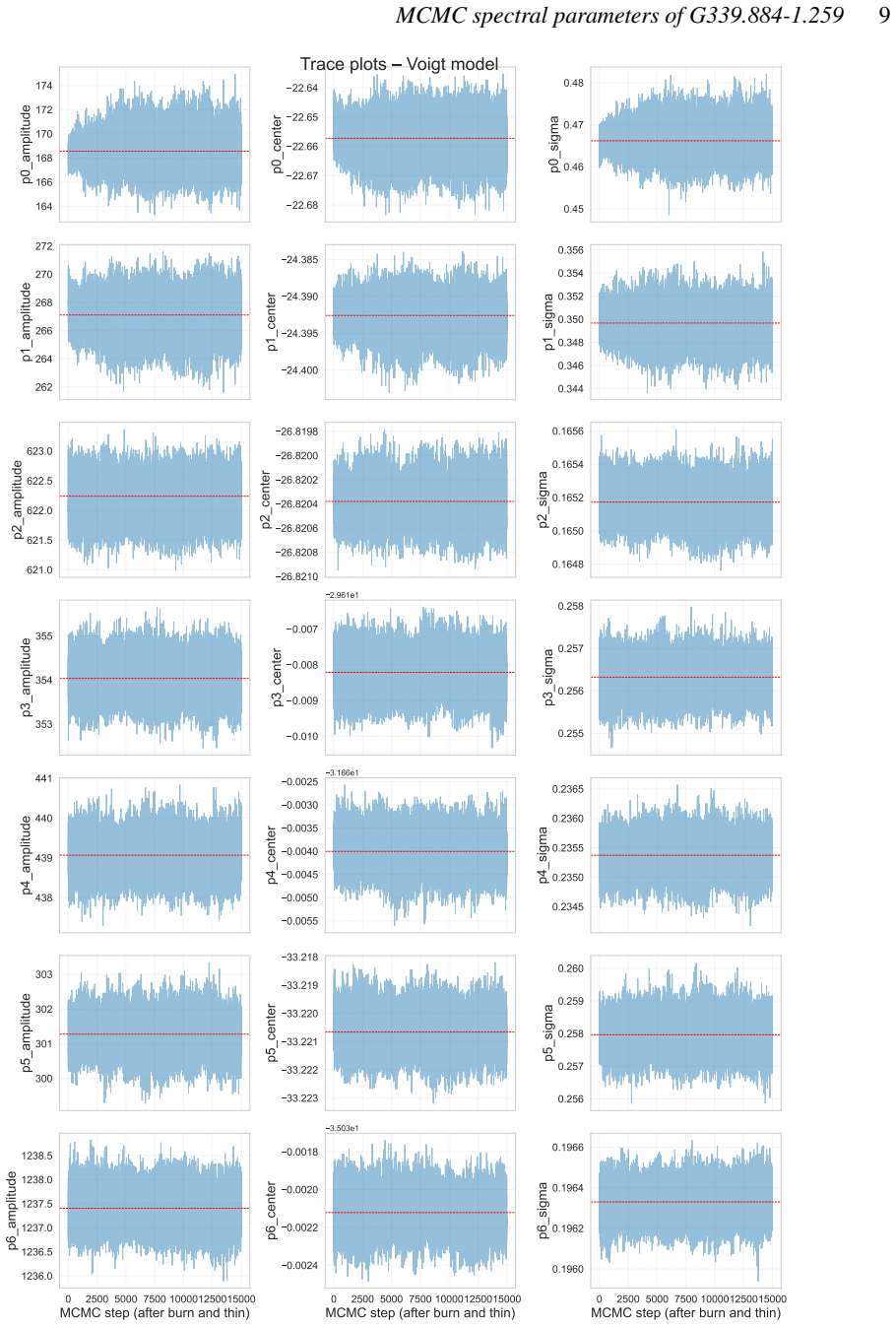
Bayesian spectral decomposition via MCMC sampling of Gaussian, Lorentzian, and Voigt profile sums, enabling direct model comparison through information criteria and goodness-of-fit metrics.
If this is right
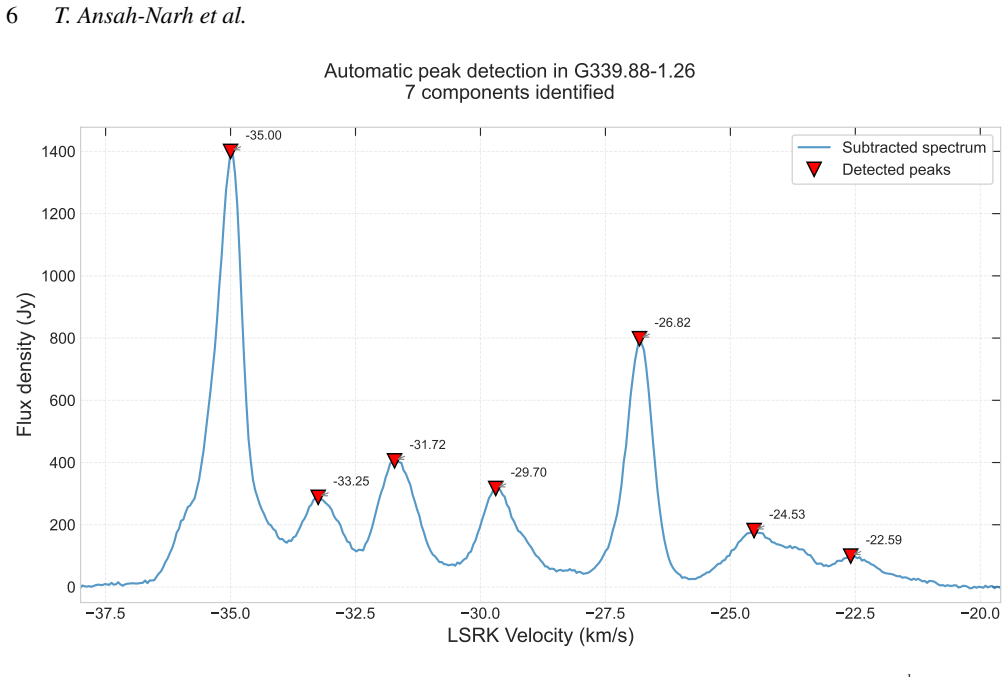
- Seven distinct velocity-coherent components are required to describe the spectrum.
- Elevated reduced chi-squared values point to unresolved substructure or non-ideal noise properties.
- The same MCMC framework can be applied to other molecular lines observed at similar frequencies.
- Parameter uncertainties obtained from the posterior can be propagated into physical interpretations of the star-forming region.
Where Pith is reading between the lines
- Pairing the Bayesian decomposition with high-resolution interferometric maps could test whether the seven components correspond to spatially distinct maser spots.
- The method supplies a quantitative way to decide when additional profile complexity is justified by the data rather than by eye.
- If Voigt profiles remain preferred across a larger sample, this may indicate that both thermal and non-thermal broadening mechanisms operate simultaneously in 6.7 GHz methanol masers.
Load-bearing premise
That sums of Gaussian, Lorentzian, or Voigt profiles are sufficient to represent the emission without significant contributions from optical-depth effects, velocity gradients, or additional unresolved sub-components beyond the seven identified.
What would settle it
Detection of a profile family or combination that produces a lower AIC or BIC than the Voigt model while eliminating the systematic residuals seen in the current fits.
Figures
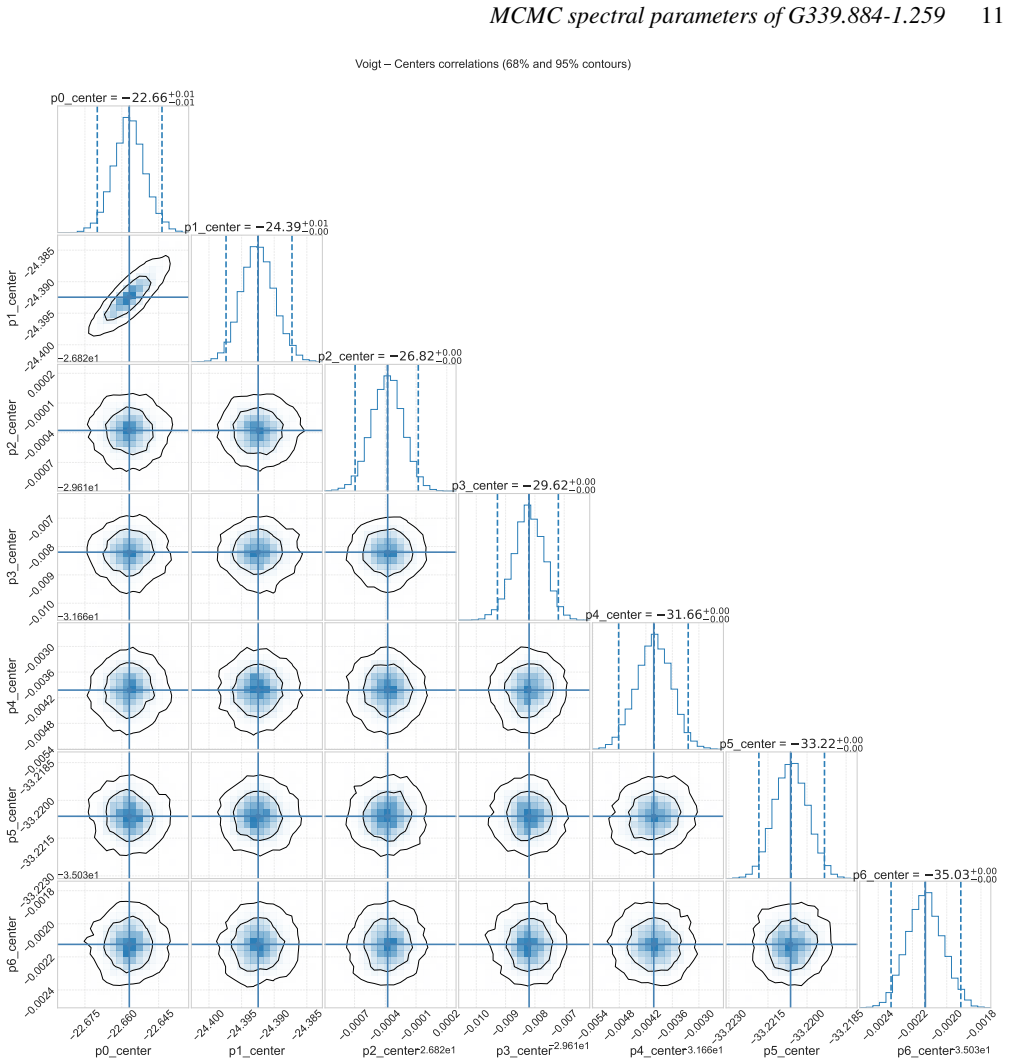
read the original abstract
Accurate decomposition of methanol maser spectra is essential for understanding high-mass star-forming regions, especially in complex blended spectra where small differences alter physical interpretation. Conventional Gaussian fitting often fails to capture non-Gaussian structure and lacks uncertainty quantification. We develop a Bayesian spectral decomposition framework using Gaussian, Lorentzian, and Voigt profiles with Markov Chain Monte Carlo sampling, enabling model comparison and uncertainty estimation. Applied to the 6.7\,GHz methanol maser G339.884$-$1.259 observed with the Ghana Radio Astronomy Observatory, our method reveals seven velocity-coherent components. The Voigt model is statistically preferred, yielding the lowest AIC and BIC ($\approx 1.98 \times 10^{4}$ and $1.99 \times 10^{4}$), the smallest RMSE ($\approx 11.1$ Jy), and the highest $R^{2}$ (0.985). Purely Gaussian or Lorentzian models leave systematic residuals. Elevated reduced $\chi^{2}_{\nu}$ values indicate unresolved substructure and non-ideal noise. Bayesian inference provides a robust framework for maser spectral analysis, extendable to other molecular lines and combinable with high-resolution interferometry.
Editorial analysis
A structured set of objections, weighed in public.
Referee Report
Summary. The manuscript develops a Bayesian MCMC framework for decomposing the 6.7 GHz methanol maser spectrum of G339.884-1.259 into sums of Gaussian, Lorentzian or Voigt profiles. It identifies seven velocity-coherent components and concludes that the Voigt model is preferred on the basis of lowest AIC/BIC (≈1.98–1.99×10^4), smallest RMSE (≈11.1 Jy) and highest R² (0.985), while noting that elevated reduced χ²_ν values signal unresolved substructure and non-ideal noise.
Significance. If the model-comparison results survive a noise-robust re-evaluation, the work supplies a practical, uncertainty-quantifying alternative to conventional Gaussian fitting for blended maser spectra and is readily extensible to other molecular lines.
major comments (1)
- [Abstract] Abstract: the manuscript reports elevated reduced χ²_ν values that 'indicate unresolved substructure and non-ideal noise,' yet still bases the statistical preference for the Voigt model on AIC, BIC, RMSE and R². These criteria presuppose a correctly specified model with i.i.d. Gaussian errors; when this assumption is violated the reported advantage may reflect extra degrees of freedom absorbing systematics rather than genuine superiority. A noise-robust alternative (e.g., marginal likelihood or posterior predictive checks) is needed to substantiate the central claim.
minor comments (2)
- The number of velocity components is stated as fixed at seven; the manuscript should clarify whether this choice was made a priori or after inspecting residuals, and whether alternative component counts were explored.
- Prior choices, MCMC convergence diagnostics (e.g., Gelman–Rubin statistic, effective sample size) and the precise definition of the likelihood function are not visible in the provided abstract; these details are required for reproducibility.
Simulated Author's Rebuttal
We thank the referee for the constructive comment on the robustness of our model comparison. We address the concern point by point below.
read point-by-point responses
-
Referee: [Abstract] Abstract: the manuscript reports elevated reduced χ²_ν values that 'indicate unresolved substructure and non-ideal noise,' yet still bases the statistical preference for the Voigt model on AIC, BIC, RMSE and R². These criteria presuppose a correctly specified model with i.i.d. Gaussian errors; when this assumption is violated the reported advantage may reflect extra degrees of freedom absorbing systematics rather than genuine superiority. A noise-robust alternative (e.g., marginal likelihood or posterior predictive checks) is needed to substantiate the central claim.
Authors: We agree that the elevated reduced χ²_ν values indicate a violation of the i.i.d. Gaussian error assumption, as already stated in the manuscript. Because all models are compared on identical data, the relative ranking via AIC/BIC (which penalize extra parameters) and the accompanying RMSE/R² improvements remain informative, and the Voigt residuals show visibly less systematic structure. However, to provide a more noise-robust validation we will add posterior predictive checks in the revised manuscript, drawing replicate spectra from the MCMC posterior of each model and comparing their ability to reproduce both the data distribution and residual patterns. We will also expand the discussion of model-misspecification limitations. These additions will appear in the Methods and Results sections. revision: yes
Circularity Check
No circularity: standard model selection on fitted spectra
full rationale
The paper fits sums of Gaussian, Lorentzian or Voigt profiles to the observed 6.7 GHz spectrum via MCMC, then ranks the models with AIC, BIC, RMSE and R². These quantities are computed directly from the data likelihood, parameter count and residuals; none of the reported preference for Voigt reduces by construction to a quantity defined solely by the fitted parameters themselves. No self-citations, uniqueness theorems or ansatzes imported from prior work appear in the derivation chain. The framework is therefore self-contained against external benchmarks for information-criteria model comparison.
Axiom & Free-Parameter Ledger
free parameters (2)
- component amplitudes, centers, and widths (multiple per profile)
- number of velocity components (fixed at seven)
axioms (2)
- standard math MCMC chains converge to the target posterior distribution
- domain assumption The noise is adequately described by the likelihood function used in the Bayesian model
Reference graph
Works this paper leans on
-
[1]
Discovery of synchronized periodic variability of methanol maser features in G26.598─0.024. , keywords =. doi:10.1051/0004-6361/202555968 , archivePrefix =. 2508.09308 , primaryClass =
-
[2]
Multi-frequency VLBI observations of maser lines during the 6.7 GHz maser flare in the high-mass young stellar object G24.33+0.14. , keywords =. doi:10.1051/0004-6361/202244772 , archivePrefix =. 2302.02723 , primaryClass =
-
[3]
Cosmic Masers: Proper Motion Toward the Next-Generation Large Projects , year = 2024, editor =
The water and methanol masers in the face-on accretion system around the high-mass protostar G353.273+0.641. Cosmic Masers: Proper Motion Toward the Next-Generation Large Projects , year = 2024, editor =. doi:10.1017/S1743921323003216 , adsurl =
-
[4]
First VLBI observations of methanol maser polarisation, in G339.88-1.2
First VLBI observations of methanol maser polarisation, in G339.88-1.26. , keywords =. doi:10.1051/0004-6361:20078670 , archivePrefix =. 0804.2106 , primaryClass =
work page internal anchor Pith review Pith/arXiv arXiv doi:10.1051/0004-6361:20078670
-
[5]
An Ordered Envelope-disk Transition in the Massive Protostellar Source G339.88-1.26
An Ordered Envelope-Disk Transition in the Massive Protostellar Source G339.88-1.26. , keywords =. doi:10.3847/1538-4357/ab0553 , archivePrefix =. 1811.04381 , primaryClass =
work page internal anchor Pith review Pith/arXiv arXiv doi:10.3847/1538-4357/ab0553
-
[6]
2005, MNRAS, 364, 1105, doi: 10.1111/j.1365-2966.2005.09655.x
Models of class II methanol masers based on improved molecular data. , keywords =. doi:10.1111/j.1365-2966.2005.09077.x , archivePrefix =. astro-ph/0504194 , primaryClass =
-
[7]
The Arecibo Methanol Maser Galactic Plane Survey. IV. Accurate Astrometry and Source Morphologies. , keywords =. doi:10.1088/0004-637X/730/1/55 , archivePrefix =. 1102.0590 , primaryClass =
work page internal anchor Pith review Pith/arXiv arXiv doi:10.1088/0004-637x/730/1/55
-
[8]
Class I and Class II methanol masers in high-mass star forming regions
Class I and Class II methanol masers in high-mass star-forming regions. , keywords =. doi:10.1051/0004-6361/200913679 , archivePrefix =. 1004.3689 , primaryClass =
work page internal anchor Pith review Pith/arXiv arXiv doi:10.1051/0004-6361/200913679
-
[9]
Maser Sources in Astrophysics , ISBN =
Gray, Malcolm , year =. Maser Sources in Astrophysics , ISBN =. doi:10.1017/cbo9780511977534 , publisher =
-
[10]
Elitzur, Moshe , year =. Astronomical Masers , ISBN =. doi:10.1007/978-94-011-2394-5 , journal =
-
[11]
LMFIT: Non-Linear Least-Squares Minimization and Curve-Fitting for Python (1.3. 3). Zenodo , author=
-
[12]
Communications in Applied Mathematics and Computational Science , keywords =
Ensemble samplers with affine invariance. Communications in Applied Mathematics and Computational Science , keywords =. doi:10.2140/camcos.2010.5.65 , adsurl =
-
[13]
Probing quintessence: Reconstruction and parameter es- timation from supernovae
Modelling methanol and hydroxyl masers in star-forming regions. , keywords =. doi:10.1046/j.1365-8711.2002.05226.x , adsurl =
-
[14]
emcee: The MCMC Hammer. , keywords =. doi:10.1086/670067 , archivePrefix =. 1202.3665 , primaryClass =
work page internal anchor Pith review Pith/arXiv arXiv doi:10.1086/670067
-
[15]
Journal of Statistical Mechanics: Theory and Experiment , volume=
Metropolis Monte Carlo sampling: convergence, localization transition and optimality , author=. Journal of Statistical Mechanics: Theory and Experiment , volume=. 2023 , publisher=
2023
-
[16]
Bayesian statistics 5 , volume=
Efficient Metropolis jumping rules , author=. Bayesian statistics 5 , volume=. 1996 , publisher=
1996
-
[17]
Statistical Science , year = 1992, month = jan, volume =
Inference from Iterative Simulation Using Multiple Sequences. Statistical Science , year = 1992, month = jan, volume =. doi:10.1214/ss/1177011136 , adsurl =
-
[18]
, year = 1977, month = feb, volume =
Empirical fits to the Voigt line width: A brief review. , year = 1977, month = feb, volume =. doi:10.1016/0022-4073(77)90161-3 , adsurl =
-
[19]
The 6-GHz methanol multibeam maser catalogue - III. Galactic longitudes 330 to 345. , keywords =. doi:10.1111/j.1365-2966.2011.19383.x , adsurl =
-
[20]
Synthesis Images of 6.7 GHz Methanol Masers. , keywords =. doi:10.1086/172914 , adsurl =
-
[21]
A new probe of magnetic fields during high-mass star formation. Zeeman splitting of 6.7 GHz methanol masers. , keywords =. doi:10.1051/0004-6361:200809447 , archivePrefix =. 0804.1141 , primaryClass =
work page internal anchor Pith review Pith/arXiv arXiv doi:10.1051/0004-6361:200809447
-
[22]
Simultaneous Estimates of Star-cluster Age, Metallicity, Mass, and Extinction (SESAMME). I. Presenting an MCMC Approach to Spectral Stellar Population Fitting. , keywords =. doi:10.3847/1538-4357/acfe0f , archivePrefix =. 2310.09365 , primaryClass =
-
[23]
Proceedings of the International Astronomical Union , volume=
SED fitting with MCMC: methodology and application to large galaxy surveys , author=. Proceedings of the International Astronomical Union , volume=. 2011 , publisher=
2011
-
[24]
Exoplanet MCMC parallel tempering for RV orbit retrieval
EMPEROR: I. Exoplanet MCMC parallel tempering for RV orbit retrieval. , keywords =. doi:10.1051/0004-6361/202554336 , archivePrefix =. 2511.05331 , primaryClass =
-
[25]
American Astronomical Society Meeting Abstracts \#229 , year = 2017, series =
Orbits for the Impatient: A Bayesian Rejection Sampling Method for Quickly Fitting the Orbits of Long-Period Exoplanets. American Astronomical Society Meeting Abstracts \#229 , year = 2017, series =
2017
-
[26]
An Affine-Invariant Sampler for Exoplanet Fitting and Discovery in Radial Velocity Data
An Affine-invariant Sampler for Exoplanet Fitting and Discovery in Radial Velocity Data. , keywords =. doi:10.1088/0004-637X/745/2/198 , archivePrefix =. 1104.2612 , primaryClass =
work page internal anchor Pith review Pith/arXiv arXiv doi:10.1088/0004-637x/745/2/198
-
[27]
Quantifying the Uncertainty in the Orbits of Extrasolar Planets
Quantifying the Uncertainty in the Orbits of Extrasolar Planets. , keywords =. doi:10.1086/427962 , archivePrefix =. astro-ph/0305441 , primaryClass =
work page internal anchor Pith review Pith/arXiv arXiv doi:10.1086/427962
-
[28]
Mid-Infrared Imaging of Star-forming Regions Containing Methanol Masers. , keywords =. doi:10.1086/317351 , adsurl =
-
[29]
88-1.26 , author=
The brightest known H2CO maser in the Milky Way: G339. 88-1.26 , author=. , volume=. 2017 , publisher=
2017
-
[30]
High-Resolution Mid-Infrared Imaging of G339.88-1.26
High-Resolution Mid-Infrared Imaging of G339.88-1.26. , keywords =. doi:10.1086/324273 , archivePrefix =. astro-ph/0109095 , primaryClass =
work page internal anchor Pith review Pith/arXiv arXiv doi:10.1086/324273
-
[31]
Class II Methanol Masers in Star Formation Regions
-
[32]
Continuum emission associated with 6.7-GHz methanol masers
Continuum emission associated with 6.7-GHz methanol masers. , keywords =. doi:10.1093/mnras/279.1.101 , archivePrefix =. astro-ph/9509068 , primaryClass =
work page internal anchor Pith review Pith/arXiv arXiv doi:10.1093/mnras/279.1.101
-
[33]
The Discovery of a New, Very Strong, and Widespread Interstellar Methanol Maser Line. , keywords =. doi:10.1086/186177 , adsurl =
-
[34]
2011, MNRAS, 411, 955, doi: 10.1111/j.1365-2966.2010.17731.x
The 6-GHz methanol multibeam maser catalogue - II. Galactic longitudes 6 to 20. , keywords =. doi:10.1111/j.1365-2966.2010.17376.x , archivePrefix =. 1007.3050 , primaryClass =
-
[35]
12.2-GHz methanol masers towards 1.2-mm dust clumps: quantifying high-mass star formation evolutionary schemes. , keywords =. doi:10.1111/j.1365-2966.2009.15831.x , archivePrefix =. 0910.1223 , primaryClass =
discussion (0)
Sign in with ORCID, Apple, or X to comment. Anyone can read and Pith papers without signing in.