REVIEW 2 major objections 2 minor 48 references
Reviewed by Pith at T0; open to challenge.
T0 means a machine referee read the full paper against a public rubric. The mark states how deep the mechanical check went, never who wrote it. the ladder, T0–T4 →
T0 review · grok-4.3
Local methods adapted from standard Bayesian optimization improve preferential optimization in high dimensions by using trust regions and derivatives of the preference model.
2026-06-28 15:52 UTC pith:GRMGUX4K
load-bearing objection The paper adapts trust-region and derivative local search to preferential BO via Laplace-approximated GPs and reports regret gains on high-dim benchmarks, but the approximation's reliability in the claimed regimes is the open question. the 2 major comments →
Local Preferential Bayesian Optimization
The pith
A machine-rendered reading of the paper's core claim, the machinery that carries it, and where it could break.
Core claim
By transferring trust-region and derivative-informed local search to pairwise preference feedback via the Laplace-approximated GP posterior, local PBO achieves better performance in high-dimensional and complex optimization landscapes than global preference-based methods, with particular gains on steep optima and policy-search problems.
What carries the argument
Local PBO methods adapting trust-region and derivative-informed local search to the preferential setting via the Laplace-approximated GP posterior.
Load-bearing premise
Adapting trust-region and derivative-informed local search from standard BO to the preferential setting via the Laplace-approximated GP posterior will produce reliable performance gains on the chosen benchmarks that generalize to real high-dimensional preference tasks.
What would settle it
A set of benchmark runs on high-dimensional GP sample paths or policy-search tasks in which the local PBO variants fail to produce lower cumulative regret than global preference baselines.
Editorial analysis
A structured set of objections, weighed in public.
Referee Report
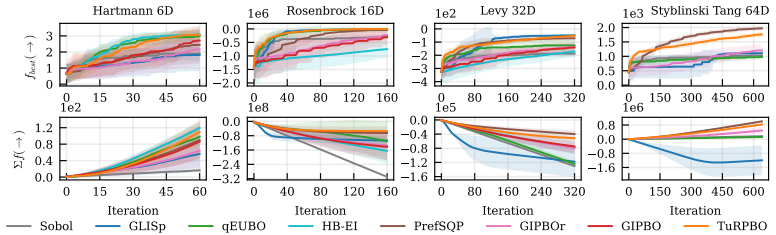
Summary. The manuscript proposes local preferential Bayesian optimization (PBO) methods that adapt trust-region and derivative-informed local search from standard BO to the pairwise preference setting. The derivative-informed variant extracts gradients and Hessians from a Laplace approximation to the non-Gaussian GP posterior induced by probit or logistic preference likelihoods. Benchmarks on GP sample paths, standard test functions, and policy-search tasks are reported to show that the local methods outperform global PBO baselines and substantially reduce cumulative regret, especially in high-dimensional landscapes with steep optima.
Significance. If the performance claims are robust, the work would address a recognized scalability barrier in PBO by importing local-search machinery that has proven useful in high-dimensional BO. The multi-domain benchmark suite (synthetic GPs, analytic functions, policy search) supplies a reasonable test of generality. No machine-checked proofs or parameter-free derivations are present, but the explicit transfer of trust-region and derivative-informed ideas is a clear methodological contribution.
major comments (2)
- [Derivative-informed local search (abstract and methods description)] The derivative-informed local search and trust-region adaptation rely on first- and second-order information extracted from the Laplace-approximated posterior. Because the preference likelihood renders the posterior non-Gaussian, the quadratic fit is known to degrade under sparse data or sharp modes—precisely the high-dimensional steep-optima regime highlighted in the central claim. No diagnostic (e.g., comparison to MCMC or predictive checks on the approximated gradients) is supplied to confirm that the extracted derivatives remain reliable enough to ground the reported regret reductions.
- [Benchmark results (abstract)] The benchmark claim that local PBO methods “substantially reduce cumulative regret” relative to global baselines rests on the assumption that the Laplace-based local acquisition and trust-region updates function as intended. If the approximation error is material, the observed gains could be artifacts of the particular benchmark instances rather than a general property of the local formulation.
minor comments (2)
- The abstract does not specify the exact form of the pairwise likelihood (probit vs. logistic) or the number of preference queries per iteration; these details affect both the Laplace approximation and the interpretation of the regret curves.
- Notation for the local acquisition function and trust-region radius update is introduced without an explicit equation reference, making it difficult to verify how the Laplace derivatives enter the update rules.
Simulated Author's Rebuttal
We appreciate the referee's detailed feedback, which highlights important considerations regarding the Laplace approximation in our local PBO methods. We respond to each major comment below and indicate planned revisions to strengthen the manuscript.
read point-by-point responses
-
Referee: [Derivative-informed local search (abstract and methods description)] The derivative-informed local search and trust-region adaptation rely on first- and second-order information extracted from the Laplace-approximated posterior. Because the preference likelihood renders the posterior non-Gaussian, the quadratic fit is known to degrade under sparse data or sharp modes—precisely the high-dimensional steep-optima regime highlighted in the central claim. No diagnostic (e.g., comparison to MCMC or predictive checks on the approximated gradients) is supplied to confirm that the extracted derivatives remain reliable enough to ground the reported regret reductions.
Authors: We acknowledge that the Laplace approximation to the non-Gaussian posterior can have limitations, particularly in regimes with sparse data or sharp modes. While this approximation is commonly used in the PBO literature for its computational efficiency, we agree that additional validation would strengthen the claims. In the revised manuscript, we will include a new subsection providing diagnostics, such as comparisons of Laplace-approximated gradients against MCMC samples on selected benchmark instances, to confirm the reliability of the extracted derivatives in the high-dimensional settings considered. revision: yes
-
Referee: [Benchmark results (abstract)] The benchmark claim that local PBO methods “substantially reduce cumulative regret” relative to global baselines rests on the assumption that the Laplace-based local acquisition and trust-region updates function as intended. If the approximation error is material, the observed gains could be artifacts of the particular benchmark instances rather than a general property of the local formulation.
Authors: The referee correctly notes that the performance improvements rely on the effectiveness of the Laplace-based methods. Our multi-domain benchmarks, including GP sample paths, analytic functions, and policy search tasks, show consistent reductions in cumulative regret, which we believe supports the general applicability. To address the concern about potential artifacts, we will expand the discussion in the revised version to include analysis of the approximation quality and its impact on the results, and add the diagnostics mentioned above. revision: yes
Circularity Check
No circularity: methods adapt standard GP approximations without definitional reduction
full rationale
The paper's core contribution is the adaptation of trust-region and derivative-informed local search from standard BO to the preferential setting via Laplace approximation of the non-Gaussian posterior induced by pairwise preference likelihoods. No equations or claims in the abstract reduce a reported prediction or regret reduction to a fitted parameter by construction, nor do they rely on self-citations for uniqueness or load-bearing premises. Benchmarks on GP paths, standard functions, and policy search are presented as independent empirical evidence rather than tautological outputs. The derivation chain remains self-contained against external benchmarks.
Axiom & Free-Parameter Ledger
read the original abstract
Bayesian optimization (BO) is a popular and effective approach for tuning expensive, noisy experiments, but requires the formulation of an explicit objective function. Preferential BO (PBO) removes this requirement by learning from pairwise human feedback, yet existing methods struggle to efficiently optimize beyond low- and medium-dimensional problems due to their global search approaches. We address this limitation by developing a family of local PBO methods that transfer key ideas from high-dimensional BO to the preferential setting. In particular, we introduce local PBO methods which adapt trust-region and derivative-informed local search to pairwise preference feedback, where the latter exploits first- and second-order derivatives of the Laplace-approximated GP posterior. Our benchmark on GP sample paths, standard optimization benchmark functions, and policy-search tasks shows that local PBO methods are especially effective in high-dimensional and complex landscapes with steep optima. Compared with global preference-based baselines, they can substantially reduce cumulative regret, making them particularly useful for real-world preference-based optimization tasks such as policy search.
Figures






Reference graph
Works this paper leans on
-
[1]
Raul Astudillo, Zhiyuan Lin, Eytan Bakshy, and Peter I. Frazier. qEUBO: A decision-theoretic acquisition function for preferential Bayesian optimization. InInternational Conference on Artificial Intelligence and Statistics (AISTATS), 25-27 April 2023, Palau de Congressos, Valencia, Spain, volume 206 ofProceedings of Machine Learning Research, pages 1093–1...
2023
-
[2]
Jiang, Samuel Daulton, Benjamin Letham, Andrew Gordon Wilson, and Eytan Bakshy
Maximilian Balandat, Brian Karrer, Daniel R. Jiang, Samuel Daulton, Benjamin Letham, Andrew Gordon Wilson, and Eytan Bakshy. BoTorch: A framework for efficient Monte-Carlo Bayesian optimization. InAdvances in Neural Information Processing Systems (NeurIPS) 33, 2020
2020
-
[3]
Global optimization based on active preference learning with radial basis functions.Machine Learning, 110(2):417–448, 2021
Alberto Bemporad and Dario Piga. Global optimization based on active preference learning with radial basis functions.Machine Learning, 110(2):417–448, 2021
2021
-
[4]
Preferential Bayesian optimisation with skew Gaussian processes
Alessio Benavoli, Dario Azzimonti, and Dario Piga. Preferential Bayesian optimisation with skew Gaussian processes. InProceedings of the Genetic and Evolutionary Computation Conference Companion, pages 1842–1850, 2021
2021
-
[5]
Eric Brochu, Vlad M Cora, and Nando De Freitas. A tutorial on Bayesian optimization of expensive cost functions, with application to active user modeling and hierarchical reinforcement learning.arXiv preprint arXiv:1012.2599, 2010
work page internal anchor Pith review Pith/arXiv arXiv 2010
-
[6]
BayeSQP: Bayesian optimization through sequential quadratic programming
Paul Brunzema and Sebastian Trimpe. BayeSQP: Bayesian optimization through sequential quadratic programming. InAdvances in Neural Information Processing Systems (NeurIPS), 2025
2025
-
[7]
Preference learning with Gaussian processes
Wei Chu and Zoubin Ghahramani. Preference learning with Gaussian processes. InProceedings of the 22nd International Conference on Machine Learning (ICML), pages 137–144, 2005
2005
-
[8]
Human-in-the-loop controller tuning using preferential Bayesian optimization.IFAC-PapersOnLine, 58(14):13–18, 2024
Joao PL Coutinho, Ivan Castillo, and Marco S Reis. Human-in-the-loop controller tuning using preferential Bayesian optimization.IFAC-PapersOnLine, 58(14):13–18, 2024
2024
-
[9]
Stefano De Blasi, Maryam Bahrami, Elmar Engels, and Alexander Gepperth. Safe contextual Bayesian optimization integrated in industrial control for self-learning machines.Journal of Intelligent Manufacturing, 35:885–903, 2024. doi: 10.1007/s10845-023-02087-3
-
[10]
Savaresi, Sebastian Trimpe, and Simone Formentin
Giacomo Delcaro, Johanna Menn, David Stenger, Sergio M. Savaresi, Sebastian Trimpe, and Simone Formentin. Twin-in-the-loop observer tuning via gradient-information Bayesian optimization with line search.Control Engineering Practice, 172:106891, 2026. ISSN 0967-
2026
-
[11]
doi: 10.1016/j.conengprac.2026.106891
-
[12]
Sequential Preference-Based Optimization
Ian Dewancker, Jakob Bauer, and Michael McCourt. Sequential preference-based optimization. arXiv preprint arXiv:1801.02788, 2018
work page internal anchor Pith review Pith/arXiv arXiv 2018
-
[13]
Consecutive preferential Bayesian optimization, November 2025
Aras Erarslan, Carlos Sevilla Salcedo, Ville Tanskanen, Anni Nisov, Eero Päiväkumpu, Heikki Aisala, Kaisu Honkapää, Arto Klami, and Petrus Mikkola. Consecutive preferential Bayesian optimization, November 2025. arXiv:2511.05163 [cs]
-
[14]
Scalable constrained Bayesian optimization
David Eriksson and Matthias Poloczek. Scalable constrained Bayesian optimization. In International Conference on Artificial Intelligence and Statistics (AISTATS), 2021
2021
-
[15]
Scalable global optimization via local Bayesian optimization.Advances in Neural Information Processing Systems (NeurIPS), 32, 2019
David Eriksson, Michael Pearce, Jacob Gardner, Ryan D Turner, and Matthias Poloczek. Scalable global optimization via local Bayesian optimization.Advances in Neural Information Processing Systems (NeurIPS), 32, 2019
2019
-
[16]
Minimizing UCB: a better local search strategy in local Bayesian optimization
Zheyi Fan, Wenyu Wang, Szu H Ng, and Qingpei Hu. Minimizing UCB: a better local search strategy in local Bayesian optimization. InAdvances in Neural Information Processing Systems (NeurIPS), 2024. 10
2024
-
[17]
Cambridge University Press, 2023
Roman Garnett.Bayesian optimization. Cambridge University Press, 2023
2023
-
[18]
Preferential Bayesian optimization
Javier González, Zhenwen Dai, Andreas Damianou, and Neil D Lawrence. Preferential Bayesian optimization. InInternational Conference on Machine Learning (ICML), pages 1282–1291. PMLR, 2017
2017
-
[19]
Simulation-aided policy tuning for black-box robot learning.IEEE Transactions on Robotics (TRO), 2025
Shiming He, Alexander von Rohr, Dominik Baumann, Ji Xiang, and Sebastian Trimpe. Simulation-aided policy tuning for black-box robot learning.IEEE Transactions on Robotics (TRO), 2025
2025
-
[20]
Event-triggered safe Bayesian optimization on quadcopters
Antonia Holzapfel, Paul Brunzema, and Sebastian Trimpe. Event-triggered safe Bayesian optimization on quadcopters. In6th Annual Learning for Dynamics & Control Conference, pages 1033–1045. PMLR, 2024
2024
-
[21]
Schoellig, and Sebastian Trimpe
Henrik Hose, Paul Brunzema, Alexander von Rohr, Alexander Gräfe, Angela P. Schoellig, and Sebastian Trimpe. Fine-tuning of neural network approximate MPC without retraining via Bayesian optimization.International Conference on Robot Intelligence Technologies and Applications (RiTA), 2025
2025
-
[22]
User preference meets pareto-optimality in multi-objective Bayesian optimization
Joshua Hang Sai Ip, Ankush Chakrabarty, Ali Mesbah, and Diego Romeres. User preference meets pareto-optimality in multi-objective Bayesian optimization. InProceedings of the AAAI Conference on Artificial Intelligence, volume 39, pages 20246–20254, 2025
2025
-
[23]
Adaptive and safe Bayesian optimization in high dimensions via one-dimensional subspaces
Johannes Kirschner, Mojmir Mutny, Nicole Hiller, Rasmus Ischebeck, and Andreas Krause. Adaptive and safe Bayesian optimization in high dimensions via one-dimensional subspaces. In International Conference on Machine Learning (ICML), pages 3429–3438. PMLR, 2019
2019
-
[24]
High-dimensional slider-based preferential Bayesian opti- mization with mixed local and global acquisition strategies.IEEE Access, 2024
Satoshi Koide and Ayano Okoso. High-dimensional slider-based preferential Bayesian opti- mization with mixed local and global acquisition strategies.IEEE Access, 2024
2024
-
[25]
Preference exploration for efficient Bayesian optimization with multiple outcomes
Zhiyuan Jerry Lin, Raul Astudillo, Peter Frazier, and Eytan Bakshy. Preference exploration for efficient Bayesian optimization with multiple outcomes. InInternational Conference on Artificial Intelligence and Statistics (AISTATS), pages 4235–4258. PMLR, 2022
2022
-
[26]
Duncan Luce
R. Duncan Luce. Semiorders and a theory of utility discrimination.Econometrica, 24(2): 178–191, 1956
1956
-
[27]
Simple random search of static linear policies is competitive for reinforcement learning
Horia Mania, Aurelia Guy, and Benjamin Recht. Simple random search of static linear policies is competitive for reinforcement learning. In S. Bengio, H. Wallach, H. Larochelle, K. Grauman, N. Cesa-Bianchi, and R. Garnett, editors,Advances in Neural Information Processing Systems (NeurIPS), volume 31. Curran Associates, Inc., 2018
2018
-
[28]
Choosing a point from the surface of a sphere.The Annals of Mathematical Statistics, pages 645–646, 1972
George Marsaglia. Choosing a point from the surface of a sphere.The Annals of Mathematical Statistics, pages 645–646, 1972
1972
-
[29]
doi:10.1109/CDC56724.2024.10886720 , booktitle =
Johanna Menn, Pietro Pelizzari, Michael Fleps-Dezasse, and Sebastian Trimpe. Lipschitz safe Bayesian optimization for automotive control. In2024 IEEE 63rd Conference on Decision and Control (CDC), pages 3782–3788, 2024. doi: 10.1109/CDC56724.2024.10886680
-
[30]
Johanna Menn, David Stenger, and Sebastian Trimpe. Preferential Bayesian optimization with crash feedback.IEEE Robotics and Automation Letters, 11(4):4299–4306, 2026. doi: 10.1109/LRA.2026.3665446
-
[31]
Projective preferential Bayesian optimization
Petrus Mikkola, Milica Todorovi ´c, Jari Järvi, Patrick Rinke, and Samuel Kaski. Projective preferential Bayesian optimization. InInternational Conference on Machine Learning (ICML), pages 6884–6892. PMLR, 2020
2020
-
[32]
Local policy search with Bayesian optimization.Advances in Neural Information Processing Systems (NeurIPS), 34:20708–20720, 2021
Sarah Müller, Alexander von Rohr, and Sebastian Trimpe. Local policy search with Bayesian optimization.Advances in Neural Information Processing Systems (NeurIPS), 34:20708–20720, 2021
2021
-
[33]
Data- efficient autotuning with Bayesian optimization: An industrial control study.IEEE Transactions on Control Systems Technology, 28(3):730–740, 2019
Matthias Neumann-Brosig, Alonso Marco, Dieter Schwarzmann, and Sebastian Trimpe. Data- efficient autotuning with Bayesian optimization: An industrial control study.IEEE Transactions on Control Systems Technology, 28(3):730–740, 2019
2019
-
[34]
Local Bayesian optimization via maximizing probability of descent
Quan Nguyen, Kaiwen Wu, Jacob Gardner, and Roman Garnett. Local Bayesian optimization via maximizing probability of descent. InAdvances in Neural Information Processing Systems (NeurIPS), volume 35, 2022
2022
-
[35]
Top-k ranking Bayesian optimization
Quoc Phong Nguyen, Sebastian Tay, Bryan Kian Hsiang Low, and Patrick Jaillet. Top-k ranking Bayesian optimization. InProceedings of the AAAI Conference on Artificial Intelligence, volume 35, pages 9135–9143, 2021. 11
2021
-
[36]
Carl Edward Rasmussen and Christopher K. I. Williams.Gaussian processes for machine learning. Adaptive computation and machine learning. MIT Press, 2006. ISBN 026218253X
2006
-
[37]
Towards practical preferential Bayesian optimization with skew Gaussian processes
Shion Takeno, Masahiro Nomura, and Masayuki Karasuyama. Towards practical preferential Bayesian optimization with skew Gaussian processes. InInternational Conference on Machine Learning (ICML), pages 33516–33533. PMLR, 2023
2023
-
[38]
Wei-Ting Tang and Joel A. Paulson. CAGES: Cost-aware gradient entropy search for efficient local multi-fidelity Bayesian optimization. In2024 IEEE 63rd Conference on Decision and Control (CDC), pages 1547–1552, December 2024. doi: 10.1109/CDC56724.2024.10886516. ISSN: 2576-2370
-
[39]
NeST-BO: Fast local Bayesian optimization via Newton-step targeting of gradient and Hessian information
Wei-Ting Tang, Akshay Kudva, and Joel Paulson. NeST-BO: Fast local Bayesian optimization via Newton-step targeting of gradient and Hessian information. InThe 29th International Conference on Artificial Intelligence and Statistics (AISTATS), 2026
2026
-
[40]
In: 2020 IEEE/RSJ International Conference on Intelligent Robots and Systems (IROS)
Maegan Tucker, Myra Cheng, Ellen Novoseller, Richard Cheng, Yisong Yue, Joel W. Burdick, and Aaron D. Ames. Human preference-based learning for high-dimensional optimization of exoskeleton walking gaits. In2020 IEEE/RSJ International Conference on Intelligent Robots and Systems (IROS), pages 3423–3430, 2020. doi: 10.1109/IROS45743.2020.9341416
-
[41]
Maegan Tucker, Kejun Li, Yisong Yue, and Aaron D Ames. Polar: Preference optimization and learning algorithms for robotics.arXiv preprint arXiv:2208.04404, 2022
-
[42]
Local Bayesian optimization for controller tuning with crash constraints.at-Automatisierungstechnik, 2024
Alexander von Rohr, David Stenger, Dominik Scheurenberg, and Sebastian Trimpe. Local Bayesian optimization for controller tuning with crash constraints.at-Automatisierungstechnik, 2024
2024
-
[43]
Individual comparisons by ranking methods.Biometrics Bulletin, 1(6):80–83,
Frank Wilcoxon. Individual comparisons by ranking methods.Biometrics Bulletin, 1(6):80–83,
-
[44]
The behavior and convergence of local Bayesian optimization.Advances in Neural Information Processing Systems (NeurIPS), 36:73497–73523, 2023
Kaiwen Wu, Kyurae Kim, Roman Garnett, and Jacob Gardner. The behavior and convergence of local Bayesian optimization.Advances in Neural Information Processing Systems (NeurIPS), 36:73497–73523, 2023
2023
-
[45]
Principled preferential Bayesian optimization
Wenjie Xu, Wenbin Wang, Yuning Jiang, Bratislav Svetozarevic, and Colin Jones. Principled preferential Bayesian optimization. InInternational Conference on Machine Learning (ICML), pages 55305–55336. PMLR, 2024
2024
-
[46]
Improving sample efficiency of high dimensional Bayesian optimization with MCMC
Zeji Yi, Yunyue Wei, Chu Xin Cheng, Kaibo He, and Yanan Sui. Improving sample efficiency of high dimensional Bayesian optimization with MCMC. In6th Annual Learning for Dynamics & Control Conference, pages 813–824. PMLR, 2024
2024
-
[47]
High-dimensional dueling optimization with preference embedding
Yangwenhui Zhang, Hong Qian, Xiang Shu, and Aimin Zhou. High-dimensional dueling optimization with preference embedding. InProceedings of the AAAI Conference on Artificial Intelligence, volume 37, pages 11280–11288, 2023
2023
-
[48]
experiment-specific
Max Gero Zimmermann, Johanna Menn, Christopher Ullmann, Viktor Glushych, Thomas Schopphoven, Wilhelm Meiners, Sebastian Trimpe, and Carlo Holly. Bayesian optimization for extreme high-speed laser material deposition.Journal of Laser Applications, 37(4), 2025. 12 A Broader Societal Impacts of the Developed Local PBO Algorithms Our paper proposes three loca...
2025
discussion (0)
Sign in with ORCID, Apple, or X to comment. Anyone can read and Pith papers without signing in.