Mergers Matter: Gravothermal Collapse in Dwarf Halos with Self-Interacting Dark Matter
Pith reviewed 2026-06-28 13:51 UTC · model grok-4.3
The pith
In self-interacting dark matter, dwarf halos with quiet merger histories undergo core collapse while those with active mergers do not.
A machine-rendered reading of the paper's core claim, the machinery that carries it, and where it could break.
Core claim
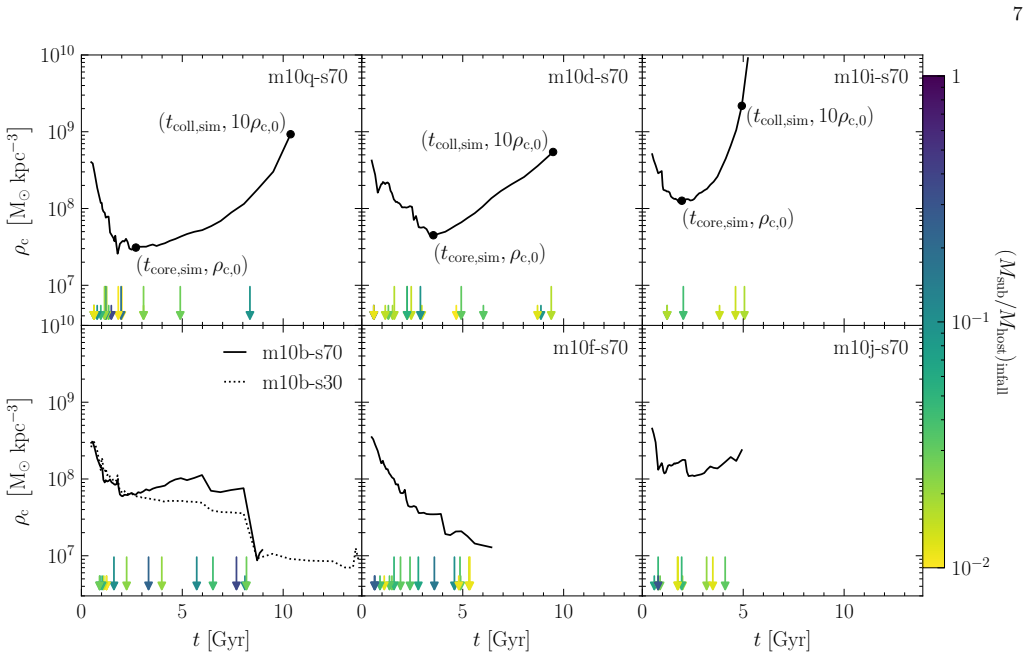
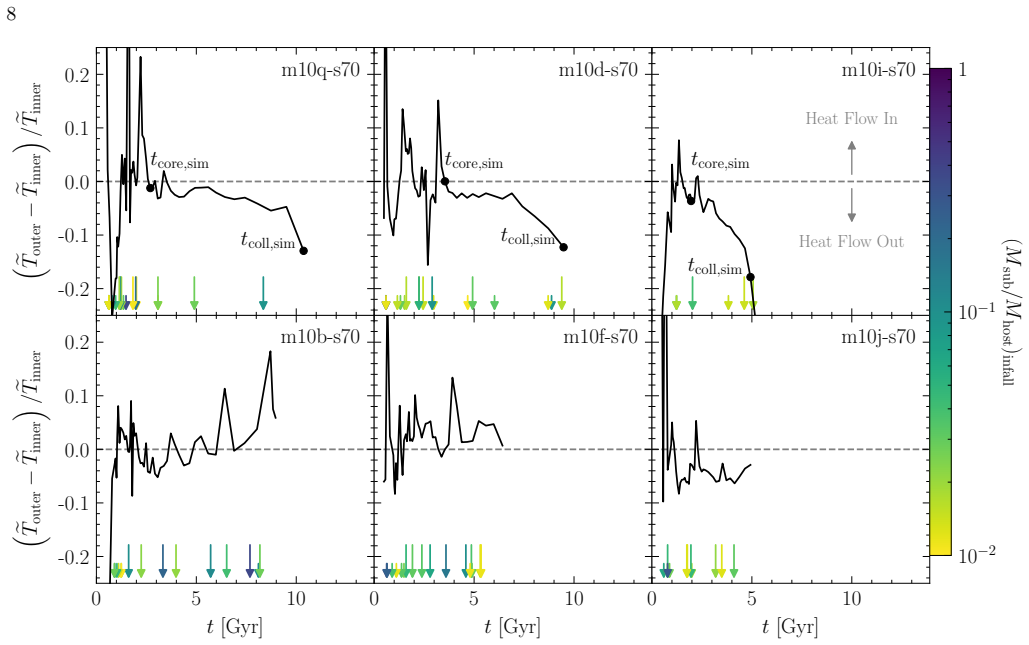
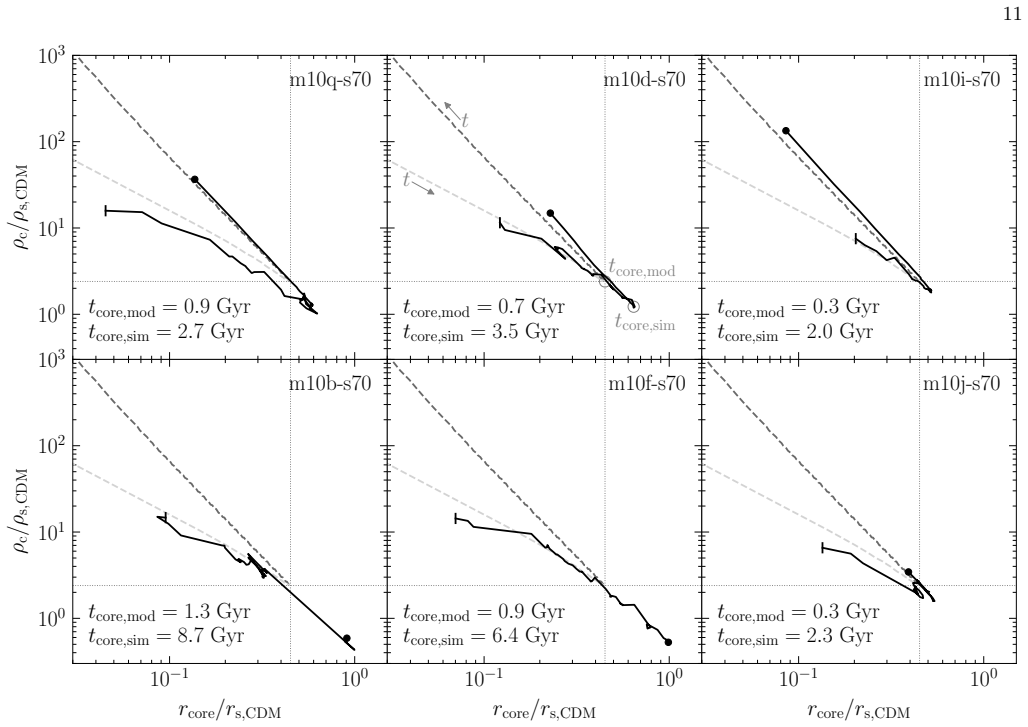
Three of the six simulated halos with the most quiescent merger histories show clear signs of core collapse. Halos with sustained mergers do not collapse, and merger-induced heat transport drives two non-collapsing halos to central densities well below the predictions of the gravothermal fluid model. Merger histories are thus essential for understanding central density distributions of dwarf galaxy halos in SIDM.
What carries the argument
The injection of orbital kinetic energy by mergers into the halo, which alters the heat transport and gravothermal evolution of the core.
If this is right
- Halos with quiescent merger histories can experience gravothermal core collapse.
- Halos with sustained mergers avoid core collapse.
- Merger heating can produce central densities below those expected from the gravothermal fluid model alone.
- This mechanism may produce dark-matter-deficient galaxies.
- The diversity of rotation curves in dwarf galaxies can exceed what is predicted from halo concentration variations alone.
Where Pith is reading between the lines
- Observations of dwarf galaxy merger histories could be used to predict which ones are likely to have collapsed cores in SIDM.
- The results suggest that SIDM models need to incorporate full merger trees for accurate predictions of dwarf galaxy properties.
- This heat injection process might interact with baryonic physics in ways that further modify central densities.
- Similar effects could appear in other velocity-dependent SIDM scenarios with large low-velocity cross sections.
Load-bearing premise
The six zoom-in halos capture a representative range of assembly histories for dwarf halos at this mass and cross section.
What would settle it
A simulation or observation of a dwarf halo with a quiescent merger history that fails to show core collapse, or an active-merger halo that does collapse, at the same cross section.
Figures
read the original abstract
Self-Interacting Dark Matter (SIDM) models with large cross sections at relative velocities below $\sim100\,{\rm km \, s}^{-1}$ can be tested with dwarf galaxy observations. We analyze six dark-matter-only zoom-in $\sim10^{10}\,{\rm M}_\odot$ halos with diverse assembly histories, adopting a cross section over mass of $\sigma/m = 70\,cm^2 \, g^{-1}$. We find that mergers inject orbital kinetic energy into the halo, altering the heat transport and the gravothermal evolution of the core. Three of the six halos -- those with the most quiescent merger histories -- show clear signs of core collapse in these simulations. Halos with sustained mergers do not collapse. Furthermore, merger-induced heat transport drives two non-collapsing halos to central densities well below the predictions of the gravothermal fluid model. These findings suggest a novel mechanism for producing dark-matter-deficient galaxies and expanding the diversity of rotation curves beyond what halo concentration alone predicts. Merger histories are thus essential for understanding central density distributions of dwarf galaxy halos in SIDM.
Editorial analysis
A structured set of objections, weighed in public.
Referee Report
Summary. The manuscript reports N-body simulations of six ~10^10 M_⊙ dark-matter-only zoom-in halos in SIDM with fixed σ/m = 70 cm² g⁻¹. It claims that the three halos with the most quiescent merger histories undergo gravothermal core collapse, while halos with sustained mergers do not collapse and that merger-induced heat transport drives two non-collapsing halos to central densities below the predictions of an independent gravothermal fluid model. The work concludes that merger histories are essential for understanding central density distributions in SIDM dwarf halos.
Significance. If the correlation between merger history and gravothermal outcome holds under controlled conditions, the result would establish mergers as a load-bearing driver of core evolution in SIDM, offering a mechanism for dark-matter-deficient galaxies and greater diversity in rotation curves than concentration variations alone predict. The direct N-body comparison to an independent fluid model is a methodological strength.
major comments (3)
- [Abstract and simulation results] The central claim that merger histories causally determine whether core collapse occurs rests on a sample of only six halos whose assembly histories are described as 'diverse but limited.' No controls are reported that hold concentration, spin, or formation time fixed while varying only merger rate, leaving open the possibility that the three collapsing halos differ systematically in initial conditions that independently affect gravothermal evolution.
- [Methods and simulation setup] No numerical resolution, particle number, softening length, convergence tests, or error analysis are supplied for the N-body runs. Because the claims involve both qualitative classification of core collapse and quantitative offsets from the fluid-model central densities, these details are required to evaluate whether the reported differences are numerically robust.
- [Comparison to gravothermal fluid model] The gravothermal fluid-model comparison is performed on the identical set of six halos. Any systematic offset in central densities could therefore arise from the same uncontrolled halo-to-halo variations rather than from merger-induced heat transport specifically.
minor comments (2)
- [Abstract] The abstract states that halos show 'clear signs of core collapse' but does not define the quantitative threshold (e.g., central density evolution, core radius, or velocity dispersion profile) used for this classification.
- [Abstract] The velocity dependence of the adopted cross section is mentioned only qualitatively ('large cross sections at relative velocities below ~100 km s⁻¹'); a precise functional form or reference would aid reproducibility.
Simulated Author's Rebuttal
We thank the referee for their constructive and detailed report. We respond point-by-point to the major comments below.
read point-by-point responses
-
Referee: [Abstract and simulation results] The central claim that merger histories causally determine whether core collapse occurs rests on a sample of only six halos whose assembly histories are described as 'diverse but limited.' No controls are reported that hold concentration, spin, or formation time fixed while varying only merger rate, leaving open the possibility that the three collapsing halos differ systematically in initial conditions that independently affect gravothermal evolution.
Authors: We agree that the sample of six halos is limited and that we have not performed controlled experiments in which concentration, spin, and formation time are held fixed while varying only merger rate. The halos were chosen to share similar masses but to exhibit diverse assembly histories; their individual properties (including concentration and spin) are reported in the manuscript. The observed correlation between quiescent merger histories and core collapse is therefore suggestive rather than a demonstration of strict causality. We will revise the discussion section to explicitly acknowledge this limitation and to note that future controlled simulations would be needed to isolate the merger-rate effect. revision: partial
-
Referee: [Methods and simulation setup] No numerical resolution, particle number, softening length, convergence tests, or error analysis are supplied for the N-body runs. Because the claims involve both qualitative classification of core collapse and quantitative offsets from the fluid-model central densities, these details are required to evaluate whether the reported differences are numerically robust.
Authors: We thank the referee for identifying this omission. We will add a new subsection to the Methods section that reports the particle number, gravitational softening length, force and time-stepping criteria, and any convergence or resolution tests that were performed. This addition will allow readers to assess the numerical robustness of both the qualitative core-collapse classifications and the quantitative density offsets. revision: yes
-
Referee: [Comparison to gravothermal fluid model] The gravothermal fluid-model comparison is performed on the identical set of six halos. Any systematic offset in central densities could therefore arise from the same uncontrolled halo-to-halo variations rather than from merger-induced heat transport specifically.
Authors: The fluid model is evolved independently for each halo using its own initial conditions and the same cross section. The central-density offsets we report are correlated with the presence of sustained mergers. Nevertheless, because the comparison uses the same set of halos, we cannot rule out contributions from other uncontrolled variations. We will revise the relevant section to state that the offsets are associated with merger activity but that additional controlled comparisons would be required to attribute them exclusively to merger-induced heat transport. revision: partial
- Performing a new suite of controlled N-body simulations that isolate merger rate while holding concentration, spin, and formation time fixed is beyond the scope and resources of the present study.
Circularity Check
No circularity: results from direct simulations compared to independent model
full rationale
The paper reports outcomes from N-body zoom-in simulations of six halos at fixed σ/m = 70 cm² g⁻¹, observing core collapse in three quiescent-merger cases and lower central densities than the gravothermal fluid model in two others. These are direct numerical results, not quantities derived by fitting parameters to the same data or by equations that reduce to the inputs by construction. No self-citation chain, ansatz smuggling, or uniqueness theorem is invoked to justify the central claims; the fluid-model comparison is presented as an external benchmark. The derivation chain is therefore self-contained against external simulation outputs.
Axiom & Free-Parameter Ledger
free parameters (1)
- cross section over mass =
70 cm^2 g^{-1}
axioms (2)
- domain assumption Dark-matter-only zoom-in simulations capture the relevant merger-driven heat transport and core evolution.
- domain assumption The gravothermal fluid model provides an accurate baseline prediction in the absence of mergers.
Forward citations
Cited by 1 Pith paper
-
Self-interacting dark matter promotes bar formation in disk galaxies
SIDM halos accelerate bar formation and growth in disk galaxies through enhanced angular momentum exchange, independent of core formation.
Reference graph
Works this paper leans on
-
[1]
Ade, P. A. R., Aghanim, N., Armitage-Caplan, C., et al. 2014, Astronomy &; Astrophysics, 571, A16, doi: 10.1051/0004-6361/201321591
-
[2]
Adhikari, S., et al. 2025, Rev. Mod. Phys., 97, 045004, doi: 10.1103/m2vm-59y3
-
[3]
Arora, A., Sanderson, R. E., Chakrabarti, S., et al. 2024, The Astrophysical Journal, 974, 223, doi: 10.3847/1538-4357/ad71c4 Astropy Collaboration, Robitaille, T. P., Tollerud, E. J., et al. 2013, A&A, 558, A33, doi: 10.1051/0004-6361/201322068
-
[4]
Balberg, S., & Shapiro, S. L. 2002, Physical Review Letters, 88, doi: 10.1103/physrevlett.88.101301
-
[5]
Balberg, S., Shapiro, S. L., & Inagaki, S. 2002, Astrophys. J., 568, 475, doi: 10.1086/339038
-
[6]
Behroozi, P. S., Wechsler, R. H., & Wu, H.-Y. 2013a, ApJ, 762, 109, doi: 10.1088/0004-637X/762/2/109
work page internal anchor Pith review doi:10.1088/0004-637x/762/2/109
-
[7]
Behroozi, P. S., Wechsler, R. H., Wu, H.-Y., et al. 2013b, ApJ, 763, 18, doi: 10.1088/0004-637X/763/1/18
work page internal anchor Pith review doi:10.1088/0004-637x/763/1/18
-
[8]
Bullock, J. S., & Boylan-Kolchin, M. 2017, Ann. Rev. Astron. Astrophys., 55, 343, doi: 10.1146/annurev-astro-091916-055313
-
[9]
1995, The Astrophysical Journal Letters, 447, L25
Burkert, A. 1995, The Astrophysical Journal Letters, 447, L25
1995
-
[10]
2000, The Astrophysical Journal Letters, 534, L143
Burkert, A. 2000, The Astrophysical Journal Letters, 534, L143
2000
-
[11]
2002, The Astrophysical Journal, 581, 777–793, doi: 10.1086/344259
Colin, P., Avila-Reese, V., Valenzuela, O., & Firmani, C. 2002, The Astrophysical Journal, 581, 777–793, doi: 10.1086/344259
-
[13]
Correa, C. A. 2021b, Mon. Not. Roy. Astron. Soc., 503, 920, doi: 10.1093/mnras/stab506
-
[14]
A., Schaller, M., Ploeckinger, S., et al
Correa, C. A., Schaller, M., Ploeckinger, S., et al. 2022, Monthly Notices of the Royal Astronomical Society, 517, 3045–3063, doi: 10.1093/mnras/stac2830
-
[15]
Dave, R., Spergel, D. N., Steinhardt, P. J., & Wandelt, B. D. 2001, The Astrophysical Journal, 547, 574–589, doi: 10.1086/318417
-
[16]
2025, arXiv, doi: 10.48550/arXiv.2512.15869
Despali, G., Giocoli, C., Moscardini, L., et al. 2025, arXiv, doi: 10.48550/arXiv.2512.15869
-
[17]
2018, The Astrophysical Journal Supplement Series, 239, 35, doi: 10.3847/1538-4365/aaee8c
Diemer, B. 2018, The Astrophysical Journal Supplement Series, 239, 35, doi: 10.3847/1538-4365/aaee8c
-
[18]
Elbert, O. D., Bullock, J. S., Garrison-Kimmel, S., et al. 2015, MNRAS, 453, 29, doi: 10.1093/mnras/stv1470
-
[19]
Elbert, O. D., Bullock, J. S., Kaplinghat, M., et al. 2018, ”The Astrophysical Journal”, 853, 109, doi: 10.3847/1538-4357/aa9710
-
[20]
Engelhardt, A., Munshi, F., Peter, A. H. G., et al. 2026, arXiv, doi: 10.48550/arXiv.2601.23264
work page internal anchor Pith review Pith/arXiv arXiv doi:10.48550/arxiv.2601.23264 2026
-
[21]
Essig, R., Mcdermott, S. D., Yu, H.-B., & Zhong, Y.-M. 2019, Phys. Rev. Lett., 123, 121102, doi: 10.1103/PhysRevLett.123.121102
-
[22]
L., Kaplinghat, M., & Yu, H.-B
Feng, J. L., Kaplinghat, M., & Yu, H.-B. 2010, Physical Review Letters, 104, doi: 10.1103/physrevlett.104.151301
-
[23]
2000, MNRAS, 314, 338, doi:10.1046/j.1365-8711.2000.03350.x
Hernandez, X. 2000, Monthly Notices of the Royal Astronomical Society, 315, L29–L32, doi: 10.1046/j.1365-8711.2000.03555.x
-
[24]
Fischer, M. S., Dolag, K., & Yu, H.-B. 2024a, Astronomy &; Astrophysics, 689, A300, doi: 10.1051/0004-6361/202449849
-
[25]
S., Kasselmann, L., Br¨ uggen, M., et al
Fischer, M. S., Kasselmann, L., Br¨ uggen, M., et al. 2024b, Monthly Notices of the Royal Astronomical Society, 529, 2327–2348, doi: 10.1093/mnras/stae699
-
[26]
Fischer, M. S., & Yu, H.-B. 2026, arXiv, doi: 10.48550/arXiv.2603.04508
-
[27]
S., Wiertel, M., Arido, C., et al
Fischer, M. S., Wiertel, M., Arido, C., et al. 2026, arXiv, doi: 10.48550/arXiv.2603.10107
-
[28]
Fitts, A., et al. 2017, Mon. Not. Roy. Astron. Soc., 471, 3547, doi: 10.1093/mnras/stx1757
-
[29]
2019, Monthly Notices of the Royal Astronomical Society, 490, 962–977, doi: 10.1093/mnras/stz2613
Fitts, A., Boylan-Kolchin, M., Bozek, B., et al. 2019, Monthly Notices of the Royal Astronomical Society, 490, 962–977, doi: 10.1093/mnras/stz2613
-
[30]
K., Kaplinghat, M., Outmezguine, N
Gad-Nasr, S., Boddy, K. K., Kaplinghat, M., Outmezguine, N. J., & Sagunski, L. 2023, https://arxiv.org/abs/2312.09296
arXiv 2023
-
[31]
Gurian, J., & May, S. 2025, Physical Review Letters, 135, doi: 10.1103/2ycz-3fvv
-
[32]
A., Despali, G., O’Neil, S., et al
Gutcke, T. A., Despali, G., O’Neil, S., et al. 2025, https://arxiv.org/abs/2510.05258
arXiv 2025
-
[33]
1978, Progress of Theoretical Physics, 60, 393, doi: 10.1143/PTP.60.393
Hachisu, I., Nakada, Y., Nomoto, K., & Sugimoto, D. 1978, Progress of Theoretical Physics, 60, 393, doi: 10.1143/PTP.60.393
-
[34]
Harris, C. R., Millman, K. J., van der Walt, S. J., et al. 2020, Nature, 585, 357, doi: 10.1038/s41586-020-2649-2
-
[35]
Hayashi, K., Chiba, M., & Ishiyama, T. 2020, Astrophys. J., 904, 45, doi: 10.3847/1538-4357/abbe0a
-
[36]
Hopkins, P. F. 2015, Monthly Notices of the Royal Astronomical Society, 450, 53, doi: 10.1093/mnras/stv195
-
[37]
Hopkins, P. F., Kereˇ s, D., O˜ norbe, J., et al. 2014, Monthly Notices of the Royal Astronomical Society, 445, 581–603, doi: 10.1093/mnras/stu1738
work page internal anchor Pith review doi:10.1093/mnras/stu1738 2014
-
[38]
Hopkins, P. F., Wetzel, A., Kereˇ s, D., et al. 2018, Monthly Notices of the Royal Astronomical Society, 480, 800–863, doi: 10.1093/mnras/sty1690
work page internal anchor Pith review doi:10.1093/mnras/sty1690 2018
-
[39]
Hunter, J. D. 2007, Computing in Science & Engineering, 9, 90, doi: 10.1109/MCSE.2007.55
-
[40]
Jiang, F., Benson, A., Hopkins, P. F., et al. 2023, Monthly Notices of the Royal Astronomical Society, 521, 4630–4644, doi: 10.1093/mnras/stad705
-
[41]
Kahlhoefer, F., Kaplinghat, M., Slatyer, T. R., & Wu, C.-L. 2019, JCAP, 2019, 010, doi: 10.1088/1475-7516/2019/12/010
-
[42]
2020, JCAP, 06, 027, doi: 10.1088/1475-7516/2020/06/027
Kaplinghat, M., Ren, T., & Yu, H.-B. 2020, JCAP, 06, 027, doi: 10.1088/1475-7516/2020/06/027
-
[43]
Kaplinghat, M., Tulin, S., & Yu, H.-B. 2016, Phys. Rev. Lett., 116, 041302, doi: 10.1103/PhysRevLett.116.041302
-
[44]
Kaplinghat, M., Valli, M., & Yu, H.-B. 2019, Mon. Not. Roy. Astron. Soc., 490, 231, doi: 10.1093/mnras/stz2511
-
[45]
2013, The Astrophysical Journal Supplement Series, 210, 14, doi: 10.1088/0067-0049/210/1/14
Kim, J.-h., Abel, T., Agertz, O., et al. 2013, The Astrophysical Journal Supplement Series, 210, 14, doi: 10.1088/0067-0049/210/1/14
-
[46]
Koda, J., & Shapiro, P. R. 2011, MNRAS, 415, 1125, doi: 10.1111/j.1365-2966.2011.18684.x
-
[47]
Seven-Year Wilkinson Microwave Anisotropy Probe (WMAP) Observations: Cosmological Interpretation
Komatsu, E., Smith, K. M., Dunkley, J., et al. 2011, The Astrophysical Journal Supplement Series, 192, 18, doi: 10.1088/0067-0049/192/2/18
work page internal anchor Pith review doi:10.1088/0067-0049/192/2/18 2011
-
[48]
Kong, D., Kaplinghat, M., Yu, H.-B., Fraternali, F., & Mancera Pi˜ na, P. E. 2022, The Astrophysical Journal, 936, 166, doi: 10.3847/1538-4357/ac8875 Kuzio de Naray, R., & McGaugh, S. S. 2014, The Astrophysical Journal, 782, L12, doi: 10.1088/2041-8205/782/1/l12
-
[49]
Larson, R. B. 1970, Monthly Notices of the Royal Astronomical Society, 147, 323, doi: 10.1093/mnras/147.4.323
-
[50]
Lightman, A. P., & Shapiro, S. L. 1978, Rev. Mod. Phys., 50, 437, doi: 10.1103/RevModPhys.50.437
-
[51]
R., Gonzalez-Perez, V., Bose, S., et al
Lovell, M. R., Gonzalez-Perez, V., Bose, S., et al. 2017, Mon. Not. Roy. Astron. Soc., 468, 2836, doi: 10.1093/mnras/stx621
-
[52]
Lynden-Bell, D., & Eggleton, P. P. 1980, Monthly Notices of the Royal Astronomical Society, 191, 483, doi: 10.1093/mnras/191.3.483
-
[53]
1968, Monthly Notices of the Royal Astronomical Society, 138, 495, doi: 10.1093/mnras/138.4.495
Lynden-Bell, D., & Wood, R. 1968, Monthly Notices of the Royal Astronomical Society, 138, 495, doi: 10.1093/mnras/138.4.495
-
[54]
Mace, C., Zeng, Z. C., Peter, A. H. G., et al. 2024, Phys. Rev. D, 110, 123024, doi: 10.1103/PhysRevD.110.123024
-
[55]
Mashchenko, S., Wadsley, J., & Couchman, H. M. P. 2008, Science, 319, 174, doi: 10.1126/science.1148666 21
-
[56]
2002, Physical Review Letters, 88, doi: 10.1103/physrevlett.88.091304
McDonald, J. 2002, Physical Review Letters, 88, doi: 10.1103/physrevlett.88.091304
-
[57]
2011, Python for high performance and scientific computing, 14, 1
McKinney, W., et al. 2011, Python for high performance and scientific computing, 14, 1
2011
-
[58]
Moreno, J., Danieli, S., Bullock, J. S., et al. 2022, Nature Astronomy, 6, 496, doi: 10.1038/s41550-021-01598-4
-
[59]
Wechsler, R. H. 2020, Astrophys. J., 896, 112, doi: 10.3847/1538-4357/ab94b0
-
[60]
Wechsler, R. H. 2021, The Astrophysical Journal Letters, 920, L11, doi: 10.3847/2041-8213/ac29c1
-
[61]
O., Kong, D., Yang, D., & Yu, H.-B
Nadler, E. O., Kong, D., Yang, D., & Yu, H.-B. 2025, https://arxiv.org/abs/2503.10748
arXiv 2025
-
[62]
Nadler, E. O., Yang, D., & Yu, H.-B. 2023, The Astrophysical Journal Letters, 958, L39, doi: 10.3847/2041-8213/ad0e09
-
[63]
Navarro, J. F., Frenk, C. S., & White, S. D. M. 1997, Astrophys. J., 490, 493, doi: 10.1086/304888
-
[64]
Nishikawa, H., Boddy, K. K., & Kaplinghat, M. 2020, Phys. Rev. D, 101, 063009, doi: 10.1103/PhysRevD.101.063009
-
[65]
Oman, K. A., et al. 2015, Mon. Not. Roy. Astron. Soc., 452, 3650, doi: 10.1093/mnras/stv1504
-
[66]
Outmezguine, N. J., Boddy, K. K., Gad-Nasr, S., Kaplinghat, M., & Sagunski, L. 2023, Monthly Notices of the Royal Astronomical Society, 523, 4786–4800, doi: 10.1093/mnras/stad1705
-
[67]
2024, https://arxiv.org/abs/2402.12452
Palubski, I., Slone, O., Kaplinghat, M., Lisanti, M., & Jiang, F. 2024, https://arxiv.org/abs/2402.12452
arXiv 2024
-
[68]
Peter, A. H. G., Rocha, M., Bullock, J. S., & Kaplinghat, M. 2013, Monthly Notices of the Royal Astronomical Society, 430, 105–120, doi: 10.1093/mnras/sts535
-
[69]
doi:10.1046/j.1365-8711.2003.06515.x , Eprint =
Power, C., Navarro, J. F., Jenkins, A., et al. 2003, MNRAS, 338, 14, doi: 10.1046/j.1365-8711.2003.05925.x
-
[70]
Relatores, N. C., Newman, A. B., Simon, J. D., et al. 2019, The Astrophysical Journal, 887, 94, doi: 10.3847/1538-4357/ab5305
-
[71]
Roberts, M. G., Kaplinghat, M., Valli, M., & Yu, H.-B. 2025, Phys. Rev. D, 111, 103041, doi: 10.1103/PhysRevD.111.103041
-
[72]
Robles, V. H., Bullock, J. S., Elbert, O. D., et al. 2017, Monthly Notices of the Royal Astronomical Society, 472, 2945–2954, doi: 10.1093/mnras/stx2253
-
[73]
Rocha, M., Peter, A. H. G., Bullock, J. S., et al. 2013, Mon. Not. Roy. Astron. Soc., 430, 81, doi: 10.1093/mnras/sts514
-
[74]
2021, JCAP, 2021, 024, doi: 10.1088/1475-7516/2021/01/024
Tulin, S. 2021, JCAP, 2021, 024, doi: 10.1088/1475-7516/2021/01/024
-
[75]
Sales, L. V., Wetzel, A., & Fattahi, A. 2022, Nature Astronomy, 6, 897, doi: 10.1038/s41550-022-01689-w
-
[76]
Sameie, O., Boylan-Kolchin, M., Sanderson, R., et al. 2021, Monthly Notices of the Royal Astronomical Society, 507, 720, doi: 10.1093/mnras/stab2173
-
[77]
2021, Monthly Notices of the Royal Astronomical Society, 504, 1379
Samuel, J., Wetzel, A., Chapman, S., et al. 2021, Monthly Notices of the Royal Astronomical Society, 504, 1379
2021
-
[78]
2019, Monthly Notices of the Royal Astronomical Society, 491, 1471–1490, doi: 10.1093/mnras/stz3054
Samuel, J., Wetzel, A., Tollerud, E., et al. 2019, Monthly Notices of the Royal Astronomical Society, 491, 1471–1490, doi: 10.1093/mnras/stz3054
-
[79]
Santos-Santos, I. M. E., Navarro, J. F., Robertson, A., et al. 2020, Monthly Notices of the Royal Astronomical Society, 495, 58–77, doi: 10.1093/mnras/staa1072
-
[80]
Shapiro, S. L., & Teukolsky, S. A. 1985, ApJL, 292, L41, doi: 10.1086/184469
-
[81]
2022, Monthly Notices of the Royal Astronomical Society, 516, 1302
Shen, X., Brinckmann, T., Rapetti, D., et al. 2022, Monthly Notices of the Royal Astronomical Society, 516, 1302
2022
discussion (0)
Sign in with ORCID, Apple, or X to comment. Anyone can read and Pith papers without signing in.