Unbreaking the Universe: MINERVA Measurements of Color Gradients in Massive Quiescent Galaxies Can Help Ease Too-Early Star Formation Tensions
Pith reviewed 2026-06-28 13:45 UTC · model grok-4.3
The pith
Color gradients in z>3 massive quiescent galaxies imply stellar masses 0.1 dex lower than central slit measurements suggest.
A machine-rendered reading of the paper's core claim, the machinery that carries it, and where it could break.
Core claim
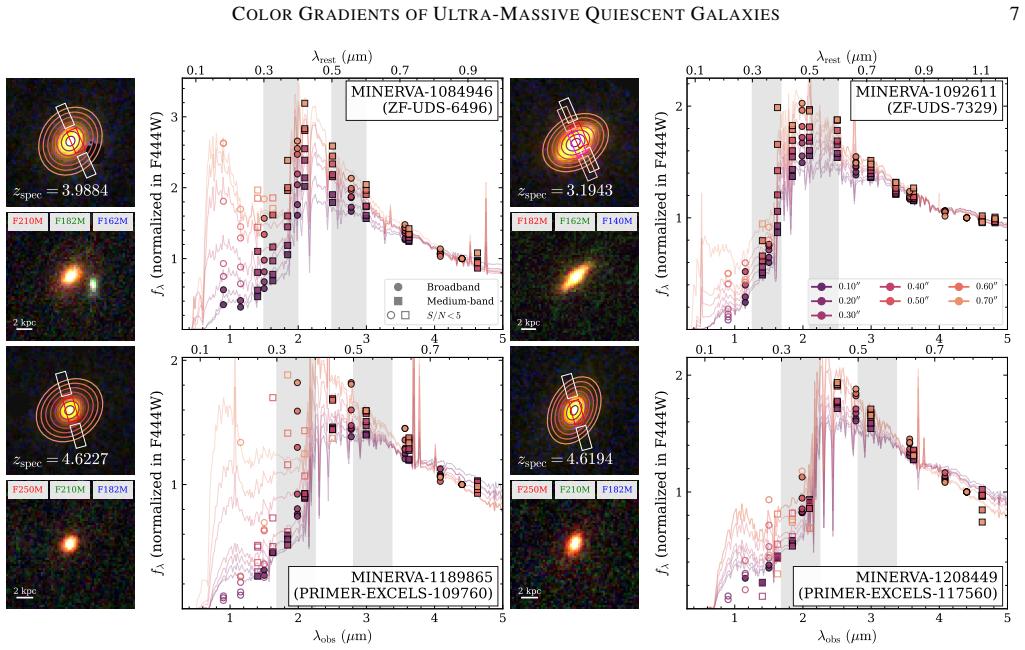
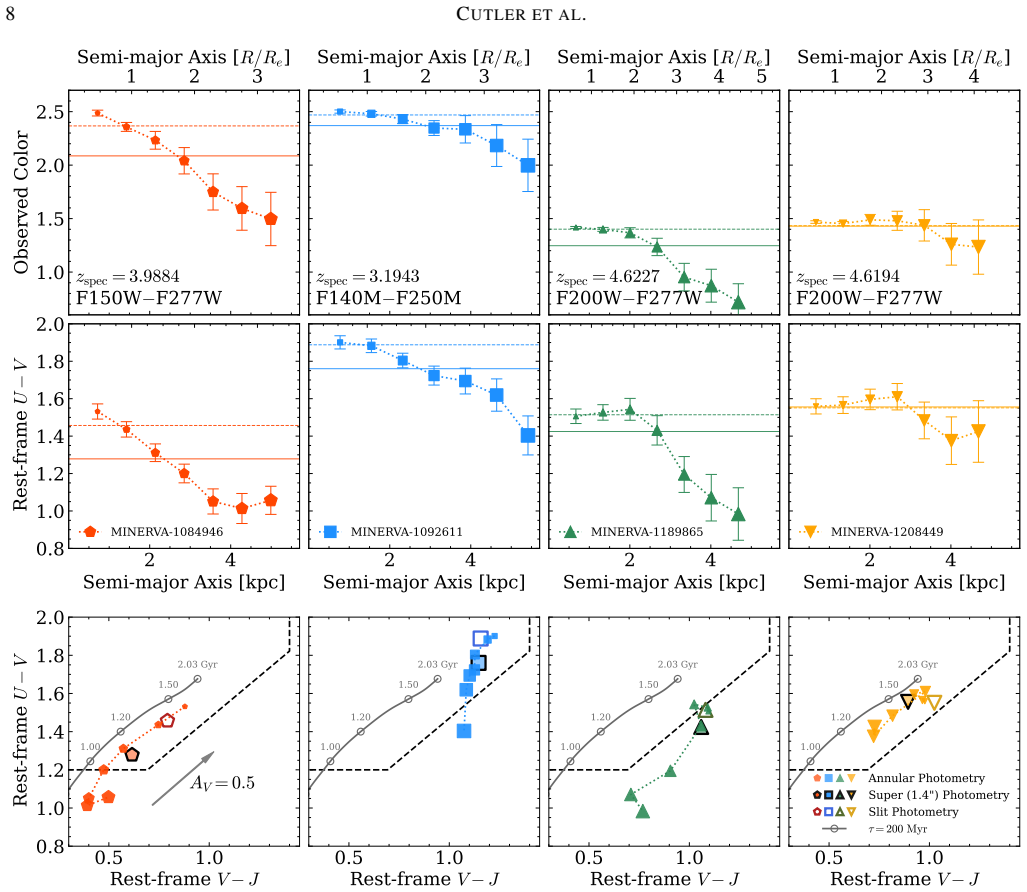
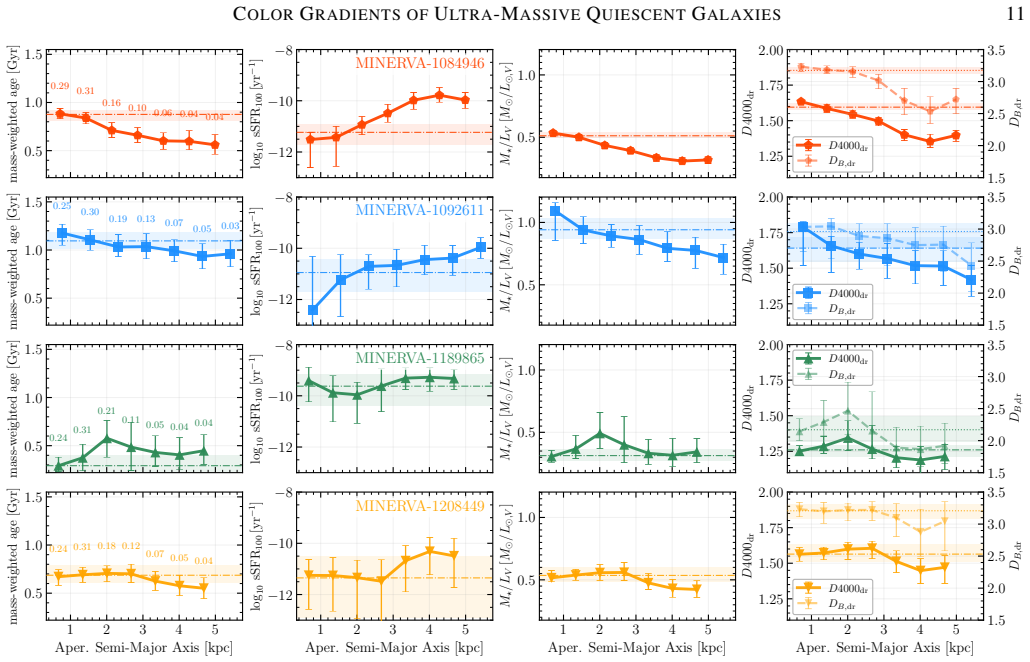
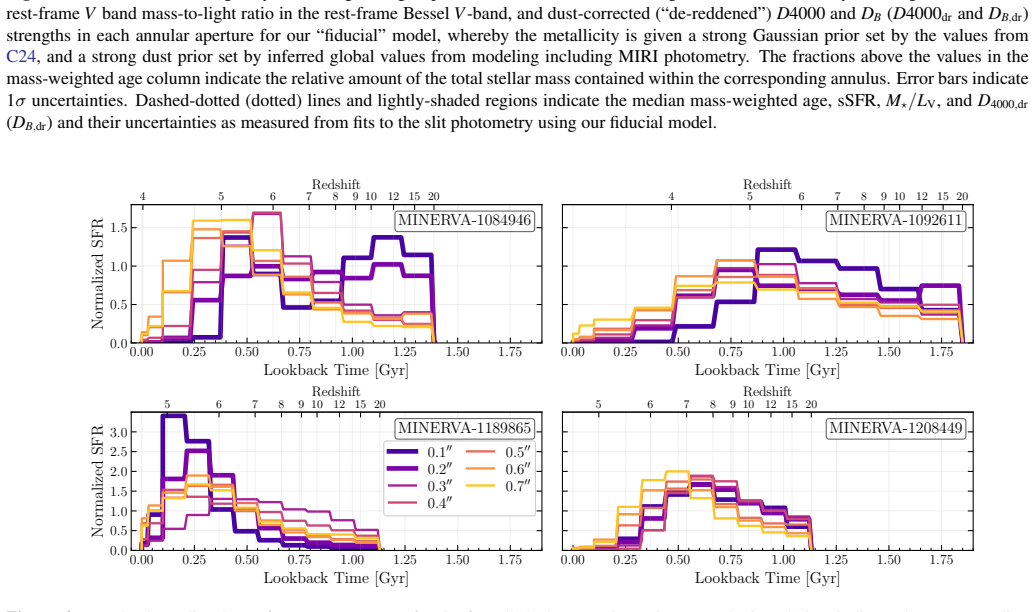
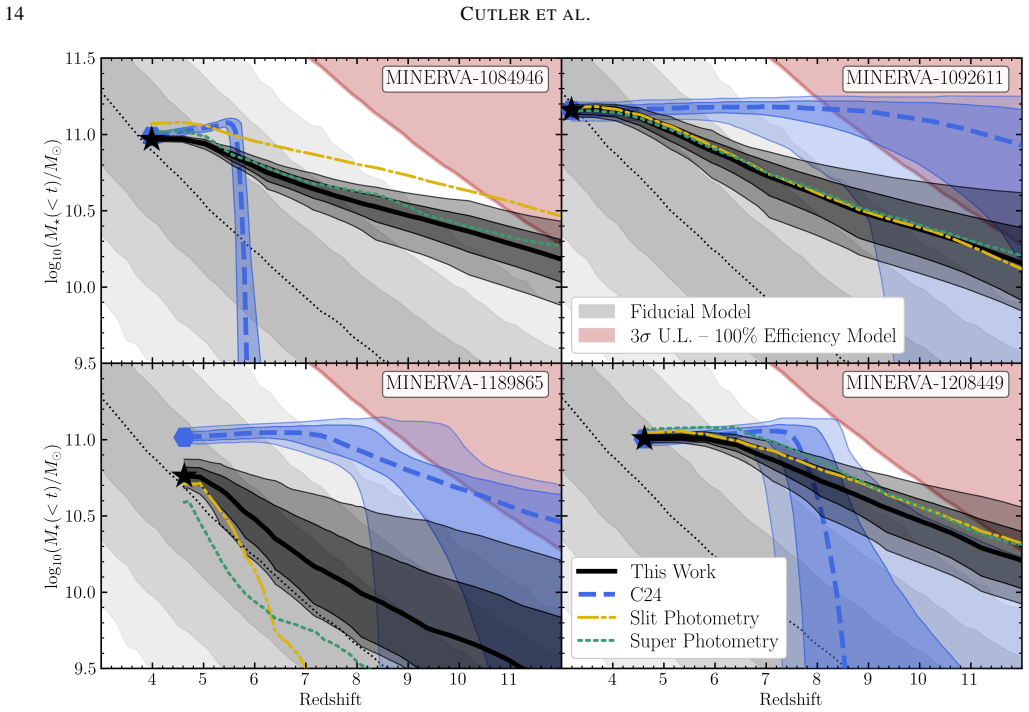
Using resolved photometry in elliptical annuli out to 0.7 arcsec, the authors find negative color gradients in three of the four galaxies. For the most extreme gradient of Delta(U-V)/Delta R = -0.126 plus or minus 0.030 mag kpc^{-1}, the stellar mass is 0.1 dex lower than from slit photometry. In the limiting case where these color gradients are entirely driven by age, tensions with extreme value statistics models are lessened out to z approximately 9.5, though different stellar population modeling choices also contribute significantly.
What carries the argument
Negative color gradients measured in elliptical annuli from MINERVA JWST medium-band photometry, compared against photometry within NIRSpec slits.
If this is right
- Stellar mass estimates from central slit data alone can be higher by 0.1 dex for galaxies with strong color gradients.
- Tensions with galaxy formation models can be reduced out to z~9.5 if the gradients prove to be age-driven.
- Different choices in stellar population modeling affect the inferred formation histories at a level comparable to the gradient correction.
- Integral field unit spectroscopy is required to break the age-dust-metallicity degeneracy in these systems.
Where Pith is reading between the lines
- If such color gradients turn out to be common among high-redshift quiescent galaxies, many earlier mass and formation-time estimates based on slit data may require downward revision.
- The effect could alter how extreme the apparent mismatch is between observations and models of the earliest massive galaxies.
- Applying the same annular photometry approach to larger samples would test whether the 0.1 dex shift is typical or limited to the most extreme cases.
- Future observations with integral field units on JWST or next-generation facilities could systematically map these gradients to refine early-universe galaxy assembly timelines.
Load-bearing premise
That the observed color gradients are driven entirely by age differences rather than dust or metallicity variations.
What would settle it
Spatially resolved spectroscopy across the galaxies that directly measures radial profiles of age, dust, and metallicity and shows the color gradients are not primarily age-driven.
Figures
read the original abstract
The discovery of a population of massive, ancient quiescent galaxies within the first 2 Gyr of the Universe's history has led to significant tensions with models of galaxy formation. However, these analyses are often based on slit spectroscopy, which typically captures only the center-most region of these galaxies and, crucially, assumes these cores are representative of the entire galaxy. To illustrate the varying stellar populations present throughout these galaxies, we present an analysis of color gradients in four $z>3$ $\log(M_\star/M_\odot)>11$ quiescent galaxies which previous works have argued are in tension with models. Using medium-band photometry from MINERVA JWST observations, we measure resolved photometry in a series of elliptical annuli out to $0.7^{\prime\prime}$ ($\sim4~R_e$). We find negative color gradients in three galaxies, and for the most extreme color gradient ($\Delta(U-V)/\Delta R=-0.126\pm0.030~{\rm mag~kpc^{-1}}$), we find the stellar mass is 0.1 dex lower when compared to photometry measured within NIRSpec slits. In the limiting case where these color gradients are entirely driven by age, we find lessened tensions with extreme value statistics models out to $z\sim9.5$, though different stellar population modeling choices also contribute significantly. Ultimately, these findings highlight the need for integral field unit spectroscopy. Spatially-resolved spectra can provide the evidence needed to break the age-dust-metallicity degeneracy, and reliably separate the effects of the observed color gradients from the effects of different physical modeling assumptions on the formation histories of these galaxies.
Editorial analysis
A structured set of objections, weighed in public.
Referee Report
Summary. The manuscript presents MINERVA JWST medium-band photometry measurements of color gradients in four z>3, log(M*/M⊙)>11 quiescent galaxies previously argued to be in tension with models. Negative gradients are reported in three galaxies; for the strongest case (Δ(U-V)/ΔR = -0.126±0.030 mag kpc^{-1}), annular photometry yields a stellar mass 0.1 dex lower than NIRSpec slit photometry. In the limiting case where gradients are entirely age-driven, tensions with extreme value statistics models are stated to be reduced out to z~9.5, with the paper noting that stellar population modeling choices also contribute and calling for IFU spectroscopy to resolve age-dust-metallicity degeneracies.
Significance. The direct annular photometry provides a concrete, data-driven quantification of aperture effects in stellar mass estimates for early quiescent galaxies, which is a useful observational constraint independent of modeling assumptions. The explicit framing of the age-driven scenario as a limiting case and the constructive call for IFU data appropriately bound the interpretation. If the 0.1 dex offset is robust, it offers a pathway to ease model tensions under specific conditions, though the conditional nature limits broader impact.
major comments (2)
- [Abstract] Abstract and final paragraph: the claim that tensions are 'lessened' out to z~9.5 in the limiting age-driven case does not specify the extreme value statistics models used or the quantitative tension metric (e.g., change in probability or sigma level) before versus after the 0.1 dex adjustment, which is load-bearing for evaluating the practical significance of the mass offset.
- [Results (mass comparison)] The 0.1 dex stellar mass offset is derived from annular versus slit photometry, but the manuscript provides no details on the stellar population synthesis assumptions, IMF, or SFH templates used to convert the photometry to mass; without this, it is unclear whether the offset is independent of the same modeling choices that the paper states also contribute to tension reduction.
minor comments (3)
- [Methods] The radial range and binning for the elliptical annuli (out to 0.7 arcsec) should be explicitly tabulated or described to allow reproduction of the gradient fits.
- [Figures] Figure captions would benefit from stating the number of annuli per galaxy and the typical photometric uncertainties per annulus.
- [Discussion] The paper correctly identifies the need for IFU data but could add a brief discussion of which existing or upcoming IFU programs (e.g., specific JWST programs) would be most suitable for these targets.
Simulated Author's Rebuttal
We thank the referee for their constructive review and positive assessment of the work. We address each major comment below and will incorporate clarifications in a revised manuscript.
read point-by-point responses
-
Referee: [Abstract] Abstract and final paragraph: the claim that tensions are 'lessened' out to z~9.5 in the limiting age-driven case does not specify the extreme value statistics models used or the quantitative tension metric (e.g., change in probability or sigma level) before versus after the 0.1 dex adjustment, which is load-bearing for evaluating the practical significance of the mass offset.
Authors: We agree that explicit identification of the models and a quantitative metric would allow readers to better evaluate the practical impact of the 0.1 dex offset. The manuscript draws on the extreme value statistics framework from prior works on the abundance of early massive galaxies, but we will revise the abstract and final paragraph to name the specific models referenced and report the change in tension (e.g., reduction in sigma level or probability) before versus after the mass adjustment under the age-driven limiting case. revision: yes
-
Referee: [Results (mass comparison)] The 0.1 dex stellar mass offset is derived from annular versus slit photometry, but the manuscript provides no details on the stellar population synthesis assumptions, IMF, or SFH templates used to convert the photometry to mass; without this, it is unclear whether the offset is independent of the same modeling choices that the paper states also contribute to tension reduction.
Authors: The 0.1 dex offset is obtained by applying identical stellar population synthesis assumptions, IMF, and SFH templates to both the annular and slit photometry, ensuring the difference arises solely from the aperture photometry rather than from varying the models. We acknowledge that these assumptions were not stated explicitly. In revision we will add the specific choices (e.g., the SPS library, IMF, and SFH parameterization) to the methods or results section so that readers can confirm the offset is measured under consistent modeling while the paper separately notes that different modeling choices contribute to tension reduction. revision: yes
Circularity Check
No significant circularity identified
full rationale
The paper's central claim rests on direct observational comparison of new MINERVA medium-band photometry in elliptical annuli versus existing NIRSpec slit apertures, producing a measured 0.1 dex stellar mass offset for the strongest gradient. The tension reduction with extreme value statistics models is presented only as a limiting case under the explicit assumption of age-driven gradients (not asserted as proven), with additional modeling choices noted as significant contributors. No equations, fitted parameters, or self-citations reduce any load-bearing step to its own inputs by construction; the derivation chain is self-contained against external photometric data and does not invoke uniqueness theorems or ansatzes from prior author work.
Axiom & Free-Parameter Ledger
axioms (2)
- domain assumption Medium-band photometry accurately traces stellar population differences when measured in elliptical annuli
- domain assumption Slit spectroscopy captures only the central region and that region is not representative when gradients exist
Reference graph
Works this paper leans on
-
[1]
Spatially resolved gas-phase metallicity at z~2-3 with JWST/NIRISS
Acharyya, A., Watson, P. J., Vulcani, B., et al. 2025, arXiv e-prints, arXiv:2508.05335, doi: 10.48550/arXiv.2508.05335
work page internal anchor Pith review Pith/arXiv arXiv doi:10.48550/arxiv.2508.05335 2025
-
[2]
Akhshik, M., Whitaker, K. E., Leja, J., et al. 2023, ApJ, 943, 179, doi: 10.3847/1538-4357/aca677
-
[3]
2024, ApJ, 976, 224, doi: 10.3847/1538-4357/ad7396
Alberts, S., Lyu, J., Shivaei, I., et al. 2024, ApJ, 976, 224, doi: 10.3847/1538-4357/ad7396
-
[4]
Antwi-Danso, J., Muzzin, A., Robbins, L., et al. 2025, arXiv e-prints, arXiv:2512.03154, doi: 10.48550/arXiv.2512.03154 Astropy Collaboration, Robitaille, T. P., Tollerud, E. J., et al. 2013, A&A, 558, A33, doi: 10.1051/0004-6361/201322068 Astropy Collaboration, Price-Whelan, A. M., Sip˝ocz, B. M., et al. 2018, AJ, 156, 123, doi: 10.3847/1538-3881/aabc4f ...
-
[5]
M., Lim, S., D’Eugenio, F., et al
Baker, W. M., Lim, S., D’Eugenio, F., et al. 2025, MNRAS, 539, 557, doi: 10.1093/mnras/staf475
-
[6]
2016, extinction v0.3.0, Zenodo, doi: 10.5281/zenodo.804967
Barbary, K. 2016, extinction v0.3.0, Zenodo, doi: 10.5281/zenodo.804967
-
[7]
2016, Journal of Open Source Software, 1, 58, doi:10.21105/joss.00058
Barbary, K. 2016, JOSS, 1, 58, doi: 10.21105/joss.00058
-
[8]
Bell, E. F., & de Jong, R. S. 2001, ApJ, 550, 212, doi: 10.1086/319728
-
[9]
Belli, S., Newman, A. B., & Ellis, R. S. 2019, ApJ, 874, 17, doi: 10.3847/1538-4357/ab07af
-
[10]
Belli, S., Park, M., Davies, R. L., et al. 2024, Nature, 630, 54, doi: 10.1038/s41586-024-07412-1
-
[11]
Bezanson, R., van Dokkum, P. G., Tal, T., et al. 2009, ApJ, 697, 1290, doi: 10.1088/0004-637X/697/2/1290
-
[12]
2016, A&A, 596, A63, doi: 10.1051/0004-6361/201629080
Boucaud, A., Bocchio, M., Abergel, A., et al. 2016, A&A, 596, A63, doi: 10.1051/0004-6361/201629080
-
[13]
2025, astropy/photutils: 2.3.0, 2.3.0 Zenodo, doi: 10.5281/zenodo.17129028
Bradley, L., Sip˝ocz, B., Robitaille, T., et al. 2025, astropy/photutils: 2.3.0, 2.3.0 Zenodo, doi: 10.5281/zenodo.17129028
-
[14]
2023, grizli, v1.9.11 Zenodo, doi: 10.5281/zenodo.8370018
Brammer, G. 2023, grizli, v1.9.11 Zenodo, doi: 10.5281/zenodo.8370018
-
[15]
Brammer, G. B., van Dokkum, P. G., & Coppi, P. 2008, ApJ, 686, 1503, doi: 10.1086/591786 Bruzual A., G. 1983, ApJ, 273, 105, doi: 10.1086/161352
work page internal anchor Pith review doi:10.1086/591786 2008
-
[16]
Carnall, A. C., McLure, R. J., Dunlop, J. S., & Davé, R. 2018, MNRAS, 480, 4379, doi: 10.1093/mnras/sty2169
work page internal anchor Pith review doi:10.1093/mnras/sty2169 2018
-
[17]
Carnall, A. C., McLure, R. J., Dunlop, J. S., et al. 2019, MNRAS, 490, 417, doi: 10.1093/mnras/stz2544
-
[18]
Carnall, A. C., McLeod, D. J., McLure, R. J., et al. 2023a, MNRAS, 520, 3974, doi: 10.1093/mnras/stad369
-
[19]
Carnall, A. C., McLure, R. J., Dunlop, J. S., et al. 2023b, Nature, 619, 716, doi: 10.1038/s41586-023-06158-6
-
[20]
Carnall, A. C., Cullen, F., McLure, R. J., et al. 2024, MNRAS, 534, 325, doi: 10.1093/mnras/stae2092
-
[21]
2003, Publications of the Astronomical Society of the Pacific, 115, 763, doi: 10.1086/376392
Chabrier, G. 2003, PASP, 115, 763, doi: 10.1086/376392
work page internal anchor Pith review doi:10.1086/376392 2003
-
[22]
Chen, L., Wang, T., Sun, H., et al. 2026, arXiv e-prints, arXiv:2603.22239, doi: 10.48550/arXiv.2603.22239
work page internal anchor Pith review Pith/arXiv arXiv doi:10.48550/arxiv.2603.22239 2026
-
[23]
Cheng, C. M., Kriek, M., Beverage, A. G., et al. 2024, MNRAS, 532, 3604, doi: 10.1093/mnras/stae1739
-
[24]
Cheng, C. M., Slob, M., Kriek, M., et al. 2025, arXiv e-prints, arXiv:2509.12316, doi: 10.48550/arXiv.2509.12316
work page internal anchor Pith review Pith/arXiv arXiv doi:10.48550/arxiv.2509.12316 2025
-
[25]
G., Glazebrook, K., Nanayakkara, T., et al
Chittenden, H. G., Glazebrook, K., Nanayakkara, T., et al. 2026, MNRAS, 547, stag474, doi: 10.1093/mnras/stag474
-
[26]
2016, ApJ, 823, 102, doi: 10.3847/0004-637X/823/2/102 de Laverny, P., Recio-Blanco, A., Worley, C
Choi, J., Dotter, A., Conroy, C., et al. 2016, ApJ, 823, 102, doi: 10.3847/0004-637X/823/2/102
work page internal anchor Pith review doi:10.3847/0004-637x/823/2/102 2016
-
[27]
Clausen, M., Momcheva, I. G., Whitaker, K. E., et al. 2025, ApJ, 993, 106, doi: 10.3847/1538-4357/ae03aa
-
[28]
Cochrane, R. K. 2025, MNRAS, 544, 1530, doi: 10.1093/mnras/staf1568
-
[29]
Modeling the Panchromatic Spectral Energy Distributions of Galaxies
Conroy, C. 2013, ARA&A, 51, 393, doi: 10.1146/annurev-astro-082812-141017
work page internal anchor Pith review doi:10.1146/annurev-astro-082812-141017 2013
-
[30]
Conroy, C., & Gunn, J. E. 2010, ApJ, 712, 833, doi: 10.1088/0004-637X/712/2/833
work page internal anchor Pith review doi:10.1088/0004-637x/712/2/833 2010
-
[31]
Conroy, C., Gunn, J. E., & White, M. 2009, ApJ, 699, 486, doi: 10.1088/0004-637X/699/1/486
work page internal anchor Pith review doi:10.1088/0004-637x/699/1/486 2009
-
[32]
Conroy, C., Naidu, R. P., Zaritsky, D., et al. 2019, ApJ, 887, 237, doi: 10.3847/1538-4357/ab5710
-
[33]
Conroy, C., White, M., & Gunn, J. E. 2010, ApJ, 708, 58, doi: 10.1088/0004-637X/708/1/58
-
[34]
E., Giavalisco, M., Ji, Z., & Cheng, Y
Cutler, S. E., Giavalisco, M., Ji, Z., & Cheng, Y . 2023, ApJ, 945, 97, doi: 10.3847/1538-4357/acb5e9
-
[35]
Cutler, S. E., Whitaker, K. E., Weaver, J. R., et al. 2024, ApJL, 967, L23, doi: 10.3847/2041-8213/ad464c de Graaff, A., Setton, D. J., Brammer, G., et al. 2025, Nature Astronomy, 9, 280, doi: 10.1038/s41550-024-02424-3
-
[36]
Dekel, A., & Burkert, A. 2014, MNRAS, 438, 1870, doi: 10.1093/mnras/stt2331 D’Eugenio, F., van der Wel, A., Wu (柏锋), P.-F., et al. 2020, MNRAS, 497, 389, doi: 10.1093/mnras/staa1937 D’Eugenio, F., Pérez-González, P. G., Maiolino, R., et al. 2024, Nature Astronomy, 8, 1443, doi: 10.1038/s41550-024-02345-1
-
[37]
2016, ApJS, 222, 8, doi: 10.3847/0067-0049/222/1/8
Dotter, A. 2016, ApJS, 222, 8, doi: 10.3847/0067-0049/222/1/8
work page internal anchor Pith review doi:10.3847/0067-0049/222/1/8 2016
-
[38]
Drlica-Wagner, A., Sevilla-Noarbe, I., Rykoff, E. S., et al. 2018, ApJS, 235, 33, doi: 10.3847/1538-4365/aab4f5
-
[39]
Duan, Q., Conselice, C. J., Li, Q., et al. 2025, MNRAS, 540, 774, doi: 10.1093/mnras/staf638
-
[40]
S., Abraham, R
Dunlop, J. S., Abraham, R. G., Ashby, M. L. N., et al. 2021, PRIMER: Public Release IMaging for Extragalactic Research„ JWST Proposal. Cycle 1, ID. #1837
2021
-
[41]
N., et al., 2009, ApJS, 182, 543 Adelman-McCarthy J
Foreman-Mackey, D., Sick, J., & Johnson, B. 2014, python-fsps: Python bindings to FSPS (v0.1.1), v0.1.1 Zenodo, doi: 10.5281/zenodo.12157
-
[42]
Forrest, B., Marsan, Z. C., Annunziatella, M., et al. 2020, ApJ, 903, 47, doi: 10.3847/1538-4357/abb819 Fortuné, S., Remus, R.-S., Kimmig, L. C., Burkert, A., & Dolag, K. 2025, A&A, 704, A185, doi: 10.1051/0004-6361/202554805 COLORGRADIENTS OFULTRA-MASSIVEQUIESCENTGALAXIES21
-
[43]
2017, Nature, 544, 71, doi: 10.1038/nature21680
Glazebrook, K., Schreiber, C., Labbé, I., et al. 2017, Nature, 544, 71, doi: 10.1038/nature21680
-
[44]
2024, Nature, 628, 277, doi: 10.1038/s41586-024-07191-9
Glazebrook, K., Nanayakkara, T., Schreiber, C., et al. 2024, Nature, 628, 277, doi: 10.1038/s41586-024-07191-9
-
[45]
2012, The DrizzlePac Handbook (Baltimore, MD: STScI)
Gonzaga, S., Hack, W., Fruchter, A., & Mack, J. 2012, The DrizzlePac Handbook (Baltimore, MD: STScI)
2012
-
[46]
E., Janish, R., Ma, C.-P., et al
Greene, J. E., Janish, R., Ma, C.-P., et al. 2015, ApJ, 807, 11, doi: 10.1088/0004-637X/807/1/11
-
[47]
Adams, J. J. 2012, ApJ, 750, 32, doi: 10.1088/0004-637X/750/1/32
-
[48]
Grogin, N. A., Kocevski, D. D., Faber, S. M., et al. 2011, ApJS, 197, 35, doi: 10.1088/0067-0049/197/2/35
-
[49]
2011, ApJ, 735, 18, doi: 10.1088/0004-637X/735/1/18
Guo, Y ., Giavalisco, M., Cassata, P., et al. 2011, ApJ, 735, 18, doi: 10.1088/0004-637X/735/1/18
-
[50]
Hamadouche, M. L., Whitaker, K. E., Valentino, F., et al. 2026, arXiv e-prints, arXiv:2602.02485, doi: 10.48550/arXiv.2602.02485
-
[51]
2012, MNRAS, 420, L18, doi:10.1111/j.1745-3933.2011.01184.x
Harrison, I., & Coles, P. 2011, MNRAS, 418, L20, doi: 10.1111/j.1745-3933.2011.01134.x
-
[52]
Harvey, T., Conselice, C. J., Adams, N. J., et al. 2025, ApJ, 978, 89, doi: 10.3847/1538-4357/ad8c29
-
[53]
2013, ApJS, 208, 19, doi: 10.1088/0067-0049/208/2/19
Hinshaw, G., Larson, D., Komatsu, E., et al. 2013, ApJS, 208, 19, doi: 10.1088/0067-0049/208/2/19
work page internal anchor Pith review doi:10.1088/0067-0049/208/2/19 2013
-
[54]
Hunter, J. D. 2007, CSE, 9, 90, doi: 10.1109/MCSE.2007.55
-
[55]
2005, A&A, 439, 863, doi: 10.1051/0004-6361:20041961
Ilbert, O., Tresse, L., Zucca, E., et al. 2005, A&A, 439, 863, doi: 10.1051/0004-6361:20041961
-
[56]
Jafariyazani, M., Newman, A. B., Mobasher, B., et al. 2020, ApJL, 897, L42, doi: 10.3847/2041-8213/aba11c
-
[57]
Jespersen, C. K., Carnall, A. C., & Lovell, C. C. 2025, ApJL, 988, L19, doi: 10.3847/2041-8213/adeb7c
-
[58]
D., Leja, J., Conroy, C., & Speagle, J
Johnson, B. D., Leja, J., Conroy, C., & Speagle, J. S. 2021, ApJS, 254, 22, doi: 10.3847/1538-4365/abef67
work page internal anchor Pith review doi:10.3847/1538-4365/abef67 2021
-
[59]
2025, The Astrophysical Journal Letters, 978, L39, doi: 10.3847/2041-8213/ada150
Ju, M., Wang, X., Jones, T., et al. 2025, ApJL, 978, L39, doi: 10.3847/2041-8213/ada150
-
[60]
2026, ApJ, 997, 29, doi: 10.3847/1538-4357/ae0a18
Kawinwanichakij, L., Glazebrook, K., Nanayakkara, T., et al. 2026, ApJ, 997, 29, doi: 10.3847/1538-4357/ae0a18
-
[61]
Kepner, J. V . 1999, ApJ, 520, 59, doi: 10.1086/307419
-
[62]
1999, ApJ, 527, 573, doi: 10.1086/308092
Kobayashi, C., & Arimoto, N. 1999, ApJ, 527, 573, doi: 10.1086/308092
-
[63]
Koekemoer, A. M., Faber, S. M., Ferguson, H. C., et al. 2011, ApJS, 197, 36, doi: 10.1088/0067-0049/197/2/36
-
[64]
2013, ApJL, 775, L16, doi: 10.1088/2041-8205/775/1/L16
Kriek, M., & Conroy, C. 2013, ApJL, 775, L16, doi: 10.1088/2041-8205/775/1/L16
-
[65]
Kriek, M., Beverage, A. G., Price, S. H., et al. 2024, ApJ, 966, 36, doi: 10.3847/1538-4357/ad2df9
-
[66]
Kron, R. G. 1980, ApJS, 43, 305, doi: 10.1086/190669 Labbé, I., Franx, M., Rudnick, G., et al. 2003, AJ, 125, 1107, doi: 10.1086/346140
-
[67]
Leja, J., Carnall, A. C., Johnson, B. D., Conroy, C., & Speagle, J. S. 2019a, ApJ, 876, 3, doi: 10.3847/1538-4357/ab133c
work page internal anchor Pith review doi:10.3847/1538-4357/ab133c
-
[68]
2019b, ApJL, 880, L9, doi: 10.3847/2041-8213/ab2f8c
Leja, J., Tacchella, S., & Conroy, C. 2019b, ApJL, 880, L9, doi: 10.3847/2041-8213/ab2f8c
-
[69]
2026, arXiv e-prints, arXiv:2602.13114, doi: 10.48550/arXiv.2602.13114
Leung, H.-H., Wild, V ., Papathomas, M., et al. 2026, arXiv e-prints, arXiv:2602.13114, doi: 10.48550/arXiv.2602.13114
-
[70]
2024, Research in Astronomy and Astrophysics, 24, 015009, doi: 10.1088/1674-4527/ad0864
Lin, H., Gong, Y ., Yue, B., & Chen, X. 2024, Research in Astronomy and Astrophysics, 24, 015009, doi: 10.1088/1674-4527/ad0864
-
[71]
2019, ApJ, 872, 50, doi: 10.3847/1538-4357/aafa84
Lin, L., Hsieh, B.-C., Pan, H.-A., et al. 2019, ApJ, 872, 50, doi: 10.3847/1538-4357/aafa84
-
[72]
2022, ApJL, 937, L30, doi: 10.3847/2041-8213/ac927f
Liu, B., & Bromm, V . 2022, ApJL, 937, L30, doi: 10.3847/2041-8213/ac927f
-
[73]
C., Harrison, I., Harikane, Y ., Tacchella, S., & Wilkins, S
Lovell, C. C., Harrison, I., Harikane, Y ., Tacchella, S., & Wilkins, S. M. 2022, Monthly Notices of the Royal Astronomical Society, 518, 2511, doi: 10.1093/mnras/stac3224
-
[74]
Lu, S., Daddi, E., Maraston, C., et al. 2026, arXiv e-prints, arXiv:2604.19942, doi: 10.48550/arXiv.2604.19942 M Evans, N. H., & Peacock, B. 2001, Measurement Science and Technology, 12, 117, doi: 10.1088/0957-0233/12/1/702
work page internal anchor Pith review Pith/arXiv arXiv doi:10.48550/arxiv.2604.19942 2026
-
[75]
2023, A&A, 672, A71, doi: 10.1051/0004-6361/202345851
Maio, U., & Viel, M. 2023, A&A, 672, A71, doi: 10.1051/0004-6361/202345851
-
[76]
C., Marchesini, D., Brammer, G
Marsan, Z. C., Marchesini, D., Brammer, G. B., et al. 2015, ApJ, 801, 133, doi: 10.1088/0004-637X/801/2/133
-
[77]
2026, A&A, 705, A236, doi: 10.1051/0004-6361/202555974
Martorano, M., van der Wel, A., Gebek, A., et al. 2026, A&A, 705, A236, doi: 10.1051/0004-6361/202555974
-
[78]
McConachie, I., de Graaff, A., Maseda, M. V ., et al. 2025, arXiv e-prints, arXiv:2510.25024, doi: 10.48550/arXiv.2510.25024
-
[79]
B., van Dokkum, P., & Mowla, L
Miller, T. B., van Dokkum, P., & Mowla, L. 2023, ApJ, 945, 155, doi: 10.3847/1538-4357/acbc74
-
[80]
Mobasher, B., Dahlen, T., Ferguson, H. C., et al. 2015, ApJ, 808, 101, doi: 10.1088/0004-637X/808/1/101
discussion (0)
Sign in with ORCID, Apple, or X to comment. Anyone can read and Pith papers without signing in.