Kinematical correlations via kappa-Poincar\'e coproducts
Pith reviewed 2026-06-28 09:22 UTC · model grok-4.3
The pith
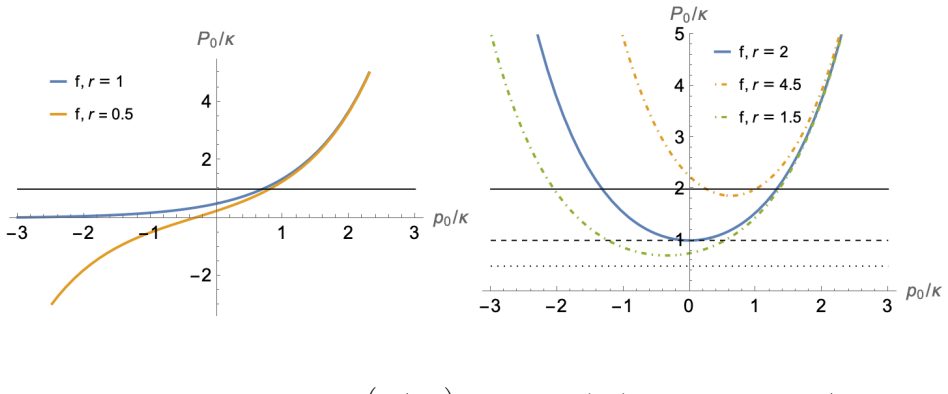
In the classical basis of κ-Minkowski spacetime, multiple preimages of a four-momentum are resolved by P_+ inside the coproduct, yielding branch-dependent back-to-back correlations under vanishing total momentum.
A machine-rendered reading of the paper's core claim, the machinery that carries it, and where it could break.
Core claim
In the classical basis the nonlinear relation between translation eigenvalues P_μ and ordered-plane-wave labels p_μ can admit more than one real auxiliary preimage. The branch-sensitive quantity P_+ ≡ P_0 + P_4 = κ e^{p_0/κ} enters the coproduct and resolves the branches in two-particle states. Imposing the vanishing total-momentum constraint therefore gives branch-dependent κ-deformed back-to-back momentum correlations. In a single-branch regime this reduces to a deformed correlated product; in a multibranch regime a state specified only by P_μ expands into distinct auxiliary branches. If P_μ are taken as the directly meaningful momenta the physical content is the resulting deformed correla
What carries the argument
The branch-sensitive quantity P_+ ≡ P_0 + P_4 = κ e^{p_0/κ} that enters the coproduct to resolve multiple preimages of the classical-basis four-momentum.
If this is right
- In the single-branch regime the constrained state reduces to a deformed correlated product of the two momenta.
- In the multibranch regime a state fixed only by classical-basis P_μ expands into a sum over distinct auxiliary branches.
- When P_μ are treated as the physical momenta the observable content is the branch-dependent correlation pattern.
- When p_μ are treated as operationally meaningful the same state is a superposition over auxiliary branches.
- Standard regular self-adjoint nonrelativistic minimal-length models lack any smooth local two-real-branch inversion on their physical domains.
Where Pith is reading between the lines
- The branch-resolution mechanism may appear in other Hopf-algebra deformations whenever the momentum-space coordinate map is locally many-to-one.
- If high-momentum scattering experiments can isolate the classical basis, the predicted correlation patterns could be compared against data at energies where multiple preimages become accessible.
- The absence of an analogous structure in minimal-length models indicates that the effect is tied to the specific form of the κ-Poincaré coproduct rather than to a generic minimal-length cutoff.
Load-bearing premise
The nonlinear map from ordered-plane-wave labels p_μ to classical-basis translation eigenvalues P_μ admits multiple real solutions in a high-momentum region and the coproduct can be applied in a branch-sensitive manner using P_+.
What would settle it
An explicit calculation of the coproduct in the classical basis for a four-momentum with two real preimages that shows the resulting two-particle state is insensitive to the choice of auxiliary branch when total momentum is set to zero.
Figures
read the original abstract
We study a kinematical consequence of the Hopf-algebraic momentum composition law in $\kappa$-Minkowski spacetime. The same curved momentum space can be described in different coordinates. In the bicrossproduct basis the ordered-plane-wave labels are the translation-generator eigenvalues, so the relevant map is one-to-one. In the classical basis, instead, the translation eigenvalues $P_\mu$ are nonlinearly related to the ordered-plane-wave labels $p_\mu$. This relation can fail to be globally one-to-one in a high-momentum region. When a given classical-basis four-momentum admits more than one real auxiliary preimage, the branch-sensitive quantity $P_+\equiv P_0+P_4=\kappa e^{p_0/\kappa}$ enters the coproduct and resolves the branches in two-particle states. Imposing the vanishing total-momentum constraint therefore gives branch-dependent $\kappa$-deformed back-to-back momentum correlations. In a single-branch regime this is just a deformed correlated product, while in a multibranch regime a state specified only by $P_\mu$ can be expanded into distinct auxiliary branches. If $P_\mu$ are taken as the directly meaningful momenta, the physical content is the resulting deformed correlation pattern. If the auxiliary variables $p_\mu$ are assigned operational meaning, the same constrained state can be interpreted as a superposition over different auxiliary branches. We also compare this structure with standard regular self-adjoint nonrelativistic minimal-length models and find no analogous smooth local two-real-branch inversion on their physical domains.
Editorial analysis
A structured set of objections, weighed in public.
Referee Report
Summary. The paper claims that the nonlinear map from ordered-plane-wave labels p_μ to classical-basis translation eigenvalues P_μ in κ-Poincaré can fail to be globally one-to-one in high-momentum regions; when multiple real preimages exist, the branch-sensitive quantity P_+ ≡ P_0 + P_4 = κ e^{p_0/κ} enters the coproduct, producing branch-dependent κ-deformed back-to-back momentum correlations under the vanishing total-momentum constraint. In the single-branch regime this reduces to a deformed correlated product, while a multibranch regime allows a P_μ-specified state to be expanded over distinct auxiliary branches. The structure is contrasted with the bijective bicrossproduct basis and with nonrelativistic minimal-length models, which lack analogous smooth local two-real-branch inversions.
Significance. If the multi-branch inversion and its consistent use in the coproduct are rigorously established on the physical domain, the result supplies a concrete, falsifiable kinematical signature of the classical-basis κ-Poincaré coproduct that is absent from the bicrossproduct basis. The explicit comparison to nonrelativistic models is a strength, as it isolates a relativistic feature. The work is parameter-free once κ is fixed and yields directly testable correlation patterns.
major comments (2)
- [Abstract / classical-basis paragraph] Abstract and the paragraph introducing the classical basis: the central claim that the nonlinear relation P_μ(p_μ) “can fail to be globally one-to-one in a high-momentum region” and that P_+ “enters the coproduct and resolves the branches” is asserted without an explicit functional form of the map, a concrete numerical example of a four-momentum P with two distinct real preimages p, or the explicit coproduct formula demonstrating branch sensitivity. This is load-bearing for the branch-dependent correlations.
- [Section describing the coproduct application] The vanishing-total-momentum constraint is stated to produce branch-dependent correlations, yet no explicit two-particle coproduct expression (e.g., Δ(P_μ) or the action on |P, p⟩ states) is supplied to show how the choice of branch for P_+ alters the allowed momenta. Without this, it is impossible to verify that the correlations are genuinely branch-dependent rather than an artifact of the labeling.
minor comments (1)
- [Abstract] Notation for the auxiliary variables p_μ versus the directly meaningful P_μ should be introduced once and used consistently; the abstract alternates between “classical-basis four-momentum” and “auxiliary preimage” without a clear table of symbols.
Simulated Author's Rebuttal
We thank the referee for the careful and constructive report. The comments correctly identify that the central technical claims require more explicit supporting material to be fully verifiable. We will revise the manuscript accordingly by adding the requested explicit forms, numerical example, and coproduct expressions.
read point-by-point responses
-
Referee: [Abstract / classical-basis paragraph] Abstract and the paragraph introducing the classical basis: the central claim that the nonlinear relation P_μ(p_μ) “can fail to be globally one-to-one in a high-momentum region” and that P_+ “enters the coproduct and resolves the branches” is asserted without an explicit functional form of the map, a concrete numerical example of a four-momentum P with two distinct real preimages p, or the explicit coproduct formula demonstrating branch sensitivity. This is load-bearing for the branch-dependent correlations.
Authors: We agree that the abstract and introductory paragraph would benefit from greater explicitness. In the revised version we will state the explicit nonlinear map P_μ(p_μ), supply a concrete numerical example of a four-momentum P with two distinct real preimages, and include the relevant coproduct formula that shows the branch sensitivity of P_+. These additions will be placed in the classical-basis section and cross-referenced from the abstract. revision: yes
-
Referee: [Section describing the coproduct application] The vanishing-total-momentum constraint is stated to produce branch-dependent correlations, yet no explicit two-particle coproduct expression (e.g., Δ(P_μ) or the action on |P, p⟩ states) is supplied to show how the choice of branch for P_+ alters the allowed momenta. Without this, it is impossible to verify that the correlations are genuinely branch-dependent rather than an artifact of the labeling.
Authors: We accept that an explicit two-particle coproduct expression is required to demonstrate the branch dependence. The revised manuscript will contain the explicit form of Δ(P_μ) together with its action on the states |P, p⟩, illustrating how distinct branches for P_+ produce different allowed momenta under the vanishing-total-momentum constraint. revision: yes
Circularity Check
No circularity; standard coproduct applied to classical-basis labels yields stated correlations without self-referential reduction.
full rationale
The derivation applies the known κ-Poincaré coproduct to the classical-basis four-momenta P_μ whose nonlinear relation to auxiliary labels p_μ is taken as given by the basis choice. The branch-sensitive quantity P_+ is defined directly from that relation and inserted into the coproduct; no parameter is fitted to a data subset and then relabeled as a prediction, no self-citation supplies a uniqueness theorem or ansatz, and the resulting correlation pattern is not equivalent by construction to the input map. The paper is therefore self-contained against external benchmarks for the purpose of circularity analysis.
Axiom & Free-Parameter Ledger
free parameters (1)
- κ
axioms (1)
- domain assumption Momentum composition is governed by the κ-Poincaré coproduct in either the bicrossproduct or classical basis.
Reference graph
Works this paper leans on
-
[1]
A. Kempf, G. Mangano and R. B. Mann,Hilbert space representation of the minimal length uncertainty relation, Phys. Rev. D52(1995) 1108 [arXiv:hep-th/9412167]
Pith/arXiv arXiv 1995
-
[2]
A. Kempf and G. Mangano,Minimal length uncertainty relation and ultraviolet regularization, Phys. Rev. D55(1997) 7909 [arXiv:hep-th/9612084]
Pith/arXiv arXiv 1997
-
[3]
Amelino-Camelia,Testable scenario for relativity with minimum length, Phys
G. Amelino-Camelia,Testable scenario for relativity with minimum length, Phys. Lett. B510(2001) 255 [arXiv:hep-th/0012238]
Pith/arXiv arXiv 2001
-
[4]
Hossenfelder,Minimal Length Scale Scenarios for Quantum Gravity, Living Rev
S. Hossenfelder,Minimal Length Scale Scenarios for Quantum Gravity, Living Rev. Rel. 16(2013) 2 [arXiv:1203.6191]
Pith/arXiv arXiv 2013
-
[5]
K. Nozari and A. Etemadi,Minimal length, maximal momentum and Hilbert space representation of quantum mechanics, Phys. Rev. D85(2012) 104029 [arXiv:1205.0158]
Pith/arXiv arXiv 2012
-
[6]
A. N. Tawfik and A. M. Diab,Review on Generalized Uncertainty Principle, Rept. Prog. Phys.78(2015) 126001 [arXiv:1509.02436]
Pith/arXiv arXiv 2015
-
[7]
H. S. Snyder,Quantized space-time, Phys. Rev.71(1947) 38
1947
-
[8]
S. Doplicher, K. Fredenhagen and J. E. Roberts,The Quantum structure of space-time at the Planck scale and quantum fields, Commun. Math. Phys.172(1995) 187 [arXiv:hep-th/0303037]
Pith/arXiv arXiv 1995
-
[9]
G. Amelino-Camelia,Relativity in space-times with short distance structure governed by an observer independent (Planckian) length scale, Int. J. Mod. Phys. D11(2002) 35 [arXiv:gr-qc/0012051]
Pith/arXiv arXiv 2002
-
[10]
Kowalski-Glikman,Introduction to doubly special relativity, Lect
J. Kowalski-Glikman,Introduction to doubly special relativity, Lect. Notes Phys.669 (2005) 131 [arXiv:hep-th/0405273]
Pith/arXiv arXiv 2005
-
[11]
L. Freidel, J. Kowalski-Glikman and L. Smolin,2+1 gravity and doubly special relativity, Phys. Rev. D69(2004) 044001 [arXiv:hep-th/0307085]
Pith/arXiv arXiv 2004
-
[12]
J. Kowalski-Glikman,Doubly special quantum and statistical mechanics from quantum kappa Poincare algebra, Phys. Lett. A299(2002) 454 [arXiv:hep-th/0111110]
Pith/arXiv arXiv 2002
-
[13]
Lukierski, A
J. Lukierski, A. Nowicki and H. Ruegg,New quantum Poincare algebra and k deformed field theory, Phys. Lett. B293(1992) 344. 26
1992
-
[14]
S. Majid and H. Ruegg,Bicrossproduct structure of kappa Poincare group and noncommutative geometry, Phys. Lett. B334(1994) 348 [arXiv:hep-th/9405107]
Pith/arXiv arXiv 1994
-
[15]
A. Agostini, G. Amelino-Camelia and F. D’Andrea,Hopf algebra description of noncommutative space-time symmetries, Int. J. Mod. Phys. A19(2004) 5187 [arXiv:hep-th/0306013]
Pith/arXiv arXiv 2004
-
[16]
G. Amelino-Camelia, L. Freidel, J. Kowalski-Glikman and L. Smolin,The principle of relative locality, Phys. Rev. D84(2011) 084010 [arXiv:1101.0931]
Pith/arXiv arXiv 2011
-
[17]
G. Amelino-Camelia, L. Freidel, J. Kowalski-Glikman and L. Smolin,Relative locality: A deepening of the relativity principle, Gen. Rel. Grav.43(2011) 2547 [arXiv:1106.0313]
Pith/arXiv arXiv 2011
-
[18]
Amelino-Camelia,Doubly special relativity, Nature418(2002) 34 [arXiv:gr-qc/0207049]
G. Amelino-Camelia,Doubly special relativity, Nature418(2002) 34 [arXiv:gr-qc/0207049]
Pith/arXiv arXiv 2002
-
[19]
J. Lukierski, H. Ruegg and W. J. Zakrzewski,Classical quantum mechanics of free kappa relativistic systems, Annals Phys.243(1995) 90 [arXiv:hep-th/9312153]
Pith/arXiv arXiv 1995
-
[20]
M. Arzano and J. Kowalski-Glikman,A group theoretic description of theκ-Poincaré Hopf algebra, Phys. Lett. B835(2022) 137535 [arXiv:2204.09394]
arXiv 2022
-
[21]
P. Kosinski, J. Lukierski, P. Maslanka and J. Sobczyk,The Classical basis for kappa deformed Poincare (super)algebra and the second kappa deformed supersymmetric Casimir, Mod. Phys. Lett. A10(1995) 2599 [arXiv:hep-th/9412114]
Pith/arXiv arXiv 1995
-
[22]
A. Borowiec and A. Pachol,Classical basis for kappa-Poincare algebra and doubly special relativity theories, J. Phys. A43(2010) 045203 [arXiv:0903.5251]
Pith/arXiv arXiv 2010
-
[23]
K. Nozari, M. A. Gorji, V. Hosseinzadeh and B. Vakili,Natural Cutoffs via Compact Symplectic Manifolds, Class. Quant. Grav.33(2016) 025009 [arXiv:1405.4083]
Pith/arXiv arXiv 2016
- [24]
-
[25]
I. P. Lobo, G. Varão, G. Gubitosi, M. Rojas and V. B. Bezerra,Coherence and entanglement in a non-commutative spacetime, Class. Quant. Grav.42(2025) 225010 [arXiv:2506.03282]
arXiv 2025
-
[26]
G. Amelino-Camelia, J. R. Ellis, N. E. Mavromatos, D. V. Nanopoulos and S. Sarkar, Tests of quantum gravity from observations of gamma-ray bursts, Nature393(1998) 763 [arXiv:astro-ph/9712103]
Pith/arXiv arXiv 1998
-
[27]
T. Jacobson, S. Liberati and D. Mattingly,TeV astrophysics constraints on Planck scale Lorentz violation, Phys. Rev. D66(2002) 081302 [arXiv:hep-ph/0112207]
Pith/arXiv arXiv 2002
-
[28]
T. Jacobson, S. Liberati and D. Mattingly,Lorentz violation at high energy: Concepts, phenomena and astrophysical constraints, Annals Phys.321(2006) 150 [arXiv:astro-ph/0505267]. 27
Pith/arXiv arXiv 2006
-
[29]
S. Liberati and L. Maccione,Lorentz Violation: Motivation and new constraints, Ann. Rev. Nucl. Part. Sci.59(2009) 245 [arXiv:0906.0681]
Pith/arXiv arXiv 2009
-
[30]
Liberati,Tests of Lorentz invariance: a 2013 update, Class
S. Liberati,Tests of Lorentz invariance: a 2013 update, Class. Quant. Grav.30(2013) 133001 [arXiv:1304.5795]
Pith/arXiv arXiv 2013
-
[31]
A. Ashtekar, S. Fairhurst and J. L. Willis,Quantum gravity, shadow states, and quantum mechanics, Class. Quant. Grav.20(2003) 1031 [arXiv:gr-qc/0207106]
Pith/arXiv arXiv 2003
-
[32]
A. Corichi, T. Vukasinac and J. A. Zapata,Polymer Quantum Mechanics and its Continuum Limit, Phys. Rev. D76(2007) 044016 [arXiv:0704.0007]
Pith/arXiv arXiv 2007
-
[33]
A. Corichi and T. Vukasinac,Effective constrained polymeric theories and their continuum limit, Phys. Rev. D86(2012) 064019 [arXiv:1202.1846]
arXiv 2012
-
[34]
M. A. Gorji, K. Nozari and B. Vakili,Polymer quantization versus the Snyder noncommutative space, Class. Quant. Grav.32(2015) 155007 [arXiv:1506.03375]
Pith/arXiv arXiv 2015
-
[35]
Pedram,A Higher Order GUP with Minimal Length Uncertainty and Maximal Momentum, Phys
P. Pedram,A Higher Order GUP with Minimal Length Uncertainty and Maximal Momentum, Phys. Lett. B714(2012) 317 [arXiv:1110.2999]
Pith/arXiv arXiv 2012
-
[36]
P. Pedram,A Higher Order GUP with Minimal Length Uncertainty and Maximal Momentum II: Applications, Phys. Lett. B718(2012) 638 [arXiv:1210.5334]
Pith/arXiv arXiv 2012
-
[37]
H. Moradpour and S. Jalalzadeh,Minimal length: A source of quantum non-locality, arXiv:2601.02413. 28
discussion (0)
Sign in with ORCID, Apple, or X to comment. Anyone can read and Pith papers without signing in.