Attractive Hopfions and Bimerons in Thin Films of Chiral Magnets: Cluster Formation and Lattice Instability in the Conical Phase
Pith reviewed 2026-06-28 08:32 UTC · model grok-4.3
The pith
Bimerons attract via shell overlap to form chains while hopfion lattices lack any stable period in the conical phase.
A machine-rendered reading of the paper's core claim, the machinery that carries it, and where it could break.
Core claim
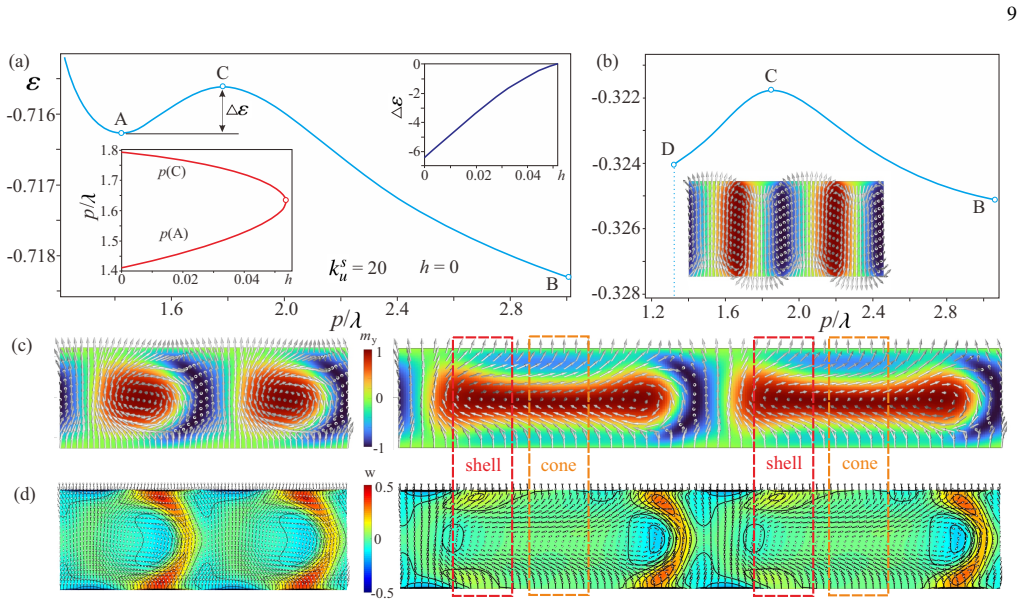
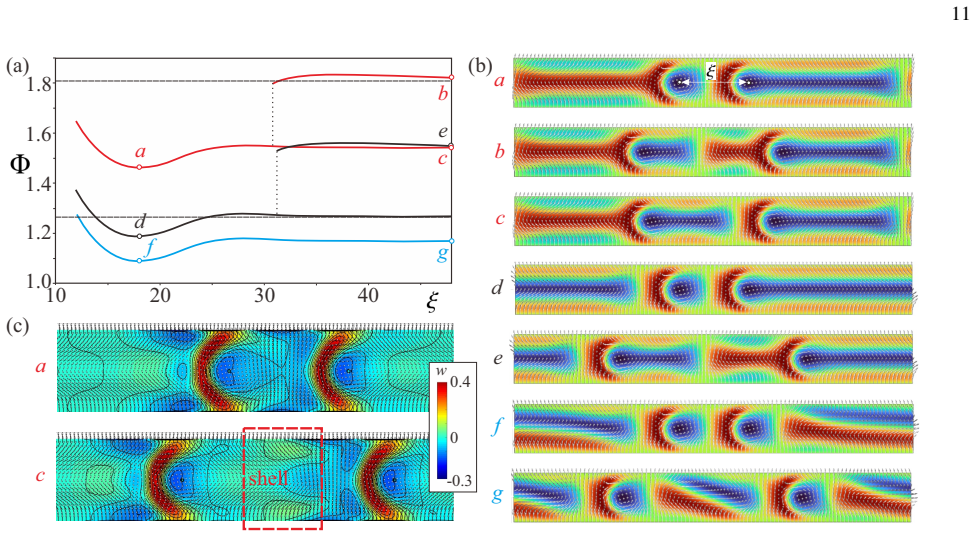
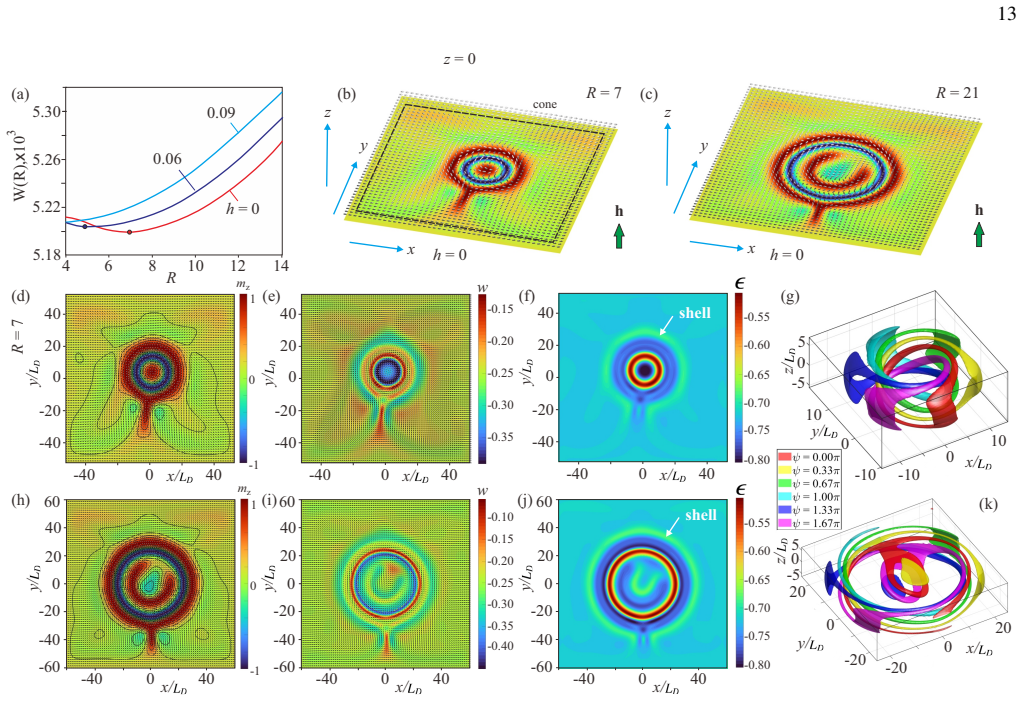
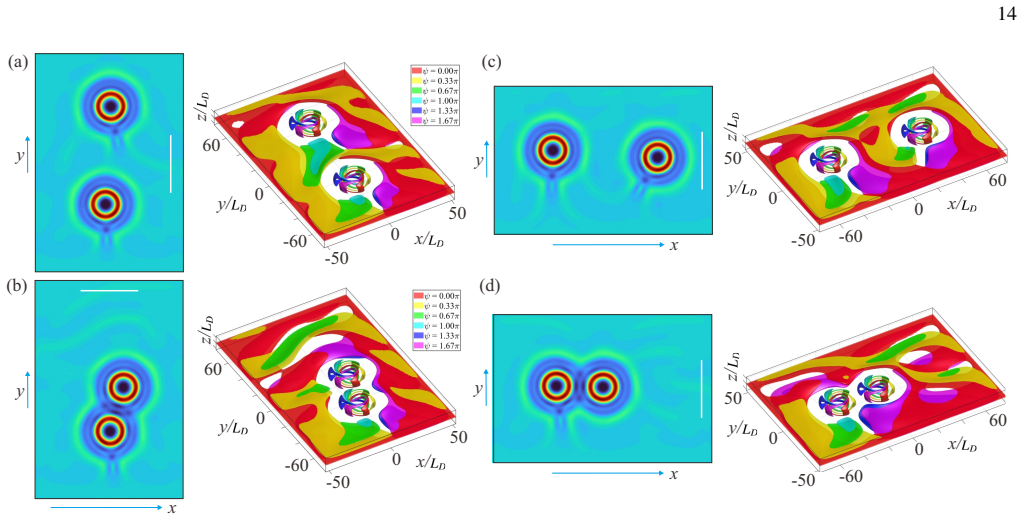
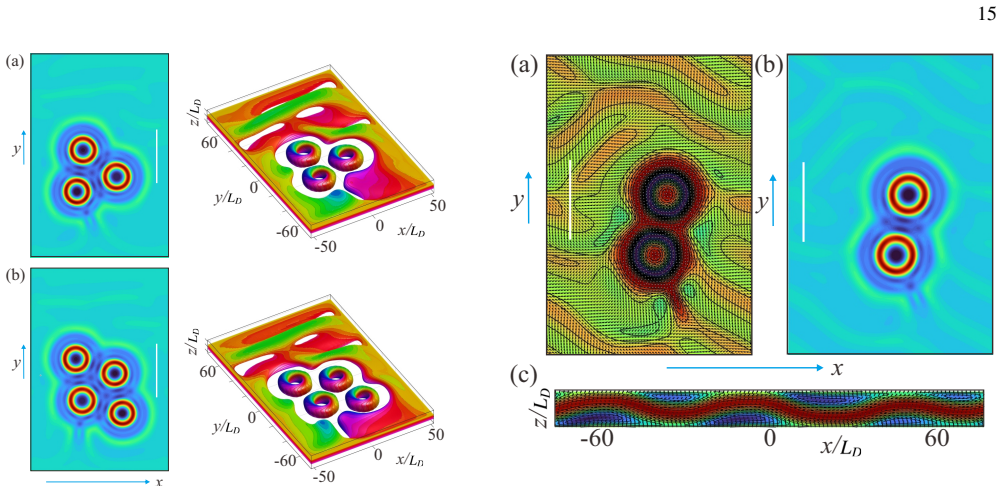
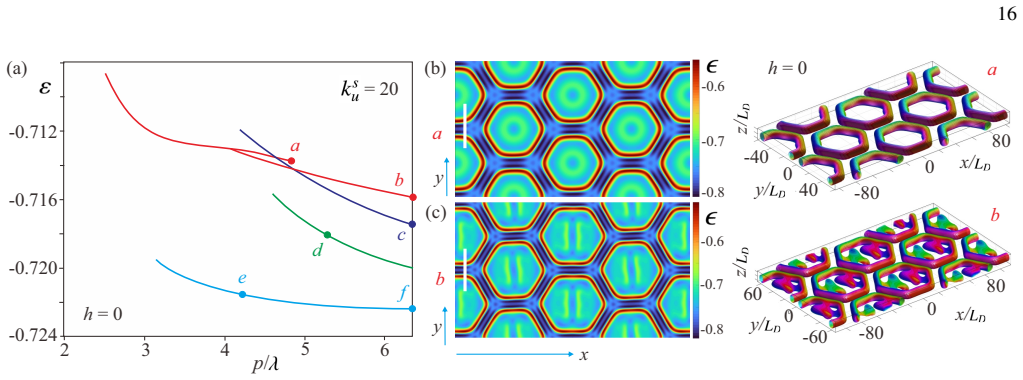
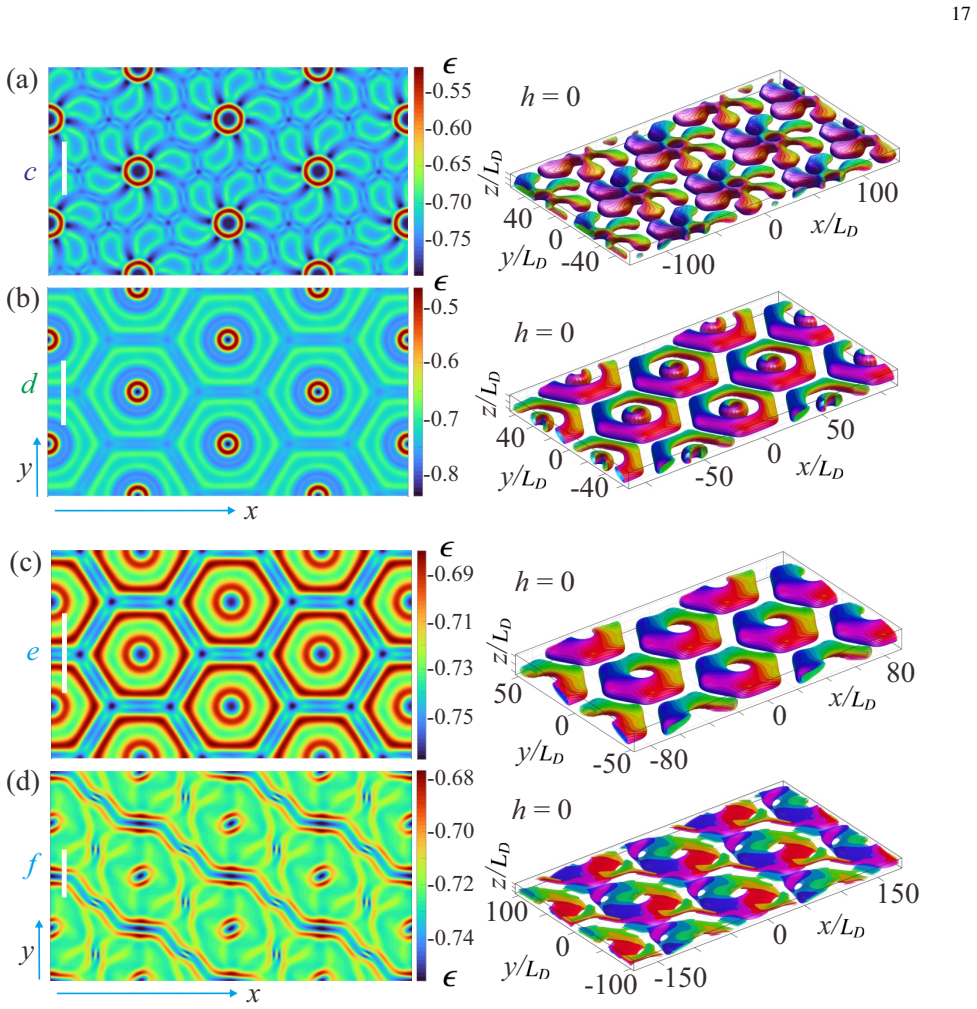
Although isolated bimerons possess positive eigen-energy with respect to the conical phase, they develop an attractive interaction mediated by the restructuring and partial overlap of their positive-energy shells, leading to the formation of bound pairs and extended bimeron chains. Isolated hopfions likewise exhibit an attractive interaction within the conical phase, leading to the formation of hexagonally ordered clusters. Hexagonal hopfion lattices do not exhibit an equilibrium lattice period; instead the conical spiral or the CF-1 phase progressively invades the inter-soliton regions, thereby preventing crystallization.
What carries the argument
Positive-energy shells relative to the conical state together with twist competition that mediates attraction between solitons.
If this is right
- Bound bimeron pairs and extended chains appear even in regimes where a full periodic lattice is thermodynamically unstable.
- Isolated hopfions form hexagonally ordered clusters inside the conical phase.
- Hexagonal hopfion lattices possess no equilibrium lattice constant.
- The conical spiral or CF-1 phase invades inter-soliton regions and blocks crystallization.
Where Pith is reading between the lines
- The same shell-overlap mechanism may produce finite rather than infinite clusters whose size is limited by sample boundaries.
- The metastability window for circularized hopfions is expected to track the stability range of the parent cholesteric fingers.
- The attraction-without-order regime could appear in confined chiral liquid crystals that support analogous conical states.
Load-bearing premise
The conical background remains the stable reference state whose energy sets the zero point for all soliton interactions, with no other phases or boundary effects taking over the energetics.
What would settle it
A simulation or thin-film experiment that tracks whether the average spacing inside a hopfion cluster stays constant or grows as the conical spiral fills the gaps between particles.
Figures
read the original abstract
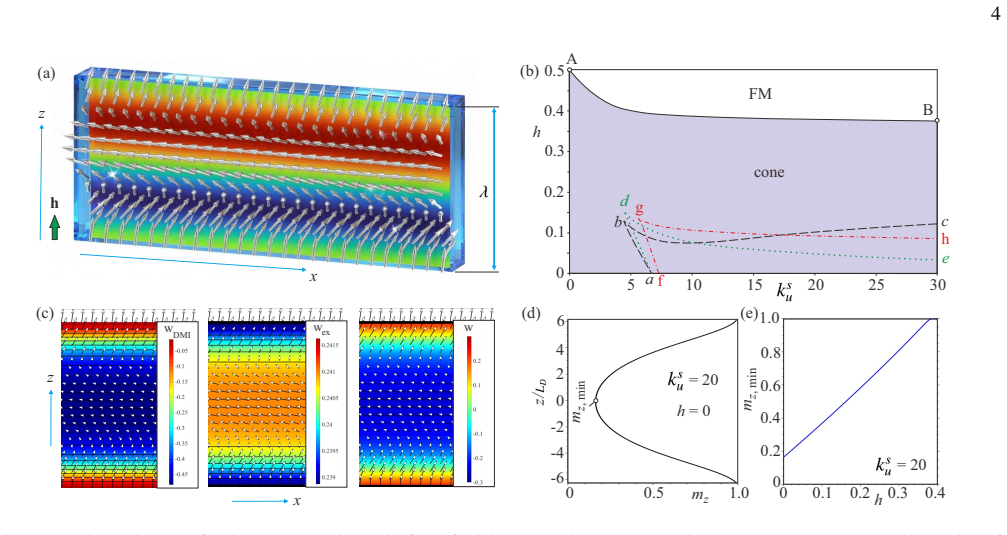
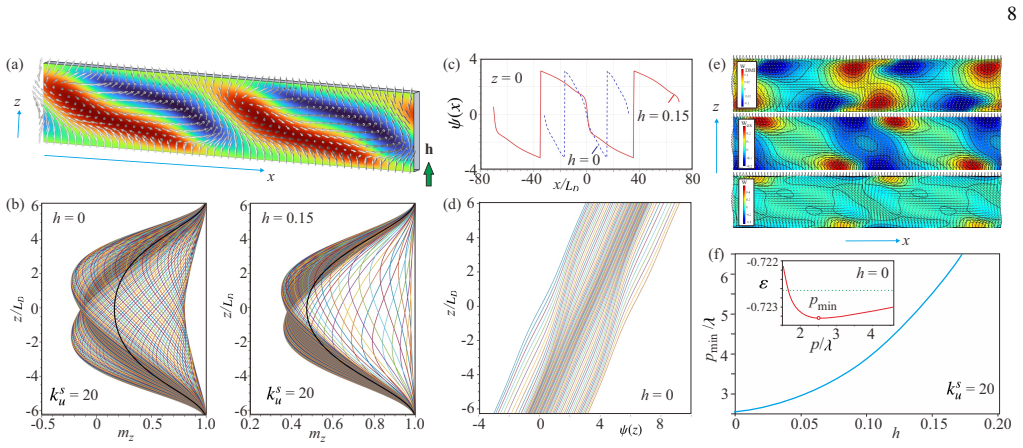
We investigate the energetics, interactions, and ordering tendencies of bimerons (cholesteric fingers of the second type, CF--2) and hopfions in thin films of chiral magnets and chiral liquid crystals hosting a conical background state. Although isolated bimerons possess positive eigen-energy with respect to the conical phase, they develop an attractive interaction mediated by the restructuring and partial overlap of their positive-energy shells, i.e., intermediate regions formed relative to the conical state. This attraction promotes the formation of bound pairs and extended bimeron chains, even in parameter regimes where a periodic bimeron lattice is no longer thermodynamically stable. Extending the analysis to three dimensions, we show that circularization of bimerons into hopfions renders their energy finite and gives rise to a well-defined metastability window closely linked to the stability range of cholesteric fingers. Isolated hopfions likewise exhibit an attractive interaction within the conical phase, leading to the formation of hexagonally ordered clusters. The attraction originates from the competition between favorable and unfavorable twist regions and from the energetic cost of the shell structures imposed by the conical background. Despite the presence of attractive pair potentials and cluster formation, we demonstrate that hexagonal hopfion lattices do not exhibit an equilibrium lattice period. Instead, the system evolves toward states in which the conical spiral or the CF--1 phase (cholesteric fingers of the first type) progressively invade the inter-soliton regions, thereby preventing crystallization. Our results reveal a regime of attraction without stable long-range order and clarify the interplay between topology, confinement, and conical-phase frustration in chiral magnet and liquid-crystal thin films.
Editorial analysis
A structured set of objections, weighed in public.
Referee Report
Summary. The manuscript investigates the energetics and interactions of bimerons (CF-2) and hopfions in thin films of chiral magnets and liquid crystals supporting a conical background state. Isolated bimerons carry positive eigen-energy relative to the conical phase yet develop attraction through restructuring and overlap of positive-energy shells, promoting bound pairs and chains. In 3D, bimeron circularization yields hopfions with finite energy and a metastability window tied to cholesteric finger stability. Isolated hopfions likewise attract, forming hexagonally ordered clusters via twist competition and shell energetics. However, hexagonal hopfion lattices lack an equilibrium period; the conical spiral or CF-1 phase invades inter-soliton regions, preventing crystallization. The work identifies a regime of attraction without stable long-range order arising from topology, confinement, and conical frustration.
Significance. If the reported energetics and invasion dynamics hold, the results establish a concrete example of attractive topological solitons that fail to crystallize due to competing background phases, clarifying the role of shell restructuring and twist energetics in confined chiral systems. The analysis of bimeron-to-hopfion circularization and the linked metastability window provides a useful bridge between 2D and 3D soliton behavior. The manuscript supplies explicit statements of the reference-state assumption and the mechanism preventing lattice formation.
minor comments (3)
- The abstract and introduction introduce CF--1 and CF--2 without a concise definition or reference to their standard topological characterization; a short paragraph or figure in §1 would improve accessibility for readers outside the immediate subfield.
- The claim that 'hexagonal hopfion lattices do not exhibit an equilibrium lattice period' is central yet presented without an explicit statement of the diagnostic used (energy minimization versus fixed-period relaxation, or comparison of chemical potential). A dedicated subsection or equation defining the criterion would strengthen the result.
- Numerical parameters controlling the conical background (reduced field, film thickness, Dzyaloshinskii-Moriya strength) are referenced only qualitatively; tabulating the ranges explored and the criteria for stability of the reference state would allow direct reproducibility assessment.
Simulated Author's Rebuttal
We thank the referee for their detailed and accurate summary of our manuscript, as well as for the positive assessment of its significance. We appreciate the recommendation for minor revision. No specific major comments were provided in the report, so we have no point-by-point responses to address at this stage. We are prepared to incorporate any additional suggestions from the editor or referee if they arise.
Circularity Check
No significant circularity in derivation chain
full rationale
The paper derives claims about bimeron/hopfion energetics, attractive interactions via shell restructuring and twist competition, cluster formation, and lattice instability directly from energy comparisons to the conical reference state. No load-bearing step reduces by construction to its inputs: there are no self-definitional relations (e.g., a quantity defined in terms of its own prediction), no fitted parameters renamed as predictions, and no uniqueness theorems or ansatzes imported solely via self-citation. The conical background is an explicit modeling choice whose consequences are computed and reported without circular reduction. The derivation remains self-contained against external micromagnetic benchmarks.
Axiom & Free-Parameter Ledger
Reference graph
Works this paper leans on
-
[1]
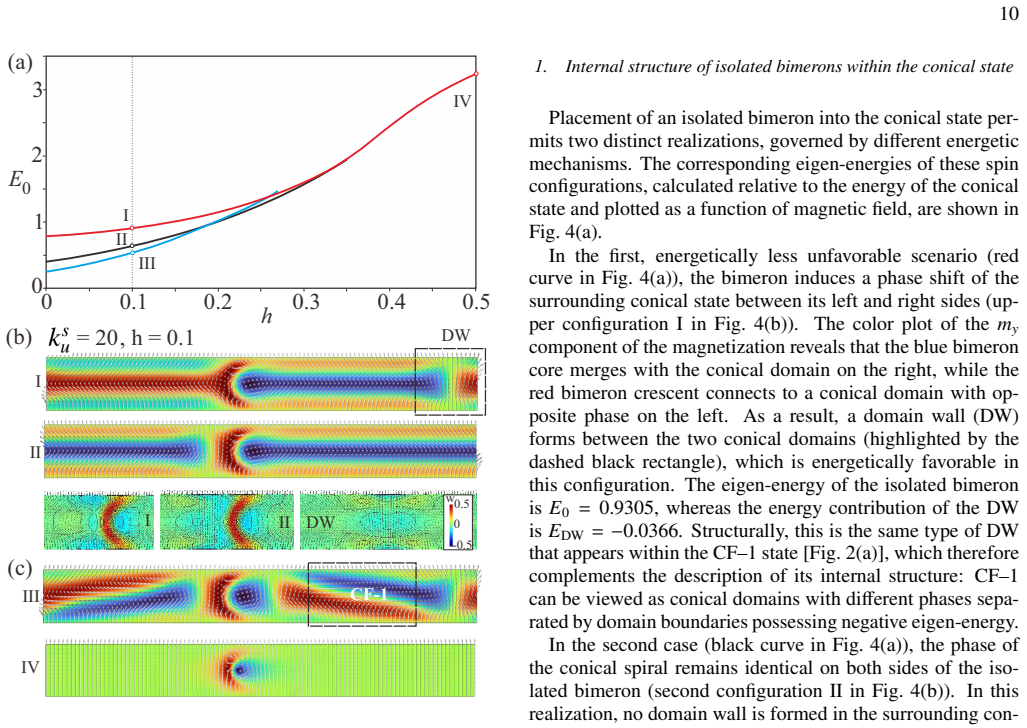
The corresponding eigen-energies of these spin configurations, calculated relative to the energy of the conical state and plotted as a function of magnetic field, are shown in Fig
Internal structure of isolated bimerons within the conical state Placement of an isolated bimeron into the conical state per- mits two distinct realizations, governed by different energetic mechanisms. The corresponding eigen-energies of these spin configurations, calculated relative to the energy of the conical state and plotted as a function of magnetic...
-
[2]
negative
Origin and structure of the attractive inter-bimeron potential To quantify the CF2–CF2 interaction within the conical phase, we compute the interaction potentialsΦfor bimeron pairs, shown in Fig. 5(a), at the parameter pointk s u =20 and h=0.1, i.e., in the regime where the bimeron lattice is already unstable. The interaction potential is obtained by eval...
-
[3]
Manton and P
N. Manton and P. Sutcliffe,Topological solitons(Cambridge University Press, 2004)
2004
-
[4]
Y . M. Shnir,Topological and non-topological solitons in scalar field theories(Cambridge University Press, 2018)
2018
-
[5]
V olovik and V
G. V olovik and V . Mineev, Zh. Eksp. Teor. Fiz73, 767 (1977)
1977
-
[6]
Rajaraman,Solitons and Instantons: An Introduction to Soli- tons and Instantons in Quantum Field Theory(North-Holland, Amsterdam, 1982)
R. Rajaraman,Solitons and Instantons: An Introduction to Soli- tons and Instantons in Quantum Field Theory(North-Holland, Amsterdam, 1982)
1982
-
[7]
A. O. Leonov and K. Nakamura, Phys. Rev. Mater.10, 036001 (2026)
2026
-
[8]
Faddeev and A
L. Faddeev and A. J. Niemi, Nature387, 58 (1997)
1997
-
[9]
Bott and L
R. Bott and L. W. Tu,Differential forms in algebraic topology, V ol. 82 (Springer Science & Business Media, 2013)
2013
-
[10]
Dzyaloshinskii, Sov
I. Dzyaloshinskii, Sov. Phys. JETP19, 960 (1964)
1964
-
[11]
Moriya, Physical Review120, 91 (1960)
T. Moriya, Physical Review120, 91 (1960)
1960
-
[12]
Oswald and P
P. Oswald and P. Pieranski,Nematic and cholesteric liquid crys- tals: concepts and physical properties illustrated by experi- ments(CRC press, 2005)
2005
-
[13]
Kleman and O
M. Kleman and O. D. Lavrentovich,Soft matter physics: an introduction(Springer, 2003)
2003
-
[14]
P. J. Ackerman and I. I. Smalyukh, Physical Review X7, 011006 (2017)
2017
-
[15]
N. Kent, R. Streubel, C.-H. Lambert, A. Ceballos, S.-G. Je, S. Dhuey, M.-Y . Im, F. B ¨uttner, F. Hellman, S. Salahuddin, et al., Applied Physics Letters115, 112404 (2019)
2019
-
[16]
Luk’yanchuk, Y
I. Luk’yanchuk, Y . Tikhonov, A. Razumnaya, and V . Vinokur, Nature Communications11, 2433 (2020)
2020
-
[17]
P. J. Ackerman and I. I. Smalyukh, Nature Materials16, 426 (2017)
2017
-
[18]
Bidasyuk, A
Y . Bidasyuk, A. Chumachenko, O. Prikhodko, S. Vilchin- skii, M. Weyrauch, and A. Yakimenko, Physical Review A92, 053603 (2015)
2015
-
[19]
Sutcliffe, Journal of Physics A: Mathematical and Theoretical 51, 375401 (2018)
P. Sutcliffe, Journal of Physics A: Mathematical and Theoretical 51, 375401 (2018)
2018
-
[20]
Sallermann, H
M. Sallermann, H. J ´onsson, and S. Bl ¨ugel, Physical Review B 107, 104404 (2023). 19
2023
-
[21]
Liu, Phys
R. Liu, Phys. Rev. B98, 79P (2018)
2018
-
[22]
A. O. Leonov, Magnetism3, 297 (2023)
2023
-
[23]
K. L. Metlov, Physical Review B111, 174450 (2025)
2025
-
[24]
Bogdanov and A
A. Bogdanov and A. Hubert, Journal of Magnetism and Mag- netic Materials138, 255 (1994)
1994
-
[25]
J.-S. B. Tai and I. I. Smalyukh, Physical Review Letters121, 187201 (2018)
2018
- [26]
-
[27]
A. O. Leonov and T. Shigenaga, Physical Review Research8, 023193 (2026)
2026
-
[28]
Nakamura and A
K. Nakamura and A. Leonov, Physical Review B110, 094403 (2024)
2024
-
[29]
A. O. Leonov, Physical Review B105, 094404 (2022)
2022
-
[30]
Leonov, I
A. Leonov, I. Dragunov, U. R ¨oßler, and A. Bogdanov, Physical Review E90, 042502 (2014)
2014
-
[31]
A. O. Leonov, Physical Review E104, 044701 (2021)
2021
-
[32]
Rapini and M
A. Rapini and M. Papoular, Le Journal de Physique Colloques 30, C4 (1969)
1969
-
[33]
Shiyanovskii, D
S. Shiyanovskii, D. V oloschenko, T. Ishikawa, and O. Lavren- tovich, Molecular Crystals and Liquid Crystals Science and Technology. Section A. Molecular Crystals and Liquid Crystals 358, 225 (2001)
2001
-
[34]
Shiyanovskii, I
S. Shiyanovskii, I. Smalyukh, and O. Lavrentovich, inDefects in liquid crystals: computer simulations, theory and experi- ments(Springer, 2001) pp. 229–270
2001
-
[35]
J. V . Selinger,Introduction to topological defects and solitons: in liquid crystals, magnets, and related materials(Springer, 2024)
2024
-
[36]
Mertelj, D
A. Mertelj, D. Lisjak, M. Drofenik, and M. ˇCopiˇc, Nature504, 237 (2013)
2013
-
[37]
Q. Liu, P. J. Ackerman, T. C. Lubensky, and I. I. Smalyukh, Proceedings of the National Academy of Sciences113, 10479 (2016)
2016
-
[38]
O. D. Lavrentovich, Proceedings of the National Academy of Sciences117, 14629 (2020)
2020
-
[39]
Cholesteric Fingers from a Magnetic Perspective: Topology, Energetics, and Interactions
T. Shigenaga and A. O. Leonov, arXiv preprint arXiv:2604.06660 (2026)
work page internal anchor Pith review Pith/arXiv arXiv 2026
-
[40]
Vansteenkiste, J
A. Vansteenkiste, J. Leliaert, M. Dvornik, M. Helsen, F. Garcia- Sanchez, and B. Van Waeyenberge, AIP advances4, 107133 (2014)
2014
-
[41]
Karhu, U
E. Karhu, U. R ¨oßler, A. Bogdanov, S. Kahwaji, B. Kirby, H. Fritzsche, M. Robertson, C. Majkrzak, and T. Monchesky, Physical Review B—Condensed Matter and Materials Physics 85, 094429 (2012)
2012
-
[42]
Huang and C
S. Huang and C. Chien, Physical Review Letters108, 267201 (2012)
2012
-
[43]
Dieny and M
B. Dieny and M. Chshiev, Reviews of Modern Physics89, 025008 (2017)
2017
-
[44]
Johnson, P
M. Johnson, P. Bloemen, F. Den Broeder, and J. De Vries, Re- ports on Progress in Physics59, 1409 (1996)
1996
-
[45]
Kawaguchi, Y
Y . Kawaguchi, Y . Tanaka, and N. Nagaosa, Physical Review B 93, 064416 (2016)
2016
-
[46]
N. A. Porter, C. S. Spencer, R. C. Temple, C. J. Kinane, T. R. Charlton, S. Langridge, and C. H. Marrows, Phys. Rev. B92, 144402 (2015)
2015
-
[47]
Leonov, G
A. Leonov, G. G ¨odecke, J. Grefe, S. S ¨ullow, and D. Menzel, Physical Review Research8, 013130 (2026)
2026
-
[48]
Muhlbauer, B
S. Muhlbauer, B. Binz, F. Jonietz, C. Pfleiderer, A. Rosch, A. Neubauer, R. Georgii, and P. Boni, Science323, 915 (2009)
2009
-
[49]
Crisanti, A
M. Crisanti, A. Leonov, R. Cubitt, A. Labh, H. Wilhelm, M. P. Schmidt, and C. Pappas, Physical Review Research5, 033033 (2023)
2023
-
[50]
Dozov, EPL (Europhysics Letters)56, 247 (2001)
I. Dozov, EPL (Europhysics Letters)56, 247 (2001)
2001
-
[51]
Borshch, Y .-K
V . Borshch, Y .-K. Kim, J. Xiang, M. Gao, A. J´akli, V . P. Panov, J. K. Vij, C. T. Imrie, M.-G. Tamba, G. H. Mehl,et al., Nature communications4, 2635 (2013)
2013
-
[52]
D. Chen, J. H. Porada, J. B. Hooper, A. Klittnick, Y . Shen, M. R. Tuchband, E. Korblova, D. Bedrov, D. M. Walba, M. A. Glaser, et al., Proceedings of the National Academy of Sciences110, 15931 (2013)
2013
-
[53]
R. B. Meyer, Applied Physics Letters14, 208 (1969)
1969
-
[54]
De Gennes, Solid State Communications6, 163 (1968)
P. De Gennes, Solid State Communications6, 163 (1968)
1968
-
[55]
Xiang, S
J. Xiang, S. V . Shiyanovskii, C. Imrie, and O. D. Lavrentovich, Physical Review Letters112, 217801 (2014)
2014
-
[56]
O. S. Iadlovska, G. R. Maxwell, G. Babakhanova, G. H. Mehl, C. Welch, S. V . Shiyanovskii, and O. D. Lavrentovich, Optics Letters43, 1850 (2018)
2018
-
[57]
Karcz, J
J. Karcz, J. Herman, N. Rychłowicz, P. Kula, E. G ´orecka, J. Szydlowska, P. W. Majewski, and D. Pociecha, Science384, 1096 (2024)
2024
-
[58]
Bogdanov and A
A. Bogdanov and A. Hubert, Journal of Magnetism and Mag- netic Materials195, 182 (1999)
1999
-
[59]
Oswald, J
P. Oswald, J. Baudry, and S. Pirkl, Physics Reports337, 67 (2000)
2000
-
[60]
Baudry, S
J. Baudry, S. Pirkl, and P. Oswald, Physical Review E59, 5562 (1999)
1999
-
[61]
I. I. Smalyukh, B. Senyuk, P. Palffy-Muhoray, O. Lavrentovich, H. Huang, E. Gartland Jr, V . Bodnar, T. Kosa, and B. Taheri, Physical Review E—Statistical, Nonlinear, and Soft Matter Physics72, 061707 (2005)
2005
-
[62]
R. B. Meyer, inLes Houches Summer School in Theoretical Physics, 1973: Molecular Fluids, edited by R. Balian and G. Weil (Gordon and Breach, New York, 1976)
1973
-
[63]
De Gennes, J
P.-G. De Gennes, J. Prost,et al., International series of mono- graphs on physics83, 2 (1995)
1995
-
[64]
Press and A
M. Press and A. Arrott, Molecular Crystals and Liquid Crystals 37, 81 (1976)
1976
-
[65]
Gil and J
L. Gil and J. Gilli, Physical Review Letters80, 5742 (1998)
1998
-
[66]
Ribi `ere, S
P. Ribi `ere, S. Pirkl, and P. Oswald, Liquid Crystals16, 203 (1994)
1994
-
[67]
Togawa, T
Y . Togawa, T. Koyama, K. Takayanagi, S. Mori, Y . Kousaka, J. Akimitsu, S. Nishihara, K. Inoue, A. Ovchinnikov, and J.-i. Kishine, Physical Review Letters108, 107202 (2012)
2012
-
[68]
S.-Z. Lin, A. Saxena, and C. D. Batista, Physical review B91, 224407 (2015)
2015
-
[69]
Ohara, X
K. Ohara, X. Zhang, Y . Chen, S. Kato, J. Xia, M. Ezawa, O. A. Tretiakov, Z. Hou, Y . Zhou, G. Zhao,et al., Nano Letters22, 8559 (2022)
2022
-
[70]
Leonov, T
A. Leonov, T. Monchesky, J. Loudon, and A. Bogdanov, Journal of Physics: Condensed Matter28, 35LT01 (2016)
2016
-
[71]
Loudon, A
J. Loudon, A. Leonov, A. Bogdanov, M. C. Hatnean, and G. Balakrishnan, Physical Review B97, 134403 (2018)
2018
-
[72]
Capic, D
D. Capic, D. A. Garanin, and E. M. Chudnovsky, Journal of Physics: Condensed Matter32, 415803 (2020)
2020
discussion (0)
Sign in with ORCID, Apple, or X to comment. Anyone can read and Pith papers without signing in.