A z sim 6.2 Quasar on the Local M_(rm BH)-σ_(rm ast) Relation Quenching Its Host Galaxy from the Aether Survey
Pith reviewed 2026-06-28 09:43 UTC · model grok-4.3
The pith
A quasar at redshift 6.2 already lies on the local black hole mass-stellar velocity dispersion relation while its outflow quenches the host galaxy.
A machine-rendered reading of the paper's core claim, the machinery that carries it, and where it could break.
Core claim
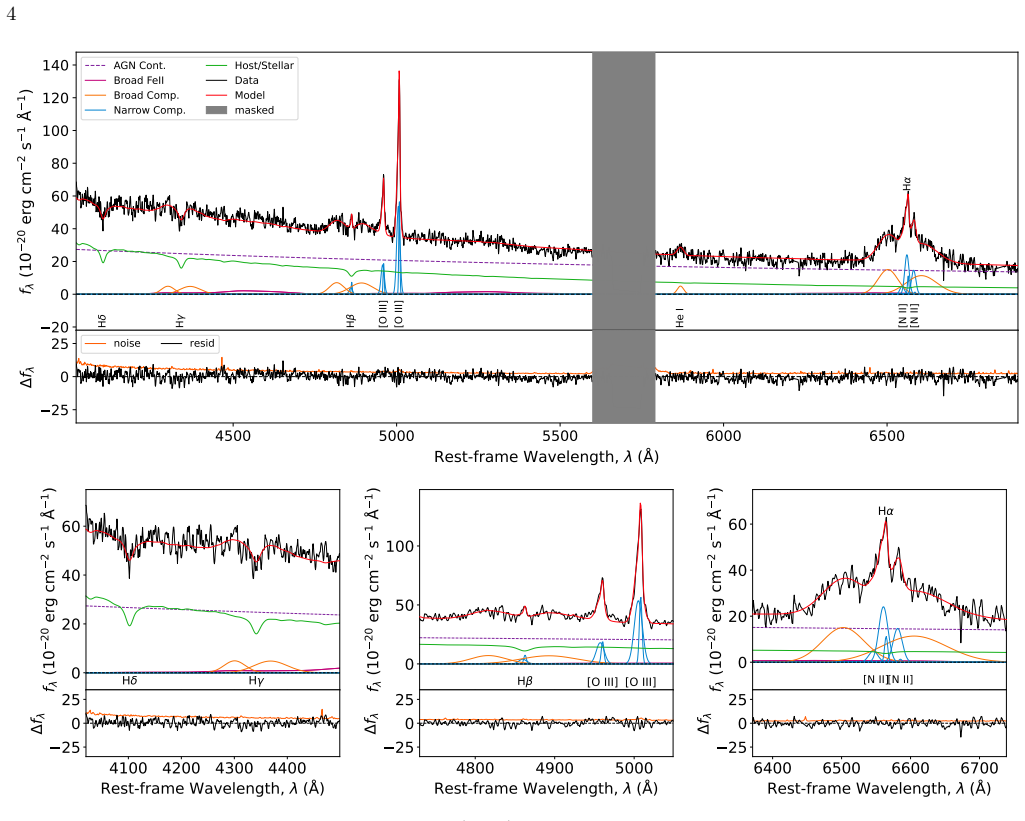
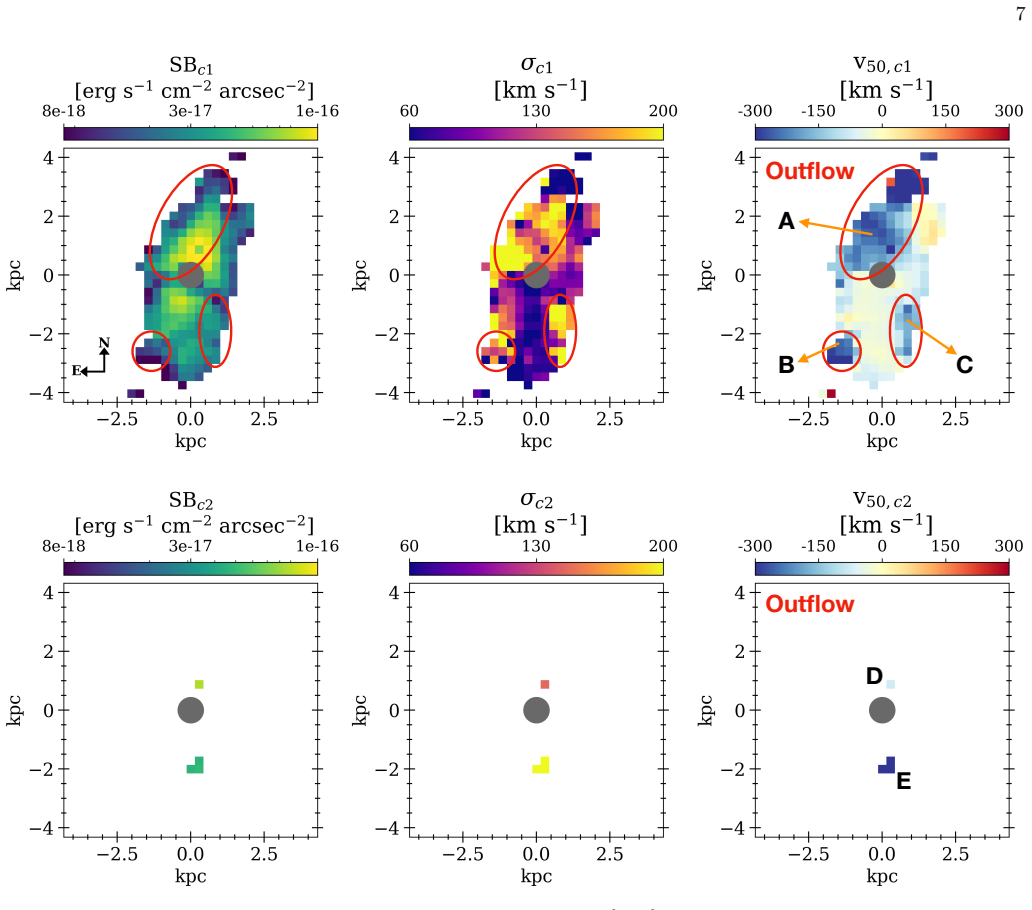
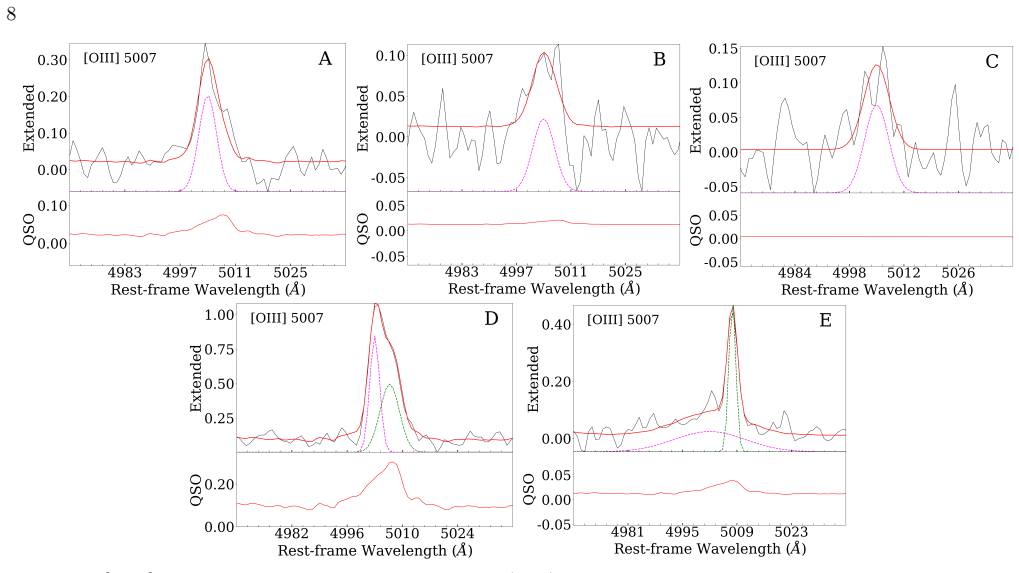
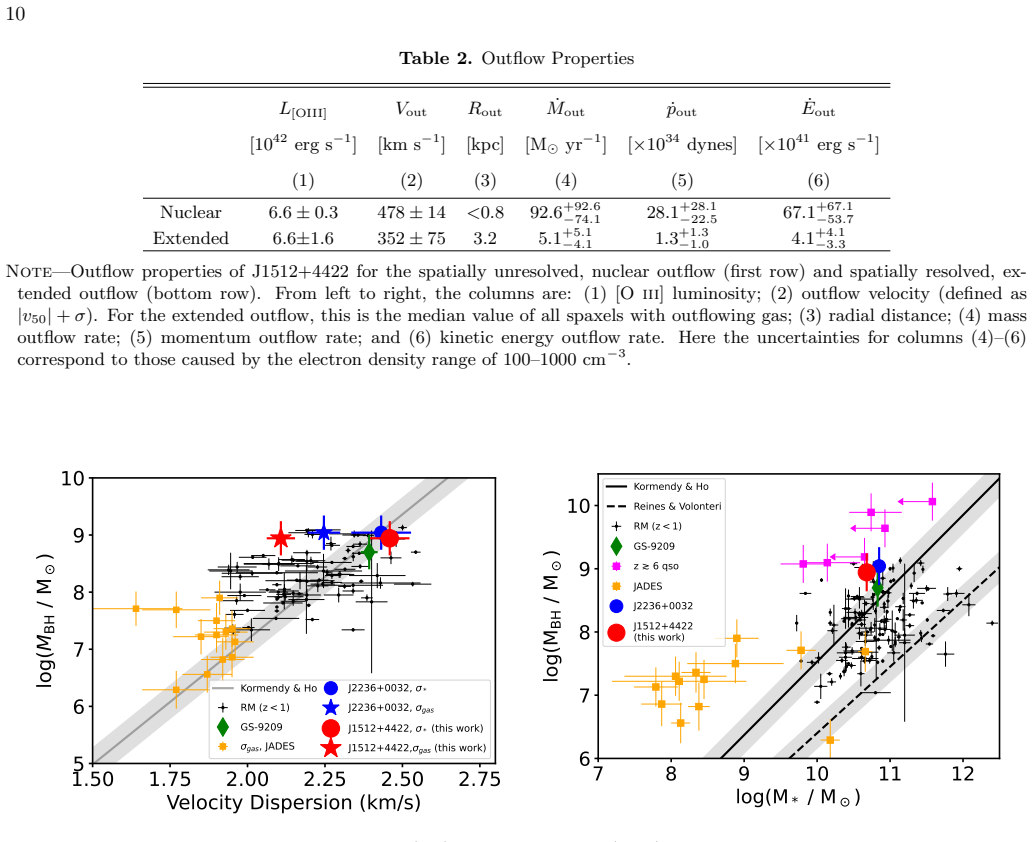
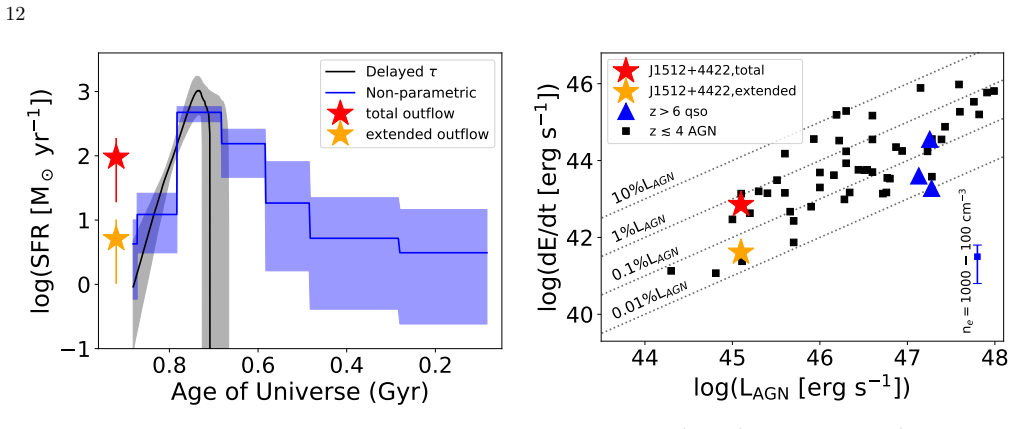
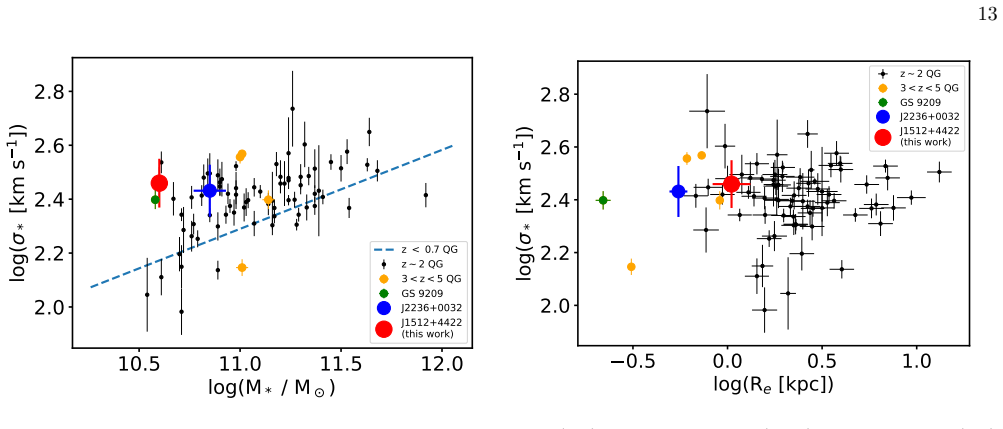
J1512+4422 at z ~ 6.2 has M_BH ≃ 8.9×10^8 M_⊙ and σ_* ≃ 288 km s^{-1}, placing it on the local M_BH-σ_* relation. The nuclear outflow reaches ~478 km s^{-1} and extends to ~3.2 kpc with a mass rate of 92.6 M_⊙ yr^{-1} and kinetic power 0.6% of quasar luminosity; its dynamical timescale of ~9 Myr matches the quenching timescale, and the mass rate exceeds the star formation rate of 0.9-4.3 M_⊙ yr^{-1}, indicating the outflow can suppress star formation. The host's σ_*, stellar mass and size resemble those of z ≳ 3 quiescent galaxies, linking the two populations.
What carries the argument
JWST/NIRSpec IFU spectroscopy measuring black hole mass from broad emission lines, stellar velocity dispersion from absorption features, and outflow properties from spatially resolved emission line kinematics.
Load-bearing premise
The conversion of observed line widths and spatial extents into black hole mass, stellar velocity dispersion, and outflow mass rate assumes standard geometries, ionization conditions, and stellar population models that hold at high redshift.
What would settle it
A direct dynamical measurement of stellar velocity dispersion or black hole mass in J1512+4422 using stellar absorption line modeling or reverberation mapping that yields values inconsistent with 288 km s^{-1} or 8.9×10^8 solar masses.
Figures
read the original abstract
We report JWST/NIRSpec integral field unit (IFU) observations of the quasar J1512$+$4422 at $z \sim 6.2$ from the Aether survey. At $\sim$900 Myr after the Big Bang, this object already lies on the $M_{\rm BH}$-$\sigma_\ast$ relation found in the local universe, with an $M_{\rm BH} \simeq 8.9\times10^8\,M_\odot$ and a stellar velocity dispersion $\sigma_\ast \simeq 288$ km s$^{-1}$. We detect an outflow with a velocity of $\sim$478 km s$^{-1}$ in the nuclear region, which likely extends to $\sim$3.2 kpc in projection and has a median velocity of $\sim$352 km s$^{-1}$. The outflow dynamical time scale ($\sim$ 9 Myr) is consistent with the time scale of the current quenching process based on the star formation history as reported previously. The total mass outflow rate (92.6$^{+92.6}_{-74.1}$ M$_{\odot}$ yr$^{-1}$) is larger than the current star formation rate (0.9$^{+3.8}_{-0.8}$ or 4.3$^{+5.8}_{-3.7}$ M$_{\odot}$ yr$^{-1}$), and the total kinetic energy outflow rate (0.6$^{+0.6}_{-0.5}$\% of quasar luminosity) meets the threshold for negative quasar feedback as suggested by simulations. These results suggest that the outflow is capable of suppressing/quenching the star formation activity within the host galaxy. Furthermore, J1512$+$4422 exhibits $\sigma_\ast$, stellar mass and size similar to those of $z \gtrsim$ 3 quiescent/post-starburst galaxies, implying a link between the two. Overall, for objects like J1512$+$4422, the evolution of their SMBHs and host galaxies appears to be tightly coupled within the first billion years. The quasar feedback likely plays a critical role in both placing them on the $M_{\rm BH}$--$\sigma_\ast$ relation and quenching.
Editorial analysis
A structured set of objections, weighed in public.
Referee Report
Summary. The manuscript reports JWST/NIRSpec IFU observations of quasar J1512+4422 at z~6.2 from the Aether survey. It claims the object already lies on the local M_BH-σ_* relation (M_BH ≃ 8.9×10^8 M_⊙, σ_* ≃ 288 km s^{-1}), detects a nuclear outflow (velocity ~478 km s^{-1}, extending to ~3.2 kpc, mass rate 92.6^{+92.6}_{-74.1} M_⊙ yr^{-1}, kinetic power 0.6% of L_QSO) whose dynamical timescale (~9 Myr) matches the quenching timescale from prior SFH, and concludes the outflow is capable of suppressing star formation, linking the object to z≳3 quiescent galaxies and implying tight early SMBH-host coupling via feedback.
Significance. If the reported values and their underlying assumptions prove robust, the result would be significant: it supplies one of the highest-redshift examples of a quasar already on the local scaling relation and provides direct evidence that quasar-driven outflows can meet simulation thresholds for negative feedback within the first Gyr, thereby helping to place the system on the relation and quench its host. The similarity in σ_*, M_*, and size to z≳3 post-starburst galaxies offers a concrete observational link between quasar activity and the emergence of the quiescent population.
major comments (2)
- [Abstract] Abstract: the central claim that J1512+4422 lies on the local M_BH-σ_* relation rests on the quoted M_BH ≃ 8.9×10^8 M_⊙ (broad-line virial estimator) and σ_* ≃ 288 km s^{-1}; the text provides no derivation details, no adopted virial factor f, no discussion of BLR geometry or stellar-population template systematics, and no sensitivity tests showing that plausible variations at z~6.2 still keep the object on the relation. These assumptions are load-bearing for the headline result.
- [Abstract] Abstract (outflow section): the reported mass outflow rate (92.6^{+92.6}_{-74.1} M_⊙ yr^{-1}) and kinetic coupling (0.6^{+0.6}_{-0.5} % of L_QSO) are stated to exceed the SFR and meet the negative-feedback threshold, yet the manuscript supplies no explicit values or ranges for the assumed n_e, volume filling factor, or projected-to-deprojected geometry corrections; without these, it is unclear whether the lower error bound remains above the simulation threshold or the SFR.
minor comments (3)
- [Abstract] The phrase “star formation history as reported previously” requires an explicit citation to the earlier work.
- [Abstract] Clarify whether σ_* is measured from stellar absorption features or from gas kinematics, and state the spatial aperture used.
- [Abstract] The large asymmetric uncertainties on the outflow rate should be accompanied by a brief statement on whether the conclusion that outflow rate > SFR remains valid across the full error range.
Simulated Author's Rebuttal
We thank the referee for their careful and constructive review. We address each major comment below and will revise the manuscript to improve transparency on key assumptions.
read point-by-point responses
-
Referee: [Abstract] Abstract: the central claim that J1512+4422 lies on the local M_BH-σ_* relation rests on the quoted M_BH ≃ 8.9×10^8 M_⊙ (broad-line virial estimator) and σ_* ≃ 288 km s^{-1}; the text provides no derivation details, no adopted virial factor f, no discussion of BLR geometry or stellar-population template systematics, and no sensitivity tests showing that plausible variations at z~6.2 still keep the object on the relation. These assumptions are load-bearing for the headline result.
Authors: The referee correctly notes that the abstract is concise and does not repeat the full derivation. The Methods section of the manuscript describes the broad-line virial estimator, the adopted virial factor, BLR geometry assumptions, and the stellar population templates used for σ_*. A sensitivity analysis to plausible variations is included in an appendix. To address the concern that these details are not immediately visible, we will revise the abstract to include a short parenthetical note on the virial factor and add an explicit paragraph in the main text summarizing the systematics and sensitivity tests. revision: yes
-
Referee: [Abstract] Abstract (outflow section): the reported mass outflow rate (92.6^{+92.6}_{-74.1} M_⊙ yr^{-1}) and kinetic coupling (0.6^{+0.6}_{-0.5} % of L_QSO) are stated to exceed the SFR and meet the negative-feedback threshold, yet the manuscript supplies no explicit values or ranges for the assumed n_e, volume filling factor, or projected-to-deprojected geometry corrections; without these, it is unclear whether the lower error bound remains above the simulation threshold or the SFR.
Authors: We agree that the abstract does not list the specific parameters adopted for the outflow calculation. These values (electron density, volume filling factor, and geometry corrections) are provided in the Methods section, along with the resulting mass and kinetic power rates. We will revise the manuscript to state the adopted parameters explicitly in the abstract or a dedicated methods paragraph and to include a short sensitivity discussion confirming that the lower error bounds remain above both the observed SFR and the simulation feedback threshold. revision: yes
Circularity Check
No circularity: observational quantities derived from JWST data and compared to external local relation and simulation thresholds
full rationale
The paper reports direct JWST/NIRSpec IFU measurements of line widths, spatial extents, and velocities for J1512+4422, converts them to M_BH, σ_*, outflow rate, and kinetic power using standard (externally calibrated) prescriptions, then compares the resulting numbers to the local M_BH-σ_* relation and to simulation feedback thresholds. No equation or step reduces any reported value to a parameter fitted from the same dataset, nor does any central claim rest on a self-citation chain whose content is itself unverified within the paper. The reference to prior star-formation history is a minor external input and does not make the outflow-quenching or relation-placement claims circular by construction.
Axiom & Free-Parameter Ledger
axioms (2)
- domain assumption Standard single-epoch or virial estimators for M_BH and stellar velocity dispersion remain valid at z~6.2 without additional high-redshift calibration.
- domain assumption The outflow mass rate and kinetic luminosity can be computed from observed velocity and spatial extent using standard assumptions about geometry and filling factor.
Reference graph
Works this paper leans on
-
[1]
Alberts, S., Williams, C. C., Helton, J. M., et al. 2023, arXiv e-prints, arXiv:2312.12207, doi: 10.48550/arXiv.2312.12207 Astropy Collaboration, Robitaille, T. P., Tollerud, E. J., et al. 2013, A&A, 558, A33, doi: 10.1051/0004-6361/201322068 Astropy Collaboration, Price-Whelan, A. M., Sip˝ ocz, B. M., et al. 2018, AJ, 156, 123, doi: 10.3847/1538-3881/aab...
-
[2]
2024, MNRAS, 527, 1033, doi: 10.1093/mnras/stad3179
Witten, C. 2024, MNRAS, 527, 1033, doi: 10.1093/mnras/stad3179
-
[3]
2007, ApJ, 668, 721, doi: 10.1086/521180
Bian, W.-H., Chen, Y.-M., Gu, Q.-S., & Wang, J.-M. 2007, ApJ, 668, 721, doi: 10.1086/521180
-
[4]
2019, A&A, 630, A59, doi: 10.1051/0004-6361/201833557
Bischetti, M., Maiolino, R., Carniani, S., et al. 2019, A&A, 630, A59, doi: 10.1051/0004-6361/201833557
-
[5]
Bischetti, M., Feruglio, C., D’Odorico, V., et al. 2022, Nature, 605, 244, doi: 10.1038/s41586-022-04608-1 B¨ oker, T., Arribas, S., L¨ utzgendorf, N., et al. 2022, A&A, 661, A82, doi: 10.1051/0004-6361/202142589
-
[6]
Boroson, T. A., & Green, R. F. 1992, ApJS, 80, 109, doi: 10.1086/191661 Cano-D´ ıaz, M., Maiolino, R., Marconi, A., et al. 2012, A&A, 537, L8, doi: 10.1051/0004-6361/201118358
-
[7]
2023, MNRAS, 526, 3273, doi: 10.1093/mnras/stad2597
Cappellari, M. 2023, MNRAS, 526, 3273, doi: 10.1093/mnras/stad2597
-
[8]
Cardelli, J. A., Clayton, G. C., & Mathis, J. S. 1989, ApJ, 345, 245, doi: 10.1086/167900
-
[9]
Carnall, A. C., McLure, R. J., Dunlop, J. S., & Dav´ e, R. 2018, MNRAS, 480, 4379, doi: 10.1093/mnras/sty2169
work page internal anchor Pith review doi:10.1093/mnras/sty2169 2018
-
[10]
Carnall, A. C., McLure, R. J., Dunlop, J. S., et al. 2023, Nature, 619, 716, doi: 10.1038/s41586-023-06158-6
-
[11]
Carnall, A. C., Cullen, F., McLure, R. J., et al. 2024, MNRAS, 534, 325, doi: 10.1093/mnras/stae2092
-
[12]
Choi, E., Ostriker, J. P., Naab, T., & Johansson, P. H. 2012, ApJ, 754, 125, doi: 10.1088/0004-637X/754/2/125
-
[13]
Modeling the Panchromatic Spectral Energy Distributions of Galaxies
Conroy, C. 2013, ARA&A, 51, 393, doi: 10.1146/annurev-astro-082812-141017
work page internal anchor Pith review doi:10.1146/annurev-astro-082812-141017 2013
-
[14]
Costa, T., Sijacki, D., & Haehnelt, M. G. 2014a, MNRAS, 444, 2355, doi: 10.1093/mnras/stu1632
-
[15]
Costa, T., Sijacki, D., Trenti, M., & Haehnelt, M. G. 2014b, MNRAS, 439, 2146, doi: 10.1093/mnras/stu101 de Graaff, A., Setton, D. J., Brammer, G., et al. 2025, Nature Astronomy, 9, 280, doi: 10.1038/s41550-024-02424-3
-
[16]
Decarli, R., Loiacono, F., Farina, E. P., et al. 2024, A&A, 689, A219, doi: 10.1051/0004-6361/202449239 Di Matteo, T., Springel, V., & Hernquist, L. 2005, Nature, 433, 604, doi: 10.1038/nature03335
-
[17]
Ding, X., Onoue, M., Silverman, J. D., et al. 2023, Nature, 621, 51, doi: 10.1038/s41586-023-06345-5
-
[18]
Ding, X., Onoue, M., Silverman, J. D., et al. 2025, ApJ, 993, 91, doi: 10.3847/1538-4357/ae045b 17
-
[19]
Eracleous, M., & Halpern, J. P. 1994, ApJS, 90, 1, doi: 10.1086/191856
-
[20]
Eracleous, M., Lewis, K. T., & Flohic, H. M. L. G. 2009, NewAR, 53, 133, doi: 10.1016/j.newar.2009.07.005
-
[21]
Fabian, A. C. 2012, ARA&A, 50, 455, doi: 10.1146/annurev-astro-081811-125521
work page internal anchor Pith review doi:10.1146/annurev-astro-081811-125521 2012
-
[22]
Fan, X., Ba˜ nados, E., & Simcoe, R. A. 2023, Annual Review of Astronomy and Astrophysics, 61, 373, doi: 10.1146/annurev-astro-052920-102455
-
[23]
P., Schindler, J.-T., Walter, F., et al
Farina, E. P., Schindler, J.-T., Walter, F., et al. 2022, ApJ, 941, 106, doi: 10.3847/1538-4357/ac9626
-
[24]
A Fundamental Relation Between Supermassive Black Holes and Their Host Galaxies
Ferrarese, L., & Merritt, D. 2000, The Astrophysical Journal Letters, 539, L9, doi: 10.1086/312838
work page internal anchor Pith review doi:10.1086/312838 2000
-
[25]
2017, A&A, 601, A143, doi: 10.1051/0004-6361/201629478
Fiore, F., Feruglio, C., Shankar, F., et al. 2017, A&A, 601, A143, doi: 10.1051/0004-6361/201629478
work page internal anchor Pith review doi:10.1051/0004-6361/201629478 2017
-
[26]
2000, The Astrophysical Journal Letters, 539, L13, doi: 10.1086/312840
Gebhardt, K., et al. 2000, The Astrophysical Journal Letters, 539, L13, doi: 10.1086/312840
-
[27]
2017, Nature, 544, 71, doi: 10.1038/nature21680
Glazebrook, K., Schreiber, C., Labb´ e, I., et al. 2017, Nature, 544, 71, doi: 10.1038/nature21680
-
[28]
Greene, J. E., & Ho, L. C. 2005a, ApJ, 630, 122, doi: 10.1086/431897
work page internal anchor Pith review doi:10.1086/431897
-
[29]
Greene, J. E., & Ho, L. C. 2005b, ApJ, 627, 721, doi: 10.1086/430590
-
[30]
Swinbank, A. M. 2014, MNRAS, 441, 3306, doi: 10.1093/mnras/stu515
-
[31]
Harrison, C. M., Costa, T., Tadhunter, C. N., et al. 2018, Nature Astronomy, 2, 198, doi: 10.1038/s41550-018-0403-6
-
[32]
Harrison, C. M., & Ramos Almeida, C. 2024, Galaxies, 12, 17, doi: 10.3390/galaxies12020017
-
[33]
Hartley, A. I., Nelson, E. J., Suess, K. A., et al. 2023, MNRAS, 522, 3138, doi: 10.1093/mnras/stad1162 Huˇ sko, F., Lacey, C. G., Roper, W. J., et al. 2025, MNRAS, 537, 2559, doi: 10.1093/mnras/staf146
-
[34]
2024, ApJ, 964, 192, doi: 10.3847/1538-4357/ad2512
Ito, K., Valentino, F., Brammer, G., et al. 2024, ApJ, 964, 192, doi: 10.3847/1538-4357/ad2512
-
[35]
2025b, arXiv e-prints, arXiv:2506.22642
Ito, K., Valentino, F., Brammer, G., et al. 2025, arXiv e-prints, arXiv:2506.22642, doi: 10.48550/arXiv.2506.22642
-
[36]
2018, PASJ, 70, 3, 36, doi: 10.1093/pasj/psy026
Izumi, T., Onoue, M., Shirakata, H., et al. 2018, PASJ, 70, 3, 36, doi: 10.1093/pasj/psy026
-
[37]
2021, ApJ, 914, 36, doi: 10.3847/1538-4357/abf6dc
Izumi, T., Matsuoka, Y., Fujimoto, S., et al. 2021, ApJ, 914, 36, doi: 10.3847/1538-4357/abf6dc
-
[38]
Jahnke, K., & Macci` o, A. V. 2011, ApJ, 734, 92, doi: 10.1088/0004-637X/734/2/92
-
[39]
Jakobsen, P., Ferruit, P., Alves de Oliveira, C., et al. 2022, A&A, 661, A80, doi: 10.1051/0004-6361/202142663
work page internal anchor Pith review doi:10.1051/0004-6361/202142663 2022
-
[40]
Ji, Z., Williams, C. C., Suess, K. A., et al. 2024, arXiv e-prints, arXiv:2401.00934, doi: 10.48550/arXiv.2401.00934
-
[41]
2015, ARA&A, 53, 115, doi: 10.1146/annurev-astro-082214-122316
King, A., & Pounds, K. 2015, ARA&A, 53, 115, doi: 10.1146/annurev-astro-082214-122316
work page internal anchor Pith review doi:10.1146/annurev-astro-082214-122316 2015
-
[42]
Kormendy, J., & Ho, L. C. 2013, ARA&A, 51, 511, doi: 10.1146/annurev-astro-082708-101811 Labb´ e, I., Huang, J., Franx, M., et al. 2005, ApJL, 624, L81, doi: 10.1086/430700
work page internal anchor Pith review doi:10.1146/annurev-astro-082708-101811 2013
-
[43]
2007, ApJ, 665, 187, doi: 10.1086/519297
Li, Y., Hernquist, L., Robertson, B., et al. 2007, ApJ, 665, 187, doi: 10.1086/519297
-
[44]
Liu, G., Zakamska, N. L., Greene, J. E., Nesvadba, N. P. H., & Liu, X. 2013, MNRAS, 436, 2576, doi: 10.1093/mnras/stt1755
-
[45]
2020, ApJ, 905, 166, doi: 10.3847/1538-4357/abc269
Liu, W., Veilleux, S., Canalizo, G., et al. 2020, ApJ, 905, 166, doi: 10.3847/1538-4357/abc269
-
[46]
2024, ApJ, 976, 33, doi: 10.3847/1538-4357/ad7de4
Liu, W., Fan, X., Yang, J., et al. 2024, ApJ, 976, 33, doi: 10.3847/1538-4357/ad7de4
-
[47]
2025a, arXiv e-prints, arXiv:2511.06085, doi: 10.48550/arXiv.2511.06085
Liu, W., Fan, X., Li, H., et al. 2025a, arXiv e-prints, arXiv:2511.06085, doi: 10.48550/arXiv.2511.06085
-
[48]
2025b, ApJ, 980, 31, doi: 10.3847/1538-4357/ada772
Liu, W., Veilleux, S., Sankar, S., et al. 2025b, ApJ, 980, 31, doi: 10.3847/1538-4357/ada772
-
[49]
2026, Nature, 653, 368, doi: 10.1038/s41586-026-10477-9
Liu, W., Fan, X., Li, H., et al. 2026, Nature, 653, 368, doi: 10.1038/s41586-026-10477-9
-
[50]
2024, arXiv e-prints, arXiv:2402.13319, doi: 10.48550/arXiv.2402.13319
Loiacono, F., Decarli, R., Mignoli, M., et al. 2024, arXiv e-prints, arXiv:2402.13319, doi: 10.48550/arXiv.2402.13319
-
[51]
Lovell, C. C., Roper, W., Vijayan, A. P., et al. 2023, MNRAS, 525, 5520, doi: 10.1093/mnras/stad2550
-
[52]
2019, MNRAS, 488, 4004, doi: 10.1093/mnras/stz1959
Lupi, A., Volonteri, M., Decarli, R., et al. 2019, MNRAS, 488, 4004, doi: 10.1093/mnras/stz1959
-
[53]
Maiolino, R., Scholtz, J., Curtis-Lake, E., et al. 2024, A&A, 691, A145, doi: 10.1051/0004-6361/202347640
-
[54]
Marshall, M. A., Perna, M., Willott, C. J., et al. 2023, A&A, 678, A191, doi: 10.1051/0004-6361/202346113
-
[55]
Marshall, M. A., Windhorst, R. A., Ferrami, G., et al. 2025, arXiv e-prints, arXiv:2502.20550, doi: 10.48550/arXiv.2502.20550
-
[56]
, archivePrefix = "arXiv", eprint =
Matsuoka, Y., Strauss, M. A., Shen, Y., et al. 2015, ApJ, 811, 91, doi: 10.1088/0004-637X/811/2/91
-
[57]
2019a, ApJL, 872, L2, doi: 10.3847/2041-8213/ab0216
Matsuoka, Y., Onoue, M., Kashikawa, N., et al. 2019a, ApJL, 872, L2, doi: 10.3847/2041-8213/ab0216
-
[58]
2019b, ApJ, 883, 183, doi: 10.3847/1538-4357/ab3c60
Matsuoka, Y., Iwasawa, K., Onoue, M., et al. 2019b, ApJ, 883, 183, doi: 10.3847/1538-4357/ab3c60
-
[59]
2023, A&A, 676, A71, doi: 10.1051/0004-6361/202346317
Mazzucchelli, C., Bischetti, M., D’Odorico, V., et al. 2023, A&A, 676, A71, doi: 10.1051/0004-6361/202346317
-
[60]
2024, Scientific Reports, 14, 3724, doi: 10.1038/s41598-024-52585-4
Nanayakkara, T., Glazebrook, K., Jacobs, C., et al. 2024, Scientific Reports, 14, 3724, doi: 10.1038/s41598-024-52585-4 18
-
[61]
Neeleman, M., Novak, M., Venemans, B. P., et al. 2021, The Astrophysical Journal, 911, 141, doi: 10.3847/1538-4357/abe70f
-
[62]
2019, ApJ, 880, 77, doi: 10.3847/1538-4357/ab29e9
Onoue, M., Kashikawa, N., Matsuoka, Y., et al. 2019, ApJ, 880, 77, doi: 10.3847/1538-4357/ab29e9
-
[63]
Onoue, M., Ding, X., Silverman, J. D., et al. 2025, Nature Astronomy, 9, 1541, doi: 10.1038/s41550-025-02628-1
-
[64]
E., & Ferland, G
Osterbrock, D. E., & Ferland, G. J. 2006, Astrophysics of gaseous nebulae and active galactic nuclei (Sausalito, CA: University Science Books)
2006
-
[65]
Park, D., Barth, A. J., Ho, L. C., & Laor, A. 2022, ApJS, 258, 38, doi: 10.3847/1538-4365/ac3f3e
-
[66]
Peng, C. Y., Ho, L. C., Impey, C. D., & Rix, H.-W. 2010, The Astronomical Journal, 139, 2097, doi: 10.1088/0004-6256/139/6/2097
work page internal anchor Pith review doi:10.1088/0004-6256/139/6/2097 2010
-
[67]
Phillips, C. L., Strauss, M. A., Onoue, M., et al. 2025, arXiv e-prints, arXiv:2510.22403, doi: 10.48550/arXiv.2510.22403
-
[68]
Relations Between Central Black Hole Mass and Total Galaxy Stellar Mass in the Local Universe
Reines, A. E., & Volonteri, M. 2015, ApJ, 813, 82, doi: 10.1088/0004-637X/813/2/82
work page internal anchor Pith review doi:10.1088/0004-637x/813/2/82 2015
-
[69]
Remigio, R. P., U, V., Barth, A. J., et al. 2025, ApJ, 992, 42, doi: 10.3847/1538-4357/adfe5d
-
[70]
Spectral Energy Distributions and Multiwavelength Selection of Type 1 Quasars
Richards, G. T., Lacy, M., Storrie-Lombardi, L. J., et al. 2006, ApJS, 166, 470, doi: 10.1086/506525
work page internal anchor Pith review doi:10.1086/506525 2006
-
[71]
Richings, A. J., & Faucher-Gigu` ere, C.-A. 2018, MNRAS, 478, 3100, doi: 10.1093/mnras/sty1285
-
[72]
2023, q3dfit: PSF decomposition and spectral analysis for JWST-IFU spectroscopy,, Astrophysics Source Code Library, record ascl:2310.004 http://ascl.net/2310.004
Rupke, D., Wylezalek, D., Zakamska, N., et al. 2023, q3dfit: PSF decomposition and spectral analysis for JWST-IFU spectroscopy,, Astrophysics Source Code Library, record ascl:2310.004 http://ascl.net/2310.004
2023
-
[73]
Salak, D., Hashimoto, T., Inoue, A. K., et al. 2024, ApJ, 962, 1, doi: 10.3847/1538-4357/ad0df5
-
[74]
Schaye, J., Crain, R. A., Bower, R. G., et al. 2015, Monthly Notices of the Royal Astronomical Society, 446, 521, doi: 10.1093/mnras/stu2058
-
[75]
Schindler, J.-T., Farina, E. P., Ba˜ nados, E., et al. 2020, ApJ, 905, 51, doi: 10.3847/1538-4357/abc2d7
-
[76]
Selsing, J., Fynbo, J. P. U., Christensen, L., & Krogager, J.-K. 2016, A&A, 585, A87, doi: 10.1051/0004-6361/201527096
-
[77]
Gorjian, V. 2021, MNRAS, 500, 2871, doi: 10.1093/mnras/staa3278
-
[78]
2019, ApJ, 873, 35, doi: 10.3847/1538-4357/ab03d9
Shen, Y., Wu, J., Jiang, L., et al. 2019, ApJ, 873, 35, doi: 10.3847/1538-4357/ab03d9
-
[79]
Sijacki, D., Springel, V., & Haehnelt, M. G. 2009, MNRAS, 400, 100, doi: 10.1111/j.1365-2966.2009.15452.x
-
[80]
Silverman, J. D., Li, J., Ding, X., et al. 2025, ApJL, 995, L67, doi: 10.3847/2041-8213/ae279c
discussion (0)
Sign in with ORCID, Apple, or X to comment. Anyone can read and Pith papers without signing in.