Epitaxial Co₂MnSi with intrinsic magnetocrystalline anisotropy as a route to bias-field-free nonlinear half-metal magnonics at the nanoscale
Pith reviewed 2026-06-28 08:47 UTC · model grok-4.3
The pith
Epitaxial Co2MnSi waveguides retain cubic anisotropy that suppresses nonlinear spin-wave instabilities over several GHz at zero bias.
A machine-rendered reading of the paper's core claim, the machinery that carries it, and where it could break.
Core claim
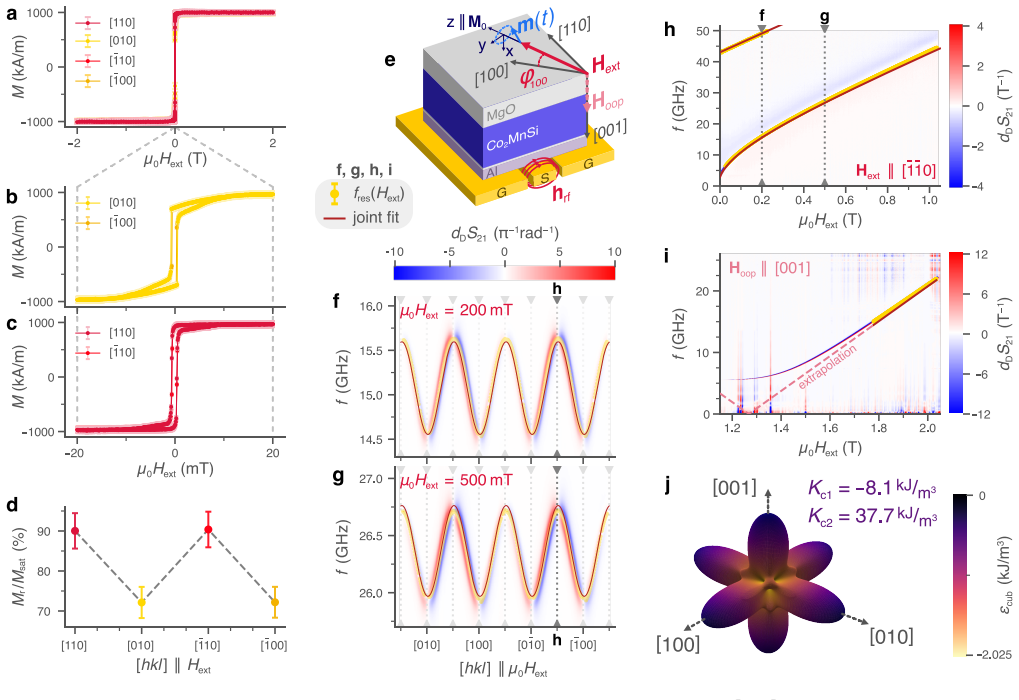
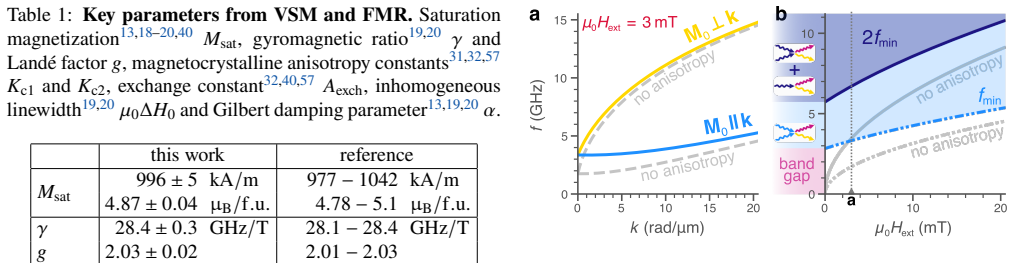
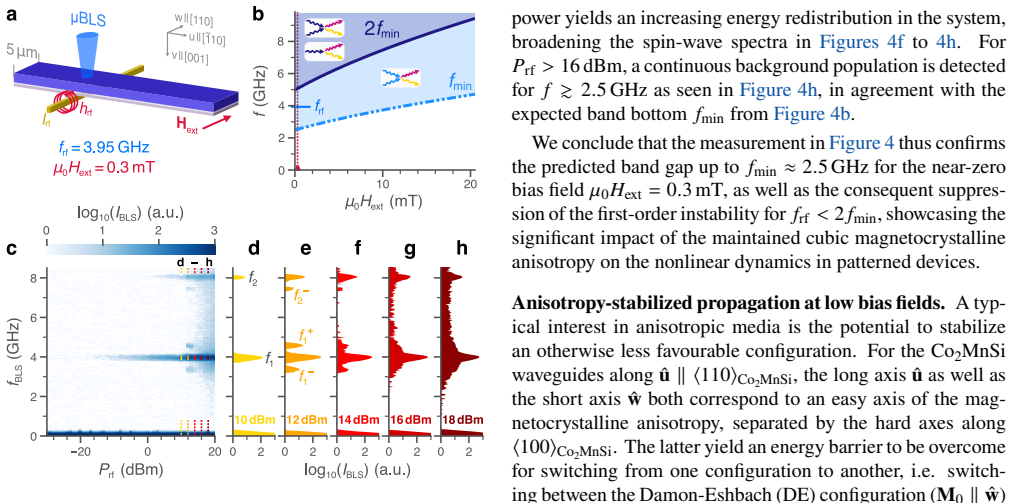
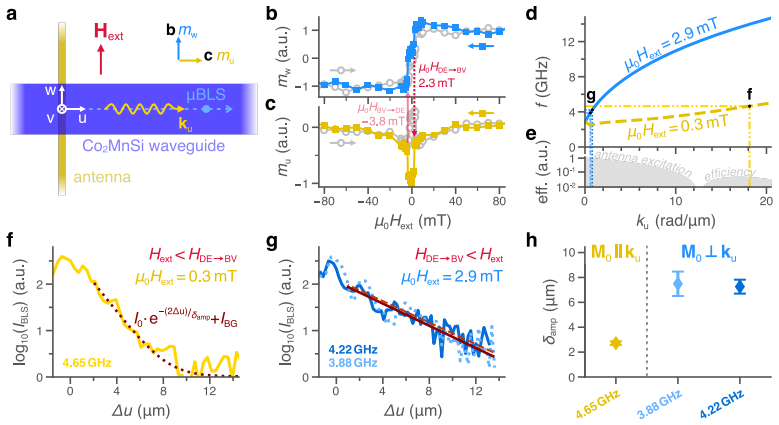
Epitaxial, L2_1-ordered Co2MnSi exhibits an intrinsic cubic anisotropy with first- and second-order contributions, stabilizing a magnetization alignment along the crystal ⟨110⟩ directions. The persistent magnetocrystalline anisotropy in the patterned structures reshapes the spin-wave dispersion which yields a first-order nonlinear instability suppression range extending over several GHz even for vanishing bias fields, and can be exploited to counteract shape demagnetization for stabilized low bias field operation in the Damon-Eshbach geometry.
What carries the argument
Persistent magnetocrystalline anisotropy that survives patterning and reshapes the spin-wave dispersion to suppress first-order nonlinear instabilities.
If this is right
- Nonlinear magnonic processes become possible without any external bias field.
- Damon-Eshbach geometry can be used at low bias with high group velocities and long decay lengths.
- The combination of half-metallicity, low damping, and bias-free nonlinearity supports hybrid spintronic-magnonic devices.
- Crystal orientation can be used as a design parameter to stabilize magnetization in nanoscale waveguides.
Where Pith is reading between the lines
- The same anisotropy-driven suppression mechanism could be tested in other L2_1 Heusler compounds with similar ordering.
- Waveguide aspect ratio and crystal cut could be co-optimized to further reduce the required bias field.
- Integration with spin-torque or voltage-controlled anisotropy might eliminate the remaining low bias entirely.
Load-bearing premise
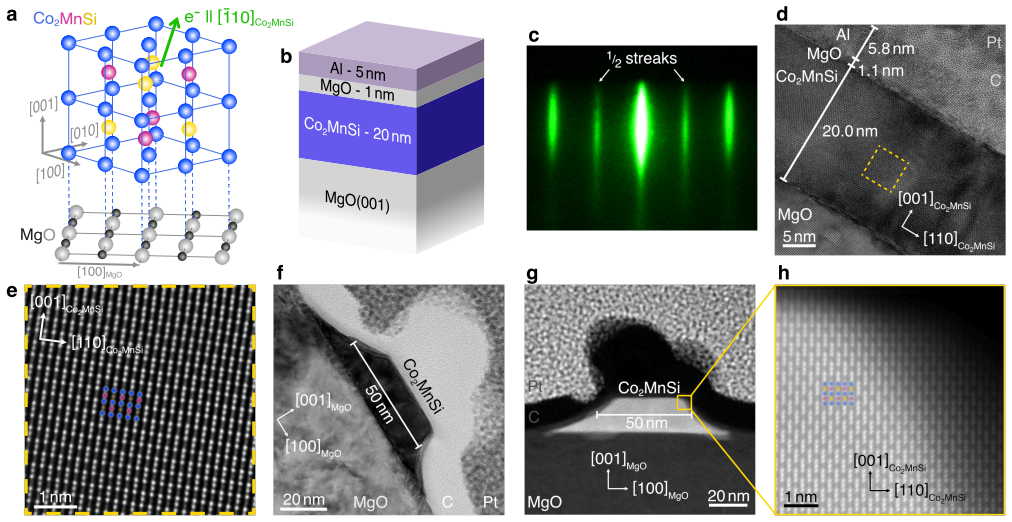
Patterning leaves the crystal structure and therefore the magnetic anisotropy properties of the Co2MnSi film unchanged.
What would settle it
A measurement on the fabricated waveguides showing that the reported multi-GHz nonlinear instability suppression window collapses or vanishes when the external bias field is set to zero.
Figures
read the original abstract
Half-metallic Heusler compounds like $\mathrm{Co_2MnSi}$ allow to bridge magnonic and spintronic functionality for hybrid unconventional computing approaches with sought-after properties like 100% spin polarization and associated low Gilbert damping $\alpha\leq 10^{-3}$. However, the desirable material parameters are inherently tied to the crystal lattice with a particularly critical dependence on structural order in $\mathrm{Co_2MnSi}$. To date, the successful fabrication of nanoscale devices with robust structural integrity remains yet a challenge, and consequently the impact of the material parameters on the resulting nonlinear spin-wave dynamics remains largely unexplored. Here, we report on a study of linear and nonlinear spin-wave dynamics in transversally magnetized $\mathrm{Co_2MnSi}$ waveguides with impeccable crystalline ordering. We show that epitaxial, $\mathrm{L2}_1$-ordered $\mathrm{Co_2MnSi}$ exhibits an intrinsic cubic anisotropy with first- and second-order contributions, stabilizing a magnetization alignment along the crystal $\langle110\rangle$ directions. We confirm the implication of an unaffected crystal structure resulting in preserved magnetic properties in the patterned structures. Herein, the persistent magnetocrystalline anisotropy reshapes the spin-wave dispersion which yields a first-order nonlinear instability suppression range extending over several GHz - even for vanishing bias fields. Moreover, the intrinsic magnetocrystalline anisotropy can be exploited to counteract shape demagnetization for a stabilized low bias field operation in the favourable Damon-Eshbach geometry with high group velocities and decay lengths. Together with the proven half-metallicity and ultralow Gilbert damping, this research establishes $\mathrm{Co_2MnSi}$ as a robust, scalable platform towards bias-field-free nonlinear half-metal magnonics.
Editorial analysis
A structured set of objections, weighed in public.
Referee Report
Summary. The manuscript reports fabrication and characterization of transversally magnetized epitaxial L2_1-ordered Co2MnSi waveguides, claiming that the material's intrinsic first- and second-order cubic magnetocrystalline anisotropy stabilizes magnetization along ⟨110⟩, reshapes the Damon-Eshbach spin-wave dispersion, and produces a several-GHz-wide suppression of first-order nonlinear instabilities even at vanishing bias fields, while also enabling stabilized low-bias DE operation with high group velocities; the central experimental assertion is that patterning leaves the crystal structure and thus the magnetic parameters unaffected.
Significance. If the preservation of anisotropy constants after patterning is quantitatively verified, the result would provide a concrete materials platform combining half-metallicity, α ≤ 10^{-3}, and bias-field-free nonlinear magnonics, directly addressing a key obstacle for scalable magnonic devices; the work also supplies falsifiable predictions for the width of the instability-suppression window as a function of the measured K1 and K2.
major comments (2)
- [Abstract / fabrication and measurement section] Abstract and fabrication/measurement paragraph: the assertion that 'an unaffected crystal structure resulting in preserved magnetic properties in the patterned structures' is made without any explicit comparison of effective anisotropy fields, BLS-derived dispersion, or fitted K1/K2 values between the continuous epitaxial film and the patterned waveguides; because the GHz-wide first-order instability suppression at H=0 is derived directly from the persistence of these anisotropy terms in the dispersion relation, this missing quantitative check is load-bearing for the central claim.
- [Nonlinear dynamics results] The reported 'several GHz' suppression range of the first-order nonlinear instability is stated to arise from the anisotropy-reshaped dispersion at H=0, yet no explicit calculation or measured threshold data (e.g., critical power vs. frequency curves) is referenced that would allow an independent reader to verify the width against the extracted K1 and K2; this gap prevents assessment of whether the observed range is quantitatively consistent with the claimed anisotropy values.
minor comments (2)
- [Introduction / anisotropy discussion] Notation for the first- and second-order cubic anisotropy constants should be defined explicitly (e.g., K1, K2) at first use rather than relying on the reader to infer from context.
- [Abstract] The abstract states 'impeccable crystalline ordering' without a quantitative metric (e.g., order parameter from XRD or STEM); a brief statement of the measured L2_1 order parameter would strengthen the structural claim.
Simulated Author's Rebuttal
We thank the referee for the constructive comments and for recognizing the potential significance of the work. We address each major comment below and agree that additional quantitative comparisons are needed to strengthen the central claims regarding preservation of magnetic parameters after patterning.
read point-by-point responses
-
Referee: [Abstract / fabrication and measurement section] Abstract and fabrication/measurement paragraph: the assertion that 'an unaffected crystal structure resulting in preserved magnetic properties in the patterned structures' is made without any explicit comparison of effective anisotropy fields, BLS-derived dispersion, or fitted K1/K2 values between the continuous epitaxial film and the patterned waveguides; because the GHz-wide first-order instability suppression at H=0 is derived directly from the persistence of these anisotropy terms in the dispersion relation, this missing quantitative check is load-bearing for the central claim.
Authors: We acknowledge that the manuscript asserts preservation of magnetic properties based on the observed anisotropy effects in the waveguides but does not include an explicit side-by-side comparison of fitted K1/K2 values, effective anisotropy fields, or BLS dispersion curves between the continuous film and patterned waveguides. This quantitative check would indeed strengthen the central claim. We will revise the manuscript to add this comparison, for example via a table of extracted parameters and overlaid dispersion data from both sample types. revision: yes
-
Referee: [Nonlinear dynamics results] The reported 'several GHz' suppression range of the first-order nonlinear instability is stated to arise from the anisotropy-reshaped dispersion at H=0, yet no explicit calculation or measured threshold data (e.g., critical power vs. frequency curves) is referenced that would allow an independent reader to verify the width against the extracted K1 and K2; this gap prevents assessment of whether the observed range is quantitatively consistent with the claimed anisotropy values.
Authors: The referee correctly identifies that the manuscript reports the several-GHz suppression range but does not provide an explicit calculation of the instability threshold derived from the measured K1 and K2 or reference critical power versus frequency data for independent verification. We will add this calculation in the revised manuscript (or supplementary information), showing how the anisotropy terms in the dispersion relation produce the observed window width, and include or reference the relevant threshold measurements where available. revision: yes
Circularity Check
No circularity: purely experimental report with no derivation chain
full rationale
The manuscript is an experimental study reporting fabrication of epitaxial Co2MnSi films and waveguides, structural characterization, and measurements of linear/nonlinear spin-wave dynamics via BLS and related techniques. It observes cubic anisotropy (first- and second-order terms) from data on continuous films, notes preservation of L21 order and magnetic properties in patterned structures on the basis of structural integrity, and reports the resulting dispersion reshaping and nonlinear instability suppression. No equations, fitted parameters, or self-citations are used to derive predictions that reduce to the inputs by construction. The central claims rest on direct experimental observations rather than any mathematical chain that could exhibit self-definition, fitted-input renaming, or load-bearing self-citation loops. This matches the default case of a self-contained experimental paper.
Axiom & Free-Parameter Ledger
axioms (1)
- domain assumption L2_1 ordering in Co2MnSi produces half-metallicity and Gilbert damping ≤10^{-3}
Reference graph
Works this paper leans on
-
[1]
D.Nature Electron- ics2020,3, 360–370, DOI:10.1038/s41928- 019- 0360-9
Sitte, K.; Fukami, S.; Stiles, M. D.Nature Electron- ics2020,3, 360–370, DOI:10.1038/s41928- 019- 0360-9. (3) Finocchio,G.;DiVentra,M.;Camsari,K.Y.;Everschor-
-
[2]
(4) Papp,Á.;Porod,W.;Csaba,G.NatureCommunications 2021,12, 6422, DOI:10.1038/s41467-021-26711- z
Sitte, K.; Khalili Amiri, P.; Zeng, Z.Journal of Mag- netismandMagneticMaterials2021,521,167506,DOI: 10.1016/j.jmmm.2020.167506. (4) Papp,Á.;Porod,W.;Csaba,G.NatureCommunications 2021,12, 6422, DOI:10.1038/s41467-021-26711- z. (5) Pirro, P.; Vasyuchka, V. I.; Serga, A. A.; Hillebrands, B.NatureReviewsMaterials2021,6,1114–1135,DOI: 10.1038/s41578-021-00332...
-
[3]
Buschow, K. H. J.Physical Review Letters1983,50, 2024–2027, DOI:10.1103/PhysRevLett.50.2024. (9) Ishida, S.; Fujii, S.; Kashiwagi, S.; Asano, S.Journal of the Physical Society of Japan1995,64, 2152–2157, DOI:10.1143/JPSJ.64.2152. (10) Liu,C.;Mewes,C.K.A.;Chshiev,M.;Mewes,T.;But- ler, W. H.Applied Physics Letters2009,95, 022509, DOI:10.1063/1.3157267. (11)...
-
[4]
Bertran, F.Physical Review B2016,93, 094417, DOI: 10.1103/PhysRevB.93.094417. (13) Guillemard, C.; Petit-Watelot, S.; Pasquier, L.; Pierre, D.; Ghanbaja, J.; Rojas-Sánchez, J.-C.; Bataille, A
-
[5]
Rault, J.; Le Fèvre, P.; Bertran, F.; Andrieu, S.Phys- icalReviewApplied2019,11,064009,DOI:10.1103/ PhysRevApplied.11.064009. (14) Sakuraba,Y.;Nakata,J.;Oogane,M.;Kubota,H.;Ando, Y.; Sakuma, A.; Miyazaki, T.Japanese Journal of Ap- plied Physics2005,44, L1100, DOI:10.1143/JJAP. 44.L1100. (15) Chudo, H.; Ando, K.; Saito, K.; Okayasu, S.; Haruki, R.; Sakurab...
-
[6]
Felser, C., Hirohata, A., Eds.; Springer Series in Mate- rials Science; Springer International Publishing: Cham, 2016, DOI:10.1007/978-3-319-21449-8. 11 (29) Palmstrøm, C. J.Progress in Crystal Growth and Char- acterization of Materials2016,62, 371–397, DOI:10. 1016/j.pcrysgrow.2016.04.020. (30) Wollmann,L.;Nayak,A.K.;Parkin,S.S.;Felser,C.An- nual Review ...
-
[7]
(34) Hasnip, P.; Loach, C.; Smith, J.; Probert, M.; Gilks, D
Cinchetti, M.; Minár, J.; Braun, J.; Ebert, H.; Ishikawa, T.;Uemura,T.;Yamamoto,M.PhysicalReviewB2012, 85, 064407, DOI:10.1103/PhysRevB.85.064407. (34) Hasnip, P.; Loach, C.; Smith, J.; Probert, M.; Gilks, D
-
[8]
Sizeland, J.; Lari, L.; Sagar, J.; Yoshida, K.; Oogane, M.; Hirohata, A.; Lazarov, V.Materials2014,7, 1473– 1482, DOI:10.3390/ma7031473. (35) Abdallah, I.; Ratel-Ramond, N.; Magen, C.; Pecassou, B.; Cours, R.; Arnoult, A.; Respaud, M.; Bobo, J. F
-
[9]
(36) Abdallah, I.; Pradines, B.; Ratel-Ramond, N.; BenAs- sayag, G.; Arras, R.; Calmels, L.; Bobo, J
BenAssayag, G.; Snoeck, E.; Biziere, N.Materials Re- searchExpress2016,3,046101,DOI:10.1088/2053- 1591/3/4/046101. (36) Abdallah, I.; Pradines, B.; Ratel-Ramond, N.; BenAs- sayag, G.; Arras, R.; Calmels, L.; Bobo, J. F.; Snoeck, E.; Biziere, N.Journal of Physics D: Applied Physics 2017,50, 035003, DOI:10.1088/1361-6463/50/3/ 035003. (37) Shaw, J. M.; Delc...
-
[10]
T.Physical Review B2018, 97, 094420, DOI:10.1103/PhysRevB.97.094420
Eriksson, O.; Nembach, H. T.Physical Review B2018, 97, 094420, DOI:10.1103/PhysRevB.97.094420. (38) Guillemard, C.; Petit-Watelot, S.; Rojas-Sánchez, J.-C
-
[11]
(39) Saito, T.; Nishio-Hamane, D.Physica B: Condensed Matter2021,603, 412761, DOI:10.1016/j.physb
Bertran, F.; Andrieu, S.Applied Physics Letters2019, 115, 172401, DOI:10.1063/1.5121614. (39) Saito, T.; Nishio-Hamane, D.Physica B: Condensed Matter2021,603, 412761, DOI:10.1016/j.physb. 2020.412761. (40) Ritchie, L.; Xiao, G.; Ji, Y.; Chen, T. Y.; Chien, C. L
-
[12]
Zhang, M.; Chen, J.; Liu, Z.; Wu, G.; Zhang, X. X. Physical Review B2003,68, 104430, DOI:10.1103/ PhysRevB.68.104430. (41) Schmalhorst, J.; Kämmerer, S.; Sacher, M.; Reiss, G.; Hütten, A.; Scholl, A.Physical Review B2004,70, 024426, DOI:10.1103/PhysRevB.70.024426. (42) Kallmayer, M.; Elmers, H. J.; Balke, B.; Wurmehl, S
-
[13]
H.; Felser, C.Journal of Physics D: Applied Physics2006,39, 786–792, DOI: 10.1088/0022-3727/39/5/S03
Emmerling, F.; Fecher, G. H.; Felser, C.Journal of Physics D: Applied Physics2006,39, 786–792, DOI: 10.1088/0022-3727/39/5/S03. (43) Graf, T.; Felser, C.; Parkin, S. S.Progress in Solid State Chemistry2011,39, 1–50, DOI:10 . 1016 / j . progsolidstchem.2011.02.001. (44) Guillemard,C.;Petit-Watelot,S.;Devolder,T.;Pasquier, L.; Boulet, P.; Migot, S.; Ghanbaj...
-
[14]
Sklenar, J.; Wu, S. M.; Pearson, J. E.; Bhattacharya, A.; Ketterson, J. B.; Wu, M.; Hoffmann, A.Journal of Applied Physics2015,117, 17D128, DOI:10.1063/ 1.4916027. (46) Kiechle, M.; Papp, A.; Mendisch, S.; Ahrens, V.; Goli- brzuch, M.; Bernstein, G. H.; Porod, W.; Csaba, G.; Becherer,M.Small2023,19,2207293,DOI:10.1002/ smll.202207293. (47) Greil, J.; Kiec...
-
[15]
Takanashi, K.; Bedanta, S.Physical Review Applied 2019,12, 014043, DOI:10.1103/PhysRevApplied. 12.014043. (55) Córdova, J. S.; Friedel, A. M.; Rossi, Q.; Robert, J
-
[16]
Spin-polarization of the electric current in half-metallic Co$_2$MnSi Heusler thin films
Bailleul, M. Spin-Polarization of the Electric Current in Half-Metallic Co2MnSi Heusler Thin Films, 2026, DOI:10.48550/ARXIV.2606.04598. (56) Neggache, A.; Hauet, T.; Bertran, F.; Le Fèvre, P
work page internal anchor Pith review Pith/arXiv arXiv doi:10.48550/arxiv.2606.04598 2026
-
[17]
Petit-Watelot, S.; Devolder, T.; Ohresser, P.; Boulet, P.; Mewes, C.; Maat, S.; Childress, J. R.; Andrieu, S. Applied Physics Letters2014,104, 252412, DOI:10. 1063/1.4885354. (57) Abdallah, I.; Pradines, B.; Ratel-Ramond, N.; BenAs- sayag,G.;Arras,R.;Calmels,L.;Bobo,J.F.;Snoeck,E.; Biziere,N.JournalofPhysicsD:AppliedPhysics2017, 50, 359501, DOI:10.1088/13...
-
[18]
Ando, Y.; Miyazaki, T.Japanese Journal of Applied Physics2007,46, L205, DOI:10 . 1143 / JJAP . 46 . L205. (62) Suhl, H.Journal of Physics and Chemistry of Solids 1957,1, 209–227, DOI:10 . 1016 / 0022 - 3697(57 ) 90010-0. (63) Sebastian, T.; Schultheiss, K.; Obry, B.; Hillebrands, B.; Schultheiss, H.Frontiers in Physics2015,3, DOI: 10.3389/fphy.2015.00035....
-
[19]
V.Physical Review Letters2019,122, 247202, DOI:10.1103/PhysRevLett.122.247202
Schneider, M.; Meyer, T.; Lägel, B.; Dubs, C.; Brächer, T.; Chumak, A. V.Physical Review Letters2019,122, 247202, DOI:10.1103/PhysRevLett.122.247202. (67) Soldatov, I. V.; Schäfer, R.Review of Scientific Instru- ments2017,88, 073701, DOI:10.1063/1.4991820. (68) McCord, J.; Urs, N. O.; Vogel, M.Applied Physics Let- ters2025,127, 180501, DOI:10.1063/5.02888...
-
[20]
V.Nano Letters2020,20, 4220–4227, DOI:10
Kewenig, M.; Dubs, C.; Pirro, P.; Chumak, A. V.Nano Letters2020,20, 4220–4227, DOI:10 . 1021 / acs . nanolett.0c00657. (70) Demidov, V. E.; Demokritov, S. O.; Rott, K.; Krzys- teczko, P.; Reiss, G.Physical Review B2008,77, 064406, DOI:10.1103/PhysRevB.77.064406. (71) Treacy, M. M. J.; Howie, A.; Wilson, C. J.Philosoph- ical Magazine A1978,38, 569–585, DOI...
-
[21]
1063/1.5045135
Shiraishi, M.; Gross, R.; Huebl, H.; Weiler, M.Review of Scientific Instruments2018,89, 076101, DOI:10. 1063/1.5045135. (74) Stancil, D. D.; Prabhakar, A.,Spin Waves: Theory and Applications; Springer: New York, 2009. 13
2009
discussion (0)
Sign in with ORCID, Apple, or X to comment. Anyone can read and Pith papers without signing in.