Visual Instruction Tuning Aligns Modalities through Abstraction
Pith reviewed 2026-06-28 10:23 UTC · model grok-4.3
The pith
Visual instruction tuning embeds image features into the intermediate semantic layers of LLMs, skipping the early unimodal layers.
A machine-rendered reading of the paper's core claim, the machinery that carries it, and where it could break.
Core claim
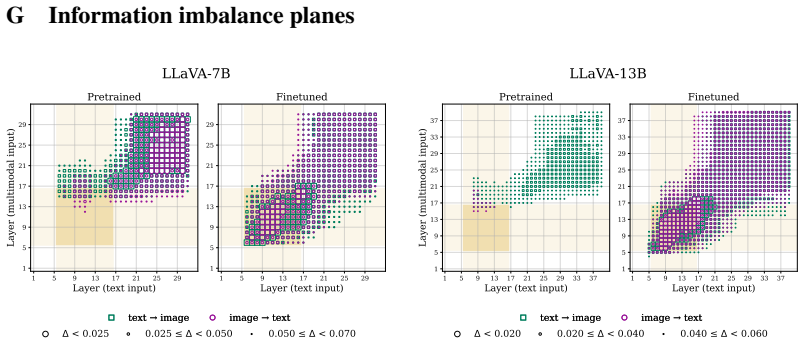
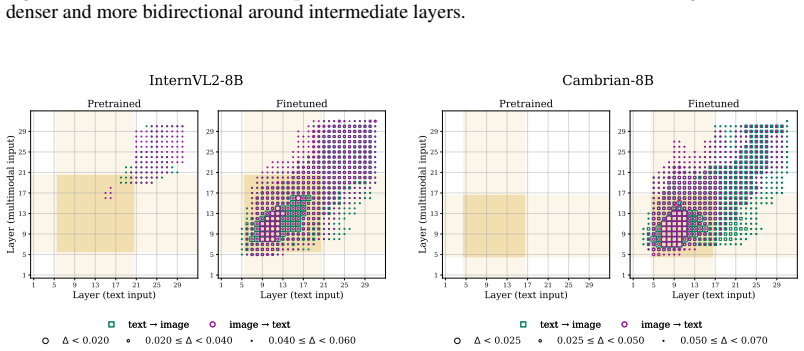
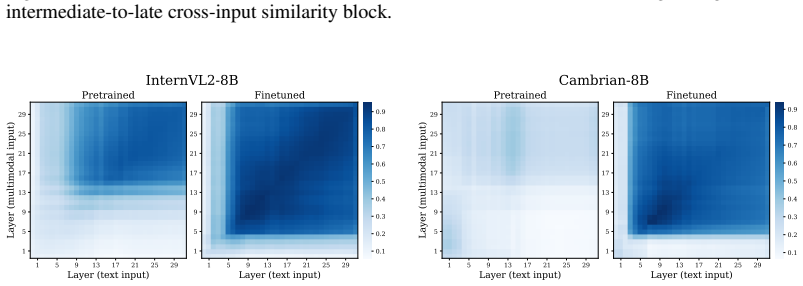
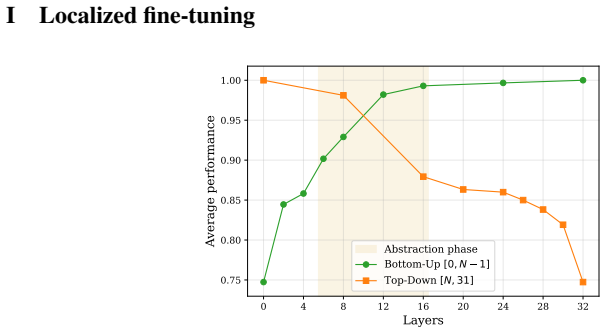
Visual instruction tuning serves as a bridge, embedding visual features directly into the intermediate semantic layers of the LLM, bypassing the early layers devoted to unimodal processing. These intermediate layers are the semantic core of vision-language processing and play a critical role in performance on a broad set of multimodal benchmarks. Fine-tuning extends and strengthens the existing abstraction phase, aligning visual features with pre-existing textual ones. Restricting fine-tuning to intermediate layers alone preserves the performance of full fine-tuning on vision-centric benchmarks while reducing training time. Multimodal integration is a localized phenomenon driven by the repur
What carries the argument
The intermediate semantic layers, which receive the embedded visual features and extend the model's existing abstraction phase to align modalities.
If this is right
- Multimodal performance depends primarily on the intermediate layers rather than uniform changes across the model.
- Training time can be reduced by updating only the intermediate layers without loss on vision-centric tasks.
- Visual and textual representations become aligned by extending the abstraction already present in the pre-trained model.
- Early layers continue to handle unimodal processing even after instruction tuning.
Where Pith is reading between the lines
- Similar localization of adaptation might occur when adding other data types such as audio or video to the same models.
- The finding points toward modular designs where semantic alignment can be targeted without retraining the full network.
- It raises the possibility that the abstraction engine in LLMs can be reused for new modalities with minimal changes.
Load-bearing premise
The probing analyses and causal interventions accurately isolate the contribution of each layer without interference from model architecture choices or dataset specifics.
What would settle it
An experiment in which restricting fine-tuning to early layers alone produces equivalent gains on multimodal benchmarks would falsify the claim that alignment occurs specifically in the intermediate layers.
Figures

















read the original abstract
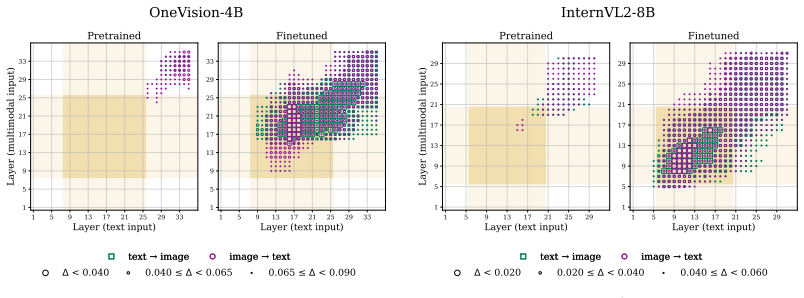
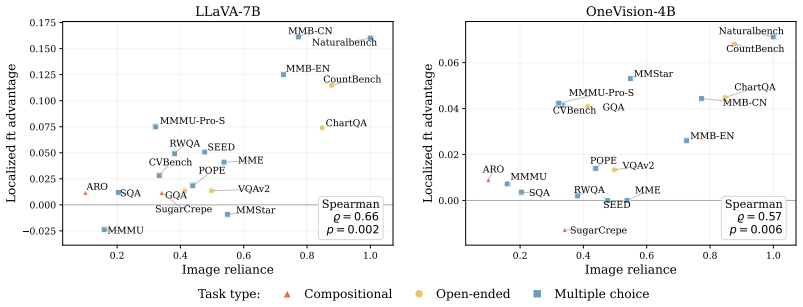
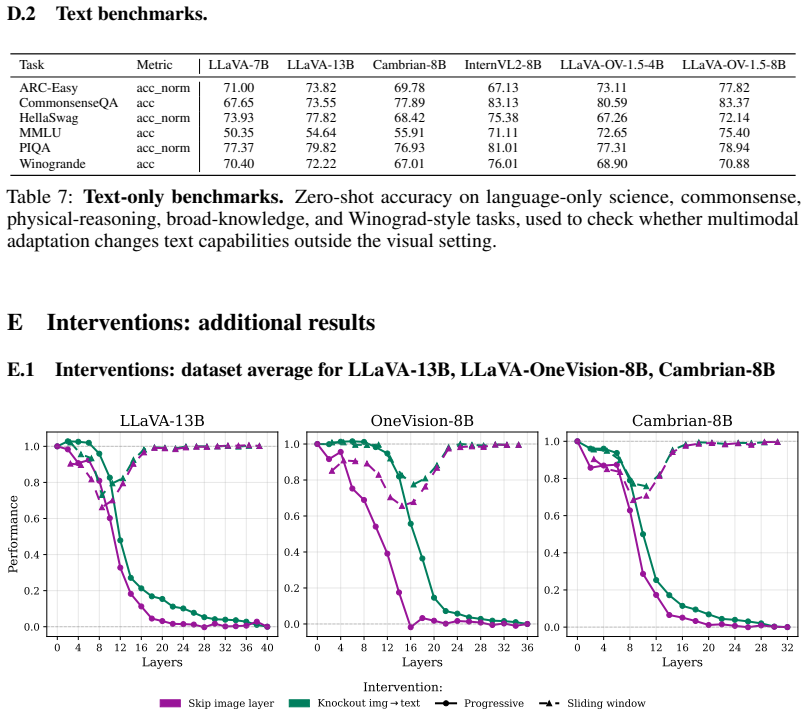
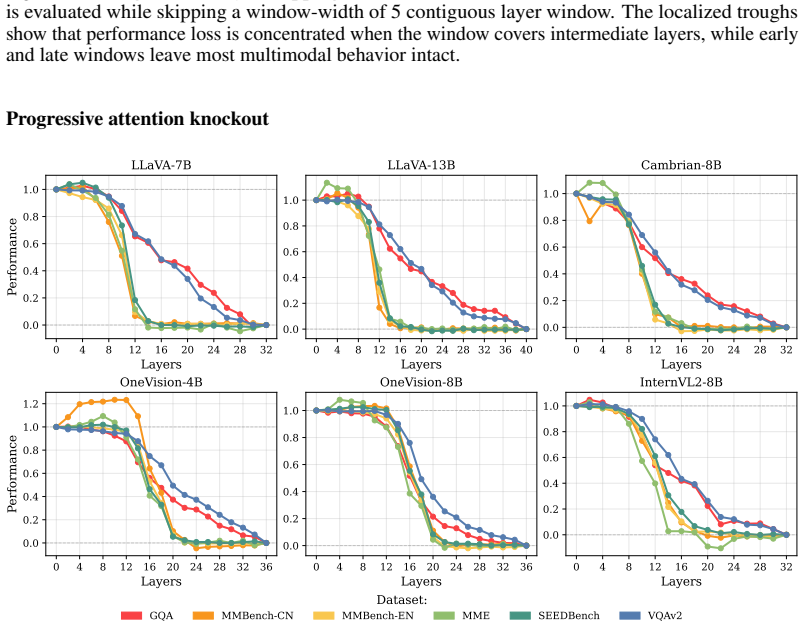
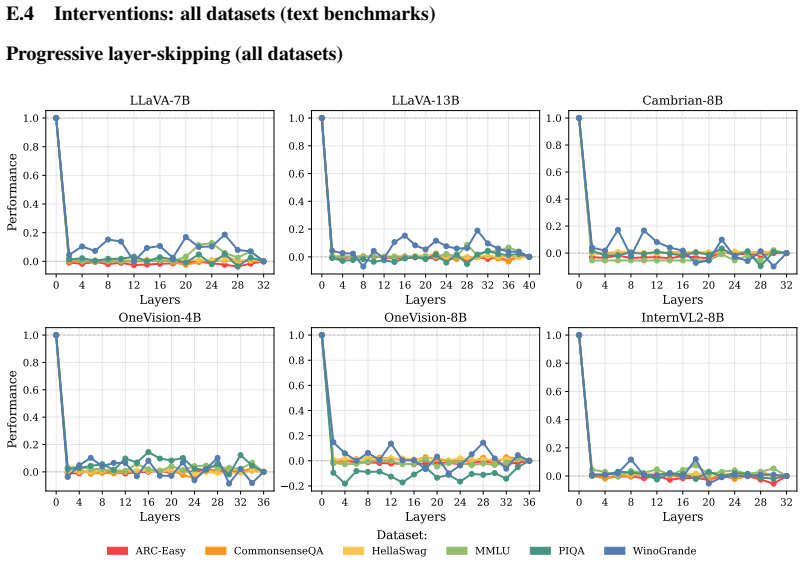
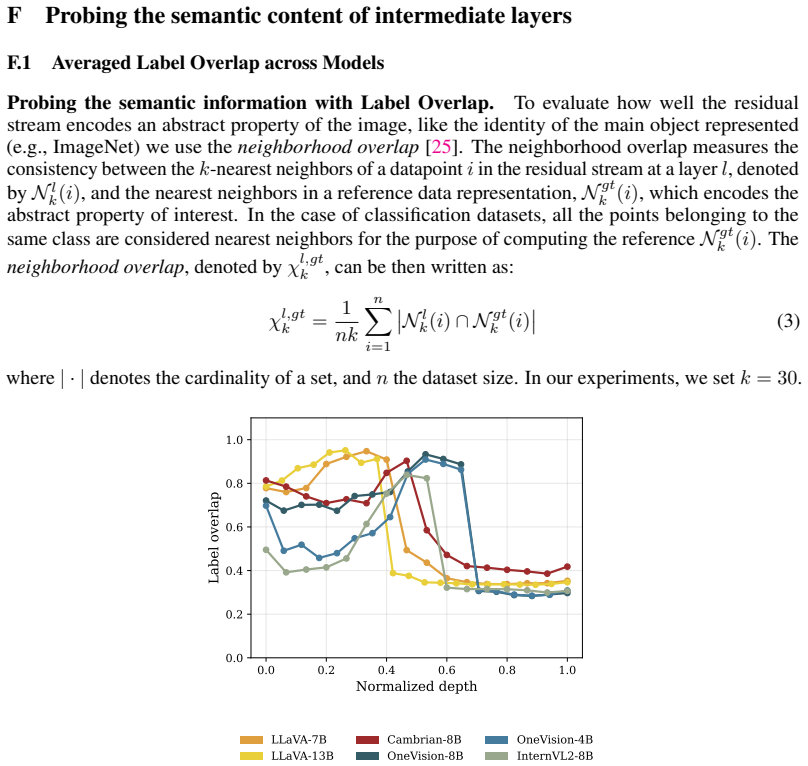
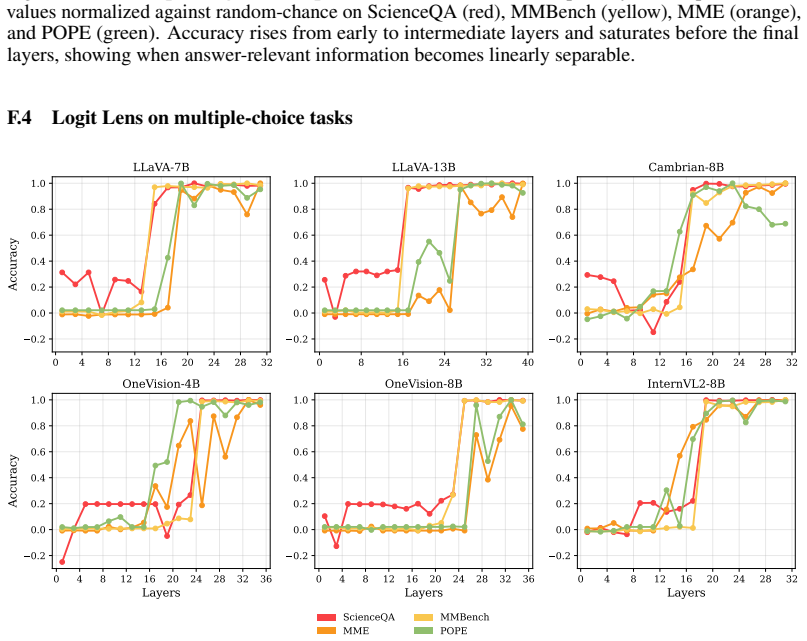
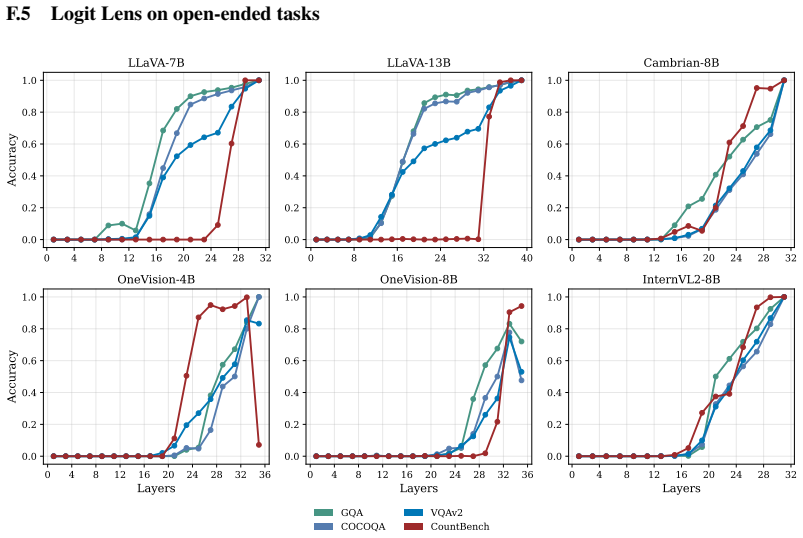
Visual instruction tuning effectively adapts a pre-trained Large Language Model (LLM) to process image information alongside text. Yet, it remains unclear how visual features are embedded into the layer-wise hierarchy of abstractions of the LLM backbone. Across a diverse set of vision-language architectures, we show that instruction tuning primarily serves as a bridge, embedding visual features directly into the intermediate semantic layers of the LLM, bypassing the early layers devoted to unimodal processing. With probing analyses and causal interventions, we show that these intermediate layers are the semantic core of vision-language processing and play a critical role in the performance on a broad set of multimodal benchmarks. In addition, by comparing the geometry of semantically equivalent visual and textual representations, we find that fine-tuning extends and strengthens the existing abstraction phase, aligning visual features with pre-existing textual ones. Finally, we confirm the functional role of this localized alignment by restricting fine-tuning to intermediate layers alone: this strategy preserves the performance of full fine-tuning on vision-centric benchmarks while reducing training time. Our results suggest that multimodal integration is a localized phenomenon driven by the repurposing of the internal abstraction engine of the LLM.
Editorial analysis
A structured set of objections, weighed in public.
Referee Report
Summary. The manuscript claims that visual instruction tuning primarily serves as a bridge embedding visual features directly into the intermediate semantic layers of the LLM backbone (bypassing early unimodal processing layers) across diverse vision-language architectures. This localization is supported by probing analyses, causal interventions, and geometry comparisons of semantically equivalent representations; the intermediate layers are positioned as the semantic core driving performance on multimodal benchmarks. The work further shows that restricting fine-tuning to these layers alone preserves full fine-tuning performance on vision-centric tasks while reducing training time, suggesting multimodal integration is a localized repurposing of the LLM's abstraction engine.
Significance. If the central claims hold, the results would provide a mechanistic account of how instruction tuning achieves cross-modal alignment by extending pre-existing textual abstraction phases rather than creating new pathways. The multi-architecture scope, use of causal interventions, and practical demonstration of layer-restricted fine-tuning constitute strengths that could guide more efficient VLM training and layer-specific interpretability studies.
major comments (2)
- [Methods / Results (diverse architectures)] Diverse-architecture experiments (methods and results sections): the paper does not report controls that swap visual-token integration locations (e.g., cross-attention depth or prefix position) while holding other factors fixed. Without such controls, the observed routing of visual features to intermediate layers could be an artifact of the chosen injection mechanism rather than a general consequence of instruction tuning, which is load-bearing for the claim that tuning 'primarily serves as a bridge' bypassing early layers.
- [Results (probing and interventions)] Probing analyses and causal interventions (results section): the abstract states these methods support the localization and functional-role claims, yet the manuscript provides no quantitative metrics, error bars, statistical tests, or explicit exclusion criteria for layer selection or intervention targets. This prevents verification that the analyses isolate intermediate-layer contributions without architecture- or dataset-specific confounds.
minor comments (2)
- [Abstract] Abstract: no specific benchmark names, performance deltas, or layer indices are given to ground the statements about 'broad set of multimodal benchmarks' and 'preserves the performance of full fine-tuning.'
- [Methods] Notation: the term 'intermediate semantic layers' should be defined with explicit layer indices or fractional depth ranges relative to the LLM backbone for each architecture examined.
Simulated Author's Rebuttal
We thank the referee for their constructive comments, which help clarify the scope and presentation of our results. We respond to each major comment below.
read point-by-point responses
-
Referee: [Methods / Results (diverse architectures)] Diverse-architecture experiments (methods and results sections): the paper does not report controls that swap visual-token integration locations (e.g., cross-attention depth or prefix position) while holding other factors fixed. Without such controls, the observed routing of visual features to intermediate layers could be an artifact of the chosen injection mechanism rather than a general consequence of instruction tuning, which is load-bearing for the claim that tuning 'primarily serves as a bridge' bypassing early layers.
Authors: The concern is valid: our multi-architecture results compare models whose integration mechanisms differ by design, but do not include within-architecture ablations that isolate injection depth while holding all other factors fixed. Such controls would strengthen the generality claim. We will add a dedicated subsection discussing this limitation and, where feasible with existing model variants, report results from controlled injection-depth sweeps. revision: yes
-
Referee: [Results (probing and interventions)] Probing analyses and causal interventions (results section): the abstract states these methods support the localization and functional-role claims, yet the manuscript provides no quantitative metrics, error bars, statistical tests, or explicit exclusion criteria for layer selection or intervention targets. This prevents verification that the analyses isolate intermediate-layer contributions without architecture- or dataset-specific confounds.
Authors: We agree that the current presentation lacks explicit reporting of error bars, statistical tests, and layer-selection criteria. The underlying experiments contain multiple runs and performance thresholds, but these details are not fully documented. In revision we will expand the relevant results subsections to include standard deviations, significance tests where appropriate, and precise criteria used to designate intermediate layers. revision: yes
Circularity Check
No circularity: empirical claims rest on external benchmarks and interventions
full rationale
The paper advances an empirical claim about layer-wise effects of instruction tuning, supported by probing analyses, causal interventions, geometric comparisons, and ablation experiments across multiple vision-language architectures. No equations, fitted parameters, or self-referential definitions are present that would make any reported result equivalent to its inputs by construction. The central findings are falsifiable against held-out multimodal benchmarks and do not rely on load-bearing self-citations or ansatzes imported from prior author work. This is the standard case of an experimental study whose derivation chain is self-contained against external data.
Axiom & Free-Parameter Ledger
axioms (1)
- domain assumption Large language models organize processing into a layer-wise hierarchy of abstractions with early layers handling unimodal features and intermediate layers handling semantics
Reference graph
Works this paper leans on
-
[1]
Flamingo: a visual language model for few-shot learning.Advances in neural information processing systems, 35:23716–23736, 2022
Jean-Baptiste Alayrac, Jeff Donahue, Pauline Luc, Antoine Miech, Iain Barr, Yana Hasson, Karel Lenc, Arthur Mensch, Katherine Millican, Malcolm Reynolds, et al. Flamingo: a visual language model for few-shot learning.Advances in neural information processing systems, 35:23716–23736, 2022
2022
-
[2]
Visual instruction tuning.Advances in neural information processing systems, 36:34892–34916, 2023
Haotian Liu, Chunyuan Li, Qingyang Wu, and Yong Jae Lee. Visual instruction tuning.Advances in neural information processing systems, 36:34892–34916, 2023
2023
-
[3]
Qwen-VL: A Versatile Vision-Language Model for Understanding, Localization, Text Reading, and Beyond
Jinze Bai, Shuai Bai, Shusheng Yang, Shijie Wang, Sinan Tan, Peng Wang, Junyang Lin, Chang Zhou, and Jingren Zhou. Qwen-vl: A versatile vision-language model for understanding, localization, text reading, and beyond.arXiv preprint arXiv:2308.12966, 2023
work page internal anchor Pith review Pith/arXiv arXiv 2023
-
[4]
Gemma Team, Aishwarya Kamath, Johan Ferret, Shreya Pathak, Nino Vieillard, Ramona Merhej, Sarah Perrin, Tatiana Matejovicova, Alexandre Ramé, Morgane Rivière, et al. Gemma 3 technical report.arXiv preprint arXiv:2503.19786, 2025
work page internal anchor Pith review Pith/arXiv arXiv 2025
-
[5]
Learning transferable visual models from 10 natural language supervision
Alec Radford, Jong Wook Kim, Chris Hallacy, Aditya Ramesh, Gabriel Goh, Sandhini Agarwal, Girish Sastry, Amanda Askell, Pamela Mishkin, Jack Clark, et al. Learning transferable visual models from 10 natural language supervision. InInternational conference on machine learning, pages 8748–8763. PmLR, 2021
2021
-
[6]
The geometry of hidden representations of large transformer models
Lucrezia Valeriani, Diego Doimo, Francesca Cuturello, Alessandro Laio, Alessio Ansuini, and Alberto Cazzaniga. The geometry of hidden representations of large transformer models. In A. Oh, T. Naumann, A. Globerson, K. Saenko, M. Hardt, and S. Levine, editors,Advances in Neural Information Processing Systems, volume 36, pages 51234–51252. Curran Associates...
2023
-
[7]
Emergence of a high-dimensional abstraction phase in language transformers
Emily Cheng, Diego Doimo, Corentin Kervadec, Iuri Macocco, Lei Yu, Alessandro Laio, and Marco Baroni. Emergence of a high-dimensional abstraction phase in language transformers. InThe Thirteenth International Conference on Learning Representations, 2025
2025
-
[8]
Layer by layer: Uncovering hidden representations in language models
Oscar Skean, Md Rifat Arefin, Dan Zhao, Niket Nikul Patel, Jalal Naghiyev, Yann LeCun, and Ravid Shwartz-Ziv. Layer by layer: Uncovering hidden representations in language models. InForty-second International Conference on Machine Learning, 2025
2025
-
[9]
Massive supervised fine-tuning experiments reveal how data, layer, and training factors shape LLM alignment quality
Yuto Harada, Yusuke Yamauchi, Yusuke Oda, Yohei Oseki, Yusuke Miyao, and Yu Takagi. Massive supervised fine-tuning experiments reveal how data, layer, and training factors shape LLM alignment quality. In Christos Christodoulopoulos, Tanmoy Chakraborty, Carolyn Rose, and Violet Peng, editors, Proceedings of the 2025 Conference on Empirical Methods in Natur...
2025
-
[10]
Middle-layer representation alignment for cross-lingual transfer in fine-tuned LLMs
Danni Liu and Jan Niehues. Middle-layer representation alignment for cross-lingual transfer in fine-tuned LLMs. In Wanxiang Che, Joyce Nabende, Ekaterina Shutova, and Mohammad Taher Pilehvar, editors, Proceedings of the 63rd Annual Meeting of the Association for Computational Linguistics (Volume 1: Long Papers), pages 15979–15996, Vienna, Austria, July 20...
2025
-
[11]
Towards interpreting visual information processing in vision-language models
Clement Neo, Luke Ong, Philip Torr, Mor Geva, David Krueger, and Fazl Barez. Towards interpreting visual information processing in vision-language models. InThe Thirteenth International Conference on Learning Representations, 2025
2025
-
[12]
The semantic hub hypothesis: Language models share semantic representations across languages and modalities
Zhaofeng Wu, Xinyan Velocity Yu, Dani Yogatama, Jiasen Lu, and Yoon Kim. The semantic hub hypothesis: Language models share semantic representations across languages and modalities. InThe Thirteenth International Conference on Learning Representations, 2025
2025
-
[13]
Cross-modal information flow in multimodal large language models
Zhi Zhang, Srishti Yadav, Fengze Han, and Ekaterina Shutova. Cross-modal information flow in multimodal large language models. InProceedings of the Computer Vision and Pattern Recognition Conference, pages 19781–19791, 2025
2025
-
[14]
Improved baselines with visual instruction tuning
Haotian Liu, Chunyuan Li, Yuheng Li, and Yong Jae Lee. Improved baselines with visual instruction tuning. InProceedings of the IEEE/CVF conference on computer vision and pattern recognition, pages 26296–26306, 2024
2024
-
[15]
LLaVA-OneVision-1.5: Fully Open Framework for Democratized Multimodal Training
Xiang An, Yin Xie, Kaicheng Yang, Wenkang Zhang, Xiuwei Zhao, Zheng Cheng, Yirui Wang, Songcen Xu, Changrui Chen, Didi Zhu, et al. Llava-onevision-1.5: Fully open framework for democratized multimodal training.arXiv preprint arXiv:2509.23661, 2025
work page internal anchor Pith review Pith/arXiv arXiv 2025
-
[16]
Internvl2: Better than the best—expanding performance boundaries of open-source multimodal models with the progressive scaling strategy, Jul 2024
OpenGVLab Team. Internvl2: Better than the best—expanding performance boundaries of open-source multimodal models with the progressive scaling strategy, Jul 2024
2024
-
[17]
Cambrian-1: A fully open, vision-centric exploration of multimodal llms.Advances in Neural Information Processing Systems, 37:87310–87356, 2024
Peter Tong, Ellis Brown, Penghao Wu, Sanghyun Woo, Adithya Jairam Vedagiri IYER, Sai Charitha Akula, Shusheng Yang, Jihan Yang, Manoj Middepogu, Ziteng Wang, et al. Cambrian-1: A fully open, vision-centric exploration of multimodal llms.Advances in Neural Information Processing Systems, 37:87310–87356, 2024
2024
-
[18]
Llama 3.2: Revolutionizing edge ai and vision with open, customizable models.Meta AI Blog, Sep 25 2024
Meta AI. Llama 3.2: Revolutionizing edge ai and vision with open, customizable models.Meta AI Blog, Sep 25 2024
2024
-
[19]
Dissecting recall of factual associations in auto-regressive language models
Mor Geva, Jasmijn Bastings, Katja Filippova, and Amir Globerson. Dissecting recall of factual associations in auto-regressive language models. InProceedings of the 2023 Conference on Empirical Methods in Natural Language Processing, pages 12216–12235, 2023
2023
-
[20]
Causal abstractions of neural networks
Atticus Geiger, Hanson Lu, Thomas Icard, and Christopher Potts. Causal abstractions of neural networks. Advances in neural information processing systems, 34:9574–9586, 2021
2021
-
[21]
Towards automated circuit discovery for mechanistic interpretability.Advances in Neural Information Processing Systems, 36:16318–16352, 2023
Arthur Conmy, Augustine Mavor-Parker, Aengus Lynch, Stefan Heimersheim, and Adrià Garriga-Alonso. Towards automated circuit discovery for mechanistic interpretability.Advances in Neural Information Processing Systems, 36:16318–16352, 2023. 11
2023
-
[22]
Svcca: Singular vector canonical correlation analysis for deep learning dynamics and interpretability.Advances in neural information processing systems, 30, 2017
Maithra Raghu, Justin Gilmer, Jason Yosinski, and Jascha Sohl-Dickstein. Svcca: Singular vector canonical correlation analysis for deep learning dynamics and interpretability.Advances in neural information processing systems, 30, 2017
2017
-
[23]
Similarity of neural network representations revisited
Simon Kornblith, Mohammad Norouzi, Honglak Lee, and Geoffrey Hinton. Similarity of neural network representations revisited. InInternational Conference on Machine Learning, pages 3519–3529. PMLR, 2019
2019
-
[24]
Ranking the informa- tion content of distance measures.PNAS nexus, 1(2):pgac039, 2022
Aldo Glielmo, Claudio Zeni, Bingqing Cheng, Gábor Csányi, and Alessandro Laio. Ranking the informa- tion content of distance measures.PNAS nexus, 1(2):pgac039, 2022
2022
-
[25]
Hierarchical nucleation in deep neural networks.Advances in Neural Information Processing Systems, 33, 2020
Diego Doimo, Aldo Glielmo, Alessio Ansuini, and Alessandro Laio. Hierarchical nucleation in deep neural networks.Advances in Neural Information Processing Systems, 33, 2020
2020
-
[26]
Llava-next: Improved reasoning, ocr, and world knowledge, January 2024
Haotian Liu, Chunyuan Li, Yuheng Li, Bo Li, Yuanhan Zhang, Sheng Shen, and Yong Jae Lee. Llava-next: Improved reasoning, ocr, and world knowledge, January 2024
2024
-
[27]
Mind the gap: Under- standing the modality gap in multi-modal contrastive representation learning
Victor Weixin Liang, Yuhui Zhang, Yongchan Kwon, Serena Yeung, and James Zou. Mind the gap: Under- standing the modality gap in multi-modal contrastive representation learning. In S. Koyejo, S. Mohamed, A. Agarwal, D. Belgrave, K. Cho, and A. Oh, editors,Advances in Neural Information Processing Systems, volume 35, pages 17612–17625. Curran Associates, Inc., 2022
2022
-
[28]
Representations of text and images align from layer one, 2026
Evžen Wybitul, Javier Rando, Florian Tramèr, and Stanislav Fort. Representations of text and images align from layer one, 2026
2026
-
[29]
Softmax linear units.Transformer Circuits Thread, 2022
Nelson Elhage, Tristan Hume, Catherine Olsson, Neel Nanda, Tom Henighan, Scott Johnston, Sheer ElShowk, Nicholas Joseph, Nova DasSarma, Ben Mann, Danny Hernandez, Amanda Askell, Kamal Ndousse, Andy Jones, Dawn Drain, Anna Chen, Yuntao Bai, Deep Ganguli, Liane Lovitt, Zac Hatfield- Dodds, Jackson Kernion, Tom Conerly, Shauna Kravec, Stanislav Fort, Saurav ...
2022
-
[30]
interpreting gpt: the logit lens.LessWrong, 2020
nostalgebraist. interpreting gpt: the logit lens.LessWrong, 2020
2020
-
[31]
Qwen3-vl technical report, 2025
Shuai Bai, Yuxuan Cai, Ruizhe Chen, Keqin Chen, Xionghui Chen, Zesen Cheng, Lianghao Deng, Wei Ding, Chang Gao, Chunjiang Ge, Wenbin Ge, Zhifang Guo, Qidong Huang, Jie Huang, Fei Huang, Binyuan Hui, Shutong Jiang, Zhaohai Li, Mingsheng Li, Mei Li, Kaixin Li, Zicheng Lin, Junyang Lin, Xuejing Liu, Jiawei Liu, Chenglong Liu, Yang Liu, Dayiheng Liu, Shixuan ...
2025
-
[32]
Pixtral 12b, 2024
Pixtral Team. Pixtral 12b, 2024
2024
-
[33]
Position: The platonic representation hypothesis
Minyoung Huh, Brian Cheung, Tongzhou Wang, and Phillip Isola. Position: The platonic representation hypothesis. In Ruslan Salakhutdinov, Zico Kolter, Katherine Heller, Adrian Weller, Nuria Oliver, Jonathan Scarlett, and Felix Berkenkamp, editors,Proceedings of the 41st International Conference on Machine Learning, volume 235 ofProceedings of Machine Learn...
2024
-
[34]
A quantitative analysis of semantic information in deep representations of text and images, 2025
Santiago Acevedo, Andrea Mascaretti, Riccardo Rende, Matéo Mahaut, Marco Baroni, and Alessandro Laio. A quantitative analysis of semantic information in deep representations of text and images, 2025
2025
-
[35]
How visual representa- tions map to language feature space in multimodal llms, 2025
Constantin Venhoff, Ashkan Khakzar, Sonia Joseph, Philip Torr, and Neel Nanda. How visual representa- tions map to language feature space in multimodal llms, 2025
2025
-
[36]
Same task, different circuits: Disentangling modality-specific mechanisms in VLMs
Yaniv Nikankin, Dana Arad, Yossi Gandelsman, and Yonatan Belinkov. Same task, different circuits: Disentangling modality-specific mechanisms in VLMs. InThe Thirty-ninth Annual Conference on Neural Information Processing Systems, 2025
2025
-
[37]
Chameleon: Mixed-Modal Early-Fusion Foundation Models
Chameleon Team. Chameleon: Mixed-modal early-fusion foundation models.arXiv preprint arXiv:2405.09818, 2024. 12
work page internal anchor Pith review Pith/arXiv arXiv 2024
-
[38]
Emu3: Next-token prediction is all you need, 2024
Xinlong Wang, Xiaosong Zhang, Zhengxiong Luo, Quan Sun, Yufeng Cui, Jinsheng Wang, Fan Zhang, Yueze Wang, Zhen Li, Qiying Yu, Yingli Zhao, Yulong Ao, Xuebin Min, Tao Li, Boya Wu, Bo Zhao, Bowen Zhang, Liangdong Wang, Guang Liu, Zheqi He, Xi Yang, Jingjing Liu, Yonghua Lin, Tiejun Huang, and Zhongyuan Wang. Emu3: Next-token prediction is all you need, 2024
2024
-
[39]
Region-based cluster discrimination for visual representation learning
Yin Xie, Kaicheng Yang, Xiang An, Kun Wu, Yongle Zhao, Weimo Deng, Zimin Ran, Yumeng Wang, Ziyong Feng, Roy Miles, et al. Region-based cluster discrimination for visual representation learning. In Proceedings of the IEEE/CVF International Conference on Computer Vision, pages 1793–1803, 2025
2025
-
[40]
Abhimanyu Dubey et al. The llama 3 herd of models.arXiv preprint arXiv:2407.21783, 2024
work page internal anchor Pith review Pith/arXiv arXiv 2024
-
[41]
Llama 3.2 vision model card
Meta AI. Llama 3.2 vision model card. https://github.com/meta-llama/llama-models/blob/ main/models/llama3_2/MODEL_CARD_VISION.md, 2024. Official model card
2024
-
[42]
Mmbench: Is your multi-modal model an all-around player? In European conference on computer vision, pages 216–233
Yuan Liu, Haodong Duan, Yuanhan Zhang, Bo Li, Songyang Zhang, Wangbo Zhao, Yike Yuan, Jiaqi Wang, Conghui He, Ziwei Liu, et al. Mmbench: Is your multi-modal model an all-around player? In European conference on computer vision, pages 216–233. Springer, 2024
2024
-
[43]
MME: A comprehensive evaluation benchmark for multimodal large language models
Chaoyou Fu, Peixian Chen, Yunhang Shen, Yulei Qin, Mengdan Zhang, Xu Lin, Jinrui Yang, Xiawu Zheng, Ke Li, Xing Sun, Yunsheng Wu, Rongrong Ji, Caifeng Shan, and Ran He. MME: A comprehensive evaluation benchmark for multimodal large language models. InThe Thirty-ninth Annual Conference on Neural Information Processing Systems Datasets and Benchmarks Track, 2025
2025
-
[44]
Seed-bench: Benchmarking multimodal large language models
Bohao Li, Yuying Ge, Yixiao Ge, Guangzhi Wang, Rui Wang, Ruimao Zhang, and Ying Shan. Seed-bench: Benchmarking multimodal large language models. InProceedings of the IEEE/CVF Conference on Computer Vision and Pattern Recognition, pages 13299–13308, 2024
2024
-
[45]
Are We on the Right Way for Evaluating Large Vision-Language Models?
Lin Chen, Jinsong Li, Xiaoyi Dong, Pan Zhang, Yuhang Zang, Zehui Chen, Haodong Duan, Jiaqi Wang, Yu Qiao, Dahua Lin, and Zhao Feng. Are we on the right way for evaluating large vision-language models? arXiv preprint arXiv:2403.20330, 2024
work page internal anchor Pith review Pith/arXiv arXiv 2024
-
[46]
Learn to explain: Multimodal reasoning via thought chains for science question answering.Advances in Neural Information Processing Systems, 35:2507–2521, 2022
Pan Lu, Swaroop Mishra, Tanglin Xia, Liang Qiu, Kai-Wei Chang, Song-Chun Zhu, Oyvind Tafjord, Peter Clark, and Ashwin Kalyan. Learn to explain: Multimodal reasoning via thought chains for science question answering.Advances in Neural Information Processing Systems, 35:2507–2521, 2022
2022
-
[47]
MMMU: A massive multi-discipline multimodal understanding and reasoning benchmark for expert AGI
Xiang Yue, Yuansheng Ni, Kai Zhang, Tianyu Zheng, Ruoqi Liu, Ge Zhang, Samuel Stevens, Dongfu Jiang, Weiming Ren, Yuxuan Sun, Cong Wei, Botao Yu, Ruibin Yuan, Renliang Sun, Ming Yin, Boyuan Zheng, Zhenzhu Yang, Yibo Liu, Wenhao Huang, Huan Sun, Yu Su, and Wenhu Chen. MMMU: A massive multi-discipline multimodal understanding and reasoning benchmark for exp...
2024
-
[48]
MMMU-Pro: A more robust multi-discipline multimodal understanding benchmark
Xiang Yue, Tianyu Zheng, Yuansheng Ni, Yubo Wang, Kai Zhang, Shengbang Tong, Yuxuan Sun, Botao Yu, Ge Zhang, Huan Sun, Yu Su, Wenhu Chen, and Graham Neubig. MMMU-Pro: A more robust multi-discipline multimodal understanding benchmark. InProceedings of the 63rd Annual Meeting of the Association for Computational Linguistics, 2025
2025
-
[49]
Evaluating object hallucination in large vision-language models
Yifan Li, Yifan Du, Kun Zhou, Jinpeng Wang, Wayne Xin Zhao, and Ji-Rong Wen. Evaluating object hallucination in large vision-language models. InProceedings of the 2023 Conference on Empirical Methods in Natural Language Processing, pages 292–305, 2023
2023
-
[50]
Grok-1.5 vision preview.https://x.ai/news/grok-1.5v, 2024
xAI. Grok-1.5 vision preview.https://x.ai/news/grok-1.5v, 2024
2024
-
[51]
NaturalBench: Evaluating vision-language models on natural adversarial samples
Baiqi Li, Zhiqiu Lin, Wenxuan Peng, Jean de Dieu Nyandwi, Daniel Jiang, Zixian Ma, Simran Khanuja, Ranjay Krishna, Graham Neubig, and Deva Ramanan. NaturalBench: Evaluating vision-language models on natural adversarial samples. InAdvances in Neural Information Processing Systems, 2024
2024
-
[52]
Teaching CLIP to count to ten
Roni Paiss, Ariel Ephrat, Omer Tov, Shiran Zada, Inbar Mosseri, Michal Irani, and Tali Dekel. Teaching CLIP to count to ten. InProceedings of the IEEE/CVF International Conference on Computer Vision, pages 3147–3157, 2023
2023
-
[53]
Making the v in vqa matter: Elevating the role of image understanding in visual question answering
Yash Goyal, Tejas Khot, Douglas Summers-Stay, Dhruv Batra, and Devi Parikh. Making the v in vqa matter: Elevating the role of image understanding in visual question answering. InProceedings of the IEEE conference on computer vision and pattern recognition, pages 6904–6913, 2017
2017
-
[54]
Gqa: A new dataset for real-world visual reasoning and compositional question answering
Drew A Hudson and Christopher D Manning. Gqa: A new dataset for real-world visual reasoning and compositional question answering. InProceedings of the IEEE/CVF conference on computer vision and pattern recognition, pages 6700–6709, 2019. 13
2019
-
[55]
Exploring models and data for image question answering
Mengye Ren, Ryan Kiros, and Richard Zemel. Exploring models and data for image question answering. Advances in neural information processing systems, 28, 2015
2015
-
[56]
Chartqa: A benchmark for question answering about charts with visual and logical reasoning
Ahmed Masry, Xuan Long Do, Jia Qing Tan, Shafiq Joty, and Enamul Hoque. Chartqa: A benchmark for question answering about charts with visual and logical reasoning. InFindings of the association for computational linguistics: ACL 2022, pages 2263–2279, 2022
2022
-
[57]
When and why vision-language models behave like bags-of-words, and what to do about it? InInternational Conference on Learning Representations, 2023
Mert Yuksekgonul, Federico Bianchi, Pratyusha Kalluri, Dan Jurafsky, and James Zou. When and why vision-language models behave like bags-of-words, and what to do about it? InInternational Conference on Learning Representations, 2023
2023
-
[58]
SugarCrepe: Fixing hackable benchmarks for vision-language compositionality
Cheng-Yu Hsieh, Jieyu Zhang, Zixian Ma, Aniruddha Kembhavi, and Ranjay Krishna. SugarCrepe: Fixing hackable benchmarks for vision-language compositionality. InAdvances in Neural Information Processing Systems, 2023
2023
-
[59]
Microsoft coco: Common objects in context
Tsung-Yi Lin, Michael Maire, Serge Belongie, James Hays, Pietro Perona, Deva Ramanan, Piotr Dollár, and C Lawrence Zitnick. Microsoft coco: Common objects in context. InEuropean conference on computer vision, pages 740–755. Springer, 2014
2014
-
[60]
Peter Young, Alice Lai, Micah Hodosh, and Julia Hockenmaier. From image descriptions to visual denotations: New similarity metrics for semantic inference over event descriptions.Transactions of the association for computational linguistics, 2:67–78, 2014
2014
-
[61]
Think you have Solved Question Answering? Try ARC, the AI2 Reasoning Challenge
Peter Clark, Isaac Cowhey, Oren Etzioni, Tushar Khot, Ashish Sabharwal, Carissa Schoenick, and Oyvind Tafjord. Think you have solved question answering? try arc, the ai2 reasoning challenge.ArXiv, abs/1803.05457, 2018
work page internal anchor Pith review Pith/arXiv arXiv 2018
-
[62]
CommonsenseQA: A question answering challenge targeting commonsense knowledge
Alon Talmor, Jonathan Herzig, Nicholas Lourie, and Jonathan Berant. CommonsenseQA: A question answering challenge targeting commonsense knowledge. InProceedings of the 2019 Conference of the North American Chapter of the Association for Computational Linguistics: Human Language Technologies, Volume 1 (Long and Short Papers), pages 4149–4158, Minneapolis, ...
2019
-
[63]
Hellaswag: Can a machine really finish your sentence? InProceedings of the 57th Annual Meeting of the Association for Computational Linguistics, 2019
Rowan Zellers, Ari Holtzman, Yonatan Bisk, Ali Farhadi, and Yejin Choi. Hellaswag: Can a machine really finish your sentence? InProceedings of the 57th Annual Meeting of the Association for Computational Linguistics, 2019
2019
-
[64]
Measuring massive multitask language understanding.Proceedings of the International Conference on Learning Representations (ICLR), 2021
Dan Hendrycks, Collin Burns, Steven Basart, Andy Zou, Mantas Mazeika, Dawn Song, and Jacob Steinhardt. Measuring massive multitask language understanding.Proceedings of the International Conference on Learning Representations (ICLR), 2021
2021
-
[65]
Piqa: Reasoning about physical commonsense in natural language
Yonatan Bisk, Rowan Zellers, Ronan Le Bras, Jianfeng Gao, and Yejin Choi. Piqa: Reasoning about physical commonsense in natural language. InThirty-Fourth AAAI Conference on Artificial Intelligence, 2020
2020
-
[66]
WinoGrande: An Adversarial Winograd Schema Challenge at Scale
Keisuke Sakaguchi, Ronan Le Bras, Chandra Bhagavatula, and Yejin Choi. Winogrande: An adversarial winograd schema challenge at scale.arXiv preprint arXiv:1907.10641, 2019
work page internal anchor Pith review Pith/arXiv arXiv 1907
-
[67]
Larochelle
Sachin Ravi and H. Larochelle. Optimization as a model for few-shot learning. InInternational Conference on Learning Representations, 2016
2016
-
[68]
Food-101 - mining discriminative components with random forests
Lukas Bossard, Matthieu Guillaumin, and Luc Van Gool. Food-101 - mining discriminative components with random forests. InEuropean Conference on Computer Vision, 2014
2014
-
[69]
Automated flower classification over a large number of classes.2008 Sixth Indian Conference on Computer Vision, Graphics & Image Processing, pages 722–729, 2008
Maria-Elena Nilsback and Andrew Zisserman. Automated flower classification over a large number of classes.2008 Sixth Indian Conference on Computer Vision, Graphics & Image Processing, pages 722–729, 2008
2008
-
[70]
Ehinger, Aude Oliva, and Antonio Torralba
Jianxiong Xiao, James Hays, Krista A. Ehinger, Aude Oliva, and Antonio Torralba. Sun database: Large- scale scene recognition from abbey to zoo.2010 IEEE Computer Society Conference on Computer Vision and Pattern Recognition, pages 3485–3492, 2010
2010
-
[71]
Places: A 10 million image database for scene recognition.IEEE Transactions on Pattern Analysis and Machine Intelligence, 40:1452–1464, 2018
Bolei Zhou, Àgata Lapedriza, Aditya Khosla, Aude Oliva, and Antonio Torralba. Places: A 10 million image database for scene recognition.IEEE Transactions on Pattern Analysis and Machine Intelligence, 40:1452–1464, 2018
2018
-
[72]
Li Fei-Fei, Rob Fergus, and Pietro Perona. Learning generative visual models from few training examples: An incremental bayesian approach tested on 101 object categories.2004 Conference on Computer Vision and Pattern Recognition Workshop, pages 178–178, 2004. 14
2004
-
[73]
Describing textures in the wild.2014 IEEE Conference on Computer Vision and Pattern Recognition, pages 3606–3613, 2013
Mircea Cimpoi, Subhransu Maji, Iasonas Kokkinos, Sammy Mohamed, and Andrea Vedaldi. Describing textures in the wild.2014 IEEE Conference on Computer Vision and Pattern Recognition, pages 3606–3613, 2013
2014
-
[74]
Lmms-eval: Reality check on the evaluation of large multimodal models
Kaichen Zhang, Bo Li, Peiyuan Zhang, Fanyi Pu, Joshua Adrian Cahyono, Kairui Hu, Yuhao Dong, Shuai Liu, Yuanhan Zhang, Jingkang Yang, Chunyuan Li, and Ziwei Liu. Lmms-eval: Reality check on the evaluation of large multimodal models. InNorth American Chapter of the Association for Computational Linguistics, 2024
2024
-
[75]
What you can cram into a single $&!#* vector: Probing sentence embeddings for linguistic properties
Alexis Conneau, German Kruszewski, Guillaume Lample, Loïc Barrault, and Marco Baroni. What you can cram into a single $&!#* vector: Probing sentence embeddings for linguistic properties. In Iryna Gurevych and Yusuke Miyao, editors,Proceedings of the 56th Annual Meeting of the Association for Computational Linguistics (Volume 1: Long Papers), pages 2126–21...
2018
discussion (0)
Sign in with ORCID, Apple, or X to comment. Anyone can read and Pith papers without signing in.