Gravitationally Induced Quantum Decoherence of Macroscopic Objects
Pith reviewed 2026-06-28 08:43 UTC · model grok-4.3
The pith
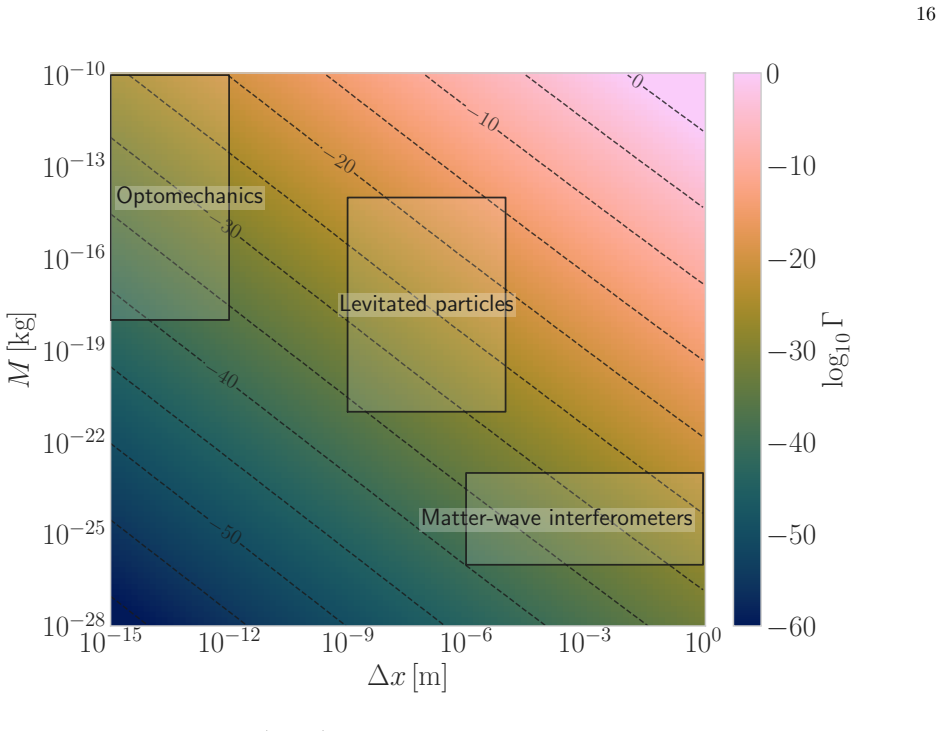
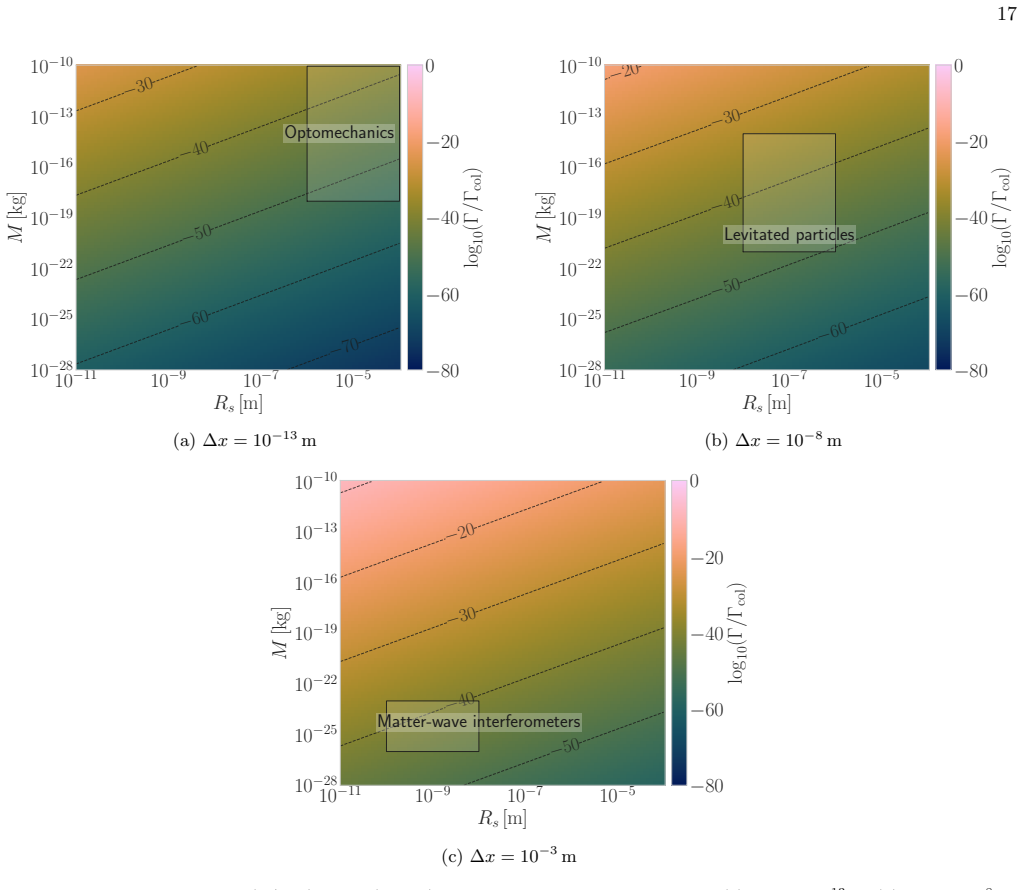
Gravitational decoherence for macroscopic spatial superpositions accumulates logarithmically with distance but remains subdominant to collisional decoherence.
A machine-rendered reading of the paper's core claim, the machinery that carries it, and where it could break.
Core claim
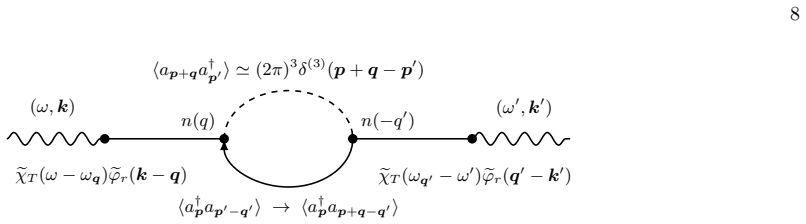
Starting from linearized gravity coupled to a massive system particle and an environmental scalar field, the decoherence exponent can be written as a bilinear functional of the difference of the system stress-energy tensors and an effective noise kernel obtained by dressing the environmental stress-energy tensor correlator with graviton propagators. For a dilute nonrelativistic gas coarse-grained in time and space, controlled approximations yield analytic expressions for the cumulative decoherence function whose dominant contribution is accumulated logarithmically over a broad range of distances.
What carries the argument
The closed-time-path influence functional in the nonrelativistic quasi-static regime, which produces an effective noise kernel by dressing the environmental stress-energy tensor correlator with graviton propagators.
If this is right
- Analytic expressions for the cumulative decoherence function follow from controlled approximations applied to the Newtonian interaction.
- The dominant contribution to the decoherence accumulates logarithmically over a broad range of distances.
- The resulting gravitational decoherence remains subdominant to conventional collisional decoherence under realistic conditions.
- The framework applies directly to a dilute nonrelativistic gas modeled by finite wave packets and coarse-grained in time and space.
Where Pith is reading between the lines
- The same influence-functional construction could be reused to compare gravitational decoherence against other long-range environmental couplings such as electromagnetic fluctuations.
- Experiments that suppress collisional decoherence to extremely low levels might become sensitive to the logarithmic gravitational term at larger object separations.
- The bilinear form on stress-energy tensors suggests a route to generalize the calculation beyond Newtonian gravity to weak-field curved backgrounds.
Load-bearing premise
The environment is modeled as a scalar field coupled through linearized gravity, and the nonrelativistic quasi-static regime is assumed to allow the decoherence exponent to be written as a bilinear functional of the system stress-energy tensors.
What would settle it
A laboratory measurement of excess decoherence rate in a controlled macroscopic superposition as a function of separation distance that either matches or deviates from the predicted logarithmic accumulation after subtracting known collisional contributions.
Figures
read the original abstract
We formulate the gravitationally induced quantum decoherence of a massive object prepared in a spatial superposition. Starting from linearized gravity coupled to a massive system particle and an environmental scalar field, we derive a closed-time-path influence functional governing the reduced system dynamics. In the nonrelativistic and quasi-static regime, the decoherence exponent can be written as a bilinear functional of the difference of the system stress-energy tensors and an effective noise kernel obtained by dressing the environmental stress-energy tensor correlator with graviton propagators. We then apply this framework to the Newtonian long-range gravitational interaction and evaluate the resulting decoherence function for a dilute nonrelativistic gas modeled by finite wave packets and coarse-grained in time and space. By performing controlled approximations, we obtain analytic expressions for the cumulative decoherence function and show that the dominant contribution is accumulated logarithmically over a broad range of distances, while remaining subdominant to conventional collisional decoherence under realistic conditions.
Editorial analysis
A structured set of objections, weighed in public.
Referee Report
Summary. The manuscript derives a closed-time-path influence functional for gravitationally induced decoherence of a massive object in spatial superposition, starting from linearized gravity coupled to a system particle and an environmental scalar field. In the nonrelativistic quasi-static regime the decoherence exponent is expressed as a bilinear functional of stress-energy tensor differences dressed by an effective noise kernel obtained from graviton propagators acting on the environmental correlator. The framework is applied to a dilute nonrelativistic gas of finite wave packets after coarse-graining; controlled approximations then produce analytic expressions for the cumulative decoherence function, whose dominant term accumulates logarithmically over a broad range of distances yet remains subdominant to conventional collisional decoherence under realistic conditions.
Significance. If the controlled approximations and subdominance result hold, the work supplies analytic expressions and a clear distance dependence (logarithmic) for gravitational decoherence, which is useful for assessing the viability of macroscopic superposition experiments. The construction rests on standard tools (linearized gravity, CTP formalism) without introducing free parameters or ad-hoc cutoffs, and the explicit comparison to collisional decoherence under realistic conditions provides a concrete, falsifiable benchmark. These features constitute a genuine contribution to the quantitative understanding of gravitational decoherence.
minor comments (3)
- [Derivation of the influence functional] The abstract states that the approximations are 'controlled' and yield analytic expressions, but the main text should explicitly state the expansion parameter, the order retained, and the estimated remainder term (e.g., in the section deriving the influence functional).
- [Application to dilute gas] The modeling of the environmental scalar field and the precise manner in which its stress-energy correlator is dressed by the graviton propagator should be written with an explicit equation for the noise kernel to allow direct reproduction of the logarithmic term.
- [Comparison to collisional decoherence] The comparison to collisional decoherence would be strengthened by listing the numerical values of the parameters (density, temperature, scattering cross-section) used to establish subdominance.
Simulated Author's Rebuttal
We thank the referee for the detailed and positive assessment of our manuscript. The summary accurately captures the derivation and main results, and we appreciate the recognition of the work's contribution to quantitative understanding of gravitational decoherence. As no specific major comments were raised, we will proceed with minor revisions to address any editorial or presentational suggestions.
Circularity Check
No significant circularity; derivation self-contained from external standards
full rationale
The paper's derivation chain begins from linearized gravity coupled to a scalar field and the closed-time-path influence functional, both standard external frameworks not defined within the paper. The decoherence exponent is expressed as a bilinear functional of stress-energy tensors dressed by graviton propagators, then applied to a dilute gas via controlled approximations yielding analytic expressions. No load-bearing step reduces by construction to a fitted parameter, self-citation, or prior ansatz from the same authors; the logarithmic accumulation and subdominance comparison follow directly from the stated nonrelativistic quasi-static regime without internal redefinition or renaming of inputs as outputs. The framework remains independent of the target result.
Axiom & Free-Parameter Ledger
axioms (2)
- domain assumption Linearized gravity is sufficient to couple the system to the environment
- domain assumption Nonrelativistic and quasi-static regime applies
Reference graph
Works this paper leans on
-
[1]
A. D. Cronin, J. Schmiedmayer, and D. E. Pritchard, Rev. Mod. Phys.81, 1051 (2009), arXiv:0712.3703 [quant-ph]
Pith/arXiv arXiv 2009
-
[2]
M. Aspelmeyer, T. J. Kippenberg, and F. Marquardt, Rev. Mod. Phys.86, 1391 (2014), arXiv:1303.0733 [cond-mat.mes- hall]
Pith/arXiv arXiv 2014
-
[3]
M. Arndt and K. Hornberger, Nature Phys.10, 271 (2014), arXiv:1410.0270 [quant-ph]
Pith/arXiv arXiv 2014
- [4]
-
[5]
C. L. Degen, F. Reinhard, and P. Cappellaro, Rev. Mod. Phys.89, 035002 (2017), arXiv:1611.02427 [quant-ph]
Pith/arXiv arXiv 2017
-
[6]
D. Carneyet al., Quantum Sci. Technol.6, 024002 (2021), arXiv:2008.06074 [physics.ins-det]
arXiv 2021
-
[7]
S. Bose, A. Mazumdar, G. W. Morley, H. Ulbricht, M. Toroˇ s, M. Paternostro, A. Geraci, P. Barker, M. S. Kim, and G. Milburn, Phys. Rev. Lett.119, 240401 (2017), arXiv:1707.06050 [quant-ph]
Pith/arXiv arXiv 2017
-
[8]
C. Marletto and V. Vedral, Phys. Rev. Lett.119, 240402 (2017), arXiv:1707.06036 [quant-ph]
Pith/arXiv arXiv 2017
-
[9]
H. D. Zeh, Found. Phys.1, 69 (1970)
1970
-
[10]
W. H. Zurek, Phys. Rev. D24, 1516 (1981)
1981
-
[11]
W. H. Zurek, Phys. Rev. D26, 1862 (1982)
1982
-
[12]
Giulini, C
D. Giulini, C. Kiefer, E. Joos, J. Kupsch, I. O. Stamatescu, and H. D. Zeh,Decoherence and the appearance of a classical world in quantum theory(1996)
1996
-
[13]
W. H. Zurek, Rev. Mod. Phys.75, 715 (2003), arXiv:quant-ph/0105127
Pith/arXiv arXiv 2003
-
[14]
M. Schlosshauer, Rev. Mod. Phys.76, 1267 (2004), arXiv:quant-ph/0312059
Pith/arXiv arXiv 2004
-
[15]
Schlosshauer,Decoherence and the Quantum-to-Classical Transition(Springer, Berlin, Heidelberg, 2007)
M. Schlosshauer,Decoherence and the Quantum-to-Classical Transition(Springer, Berlin, Heidelberg, 2007)
2007
-
[16]
M. Schlosshauer, Phys. Rept.831, 1 (2019), arXiv:1911.06282 [quant-ph]
arXiv 2019
-
[17]
Joos and H
E. Joos and H. D. Zeh, Z. Phys. B59, 223 (1985)
1985
-
[18]
M. R. Gallis and G. N. Fleming, Phys. Rev. A42, 38 (1990)
1990
-
[19]
K. Hornberger and J. E. Sipe, Phys. Rev. A68, 012105 (2003), arXiv:quant-ph/0303094
Pith/arXiv arXiv 2003
-
[20]
R. P. Feynman and F. L. Vernon, Jr., Annals Phys.24, 118 (1963)
1963
-
[21]
J. S. Schwinger, J. Math. Phys.2, 407 (1961)
1961
-
[22]
L. V. Keldysh, Sov. Phys. JETP20, 1018 (1965)
1965
-
[23]
E. A. Calzetta and B. L. Hu,Nonequilibrium Quantum Field Theory(Oxford University Press, 2009)
2009
-
[24]
C. Anastopoulos and B. L. Hu, Class. Quant. Grav.30, 165007 (2013), arXiv:1305.5231 [gr-qc]
Pith/arXiv arXiv 2013
-
[25]
M. P. Blencowe, Phys. Rev. Lett.111, 021302 (2013), arXiv:1211.4751 [quant-ph]
Pith/arXiv arXiv 2013
-
[26]
Gerlich, S
S. Gerlich, S. Eibenberger, M. Tomandl, S. Nimmrichter, K. Hornberger, P. J. Fagan, J. T¨ uxen, M. Mayor, and M. Arndt, Nature Commun.2, 263 (2011)
2011
-
[27]
Kovachy, P
T. Kovachy, P. Asenbaum, C. Overstreet, C. A. Donnelly, S. M. Dickerson, A. Sugarbaker, J. M. Hogan, and M. A. Kasevich, Nature528, 530 (2015)
2015
-
[28]
J. Bateman, S. Nimmrichter, K. Hornberger, and H. Ulbricht, Nature Commun.5, 4788 (2014), arXiv:1312.0500 [quant-ph]
Pith/arXiv arXiv 2014
-
[29]
O. Romero-Isart, A. C. Pflanzer, F. Blaser, R. Kaltenbaek, N. Kiesel, M. Aspelmeyer, and J. I. Cirac, Phys. Rev. Lett. 107, 020405 (2011), arXiv:1103.4081 [quant-ph]
Pith/arXiv arXiv 2011
-
[30]
Eichenfield, J
M. Eichenfield, J. Chan, R. M. Camacho, K. J. Vahala, and O. Painter, Nature462, 78 (2009)
2009
-
[31]
W. Marshall, C. Simon, R. Penrose, and D. Bouwmeester, Phys. Rev. Lett.91, 130401 (2003), arXiv:quant-ph/0210001
Pith/arXiv arXiv 2003
-
[32]
J. D. Teufel, T. Donner, D. Li, J. W. Harlow, M. S. Allman, K. Cicak, A. J. Sirois, J. D. Whittaker, K. W. Lehnert, and R. W. Simmonds, Nature475, 359 (2011), arXiv:1103.2144 [quant-ph]
Pith/arXiv arXiv 2011
discussion (0)
Sign in with ORCID, Apple, or X to comment. Anyone can read and Pith papers without signing in.