Steep Redshift Evolution of the Ionizing Escape Fraction at z = 5--12: Empirical Constraints and Comparison with Simulations
Pith reviewed 2026-06-28 05:03 UTC · model grok-4.3
The pith
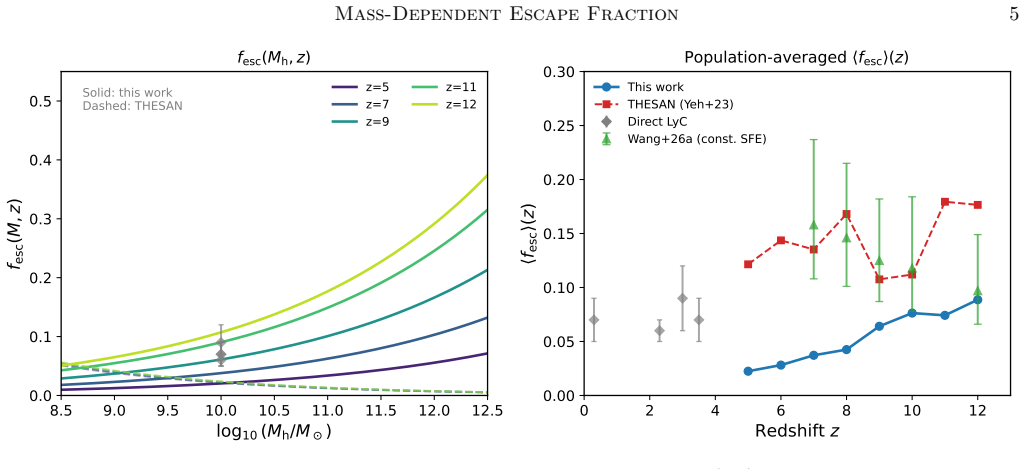
The ionizing escape fraction rises steeply with redshift from about 2 percent at z=5 to 9 percent at z=12.
A machine-rendered reading of the paper's core claim, the machinery that carries it, and where it could break.
Core claim
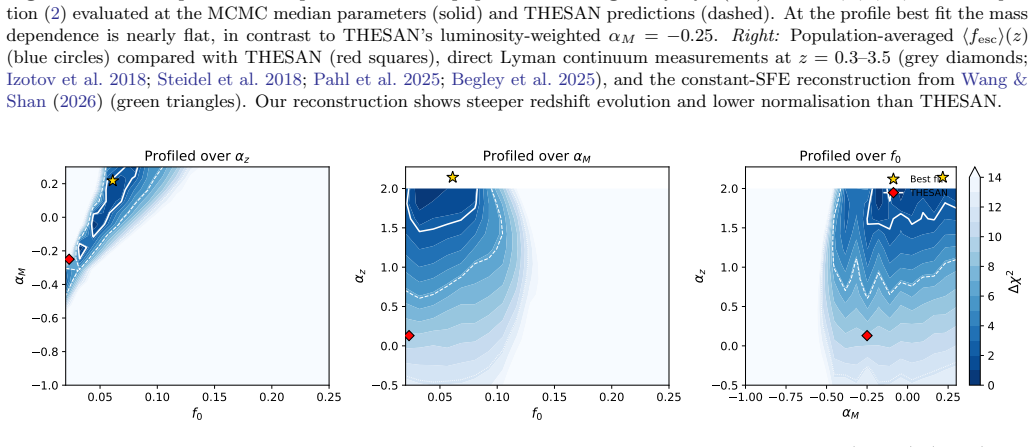
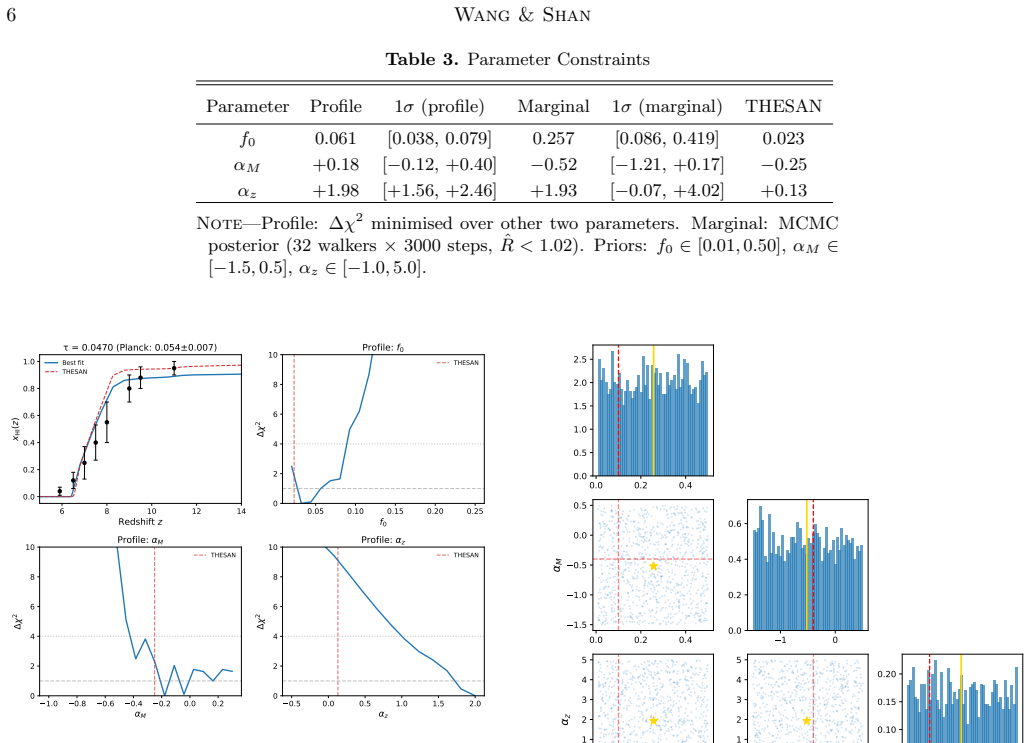
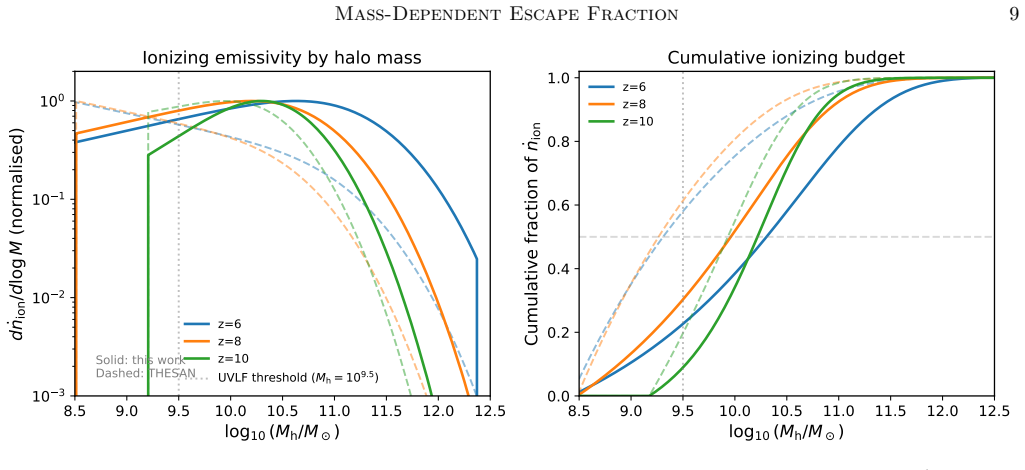
Conditioned on UV luminosity functions at z=5-12, Planck Thomson optical depth, neutral fraction measurements, and a high-redshift prior, a dense grid scan and MCMC on the model f_esc = f_0 (M/10^10 M_sun)^α_M [(1+z)/10]^α_z returns profile-likelihood constraints f_0=0.061_{-0.023}^{+0.018}, α_M=0.18_{-0.30}^{+0.22}, α_z=1.98_{-0.42}^{+0.48}. The resulting population-averaged escape fraction therefore increases from roughly 2 percent at z=5 to 9 percent at z=12, with halos below the observational threshold contributing more than 80 percent of the ionizing budget at z greater than or equal to 10; the steep-evolution solution also reproduces the observed optical depth to within 0.7 sigma.
What carries the argument
The three-parameter power-law escape-fraction model f_esc(M_h,z) linked to data through abundance matching of M_UV to halo mass and a validated reionization ODE solver.
If this is right
- Sub-threshold halos supply more than 80 percent of the ionizing photons at z greater than or equal to 10.
- The model yields a Thomson optical depth of 0.047, consistent with Planck at 0.7 sigma.
- The per-halo median escape fraction in the THESAN simulation shows similarly steep redshift evolution, while luminosity-weighted averages flatten the trend because massive halos dominate at lower redshift.
- Robustness checks establish that the redshift exponent exceeds 1.0 at greater than 95 percent .
- Tabulated posterior distributions of f_esc(M_h,z) are supplied for direct use in other reionization simulations.
Where Pith is reading between the lines
- Future deeper surveys that reach fainter galaxies at z greater than 10 could directly test whether low-mass halos indeed dominate the ionizing output.
- The strong degeneracy among the three parameters in the full posterior implies that additional independent observables, such as the redshift evolution of the neutral fraction at specific redshifts, would be needed to tighten the constraints further.
- If the weak mass dependence holds, escape-fraction prescriptions in galaxy-formation simulations can be simplified to depend mainly on redshift rather than on detailed halo properties.
- The difference between per-halo and luminosity-weighted averages suggests that comparisons between empirical constraints and simulations must specify the averaging method to avoid apparent tension.
- keywords:[
Load-bearing premise
That a single three-parameter power-law form adequately describes the escape fraction over the full halo-mass and redshift range, together with the accuracy of abundance matching that converts observed UV magnitudes into halo masses.
What would settle it
A direct measurement of the escape fraction for a statistical sample of galaxies at z greater than 10 that shows no increase or a decrease with redshift, or that attributes most ionizing photons to halos above the observational threshold.
Figures
read the original abstract
The ionizing photon escape fraction $f_{\rm esc}$ governs cosmic reionization yet remains observationally unconstrained as a function of halo mass. We present the first empirical constraints on $f_{\rm esc}(M_{\rm h},z)$ across the epoch of reionization, using a three-parameter power-law model $f_{\rm esc} = f_0\,(M/10^{10}M_\odot)^{\alpha_M}\,[(1{+}z)/10]^{\alpha_z}$, conditioned on HST and JWST UV luminosity functions at $z=5$--12, the Planck Thomson optical depth, seven neutral-fraction measurements, and one high-redshift prior. Using Schechter fits to the latest HST and JWST UV luminosity functions, abundance matching to link $M_{\rm UV}$ to halo mass, and a reionization ODE solver validated against Planck, we constrain the model via a dense grid scan and ensemble MCMC. The profile likelihood yields tight constraints: $f_0=0.061_{-0.023}^{+0.018}$, $\alpha_M=0.18_{-0.30}^{+0.22}$, $\alpha_z=1.98_{-0.42}^{+0.48}$. In contrast, the full marginal posterior is substantially broadened by a strong $f_0$--$\alpha_M$--$\alpha_z$ degeneracy ($\alpha_z = 1.93_{-2.00}^{+2.09}$, $\alpha_M = -0.52_{-0.69}^{+0.69}$). The population-averaged $\langle f_{\rm esc} \rangle(z)$ rises from $\sim$2\% at $z=5$ to $\sim$9\% at $z=12$, with sub-threshold halos contributing $>80\%$ of the ionizing budget at $z\geq10$. Comparing with THESAN, we find that the per-halo median $f_{\rm esc}$ shows steep evolution consistent with our profile result, while luminosity-weighted averaging systematically flattens the trend because massive halos dominate the ionizing budget at $z\lesssim7$. Robustness checks confirm $\alpha_z>1.0$ at $>95\%$ confidence; the steep-evolution model predicts $\tau_e=0.047$, consistent with Planck at $0.7\sigma$. We provide tabulated $f_{\rm esc}(M_{\rm h},z)$ posteriors as empirical inputs for reionization simulations.
Editorial analysis
A structured set of objections, weighed in public.
Referee Report
Summary. The paper claims to provide the first empirical constraints on f_esc(M_h, z) across reionization using a three-parameter power-law model f_esc = f_0 (M/10^{10} M_⊙)^{α_M} [(1+z)/10]^{α_z}. The model is fit via profile likelihood and MCMC to HST/JWST UV luminosity functions at z=5--12 (via abundance matching), Planck τ_e, seven neutral-fraction measurements, and one high-z prior. It reports tight profile-likelihood values f_0=0.061_{-0.023}^{+0.018}, α_M=0.18_{-0.30}^{+0.22}, α_z=1.98_{-0.42}^{+0.48}, implying ⟨f_esc⟩ rising from ~2% at z=5 to ~9% at z=12 with sub-threshold halos contributing >80% of the ionizing budget at z≥10. The model is compared to THESAN simulations and robustness checks are presented, with tabulated posteriors provided.
Significance. If the parametric assumptions and abundance-matching procedure hold, the tabulated f_esc(M_h,z) posteriors would supply useful empirical inputs for reionization simulations. The explicit comparison with THESAN (per-halo median vs. luminosity-weighted averaging) is a constructive element that highlights differences in how massive halos contribute at lower z. The use of both profile likelihood and full posterior is noted, though the former drives the headline claims.
major comments (3)
- [Abstract] Abstract: The model is conditioned on the Planck Thomson optical depth as an input datum, yet the abstract presents the predicted τ_e=0.047 as consistent with Planck at 0.7σ. This circularity means the consistency statement is not an independent validation and may influence the derived α_z constraint.
- [Abstract] Abstract: The three-parameter power-law form is assumed to hold over the full halo-mass range, including the low-mass extrapolation required by abundance matching from Schechter UVLFs below the observed M_UV threshold. No validation or comparison against alternative functional forms (e.g., with mass-dependent breaks) is described, which is load-bearing for the claim that sub-threshold halos contribute >80% of the ionizing budget at z≥10.
- [Abstract] Abstract: The profile likelihood yields tight constraints (α_z=1.98_{-0.42}^{+0.48}), but the marginal posterior is substantially broader (α_z=1.93_{-2.00}^{+2.09}) due to strong f_0–α_M–α_z degeneracy. The robustness checks claiming α_z>1.0 at >95% confidence must explicitly demonstrate independence from the Planck τ_e conditioning and from the choice to emphasize profile likelihood.
minor comments (1)
- [Abstract] Abstract: The distinction between the reported profile-likelihood intervals and the broader marginal posterior should be stated more clearly when presenting the headline constraints.
Simulated Author's Rebuttal
We thank the referee for their insightful comments on our manuscript. We address each of the three major comments point by point below, indicating the revisions we will make to strengthen the paper.
read point-by-point responses
-
Referee: [Abstract] Abstract: The model is conditioned on the Planck Thomson optical depth as an input datum, yet the abstract presents the predicted τ_e=0.047 as consistent with Planck at 0.7σ. This circularity means the consistency statement is not an independent validation and may influence the derived α_z constraint.
Authors: We agree with the referee that the consistency with Planck τ_e is not an independent validation since the model is conditioned on it. We will revise the abstract to state that the best-fit model yields τ_e=0.047, which is consistent with the input Planck value at 0.7σ, thereby removing any implication of independent validation. This revision will clarify the role of the τ_e constraint without altering the scientific conclusions. revision: yes
-
Referee: [Abstract] Abstract: The three-parameter power-law form is assumed to hold over the full halo-mass range, including the low-mass extrapolation required by abundance matching from Schechter UVLFs below the observed M_UV threshold. No validation or comparison against alternative functional forms (e.g., with mass-dependent breaks) is described, which is load-bearing for the claim that sub-threshold halos contribute >80% of the ionizing budget at z≥10.
Authors: The referee correctly identifies that the power-law assumption is central to the extrapolation and the >80% contribution claim. We did not perform comparisons to alternative forms such as those with mass-dependent breaks, as the three-parameter model was selected for its simplicity given the available data. We will add a dedicated paragraph in the discussion section acknowledging this assumption as a limitation and noting that more complex models could be explored in future work with additional data. This will temper the claim appropriately. revision: partial
-
Referee: [Abstract] Abstract: The profile likelihood yields tight constraints (α_z=1.98_{-0.42}^{+0.48}), but the marginal posterior is substantially broader (α_z=1.93_{-2.00}^{+2.09}) due to strong f_0–α_M–α_z degeneracy. The robustness checks claiming α_z>1.0 at >95% confidence must explicitly demonstrate independence from the Planck τ_e conditioning and from the choice to emphasize profile likelihood.
Authors: The manuscript already reports both the profile likelihood constraints and the broader marginal posterior, explicitly discussing the degeneracy. The robustness checks for α_z>1.0 at >95% confidence are derived from the profile likelihood, which is appropriate for identifying the best-constrained parameters. We will revise the text to more clearly state that these checks are conditional on the full dataset including Planck τ_e, and note that removing the τ_e constraint would broaden the posterior further. We maintain that the profile likelihood provides the relevant tight constraints for the headline results, but will emphasize the marginal results more prominently in the abstract and conclusions. revision: partial
Circularity Check
Fitted Planck τ_e presented as independent 'prediction' of the model
specific steps
-
fitted input called prediction
[Abstract]
"conditioned on HST and JWST UV luminosity functions at z=5--12, the Planck Thomson optical depth, seven neutral-fraction measurements, and one high-redshift prior. ... the steep-evolution model predicts τ_e=0.047, consistent with Planck at 0.7σ"
The model parameters (including α_z) are obtained only after including Planck τ_e in the fit; the subsequent statement that the model 'predicts' a τ_e value consistent with Planck therefore reduces directly to the input datum by construction rather than constituting an independent test.
full rationale
The derivation conditions the three-parameter power-law fit on the Planck optical depth as an explicit constraint in the likelihood, then reports the resulting τ_e=0.047 as a 'prediction' consistent with Planck. This is the only load-bearing reduction that matches a defined circularity pattern; the assumed functional form and abundance-matching extrapolation are modeling choices rather than self-referential by construction, and no self-citation chains or uniqueness theorems are invoked. The central empirical constraints on α_z and sub-threshold contributions therefore retain independent content from the UVLF and x_HI data even after the τ_e tautology is removed.
Axiom & Free-Parameter Ledger
free parameters (3)
- f_0
- α_M
- α_z
axioms (2)
- domain assumption Abundance matching accurately maps observed M_UV to halo mass M_h across z=5–12.
- standard math The reionization ODE solver reproduces the Planck optical depth when fed the fitted f_esc.
Reference graph
Works this paper leans on
-
[1]
Planck 2018 results. VI. Cosmological parameters
Aghanim, N. and others. Planck 2018 results. VI. Cosmological parameters. Astron. Astrophys. 2020. doi:10.1051/0004-6361/201833910. arXiv:1807.06209
work page internal anchor Pith review Pith/arXiv arXiv doi:10.1051/0004-6361/201833910 2018
-
[2]
Bullock, James S. and Boylan-Kolchin, Michael. Small-Scale Challenges to the CDM Paradigm. Ann. Rev. Astron. Astrophys. 2017. doi:10.1146/annurev-astro-091916-055313. arXiv:1707.04256
-
[3]
A Universal Density Profile from Hierarchical Clustering
Navarro, Julio F. and Frenk, Carlos S. and White, Simon D. M. A Universal density profile from hierarchical clustering. Astrophys. J. 1997. doi:10.1086/304888. arXiv:astro-ph/9611107
work page internal anchor Pith review Pith/arXiv arXiv doi:10.1086/304888 1997
-
[4]
Oh, Se-Heon and Brook, Chris and Governato, Fabio and Brinks, Elias and Mayer, Lucio and de Blok, W. J. G. and Brooks, Alyson and Walter, Fabian. The central slope of dark matter cores in dwarf galaxies: Simulations vs. THINGS. Astron. J. 2011. doi:10.1088/0004-6256/142/1/24. arXiv:1011.2777
work page internal anchor Pith review Pith/arXiv arXiv doi:10.1088/0004-6256/142/1/24 2011
-
[5]
Evidence against dissipationless dark matter from observations of galaxy haloes
Moore, Ben. Evidence against dissipationless dark matter from observations of galaxy haloes. Nature. 1994. doi:10.1038/370629a0
-
[6]
de Blok, W. J. G. The Core-Cusp Problem. Adv. Astron. 2010. doi:10.1155/2010/789293. arXiv:0910.3538
work page internal anchor Pith review Pith/arXiv arXiv doi:10.1155/2010/789293 2010
-
[7]
The unexpected diversity of dwarf galaxy rotation curves
Oman, Kyle A. and others. The unexpected diversity of dwarf galaxy rotation curves. Mon. Not. Roy. Astron. Soc. 2015. doi:10.1093/mnras/stv1504. arXiv:1504.01437
work page internal anchor Pith review Pith/arXiv arXiv doi:10.1093/mnras/stv1504 2015
-
[8]
Creasey, Peter and Sameie, Omid and Sales, Laura V. and Yu, Hai-Bo and Vogelsberger, Mark and Zavala, Jes \'u s. Spreading out and staying sharp creating diverse rotation curves via baryonic and self-interaction effects. Mon. Not. Roy. Astron. Soc. 2017. doi:10.1093/mnras/stx522. arXiv:1612.03903
work page internal anchor Pith review Pith/arXiv arXiv doi:10.1093/mnras/stx522 2017
-
[9]
Where are the missing galactic satellites?
Klypin, Anatoly A. and Kravtsov, Andrey V. and Valenzuela, Octavio and Prada, Francisco. Where are the missing Galactic satellites?. Astrophys. J. 1999. doi:10.1086/307643. arXiv:astro-ph/9901240
work page internal anchor Pith review Pith/arXiv arXiv doi:10.1086/307643 1999
-
[10]
Dark Matter Substructure in Galactic Halos
Moore, B. and Ghigna, S. and Governato, F. and Lake, G. and Quinn, Thomas R. and Stadel, J. and Tozzi, P. Dark matter substructure within galactic halos. Astrophys. J. Lett. 1999. doi:10.1086/312287. arXiv:astro-ph/9907411
work page internal anchor Pith review Pith/arXiv arXiv doi:10.1086/312287 1999
-
[11]
2011, MNRAS, 418, L20, doi: 10.1111/j.1745-3933.2011.01134.x
Boylan-Kolchin, Michael and Bullock, James S. and Kaplinghat, Manoj. Too big to fail? The puzzling darkness of massive Milky Way subhaloes. Mon. Not. Roy. Astron. Soc. 2011. doi:10.1111/j.1745-3933.2011.01074.x. arXiv:1103.0007
-
[12]
Too Big to Fail in the Local Group
Garrison-Kimmel, Shea and Boylan-Kolchin, Michael and Bullock, James S. and Kirby, Evan N. Too Big to Fail in the Local Group. Mon. Not. Roy. Astron. Soc. 2014. doi:10.1093/mnras/stu1477. arXiv:1404.5313
work page internal anchor Pith review Pith/arXiv arXiv doi:10.1093/mnras/stu1477 2014
-
[13]
Observational evidence for self-interacting cold dark matter
Spergel, David N. and Steinhardt, Paul J. Observational evidence for selfinteracting cold dark matter. Phys. Rev. Lett. 2000. doi:10.1103/PhysRevLett.84.3760. arXiv:astro-ph/9909386
work page internal anchor Pith review Pith/arXiv arXiv doi:10.1103/physrevlett.84.3760 2000
-
[14]
Dark Matter Self-interactions and Small Scale Structure
Tulin, Sean and Yu, Hai-Bo. Dark Matter Self-interactions and Small Scale Structure. Phys. Rept. 2018. doi:10.1016/j.physrep.2017.11.004. arXiv:1705.02358
work page internal anchor Pith review Pith/arXiv arXiv doi:10.1016/j.physrep.2017.11.004 2018
-
[15]
Rocha, Miguel and Peter, Annika H. G. and Bullock, James S. and Kaplinghat, Manoj and Garrison-Kimmel, Shea and Onorbe, Jose and Moustakas, Leonidas A. Cosmological Simulations with Self-Interacting Dark Matter I: Constant Density Cores and Substructure. Mon. Not. Roy. Astron. Soc. 2013. doi:10.1093/mnras/sts514. arXiv:1208.3025
work page internal anchor Pith review Pith/arXiv arXiv doi:10.1093/mnras/sts514 2013
-
[16]
Peter, Annika H. G. and Rocha, Miguel and Bullock, James S. and Kaplinghat, Manoj. Cosmological Simulations with Self-Interacting Dark Matter II: Halo Shapes vs. Observations. Mon. Not. Roy. Astron. Soc. 2013. doi:10.1093/mnras/sts535. arXiv:1208.3026
work page internal anchor Pith review Pith/arXiv arXiv doi:10.1093/mnras/sts535 2013
-
[17]
How the Self-Interacting Dark Matter Model Explains the Diverse Galactic Rotation Curves
Kamada, Ayuki and Kaplinghat, Manoj and Pace, Andrew B. and Yu, Hai-Bo. How the Self-Interacting Dark Matter Model Explains the Diverse Galactic Rotation Curves. Phys. Rev. Lett. 2017. doi:10.1103/PhysRevLett.119.111102. arXiv:1611.02716
work page internal anchor Pith review Pith/arXiv arXiv doi:10.1103/physrevlett.119.111102 2017
-
[18]
Correa, Camila A. Constraining velocity-dependent self-interacting dark matter with the Milky Way s dwarf spheroidal galaxies. Mon. Not. Roy. Astron. Soc. 2021. doi:10.1093/mnras/stab506. arXiv:2007.02958
-
[19]
Markevitch, Maxim and Gonzalez, A. H. and Clowe, D. and Vikhlinin, A. and David, L. and Forman, W. and Jones, C. and Murray, S. and Tucker, W. Direct constraints on the dark matter self-interaction cross-section from the merging galaxy cluster 1E0657-56. Astrophys. J. 2004. doi:10.1086/383178. arXiv:astro-ph/0309303
work page internal anchor Pith review Pith/arXiv arXiv doi:10.1086/383178 2004
-
[20]
Randall, Scott W. and Markevitch, Maxim and Clowe, Douglas and Gonzalez, Anthony H. and Bradac, Marusa. Constraints on the Self-Interaction Cross-Section of Dark Matter from Numerical Simulations of the Merging Galaxy Cluster 1E 0657-56. Astrophys. J. 2008. doi:10.1086/587859. arXiv:0704.0261
work page internal anchor Pith review Pith/arXiv arXiv doi:10.1086/587859 2008
-
[21]
The non-gravitational interactions of dark matter in colliding galaxy clusters
Harvey, David and Massey, Richard and Kitching, Thomas and Taylor, Andy and Tittley, Eric. The non-gravitational interactions of dark matter in colliding galaxy clusters. Science. 2015. doi:10.1126/science.1261381. arXiv:1503.07675
work page internal anchor Pith review Pith/arXiv arXiv doi:10.1126/science.1261381 2015
-
[22]
Constraining Self-Interacting Dark Matter with the Milky Way's dwarf spheroidals
Zavala, Jesus and Vogelsberger, Mark and Walker, Matthew G. Constraining Self-Interacting Dark Matter with the Milky Way's dwarf spheroidals. Mon. Not. Roy. Astron. Soc. 2013. doi:10.1093/mnrasl/sls053. arXiv:1211.6426
work page internal anchor Pith review Pith/arXiv arXiv doi:10.1093/mnrasl/sls053 2013
-
[23]
Dark matter self-interactions from the internal dynamics of dwarf spheroidals
Valli, Mauro and Yu, Hai-Bo. Dark matter self-interactions from the internal dynamics of dwarf spheroidals. Nature Astron. 2018. doi:10.1038/s41550-018-0560-7. arXiv:1711.03502
work page internal anchor Pith review Pith/arXiv arXiv doi:10.1038/s41550-018-0560-7 2018
-
[24]
Nishikawa, Hiroya and Boddy, Kimberly K. and Kaplinghat, Manoj. Accelerated core collapse in tidally stripped self-interacting dark matter halos. Phys. Rev. D. 2020. doi:10.1103/PhysRevD.101.063009. arXiv:1901.00499
-
[25]
Dark Matter Self-Interactions and Light Force Carriers
Buckley, Matthew R. and Fox, Patrick J. Dark Matter Self-Interactions and Light Force Carriers. Phys. Rev. D. 2010. doi:10.1103/PhysRevD.81.083522. arXiv:0911.3898
work page internal anchor Pith review Pith/arXiv arXiv doi:10.1103/physrevd.81.083522 2010
-
[26]
Beyond Collisionless Dark Matter: Particle Physics Dynamics for Dark Matter Halo Structure
Tulin, Sean and Yu, Hai-Bo and Zurek, Kathryn M. Beyond Collisionless Dark Matter: Particle Physics Dynamics for Dark Matter Halo Structure. Phys. Rev. D. 2013. doi:10.1103/PhysRevD.87.115007. arXiv:1302.3898
work page internal anchor Pith review Pith/arXiv arXiv doi:10.1103/physrevd.87.115007 2013
-
[27]
Tucker-Smith, David and Weiner, Neal. Inelastic dark matter. Phys. Rev. D. 2001. doi:10.1103/PhysRevD.64.043502. arXiv:hep-ph/0101138
work page internal anchor Pith review Pith/arXiv arXiv doi:10.1103/physrevd.64.043502 2001
-
[28]
Self-Scattering for Dark Matter with an Excited State
Schutz, Katelin and Slatyer, Tracy R. Self-Scattering for Dark Matter with an Excited State. JCAP. 2015. doi:10.1088/1475-7516/2015/01/021. arXiv:1409.2867
work page internal anchor Pith review Pith/arXiv arXiv doi:10.1088/1475-7516/2015/01/021 2015
-
[29]
Self-interacting inelastic dark matter: A viable solution to the small scale structure problems
Blennow, Mattias and Clementz, Stefan and Herrero-Garcia, Juan. Self-interacting inelastic dark matter: A viable solution to the small scale structure problems. JCAP. 2017. doi:10.1088/1475-7516/2017/03/048. arXiv:1612.06681
work page internal anchor Pith review Pith/arXiv arXiv doi:10.1088/1475-7516/2017/03/048 2017
-
[30]
Arkani-Hamed, Nima and Finkbeiner, Douglas P. and Slatyer, Tracy R. and Weiner, Neal. A Theory of Dark Matter. Phys. Rev. D. 2009. doi:10.1103/PhysRevD.79.015014. arXiv:0810.0713
work page internal anchor Pith review Pith/arXiv arXiv doi:10.1103/physrevd.79.015014 2009
-
[31]
Kaplan, David E. and Luty, Markus A. and Zurek, Kathryn M. Asymmetric Dark Matter. Phys. Rev. D. 2009. doi:10.1103/PhysRevD.79.115016. arXiv:0901.4117
work page internal anchor Pith review Pith/arXiv arXiv doi:10.1103/physrevd.79.115016 2009
-
[32]
Review of asymmetric dark matter
Petraki, Kalliopi and Volkas, Raymond R. Review of asymmetric dark matter. Int. J. Mod. Phys. A. 2013. doi:10.1142/S0217751X13300287. arXiv:1305.4939
work page internal anchor Pith review Pith/arXiv arXiv doi:10.1142/s0217751x13300287 2013
-
[33]
Higgs-field portal into hidden sectors
Patt, Brian and Wilczek, Frank. Higgs-field portal into hidden sectors. 2006. arXiv:hep-ph/0605188
Pith/arXiv arXiv 2006
-
[34]
Majorana Dark Matter with a Coloured Mediator: Collider vs Direct and Indirect Searches
Garny, Mathias and Ibarra, Alejandro and Rydbeck, Sara and Vogl, Stefan. Majorana Dark Matter with a Coloured Mediator: Collider vs Direct and Indirect Searches. JHEP. 2014. doi:10.1007/JHEP06(2014)169. arXiv:1403.4634
work page internal anchor Pith review Pith/arXiv arXiv doi:10.1007/jhep06(2014)169 2014
-
[35]
Revisiting Big-Bang Nucleosynthesis Constraints on Long-Lived Decaying Particles
Kawasaki, Masahiro and Kohri, Kazunori and Moroi, Takeo and Takaesu, Yoshitaro. Revisiting Big-Bang Nucleosynthesis Constraints on Long-Lived Decaying Particles. Phys. Rev. D. 2018. doi:10.1103/PhysRevD.97.023502. arXiv:1709.01211
work page internal anchor Pith review Pith/arXiv arXiv doi:10.1103/physrevd.97.023502 2018
-
[36]
Akerib, D. S. and others. The LUX-ZEPLIN (LZ) Experiment. Nucl. Instrum. Meth. A. 2020. doi:10.1016/j.nima.2019.163047. arXiv:1910.09124
-
[37]
Aprile, E. and others. The XENONnT dark matter experiment. Eur. Phys. J. C. 2024. doi:10.1140/epjc/s10052-024-12982-5. arXiv:2402.10446
-
[38]
Dark Matter Search Results from the PICO-60 C$_3$F$_8$ Bubble Chamber
Amole, C. and others. Dark Matter Search Results from the PICO-60 C _3 F _8 Bubble Chamber. Phys. Rev. Lett. 2017. doi:10.1103/PhysRevLett.118.251301. arXiv:1702.07666
work page internal anchor Pith review Pith/arXiv arXiv doi:10.1103/physrevlett.118.251301 2017
-
[39]
Abdelhameed, A. H. and others. First results from the CRESST-III low-mass dark matter program. Phys. Rev. D. 2019. doi:10.1103/PhysRevD.100.102002. arXiv:1904.00498
-
[40]
Krnjaic, Gordan and McKeen, David and Mizuta, Riku and Mohlabeng, Gopolang and Morrissey, David E. and Tuckler, Douglas. X-rays from Inelastic Dark Matter Freeze-in. 2025. arXiv:2509.19428
arXiv 2025
-
[41]
The Sommerfeld enhancement for dark matter with an excited state
Slatyer, Tracy R. The Sommerfeld enhancement for dark matter with an excited state. JCAP. 2010. doi:10.1088/1475-7516/2010/02/028. arXiv:0910.5713
work page internal anchor Pith review Pith/arXiv arXiv doi:10.1088/1475-7516/2010/02/028 2010
-
[42]
Cui, Yanou and D'Eramo, Francesco. Surprises from complete vector portal theories: New insights into the dark sector and its interplay with Higgs physics. Phys. Rev. D. 2017. doi:10.1103/PhysRevD.96.095006. arXiv:1705.03897
work page internal anchor Pith review Pith/arXiv arXiv doi:10.1103/physrevd.96.095006 2017
-
[44]
O'Donnell, Jackson H. and Jeltema, Tesla E. and Roberts, M. Grant and Nightingale, James and Flowers, Abigail and Aldas, Dhruv. A Constraint on Dark Matter Self-Interaction from Combined Strong Lensing and Stellar Kinematics in MACS J0138-2155. 2025. arXiv:2508.20179
arXiv 2025
-
[45]
Light Dark Matter: Models and Constraints
Knapen, Simon and Lin, Tongyan and Zurek, Kathryn M. Light Dark Matter: Models and Constraints. Phys. Rev. D. 2017. doi:10.1103/PhysRevD.96.115021. arXiv:1709.07882
work page internal anchor Pith review Pith/arXiv arXiv doi:10.1103/physrevd.96.115021 2017
-
[46]
2012, MNRAS, 422, 3285, doi: 10.1111/j.1365-2966.2012.20848.x
Vogelsberger, Mark and Zavala, Jesus and Loeb, Abraham. Subhaloes in Self-Interacting Galactic Dark Matter Haloes. Mon. Not. Roy. Astron. Soc. 2012. doi:10.1111/j.1365-2966.2012.21182.x. arXiv:1201.5892
-
[47]
Branco, G. C. and Ferreira, P. M. and Lavoura, L. and Rebelo, M. N. and Sher, Marc and Silva, Joao P. Theory and phenomenology of two-Higgs-doublet models. Phys. Rept. 2012. doi:10.1016/j.physrep.2012.02.002. arXiv:1106.0034
work page internal anchor Pith review Pith/arXiv arXiv doi:10.1016/j.physrep.2012.02.002 2012
-
[48]
Dark-Matter Electric and Magnetic Dipole Moments
Sigurdson, Kris and Doran, Michael and Kurylov, Andriy and Caldwell, Robert R. and Kamionkowski, Marc. Dark-matter electric and magnetic dipole moments. Phys. Rev. D. 2004. doi:10.1103/PhysRevD.70.083501. arXiv:astro-ph/0406355
work page internal anchor Pith review Pith/arXiv arXiv doi:10.1103/physrevd.70.083501 2004
-
[49]
Robust cosmological constraints on axion-like particles
Depta, Paul Frederik and Hufnagel, Marco and Schmidt-Hoberg, Kai. Robust cosmological constraints on axion-like particles. JCAP. 2020. doi:10.1088/1475-7516/2020/05/009. arXiv:2002.08370
-
[50]
Constraints on dark matter annihilation from CMB observations before Planck
Lopez-Honorez, Laura and Mena, Olga and Palomares-Ruiz, Sergio and Vincent, Aaron C. Constraints on dark matter annihilation from CMB observationsbefore Planck. JCAP. 2013. doi:10.1088/1475-7516/2013/07/046. arXiv:1303.5094
work page internal anchor Pith review Pith/arXiv arXiv doi:10.1088/1475-7516/2013/07/046 2013
-
[51]
Slatyer, Tracy R. Indirect dark matter signatures in the cosmic dark ages. I. Generalizing the bound on s-wave dark matter annihilation from Planck results. Phys. Rev. D. 2016. doi:10.1103/PhysRevD.93.023527. arXiv:1506.03811
work page internal anchor Pith review Pith/arXiv arXiv doi:10.1103/physrevd.93.023527 2016
-
[52]
Strong CMB Constraint On P-Wave Annihilating Dark Matter
An, Haipeng and Wise, Mark B. and Zhang, Yue. Effects of Bound States on Dark Matter Annihilation. Phys. Rev. D. 2016. doi:10.1103/PhysRevD.93.115020. arXiv:1606.02305
work page internal anchor Pith review Pith/arXiv arXiv doi:10.1103/physrevd.93.115020 2016
-
[53]
Stringent Constraints on Self-Interacting Dark Matter Using Milky-Way Satellite Galaxies Kinematics
Ando, Shin'ichiro and Hayashi, Kohei and Horigome, Shunichi and Ibe, Masahiro and Shirai, Satoshi. Stringent Constraints on Self-Interacting Dark Matter Using Milky-Way Satellite Galaxies Kinematics. 2025. arXiv:2503.13650
arXiv 2025
-
[54]
Binder, Tobias and Covi, Laura and Kamada, Ayuki and Murai, Kai and Takahashi, Tomo and Yoshida, Naoki. Matter Power Spectrum in Hidden Neutrino Interacting Dark Matter Models: A General Treatment. JCAP. 2016. doi:10.1088/1475-7516/2016/11/043. arXiv:1602.07624
work page internal anchor Pith review Pith/arXiv arXiv doi:10.1088/1475-7516/2016/11/043 2016
-
[55]
Constraining Dark Matter candidates from structure formation
Boehm, C. and Fayet, P. and Schaeffer, R. Constraining dark matter candidates from structure formation. Phys. Lett. B. 2001. doi:10.1016/S0370-2693(01)01060-7. arXiv:astro-ph/0012504
work page internal anchor Pith review Pith/arXiv arXiv doi:10.1016/s0370-2693(01)01060-7 2001
-
[56]
Loopy Constraints on Leptophilic Dark Matter and Internal Bremsstrahlung
Kopp, Joachim and Michaels, Lisa and Smirnov, Juri. Loopy constraints on leptophilic dark matter and internal bremsstrahlung. JCAP. 2014. doi:10.1088/1475-7516/2014/04/022. arXiv:1401.6457
work page internal anchor Pith review Pith/arXiv arXiv doi:10.1088/1475-7516/2014/04/022 2014
-
[57]
The Astrophysical Uncertainties Of Dark Matter Direct Detection Experiments
McCabe, Christopher. The Astrophysical Uncertainties of Inelastic Dark Matter. Phys. Rev. D. 2010. doi:10.1103/PhysRevD.82.023530. arXiv:1005.0579
work page internal anchor Pith review Pith/arXiv arXiv doi:10.1103/physrevd.82.023530 2010
-
[58]
Barak, L. and others. SENSEI: Direct-Detection Results on sub-GeV Dark Matter from a New Skipper-CCD. Phys. Rev. Lett. 2020. doi:10.1103/PhysRevLett.125.171802. arXiv:2004.11378
-
[59]
Raffelt, Georg G. Particle physics from stars. Ann. Rev. Nucl. Part. Sci. 1999. doi:10.1146/annurev.nucl.49.1.163. arXiv:hep-ph/9903472
work page internal anchor Pith review Pith/arXiv arXiv doi:10.1146/annurev.nucl.49.1.163 1999
-
[60]
Colloquium: Quantum matter built from nanoscopic lattices of atoms and photons , author =. Rev. Mod. Phys. , volume =. 2018 , month =. doi:10.1103/RevModPhys.90.031002 , url =
-
[61]
Stellar cooling bounds on new light particles: plasma mixing effects
Hardy, Edward and Lasenby, Robert. Stellar cooling bounds on new light particles: plasma mixing effects. JHEP. 2017. doi:10.1007/JHEP02(2017)033. arXiv:1611.05852
work page internal anchor Pith review Pith/arXiv arXiv doi:10.1007/jhep02(2017)033 2017
-
[62]
Electrophobic Scalar Boson and Muonic Puzzles
Liu, Yu-Sheng and McKeen, David and Miller, Gerald A. Electrophobic Scalar Boson and Muonic Puzzles. Phys. Rev. Lett. 2016. doi:10.1103/PhysRevLett.117.101801. arXiv:1605.04612
work page internal anchor Pith review Pith/arXiv arXiv doi:10.1103/physrevlett.117.101801 2016
-
[63]
Big Bang Nucleosynthesis: 2015
Cyburt, Richard H. and Fields, Brian D. and Olive, Keith A. and Yeh, Tsung-Han. Big Bang Nucleosynthesis: 2015. Rev. Mod. Phys. 2016. doi:10.1103/RevModPhys.88.015004. arXiv:1505.01076
work page internal anchor Pith review Pith/arXiv arXiv doi:10.1103/revmodphys.88.015004 2015
-
[64]
Probing scalar-neutrino and scalar-dark-matter interactions with PandaX-4T
Li, Tao and others. Probing scalar-neutrino and scalar-dark-matter interactions with PandaX-4T. 2025. arXiv:2511.13515
Pith/arXiv arXiv 2025
-
[65]
Simulating the joint evolution of quasars, galaxies and their large-scale distribution
Springel, Volker and others. Simulating the joint evolution of quasars, galaxies and their large-scale distribution. Nature. 2005. doi:10.1038/nature03597. arXiv:astro-ph/0504097
work page internal anchor Pith review Pith/arXiv arXiv doi:10.1038/nature03597 2005
-
[66]
Explosive Dark Matter Annihilation
Hisano, Junji and Matsumoto, Shigeki and Nojiri, Mihoko M. Explosive dark matter annihilation. Phys. Rev. Lett. 2004. doi:10.1103/PhysRevLett.92.031303. arXiv:hep-ph/0307216
work page internal anchor Pith review Pith/arXiv arXiv doi:10.1103/physrevlett.92.031303 2004
-
[67]
Radiative bound-state-formation cross-sections for dark matter interacting via a Yukawa potential
Petraki, Kalliopi and Postma, Marieke and de Vries, Jordy. Radiative bound-state-formation cross-sections for dark matter interacting via a Yukawa potential. JHEP. 2017. doi:10.1007/JHEP04(2017)077. arXiv:1611.01394
work page internal anchor Pith review Pith/arXiv arXiv doi:10.1007/jhep04(2017)077 2017
-
[68]
Beacham, J. and others. Physics Beyond Colliders at CERN: Beyond the Standard Model Working Group Report. J. Phys. G. 2020. doi:10.1088/1361-6471/ab4cd2. arXiv:1901.09966
-
[69]
Boehm, C. and Fayet, Pierre. Scalar dark matter candidates. Nucl. Phys. B. 2004. doi:10.1016/j.nuclphysb.2004.01.015. arXiv:hep-ph/0305261
work page internal anchor Pith review Pith/arXiv arXiv doi:10.1016/j.nuclphysb.2004.01.015 2004
-
[70]
Chang, Jae Hyeok and Essig, Rouven and McDermott, Samuel D. Supernova 1987A Constraints on Sub-GeV Dark Sectors, Millicharged Particles, the QCD Axion, and an Axion-like Particle. JHEP. 2018. doi:10.1007/JHEP09(2018)051. arXiv:1803.00993
work page internal anchor Pith review Pith/arXiv arXiv doi:10.1007/jhep09(2018)051 2018
-
[71]
Chluba, J. and Sunyaev, R. A. The evolution of CMB spectral distortions in the early Universe. Mon. Not. Roy. Astron. Soc. 2012. doi:10.1111/j.1365-2966.2011.19786.x. arXiv:1109.6552
-
[72]
Cosmological constraints on exotic injection of electromagnetic energy
Poulin, Vivian and Lesgourgues, Julien and Serpico, Pasquale D. Cosmological constraints on exotic injection of electromagnetic energy. JCAP. 2017. doi:10.1088/1475-7516/2017/03/043. arXiv:1610.10051
work page internal anchor Pith review Pith/arXiv arXiv doi:10.1088/1475-7516/2017/03/043 2017
-
[73]
Detection of low-energy electrons with transition-edge sensors
Pepe, Carlo and others. Detection of low-energy electrons with transition-edge sensors. Phys. Rev. Applied. 2024. doi:10.1103/PhysRevApplied.22.L041007. arXiv:2405.19475
-
[74]
and Maity, Tarak Nath and O'Hare, Ciaran A
Carew, Ben and Caddell, Ashlee R. and Maity, Tarak Nath and O'Hare, Ciaran A. J. Neutrino fog for dark matter-electron scattering experiments. Phys. Rev. D. 2024. doi:10.1103/PhysRevD.109.083016. arXiv:2312.04303
-
[75]
Toma, Takashi. Internal Bremsstrahlung Signature of Real Scalar Dark Matter and Consistency with Thermal Relic Density. Phys. Rev. Lett. 2013. doi:10.1103/PhysRevLett.111.091301. arXiv:1307.6181
work page internal anchor Pith review Pith/arXiv arXiv doi:10.1103/physrevlett.111.091301 2013
-
[76]
Self-consistent Calculation of the Sommerfeld Enhancement
Blum, Kfir and Sato, Ryosuke and Slatyer, Tracy R. Self-consistent Calculation of the Sommerfeld Enhancement. JCAP. 2016. doi:10.1088/1475-7516/2016/06/021. arXiv:1603.01383
work page internal anchor Pith review Pith/arXiv arXiv doi:10.1088/1475-7516/2016/06/021 2016
-
[77]
Magnetic Inelastic Dark Matter
Chang, Spencer and Weiner, Neal and Yavin, Itay. Magnetic Inelastic Dark Matter. Phys. Rev. D. 2010. doi:10.1103/PhysRevD.82.125011. arXiv:1007.4200
work page internal anchor Pith review Pith/arXiv arXiv doi:10.1103/physrevd.82.125011 2010
-
[78]
The Effective Field Theory of Dark Matter Direct Detection
Fitzpatrick, A. Liam and Haxton, Wick and Katz, Emanuel and Lubbers, Nicholas and Xu, Yiming. The Effective Field Theory of Dark Matter Direct Detection. JCAP. 2013. doi:10.1088/1475-7516/2013/02/004. arXiv:1203.3542
work page internal anchor Pith review Pith/arXiv arXiv doi:10.1088/1475-7516/2013/02/004 2013
-
[79]
Regulating Sommerfeld resonances for multi-state systems and higher partial waves
Parikh, Aditya and Sato, Ryosuke and Slatyer, Tracy R. Regulating Sommerfeld resonances for multi-state systems and higher partial waves. JHEP. 2025. doi:10.1007/JHEP12(2025)025. arXiv:2410.18168
-
[80]
Raffelt, G. G. Stars as laboratories for fundamental physics : The astrophysics of neutrinos, axions, and other weakly interacting particles. 1996
1996
-
[81]
Lees, J. P. and others. Search for a Dark Photon in e^+e^- Collisions at BaBar. Phys. Rev. Lett. 2014. doi:10.1103/PhysRevLett.113.201801. arXiv:1406.2980
work page internal anchor Pith review Pith/arXiv arXiv doi:10.1103/physrevlett.113.201801 2014
discussion (0)
Sign in with ORCID, Apple, or X to comment. Anyone can read and Pith papers without signing in.