Dissipative Dark Energy can explain the DESI phantom crossing
Pith reviewed 2026-06-28 04:58 UTC · model grok-4.3
The pith
A weak dissipative term added to quintessence allows dark energy to cross the phantom divide and match DESI data.
A machine-rendered reading of the paper's core claim, the machinery that carries it, and where it could break.
Core claim
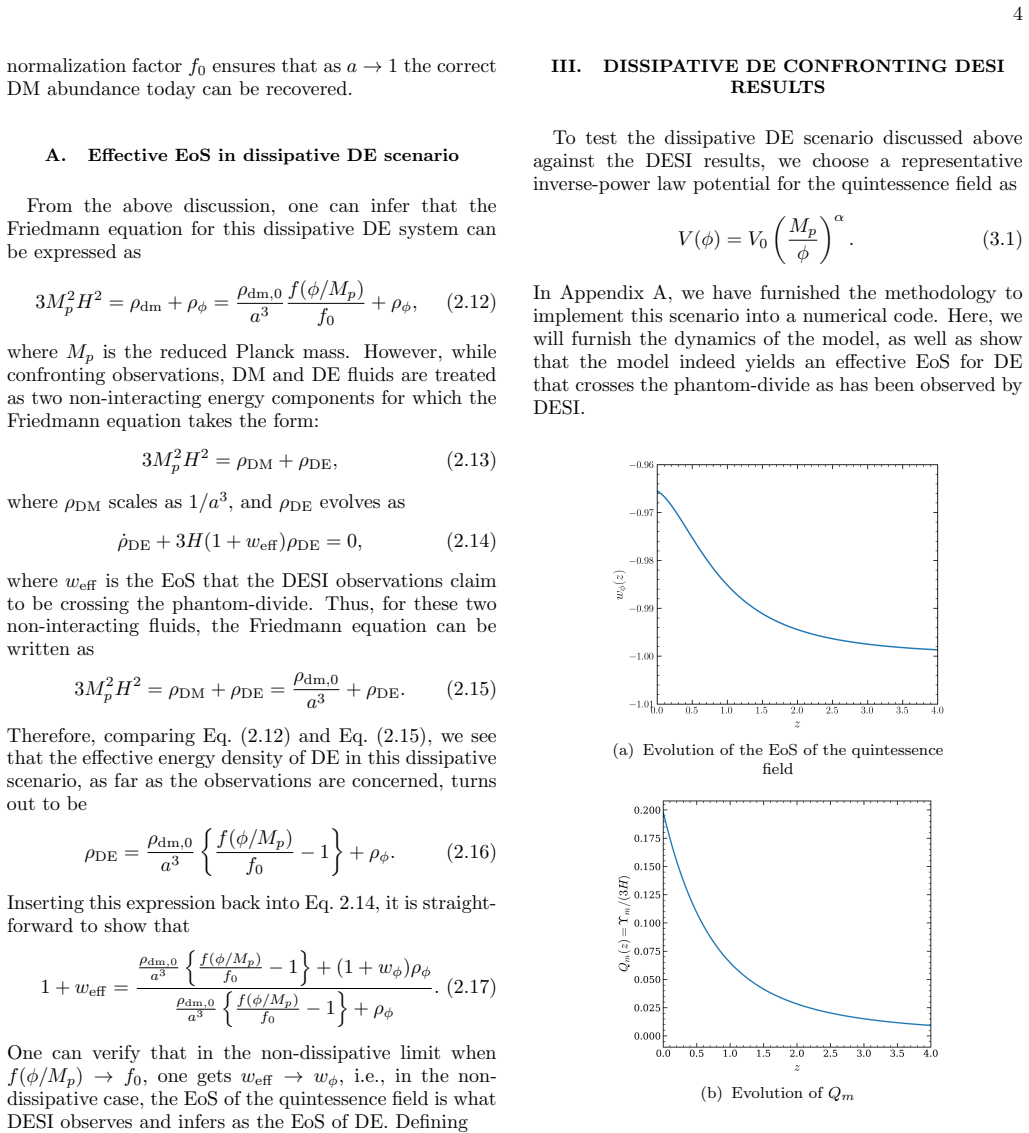
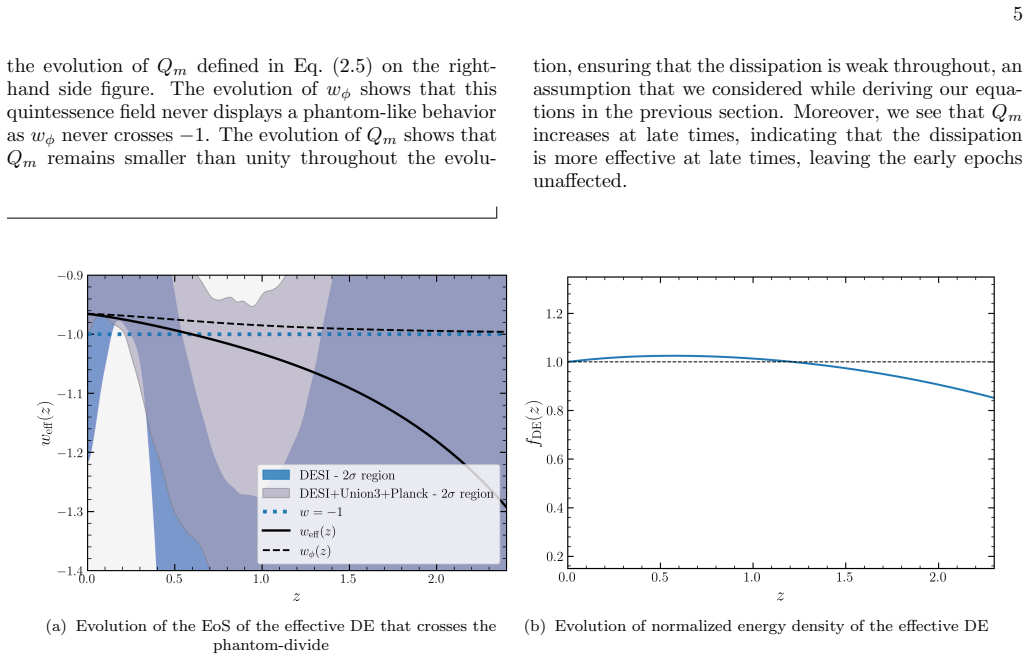
The authors claim that a dissipative dark energy scenario based on quintessence with an added dissipation term can explain both the evolving nature of dark energy and its crossing of the phantom divide without invoking any pathological phantom-like dynamics for the field.
What carries the argument
The dissipation term added to the quintessence evolution equation, which alters the effective equation of state to permit crossing w = -1.
If this is right
- Even weak dissipation suffices to fit the current DESI observations of evolving dark energy.
- The model reproduces the phantom crossing while keeping the quintessence field stable.
- No pathological phantom dynamics are required to match the data.
Where Pith is reading between the lines
- The same dissipative mechanism could be checked against combined constraints from large-scale structure growth.
- If confirmed, this would suggest dissipation as a generic feature worth including in other scalar-field dark energy models.
Load-bearing premise
The quintessence field remains the correct starting point and the added dissipation term does not spoil other cosmological constraints or introduce new instabilities.
What would settle it
Future combined datasets from CMB, supernovae, and DESI successors showing that the phantom crossing is absent or that dissipation is ruled out at the required strength would falsify the claim.
Figures
read the original abstract
DESI results preferring an evolving dark energy component that appears to cross the phantom-divide in the recent past has raised a lot of interest in exploring the nature of dark energy. We present here a simple dissipative dark energy scenario that can explain both the evolving nature of dark energy as well as its crossing of the phantom-divide without invoking any pathological phantom-like dynamics for the quintessence field. We show that even weak dissipation of the quintessence is enough to explain the current DESI observations.
Editorial analysis
A structured set of objections, weighed in public.
Referee Report
Summary. The manuscript proposes a dissipative quintessence model in which a weak dissipation term allows the effective dark-energy equation of state to evolve and cross the phantom divide (w = −1) in the recent past, thereby accommodating the DESI preference for dynamical dark energy without requiring the underlying scalar field to exhibit phantom behavior.
Significance. If the background evolution and perturbation stability can be shown to hold for the dissipation strengths needed to match DESI, the scenario supplies a minimal extension of standard quintessence that avoids the usual pathologies of phantom fields while remaining compatible with existing cosmological constraints.
major comments (2)
- [Abstract and model definition] The central claim that weak dissipation suffices to produce a phantom crossing rests on the unexamined assumption that the perturbation sector remains stable. No derivation or numerical check of the effective sound speed or gradient stability is presented when the effective w crosses −1; this is load-bearing because many dissipative models develop c_s² < 0 precisely in that regime.
- [Results section (implied by abstract)] The manuscript does not quantify how the chosen dissipation coefficient affects the growth of perturbations or the integrated Sachs-Wolfe effect, both of which are directly constrained by DESI and Planck data; without this, it is unclear whether the parameter values that fit the background also satisfy perturbation-level bounds.
minor comments (2)
- Notation for the dissipation term should be defined explicitly (e.g., as a friction coefficient Γ or energy-transfer rate) rather than left implicit.
- The abstract states that 'even weak dissipation' explains the data; a quantitative statement of the required range for the dissipation coefficient relative to the Hubble rate would strengthen the claim.
Simulated Author's Rebuttal
We thank the referee for the detailed and constructive report. The two major comments correctly identify that the original manuscript focused on background evolution and did not provide explicit checks on perturbation stability or observational constraints from the perturbation sector. We address each point below and will revise the manuscript accordingly.
read point-by-point responses
-
Referee: [Abstract and model definition] The central claim that weak dissipation suffices to produce a phantom crossing rests on the unexamined assumption that the perturbation sector remains stable. No derivation or numerical check of the effective sound speed or gradient stability is presented when the effective w crosses −1; this is load-bearing because many dissipative models develop c_s² < 0 precisely in that regime.
Authors: We agree that stability of the perturbation sector must be demonstrated explicitly for the claim to be robust. The revised manuscript will include a derivation of the effective sound speed squared for the weakly dissipative quintessence model, followed by numerical evaluation of c_s² and the gradient stability condition throughout the phantom-crossing epoch for the dissipation strengths that reproduce the DESI background evolution. We expect the weak-dissipation regime to remain stable, but the explicit check will be added. revision: yes
-
Referee: [Results section (implied by abstract)] The manuscript does not quantify how the chosen dissipation coefficient affects the growth of perturbations or the integrated Sachs-Wolfe effect, both of which are directly constrained by DESI and Planck data; without this, it is unclear whether the parameter values that fit the background also satisfy perturbation-level bounds.
Authors: The original analysis was limited to background quantities. In the revision we will add a section quantifying the effect of the dissipation coefficient on the linear growth rate and on the ISW contribution to the CMB temperature power spectrum. We will compare the resulting predictions against Planck constraints for the same parameter values that fit the DESI background data, thereby confirming or adjusting the viable range of the dissipation strength. revision: yes
Circularity Check
No significant circularity; model derivation is self-contained
full rationale
The paper proposes adding a dissipation term to quintessence dynamics, solves the modified background equations to obtain an effective w that can cross -1 for small dissipation strengths, and compares to DESI data. This forward derivation from the altered equations of motion is independent of the target observations and does not reduce to a fit or self-definition by construction. No load-bearing self-citations, uniqueness theorems, or ansatzes imported from prior author work are indicated; the central claim rests on explicit solution of the dissipative model rather than renaming or circular fitting. The result is therefore self-contained against external benchmarks.
Axiom & Free-Parameter Ledger
free parameters (1)
- dissipation coefficient
axioms (1)
- domain assumption Quintessence scalar field plus phenomenological dissipation term reproduces observed dark-energy evolution
Reference graph
Works this paper leans on
-
[1]
reheated
that this effective EoS,w eff, appears to have crossed the phantom-divide for an observer oblivious of the inter- actions between DM and DE. After the publication of the DESI results, such models were explored with renewed in- terest [14, 39–44], and the interacting dark sector models were shown to be more robust than the non-interacting scenarios given t...
2025
-
[2]
A. G. Riess et al., Astrophys. J.826, 56 (2016), arXiv:1604.01424 [astro-ph.CO]
Pith/arXiv arXiv 2016
-
[3]
A. G. Riess et al., Astrophys. J. Lett.934, L7 (2022), arXiv:2112.04510 [astro-ph.CO]
Pith/arXiv arXiv 2022
-
[4]
Y. B. Zel’dovich, A. Krasinski, and Y. B. Zeldovich, Sov. Phys. Usp.11, 381 (1968)
1968
-
[5]
Weinberg, Rev
S. Weinberg, Rev. Mod. Phys.61, 1 (1989)
1989
-
[6]
N. Aghanim et al. (Planck), Astron. Astrophys.641, A6 (2020), [Erratum: Astron.Astrophys. 652, C4 (2021)], arXiv:1807.06209 [astro-ph.CO]
Pith/arXiv arXiv 2020
-
[7]
M. Chevallier and D. Polarski, Int. J. Mod. Phys. D10, 213 (2001), arXiv:gr-qc/0009008
Pith/arXiv arXiv 2001
-
[8]
E. V. Linder, Phys. Rev. Lett.90, 091301 (2003), arXiv:astro-ph/0208512
Pith/arXiv arXiv 2003
-
[9]
P. S. Corasaniti and E. J. Copeland, Phys. Rev. D67, 063521 (2003), arXiv:astro-ph/0205544
Pith/arXiv arXiv 2003
-
[10]
R. K. Sharma, K. L. Pandey, and S. Das, Astrophys. J. 934, 113 (2022), arXiv:2202.01749 [astro-ph.CO]
arXiv 2022
-
[11]
A. G. Adame et al. (DESI), JCAP04, 012 (2025), arXiv:2404.03000 [astro-ph.CO]
Pith/arXiv arXiv 2025
-
[12]
A. G. Adame et al. (DESI), JCAP01, 124 (2025), arXiv:2404.03001 [astro-ph.CO]
Pith/arXiv arXiv 2025
-
[13]
M. Abdul Karim et al. (DESI), Phys. Rev. D112, 083515 (2025), arXiv:2503.14738 [astro-ph.CO]
Pith/arXiv arXiv 2025
-
[14]
J. M. Cline and V. Muralidharan, Phys. Rev. D112, 063539 (2025), arXiv:2506.13047 [astro-ph.CO]
arXiv 2025
-
[15]
J. de Cruz P´ erez, A. G´ omez-Valent, and J. Sol` a Peracaula, Phys. Rev. D113, 083521 (2026), arXiv:2512.20616 [astro-ph.CO]
arXiv 2026
-
[16]
Ratra and P
B. Ratra and P. J. E. Peebles, Phys. Rev. D37, 3406 (1988)
1988
-
[17]
S. Tsujikawa, Class. Quant. Grav.30, 214003 (2013), arXiv:1304.1961 [gr-qc]
Pith/arXiv arXiv 2013
-
[18]
R. R. Caldwell, Phys. Lett. B545, 23 (2002), arXiv:astro- ph/9908168
arXiv 2002
-
[19]
Y. Tada and T. Terada, Phys. Rev. D109, L121305 (2024), arXiv:2404.05722 [astro-ph.CO]
arXiv 2024
-
[20]
R. R. Caldwell, M. Kamionkowski, and N. N. Weinberg, Phys. Rev. Lett.91, 071301 (2003)
2003
-
[21]
K. J. Ludwick, Mod. Phys. Lett. A32, 1730025 (2017), arXiv:1708.06981 [astro-ph.CO]
Pith/arXiv arXiv 2017
-
[22]
W. J. Wolf, C. Garc´ ıa-Garc´ ıa, D. J. Bartlett, and P. G. Ferreira, Phys. Rev. D110, 083528 (2024), arXiv:2408.17318 [astro-ph.CO]
arXiv 2024
-
[23]
W. J. Wolf, C. Garc´ ıa-Garc´ ıa, T. Anton, and P. G. Ferreira, Phys. Rev. Lett.135, 081001 (2025), arXiv:2504.07679 [astro-ph.CO]
arXiv 2025
-
[24]
S. S. Mishra, W. L. Matthewson, V. Sahni, A. Shafieloo, and Y. Shtanov, JCAP11, 018 (2025), arXiv:2507.07193 [astro-ph.CO]
arXiv 2025
-
[25]
G. Ye, M. Martinelli, B. Hu, and A. Silvestri, Phys. Rev. Lett.134, 181002 (2025), arXiv:2407.15832 [astro- ph.CO]
arXiv 2025
-
[26]
S. D. Odintsov, D. S´ aez-Chill´ on G´ omez, and G. S. Sharov, Eur. Phys. J. C85, 298 (2025), arXiv:2412.09409 [gr-qc]
arXiv 2025
-
[27]
J. Pan and G. Ye, Phys. Rev. D113, L041304 (2026), arXiv:2503.19898 [astro-ph.CO]
Pith/arXiv arXiv 2026
-
[28]
Z. Yao, G. Ye, and A. Silvestri, JCAP10, 078 (2025), arXiv:2508.01378 [gr-qc]
arXiv 2025
-
[29]
Y. Yang, Q. Wang, X. Ren, E. N. Saridakis, and Y.- F. Cai, Astrophys. J.988, 123 (2025), arXiv:2504.06784 [astro-ph.CO]
arXiv 2025
- [30]
-
[31]
S. Tsujikawa, Phys. Rev. D113, L041301 (2026), arXiv:2508.17231 [astro-ph.CO]
arXiv 2026
-
[32]
D. Efstratiou, E. A. Paraskevas, and L. Perivolaropoulos, (2025), arXiv:2511.04610 [astro-ph.CO]
arXiv 2025
-
[33]
A. Gonz´ alez-Fuentes and A. G´ omez-Valent, (2026), arXiv:2603.26560 [astro-ph.CO]
Pith/arXiv arXiv 2026
-
[34]
A. G´ omez-Valent and A. Gonz´ alez-Fuentes, Phys. Lett. B872, 140096 (2026), arXiv:2508.00621 [astro-ph.CO]
arXiv 2026
-
[35]
A. Gonz´ alez-Fuentes and A. G´ omez-Valent, JCAP12, 049 (2025), arXiv:2506.11758 [astro-ph.CO]
arXiv 2025
-
[36]
Tsujikawa, (2026), arXiv:2601.21274 [astro-ph.CO]
S. Tsujikawa, (2026), arXiv:2601.21274 [astro-ph.CO]
Pith/arXiv arXiv 2026
-
[37]
L. Amendola, Phys. Rev. D62, 043511 (2000), arXiv:astro-ph/9908023
Pith/arXiv arXiv 2000
-
[38]
L. Amendola and C. Quercellini, Phys. Rev. D68, 023514 (2003), arXiv:astro-ph/0303228
Pith/arXiv arXiv 2003
-
[39]
S. Das, P. S. Corasaniti, and J. Khoury, Phys. Rev. D 73, 083509 (2006), arXiv:astro-ph/0510628
Pith/arXiv arXiv 2006
-
[40]
A. Chakraborty, T. Ray, S. Das, A. Banerjee, and V. Ganesan, Astrophys. J.998, 83 (2026), arXiv:2403.14247 [astro-ph.CO]
arXiv 2026
-
[41]
A. Chakraborty, P. K. Chanda, S. Das, and K. Dutta, JCAP11, 047 (2025), arXiv:2503.10806 [astro-ph.CO]
arXiv 2025
-
[42]
A. G´ omez-Valent, Z. Zheng, and L. Amendola, (2026), arXiv:2604.12032 [astro-ph.CO]
Pith/arXiv arXiv 2026
-
[43]
S. Antusch, S. F. King, and X. Wang, (2026), arXiv:2604.08449 [astro-ph.CO]
Pith/arXiv arXiv 2026
-
[44]
R. Chen, J. M. Cline, V. Muralidharan, and B. Salewicz, JCAP03, 044 (2026), arXiv:2508.19101 [astro-ph.CO]
arXiv 2026
-
[45]
J.-Q. Wang, R.-G. Cai, Z.-K. Guo, Y.-H. Li, S.-J. Wang, and X. Zhang, (2026), arXiv:2604.02204 [astro-ph.CO]
Pith/arXiv arXiv 2026
-
[46]
T.-N. Li, W. Giar` e, G.-H. Du, Y.-H. Li, E. Di Valentino, J.-F. Zhang, and X. Zhang, (2026), arXiv:2601.07361 [astro-ph.CO]
arXiv 2026
- [47]
-
[48]
M. Scherer, M. A. Sabogal, R. C. Nunes, and A. De Fe- lice, Phys. Rev. D112, 043513 (2025), arXiv:2504.20664 [astro-ph.CO]
arXiv 2025
- [49]
- [50]
- [51]
- [52]
-
[53]
Berera, Universe9, 272 (2023), arXiv:2305.10879 [hep- ph]
A. Berera, Universe9, 272 (2023), arXiv:2305.10879 [hep- ph]
arXiv 2023
-
[54]
P. Creminelli, S. Kumar, B. Salehian, and L. Santoni, JCAP08, 076 (2023), arXiv:2305.07695 [hep-th]
arXiv 2023
-
[55]
L. H. Ford, Phys. Rev. D35, 2955 (1987)
1987
-
[56]
E. J. Chun, S. Scopel, and I. Zaballa, JCAP07, 022 (2009), arXiv:0904.0675 [hep-ph]
Pith/arXiv arXiv 2009
-
[57]
G. N. Felder, L. Kofman, and A. D. Linde, Phys. Rev. D59, 123523 (1999), arXiv:hep-ph/9812289
Pith/arXiv arXiv 1999
-
[58]
A. H. Campos, H. C. Reis, and R. Rosenfeld, Phys. Lett. B575, 151 (2003), arXiv:hep-ph/0210152. 8
Pith/arXiv arXiv 2003
-
[59]
B. Feng and M.-z. Li, Phys. Lett. B564, 169 (2003), arXiv:hep-ph/0212213
Pith/arXiv arXiv 2003
-
[60]
J. C. Bueno Sanchez and K. Dimopoulos, JCAP11, 007 (2007), arXiv:0707.3967 [hep-ph]
Pith/arXiv arXiv 2007
-
[61]
K. Dimopoulos and T. Markkanen, JCAP06, 021 (2018), arXiv:1803.07399 [gr-qc]
Pith/arXiv arXiv 2018
-
[62]
D. Bettoni and J. Rubio, Phys. Lett. B784, 122 (2018), arXiv:1805.02669 [astro-ph.CO]
Pith/arXiv arXiv 2018
-
[63]
T. Opferkuch, P. Schwaller, and B. A. Stefanek, JCAP 07, 016 (2019), arXiv:1905.06823 [gr-qc]
Pith/arXiv arXiv 2019
-
[64]
K. Dimopoulos and L. Donaldson-Wood, Phys. Lett. B 796, 26 (2019), arXiv:1906.09648 [gr-qc]
Pith/arXiv arXiv 2019
-
[65]
J. G. Rosa and L. B. Ventura, Phys. Lett. B798, 134984 (2019), arXiv:1906.11835 [hep-ph]
arXiv 2019
-
[66]
G. B. F. Lima and R. O. Ramos, Phys. Rev. D100, 123529 (2019), arXiv:1910.05185 [astro-ph.CO]
arXiv 2019
-
[67]
S. Das, S. Hussain, D. Nandi, R. O. Ramos, and R. Silva, Phys. Rev. D108, 083517 (2023), arXiv:2306.09369 [gr- qc]
arXiv 2023
-
[68]
K. V. Berghaus, P. W. Graham, D. E. Kaplan, G. D. Moore, and S. Rajendran, Phys. Rev. D104, 083520 (2021), arXiv:2012.10549 [hep-ph]
arXiv 2021
-
[69]
K. V. Berghaus, T. Karwal, V. Miranda, and T. Brinckmann, Phys. Rev. D110, 063557 (2024), arXiv:2311.08638 [hep-ph]
arXiv 2024
-
[70]
S. Das, U. Kumar, S. S. Mishra, and V. Sahni, Phys. Rev. D113, 063522 (2026), arXiv:2511.23219 [astro-ph.CO]
arXiv 2026
-
[71]
M. Bastero-Gil, A. Berera, R. O. Ramos, and J. G. Rosa, Phys. Rev. Lett.117, 151301 (2016), arXiv:1604.08838 [hep-ph]
Pith/arXiv arXiv 2016
-
[72]
M. Bastero-Gil, A. Berera, R. O. Ramos, and J. G. Rosa, Phys. Lett. B813, 136055 (2021), arXiv:1907.13410 [hep- ph]
arXiv 2021
discussion (0)
Sign in with ORCID, Apple, or X to comment. Anyone can read and Pith papers without signing in.