REVIEW 3 minor
Theory of frozen flux in a narrow uniform superconducting strip after cooling in a small magnetic field
T0 review · 0 major / 3 minor · reviewed 2026-06-28 · grok-4.3
Pith's one-line read Frozen vortex density in a narrow superconducting strip is fixed by solving the dynamic balance of thermally activated entries and exits near Tc.
desk verdict This paper derives an explicit T_fr(B) and frozen vortex density from a rate-balance equation for vortex entry/exit over the edge barrier, giving a strong field dependence that could be checked experimentally. read the letter →
The pith
A machine-rendered reading of the paper's core claim, the machinery that carries it, and where it could break.
The reading
What carries the argument
dynamic-balance equation that equates the rates of thermally activated vortex entries and exits over the geometrical energy barrier formed by strip edges and Meissner screening current
What would settle it
A measurement of frozen flux density versus applied field that fails to show the predicted strong dependence near the minimum expulsion field, or a cooling-rate scan that does not produce the expected logarithmic shift in T_fr.
Extended reading notes
Core claim
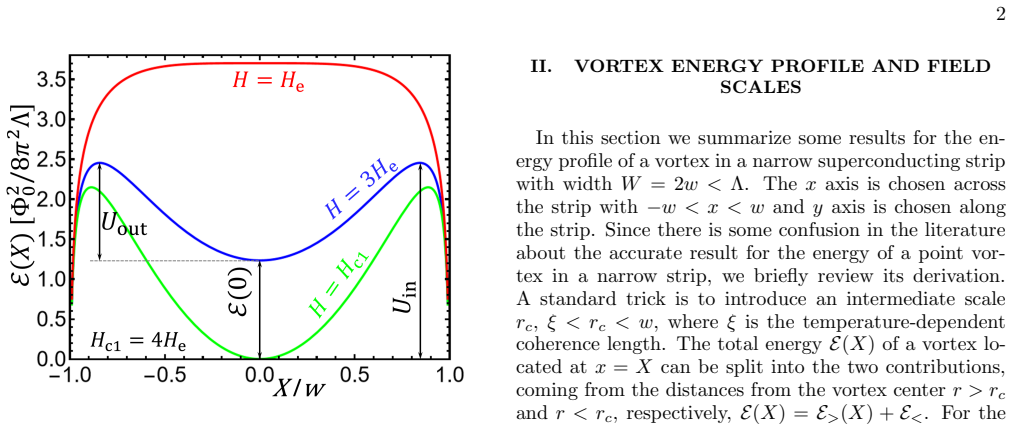
In the field range between the minimum flux-expulsion field and the penetration field, equilibrium flux density remains finite because of thermal activation but drops rapidly with falling temperature. During continued cooling the escape rate falls exponentially, so the vortex density departs from equilibrium at a field-dependent freezing temperature T_fr. The dynamic-balance equation for thermally activated exits and entries over the geometrical barrier set by the strip edges and Meissner current is derived and solved, giving definite quantitative expressions for T_fr and the frozen vortex density.
Load-bearing premise
The low-temperature vortex configuration is formed at temperatures very close to Tc where flux density is set by dynamic balance between thermally activated exits and entries over the edge barrier.
Editorial extensions
If this is right
- The relative freezing temperature 1-T_fr/Tc exceeds the fluctuation width of the transition by a large logarithmic factor.
- T_fr rapidly increases as the applied field approaches the minimum flux-expulsion field.
- T_fr increases only logarithmically with decreasing cooling rate.
- The resulting frozen flux density exhibits very strong magnetic-field dependence that can be used to define the effective flux-expulsion field.
Reading between the lines
- If the cooling-rate scaling holds, experiments with controlled slower cooling should produce measurably lower trapped densities at the same final field.
- The sharp field dependence near the expulsion threshold supplies a direct experimental route to extract the minimum expulsion field from frozen-flux data.
- The same edge-barrier rate balance may control trapped flux in other thin-film device geometries that rely on narrow strips or edges.
Signed reviews
Editorial analysis
A structured set of objections, weighed in public.
Referee Report
Summary. The manuscript analyzes residual frozen flux in a long narrow superconducting strip cooled through Tc in a small perpendicular magnetic field. It posits that the low-temperature vortex configuration forms near Tc via dynamic balance between thermally activated vortex entry and exit over the geometrical energy barrier set by strip edges and Meissner screening currents. The authors derive and solve the corresponding rate-balance equation, obtaining explicit expressions for the field-dependent freezing temperature T_fr and the resulting frozen vortex density; these exhibit a logarithmic separation of T_fr from Tc, strong increase near the minimum flux-expulsion field, and logarithmic dependence on cooling rate. The frozen density is predicted to have a very strong field dependence usable to define an effective expulsion field.
Significance. If the central derivation holds, the work supplies quantitative, first-principles predictions (apart from the cooling rate) for a technologically relevant quantity—trapped flux in narrow superconducting strips—without fitted parameters. The logarithmic factor separating T_fr from the fluctuation regime follows directly from the exponential Arrhenius dependence of the escape rate, and the strong B-dependence of the frozen density is a falsifiable output. These features constitute a clear advance over purely equilibrium or phenomenological treatments of flux trapping.
minor comments (3)
- The abstract states that the dynamic-balance equation 'yields definite quantitative results,' yet the explicit form of the solved T_fr(B, cooling rate) and the frozen density are not displayed in the provided abstract; placing the final closed-form expressions in the introduction or a dedicated results section would improve readability.
- Notation for the minimum flux-expulsion field and the penetration field should be defined once at first use and used consistently; the abstract refers to both without symbols, which may confuse readers unfamiliar with the prior literature on geometrical barriers.
- The cooling-rate dependence is stated to be logarithmic; a brief remark on the range of cooling rates for which the continuum rate-equation approximation remains valid would strengthen the applicability statement.
Simulated Author's Rebuttal
We thank the referee for the positive summary, significance assessment, and recommendation of minor revision. No specific major comments were provided in the report.
Circularity Check
No significant circularity; derivation is self-contained
full rationale
The paper derives the dynamic-balance rate equation directly from Arrhenius escape rates for vortex entry/exit over the edge+Meissner barrier, then solves it to obtain explicit T_fr(B, cooling rate) and frozen density expressions. The logarithmic separation of T_fr from the fluctuation regime follows immediately from the exponential temperature dependence of the rates; no parameter is fitted to the target observables and then renamed as a prediction, no self-citation supplies a load-bearing uniqueness theorem, and the central results are not algebraically equivalent to the input assumptions by construction. The model remains falsifiable against independent measurements of barrier heights or cooling-rate dependence.
Assumptions & free parameters
free parameters (1)
- cooling rate
assumptions (1)
- domain assumption Flux density near Tc is set by dynamic balance between thermally activated vortex entry and exit rates over the geometrical barrier created by strip edges and Meissner current.
Cite this review
Pith. "Pith review of Theory of frozen flux in a narrow uniform superconducting strip after cooling in a small magnetic field." pith.science (2026). https://pith.science/paper/LGEUQKEC
@misc{pith2026260604961,
  author       = {Pith},
  title        = {Pith review of: Theory of frozen flux in a narrow uniform superconducting strip after cooling in a small magnetic field},
  year         = {2026},
  howpublished = {\url{https://pith.science/paper/LGEUQKEC}},
  note         = {Machine review of arXiv:2606.04961}
}
abstract
We analyze residual frozen flux in a long narrow superconducting strip cooled through its transition temperature $T_{c}$ in a small perpendicular magnetic field. This problem is relevant for the issue of trapped magnetic flux in superconducting electronic devices. During cooling, the low-temperature vortex configuration is formed at temperatures very close to $T_{c}$, where the flux density is determined by dynamic balance between the thermally-activated exits and entries of vortices over the geometrical energy barrier formed by the interaction with the strip edges and the Meissner screening current. In the field range between the minimum flux-expulsion field and the penetration field, the equilibrium flux density is finite due to thermal activation and rapidly decreases with decreasing temperature. During cooling, however, the escape rate decreases exponentially, and the vortex density falls out of equilibrium at a field-dependent freezing temperature $T_{\mathrm{fr}}$. We derive and solve the dynamic-balance equation for this process, which yields definite quantitative results for $T_{\mathrm{fr}}$ and the frozen vortex density. The relative freezing temperature $1\!-\!T_{\mathrm{fr}}/T_{c}$ exceeds the fluctuation width of the transition by a large logarithmic factor, rapidly increases when the magnetic field approaches the minimum flux-expulsion field, and logarithmically increases with decreasing cooling rate. The resulting frozen flux density has a very strong magnetic-field dependence which can be used to define the effective flux-expulsion magnetic field.
Figures


Figures from the paper (6 more)


Reviewed June 28, 2026 · model on record in the stance chip above.
Discussion (0). Continue with ORCID to comment.