A thorium-229 optical nuclear clock with feedback loop
Pith reviewed 2026-06-28 02:35 UTC · model grok-4.3
The pith
Stabilizing a laser to the thorium-229 nuclear transition inside a crystal creates a nuclear optical clock with shot-noise-limited stability reaching 10^{-15} over a day.
A machine-rendered reading of the paper's core claim, the machinery that carries it, and where it could break.
Core claim
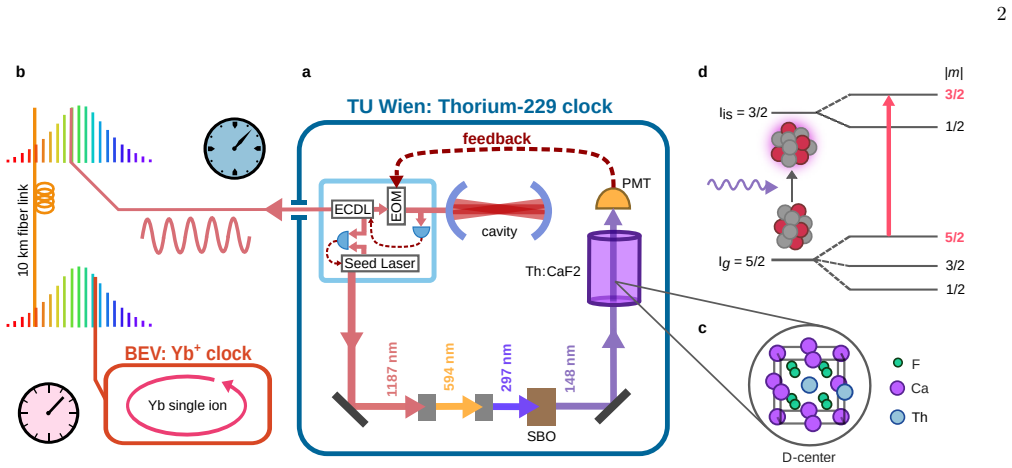
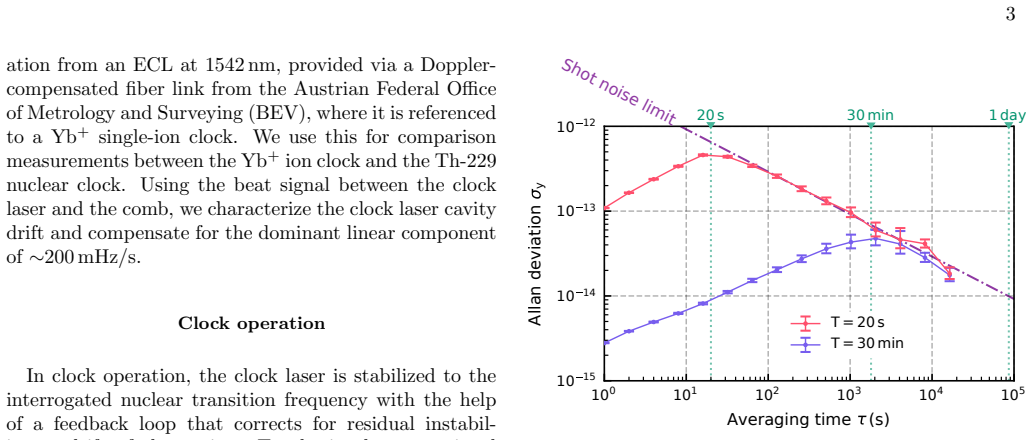
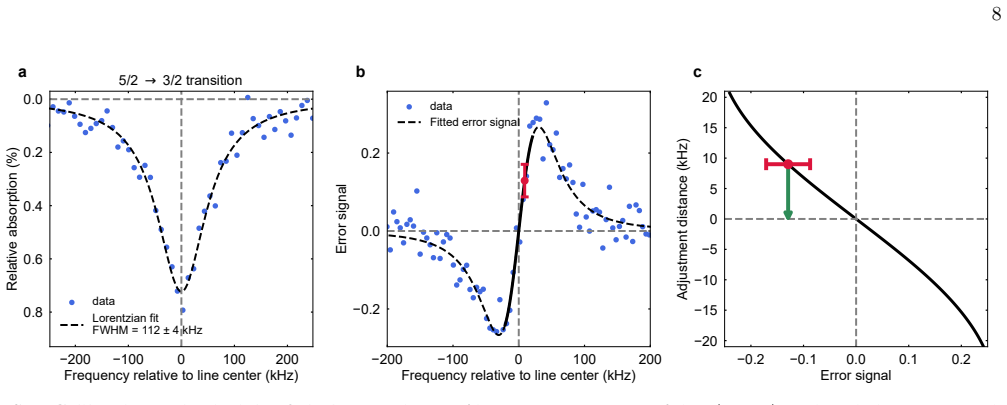
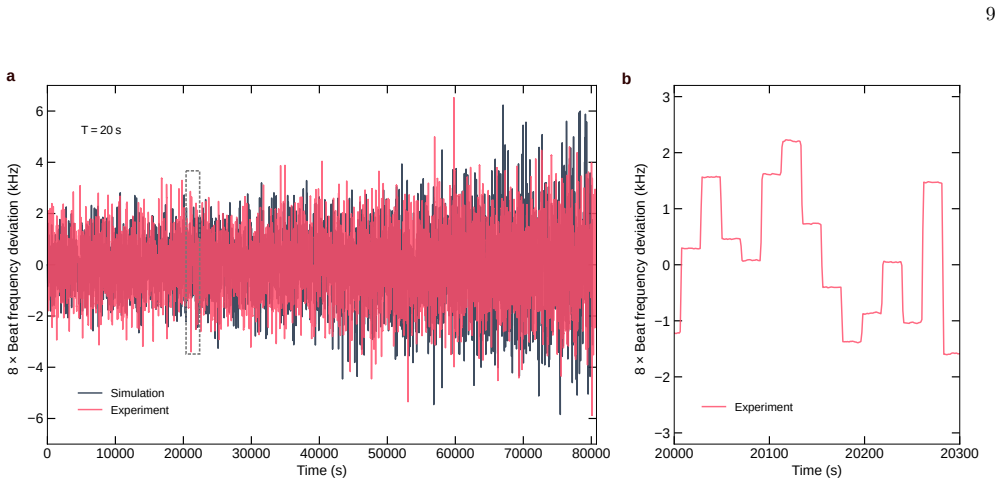
The thorium-229 nuclear clock is implemented by stabilizing a continuous-wave laser to the 148 nm nuclear transition with rapid feedback based on continuous absorption spectroscopy in a millimeter-sized room temperature calcium fluoride crystal, showing a fractional frequency instability of 3·10^{-12} √(τ/s) and applied to constrain ultralight dark matter.
What carries the argument
The rapid feedback loop using continuous absorption spectroscopy to lock the laser to the thorium-229 nuclear transition.
If this is right
- The nuclear clock enables tests of fundamental physics with enhanced sensitivity from the nuclear transition.
- Future improvements could reduce instability by several orders of magnitude in solid-state nuclear clocks.
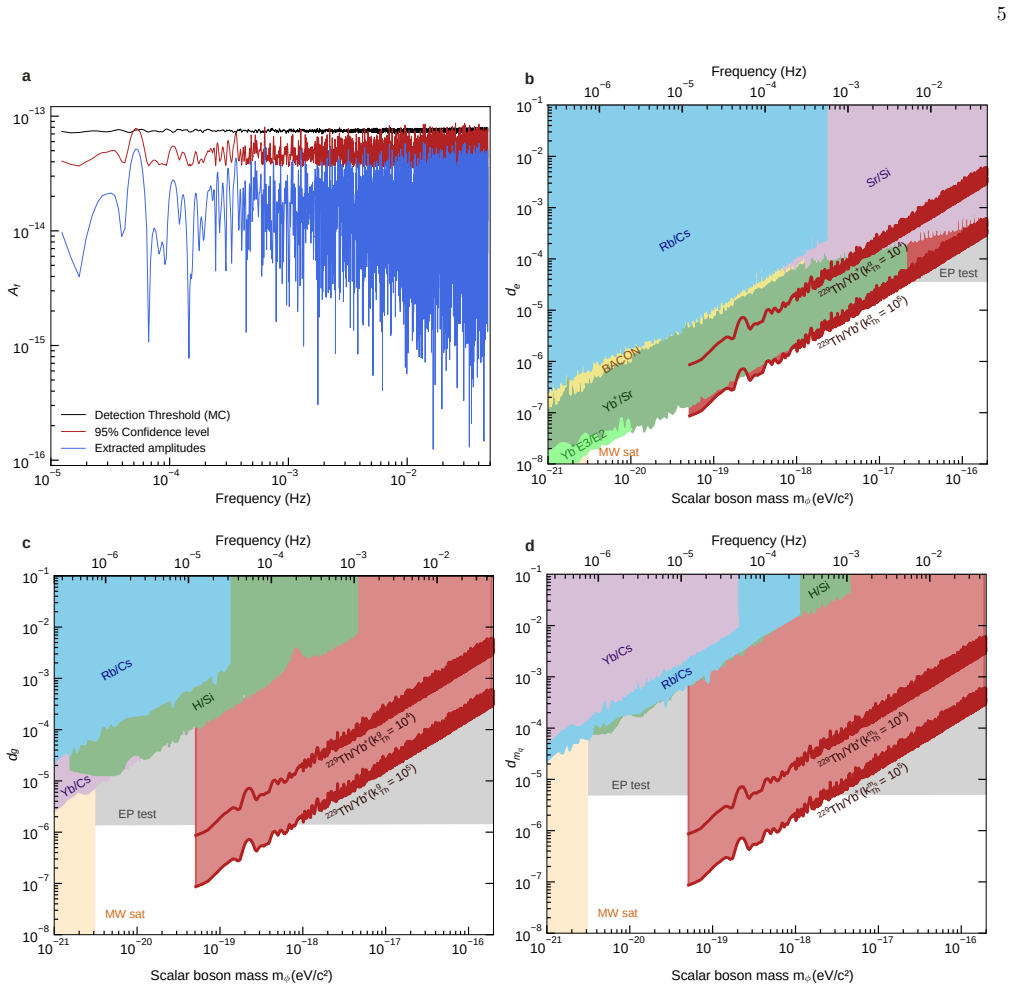
- The dark matter constraints on couplings to photons, strong force, and quarks are competitive with atomic clock results.
- The solid-state approach allows continuous operation at room temperature without vacuum systems.
Where Pith is reading between the lines
- This feedback method may allow nuclear clocks to be built more easily than traditional atomic clocks by using embedded nuclei.
- The technique could be adapted to detect other signals like variations in fundamental constants on short time scales.
- Differential measurements between this nuclear clock and atomic clocks could isolate effects specific to nuclear transitions.
Load-bearing premise
The continuous absorption spectroscopy feedback loop maintains lock to the nuclear transition without introducing frequency shifts or excess noise beyond the reported shot-noise limit, and observed variations are not due to unaccounted systematics.
What would settle it
A measurement showing that the frequency instability does not follow the reported shot-noise scaling of 3·10^{-12} √(τ/s) or that dark matter constraints are inconsistent with other experiments due to systematics in the crystal or laser system.
Figures
read the original abstract
The laser-accessible nuclear transition in the thorium-229 isotope has been identified as a promising candidate for the realization of an optical nuclear clock. Such a nuclear clock might rival or outperform current optical clocks based on electron-shell transitions in atoms or ions, is expected to be more robust against external perturbations, and provides enhanced sensitivity in clock-based tests of fundamental principles of physics. Here, we implement a thorium-229 nuclear clock by stabilizing a continuous-wave laser to the 148 nm nuclear transition with rapid feedback based on continuous absorption spectroscopy. The thorium-229 nuclei are embedded into a millimeter-sized, room temperature calcium fluoride crystal. A subharmonic of the 148 nm radiation is continuously compared to a Yb+ single-ion clock. The nuclear clock shows a simple shot-noise limited scaling of the fractional frequency instability of $3\cdot 10^{-12} \sqrt{\tau/\text{s}}$ where $\tau$ is the averaging time, approaching $10^{-15}$ instabilities over 1 day of continuous operation. Improvements of the instability by several orders of magnitude can be projected for future solid-state nuclear clocks. We use the nuclear clock to constrain models of ultralight dark matter by searching for periodic fluctuations and slow drifts in the nuclear transition energy, on time scales between 20 s and 1 day. Drawing benefit from the enhanced sensitivity of the thorium-229 transition, these constraints compete with the best atomic clocks concerning dark matter coupling to photons and go beyond previous measurements regarding coupling to the strong force and quarks.
Editorial analysis
A structured set of objections, weighed in public.
Referee Report
Summary. The paper reports implementation of a thorium-229 nuclear clock by locking a continuous-wave laser to the 148 nm nuclear transition in 229Th nuclei embedded in a room-temperature CaF2 crystal, using rapid feedback from continuous absorption spectroscopy. A subharmonic of the laser is compared to an independent Yb+ single-ion clock. The nuclear clock exhibits shot-noise-limited fractional frequency instability scaling as 3·10^{-12} √(τ/s) and is used to constrain ultralight dark matter models via searches for periodic fluctuations and drifts in the transition frequency over timescales from 20 s to 1 day.
Significance. If the central performance claims hold after correction, this constitutes the first demonstration of a continuously operated solid-state nuclear clock with feedback stabilization, providing a new platform with potential robustness advantages over atomic clocks and competitive sensitivity for tests of fundamental physics including dark matter couplings to photons, the strong force, and quarks. The projected improvements and DM constraints add value.
major comments (1)
- [Abstract] Abstract: The stated instability scaling '3·10^{-12} √(τ/s)' is inconsistent both with standard shot-noise-limited behavior (which scales as 1/√τ, decreasing with averaging time) and with the claimed performance of approaching 10^{-15} at 1 day (τ=86400 s yields ~8.8×10^{-10} under the given formula). This is load-bearing for the performance and DM-search claims and requires explicit correction or clarification of the formula and supporting data.
minor comments (1)
- [Abstract] The abstract provides limited detail on the full error budget, statistical analysis of the instability data, or quantitative assessment of potential systematics in the feedback loop and crystal environment that could affect the lock or introduce frequency shifts.
Simulated Author's Rebuttal
We thank the referee for their careful reading and for identifying the inconsistency in the reported instability scaling. We address the major comment below.
read point-by-point responses
-
Referee: [Abstract] Abstract: The stated instability scaling '3·10^{-12} √(τ/s)' is inconsistent both with standard shot-noise-limited behavior (which scales as 1/√τ, decreasing with averaging time) and with the claimed performance of approaching 10^{-15} at 1 day (τ=86400 s yields ~8.8×10^{-10} under the given formula). This is load-bearing for the performance and DM-search claims and requires explicit correction or clarification of the formula and supporting data.
Authors: We agree that the scaling as written in the abstract is inconsistent with standard shot-noise-limited behavior and with the claimed performance at long averaging times. This is the result of a typographical error: the correct expression is 3·10^{-12} / √(τ/s). With the corrected formula, the instability at τ=86400 s is approximately 1.02×10^{-14}, consistent with the stated approach to 10^{-15} over one day. The underlying data, analysis, and figures in the manuscript support the corrected scaling. We will revise the abstract and any other occurrences of the formula. revision: yes
Circularity Check
No significant circularity; experimental results are independently benchmarked
full rationale
The central results are direct experimental measurements: laser stabilization via continuous absorption spectroscopy in a Th-229 doped crystal, with frequency instability obtained by continuous comparison against an independent Yb+ single-ion clock. The reported shot-noise scaling and 10^{-15} level are presented as observed performance from that comparison, not derived from a fit to the target quantity itself. Dark-matter constraints arise from post-processing the measured frequency time series for periodic or drift signals; no parameter is fitted to the DM result and then re-used as a prediction. No self-citation chain, uniqueness theorem, or ansatz is invoked to justify the core claims. The derivation chain is therefore self-contained against external references and does not reduce to its inputs by construction.
Axiom & Free-Parameter Ledger
axioms (2)
- domain assumption The 148 nm transition in thorium-229 is a nuclear transition accessible by laser excitation.
- domain assumption The Yb+ single-ion clock provides a stable reference for comparison.
Forward citations
Cited by 4 Pith papers
-
Generation of continuous-wave laser light at 148.4 nm using cavity-enhanced second harmonic generation in $BaMgF_4$
First experimental generation of 148.4 nm CW VUV laser light via cavity-enhanced SHG in BaMgF4 crystal, yielding 16 pW output power.
-
Record nonlinear conversion efficiency in the production of high spectral purity vacuum ultraviolet laser at 148 nm
Demonstration of record conversion efficiency for a 148 nm VUV frequency comb using 16th-harmonic generation in a bulk-grown QPM crystal.
-
Colloquium: Nuclear clocks
Colloquium overview of Th-229 nuclear clock development, covering its nuclear physics basis, recent direct laser excitation, clock design and systematics in traps and solids, and sensitivity to fundamental constant va...
-
The $^{229}$Th Isomer: Nuclear Structure, Clocks, and Tests of Fundamental Physics
Review of the 229Th isomer covering spectroscopy, nuclear structure models, and applications to fundamental physics tests.
Reference graph
Works this paper leans on
-
[1]
Peik and C
E. Peik and C. Tamm, Nuclear laser spectroscopy of the 3.5 eV transition in Th-229, Europhysics Letters61, 181 (2003)
2003
-
[2]
A. D. Ludlow, M. M. Boyd, J. Ye, E. Peik, and P. O. Schmidt, Optical atomic clocks, Reviews of Modern Physics87, 637 (2015)
2015
-
[3]
W. G. Rellergert, D. DeMille, R. R. Greco, M. P. Hehlen, J. R. Torgerson, and E. R. Hudson, Constraining the evo- lution of the fundamental constants with a solid-state optical frequency reference based on the 229Th nucleus, Physical Review Letters104, 200802 (2010)
2010
-
[4]
Kazakov, A
G. Kazakov, A. Litvinov, V. Romanenko, L. Yatsenko, A. Romanenko, M. Schreitl, G. Winkler, and T. Schumm, Performance of a 229Thorium solid-state nuclear clock, New Journal of physics14, 083019 (2012)
2012
-
[5]
V. V. Flambaum, Enhanced effect of temporal variation of the fine structure constant and the strong interaction in 229Th, Physical Review Letters97, 92502 (2006)
2006
-
[6]
E. Peik, T. Schumm, M. Safronova, A. Palffy, J. Weiten- berg, and P. G. Thirolf, Nuclear clocks for testing fun- damental physics, Quantum Science and Technology6, 034002 (2021)
2021
-
[7]
I. Morawetz, T. Riebner, L. T. De Col, F. Schneider, N. Sempelmann, F. Schaden, M. Bartokos, G. Kazakov, S. Lahs, K. Beeks,et al., Continuous-wave nuclear laser absorption spectroscopy of Thorium-229, arXiv preprint arXiv:2604.16640 (2026)
Pith/arXiv arXiv 2026
-
[8]
Vanier and C
J. Vanier and C. Audoin, The classical caesium beam frequency standard: fifty years later, Metrologia42, S31 (2005)
2005
-
[9]
Wynands and S
R. Wynands and S. Weyers, Atomic fountain clocks, Metrologia42, S64 (2005)
2005
-
[10]
T. M. Fortier, A. N. Luiten, and H. S. Margolis, Optical atomic clocks: defining the future of time and frequency metrology, Optica13, 143 (2026)
2026
-
[11]
C. J. Campbell, A. G. Radnaev, A. Kuzmich, V. A. Dzuba, V. V. Flambaum, and A. Derevianko, Single-ion nuclear clock for metrology at the 19th decimal place, 11 Phys. Rev. Lett.108, 120802 (2012)
2012
-
[12]
Beeks, T
K. Beeks, T. Sikorsky, T. Schumm, J. Thielking, M. V. Okhapkin, and E. Peik, The thorium-229 low-energy iso- mer and the nuclear clock, Nature Reviews Physics3, 238 (2021)
2021
-
[13]
Zhang, T
C. Zhang, T. Ooi, J. S. Higgins, J. F. Doyle, L. von der Wense, K. Beeks, A. Leitner, G. A. Kazakov, P. Li, P. G. Thirolf,et al., Frequency ratio of the 229Th nuclear iso- meric transition and the 87Sr atomic clock, Nature633, 63 (2024)
2024
-
[14]
T. Ooi, J. F. Doyle, C. Zhang, J. S. Higgins, J. Ye, K. Beeks, T. Sikorsky, and T. Schumm, Frequency re- producibility of solid-state thorium-229 nuclear clocks, Nature650, 72 (2026)
2026
-
[15]
Beeks, G
K. Beeks, G. A. Kazakov, F. Schaden, I. Morawetz, L. Toscani De Col, T. Riebner, M. Bartokos, T. Siko- rsky, T. Schumm, C. Zhang, T. Ooi, J. S. Higgins, J. F. Doyle, J. Ye, and M. S. Safronova, Fine-structure con- stant sensitivity of the th-229 nuclear clock transition, Nature Communications16(2025)
2025
-
[16]
Kroger and C
L. Kroger and C. Reich, Features of the low-energy level scheme of 229Th as observed in theα-decay of 233U, Nu- clear Physics A259, 29 (1976)
1976
-
[17]
Burke, P
D. Burke, P. Garrett, T. Qu, and R. Naumann, Addi- tional evidence for the proposed excited state at≤5 eV in 229Th, Physical Review C42, R499 (1990)
1990
-
[18]
R. G. Helmer and C. W. Reich, An excited state of 229Th at 3.5 eV, Physical Review C49, 1845 (1994)
1994
-
[19]
B. R. Beck, J. A. Becker, P. Beiersdorfer, G. V. Brown, K. J. Moody, J. B. Wilhelmy, F. S. Porter, C. A. Kil- bourne, and R. L. Kelley, Energy splitting of the ground- state doublet in the nucleus 229Th, Phys. Rev. Lett.98, 142501 (2007)
2007
-
[20]
B. Beck, C. Wu, P. Beiersdorfer, G. Brown, J. Becker, K. Moody, J. Wilhelmy, F. Porter, C. Kilbourne, and R. Kelley, Improved value for the energy splitting of the ground-state doublet in the nucleus 229mTh,12th Inter- national Conference on Nuclear Reaction Mechanisms, Proceedings of the 12th International Conference on Nu- clear Reaction Mechanisms (200...
2009
-
[21]
L. v. d. Wense, B. Seiferle, M. Laatiaoui, J. B. Neumayr, H. J. Maier, H. F. Wirth, C. Mokry, J. Runke, K. Eber- hardt, C. E. D¨ ullmann, N. G. Trautmann, and P. G. Thirolf, Direct detection of the 229Th nuclear clock tran- sition, Nature533, 47 (2016)
2016
-
[22]
Seiferle, L
B. Seiferle, L. von der Wense, P. V. Bilous, I. Amersdorf- fer, C. Lemell, F. Libisch, S. Stellmer, T. Schumm, C. E. D¨ ullmann, A. P´ alffy,et al., Energy of the229Th nuclear clock transition, Nature573, 243 (2019)
2019
-
[23]
Kraemer, J
S. Kraemer, J. Moens, M. Athanasakis-Kaklamanakis, S. Bara, K. Beeks, P. Chhetri, K. Chrysalidis, A. Claessens, T. E. Cocolios, J. G. Correia,et al., Obser- vation of the radiative decay of the 229Th nuclear clock isomer, Nature617, 706 (2023)
2023
-
[24]
Tiedau, M
J. Tiedau, M. Okhapkin, K. Zhang, J. Thielk- ing, G. Zitzer, E. Peik, F. Schaden, T. Pronebner, I. Morawetz, L. T. De Col,et al., Laser excitation of the Th-229 nucleus, Physical Review Letters132, 182501 (2024)
2024
-
[25]
Elwell, C
R. Elwell, C. Schneider, J. Jeet, J. Terhune, H. T. Mor- gan, A. Alexandrova, H. Tran Tan, A. Derevianko, and E. R. Hudson, Laser excitation of the 229Th nuclear iso- meric transition in a solid-state host, Physical Review Letters133, 013201 (2024)
2024
-
[26]
Zhang, L
C. Zhang, L. von der Wense, J. F. Doyle, J. S. Higgins, T. Ooi, H. U. Friebel, J. Ye, R. Elwell, J. E. S. Terhune, H. W. T. Morgan, A. N. Alexandrova, H. B. Tran Tan, A. Derevianko, and E. R. Hudson, 229ThF4 thin films for solid-state nuclear clocks, Nature636, 603 (2024)
2024
- [27]
-
[28]
V. Lal, M. V. Okhapkin, J. Tiedau, N. Irwin, V. Petrov, and E. Peik, Continuous-wave laser source at the 148 nm nuclear transition of Th-229, Optica12, 1971 (2025)
1971
-
[29]
Q. Xiao, G. Penyazkov, X. Li, B. Huang, W. Bu, J. Shi, H. Shi, T. Liao, G. Yan, H. Tian, Y. Li, J. Li, B. Lu, L. You, Y. Lin, Y. Mo, and S. Ding, Continuous-wave narrow-linewidth vacuum ultraviolet laser source, Nature 650, 852 (2026)
2026
-
[30]
Beeks, T
K. Beeks, T. Sikorsky, V. Rosecker, M. Pressler, F. Schaden, D. Werban, N. Hosseini, L. Rudischer, F. Schneider, P. Berwian,et al., Growth and characteri- zation of thorium-doped calcium fluoride single crystals, Scientific Reports13, 3897 (2023)
2023
-
[31]
Beeks, T
K. Beeks, T. Sikorsky, F. Schaden, M. Pressler, F. Schnei- der, B. N. Koch, T. Pronebner, D. Werban, N. Hosseini, G. Kazakov,et al., Optical transmission enhancement of ionic crystals via superionic fluoride transfer: Growing vuv-transparent radioactive crystals, Physical Review B 109, 094111 (2024)
2024
-
[32]
T. Udem, R. Holzwarth, and T. W. H¨ ansch, Optical fre- quency metrology, Nature416, 233 (2002)
2002
-
[33]
Beeks,The nuclear excitation of Thorium-229 in the CaF2 environment: Development of a crystalline nuclear clock, Ph.D
K. Beeks,The nuclear excitation of Thorium-229 in the CaF2 environment: Development of a crystalline nuclear clock, Ph.D. thesis, Technische Universit¨ at Wien (2022)
2022
-
[34]
Masuda, A
T. Masuda, A. Yoshimi, A. Fujieda, H. Fujimoto, H. Haba, H. Hara, T. Hiraki, H. Kaino, Y. Kasamatsu, S. Kitao,et al., X-ray pumping of the 229Th nuclear clock isomer, Nature573, 238 (2019)
2019
-
[35]
Hiraki, K
T. Hiraki, K. Okai, M. Bartokos, K. Beeks, H. Fujimoto, Y. Fukunaga, H. Haba, Y. Kasamatsu, S. Kitao, A. Leit- ner,et al., Controlling 229Th isomeric state population in a vuv transparent crystal, Nature Communications15, 5536 (2024)
2024
-
[36]
J. S. Higgins, T. Ooi, J. F. Doyle, C. Zhang, J. Ye, K. Beeks, T. Sikorsky, and T. Schumm, Temperature Sensitivity of a Thorium-229 Solid-State Nuclear Clock, Phys. Rev. Lett.134, 113801 (2025)
2025
-
[37]
Schaden, T
F. Schaden, T. Riebner, I. Morawetz, L. T. De Col, G. Kazakov, K. Beeks, T. Sikorsky, T. Schumm, K. Zhang, V. Lal,et al., Laser-induced quenching of the Th-229 nuclear clock isomer in calcium fluoride, Physical Review Research7, L022036 (2025)
2025
-
[38]
M. Guan, M. Bartokos, K. Beeks, H. Fujimoto, Y. Fuku- naga, H. Haba, T. Hiraki, Y. Kasamatsu, S. Kitao, A. Leitner,et al., X-ray-induced quenching of the 229Th clock isomer in CaF 2, Physical Review Letters136, 013203 (2026)
2026
-
[39]
Riley and D
W. Riley and D. Howe, Handbook of frequency stability analysis (2008)
2008
-
[40]
Filzinger, S
M. Filzinger, S. D¨ orscher, R. Lange, J. Klose, M. Steinel, E. Benkler, E. Peik, C. Lisdat, and N. Huntemann, Im- proved limits on the coupling of ultralight bosonic dark matter to photons from optical atomic clock comparisons, Physical Review Letters130, 253001 (2023)
2023
-
[41]
Beloy, M
K. Beloy, M. I. Bodine, T. Bothwell, S. M. Brewer, S. L. Bromley,et al., Frequency ratio measurements at 18-digit accuracy using an optical clock network, Nature591, 564 (2021)
2021
-
[42]
A. Hees, J. Gu´ ena, M. Abgrall, S. Bize, and P. Wolf, Searching for an oscillating massive scalar field as a dark matter candidate using atomic hyperfine frequency com- parisons, Physical review letters117, 061301 (2016)
2016
-
[43]
C. J. Kennedy, E. Oelker, J. M. Robinson, T. Bothwell, D. Kedar, W. R. Milner, G. E. Marti, A. Derevianko, and J. Ye, Precision metrology meets cosmology: im- 12 proved constraints on ultralight dark matter from atom- cavity frequency comparisons, Physical Review Letters 125, 201302 (2020)
2020
-
[44]
Kobayashi, A
T. Kobayashi, A. Takamizawa, D. Akamatsu, A. Kawasaki, A. Nishiyama, K. Hosaka, Y. Hisai, M. Wada, H. Inaba, T. Tanabe,et al., Search for ultra- light dark matter from long-term frequency comparisons of optical and microwave atomic clocks, Physical review letters129, 241301 (2022)
2022
-
[45]
Banerjee, D
A. Banerjee, D. Budker, M. Filzinger, N. Huntemann, G. Paz, G. Perez, S. Porsev, and M. Safronova, Oscil- lating nuclear charge radii as sensors for ultralight dark matter, Physical Review Letters135, 223001 (2025)
2025
-
[46]
Touboul, G
P. Touboul, G. M´ etris, M. Rodrigues, J. Berg´ e, A. Robert, Q. Baghi, Y. Andr´ e, J. Bedouet, D. Boulanger, S. Bremer,et al., Microscope mission: final results of the test of the equivalence principle, Physical review letters129, 121102 (2022)
2022
-
[47]
J. Arakawa, J. F. Doyle, E. Fuchs, J. S. Higgins, F. Kirk, K. Li, T. Ooi, G. Perez, W. Ratzinger, M. S. Safronova, et al., Probing ultralight dark matter at the mega-planck scale with the thorium nuclear clock, arXiv preprint arXiv:2602.16804 (2026)
arXiv 2026
-
[48]
V. A. Dzuba, V. V. Flambaum, and M. V. Marchenko, Relativistic effects in Sr, Dy, Yb II, and Yb III and search for variation of the fine-structure constant, Physical Re- view A68, 022506 (2003)
2003
-
[49]
D. F. J. Kimball and K. van Bibber, eds.,The Search for Ultralight Bosonic Dark Matter(Springer International Publishing, 2023)
2023
-
[50]
Arvanitaki, J
A. Arvanitaki, J. Huang, and K. Van Tilburg, Search- ing for dilaton dark matter with atomic clocks, Physical Review D91, 015015 (2015)
2015
-
[51]
Caputo, D
A. Caputo, D. Gazit, H.-W. Hammer, J. Kopp, G. Paz, G. Perez, and K. Springmann, Sensitivity of nuclear clocks to new physics, Physical Review C112, L031302 (2025)
2025
-
[52]
J. D. Scargle, Studies in astronomical time series analy- sis. II-Statistical aspects of spectral analysis of unevenly spaced data, Astrophysical Journal, Part 1, vol. 263, Dec. 15, 1982, p. 835-853.263, 835 (1982)
1982
-
[53]
Fuchs, F
E. Fuchs, F. Kirk, E. Madge, C. Paranjape, E. Peik, G. Perez, W. Ratzinger, and J. Tiedau, Searching for dark matter with the 229Th nuclear lineshape from laser spectroscopy, Physical Review X15, 021055 (2025)
2025
-
[54]
Perlov, A
D. Perlov, A. Zaytsev, A. Zamkov, N. Radionov, A. Cher- apakhin, N. Evtikhiev, and A. Sadovskiy, Method for manufacturing of patterned SrB 4BO7 and PbB4O7 crys- tals (2024), uS Patent 11,868,022
2024
-
[55]
S. C. Buchter, T. Y. Fan, V. Liberman, J. J. Zayhowski, M. Rothschild, E. J. Mason, A. Cassanho, H. P. Jenssen, and J. H. Burnett, Periodically poled BaMgF 4 for ultra- violet frequency generation, Opt. Lett.26, 1693 (2001)
2001
-
[56]
H. W. T. Morgan, J. E. S. Terhune, R. Elwell, H. B. T. Tan, U. C. Perera, A. Derevianko, E. R. Hud- son, and A. N. Alexandrova, A spinless crystal for a high-performance solid-state 229Th nuclear clock, arXiv preprint arXiv:2503.11374 (2025)
arXiv 2025
- [57]
-
[58]
M. Filzinger, M. R. Steinel, J. Jiang, D. Bennett, T. E. Mehlst¨ aubler, E. Peik, and N. Huntemann, A multi- ion optical clock with5×10 −19 uncertainty (2026), arXiv:2603.23446 [physics.atom-ph]
arXiv 2026
-
[59]
M. C. Marshall, D. A. R. Castillo, W. J. Arthur- Dworschack, A. Aeppli, K. Kim, D. Lee, W. Warfield, J. Hinrichs, N. V. Nardelli, T. M. Fortier, J. Ye, D. R. Leibrandt, and D. B. Hume, High-stability single-ion clock with 5.5×10 −19 systematic uncertainty, Phys. Rev. Lett.135, 033201 (2025)
2025
-
[60]
Rubiola, On the measurement of frequency and of its sample variance with high-resolution counters, Review of Scientific Instruments76, 054703 (2005)
E. Rubiola, On the measurement of frequency and of its sample variance with high-resolution counters, Review of Scientific Instruments76, 054703 (2005)
2005
-
[61]
S. T. Dawkins, J. J. McFerran, and A. N. Luiten, Consid- erations on the measurement of the stability of oscillators with frequency counters, IEEE Transactions on Ultrason- ics, Ferroelectrics, and Frequency Control54, 918 (2007)
2007
-
[62]
Stuhler, A
J. Stuhler, A. Friedenauer, P. Thoumany, C. Tresp, D. Heinrich, and S. Ritter, Industrial 171Yb+ single-ion optical clock with systematic uncertainty below 2×10⁻¹⁷, inQuantum Sensing, Imaging, and Precision Metrol- ogy IV, Vol. 13920, edited by S. M. Shahriar, Interna- tional Society for Optics and Photonics (SPIE, 2026) p. 1392009
2026
-
[63]
S. G. Karshenboim, V. Flambaum, and E. Peik, Atomic clocks and constraints on variations of fundamental con- stants, inSpringer Handbook of Atomic, Molecular, and Optical Physics, edited by G. W. F. Drake (Springer In- ternational Publishing, Cham, 2023) pp. 449–459
2023
-
[64]
Damour and J
T. Damour and J. F. Donoghue, Equivalence principle vi- olations and couplings of a light dilaton, Physical Review D82, 084033 (2010)
2010
-
[65]
G. P. Centers, J. W. Blanchard, J. Conrad, N. L. Figueroa, A. Garcon, A. V. Gramolin, D. F. J. Kimball, M. Lawson, B. Pelssers, J. A. Smiga,et al., Stochastic fluctuations of bosonic dark matter, Nature communica- tions12, 7321 (2021)
2021
-
[66]
The Astropy Collaboration, A. M. Price-Whelan, P. L. Lim,et al., The astropy project: Sustaining and growing a community-oriented open-source project and the latest major release (v5.0) of the core package, apj935, 167 (2022), arXiv:2206.14220 [astro-ph.IM]
Pith/arXiv arXiv 2022
discussion (0)
Sign in with ORCID, Apple, or X to comment. Anyone can read and Pith papers without signing in.