Neutrino mass constraints in interacting dark energy models after DESI DR2
Pith reviewed 2026-06-28 04:50 UTC · model grok-4.3
The pith
The upper bound on total neutrino mass varies from 0.051 eV to 0.129 eV depending on the form of dark energy-dark matter interaction.
A machine-rendered reading of the paper's core claim, the machinery that carries it, and where it could break.
Core claim
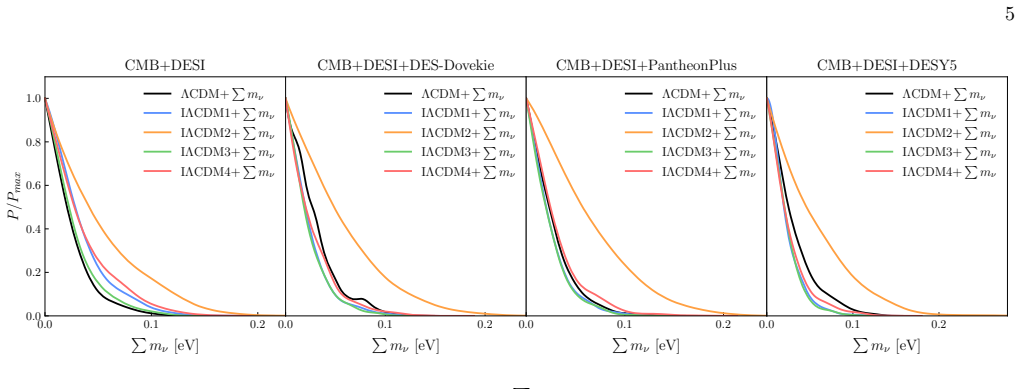
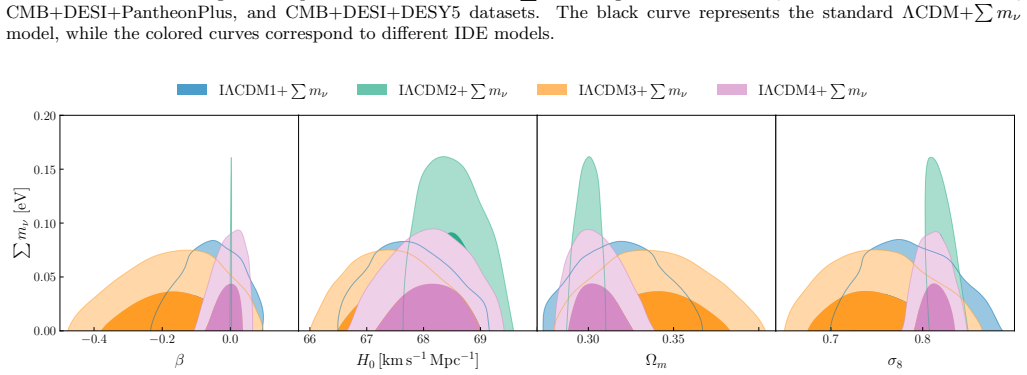
The upper bounds on ∑mν exhibit profound sensitivity to the specific phenomenological formulation of the interaction term. The IΛCDM2 model (Q ∝ H ρc) substantially relaxes the stringent upper limit (∑mν < 0.129 eV at 95% CL), while the IΛCDM3 model (Q ∝ H0 ρde) severely compresses the allowed parameter space, yielding ∑mν < 0.051 eV. Goodness-of-fit evaluations indicate that current data statistically favor these mass-suppressing IDE models, establishing an exacerbated statistical tension with the normal hierarchy lower bound (~0.06 eV) from terrestrial neutrino oscillation experiments.
What carries the argument
Four interacting dark energy models defined by different functional forms of the energy transfer rate Q between dark energy and dark matter densities.
If this is right
- The IΛCDM2 interaction allows a higher neutrino mass sum while remaining consistent with the combined datasets.
- The IΛCDM3 interaction produces a tighter neutrino mass limit than the standard non-interacting case.
- Statistical preference for the mass-suppressing models increases the tension with the 0.06 eV lower bound from oscillation data.
- Different interaction forms produce observably different neutrino mass constraints when the same datasets are used.
Where Pith is reading between the lines
- If the preferred interaction forms are correct, future neutrino mass experiments could rule out or confirm entire classes of dark sector models.
- The sensitivity to Q's functional form suggests that other phenomenological choices for the interaction could produce still different neutrino bounds.
- Resolving the tension may require either ruling out the interaction or finding a dynamical dark energy model without energy exchange that fits the same data.
Load-bearing premise
The deviation from Lambda CDM reported by DESI is caused by a dark energy-dark matter interaction whose functional form can be chosen from the four prescriptions examined.
What would settle it
An independent measurement of the sum of neutrino masses that lies outside the range allowed by the statistically preferred interaction models, or new data showing the DESI deviation persists without any interaction term.
Figures
read the original abstract
Recent DESI observations indicate a deviation from the $\Lambda$CDM model, showing a preference for dynamical dark energy and thereby relaxing the upper limit on the neutrino mass within this framework. This deviation can also be explained by the presence of an interaction between dark energy and dark matter. In this work, we investigate the cosmological upper bounds on the total neutrino mass ($\sum m_{\nu}$) across four different interacting dark energy (IDE) models. The present analysis employs the latest DESI baryon acoustic oscillation, cosmic microwave background, and type Ia supernova datasets. These results demonstrate that the upper bounds on $\sum m_{\nu}$ exhibit profound sensitivity to the specific phenomenological formulation of the interaction term. While the I$\Lambda$CDM2 model ($Q \propto H \rho_{\mathrm{c}}$) substantially relaxes the stringent upper limit ($\sum m_{\nu} < 0.129$ eV at 95% confidence level), notably the I$\Lambda$CDM3 model ($Q \propto H_0 \rho_{\mathrm{de}}$), severely compresses the allowed parameter space, yielding a highly restrictive bound of $\sum m_{\nu} < 0.051$ eV. Furthermore, rigorous goodness-of-fit evaluations utilizing the Deviance Information Criterion and $\Delta\chi^2_{\mathrm{MAP}}$ indicate that the current observational data statistically favor these mass-suppressing IDE models. This establishes an exacerbated statistical tension between the observationally preferred IDE scenarios and the normal hierarchy lower bound ($\sim 0.06$ eV) determined by terrestrial neutrino oscillation experiments.
Editorial analysis
A structured set of objections, weighed in public.
Referee Report
Summary. The paper examines constraints on the total neutrino mass ∑m_ν in four phenomenological interacting dark energy (IDE) models (IΛCDM1–4) distinguished by the functional form of the energy transfer rate Q. Using DESI DR2 BAO combined with CMB and SNIa data, it reports that the 95% CL upper bounds on ∑m_ν vary strongly with the choice of Q: IΛCDM2 (Q ∝ H ρ_c) relaxes the limit to <0.129 eV while IΛCDM3 (Q ∝ H_0 ρ_de) tightens it to <0.051 eV. DIC and Δχ²_MAP comparisons are used to argue that the data statistically favor the mass-suppressing IDE models, creating tension with the ~0.06 eV lower bound from neutrino oscillation experiments.
Significance. If the numerical results hold, the work usefully illustrates the strong model dependence of neutrino-mass limits within the IDE framework and the potential for certain interaction prescriptions to exacerbate tension with terrestrial neutrino data. The timely use of DESI DR2 data is a positive feature. The central demonstration—that different Q forms produce qualitatively different bounds from the same dataset—directly supports the paper’s stated goal and does not rely on unstated assumptions about the physical origin of the DESI deviation.
major comments (2)
- [Methods and Results sections] The abstract and results (presumably §4) quote precise 95% CL bounds and DIC/Δχ² values, yet the manuscript supplies no information on DESI DR2 data cuts, covariance-matrix construction, prior ranges for the interaction coupling and ∑m_ν, or MCMC convergence diagnostics. These omissions are load-bearing for the central sensitivity claim and prevent independent verification of the quoted limits.
- [§4 (goodness-of-fit discussion)] The statement that the data “statistically favor these mass-suppressing IDE models” rests on DIC and Δχ²_MAP, but the manuscript does not tabulate the numerical DIC differences relative to ΛCDM or report the effective number of parameters, making it impossible to judge whether the preference is decisive or marginal.
minor comments (2)
- [Introduction] Notation for the four models (IΛCDM1–4) should be defined explicitly at first use, together with the exact proportionality constants in each Q expression.
- [Figure captions] Figure captions should state the exact data combination and parameter priors used for each contour plot.
Simulated Author's Rebuttal
We thank the referee for the careful and constructive report. The comments highlight important issues of reproducibility and clarity in the statistical analysis, which we address below by expanding the manuscript accordingly.
read point-by-point responses
-
Referee: [Methods and Results sections] The abstract and results (presumably §4) quote precise 95% CL bounds and DIC/Δχ² values, yet the manuscript supplies no information on DESI DR2 data cuts, covariance-matrix construction, prior ranges for the interaction coupling and ∑m_ν, or MCMC convergence diagnostics. These omissions are load-bearing for the central sensitivity claim and prevent independent verification of the quoted limits.
Authors: We agree that these details are necessary for independent verification. In the revised manuscript we have inserted a new subsection (Methods, §2.3) that specifies the DESI DR2 redshift-bin cuts and sample selection, the covariance-matrix construction (following the DESI collaboration release), the uniform prior ranges adopted for the interaction coupling ξ and for ∑m_ν (0–2 eV), and the MCMC convergence criteria (Gelman–Rubin R−1 < 0.01 together with effective sample sizes). These additions directly support the quoted 95 % CL bounds. revision: yes
-
Referee: [§4 (goodness-of-fit discussion)] The statement that the data “statistically favor these mass-suppressing IDE models” rests on DIC and Δχ²_MAP, but the manuscript does not tabulate the numerical DIC differences relative to ΛCDM or report the effective number of parameters, making it impossible to judge whether the preference is decisive or marginal.
Authors: We accept the point. The revised §4 now contains an explicit table (Table 3) listing, for each IDE model and for ΛCDM: the DIC value, ΔDIC relative to ΛCDM, the effective number of parameters p_D, and the corresponding Δχ²_MAP. The tabulated differences allow readers to evaluate whether the preference for the mass-suppressing models is moderate or decisive. revision: yes
Circularity Check
No significant circularity
full rationale
The paper performs standard Bayesian parameter estimation on four phenomenological IDE models (with different Q forms) against DESI DR2 + CMB + SNIa data, reporting the resulting posterior upper limits on ∑mν. These limits are explicitly the output of the fits under each model choice; the central claim is precisely the demonstrated sensitivity of those limits to the choice of Q, which is shown directly by the differing posteriors and DIC/Δχ² values. No step claims a first-principles derivation, prediction, or uniqueness theorem that reduces by construction to the input data or to a self-citation. The analysis is self-contained against external benchmarks (the data likelihoods) and does not rename known results or smuggle ansatzes via citation.
Axiom & Free-Parameter Ledger
free parameters (2)
- interaction coupling strength
- sum m_nu
axioms (2)
- domain assumption The background expansion and perturbation equations remain valid when a phenomenological interaction term Q is added to the continuity equations of dark energy and dark matter.
- domain assumption The DESI DR2 BAO measurements, Planck CMB, and Pantheon+ SNIa datasets can be combined without additional systematic covariance terms beyond those already published.
Forward citations
Cited by 1 Pith paper
-
Are Cosmological Data Excluding Sterile Neutrinos or Only the Fully Thermalized Limit?
Cosmological observations constrain the effective abundance of light sterile neutrinos tightly while allowing non-fully-thermalized realizations to remain viable across LambdaCDM and CPL models.
Reference graph
Works this paper leans on
-
[1]
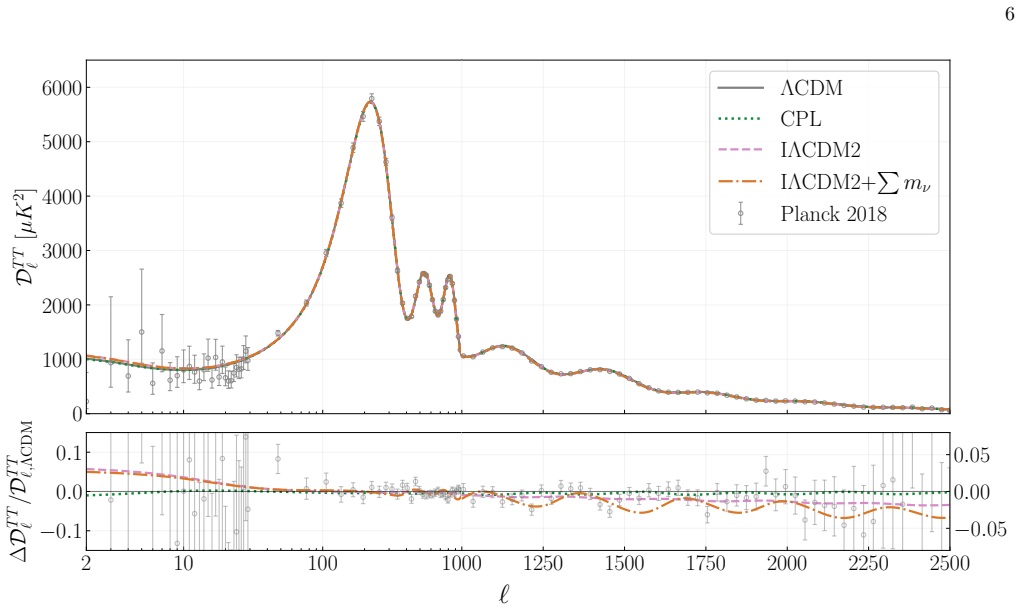
relative to ΛCDM. Notably, near the first acoustic peak, the observational data points fit the ΛCDM model extremely well with small relative errors, imposing strin- gent constraints on these interacting models. As previ- ously mentioned, the interaction strength within these coupled models is tightly constrained in this region. Fur- ther examining the mod...
2000
-
[2]
M. Abdul Karimet al.(DESI), Phys. Rev. D112, 083515 (2025), arXiv:2503.14738 [astro-ph.CO]
Pith/arXiv arXiv 2025
-
[3]
A. G. Adameet al.(DESI), JCAP02, 021 (2025), arXiv:2404.03002 [astro-ph.CO]
Pith/arXiv arXiv 2025
-
[4]
B. Feng, X.-L. Wang, and X.-M. Zhang, Phys. Lett. B 607, 35 (2005), arXiv:astro-ph/0404224
Pith/arXiv arXiv 2005
-
[5]
Z.-K. Guo, Y.-S. Piao, X.-M. Zhang, and Y.-Z. Zhang, Phys. Lett. B608, 177 (2005), arXiv:astro-ph/0410654
Pith/arXiv arXiv 2005
-
[6]
Zhang, Commun
X. Zhang, Commun. Theor. Phys.44, 762 (2005)
2005
-
[7]
X. Zhang, Int. J. Mod. Phys. D14, 1597 (2005), arXiv:astro-ph/0504586
Pith/arXiv arXiv 2005
- [8]
-
[9]
L. Amendola, Phys. Rev. D62, 043511 (2000), arXiv:astro-ph/9908023
Pith/arXiv arXiv 2000
-
[10]
B. Wang, E. Abdalla, F. Atrio-Barandela, and D. Pavon, Rept. Prog. Phys.79, 096901 (2016), arXiv:1603.08299 [astro-ph.CO]
Pith/arXiv arXiv 2016
-
[11]
M. Cortˆ es and A. R. Liddle, JCAP12, 007 (2024), arXiv:2404.08056 [astro-ph.CO]
arXiv 2024
-
[12]
D. Shlivko and P. J. Steinhardt, Phys. Lett. B855, 138826 (2024), arXiv:2405.03933 [astro-ph.CO]
Pith/arXiv arXiv 2024
-
[13]
O. Luongo and M. Muccino, Astron. Astrophys.690, A40 (2024), arXiv:2404.07070 [astro-ph.CO]
arXiv 2024
-
[14]
H. Wang and Y.-S. Piao, Phys. Lett. B873, 140180 (2026), arXiv:2404.18579 [astro-ph.CO]
arXiv 2026
-
[15]
Y. Tada and T. Terada, Phys. Rev. D109, L121305 (2024), arXiv:2404.05722 [astro-ph.CO]
arXiv 2024
-
[16]
S. Bhattacharya, G. Borghetto, A. Malhotra, S. Parameswaran, G. Tasinato, and I. Zavala, JCAP09, 073 (2024), arXiv:2405.17396 [astro-ph.CO]
arXiv 2024
-
[17]
O. F. Ramadan, J. Sakstein, and D. Rubin, Phys. Rev. D110, L041303 (2024), arXiv:2405.18747 [astro- ph.CO]
arXiv 2024
-
[18]
W. Giar` e, M. Najafi, S. Pan, E. Di Valentino, and J. T. Firouzjaee, JCAP10, 035 (2024), arXiv:2407.16689 [astro-ph.CO]
arXiv 2024
- [19]
-
[20]
Y. Yang, X. Ren, Q. Wang, Z. Lu, D. Zhang, Y.-F. Cai, and E. N. Saridakis, Sci. Bull.69, 2698 (2024), arXiv:2404.19437 [astro-ph.CO]
arXiv 2024
-
[21]
K. Lodhaet al.(DESI), Phys. Rev. D112, 083511 (2025), arXiv:2503.14743 [astro-ph.CO]
Pith/arXiv arXiv 2025
-
[22]
Guet al.(DESI), Nature Astron.9, 1879 (2025), [Erratum: Nature Astron
G. Guet al.(DESI), Nature Astron.9, 1879 (2025), [Erratum: Nature Astron. 9, 1898 (2025)], arXiv:2504.06118 [astro-ph.CO]
arXiv 2025
-
[23]
J. de Cruz P´ erez, A. G´ omez-Valent, and J. Sol` a Peracaula, Phys. Rev. D113, 083521 (2026), arXiv:2512.20616 [astro-ph.CO]
arXiv 2026
-
[24]
I. D. Gialamas, G. H¨ utsi, K. Kannike, A. Racioppi, M. Raidal, M. Vasar, and H. Veerm¨ ae, Phys. Rev. D 111, 043540 (2025), arXiv:2406.07533 [astro-ph.CO]
arXiv 2025
-
[25]
G. Ye, M. Martinelli, B. Hu, and A. Silvestri, Phys. Rev. Lett.134, 181002 (2025), arXiv:2407.15832 [astro- ph.CO]
arXiv 2025
-
[26]
K. Lodhaet al.(DESI), Phys. Rev. D111, 023532 (2025), arXiv:2405.13588 [astro-ph.CO]
arXiv 2025
-
[27]
M. Malekjani, Z. Davari, and S. Pourojaghi (DESI), Phys. Rev. D111, 083547 (2025), arXiv:2407.09767 [astro-ph.CO]
arXiv 2025
-
[28]
J. Rebou¸ cas, D. H. F. de Souza, K. Zhong, V. Mi- randa, and R. Rosenfeld, JCAP02, 024 (2025), arXiv:2408.14628 [astro-ph.CO]
arXiv 2025
-
[29]
C.-G. Park, J. de Cruz P´ erez, and B. Ratra, Int. J. Mod. Phys. D34, 2550058 (2025), arXiv:2410.13627 [astro- ph.CO]
arXiv 2025
- [30]
-
[31]
W. J. Wolf, C. Garc´ ıa-Garc´ ıa, T. Anton, and P. G. Ferreira, Phys. Rev. Lett.135, 081001 (2025), arXiv:2504.07679 [astro-ph.CO]
arXiv 2025
-
[32]
A. J. Shajib and J. A. Frieman, Phys. Rev. D112, 063508 (2025), arXiv:2502.06929 [astro-ph.CO]
arXiv 2025
-
[33]
W. Giar` e, T. Mahassen, E. Di Valentino, and S. Pan, Phys. Dark Univ.48, 101906 (2025), arXiv:2502.10264 [astro-ph.CO]
arXiv 2025
-
[34]
E. Chaussidonet al., Phys. Rev. D112, 063548 (2025), arXiv:2503.24343 [astro-ph.CO]
arXiv 2025
-
[35]
Y.-H. Pang, X. Zhang, and Q.-G. Huang, Sci. China Phys. Mech. Astron.68, 280410 (2025), arXiv:2503.21600 [astro-ph.CO]
arXiv 2025
-
[36]
S. Roy Choudhury, Astrophys. J. Lett.986, L31 (2025), arXiv:2504.15340 [astro-ph.CO]
arXiv 2025
-
[37]
A. Paliathanasis, Phys. Dark Univ.48, 101956 (2025), arXiv:2502.16221 [astro-ph.CO]
arXiv 2025
-
[38]
M. Scherer, M. A. Sabogal, R. C. Nunes, and A. De Fe- lice, Phys. Rev. D112, 043513 (2025), arXiv:2504.20664 9 [astro-ph.CO]
arXiv 2025
- [39]
-
[40]
T. Liu, X. Li, and J. Wang, Astrophys. J.988, 243 (2025), arXiv:2504.21373 [astro-ph.CO]
arXiv 2025
-
[41]
E. M. Teixeira, W. Giar` e, N. B. Hogg, T. Montandon, A. Poudou, and V. Poulin, Phys. Rev. D112, 023515 (2025), arXiv:2504.10464 [astro-ph.CO]
arXiv 2025
-
[42]
E. Specogna, S. A. Adil, E. Ozulker, E. Di Valentino, R. C. Nunes, O. Akarsu, and A. A. Sen, Phys. Rev. D 113, 103549 (2026), arXiv:2504.17859 [gr-qc]
Pith/arXiv arXiv 2026
- [43]
- [44]
-
[45]
E. ¨Oz¨ ulker, E. Di Valentino, and W. Giar` e, (2025), arXiv:2506.19053 [astro-ph.CO]
arXiv 2025
-
[46]
A. N. Ormondroyd, W. J. Handley, M. P. Hobson, and A. N. Lasenby, (2025), arXiv:2503.17342 [astro-ph.CO]
arXiv 2025
- [47]
- [48]
-
[49]
Z. Zhang, T. Xu, and Y. Chen, Astrophys. J.999, 248 (2026), arXiv:2512.07281 [astro-ph.CO]
Pith/arXiv arXiv 2026
-
[50]
H. Cheng, E. Di Valentino, and L. Visinelli, JHEAp 53, 100610 (2026), arXiv:2505.22066 [astro-ph.CO]
Pith/arXiv arXiv 2026
-
[51]
Y. Cai, X. Ren, T. Qiu, M. Li, and X. Zhang, (2025), 10.1093/nsr/nwag115, arXiv:2505.24732 [astro-ph.CO]
work page internal anchor Pith review Pith/arXiv arXiv doi:10.1093/nsr/nwag115 2025
- [52]
-
[53]
D. H. Lee, W. Yang, E. Di Valentino, S. Pan, and C. van de Bruck, Phys. Rev. D113, 063554 (2026), arXiv:2507.11432 [astro-ph.CO]
arXiv 2026
- [54]
-
[55]
F. B. M. d. Santos, J. Morais, S. Pan, W. Yang, and E. Di Valentino, (2025), arXiv:2504.04646 [astro- ph.CO]
arXiv 2025
- [56]
- [57]
-
[58]
J. Khoury, M.-X. Lin, and M. Trodden, Phys. Rev. Lett.135, 181001 (2025), arXiv:2503.16415 [astro- ph.CO]
arXiv 2025
- [59]
-
[60]
D. A. Kessler, L. A. Escamilla, S. Pan, and E. Di Valentino, (2025), arXiv:2504.00776 [astro- ph.CO]
arXiv 2025
- [61]
-
[62]
Di Valentinoet al.(CosmoVerse Network), Phys
E. Di Valentinoet al.(CosmoVerse Network), Phys. Dark Univ.49, 101965 (2025), arXiv:2504.01669 [astro- ph.CO]
Pith/arXiv arXiv 2025
-
[63]
E. Fazzari, W. Giar` e, and E. Di Valentino, Astro- phys. J. Lett.996, L5 (2026), arXiv:2509.16196 [astro- ph.CO]
arXiv 2026
-
[64]
J.-Y. Song, G.-H. Du, T.-N. Li, L.-F. Wang, J.-Z. Qi, J.-F. Zhang, and X. Zhang, Sci. China Phys. Mech. Astron.69, 240413 (2026), arXiv:2511.12017 [astro- ph.CO]
arXiv 2026
-
[65]
M. Bella, V. Poulin, S. Vagnozzi, and L. Knox, (2026), arXiv:2604.13535 [astro-ph.CO]
Pith/arXiv arXiv 2026
-
[66]
L. Comini, S. Vagnozzi, and A. Loeb, JHEAp53, 100626 (2026), arXiv:2604.13866 [astro-ph.CO]
Pith/arXiv arXiv 2026
-
[67]
A. Gonz´ alez-Fuentes and A. G´ omez-Valent, (2026), arXiv:2603.26560 [astro-ph.CO]
Pith/arXiv arXiv 2026
-
[68]
D. Pedrotti, L. A. Escamilla, V. Marra, L. Perivolaropoulos, and S. Vagnozzi, Phys. Rev. D113, 043507 (2026), arXiv:2510.01974 [astro-ph.CO]
Pith/arXiv arXiv 2026
-
[69]
X. Ren, S.-Y. Li, Y. Liu, Y. Cai, H. Li, and X. Zhang, (2026), arXiv:2606.01360 [astro-ph.CO]
Pith/arXiv arXiv 2026
-
[70]
X. Li, T. Liu, T.-N. Li, G.-H. Du, A. Shafieloo, and M. Biesiada, Astrophys. J. Lett.1001, L21 (2026)
2026
-
[71]
Y.-H. Yao, Y.-H. Shen, T.-N. Li, G.-H. Du, and Y. Gong, Phys. Dark Univ.52, 102318 (2026), arXiv:2510.13436 [astro-ph.CO]
Pith/arXiv arXiv 2026
-
[72]
T.-t. Qiu, Y. Cai, Y. Liu, S.-Y. Li, J. Evslin, and X. Zhang, Chin. Phys. C50, 012001 (2026), arXiv:2511.19994 [astro-ph.CO]
arXiv 2026
- [73]
-
[74]
L. Huang, R.-G. Cai, and S.-J. Wang, Sci. China Phys. Mech. Astron.68, 100413 (2025), arXiv:2502.04212 [astro-ph.CO]
arXiv 2025
-
[75]
G. Efstathiou, Mon. Not. Roy. Astron. Soc.538, 875 (2025), arXiv:2408.07175 [astro-ph.CO]
arXiv 2025
-
[76]
B. Popovicet al.(DES), Mon. Not. Roy. Astron. Soc. 548, stag632 (2026), arXiv:2511.07517 [astro-ph.CO]
Pith/arXiv arXiv 2026
-
[77]
J.-F. Zhang, M.-M. Zhao, Y.-H. Li, and X. Zhang, JCAP04, 038 (2015), arXiv:1502.04028 [astro-ph.CO]
Pith/arXiv arXiv 2015
-
[78]
R. Allison, P. Caucal, E. Calabrese, J. Dunkley, and T. Louis, Phys. Rev. D92, 123535 (2015), arXiv:1509.07471 [astro-ph.CO]
Pith/arXiv arXiv 2015
-
[79]
C.-Q. Geng, C.-C. Lee, R. Myrzakulov, M. Sami, and E. N. Saridakis, JCAP01, 049 (2016), arXiv:1504.08141 [astro-ph.CO]
Pith/arXiv arXiv 2016
-
[80]
Y. Chen and L. Xu, Phys. Lett. B752, 66 (2016), arXiv:1507.02008 [astro-ph.CO]
Pith/arXiv arXiv 2016
discussion (0)
Sign in with ORCID, Apple, or X to comment. Anyone can read and Pith papers without signing in.