Constraining Orbital Eccentricity of a Supermassive Black Hole Binary Candidate PKS 2131-0211
Pith reviewed 2026-06-28 04:38 UTC · model grok-4.3
The pith
Incorporating orbital eccentricity into the kinematic model for PKS 2131-021 yields a best-fit value of 0.053 but red-noise modeling favors the circular case with an upper limit below 0.15.
A machine-rendered reading of the paper's core claim, the machinery that carries it, and where it could break.
Core claim
The paper demonstrates that a Keplerian eccentric orbit inserted into the kinematic Doppler-boosting model produces a statistically acceptable description of the radio light curve with eccentricity 0.053 plus or minus 0.015 and a Bayes factor of 3.15 over the circular case. When the same data are jointly modeled with a damped random walk to capture red noise, the circular orbit becomes preferred and the eccentricity is limited to less than 0.15. The circular-plus-DRW model is strongly favored overall and still recovers a well-defined orbital period across the 1975-2021 data sets.
What carries the argument
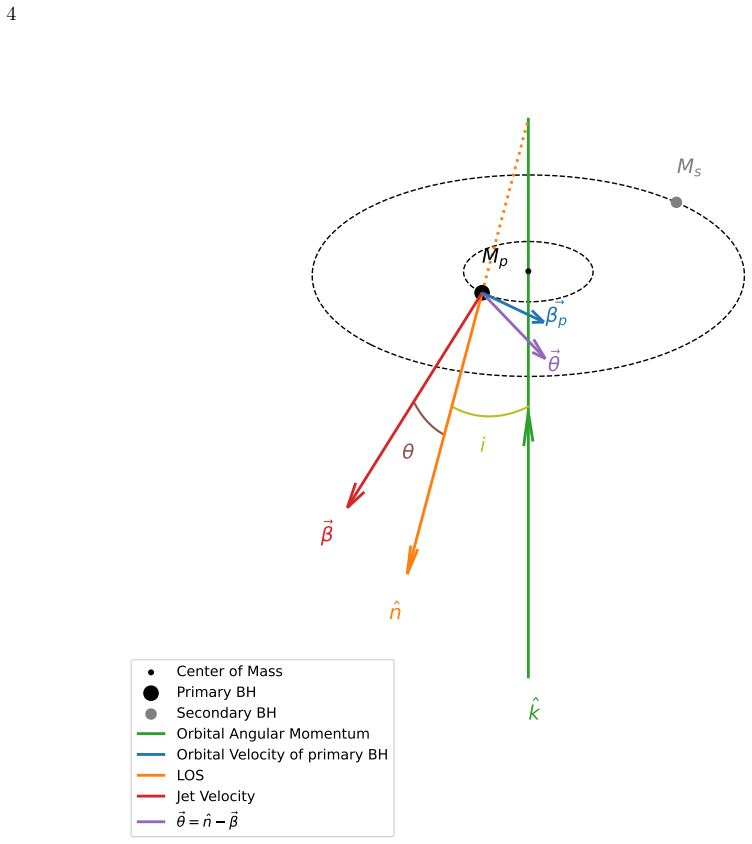
Kinematic orbital model extended by the Keplerian parametric solution for eccentric SMBH binary motion, which modulates the observed radio flux through relativistic Doppler boosting.
If this is right
- Eccentricity can be bounded from existing radio time series using Bayesian parameter estimation.
- A Bayes factor of 3.15 favors the eccentric model when red noise is ignored.
- Inclusion of a damped random walk reverses the model ranking and supplies an eccentricity upper limit of 0.15.
- The recovered orbital period stays stable even when broader uncertainties are allowed.
- The circular-plus-DRW description is the most strongly supported among the models tested.
Where Pith is reading between the lines
- Future multi-frequency or polarization monitoring could test whether the same periodicity appears outside the radio band.
- Similar modeling applied to other periodic blazar candidates would show how often residual eccentricity is required.
- Longer baselines or higher-cadence data would tighten the eccentricity upper limit under the red-noise treatment.
- If the circular-plus-DRW model remains preferred, searches for gravitational-wave signals from this system should assume a circular orbit.
Load-bearing premise
The sinusoidal flux variations are produced by relativistic Doppler boosting from the orbital motion of the jet-emitting black hole around its companion.
What would settle it
A new radio monitoring campaign that shows either the absence of the claimed periodicity or a phase shift inconsistent with the fitted orbital period would falsify the model.
Figures
read the original abstract
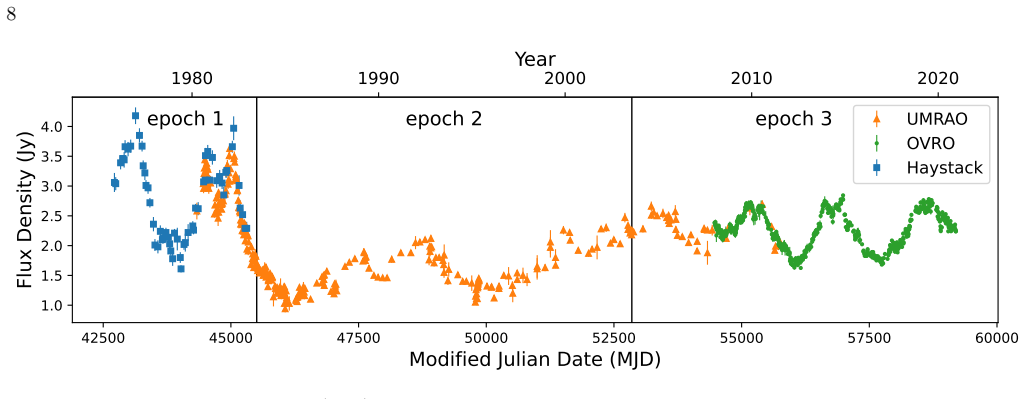
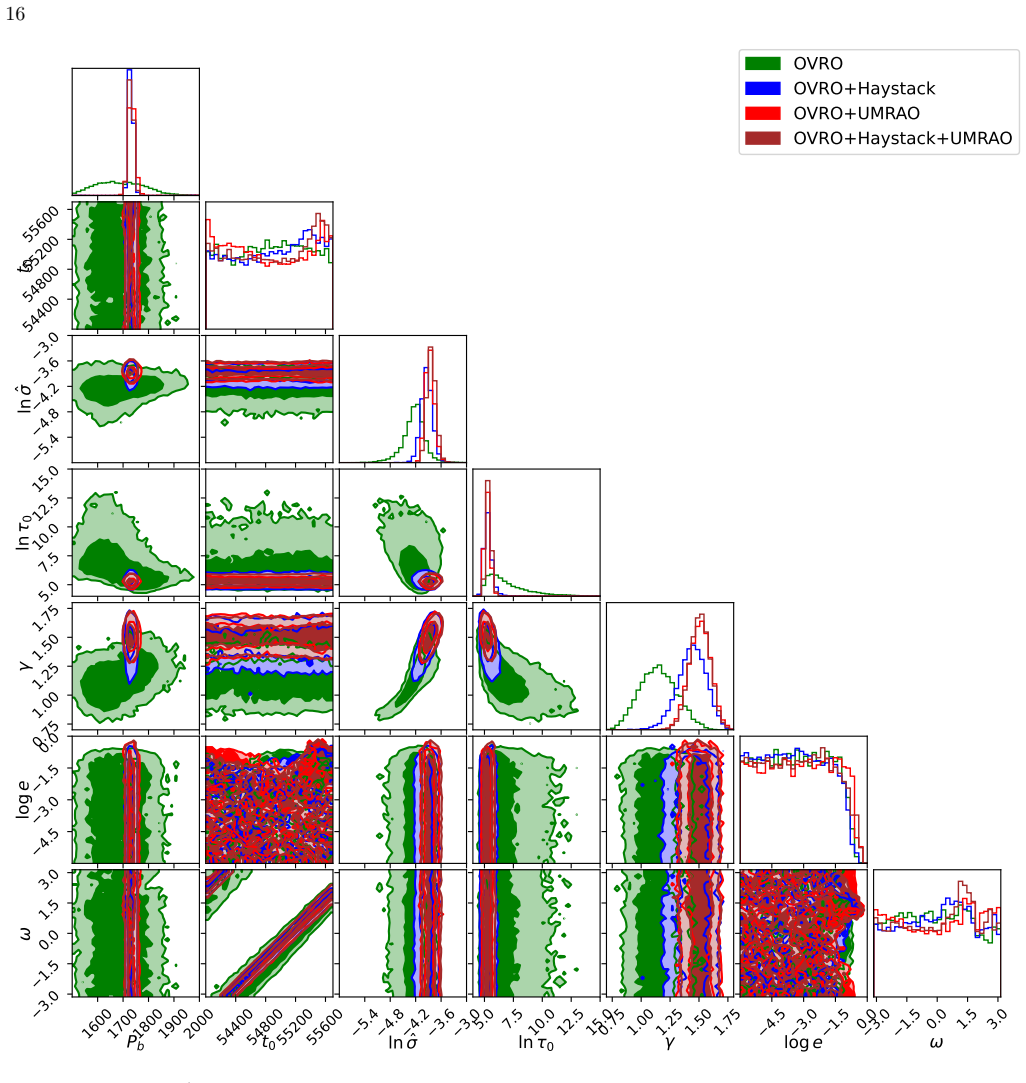
A detailed analysis of the decades-long radio light curve of blazar PKS 2131-021 showed epochs of sinusoidal variations in the radio flux density time-series as detailed in O'Neill et al. (2022). The observed sinusoidal flux modulation arises naturally from relativistic Doppler boosting of the jet when the jet-emitting supermassive black hole (SMBH) orbits its companion. For SMBHs in circular orbits, this scenario yields sinusoidal light curves, offering a simple kinematic explanation for the observed variability in PKS 2131-021. We present an approach that incorporates the effects of orbital eccentricity into the Kinematic Orbital model for PKS 2131-021, using the Keplerian parametric solution to describe the SMBH binary orbit. Using the available radio light curve data, we demonstrate that the proposed SMBH binary likely possesses a residual orbital eccentricity, which we constrain through detailed Bayesian parameter estimation studies to be 0.053 \pm 0.015 with a Bayes factor of 3.15 over the circular model. However, when the analysis accounts for the presence of red noise in the data using a Damped Random Walk (DRW) process, the circular model is preferred, giving an eccentricity upper limit of e < 0.15. Nevertheless, our efforts reveal that the Circular+DRW model is strongly favored. This model consistently recovers a coherent periodic signal across all datasets, with the orbital period remaining well-defined even when accounting for broader uncertainties. This analysis incorporated archival observations from the Haystack Observatory, the University of Michigan Radio Astronomy Observatory (UMRAO), and the Owens Valley Radio Observatory (OVRO), spanning the period from 1975 to 2021, compiled by O'Neill et al. (2022).
Editorial analysis
A structured set of objections, weighed in public.
Referee Report
Summary. The paper extends a kinematic orbital model for the blazar PKS 2131-021, previously interpreted as a supermassive black hole binary with sinusoidal radio flux variations due to relativistic Doppler boosting, to include orbital eccentricity via the Keplerian parametric solution. Using archival radio light-curve data (1975–2021) from Haystack, UMRAO, and OVRO, Bayesian parameter estimation yields e = 0.053 ± 0.015 with a Bayes factor of 3.15 favoring the eccentric model over circular; however, inclusion of a Damped Random Walk (DRW) red-noise process reverses the preference, yielding an upper limit e < 0.15 while strongly favoring the Circular+DRW model overall.
Significance. If the reported constraints and model comparisons hold after fuller documentation, the work supplies a quantitative eccentricity bound on a candidate SMBHB system and demonstrates the importance of red-noise modeling in periodicity searches. The explicit test of DRW sensitivity is a methodological strength. However, the modest Bayes factor without DRW and the strong dependence on the noise model limit the immediate impact on binary-evolution studies; the result is primarily a cautionary constraint rather than a definitive eccentricity detection.
major comments (3)
- [Abstract, §3] Abstract and §3 (Bayesian analysis): the Bayes factor of 3.15 is reported without the corresponding marginal likelihood values, prior specifications, or sampler convergence diagnostics; because the central claim rests on this modest evidence and its reversal under DRW, the absence of these quantities prevents assessment of whether the eccentricity constraint is robust.
- [Abstract] Abstract: the reversal of model preference once the DRW process is included is load-bearing for the final conclusion that Circular+DRW is strongly favored, yet no quantitative evidence (e.g., Bayes factor between Circular+DRW and Eccentric+DRW) or posterior predictive checks are provided to substantiate the strength of that preference.
- [Abstract] Abstract: the data-handling steps for combining the three archival datasets (Haystack, UMRAO, OVRO) and any treatment of uneven sampling or measurement uncertainties are not described; these choices directly affect the recovered periodic signal and the derived eccentricity upper limit.
minor comments (1)
- The abstract states that the Circular+DRW model 'consistently recovers a coherent periodic signal'; a figure or table showing the recovered period and its uncertainty across the three datasets would improve clarity.
Simulated Author's Rebuttal
We thank the referee for their careful and constructive review. We address each major comment below and have revised the manuscript to supply the requested documentation on the Bayesian analysis, model comparisons, and data procedures.
read point-by-point responses
-
Referee: [Abstract, §3] Abstract and §3 (Bayesian analysis): the Bayes factor of 3.15 is reported without the corresponding marginal likelihood values, prior specifications, or sampler convergence diagnostics; because the central claim rests on this modest evidence and its reversal under DRW, the absence of these quantities prevents assessment of whether the eccentricity constraint is robust.
Authors: We agree that these quantities are required for independent assessment. In the revised manuscript we now report the marginal likelihood values underlying the Bayes factor of 3.15, list all prior distributions, and include sampler convergence diagnostics (Gelman-Rubin statistics and trace summaries) in §3 and a new appendix. revision: yes
-
Referee: [Abstract] Abstract: the reversal of model preference once the DRW process is included is load-bearing for the final conclusion that Circular+DRW is strongly favored, yet no quantitative evidence (e.g., Bayes factor between Circular+DRW and Eccentric+DRW) or posterior predictive checks are provided to substantiate the strength of that preference.
Authors: We acknowledge that a direct Bayes factor and posterior predictive checks would strengthen the claim. In the revised manuscript we add the Bayes factor comparing Circular+DRW versus Eccentric+DRW and include posterior predictive checks in §3 demonstrating that the Circular+DRW model reproduces the data features without eccentricity. revision: yes
-
Referee: [Abstract] Abstract: the data-handling steps for combining the three archival datasets (Haystack, UMRAO, OVRO) and any treatment of uneven sampling or measurement uncertainties are not described; these choices directly affect the recovered periodic signal and the derived eccentricity upper limit.
Authors: The dataset compilation follows the procedures of O'Neill et al. (2022). To address the concern we have expanded §2 of the revised manuscript with an explicit description of the merging steps, the handling of uneven sampling via the likelihood, and the propagation of observatory-specific measurement uncertainties. revision: yes
Circularity Check
No significant circularity; eccentricity is a fitted parameter from Bayesian analysis of light-curve data
full rationale
The paper's central result is a Bayesian parameter estimation of orbital elements (including eccentricity e = 0.053 ± 0.015) directly from radio flux time-series data spanning 1975-2021. The reported Bayes factor and upper limits arise from comparing posterior probabilities of eccentric vs. circular models (with and without DRW red-noise component). No equation or step reduces the output to the input by construction; the kinematic Doppler-boosting model is adopted from prior literature (O'Neill et al. 2022) but is externally falsifiable and the present work tests its sensitivity to noise modeling. No self-citation load-bearing steps, self-definitional relations, or fitted-input-called-prediction patterns are present. The derivation chain is self-contained against the supplied observational data.
Axiom & Free-Parameter Ledger
free parameters (2)
- orbital eccentricity e =
0.053 ± 0.015
- DRW parameters
axioms (2)
- domain assumption The observed sinusoidal flux modulation arises naturally from relativistic Doppler boosting of the jet when the jet-emitting supermassive black hole (SMBH) orbits its companion.
- standard math The binary orbit is described by the Keplerian parametric solution.
invented entities (1)
-
supermassive black hole binary companion
no independent evidence
Reference graph
Works this paper leans on
-
[1]
Is Quasar Optical Variability a Damped Random Walk?
Is Quasar Optical Variability a Damped Random Walk?. , keywords =. doi:10.1088/0004-637X/765/2/106 , archivePrefix =. 1202.3783 , primaryClass =
work page internal anchor Pith review Pith/arXiv arXiv doi:10.1088/0004-637x/765/2/106
-
[2]
How far is quasar UV/optical variability from damped random walk at low frequency?
How Far Is Quasar UV/Optical Variability from a Damped Random Walk at Low Frequency?. , keywords =. doi:10.3847/1538-4357/aa8d71 , archivePrefix =. 1709.05271 , primaryClass =
work page internal anchor Pith review Pith/arXiv arXiv doi:10.3847/1538-4357/aa8d71
-
[3]
Are the Variations in Quasar Optical Flux Driven by Thermal Fluctuations?
Are the Variations in Quasar Optical Flux Driven by Thermal Fluctuations?. , keywords =. doi:10.1088/0004-637X/698/1/895 , archivePrefix =. 0903.5315 , primaryClass =
work page internal anchor Pith review Pith/arXiv arXiv doi:10.1088/0004-637x/698/1/895
-
[4]
Modeling the Time Variability of SDSS Stripe 82 Quasars as a Damped Random Walk
Modeling the Time Variability of SDSS Stripe 82 Quasars as a Damped Random Walk. , keywords =. doi:10.1088/0004-637X/721/2/1014 , archivePrefix =. 1004.0276 , primaryClass =
work page internal anchor Pith review Pith/arXiv arXiv doi:10.1088/0004-637x/721/2/1014
-
[5]
Quantifying Quasar Variability as Part of a General Approach to Classifying Continuously Varying Sources. , keywords =. doi:10.1088/0004-637X/708/2/927 , archivePrefix =. 0909.1326 , primaryClass =
work page internal anchor Pith review Pith/arXiv arXiv doi:10.1088/0004-637x/708/2/927
-
[6]
False periodicities in quasar time-domain surveys
False periodicities in quasar time-domain surveys. , keywords =. doi:10.1093/mnras/stw1412 , archivePrefix =. 1606.02620 , primaryClass =
work page internal anchor Pith review Pith/arXiv arXiv doi:10.1093/mnras/stw1412
-
[7]
Quasars with Periodic Variability: Capabilities and Limitations of Bayesian Searches for Supermassive Black Hole Binaries in Time-domain Surveys. , keywords =. doi:10.3847/1538-4357/ac8356 , archivePrefix =. 2110.07465 , primaryClass =
-
[8]
Kasliwal, Vishal P. and Vogeley, Michael S. and Richards, Gordon T. , title =. Monthly Notices of the Royal Astronomical Society , volume =. 2015 , month =. doi:10.1093/mnras/stv1230 , url =
-
[9]
Absence of the predicted 2022 October outburst of OJ 287 and implications for binary SMBH scenarios. , keywords =. doi:10.1093/mnrasl/slad016 , archivePrefix =. 2302.11646 , primaryClass =
-
[10]
MOMO. VI. Multifrequency Radio Variability of the Blazar OJ 287 from 2015 to 2022, Absence of Predicted 2021 Precursor-flare Activity, and a New Binary Interpretation of the 2016/2017 Outburst. , keywords =. doi:10.3847/1538-4357/acaf71 , archivePrefix =. 2302.11486 , primaryClass =
-
[11]
Astronomische Nachrichten , keywords =
Multiwavelength astrophysics of the blazar OJ 287 and the project MOMO. Astronomische Nachrichten , keywords =. doi:10.1002/asna.20220126 , archivePrefix =. 2207.11291 , primaryClass =
-
[12]
The NANOGrav 15 yr Data Set: Targeted Searches for Supermassive Black Hole Binaries
The NANOGrav 15 yr Data Set: Targeted Searches for Supermassive Black Hole Binaries. arXiv e-prints , keywords =. doi:10.48550/arXiv.2508.16534 , archivePrefix =. 2508.16534 , primaryClass =
work page internal anchor Pith review Pith/arXiv arXiv doi:10.48550/arxiv.2508.16534
-
[13]
Eccentricity of supermassive black hole binaries coalescing from gas rich mergers
Eccentricity of Supermassive Black Hole Binaries Coalescing from Gas-rich Mergers. , keywords =. doi:10.1086/497108 , archivePrefix =. astro-ph/0508493 , primaryClass =
work page internal anchor Pith review Pith/arXiv arXiv doi:10.1086/497108
-
[14]
Keplerian Orbits and Dynamics of Exoplanets
-
[15]
Exploring the Effect of Periastron Advance in Small-Eccentricity Binary Pulsars
Exploring the effect of periastron advance in small-eccentricity binary pulsars. , keywords =. doi:10.1093/mnras/sty2177 , archivePrefix =. 1808.02508 , primaryClass =
work page internal anchor Pith review Pith/arXiv arXiv doi:10.1093/mnras/sty2177
-
[16]
lcsim: Light curve simulation code
-
[17]
Explaining temporal variations in the jet PA of the blazar OJ 287 using its BBH central engine model. , keywords =. doi:10.1093/mnras/stab730 , archivePrefix =. 2103.05274 , primaryClass =
-
[18]
Promise of Persistent Multi-Messenger Astronomy with the Blazar OJ 287. Galaxies , keywords =. doi:10.3390/galaxies10010001 , archivePrefix =. 2112.10102 , primaryClass =
-
[19]
Spitzer Observations of the Predicted Eddington Flare from Blazar OJ 287. , keywords =. doi:10.3847/2041-8213/ab79a4 , archivePrefix =. 2004.13392 , primaryClass =
-
[20]
Authenticating the Presence of a Relativistic Massive Black Hole Binary in OJ 287 Using Its General Relativity Centenary Flare: Improved Orbital Parameters. , keywords =. doi:10.3847/1538-4357/aadd95 , archivePrefix =. 1808.09309 , primaryClass =
-
[21]
Primary black hole spin in OJ287 as determined by the General Relativity centenary flare
Primary Black Hole Spin in OJ 287 as Determined by the General Relativity Centenary Flare. , keywords =. doi:10.3847/2041-8205/819/2/L37 , archivePrefix =. 1603.04171 , primaryClass =
work page internal anchor Pith review Pith/arXiv arXiv doi:10.3847/2041-8205/819/2/l37 2041
-
[22]
Signatures of circumbinary disc dynamics in multimessenger population studies of massive black hole binaries. , keywords =. doi:10.1093/mnras/stae2251 , archivePrefix =. 2403.08871 , primaryClass =
-
[23]
Reviving stochasticity: uncertainty in SMBH binary eccentricity is unavoidable. , keywords =. doi:10.1093/mnras/stad2891 , archivePrefix =. 2307.08756 , primaryClass =
-
[24]
PKS J0805-0111: A Second Owens Valley Radio Observatory Blazar Showing Highly Significant Sinusoidal Radio Variability The Tip of the Iceberg. , keywords =. doi:10.3847/1538-4357/addc60 , archivePrefix =. 2408.02645 , primaryClass =
-
[25]
Strong sinusoidal variations at 95, 147 and 225 GHz in PKS 2131 - 021 and PKS J0805 - 0111
Atacama Cosmology Telescope: Observations of supermassive black hole binary candidates. Strong sinusoidal variations at 95, 147 and 225 GHz in PKS 2131 - 021 and PKS J0805 - 0111. arXiv e-prints , keywords =. doi:10.48550/arXiv.2504.04278 , archivePrefix =. 2504.04278 , primaryClass =
-
[26]
SMBH binary candidate PKS J2134-0153: possible multi-band periodic variability and inter-band time lags. , keywords =. doi:10.1093/mnras/stae2553 , archivePrefix =. 2411.06366 , primaryClass =
-
[27]
Essential relativistic celestial mechanics
-
[28]
Precision timing measurements of PSR J1012+5307. , keywords =. doi:10.1046/j.1365-8711.2001.04606.x , archivePrefix =. astro-ph/0102309 , primaryClass =
-
[29]
State of the Field: Extreme Precision Radial Velocities
State of the Field: Extreme Precision Radial Velocities. , keywords =. doi:10.1088/1538-3873/128/964/066001 , archivePrefix =. 1602.07939 , primaryClass =
work page internal anchor Pith review Pith/arXiv arXiv doi:10.1088/1538-3873/128/964/066001
-
[30]
Unified Schemes for Radio-Loud Active Galactic Nuclei. , keywords =. doi:10.1086/133630 , archivePrefix =. astro-ph/9506063 , primaryClass =
work page internal anchor Pith review Pith/arXiv arXiv doi:10.1086/133630
-
[31]
Observational Signatures of Supermassive Black Hole Binaries. arXiv e-prints , keywords =. doi:10.48550/arXiv.2310.16896 , archivePrefix =. 2310.16896 , primaryClass =
-
[32]
The second data release from the European Pulsar Timing Array. IV. Implications for massive black holes, dark matter, and the early Universe. , keywords =. doi:10.1051/0004-6361/202347433 , archivePrefix =. 2306.16227 , primaryClass =
-
[33]
The NANOGrav 15 yr Data Set: Constraints on Supermassive Black Hole Binaries from the Gravitational-wave Background. , keywords =. doi:10.3847/2041-8213/ace18b , archivePrefix =. 2306.16220 , primaryClass =
-
[34]
An introduction to Bayesian inference in gravitational-wave astronomy: Parameter estimation, model selection, and hierarchical models. , keywords =. doi:10.1017/pasa.2019.2 , archivePrefix =. 1809.02293 , primaryClass =
-
[35]
Kass and Adrian E
Robert E. Kass and Adrian E. Raftery , journal =. Bayes Factors , urldate =
-
[36]
Toward the Unambiguous Identification of Supermassive Binary Black Holes through Bayesian Inference. , keywords =. doi:10.3847/1538-4357/abac5a , archivePrefix =. 2004.10944 , primaryClass =
-
[37]
MOJAVE. XIX. Brightness Temperatures and Intrinsic Properties of Blazar Jets. , keywords =. doi:10.3847/1538-4357/ac27af , archivePrefix =. 2109.04977 , primaryClass =
-
[38]
MOJAVE. XVII. Jet Kinematics and Parent Population Properties of Relativistically Beamed Radio-loud Blazars. , keywords =. doi:10.3847/1538-4357/ab08ee , archivePrefix =. 1902.09591 , primaryClass =
work page internal anchor Pith review Pith/arXiv arXiv doi:10.3847/1538-4357/ab08ee 1902
-
[39]
The Unique Blazar OJ 287 and its Massive Binary Black Hole Central Engine
The Unique Blazar OJ 287 and Its Massive Binary Black Hole Central Engine. Universe , keywords =. doi:10.3390/universe5050108 , archivePrefix =. 1905.02689 , primaryClass =
work page internal anchor Pith review Pith/arXiv arXiv doi:10.3390/universe5050108 1905
-
[40]
PKS 2131‑021 Discovery of Strong Coherent Sinusoidal Variations from Radio to Optical Frequencies: Compelling Evidence for a Blazar Supermassive Black Hole Binary. , keywords =. doi:10.3847/1538-4357/adc567 , archivePrefix =. 2407.09647 , primaryClass =
-
[41]
Unraveling the formation histories of the first supermassive black holes with the Square Kilometre Array's pulsar timing array. , keywords =. doi:10.1051/0004-6361/202345911 , archivePrefix =. 2207.14309 , primaryClass =
-
[42]
Pulsar Timing Array Based Search for Supermassive Black Hole Binaries in the Square Kilometer Array Era. , keywords =. doi:10.1103/PhysRevLett.118.151104 , archivePrefix =. 1611.09440 , primaryClass =
work page internal anchor Pith review Pith/arXiv arXiv doi:10.1103/physrevlett.118.151104
-
[43]
The MeerKAT Pulsar Timing Array: the 4.5-yr data release and the noise and stochastic signals of the millisecond pulsar population. , keywords =. doi:10.1093/mnras/stae2572 , archivePrefix =. 2412.01148 , primaryClass =
-
[44]
The Parkes Pulsar Timing Array third data release. , keywords =. doi:10.1017/pasa.2023.36 , archivePrefix =. 2306.16230 , primaryClass =
-
[45]
Coifman, R. R. and Donoho, D. L. Translation-Invariant De-Noising. Wavelets and Statistics. 1995. doi:10.1007/978-1-4612-2544-7_9
-
[46]
An Unusual Pulse Shape Change Event in PSR J1713+0747 Observed with the Green Bank Telescope and CHIME. , keywords =. doi:10.3847/1538-4357/ad2930 , archivePrefix =. 2210.12266 , primaryClass =
-
[47]
Improving DM estimates using low-frequency scatter-broadening estimates. , keywords =. doi:10.1093/mnras/stae2405 , archivePrefix =. 2309.16765 , primaryClass =
-
[48]
A Second Chromatic Timing Event of Interstellar Origin toward PSR J1713+0747
A Second Chromatic Timing Event of Interstellar Origin toward PSR J1713+0747. , keywords =. doi:10.3847/1538-4357/aac770 , archivePrefix =. 1712.03651 , primaryClass =
work page internal anchor Pith review Pith/arXiv arXiv doi:10.3847/1538-4357/aac770
-
[49]
The NANOGrav Nine-Year Data Set: Measurement and Interpretation of Variations in Dispersion Measures
The NANOGrav Nine-year Data Set: Measurement and Analysis of Variations in Dispersion Measures. , keywords =. doi:10.3847/1538-4357/aa73df , archivePrefix =. 1612.03187 , primaryClass =
work page internal anchor Pith review Pith/arXiv arXiv doi:10.3847/1538-4357/aa73df
-
[50]
The NANOGrav 15 yr Data Set: Observations and Timing of 68 Millisecond Pulsars. , keywords =. doi:10.3847/2041-8213/acda9a , archivePrefix =. 2306.16217 , primaryClass =
-
[51]
The second data release from the European Pulsar Timing Array. I. The dataset and timing analysis. , keywords =. doi:10.1051/0004-6361/202346841 , archivePrefix =. 2306.16224 , primaryClass =
-
[52]
Low-frequency pulse-jitter measurement with the uGMRT I: PSR J0437-4715. , keywords =. doi:10.1017/pasa.2024.30 , archivePrefix =. 2312.01875 , primaryClass =
-
[53]
Noise analysis of the Indian Pulsar Timing Array data release I. , keywords =. doi:10.1103/PhysRevD.108.023008 , archivePrefix =. 2303.12105 , primaryClass =
-
[54]
The second data release from the European Pulsar Timing Array. II. Customised pulsar noise models for spatially correlated gravitational waves. , keywords =. doi:10.1051/0004-6361/202346842 , archivePrefix =. 2306.16225 , primaryClass =
-
[55]
Low-frequency wideband timing of InPTA pulsars observed with the uGMRT. , keywords =. doi:10.1093/mnras/stac532 , archivePrefix =. 2112.06908 , primaryClass =
-
[56]
Multiband extension of the wideband timing technique. , keywords =. doi:10.1093/mnras/stad3122 , archivePrefix =. 2304.13072 , primaryClass =
-
[57]
ENTERPRISE: Enhanced Numerical Toolbox Enabling a Robust PulsaR Inference SuitE
-
[59]
TEMPO2, a new pulsar-timing package - I. An overview. , keywords =. doi:10.1111/j.1365-2966.2006.10302.x , archivePrefix =. astro-ph/0603381 , primaryClass =
-
[60]
Robust Statistics , ISBN=
Huber, Peter J and Ronchetti, Elvezio M , chapter=. Robust Statistics , ISBN=. 2011 , month=
2011
-
[61]
Interstellar scattering and scintillation of radio waves. , keywords =. doi:10.1146/annurev.aa.15.090177.002403 , adsurl =
-
[62]
Dispersion measure variability for 36 millisecond pulsars at 150 MHz with LOFAR. , keywords =. doi:10.1051/0004-6361/202039517 , archivePrefix =. 2011.13742 , primaryClass =
-
[63]
Current Science , year = 2017, month = aug, volume =
The upgraded GMRT: opening new windows on the radio Universe. Current Science , year = 2017, month = aug, volume =. doi:10.18520/cs/v113/i04/707-714 , adsurl =
-
[64]
IAU Colloq
Giant metrewave radio telescope (GMRT). IAU Colloq. 131: Radio Interferometry. Theory, Techniques, and Applications , year = 1991, editor =
1991
-
[65]
The NANOGrav 12.5 yr Data Set: Search for Gravitational Wave Memory. , keywords =. doi:10.3847/1538-4357/ad0726 , adsurl =
-
[66]
Efficient prescription to search for linear gravitational wave memory from hyperbolic black hole encounters and its application to the NANOGrav 12.5-year dataset. , keywords =. doi:10.1103/PhysRevD.109.103018 , archivePrefix =. 2402.03472 , primaryClass =
-
[67]
The second data release from the European Pulsar Timing Array. V. Search for continuous gravitational wave signals. , keywords =. doi:10.1051/0004-6361/202348568 , archivePrefix =. 2306.16226 , primaryClass =
-
[68]
The Astrophysics of Nanohertz Gravitational Waves
The astrophysics of nanohertz gravitational waves. , keywords =. doi:10.1007/s00159-019-0115-7 , archivePrefix =. 1811.08826 , primaryClass =
work page internal anchor Pith review Pith/arXiv arXiv doi:10.1007/s00159-019-0115-7
-
[69]
The NANOGrav 15 yr Data Set: Bayesian Limits on Gravitational Waves from Individual Supermassive Black Hole Binaries. , keywords =. doi:10.3847/2041-8213/ace18a , archivePrefix =. 2306.16222 , primaryClass =
-
[70]
Upper limits on the isotropic gravitational radiation background from pulsar timing analysis. , keywords =. doi:10.1086/183954 , adsurl =
-
[71]
The International Pulsar Timing Array second data release: Search for an isotropic gravitational wave background. , keywords =. doi:10.1093/mnras/stab3418 , archivePrefix =. 2201.03980 , primaryClass =
-
[72]
The NANOGrav 12.5 yr Data Set: Search for an Isotropic Stochastic Gravitational-wave Background. , keywords =. doi:10.3847/2041-8213/abd401 , archivePrefix =. 2009.04496 , primaryClass =
-
[73]
The NANOGrav 15-year Data Set: Search for Signals from New Physics
The NANOGrav 15 yr Data Set: Search for Signals from New Physics. , keywords =. doi:10.3847/2041-8213/acdc91 , archivePrefix =. 2306.16219 , primaryClass =
work page internal anchor Pith review Pith/arXiv arXiv doi:10.3847/2041-8213/acdc91 2041
-
[74]
A new class of radio pulsars. , keywords =. doi:10.1038/300728a0 , adsurl =
-
[75]
Current Science , year = 1982, month = dec, volume =
On the origin of the recently discovered ultra-rapid pulsar. Current Science , year = 1982, month = dec, volume =
1982
-
[76]
, year = 1969, month = nov, volume =
Observation of a Rapidly Pulsating Radio Source (Reprinted from Nature, February 24, 1968). , year = 1969, month = nov, volume =. doi:10.1038/224472b0 , adsurl =
-
[77]
Searching for the Nano-Hertz Stochastic Gravitational Wave Background with the Chinese Pulsar Timing Array Data Release I. Research in Astronomy and Astrophysics , keywords =. doi:10.1088/1674-4527/acdfa5 , archivePrefix =. 2306.16216 , primaryClass =
work page internal anchor Pith review Pith/arXiv arXiv doi:10.1088/1674-4527/acdfa5
-
[78]
Search for an isotropic gravitational-wave background with the Parkes Pulsar Timing Array
Search for an Isotropic Gravitational-wave Background with the Parkes Pulsar Timing Array. , keywords =. doi:10.3847/2041-8213/acdd02 , archivePrefix =. 2306.16215 , primaryClass =
work page internal anchor Pith review Pith/arXiv arXiv doi:10.3847/2041-8213/acdd02 2041
-
[79]
The NANOGrav 15-year Data Set: Evidence for a Gravitational-Wave Background
The NANOGrav 15 yr Data Set: Evidence for a Gravitational-wave Background. , keywords =. doi:10.3847/2041-8213/acdac6 , archivePrefix =. 2306.16213 , primaryClass =
work page internal anchor Pith review Pith/arXiv arXiv doi:10.3847/2041-8213/acdac6 2041
-
[80]
The second data release from the European Pulsar Timing Array. III. Search for gravitational wave signals. , keywords =. doi:10.1051/0004-6361/202346844 , archivePrefix =. 2306.16214 , primaryClass =
work page internal anchor Pith review Pith/arXiv arXiv doi:10.1051/0004-6361/202346844
-
[81]
The MeerKAT Pulsar Timing Array: first data release. , keywords =. doi:10.1093/mnras/stac3644 , archivePrefix =. 2212.04648 , primaryClass =
discussion (0)
Sign in with ORCID, Apple, or X to comment. Anyone can read and Pith papers without signing in.