Syll: Open-Source Personal Automation with Cross-Surface Execution
Pith reviewed 2026-06-29 06:58 UTC · model grok-4.3
The pith
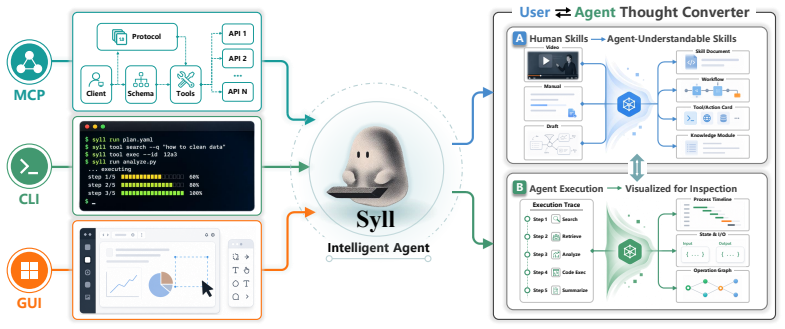
Syll compiles user demonstrations into reusable skills that execute and report back across APIs, CLI, and GUI surfaces.
A machine-rendered reading of the paper's core claim, the machinery that carries it, and where it could break.
Core claim
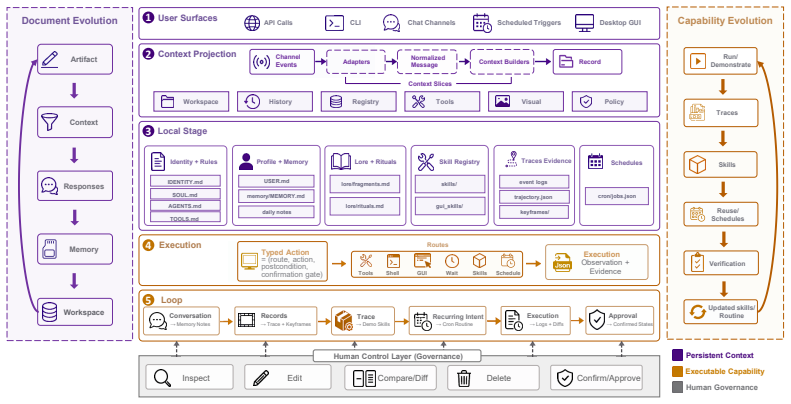
Syll centers on a bidirectional user-agent layer in which demonstrations compile into reusable skills for cross-surface execution while agent runs translate into multimodal evidence for inspection, with all components stored as persistent local artifacts that support direct editing and extension.
What carries the argument
The bidirectional user-agent interaction layer that compiles demonstrations into skills and converts executions into inspectable multimodal evidence.
If this is right
- Agents can coordinate actions that span APIs, shells, and GUIs in a single session.
- Users can extend or audit agent behavior by editing local skill and memory files directly.
- Execution traces become human-readable through combined logs, images, and approval points.
- The same harness supports both teaching new procedures and running them in production applications.
Where Pith is reading between the lines
- Shared local skill files could enable users to exchange automation routines without central servers.
- The approach may reduce reliance on separate agents specialized for each interface type.
- Persistent artifacts open the possibility of version control and collaborative editing of agent behaviors.
Load-bearing premise
Direct user demonstrations can be compiled into skills that execute correctly across different interfaces without needing extensive manual adjustments or debugging.
What would settle it
A demonstration recorded on one interface, such as a Photoshop workflow, fails to replay correctly on a similar but different interface or application without additional interface-specific code or repeated user fixes.
Figures
read the original abstract
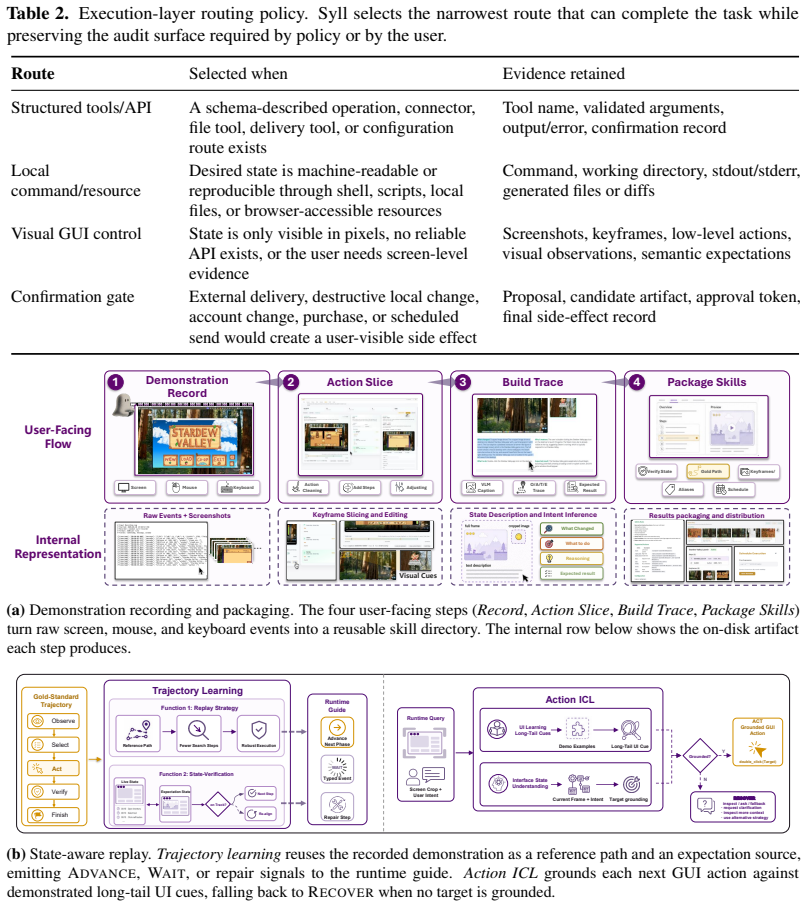
Personal AI agents must increasingly operate across APIs, shells, web surfaces, and desktop GUIs, yet many systems remain tuned to a single interface and offer limited support for user teaching and auditability. We present Syll, an open-source, self-hosted multimodal agent harness that unifies MCP/API tools, CLI execution, and visual GUI control in a modular runtime, enabling agents to coordinate computer use across heterogeneous interfaces while streamlining how users and agents exchange information. At the core of Syll is a bidirectional user-agent interaction layer: users teach procedures through direct demonstration, which Syll compiles into reusable skills; agent execution is translated back into multimodal evidence -- logs, keyframes, and approval checkpoints -- for inspection and control. Syll further externalizes memory, skills, routines, and governance as editable local artifacts, supporting straightforward inspection, extension, and downstream development. Our implementation has been validated on production desktop applications including Adobe Photoshop, Adobe Audition, Stardew Valley, macOS Finder and others. We report mechanism-oriented studies that validate multimodal routing, teachable GUI replay, and persistent local artifacts. We hope Syll can serve as a practical open-source foundation for personal automation that users can teach, inspect, and continuously extend.
Editorial analysis
A structured set of objections, weighed in public.
Referee Report
Summary. The manuscript presents Syll, an open-source self-hosted multimodal agent harness that unifies MCP/API tools, CLI execution, and visual GUI control. Its core contribution is a bidirectional user-agent interaction layer in which users teach procedures via direct demonstration (compiled into reusable skills) and agent executions are rendered back as multimodal evidence (logs, keyframes, approval checkpoints). The system externalizes memory, skills, routines, and governance as editable local artifacts. Validation is asserted on production desktop applications (Adobe Photoshop, Adobe Audition, Stardew Valley, macOS Finder, others) together with mechanism-oriented studies on multimodal routing, teachable GUI replay, and persistent local artifacts.
Significance. If the described bidirectional layer and cross-surface execution function reliably, Syll could provide a practical, inspectable, and extensible open-source foundation for personal automation agents. The open-source release and emphasis on local editable artifacts are concrete strengths that lower barriers to adoption and further development. However, the absence of any quantitative results, error analysis, or experimental detail in the manuscript substantially reduces the assessed significance of the work.
major comments (2)
- [Abstract] Abstract: the claim that the implementation 'has been validated on production desktop applications including Adobe Photoshop, Adobe Audition, Stardew Valley, macOS Finder and others' is load-bearing for the central assertion of reliable cross-surface execution, yet the manuscript supplies no success rates, failure modes, interface-specific adjustments, or experimental protocol.
- [Abstract] Abstract: the statement that 'mechanism-oriented studies that validate multimodal routing, teachable GUI replay, and persistent local artifacts' are reported is unsupported; no data, tables, figures, or analysis appear, leaving the weakest assumption (reliable compilation of demonstrations into reusable skills across heterogeneous interfaces) unexamined.
Simulated Author's Rebuttal
We thank the referee for the careful reading and constructive feedback on the abstract claims. We address each major comment below and will revise the manuscript accordingly to ensure all assertions are accurately supported by the presented content.
read point-by-point responses
-
Referee: [Abstract] Abstract: the claim that the implementation 'has been validated on production desktop applications including Adobe Photoshop, Adobe Audition, Stardew Valley, macOS Finder and others' is load-bearing for the central assertion of reliable cross-surface execution, yet the manuscript supplies no success rates, failure modes, interface-specific adjustments, or experimental protocol.
Authors: We agree that the abstract phrasing implies a level of empirical validation that the manuscript does not provide in quantitative form. The current text describes the system's application to those desktop environments through implementation examples and mechanism walkthroughs rather than controlled experiments. We will revise the abstract to replace 'has been validated on' with language such as 'has been exercised on' or 'demonstrated with' to accurately reflect the illustrative nature of the examples. No quantitative metrics will be added unless new material is introduced. revision: yes
-
Referee: [Abstract] Abstract: the statement that 'mechanism-oriented studies that validate multimodal routing, teachable GUI replay, and persistent local artifacts' are reported is unsupported; no data, tables, figures, or analysis appear, leaving the weakest assumption (reliable compilation of demonstrations into reusable skills across heterogeneous interfaces) unexamined.
Authors: The manuscript presents the design and implementation of multimodal routing, teachable GUI replay, and persistent local artifacts, including examples of their use, but does not contain formal studies, quantitative data, tables, or error analysis. The phrase 'mechanism-oriented studies that validate' overstates the content. We will revise the abstract to remove this phrasing and instead state that the manuscript describes the mechanisms for these features, without claiming validation through studies. revision: yes
Circularity Check
No significant circularity
full rationale
The paper is a direct system description of an open-source multimodal agent harness. It presents architecture, features (bidirectional teaching/execution layer, local artifacts), implementation details, and validation on specific applications without any mathematical derivations, equations, predictions, fitted parameters, or load-bearing self-citations. No steps reduce by construction to inputs; the central claims are architectural and empirical in nature, with the open-source implementation serving as primary evidence.
Axiom & Free-Parameter Ledger
Reference graph
Works this paper leans on
-
[1]
OSWorld-Human: Benchmarking the Efficiency of Computer-Use Agents
Reyna Abhyankar, Qi Qi, and Yiying Zhang. Osworld-human: Benchmarking the efficiency of computer-use agents.arXiv, abs/2506.16042, 2025
work page internal anchor Pith review Pith/arXiv arXiv 2025
-
[2]
Computer use tool
Anthropic. Computer use tool. https://docs.anthropic.com/en/docs/ build-with-claude/computer-use, 2026. Accessed 2026-04-24
2026
-
[3]
Eager: Programming repetitive tasks by example
Allen Cypher. Eager: Programming repetitive tasks by example. InProceedings of the SIGCHI conference on Human factors in computing systems, pages 33–39, 1991
1991
-
[4]
nanobot: An ultra-lightweight personal ai agent framework
HKUDS. nanobot: An ultra-lightweight personal ai agent framework. https://github. com/HKUDS/nanobot, 2026. Accessed 2026-04-29
2026
-
[5]
Measuring ai ability to complete long software tasks
Thomas Kwa, Ben West, Joel Becker, Amy Deng, Katharyn Garcia, Max Hasin, Sami Jawhar, Megan Kinniment, Nate Rush, Sydney V on Arx, et al. Measuring ai ability to complete long software tasks. InThe Thirty-ninth Annual Conference on Neural Information Processing Systems, 2025
2025
-
[6]
Coscripter: automating & sharing how-to knowledge in the enterprise
Gilly Leshed, Eben M Haber, Tara Matthews, and Tessa Lau. Coscripter: automating & sharing how-to knowledge in the enterprise. InProceedings of the SIGCHI Conference on Human Factors in Computing Systems, pages 1719–1728, 2008
2008
-
[7]
What is the model context protocol? https:// modelcontextprotocol.io/docs/getting-started/intro, 2026
Model Context Protocol. What is the model context protocol? https:// modelcontextprotocol.io/docs/getting-started/intro, 2026. Accessed 2026-04-24. 9
2026
-
[8]
Harness engineering: Leveraging codex in an agent-first world
OpenAI. Harness engineering: Leveraging codex in an agent-first world. https://openai. com/index/harness-engineering/, 2026. Published 2026-02-11, accessed 2026-04- 29
2026
-
[9]
OpenClaw: Open-source self-hosted ai agent framework
OpenClaw Contributors. OpenClaw: Open-source self-hosted ai agent framework. https: //github.com/openclaw/openclaw, 2025. Accessed 2026-04-29
2025
-
[10]
UI-TARS: Pioneering Automated GUI Interaction with Native Agents
Yujia Qin, Yining Ye, Junjie Fang, Haoming Wang, Shihao Liang, Shizuo Tian, Junda Zhang, Jiahao Li, Yunxin Li, Shijue Huang, et al. Ui-tars: Pioneering automated gui interaction with native agents.arXiv preprint arXiv:2501.12326, 2025
work page internal anchor Pith review Pith/arXiv arXiv 2025
-
[11]
Toolformer: Language models can teach themselves to use tools.Advances in neural information processing systems, 36: 68539–68551, 2023
Timo Schick, Jane Dwivedi-Yu, Roberto Dess`ı, Roberta Raileanu, Maria Lomeli, Eric Hambro, Luke Zettlemoyer, Nicola Cancedda, and Thomas Scialom. Toolformer: Language models can teach themselves to use tools.Advances in neural information processing systems, 36: 68539–68551, 2023
2023
-
[12]
Reflexion: Language agents with verbal reinforcement learning.Advances in neural information processing systems, 36:8634–8652, 2023
Noah Shinn, Federico Cassano, Ashwin Gopinath, Karthik Narasimhan, and Shunyu Yao. Reflexion: Language agents with verbal reinforcement learning.Advances in neural information processing systems, 36:8634–8652, 2023
2023
-
[13]
Osworld: Benchmarking multimodal agents for open-ended tasks in real computer environments.Advances in Neural Information Processing Systems, 37:52040–52094, 2024
Tianbao Xie, Danyang Zhang, Jixuan Chen, Xiaochuan Li, Siheng Zhao, Ruisheng Cao, Toh J Hua, Zhoujun Cheng, Dongchan Shin, Fangyu Lei, et al. Osworld: Benchmarking multimodal agents for open-ended tasks in real computer environments.Advances in Neural Information Processing Systems, 37:52040–52094, 2024
2024
-
[14]
Swe-agent: Agent-computer interfaces enable automated software engineering.Advances in Neural Information Processing Systems, 37:50528–50652, 2024
John Yang, Carlos E Jimenez, Alexander Wettig, Kilian Lieret, Shunyu Yao, Karthik Narasimhan, and Ofir Press. Swe-agent: Agent-computer interfaces enable automated software engineering.Advances in Neural Information Processing Systems, 37:50528–50652, 2024
2024
-
[15]
ReAct: Synergizing Reasoning and Acting in Language Models
Shunyu Yao, Jeffrey Zhao, Dian Yu, Nan Du, Izhak Shafran, Karthik Narasimhan, and Yuan Cao. React: Synergizing reasoning and acting in language models.arXiv preprint arXiv:2210.03629, 2022
work page internal anchor Pith review Pith/arXiv arXiv 2022
-
[16]
Sikuli: using gui screenshots for search and automation
Tom Yeh, Tsung-Hsiang Chang, and Robert C Miller. Sikuli: using gui screenshots for search and automation. InProceedings of the 22nd annual ACM symposium on User interface software and technology, pages 183–192, 2009
2009
-
[17]
Showui-aloha: Human-taught gui agent.arXiv preprint arXiv:2601.07181, 2026
Yichun Zhang, Xiangwu Guo, Yauhong Goh, Jessica Hu, Zhiheng Chen, Xin Wang, Difei Gao, and Mike Zheng Shou. Showui-aloha: Human-taught gui agent.arXiv preprint arXiv:2601.07181, 2026
-
[18]
Xu, Hao Zhu, Xuhui Zhou, Robert Lo, Abishek Sridhar, Xianyi Cheng, Yonatan Bisk, Daniel Fried, Uri Alon, and Graham Neubig
Shuyan Zhou, Frank F. Xu, Hao Zhu, Xuhui Zhou, Robert Lo, Abishek Sridhar, Xianyi Cheng, Yonatan Bisk, Daniel Fried, Uri Alon, and Graham Neubig. WebArena: A realistic web environment for building autonomous agents. InInternational Conference on Learning Representations, 2024. 10
2024
discussion (0)
Sign in with ORCID, Apple, or X to comment. Anyone can read and Pith papers without signing in.