REVIEW 1 minor 95 references
A purification of the steady state exactly encodes slow relaxation rates near dissipative first-order transitions when the Lindbladian has hidden time-reversal symmetry.
Reviewed by Pith at T0; open to challenge. T0 means a machine referee read the full paper against a public rubric. the ladder, T0–T4 →
T0 review · grok-4.3
2026-06-27 21:23 UTC pith:2WAKUEGY
load-bearing objection A conjecture that a purification of the NESS gives exact slow timescales near dissipative transitions in hidden time-reversal symmetric Lindbladians, checked numerically on two models.
Exact metastability in a class of driven-dissipative quantum many-body systems
The pith
A machine-rendered reading of the paper's core claim, the machinery that carries it, and where it could break.
Core claim
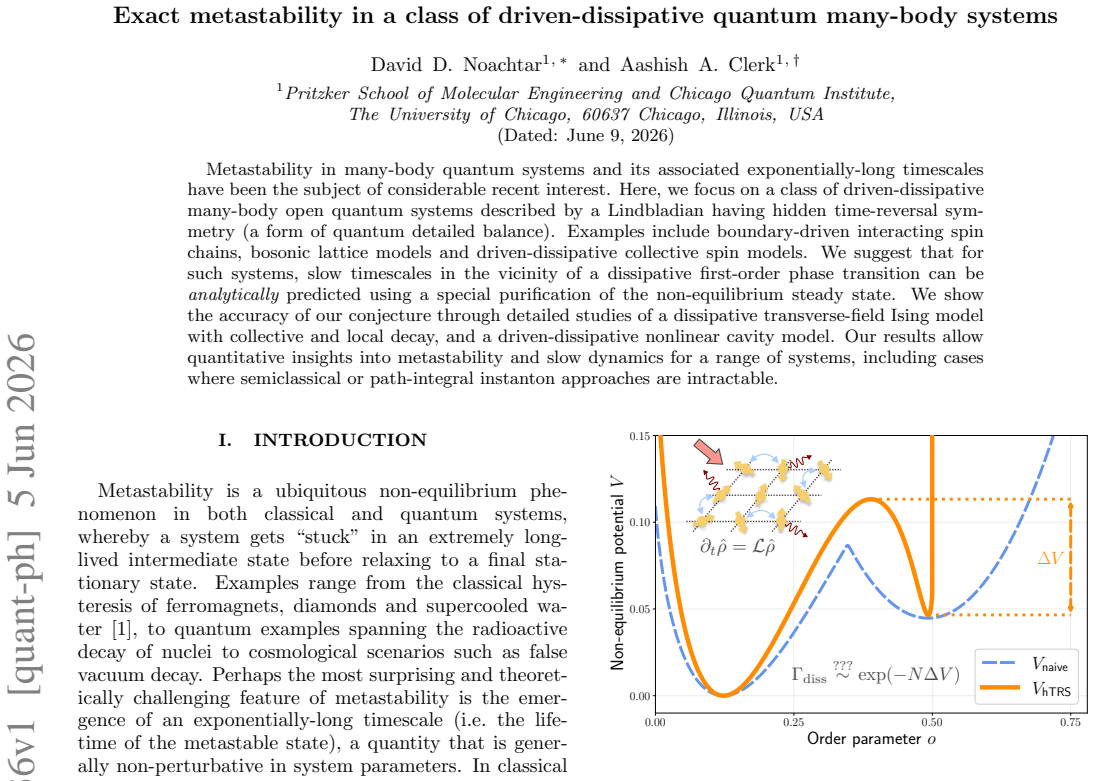
For Lindbladians that obey hidden time-reversal symmetry, a particular purification of the non-equilibrium steady state encodes the slow relaxation rate in the vicinity of a dissipative first-order phase transition, thereby furnishing an analytic prediction for the associated metastable lifetime.
What carries the argument
The special purification of the non-equilibrium steady state, which uses the hidden time-reversal symmetry to isolate the slow eigenvalue of the Liouvillian.
Load-bearing premise
Hidden time-reversal symmetry of the Lindbladian is enough to make the purification exactly encode the slow relaxation rate.
What would settle it
A direct numerical diagonalization or long-time simulation of the Liouvillian for the dissipative Ising chain near its first-order transition that yields a relaxation rate differing from the one extracted from the purified steady state would falsify the claim.
If this is right
- Metastable lifetimes in boundary-driven spin chains and bosonic lattices become available in closed form.
- Collective spin models admit quantitative metastability predictions without path-integral methods.
- The same purification supplies the slow timescale for any Lindbladian in the class that exhibits a dissipative first-order transition.
- Analytic access extends to parameter regimes where semiclassical approximations break down.
Where Pith is reading between the lines
- The purification technique may generalize to other discrete symmetries that allow an exact mapping between steady-state properties and slow modes.
- It could be used to design open-system Hamiltonians whose metastable lifetimes are tuned by choice of the steady-state purification.
- Numerical checks on larger system sizes would test whether the exactness persists beyond the models studied.
- The approach offers a route to connect metastability in open systems to equilibrium concepts of detailed balance.
Editorial analysis
A structured set of objections, weighed in public.
Referee Report
Summary. The paper conjectures that in a class of driven-dissipative quantum many-body systems whose Lindbladian possesses hidden time-reversal symmetry, the slow relaxation timescales near a dissipative first-order phase transition can be analytically predicted from a special purification of the non-equilibrium steady state. Accuracy of the conjecture is demonstrated via detailed numerical studies of the dissipative transverse-field Ising model (with collective and local decay) and a driven-dissipative nonlinear cavity model.
Significance. If the conjecture holds, the approach supplies a symmetry-based route to quantitative predictions of metastability timescales in open quantum systems where semiclassical or path-integral instanton methods are intractable. The numerical verification across two distinct models constitutes a concrete strength of the work.
minor comments (1)
- [Abstract] Abstract, paragraph 3: the phrase 'special purification' is introduced without a brief clarifying clause or reference; adding one sentence would improve immediate readability for readers outside the subfield.
Simulated Author's Rebuttal
We thank the referee for their positive summary of the manuscript, recognition of its significance, and recommendation for minor revision. We are pleased that the conjecture and its numerical support across two models are viewed favorably.
Circularity Check
No significant circularity identified
full rationale
The paper frames its core claim explicitly as a conjecture: hidden time-reversal symmetry of the Lindbladian permits a special purification of the NESS to encode slow relaxation rates near dissipative first-order transitions. This is tested numerically on two concrete models (dissipative TFIM and nonlinear cavity) rather than derived via any chain of equations that reduces the predicted timescale to a fitted parameter or self-citation by construction. No load-bearing self-citations, ansatz smuggling, or renaming of known results appear in the supplied text; the symmetry property is invoked as an independent assumption whose sufficiency is conjectured and then checked externally. The derivation therefore remains self-contained against external benchmarks and does not collapse to its inputs.
Axiom & Free-Parameter Ledger
read the original abstract
Metastability in many-body quantum systems and its associated exponentially-long timescales have been the subject of considerable recent interest. Here, we focus on a class of driven-dissipative many-body open quantum systems described by a Lindbladian having hidden time-reversal symmetry (a form of quantum detailed balance). Examples include boundary-driven interacting spin chains, bosonic lattice models and driven-dissipative collective spin models. We suggest that for such systems, slow timescales in the vicinity of a dissipative first-order phase transition can be analytically predicted using a special purification of the non-equilibrium steady state. We show the accuracy of our conjecture through detailed studies of a dissipative transverse-field Ising model with collective and local decay, and a driven-dissipative nonlinear cavity model. Our results allow quantitative insights into metastability and slow dynamics for a range of systems, including cases where semiclassical or path-integral instanton approaches are intractable.
Figures


Reference graph
Works this paper leans on
-
[1]
Analytic predictions for slow relaxation near the first-order dissipative phase transition We now return to our original goal: does the effective potential defined by the purification of our NESS predict slow-relaxation rates near a first-order DPT? As per our general conjecture, we can directly use the coefficientsψ k of the purified wavefunction to defi...
-
[2]
9 forN→ ∞
Analysis of the non-equilibrium effective potential and potential barrier Having established the validity of our analytic ap- proach, we now use it to develop insights into how the effective potential barrier (and hence metastability timescales) vary as we move through our phase diagram; results are shown in Fig. 9 forN→ ∞. We stress that even with permut...
-
[3]
We note that analytic techniques suitable for other dissipative spin models are not imme- diately applicable to our model
Alternate methods for obtaining slow rates Our results here provide (to the best of our knowledge) the first analytic predictions for the scaling of the dissipa- tive gap of the DTFIM. We note that analytic techniques suitable for other dissipative spin models are not imme- diately applicable to our model. In Ref. [23], metastable 8 The potential barrier ...
-
[4]
Langer, Annals of Physics54, 258 (1969)
J. Langer, Annals of Physics54, 258 (1969)
1969
-
[5]
H¨ anggi, P
P. H¨ anggi, P. Talkner, and M. Borkovec, Reviews of Modern Physics62, 251 (1990)
1990
-
[6]
C. Yin, F. M. Surace, and A. Lucas, Physical Review X 15, 011064 (2025)
2025
-
[7]
Ptaszy´ nski and M
K. Ptaszy´ nski and M. Esposito, Physical Review E110, 044134 (2024)
2024
-
[8]
D. C. Rose, K. Macieszczak, I. Lesanovsky, and J. P. Garrahan, Physical Review E94, 052132 (2016)
2016
-
[9]
N. Leppenen and E. Shahmoon, “Quantum bistability at the interplay between collective and individual decay,” 18 (2024), arXiv:2404.02134 [quant-ph] version: 1
-
[10]
Minganti, A
F. Minganti, A. Biella, N. Bartolo, and C. Ciuti, Physical Review A98, 042118 (2018)
2018
-
[11]
Switching Dynamics of Metastable Open Quantum Systems
Y.-X. Xiang, W. Li, Z. Bai, and Y.-Q. Ma, “Switch- ing Dynamics of Metastable Open Quantum Systems,” (2025), arXiv:2505.05202 [quant-ph]
work page internal anchor Pith review Pith/arXiv arXiv 2025
-
[12]
Gelhausen and M
J. Gelhausen and M. Buchhold, Physical Review A97, 023807 (2018)
2018
-
[13]
Q.-M. Chen, M. Fischer, Y. Nojiri, M. Renger, E. Xie, M. Partanen, S. Pogorzalek, K. G. Fedorov, A. Marx, F. Deppe, and R. Gross, Nature Communications14, 2896 (2023)
2023
-
[14]
Beaulieu, F
G. Beaulieu, F. Minganti, S. Frasca, V. Savona, S. Fe- licetti, R. Di Candia, and P. Scarlino, Nature Commu- nications16, 1954 (2025)
1954
-
[15]
Groszkowski, M
P. Groszkowski, M. Koppenh¨ ofer, H.-K. Lau, and A. Clerk, Physical Review X12, 011015 (2022)
2022
-
[16]
Building a fault-tolerant quantum computer using concatenated cat codes
C. Chamberland, K. Noh, P. Arrangoiz-Arriola, E. T. Campbell, C. T. Hann, J. Iverson, H. Putterman, T. C. Bohdanowicz, S. T. Flammia, A. Keller, G. Refael, J. Preskill, L. Jiang, A. H. Safavi-Naeini, O. Painter, and F. G. S. L. Brand˜ ao, PRX Quantum3, 010329 (2022), arXiv:2012.04108 [quant-ph]
work page Pith review arXiv 2022
-
[17]
Marthaler and M
M. Marthaler and M. I. Dykman, Physical Review A73, 042108 (2006)
2006
-
[18]
M. I. Dykman, Physical Review E75, 011101 (2007), publisher: American Physical Society
2007
-
[19]
C.-W. Lee, P. Brookes, K.-S. Park, M. H. Szyma´ nska, and E. Ginossar, Physical Review A112, 012216 (2025)
2025
-
[20]
Carde, R
L. Carde, R. Gautier, N. Didier, A. Petrescu, J. Cohen, and A. McDonald, Physical Review Letters136, 100402 (2026)
2026
-
[21]
T. Rakovszky, B. Placke, N. P. Breuckmann, and V. Khemani, “Bottlenecks in quantum channels and finite temperature phases of matter,” (2024), arXiv:2412.09598 [quant-ph]
-
[22]
Macieszczak, D
K. Macieszczak, D. C. Rose, I. Lesanovsky, and J. P. Garrahan, Physical Review Research3, 033047 (2021)
2021
-
[23]
Macieszczak, M
K. Macieszczak, M. Gut ¸˘ a, I. Lesanovsky, and J. P. Gar- rahan, Physical Review Letters116, 240404 (2016)
2016
-
[24]
Thompson and A
F. Thompson and A. Kamenev, Physical Review Re- search4, 023020 (2022)
2022
-
[25]
Qubit decoherence in dissipative two-photon resonator: real-time instantons and Wigner function,
V. Y. Mylnikov, S. O. Potashin, and A. Kamenev, “Qubit decoherence in dissipative two-photon resonator: real-time instantons and Wigner function,” (2025), arXiv:2512.10921 [quant-ph]
-
[26]
Quantum instanton approach to metastable collective spins
K. Ptaszynski, M. Chudak, and M. Esposito, “Quan- tum instanton approach to metastable collective spins,” (2026), arXiv:2604.15091 [quant-ph]
work page internal anchor Pith review Pith/arXiv arXiv 2026
-
[27]
Dutta, S
S. Dutta, S. Zhang, and M. Haque, Physical Review Letters134, 050407 (2025)
2025
-
[28]
Roberts, A
D. Roberts, A. Lingenfelter, and A. Clerk, PRX Quan- tum2, 020336 (2021), publisher: American Physical So- ciety
2021
-
[29]
M. Yao, A. Lingenfelter, R. Belyansky, D. Roberts, and A. A. Clerk, “Hidden time-reversal in driven XXZ spin chains: exact solutions and new dissipative phase transitions,” (2024), arXiv:2407.12750 [cond-mat, physics:quant-ph]
-
[30]
Lingenfelter, M
A. Lingenfelter, M. Yao, A. Pocklington, Y.-X. Wang, A. Irfan, W. Pfaff, and A. A. Clerk, Physical Review X 14, 021028 (2024)
2024
-
[31]
Roberts and A
D. Roberts and A. Clerk, Physical Review Letters130, 063601 (2023)
2023
-
[32]
A. Lingenfelter and A. A. Clerk, “Exact steady states of interacting driven dissipative fermionic systems with hid- den time-reversal symmetry,” (2026), arXiv:2605.10846 [quant-ph]
work page internal anchor Pith review Pith/arXiv arXiv 2026
-
[33]
Roberts and A
D. Roberts and A. Clerk, Physical Review Letters131, 190403 (2023), publisher: American Physical Society
2023
-
[34]
Timescales, Squeezing and Heisenberg Scal- ings in Many-Body Continuous Sensing,
G. Lee, R. Belyansky, L. Jiang, and A. A. Clerk, “Timescales, Squeezing and Heisenberg Scal- ings in Many-Body Continuous Sensing,” (2025), arXiv:2505.04591 [quant-ph]
-
[35]
D. Yang, S. F. Huelga, and M. B. Plenio, Physical Re- view X13, 031012 (2023)
2023
-
[36]
Godley and M
A. Godley and M. Guta, Quantum7, 973 (2023)
2023
-
[37]
F. Girotti, A. Godley, and M. Gut ¸˘ a, Quantum9, 1835 (2025), arXiv:2408.00626 [quant-ph]
-
[38]
Lindblad, Communications in Mathematical Physics 48, 119 (1976)
G. Lindblad, Communications in Mathematical Physics 48, 119 (1976)
1976
-
[39]
Gorini, A
V. Gorini, A. Kossakowski, and E. C. G. Sudarshan, Journal of Mathematical Physics17, 821 (1976)
1976
-
[40]
Fazio, J
R. Fazio, J. Keeling, L. Mazza, and M. Schir` o, SciPost Physics Lecture Notes , 099 (2025)
2025
-
[41]
Mori and T
T. Mori and T. Shirai, Physical Review Letters125, 230604 (2020)
2020
-
[42]
Z. Wang, Y. Lu, Y. Peng, R. Qi, Y. Wang, and J. Jie, Physical Review B108, 054313 (2023)
2023
-
[43]
G. Lee, A. McDonald, and A. Clerk, Physical Review B 108, 064311 (2023)
2023
-
[44]
Casteels, R
W. Casteels, R. Fazio, and C. Ciuti, Physical Review A 95, 012128 (2017)
2017
-
[45]
Critical slowing down in driven-dissipative Bose-Hubbard lattices
F. Vicentini, F. Minganti, R. Rota, G. Orso, and C. Ciuti, “Critical slowing down in driven-dissipative Bose-Hubbard lattices,” (2018), arXiv:1709.04238
work page internal anchor Pith review Pith/arXiv arXiv 2018
-
[46]
Marcuzzi, E
M. Marcuzzi, E. Levi, S. Diehl, J. P. Garrahan, and I. Lesanovsky, Physical Review Letters113, 210401 (2014), publisher: American Physical Society
2014
-
[47]
Roberts and A
D. Roberts and A. A. Clerk, Physical Review X10, 021022 (2020)
2020
-
[48]
Hanggi, H
P. Hanggi, H. Grabert, P. Talkner, and H. Thomas, Physical Review A29, 371 (1984), publisher: American Physical Society
1984
-
[49]
M. I. Freidlin and A. D. Wentzell,Random Perturba- tions of Dynamical Systems, Grundlehren der mathema- tischen Wissenschaften, Vol. 260 (Springer Berlin Heidel- berg, Berlin, Heidelberg, 2012)
2012
-
[50]
Kramers' law: Validity, derivations and generalisations
N. Berglund, “Kramers’ law: Validity, derivations and generalisations,” (2013), arXiv:1106.5799 [math]
work page internal anchor Pith review Pith/arXiv arXiv 2013
-
[51]
E. A. Carlen and J. Maas, Journal of Functional Analysis 273, 1810 (2017)
2017
-
[52]
Kossakowski, A
A. Kossakowski, A. Frigerio, V. Gorini, and M. Verri, Communications in Mathematical Physics57, 97 (1977)
1977
-
[53]
Fagnola and V
F. Fagnola and V. Umanit` a, Communications in Mathe- matical Physics298, 523 (2010)
2010
-
[54]
F. Fagnola and V. Umanit` a, Infinite Dimensional Anal- ysis, Quantum Probability and Related Topics (2012), 10.1142/S0219025707002762, publisher: World Scientific Publishing Company
-
[55]
R. Duvenhage, K. Oerder, and K. v. d. Heuvel, Quantum 9, 1743 (2025), arXiv:2411.02339 [quant-ph]
-
[56]
Stannigel, P
K. Stannigel, P. Rabl, and P. Zoller, New Journal of Physics14, 063014 (2012)
2012
-
[57]
Cabot, F
A. Cabot, F. Carollo, and I. Lesanovsky, Physical Re- view Letters132, 050801 (2024)
2024
-
[58]
H. J. Carmichael, Journal of Physics B: Atomic and Molecular Physics13, 3551 (1980). 19
1980
-
[59]
C. W. Gardiner, Physical Review Letters70, 2269 (1993)
1993
-
[60]
V. V. Albert and L. Jiang, Physical Review A89, 022118 (2014)
2014
-
[61]
Buˇ ca and T
B. Buˇ ca and T. Prosen, New Journal of Physics14, 073007 (2012)
2012
-
[62]
Switching rates in Kerr resonator with two-photon dissipation and driving,
V. Y. Mylnikov, S. O. Potashin, M. S. Ukhtary, and G. S. Sokolovskii, “Switching rates in Kerr resonator with two-photon dissipation and driving,” (2025), arXiv:2511.13308 [quant-ph]
-
[63]
Marcuzzi, J
M. Marcuzzi, J. Schick, B. Olmos, and I. Lesanovsky, Journal of Physics A: Mathematical and Theoretical47, 482001 (2014)
2014
-
[64]
Tucker, D
K. Tucker, D. Barberena, R. J. Lewis-Swan, J. K. Thompson, J. G. Restrepo, and A. M. Rey, Physical Review A102, 051701 (2020)
2020
-
[65]
D. Barberena, “Generalized Holstein-Primakoff mapping and$1/N$expansion of collective spin systems undergo- ing single particle dissipation,” (2025), arXiv:2508.05751 [quant-ph]
-
[66]
E. Y. Song, D. Barberena, D. J. Young, E. Chaparro, A. Chu, S. Agarwal, Z. Niu, J. T. Young, A. M. Rey, and J. K. Thompson, Science Advances11, eadu5799 (2025), publisher: American Association for the Advancement of Science
2025
-
[67]
Koppenh¨ ofer and A
M. Koppenh¨ ofer and A. A. Clerk, Physical Review Re- search5, 043279 (2023)
2023
-
[68]
Breakdown of steady-state superradiance in ex- tended driven atomic arrays,
S. Ostermann, O. Rubies-Bigorda, V. Zhang, and S. F. Yelin, “Breakdown of steady-state superradiance in ex- tended driven atomic arrays,” (2023), arXiv:2311.10824 [quant-ph]
-
[69]
D. A. Paz and M. F. Maghrebi, Physical Review A104, 023713 (2021), publisher: American Physical Society
2021
-
[70]
L. A. Lugiato, Contemporary Physics24, 333 (1983)
1983
-
[71]
Bonifacio, M
R. Bonifacio, M. Gronchi, and L. A. Lugiato, Physical Review A18, 2266 (1978)
1978
-
[72]
P. D. Drummond and D. F. Walls, Journal of Physics A: Mathematical and General13, 725 (1980)
1980
-
[73]
Puri and S
R. Puri and S. Lawande, Physics Letters A72, 200 (1979)
1979
-
[74]
Agarwal, E
S. Agarwal, E. Chaparro, D. Barberena, A. P. Orioli, G. Ferioli, S. Pancaldi, I. Ferrier-Barbut, A. Browaeys, and A. Rey, PRX Quantum5, 040335 (2024)
2024
-
[75]
Iemini, A
F. Iemini, A. Russomanno, J. Keeling, M. Schir` o, M. Dal- monte, and R. Fazio, Physical Review Letters121, 035301 (2018), publisher: American Physical Society
2018
-
[76]
Marcuzzi, E
M. Marcuzzi, E. Levi, W. Li, J. P. Garrahan, B. Olmos, and I. Lesanovsky, New Journal of Physics17, 072003 (2015)
2015
-
[77]
G. Ferioli, A. Glicenstein, I. Ferrier-Barbut, and A. Browaeys, Nature Physics19, 1345 (2023), arXiv:2207.10361 [quant-ph]
-
[78]
B. A. Chase and J. M. Geremia, Physical Review A78, 052101 (2008)
2008
-
[79]
Shammah, S
N. Shammah, S. Ahmed, N. Lambert, S. De Liberato, and F. Nori, Physical Review A98, 063815 (2018)
2018
-
[80]
Hartmann, Quantum Information and Computation 16, 1333 (2016)
S. Hartmann, Quantum Information and Computation 16, 1333 (2016)
2016
discussion (0)
Sign in with ORCID, Apple, or X to comment. Anyone can read and Pith papers without signing in.