REVIEW 3 major objections 2 minor 14 references
GRPO Does Not Close the Multi-Agent Coordination Gap
T0 review · 3 major / 2 minor · reviewed 2026-06-27 · grok-4.3
Pith's one-line read GRPO applied to task rollouts does not close the multi-agent coordination gap in LLMs
desk verdict GRPO shows no gain on this task but the degenerate reward undercuts what that means for coordination. read the letter →
The pith
A machine-rendered reading of the paper's core claim, the machinery that carries it, and where it could break.
The reading
What carries the argument
The dining philosophers problem as a test bed for multi-agent coordination, evaluated with a four-term reward function before and after GRPO training on task rollouts.
What would settle it
A replication that applies GRPO with a modified reward preventing zero-action maxima and records a statistically significant reward increase on the same philosopher counts.
Extended reading notes
Core claim
GRPO on rollouts from the dining philosophers task yields no statistically significant increase in per-episode reward for 8B and 14B models at five, ten, or fifteen philosophers. A Welch's t-test at five philosophers gives p = 0.66 and Hedges' g of -0.11. Training reward for both sizes peaks at step nine and declines by the default step-15 checkpoint. The four-term reward admits a degenerate maximum at zero actions, which some models reach with mean reward near 1.0 while serving zero meals.
Load-bearing premise
The four-term reward function faithfully measures coordination quality rather than allowing a high score from the degenerate choice of taking no actions.
Editorial extensions
If this is right
- GRPO produces no statistically significant change in per-episode reward at five, ten, or fifteen philosophers.
- Training reward for both 8B and 14B models peaks at step nine and declines by step fifteen.
- High reward values can be reached with zero meals served, indicating a degenerate solution.
- The bottleneck for open-weight 14B models is training methodology rather than compute.
Reading between the lines
- A reward that explicitly subtracts for inaction could allow GRPO to produce coordination gains.
- Training on a curriculum that increases the number of philosophers gradually might reduce the scaling problem.
- The same reward and checkpoint issues may limit GRPO on other multi-agent benchmarks.
Signed reviews
Editorial analysis
A structured set of objections, weighed in public.
Referee Report
Summary. The paper evaluates LLMs on multi-agent coordination via the dining philosophers problem across 630 episodes with seven models and three philosopher counts. Frontier closed-source models achieve mean rewards 0.45–0.87 while Mistral-Small reaches 0.83–0.99 and Qwen3-14B reaches 0.13–0.35. It then applies GRPO on task rollouts and reports no statistically significant improvement (Welch t-test p=0.66, Hedges’ g=-0.11 at five philosophers; similar at ten and fifteen). The paper notes that training rewards peak at step nine then decline and that the four-term reward admits a degenerate maximum at zero actions (reached by some models at zero meals served). It concludes that the bottleneck for open-weight models is reward shaping and checkpoint discipline rather than compute.
Significance. If the central empirical result holds after addressing the reward issue, the work supplies a clean, reproducible test-bed for multi-agent coordination, per-episode statistics, effect sizes, and explicit acknowledgment of a degenerate reward maximum. These elements provide a useful negative result on GRPO and point toward concrete methodological improvements (reward shaping, curriculum, checkpoint selection) that future work can build on.
major comments (3)
- [Abstract and reward-function description] The four-term reward (explicitly described in the abstract) reaches its global maximum when all agents output zero actions, yielding reward 1.0 for DeepSeek-R1-Distill-Qwen-7B and 0.83 for Mistral-Small at five philosophers with zero meals served. Because both the GRPO-trained and baseline policies may lie near this attractive fixed point, the reported non-significant difference (p=0.66, g=-0.11) does not yet demonstrate that coordination is unlearnable under GRPO; it only shows that the chosen scalarization does not penalize inaction.
- [GRPO training results and checkpoint selection] The training curves for the 8B and 14B GRPO runs peak at step nine and then decline, so the default checkpoint saved at step 15 is strictly inferior to several earlier checkpoints. This choice of final checkpoint directly affects the comparison used to support the claim that GRPO cannot close the coordination gap.
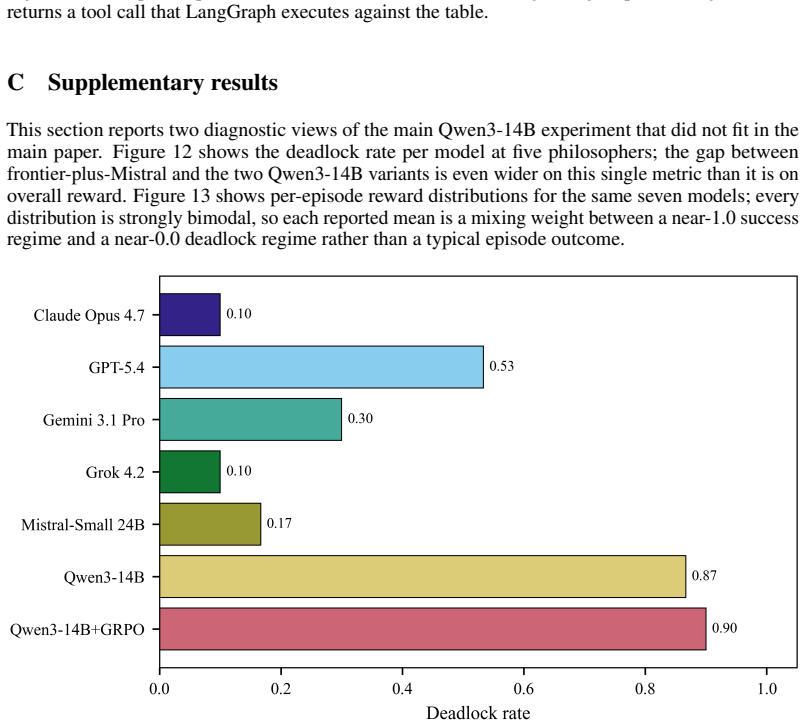
- [Evaluation protocol and results tables] The central claim that GRPO does not close the gap rests on per-episode reward as the primary measure of coordination quality. Because the reward admits a degenerate maximum at the no-op policy, the manuscript should report auxiliary metrics (meals served, deadlock rate, or action entropy) for both baseline and GRPO runs to confirm that high-reward trajectories actually reflect coordination rather than inaction.
minor comments (2)
- [Abstract] The abstract refers to “four frontier closed-source systems” without naming them; listing the exact models would improve reproducibility and context.
- [Methods and results] Ensure every reported statistical test is accompanied by the exact sample size (number of episodes) and the precise definition of the reward terms so readers can replicate the degenerate-maximum observation.
Simulated Author's Rebuttal
We thank the referee for the careful and constructive review. We agree that the reward degeneracy and checkpoint selection warrant further clarification and auxiliary metrics, which we will incorporate. Our responses below address each major comment directly while preserving the manuscript's reported findings.
read point-by-point responses
-
Referee: [Abstract and reward-function description] The four-term reward (explicitly described in the abstract) reaches its global maximum when all agents output zero actions, yielding reward 1.0 for DeepSeek-R1-Distill-Qwen-7B and 0.83 for Mistral-Small at five philosophers with zero meals served. Because both the GRPO-trained and baseline policies may lie near this attractive fixed point, the reported non-significant difference (p=0.66, g=-0.11) does not yet demonstrate that coordination is unlearnable under GRPO; it only shows that the chosen scalarization does not penalize inaction.
Authors: We thank the referee for this point. The manuscript already explicitly states that the four-term reward admits a degenerate maximum at zero actions, with the cited models achieving the reported rewards at zero meals served. The central empirical finding is that GRPO produces no statistically significant improvement over baseline under this reward; the conclusion frames this as evidence that reward shaping (rather than compute) is the bottleneck. We will revise the abstract and discussion to more explicitly caveat that the result is tied to the current scalarization and does not claim coordination is unlearnable under GRPO with improved rewards. revision: partial
-
Referee: [GRPO training results and checkpoint selection] The training curves for the 8B and 14B GRPO runs peak at step nine and then decline, so the default checkpoint saved at step 15 is strictly inferior to several earlier checkpoints. This choice of final checkpoint directly affects the comparison used to support the claim that GRPO cannot close the coordination gap.
Authors: The manuscript already reports that training reward peaked at step nine and declined, explicitly noting that the default checkpoint at step 15 is inferior to earlier ones. The default was used to reflect standard practice without post-hoc selection. We will add results from the best checkpoint (step nine) alongside the default in the revised results section and discuss implications for checkpoint discipline. revision: yes
-
Referee: [Evaluation protocol and results tables] The central claim that GRPO does not close the gap rests on per-episode reward as the primary measure of coordination quality. Because the reward admits a degenerate maximum at the no-op policy, the manuscript should report auxiliary metrics (meals served, deadlock rate, or action entropy) for both baseline and GRPO runs to confirm that high-reward trajectories actually reflect coordination rather than inaction.
Authors: We agree that auxiliary metrics are required to interpret results given the reward structure. The manuscript already notes zero meals served for the high-reward no-op cases. We will expand the evaluation tables to report meals served, deadlock rate, and action entropy for both baseline and GRPO runs across all philosopher counts. revision: yes
Circularity Check
No significant circularity; empirical measurement against external task
full rationale
The paper reports experimental results from running LLMs on the dining philosophers task, computing per-episode rewards, applying GRPO training, and performing Welch's t-tests on the resulting data. No mathematical derivation, uniqueness theorem, or fitted parameter is presented whose output is defined in terms of itself or reduced to a self-citation chain. The reward function is explicitly defined and its degenerate maximum is acknowledged in the text, but the central statistical claim (p=0.66, g=-0.11) is a direct comparison of observed rollout values rather than a quantity forced by construction. The analysis is therefore self-contained against the external benchmark of task performance.
Assumptions & free parameters
Cite this review
Pith. "Pith review of GRPO Does Not Close the Multi-Agent Coordination Gap." pith.science (2026). https://pith.science/paper/T5C6SRQJ
@misc{pith2026260607845,
  author       = {Pith},
  title        = {Pith review of: GRPO Does Not Close the Multi-Agent Coordination Gap},
  year         = {2026},
  howpublished = {\url{https://pith.science/paper/T5C6SRQJ}},
  note         = {Machine review of arXiv:2606.07845}
}
read the original abstract
We measure how well current large language models coordinate as multiple agents sharing a common resource, using the dining philosophers problem as a clean test bed. Across 630 episodes spanning seven models and three philosopher counts, four frontier closed-source systems reach mean reward 0.45 to 0.87 and Mistral-Small 24B reaches 0.83 to 0.99, while Qwen3-14B reaches 0.13 to 0.35. We then ask whether group relative policy optimization (GRPO) on rollouts from the task itself can close the gap and find that it cannot: a Welch's t-test on per-episode reward at five philosophers gives p = 0.66 and a Hedges' g of -0.11, with no statistically significant change at ten or fifteen philosophers either. Two further observations qualify the result. The training reward of both 8B and 14B runs peaked at step nine and then declined, so the default saved checkpoint at step 15 is strictly worse than several earlier ones. The four-term reward we use admits a degenerate maximum at zero actions, which DeepSeek-R1-Distill-Qwen-7B and Mistral-Small 24B at five philosophers both inhabit, with mean reward 1.0 and 0.83 respectively at zero meals. The bottleneck for an open-weight 14B model on multi-agent coordination is not training compute but training methodology: reward shaping that does not collapse to a no-action maximum, checkpoint discipline that does not depend on the final step, and curriculum across problem scales.
Figures


Figures from the paper (11 more)




Reference graph
Works this paper leans on
-
[1]
Constitutional AI: Harmlessness from AI Feedback
Yuntao Bai, Saurav Kadavath, Sandipan Kundu, Amanda Askell, Jackson Kernion, Andy Jones, Anna Chen, Anna Goldie, Azalia Mirhoseini, Cameron McKinnon, Carol Chen, Catherine Olsson, Christopher Olah, Danny Hernandez, Dawn Drain, Deep Ganguli, Dustin Li, Eli Tran-Johnson, Ethan Perez, Jamie Kerr, et al. Constitutional AI: Harmlessness from AI feedback.arXiv ...
-
[2]
DeepSeek-R1: Incentivizing Reasoning Capability in LLMs via Reinforcement Learning
DeepSeek-AI. DeepSeek-R1: Incentivizing reasoning capability in LLMs via reinforcement learning. arXiv preprint arXiv:2501.12948,
-
[3]
Yilun Du, Shuang Li, Antonio Torralba, Joshua B
doi: 10.1007/BF00289519. Yilun Du, Shuang Li, Antonio Torralba, Joshua B. Tenenbaum, and Igor Mordatch. Improving factuality and reasoning in language models through multiagent debate. InInternational Conference on Machine Learning (ICML),
-
[4]
Aaron Grattafiori et al. The Llama 3 herd of models.arXiv preprint arXiv:2407.21783,
-
[5]
URL https://openreview.net/forum?id= nZeVKeeFYf9. 9 Albert Q. Jiang, Alexandre Sablayrolles, Arthur Mensch, Chris Bamford, Devendra Singh Chaplot, Diego de las Casas, Florian Bressand, Gianna Lengyel, Guillaume Lample, Lucile Saulnier, Lélio Renard Lavaud, Marie-Anne Lachaux, Pierre Stock, Teven Le Scao, Thibaut Lavril, Thomas Wang, Timothée Lacroix, and ...
-
[6]
Efficient memory management for large language model serving with pagedattention,
doi: 10.1145/3600006.3613165. Leslie Lamport. Time, clocks, and the ordering of events in a distributed system.Communications of the ACM, 21(7):558–565,
-
[7]
Time, clocks, and the ordering of events in a distributed system
doi: 10.1145/359545.359563. Guohao Li, Hasan Abed Al Kader Hammoud, Hani Itani, Dmitrii Khizbullin, and Bernard Ghanem. CAMEL: Communicative agents for “mind” exploration of large language model society. In Advances in Neural Information Processing Systems (NeurIPS),
-
[8]
Grégoire Mialon, Clémentine Fourrier, Craig Swift, Thomas Wolf, Yann LeCun, and Thomas Scialom
doi: 10.1126/science.ade9097. Grégoire Mialon, Clémentine Fourrier, Craig Swift, Thomas Wolf, Yann LeCun, and Thomas Scialom. GAIA: a benchmark for general AI assistants. InInternational Conference on Learning Representations (ICLR),
Show all 14 references
-
[9]
Rafael Rafailov, Archit Sharma, Eric Mitchell, Stefano Ermon, Christopher D
doi: 10.1145/3586183.3606763. Rafael Rafailov, Archit Sharma, Eric Mitchell, Stefano Ermon, Christopher D. Manning, and Chelsea Finn. Direct preference optimization: Your language model is secretly a reward model. InAdvances in Neural Information Processing Systems (NeurIPS),
-
[10]
Proximal policy optimization algorithms.arXiv preprint arXiv:1707.06347,
10 John Schulman, Filip Wolski, Prafulla Dhariwal, Alec Radford, and Oleg Klimov. Proximal policy optimization algorithms.arXiv preprint arXiv:1707.06347,
-
[11]
Zhihong Shao, Peiyi Wang, Qihao Zhu, Runxin Xu, Junxiao Song, Xiao Bi, Haowei Zhang, Mingchuan Zhang, Y . K. Li, Y . Wu, and Daya Guo. DeepSeekMath: Pushing the limits of mathematical reasoning in open language models.arXiv preprint arXiv:2402.03300,
-
[12]
V oyager: An open-ended embodied agent with large language models.arXiv preprint arXiv:2305.16291, 2023a
Guanzhi Wang, Yuqi Xie, Yunfan Jiang, Ajay Mandlekar, Chaowei Xiao, Yuke Zhu, Linxi Fan, and Anima Anandkumar. V oyager: An open-ended embodied agent with large language models.arXiv preprint arXiv:2305.16291, 2023a. Lei Wang, Wanyu Xu, Yihuai Lan, Zhiqiang Hu, Yunshi Lan, Roy...
-
[13]
Qwen3 technical report
An Yang, Anfeng Li, Baosong Yang, Beichen Zhang, Binyuan Hui, Bo Zheng, Bowen Yu, Chang Gao, Chengen Huang, Chenxu Lv, Chujie Zheng, Dayiheng Liu, et al. Qwen3 technical report. arXiv preprint arXiv:2505.09388,
-
[14]
We run for sixteen steps total
with default β1, β2. We run for sixteen steps total. The LoRA adapter has rank r= 8 . Rollouts are collected atN= 5philosophers and 5 rounds per episode. Reward weights.Equation 1 uses α= 1.0 , β= 0.5 , γ= 0.3 , δ= 0.1 . These are the values used during training and during all...
Reviewed June 27, 2026 · model on record in the stance chip above.
Discussion (0). Continue with ORCID to comment.