Modern Time-Series and Spectral Methods for Analyzing Solar and Stellar Oscillatory Signals
Pith reviewed 2026-06-27 19:44 UTC · model grok-4.3
The pith
Synthetic benchmarks of spectral methods yield guidelines for choosing analysis techniques suited to solar and stellar oscillation signals.
A machine-rendered reading of the paper's core claim, the machinery that carries it, and where it could break.
Core claim
Comparative tests on synthetic benchmarks demonstrate that method performance depends on signal stationarity, sampling regularity, and noise characteristics, and these results are distilled into practical guidelines for selecting appropriate techniques when analyzing solar and stellar oscillatory signals.
What carries the argument
Comparative analysis of methods on synthetic benchmarks that vary stationarity, sampling regularity, and noise characteristics.
Load-bearing premise
Performance differences measured on the chosen synthetic benchmarks will carry over directly to real solar and stellar observations that contain additional unmodeled effects such as instrumental artifacts.
What would settle it
Apply the recommended method-selection rules to a collection of real solar or stellar time series whose oscillation frequencies and amplitudes are already known from independent measurements, and verify whether the guidelines produce more accurate recoveries than the non-recommended alternatives.
Figures
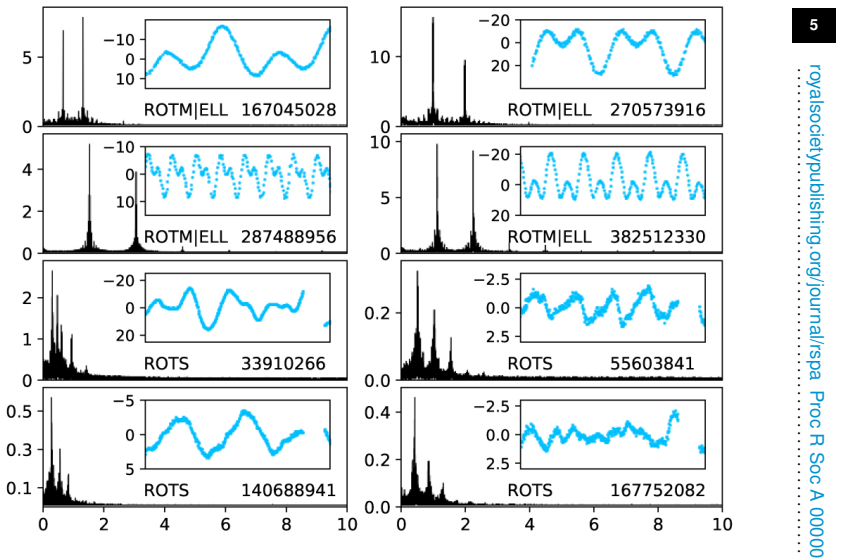
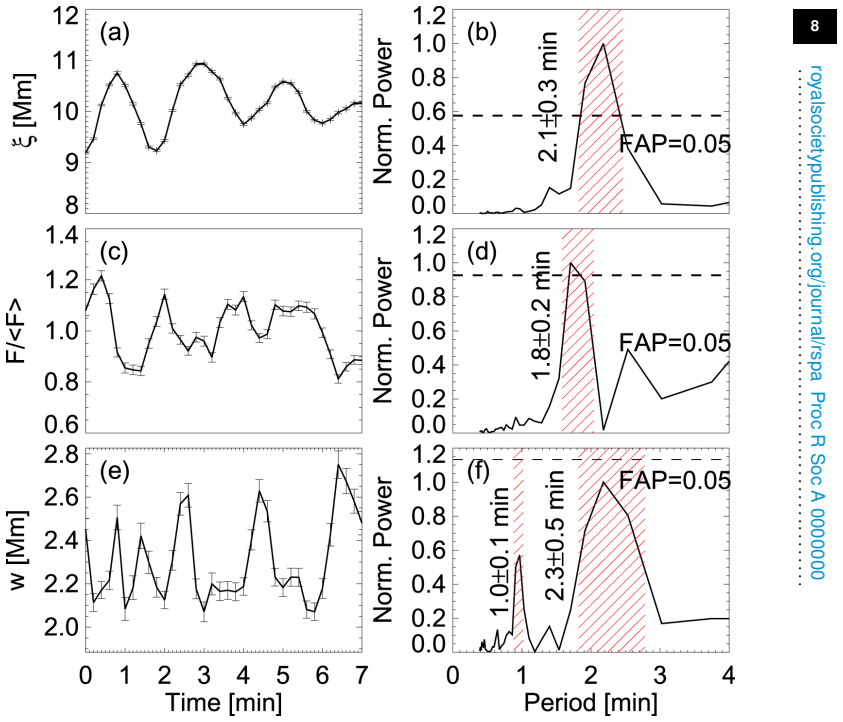
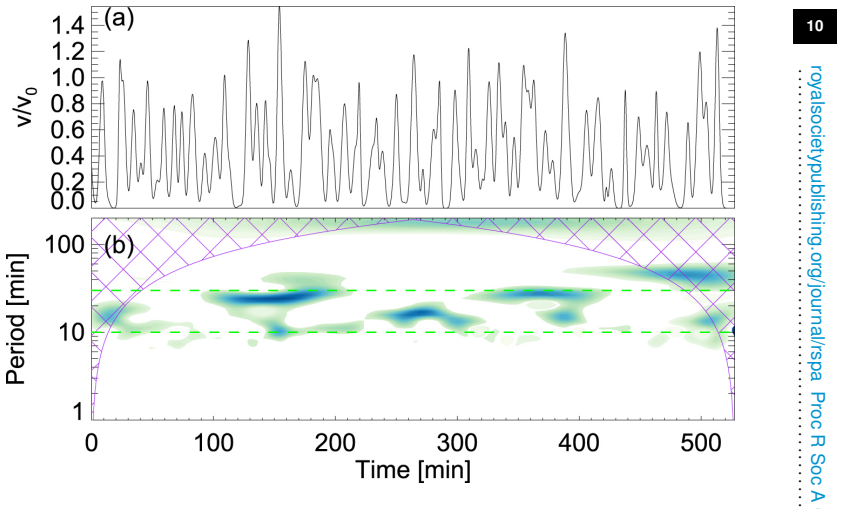
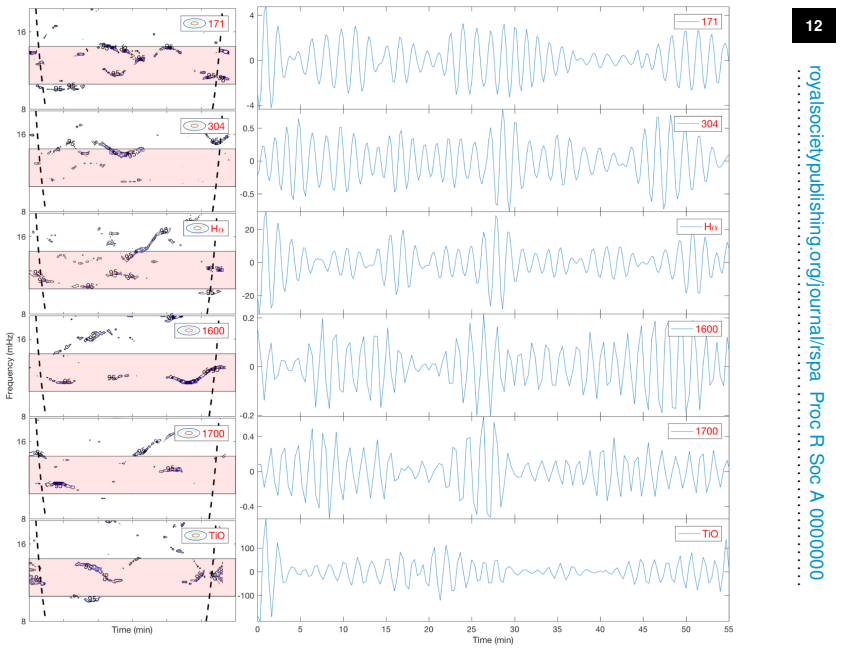
read the original abstract
Time-series analysis plays a central role in understanding oscillatory and wave phenomena in solar and stellar atmospheres. However, astrophysical observations are inherently affected by instrumental noise, non-stationary dynamics, and uneven sampling. This review provides a comprehensive overview and comparative analysis of principal methods for detecting and characterizing periodicities in solar and stellar signals. We cover Fourier-transform-based transforms, nonlinear-fitting-based methods (Lomb--Scargle periodogram), time-frequency methods (wavelet and synchrosqueezed transforms), and adaptive decomposition techniques (Empirical Mode Decomposition). Advanced statistical significance tests, including false-alarm probability, autoregressive models, and Bayesian Markov Chain Monte Carlo (MCMC) approaches, are discussed their practical limitations and misuse risks. Through comparative analysis using synthetic benchmarks, we provide guidelines for selecting methods based on signal stationarity, sampling regularity, and noise characteristics. Finally, we outline future directions that integrate Bayesian inference with time-frequency analysis to achieve both statistical rigor and temporal localization in studying non-stationary solar and stellar oscillations.
Editorial analysis
A structured set of objections, weighed in public.
Referee Report
Summary. The manuscript reviews principal methods for detecting and characterizing periodicities in solar and stellar oscillatory signals, including Fourier-transform-based approaches, the Lomb-Scargle periodogram, wavelet and synchrosqueezed transforms, Empirical Mode Decomposition, and statistical significance tests (false-alarm probability, autoregressive models, Bayesian MCMC). It presents a comparative analysis on synthetic benchmarks to derive guidelines for method selection according to signal stationarity, sampling regularity, and noise characteristics, and outlines future directions integrating Bayesian inference with time-frequency methods.
Significance. A rigorously supported set of selection guidelines grounded in quantitative synthetic benchmarks could offer practical utility to the solar/stellar community for handling non-stationary and unevenly sampled data. The review nature of the work limits its novelty, but clear documentation of benchmark performance metrics and explicit discussion of generalization limits would strengthen its value as a reference.
major comments (2)
- [Abstract / comparative analysis] Abstract and the comparative-analysis section: the central claim that actionable guidelines are provided 'through comparative analysis using synthetic benchmarks' is load-bearing for the paper's contribution, yet no quantitative results (detection rates, false-alarm rates, error metrics), specific benchmark parameters, or tables of performance comparisons are described; without these the guidelines cannot be evaluated.
- [Guidelines / future directions] Guidelines section: the assumption that relative performance differences observed on the synthetic suite will hold for real solar/stellar observations is not tested or qualified; real data routinely contain additional effects (instrumental systematics, irregular gaps, correlated noise, multi-scale non-stationarity) whose impact on method ranking is left unaddressed.
minor comments (1)
- The abstract states that statistical tests are discussed 'their practical limitations and misuse risks' but the corresponding section should explicitly balance limitations for every method covered, not only the significance tests.
Simulated Author's Rebuttal
We thank the referee for the constructive feedback. The comments highlight opportunities to strengthen the quantitative presentation of our benchmarks and to qualify the scope of the derived guidelines. We address each point below and will incorporate revisions in the next version of the manuscript.
read point-by-point responses
-
Referee: [Abstract / comparative analysis] Abstract and the comparative-analysis section: the central claim that actionable guidelines are provided 'through comparative analysis using synthetic benchmarks' is load-bearing for the paper's contribution, yet no quantitative results (detection rates, false-alarm rates, error metrics), specific benchmark parameters, or tables of performance comparisons are described; without these the guidelines cannot be evaluated.
Authors: We acknowledge that the current manuscript presents the comparative analysis and resulting guidelines in descriptive form without tabulating explicit performance metrics or benchmark parameters. This limits the ability of readers to independently evaluate the strength of the claims. In revision we will add a new table (and accompanying text) that reports the specific synthetic benchmark parameters together with quantitative metrics such as detection rates, false-alarm rates, and reconstruction error for each method under the tested conditions of stationarity, sampling regularity, and noise level. revision: yes
-
Referee: [Guidelines / future directions] Guidelines section: the assumption that relative performance differences observed on the synthetic suite will hold for real solar/stellar observations is not tested or qualified; real data routinely contain additional effects (instrumental systematics, irregular gaps, correlated noise, multi-scale non-stationarity) whose impact on method ranking is left unaddressed.
Authors: The referee is correct that the manuscript does not explicitly test or discuss how additional real-data complications (instrumental systematics, irregular gaps beyond the synthetic sampling, correlated noise, or multi-scale non-stationarity) might alter the relative performance rankings obtained from the controlled synthetic suite. We will revise the guidelines section to include a dedicated paragraph that qualifies the applicability of the synthetic results, notes these untested effects, and recommends case-by-case validation when applying the guidelines to actual observations. revision: yes
Circularity Check
No circularity; review and benchmark comparison with no load-bearing derivations or self-referential predictions
full rationale
The paper is explicitly a review synthesizing existing methods (Fourier, Lomb-Scargle, wavelets, EMD, statistical tests) and reporting comparative results on synthetic benchmarks to produce selection guidelines. No equations, parameter fits, uniqueness theorems, or predictions are derived that reduce to the paper's own inputs by construction. The benchmark-based guidelines are an empirical output, not a closed-loop renaming or self-definition. Self-citations, if present, are not load-bearing for any central claim. This matches the default non-circular case for a synthesis paper.
Axiom & Free-Parameter Ledger
Reference graph
Works this paper leans on
-
[1]
Stochastic transients as a source of quasi-periodic processes in the solar atmosphere
doi:10.3847/0067-0049/224/2/30 , eid =. arXiv , author =:1603.08977 , journal =
work page internal anchor Pith review Pith/arXiv arXiv doi:10.3847/0067-0049/224/2/30
-
[2]
Philosophical Transactions of the Royal Society of London Series A , keywords =
Philosophical Transactions of the Royal Society of London Series A , keywords =. doi:10.1098/rsta.2011.0640 , eprint =
-
[3]
doi:10.1007/s11207-015-0691-2 , eprint =
, keywords =. doi:10.1007/s11207-015-0691-2 , eprint =
-
[4]
Significance testing for quasi-periodic pulsations in solar and stellar flares
doi:10.1051/0004-6361/201730595 , eid =. arXiv , author =:1703.07294 , journal =
work page internal anchor Pith review Pith/arXiv arXiv doi:10.1051/0004-6361/201730595
-
[5]
Ensemble empirical mode decomposition: a noise-assisted data analysis method , volume =
Wu, Zhaohua and Huang, Norden E , journal =. Ensemble empirical mode decomposition: a noise-assisted data analysis method , volume =
-
[6]
Multivariate empirical mode decomposition , volume =
Rehman, Naveed and Mandic, Danilo P , journal =. Multivariate empirical mode decomposition , volume =
-
[7]
A complete ensemble empirical mode decomposition with adaptive noise , year =
Torres, Mar. A complete ensemble empirical mode decomposition with adaptive noise , year =. 2011 IEEE international conference on acoustics, speech and signal processing (ICASSP) , organization =
2011
-
[8]
arXiv , author =:2406.12578 , journal =
doi:10.1051/0004-6361/202450711 , eid =. arXiv , author =:2406.12578 , journal =
-
[9]
Forward Modelling of Standing Kink Modes in Coronal Loops II. Applications
doi:10.3847/0067-0049/223/2/24 , eid =. arXiv , author =:1602.07598 , journal =
work page internal anchor Pith review Pith/arXiv arXiv doi:10.3847/0067-0049/223/2/24
-
[10]
arXiv , author =:2403.10392 , journal =
doi:10.3847/1538-4357/ad36ca , eid =. arXiv , author =:2403.10392 , journal =
-
[11]
doi:10.1007/s11214-009-9536-3 , journal =
-
[12]
doi:10.1007/BF00733425 , journal =
-
[13]
doi:10.1088/2041-8205/713/2/L79 , eprint =
, keywords =. doi:10.1088/2041-8205/713/2/L79 , eprint =
-
[14]
doi:10.1051/0004-6361:200810473 , journal =
-
[15]
An algorithm for the machine calculation of complex Fourier series , volume =
Cooley, James W and Tukey, John W , journal =. An algorithm for the machine calculation of complex Fourier series , volume =
-
[16]
doi:10.1086/160554 , journal =
-
[17]
, keywords =. doi:10.1051/0004-6361:20041453 , eprint =
-
[18]
, keywords =. doi:10.1111/j.1365-2966.2009.15868.x , eprint =
-
[19]
arXiv , author =:2208.02493 , journal =
doi:10.3847/1538-4357/ac85ba , eid =. arXiv , author =:2208.02493 , journal =
-
[20]
doi:10.1007/BF00648343 , journal =
-
[21]
doi:10.1086/112924 , journal =
-
[22]
A new formalism for the floating-mean and Keplerian periodograms
, keywords =. doi:10.1051/0004-6361:200811296 , eprint =
-
[23]
doi:10.1093/mnras/sty2469 , eprint =
, keywords =. doi:10.1093/mnras/sty2469 , eprint =
-
[24]
Oscillations and waves in sunspots , volume =
Khomenko, Elena and Collados, Manuel , journal =. Oscillations and waves in sunspots , volume =
-
[25]
Pulsation and Mass Loss in Stars , doi =
-
[26]
Publications de l'Observatoire Astronomique de Beograd , keywords =
-
[27]
doi:10.1007/s11207-016-0977-z , eprint =
, keywords =. doi:10.1007/s11207-016-0977-z , eprint =
-
[28]
doi:10.1038/304689a0 , journal =
-
[29]
doi:10.1146/annurev.aa.22.090184.003113 , journal =
-
[30]
Challenges to Theories of the Structure of Moderate-Mass Stars , doi =
-
[31]
doi:10.1007/s41116-016-0003-4 , eid =. arXiv , author =:1606.07071 , journal =
work page internal anchor Pith review Pith/arXiv arXiv doi:10.1007/s41116-016-0003-4
-
[32]
QPOs in the Time Domain: An Autocorrelation Analysis
doi:10.1051/0004-6361/201014736 , eid =. arXiv , author =:1009.2465 , journal =
work page internal anchor Pith review Pith/arXiv arXiv doi:10.1051/0004-6361/201014736
-
[33]
Automatic Autocorrelation and Spectral Analysis , doi =
Estimation of Time Series Models , url =. Automatic Autocorrelation and Spectral Analysis , doi =. 2006 , bdsk-url-1 =
2006
-
[34]
doi:10.3847/1538-4357/acb34f , eid =
, keywords =. doi:10.3847/1538-4357/acb34f , eid =
-
[35]
doi:10.3847/1538-4357/ad4a58 , eid =
, keywords =. doi:10.3847/1538-4357/ad4a58 , eid =
-
[36]
arXiv , author =:2002.09816 , journal =
doi:10.1007/s10509-020-3744-4 , eid =. arXiv , author =:2002.09816 , journal =
-
[37]
arXiv , author =:1911.05217 , journal =
doi:10.3847/2041-8213/ab5648 , eid =. arXiv , author =:1911.05217 , journal =
-
[38]
High-frequency Oscillations in the Atmosphere above a Sunspot Umbra
doi:10.3847/2041-8213/aab4f3 , eid =. arXiv , author =:1803.09046 , journal =
work page internal anchor Pith review Pith/arXiv arXiv doi:10.3847/2041-8213/aab4f3 2041
-
[39]
doi:10.3847/1538-4357/aa7d52 , eid =. arXiv , author =:1803.07893 , journal =
work page internal anchor Pith review Pith/arXiv arXiv doi:10.3847/1538-4357/aa7d52
-
[40]
doi:10.1175/1520-0477(1998)079<0061:APGTWA>2.0.CO;2 , journal =
-
[41]
doi:10.1098/rspa.1998.0193 , journal =
-
[42]
Synchrosqueezed wavelet transforms: An empirical mode decomposition-like tool , volume =
Daubechies, Ingrid and Lu, Jianfeng and Wu, Hau-Tieng , journal =. Synchrosqueezed wavelet transforms: An empirical mode decomposition-like tool , volume =
-
[43]
arXiv , author =:2101.11998 , journal =
doi:10.1088/1674-4527/21/7/179 , eid =. arXiv , author =:2101.11998 , journal =
-
[44]
AAS/Solar Physics Division Abstracts \#48 , eid =
-
[45]
Observations of upward propagating waves in the transition region and corona above Sunspots
doi:10.3847/1538-4357/aaab5a , eid =. arXiv , author =:1801.07515 , journal =
work page internal anchor Pith review Pith/arXiv arXiv doi:10.3847/1538-4357/aaab5a
-
[46]
arXiv , author =:2110.14257 , journal =
doi:10.1051/0004-6361/202142028 , eid =. arXiv , author =:2110.14257 , journal =
-
[47]
arXiv , author =:2010.10851 , journal =
doi:10.3847/1538-4357/abb5b7 , eid =. arXiv , author =:2010.10851 , journal =
-
[48]
doi:10.1093/mnras/staa1061 , eprint =
, keywords =. doi:10.1093/mnras/staa1061 , eprint =
-
[49]
ConceFT: Concentration of frequency and time via a multitapered synchrosqueezed transform , volume =
Daubechies, Ingrid and Wang, Yi and Wu, Hau-tieng , journal =. ConceFT: Concentration of frequency and time via a multitapered synchrosqueezed transform , volume =
-
[50]
Oscillatory processes in solar flares
doi:10.1088/0741-3335/52/12/124009 , eid =. arXiv , author =:1010.0063 , journal =
work page internal anchor Pith review Pith/arXiv arXiv doi:10.1088/0741-3335/52/12/124009
-
[51]
doi:10.1007/s11207-010-9701-6 , journal =
-
[52]
On standing sausage waves in photospheric magnetic waveguides
doi:10.1051/0004-6361/201220542 , eid =. arXiv , author =:1210.6476 , journal =
work page internal anchor Pith review Pith/arXiv arXiv doi:10.1051/0004-6361/201220542
-
[53]
The Astrophysical Journal , keywords =
, keywords =. doi:10.3847/0004-637X/830/2/110 , eid =
-
[54]
A study of the characteristics of white noise using the empirical mode decomposition method , volume =
Wu, Zhaohua and Huang, Norden E , journal =. A study of the characteristics of white noise using the empirical mode decomposition method , volume =
-
[55]
doi:10.3390/universe9020092 , eid =
Universe , keywords =. doi:10.3390/universe9020092 , eid =
-
[56]
doi:10.1007/s11207-010-9533-4 , journal =
-
[57]
arXiv , author =:2108.03781 , journal =
doi:10.3847/1538-4357/ac1c05 , eid =. arXiv , author =:2108.03781 , journal =
-
[58]
doi:10.1126/science.1168680 , eprint =
Science , keywords =. doi:10.1126/science.1168680 , eprint =
-
[59]
doi:10.1051/0004-6361:20035666 , journal =
-
[60]
A New Analysis Procedure for Detecting Periodicities within Complex Solar Coronal Arcades
doi:10.3847/1538-4357/ab264c , eid =. arXiv , author =:1902.06644 , journal =
work page internal anchor Pith review Pith/arXiv arXiv doi:10.3847/1538-4357/ab264c 1902
-
[61]
doi:10.1111/j.1365-2966.2006.10396.x , journal =
-
[62]
The global oscillation network group (GONG) project , volume =
Harvey, JW and Hill, F and Hubbard, RP and Kennedy, JR and Leibacher, JW and Pintar, JA and Gilman, PA and Noyes, RW and Title, AM and Toomre, J and others , journal =. The global oscillation network group (GONG) project , volume =
-
[63]
Determining global parameters of the oscillations of solar-like stars
doi:10.1051/0004-6361/200913266 , eid =. arXiv , author =:0912.3367 , journal =
work page internal anchor Pith review Pith/arXiv arXiv doi:10.1051/0004-6361/200913266
-
[64]
doi:10.1088/0004-637X/798/2/108 , eid =. arXiv , author =:1410.8162 , journal =
work page internal anchor Pith review Pith/arXiv arXiv doi:10.1088/0004-637x/798/2/108
-
[65]
Coronal Fourier power spectra: implications for coronal seismology and coronal heating
doi:10.1088/0004-637X/798/1/1 , eid =. arXiv , author =:1410.2171 , journal =
work page internal anchor Pith review Pith/arXiv arXiv doi:10.1088/0004-637x/798/1/1
-
[66]
Modelling Quasi-Periodic Pulsations in Solar and Stellar Flares
doi:10.1007/s11214-018-0478-5 , eid =. arXiv , author =:1802.04180 , journal =
work page internal anchor Pith review Pith/arXiv arXiv doi:10.1007/s11214-018-0478-5
-
[67]
On The Fourier And Wavelet Analysis Of Coronal Time Series
doi:10.3847/0004-637X/825/2/110 , eid =. arXiv , author =:1606.05251 , journal =
work page internal anchor Pith review Pith/arXiv arXiv doi:10.3847/0004-637x/825/2/110
discussion (0)
Sign in with ORCID, Apple, or X to comment. Anyone can read and Pith papers without signing in.