The origin of WHAM Point Source~46
Pith reviewed 2026-06-27 16:19 UTC · model grok-4.3
The pith
PG 0931+691 cannot ionize WHAM Point Source 46; a shock in an intermediate-velocity cloud does.
A machine-rendered reading of the paper's core claim, the machinery that carries it, and where it could break.
Core claim
PG 0931+691 cannot be the dominant ionizer of WPS 46 because no H-alpha is found near the star and the observed line ratios plus morphology are inconsistent with stellar photoionization. The source is instead associated with an intermediate-velocity complex whose H-alpha and nebular lines arise from shocks within the cloud.
What carries the argument
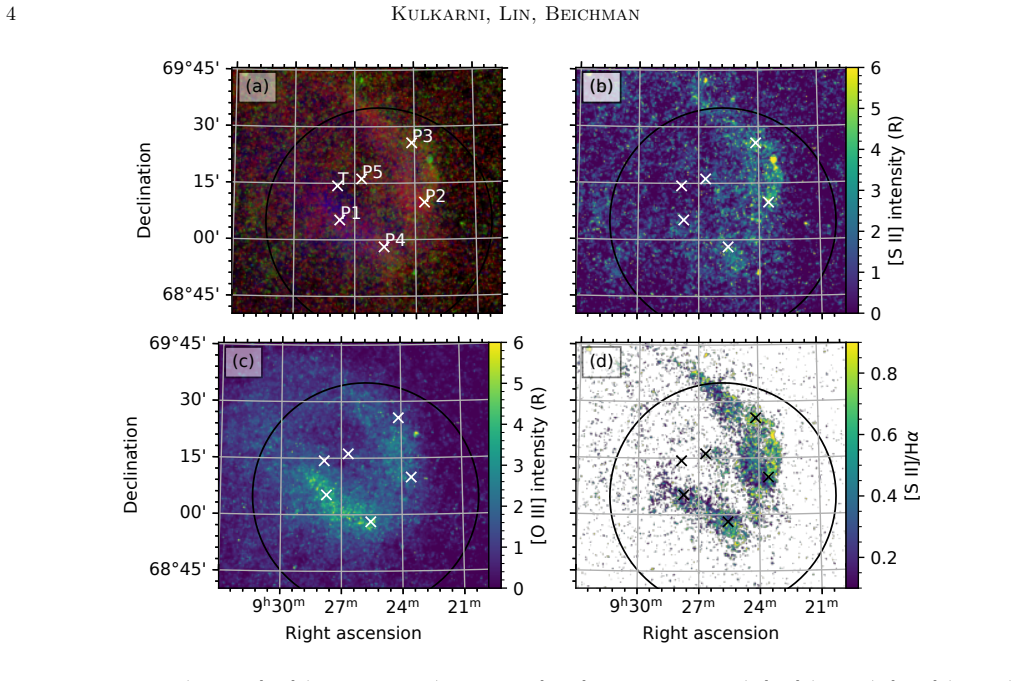
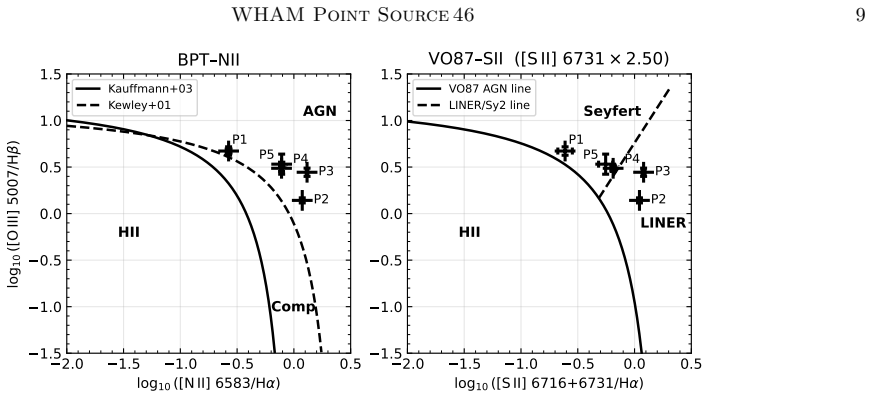
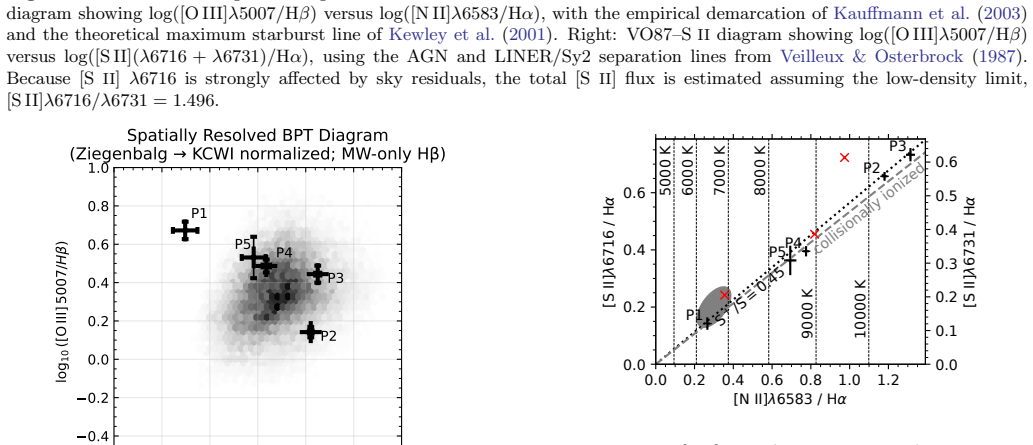
The non-detection of H-alpha within an arc-minute of PG 0931+691 combined with BPT-diagram and [S II]/H-alpha ratios that favor shock or LI(N)ER excitation over H II-region photoionization.
If this is right
- Other WHAM point sources previously linked to subdwarfs may require similar re-examination.
- H-alpha from shocks can serve as a tracer for interactions between intermediate-velocity clouds and the Galactic disk or halo.
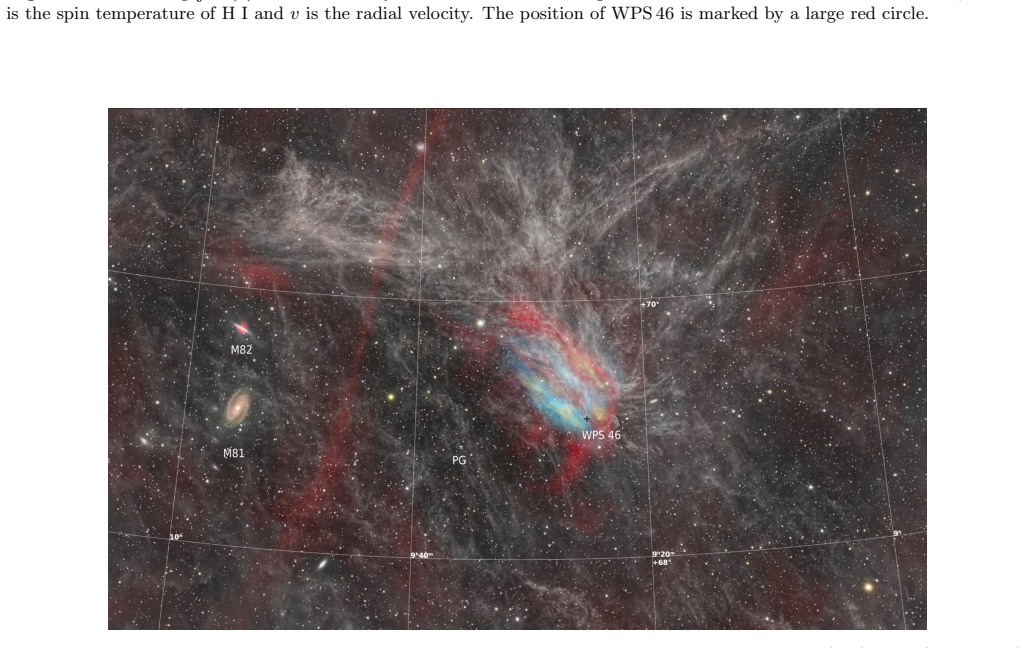
- Sub-degree ionized structures can be mapped by combining SDSS Local Volume Mapper spectra with deep narrow-band images.
Where Pith is reading between the lines
- Shocks driven by infalling or fountain gas may supply a larger fraction of the warm ionized medium than models that rely only on stellar photons have assumed.
- The same line-ratio and morphology tests could be applied to faint emission patches found in other all-sky surveys to separate stellar and shock contributions.
Load-bearing premise
The lack of detectable H-alpha near the star plus the line ratios are enough to exclude the star as the main ionizer and to favor shock ionization.
What would settle it
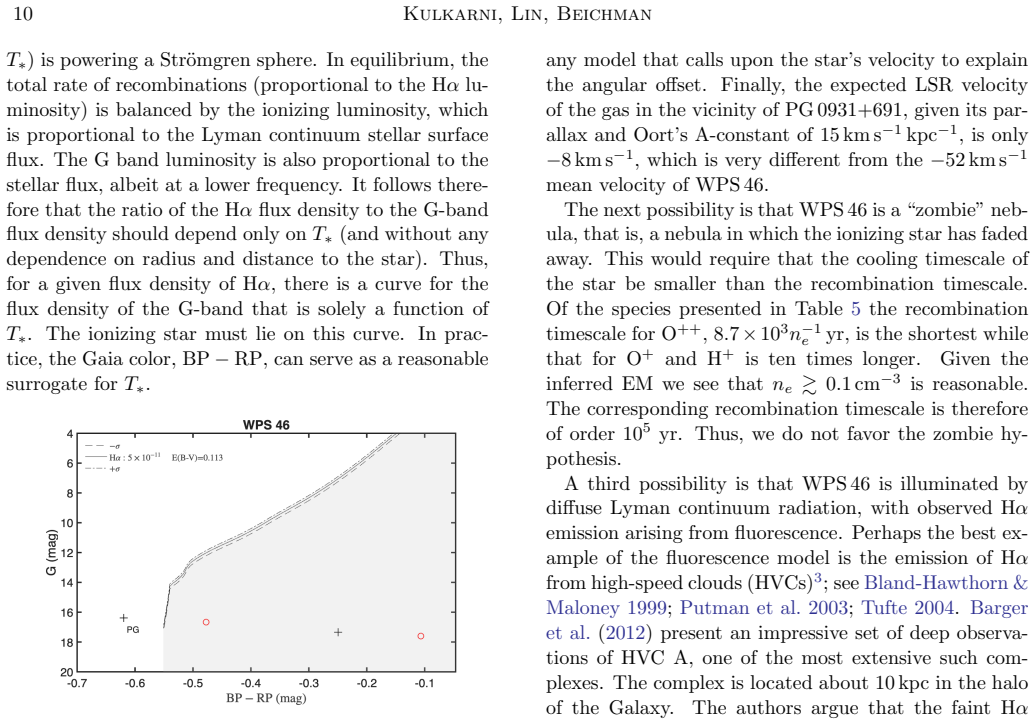
Detection of enough ultraviolet flux or H-alpha from PG 0931+691 to power the observed nebula, or kinematic measurements showing WPS 46 shares the star's velocity rather than the intermediate-velocity cloud's velocity.
Figures
read the original abstract
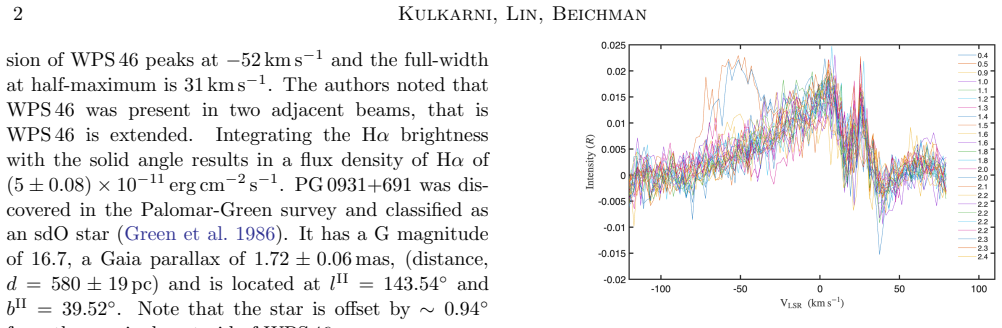
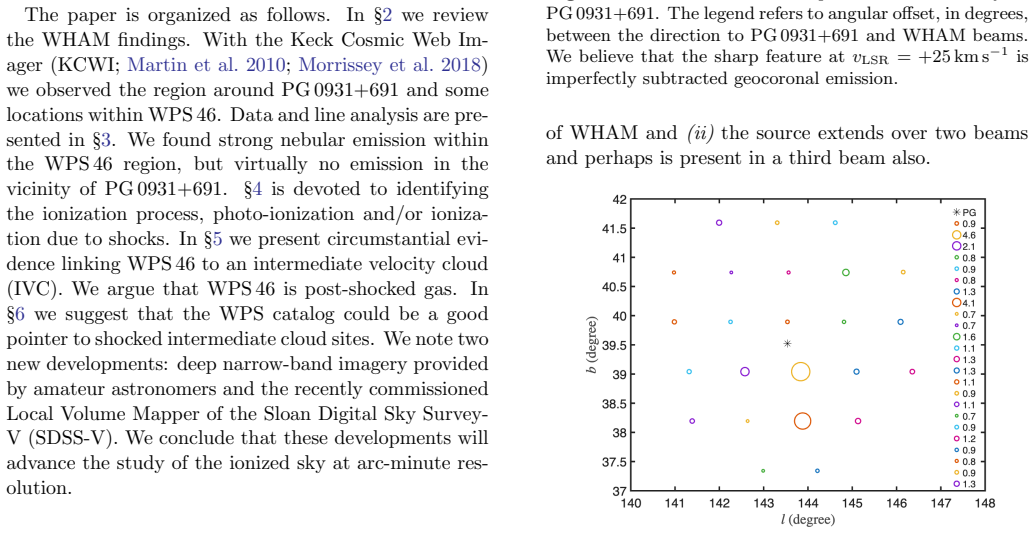
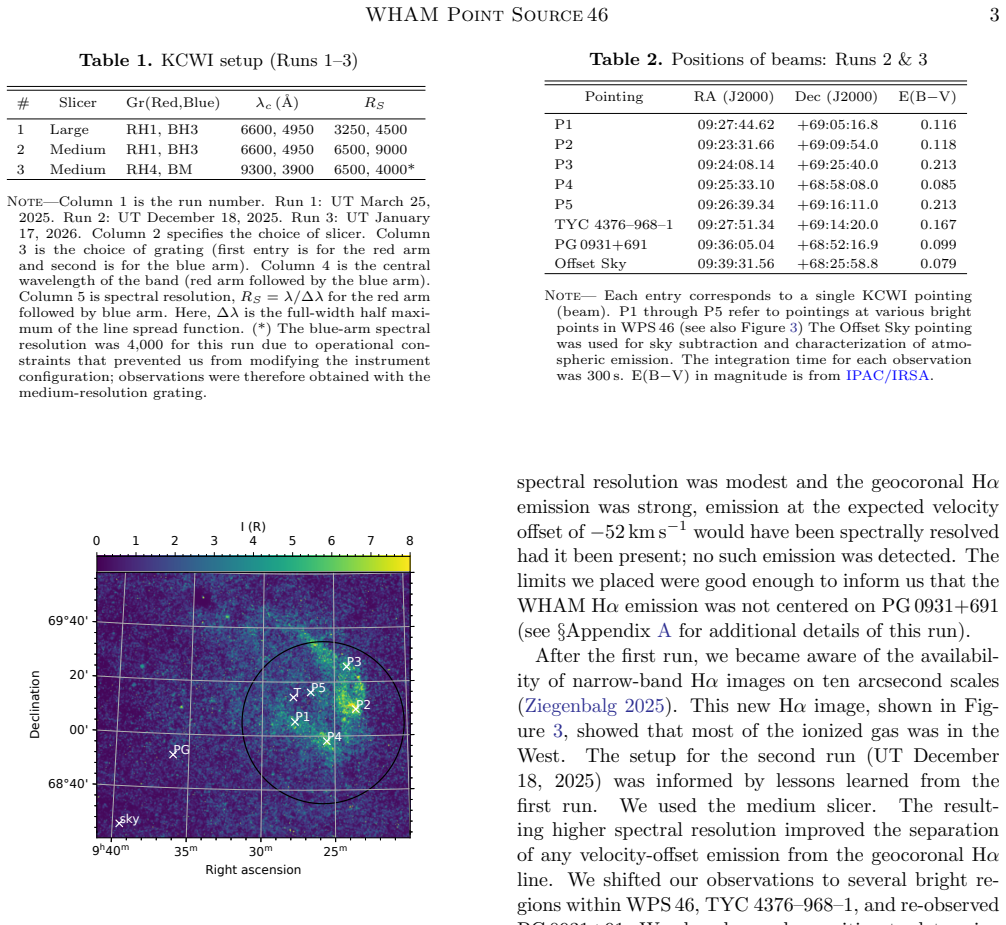
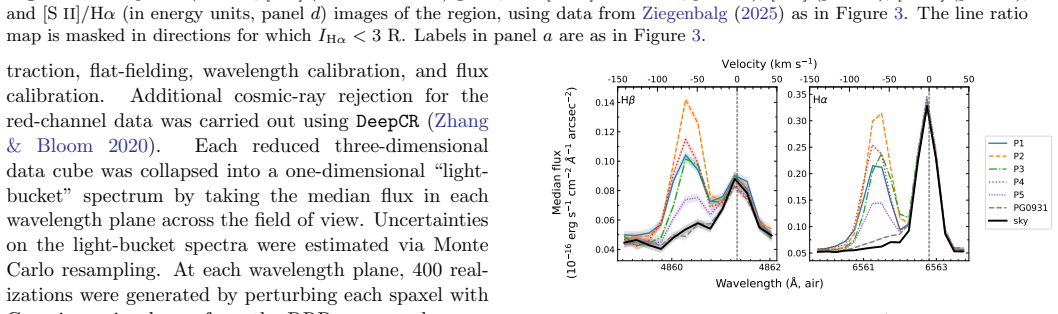
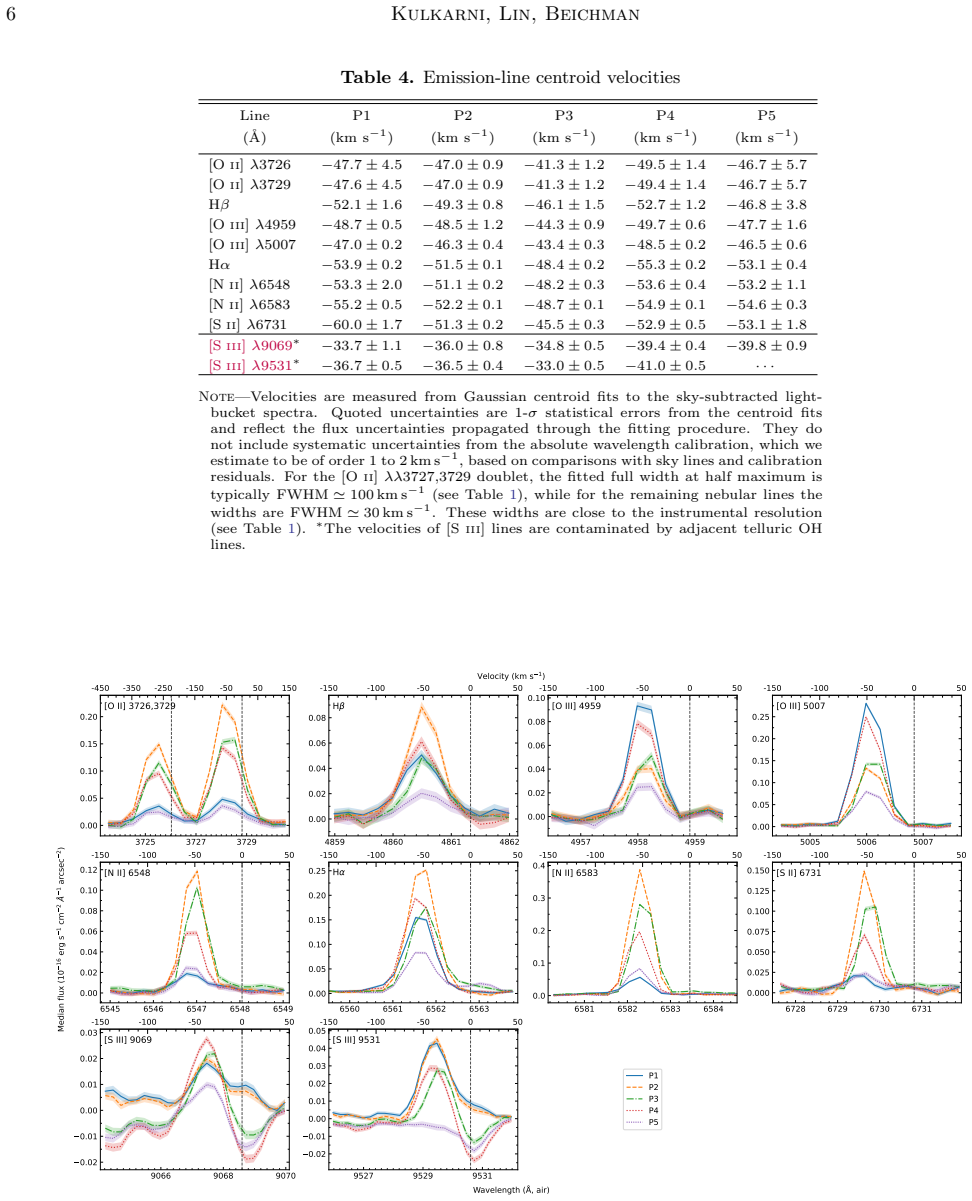
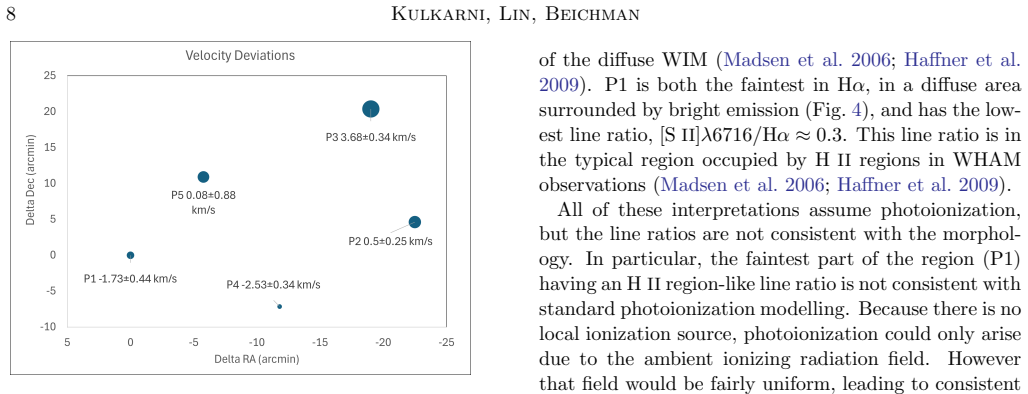
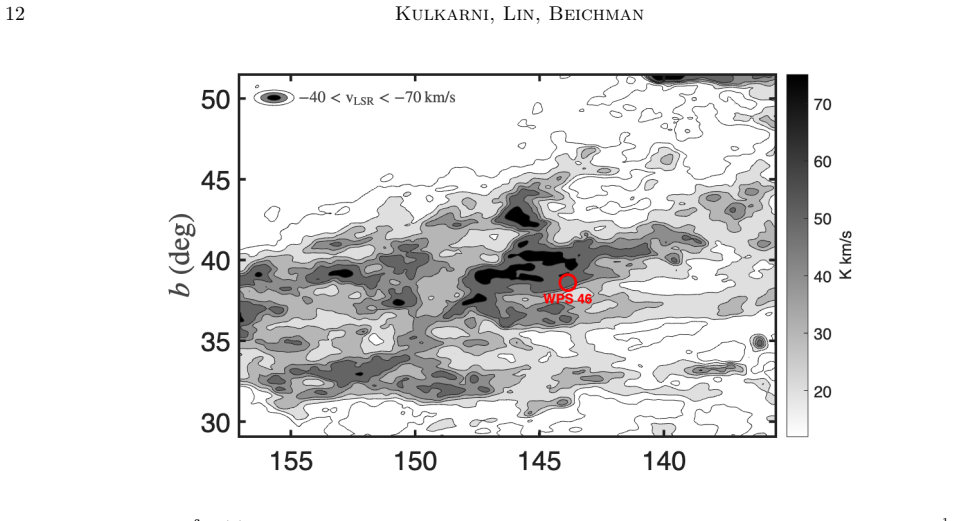
The Wisconsin H$\alpha$ Mapper (WHAM) surveyed the entire Galactic sky in H$\alpha$ ($\vert v_{\rm LSR}\vert \lesssim 100\, {\rm km\,s^{-1}}$) to approximately 0.1\,Rayleigh (R), albeit with a 1-degree beam. %The resulting WHAM Sky Survey, along with large area %imaging in [\ion{S}{2}] and [\ion{N}{2}], laid the foundation for Warm Ionized %Medium (WIM) science. \cite{rcm+05} reported ``point sources" which stood out against the Galactic background in space and velocity. Half of the sources are associated with plausible planetary nebulae and OB stars. Reynolds et al (2005) suggested sub dwarfs for one quarter of the sources. Here, we investigate one such source, WPS\,46, for which Reynolds et al (2005) suggested the sub-dwarf PG\,0931+691 to provide the source of ionization. With the Keck Cosmic Web Imager we found numerous nebular emission lines within the vicinity of WPS\,46, but we failed to find H$\alpha$ emission in the arc-minute vicinity of PG\,0931+691. The line ratios (BPT diagram and [\ion{S}{2}]/H$\alpha$) combined with the morphology are more consistent with AGN or LI(N)ER-like ionization than with pure warm ionized medium or \ion{H}{2} region-like photoionization. Separately, we offer compelling reasons to argue that PG\,0931+691 cannot be the source of ionizing power for WPS\,46. We suggest that WPS\,46 is associated with an intermediate velocity complex (IVC) and that H$\alpha$ and nebula emission may arise as a result of a shock. We conclude by outlining a plan of action of using SDSS's Local Volume Mapper along with deep narrow band imagery obtained by amateur astronomers to explore and study the ionized sky on sub-degree scales, in general, and specifically studies of IVC and high-velocity complexes.
Editorial analysis
A structured set of objections, weighed in public.
Referee Report
Summary. The manuscript investigates the origin of WHAM Point Source 46 (WPS 46), previously suggested by Reynolds et al. (2005) to be ionized by the subdwarf PG 0931+691. Keck Cosmic Web Imager observations detect multiple nebular emission lines near WPS 46 but find no Hα emission within an arc-minute of PG 0931+691. Line ratios (BPT diagram and [S II]/Hα) are reported as more consistent with AGN/LI(N)ER-like ionization than with WIM or H II region photoionization. The authors argue that PG 0931+691 cannot be the ionizing source, associate WPS 46 with an intermediate-velocity cloud (IVC), and attribute the emission to shock ionization. They conclude with a proposed observing plan using SDSS Local Volume Mapper and amateur narrow-band imaging.
Significance. If the non-detection and line-ratio interpretations are robust, the work provides a concrete case study reclassifying one WHAM point source away from the subdwarf category and illustrates the utility of high-resolution spectroscopy for distinguishing shock versus photoionization in the Galactic ionized medium. It adds new Keck data to the observational record and outlines practical strategies for sub-degree-scale studies of IVCs and high-velocity complexes.
major comments (2)
- [Keck observations / abstract] The central claim that PG 0931+691 cannot be the ionizing source rests on the non-detection of Hα within an arc-minute, yet the manuscript provides no quantitative upper limit on Hα flux or surface brightness, nor any sensitivity or exposure-time details for the Keck Cosmic Web Imager data. This omission makes it impossible to assess the strength of the exclusion (abstract and Keck observations section).
- [Line-ratio analysis / discussion] The preference for shock ionization over stellar photoionization is based on BPT-diagram location and [S II]/Hα ratios, but the text does not tabulate the measured line fluxes, uncertainties, or explicit comparisons to shock-model versus photoionization-model grids. Without these, the diagnostic conclusion remains qualitative (line-ratio analysis and discussion sections).
minor comments (2)
- [Abstract] Abstract: 'sub dwarfs' should read 'subdwarfs'; the phrase 'source of ionizing power' is clearer than 'source of ionization' in the final sentence.
- [Discussion] A figure overlaying the WPS 46 position and velocity on known IVC maps would strengthen the morphological association claim.
Simulated Author's Rebuttal
We thank the referee for the constructive comments, which help strengthen the quantitative support for our conclusions. We respond to each major comment below and have revised the manuscript to address the identified omissions.
read point-by-point responses
-
Referee: [Keck observations / abstract] The central claim that PG 0931+691 cannot be the ionizing source rests on the non-detection of Hα within an arc-minute, yet the manuscript provides no quantitative upper limit on Hα flux or surface brightness, nor any sensitivity or exposure-time details for the Keck Cosmic Web Imager data. This omission makes it impossible to assess the strength of the exclusion (abstract and Keck observations section).
Authors: We agree that quantitative details are required to evaluate the non-detection. In the revised manuscript we have added the KCWI observing log (total on-source integration of 7200 s under 0.8-arcsec seeing) to the observations section. We also report a 3σ upper limit of 0.04 R on Hα surface brightness within a 1-arcmin radius of PG 0931+691, derived from the rms noise in the continuum-subtracted datacube. This limit is well below the WHAM point-source threshold and is now referenced in the abstract. These additions directly address the concern. revision: yes
-
Referee: [Line-ratio analysis / discussion] The preference for shock ionization over stellar photoionization is based on BPT-diagram location and [S II]/Hα ratios, but the text does not tabulate the measured line fluxes, uncertainties, or explicit comparisons to shock-model versus photoionization-model grids. Without these, the diagnostic conclusion remains qualitative (line-ratio analysis and discussion sections).
Authors: We accept that the diagnostic discussion would be more rigorous with tabulated values and model comparisons. The revised manuscript now contains a new table listing all detected line fluxes with 1σ uncertainties and the derived [S II]/Hα, [N II]/Hα, and [O III]/Hβ ratios. We have added a BPT diagram figure that overlays our measurements (with error bars) on both shock-ionization grids (Allen et al. 2008) and stellar/AGN photoionization grids generated with CLOUDY. The observed ratios place WPS 46 firmly in the LINER/shock region, providing quantitative support for the shock-ionization interpretation tied to the IVC. These changes appear in the line-ratio analysis and discussion sections. revision: yes
Circularity Check
No significant circularity identified
full rationale
This is a purely observational astronomy paper based on new Keck Cosmic Web Imager spectroscopy. The central claims (PG 0931+691 cannot ionize WPS 46; emission arises from IVC shocks) rest on direct non-detections, measured line ratios (BPT, [S II]/Hα), morphology, and velocities compared against standard external diagnostics. No derivations, fitted parameters, predictions, ansatzes, or self-citation chains appear; the logic is self-contained against external benchmarks and does not reduce to its own inputs by construction.
Axiom & Free-Parameter Ledger
axioms (1)
- domain assumption BPT diagram and [S II]/Hα ratios reliably distinguish between photoionization by stars, AGN/LINERs, and shocks in the Galactic context.
Reference graph
Works this paper leans on
-
[1]
The MAPPINGS III Library of Fast Radiative Shock Models
The MAPPINGS III Library of Fast Radiative Shock Models. , keywords =. doi:10.1086/589652 , archivePrefix =. 0805.0204 , primaryClass =
work page internal anchor Pith review Pith/arXiv arXiv doi:10.1086/589652
-
[2]
Present-day Galactic Evolution: Low-metallicity, Warm, Ionized Gas Inflow Associated with High-velocity Cloud Complex A. , keywords =. doi:10.1088/0004-637X/761/2/145 , archivePrefix =. 1211.1973 , primaryClass =
work page internal anchor Pith review Pith/arXiv arXiv doi:10.1088/0004-637x/761/2/145 1973
-
[3]
The Smith cloud: HI associated with the Sgr dwarf?. , keywords =. doi:10.1046/j.1365-8711.1998.01902.x , archivePrefix =. astro-ph/9802220 , primaryClass =
-
[4]
The Escape of Ionizing Photons from the Galaxy
The Escape of Ionizing Photons from the Galaxy. , keywords =. doi:10.1086/311797 , archivePrefix =. astro-ph/9810469 , primaryClass =
work page internal anchor Pith review Pith/arXiv arXiv doi:10.1086/311797
-
[5]
HI4PI: A full-sky HI survey based on EBHIS and GASS
HI4PI: A full-sky H I survey based on EBHIS and GASS. , keywords =. doi:10.1051/0004-6361/201629178 , archivePrefix =. 1610.06175 , primaryClass =
work page internal anchor Pith review Pith/arXiv arXiv doi:10.1051/0004-6361/201629178
-
[6]
Classification parameters for the emission-line spectra of extragalactic objects. , keywords =. doi:10.1086/130766 , adsurl =
-
[7]
H-alpha Distance Constraints for High-Velocity Clouds in the Galactic Halo
H Distance Constraints for High Velocity Clouds in the Galactic Halo. Extragalactic Gas at Low Redshift , year = 2002, editor =. doi:10.48550/arXiv.astro-ph/0110044 , archivePrefix =. astro-ph/0110044 , primaryClass =
work page internal anchor Pith review Pith/arXiv arXiv doi:10.48550/arxiv.astro-ph/0110044 2002
-
[8]
VOSA: Virtual Observatory SED Analyzer. An application to the Collinder 69 open cluster
VOSA: virtual observatory SED analyzer. An application to the Collinder 69 open cluster. , keywords =. doi:10.1051/0004-6361:200810395 , archivePrefix =. 0808.0270 , primaryClass =
work page internal anchor Pith review Pith/arXiv arXiv doi:10.1051/0004-6361:200810395
-
[9]
The Relationship between Infrared, Optical, and Ultraviolet Extinction. , keywords =. doi:10.1086/167900 , adsurl =
-
[10]
The SDSS-V Local Volume Mapper (LVM): Scientific Motivation and Project Overview. , keywords =. doi:10.3847/1538-3881/ad6de9 , archivePrefix =. 2405.01637 , primaryClass =
-
[11]
Physics of the Interstellar and Intergalactic Medium
-
[12]
Spectrophotometry of the Cygnus Loop. , keywords =. doi:10.1086/160408 , adsurl =
-
[13]
On the Metallicity and Origin of the Smith High-Velocity Cloud
On the Metallicity and Origin of the Smith High-velocity Cloud. , keywords =. doi:10.3847/2041-8205/816/1/L11 , archivePrefix =. 1512.04957 , primaryClass =
work page internal anchor Pith review Pith/arXiv arXiv doi:10.3847/2041-8205/816/1/l11 2041
-
[14]
Smith's Cloud: A High-velocity Cloud Colliding with the Milky Way
The Smith Cloud: A High-Velocity Cloud Colliding with the Milky Way. , keywords =. doi:10.1086/588838 , archivePrefix =. 0804.4155 , primaryClass =
work page internal anchor Pith review Pith/arXiv arXiv doi:10.1086/588838
-
[15]
The Palomar-Green Catalog of Ultraviolet-Excess Stellar Objects. , keywords =. doi:10.1086/191115 , adsurl =
-
[16]
The population of hot subdwarf stars studied with Gaia. I. The catalog of known hot subdwarf stars. , keywords =. doi:10.1051/0004-6361/201630135 , archivePrefix =. 1612.02995 , primaryClass =
work page internal anchor Pith review Pith/arXiv arXiv doi:10.1051/0004-6361/201630135
-
[17]
The Ionized Component of Intermediate-Velocity Cloud Complex L
The Ionized Component of Intermediate-Velocity Cloud Complex L. Extra-Planar Gas , year = 2005, editor =. doi:10.48550/arXiv.astro-ph/0410675 , archivePrefix =. astro-ph/0410675 , primaryClass =
work page internal anchor Pith review Pith/arXiv arXiv doi:10.48550/arxiv.astro-ph/0410675 2005
-
[18]
WHAM Observations of H , [S II], and [N II] toward the Orion and Perseus Arms: Probing the Physical Conditions of the Warm Ionized Medium. , keywords =. doi:10.1086/307734 , archivePrefix =. astro-ph/9904143 , primaryClass =
work page internal anchor Pith review Pith/arXiv arXiv doi:10.1086/307734
-
[19]
EAS Publications Series , year = 2012, editor =
Ionization of Infalling Gas. EAS Publications Series , year = 2012, editor =. doi:10.1051/eas/1256052 , archivePrefix =. 0901.0940 , primaryClass =
-
[20]
The SDSS-V Local Volume Mapper Telescope System. , keywords =. doi:10.3847/1538-3881/ad7948 , adsurl =
-
[21]
A Map of the Ionized Component of the Intermediate Velocity Cloud Complex K
A Map of the Ionized Component of the Intermediate-Velocity Cloud Complex K. , keywords =. doi:10.1086/322867 , archivePrefix =. astro-ph/0107250 , primaryClass =
work page internal anchor Pith review Pith/arXiv arXiv doi:10.1086/322867
-
[22]
The Wisconsin H-Alpha Mapper Northern Sky Survey
The Wisconsin H Mapper Northern Sky Survey. , keywords =. doi:10.1086/378850 , archivePrefix =. astro-ph/0309117 , primaryClass =
work page internal anchor Pith review Pith/arXiv arXiv doi:10.1086/378850
-
[23]
doi:10.1103/RevModPhys.81.969 , Journal =
-
[24]
Hot Subluminous Stars. , keywords =. doi:10.1088/1538-3873/128/966/082001 , archivePrefix =. 1604.07749 , primaryClass =
work page internal anchor Pith review Pith/arXiv arXiv doi:10.1088/1538-3873/128/966/082001
-
[25]
Ionized Gas in the Smith Cloud
Ionized Gas in the Smith Cloud. , keywords =. doi:10.1088/0004-637X/703/2/1832 , archivePrefix =. 0908.1720 , primaryClass =
work page internal anchor Pith review Pith/arXiv arXiv doi:10.1088/0004-637x/703/2/1832
-
[26]
Magnetized Gas in the Smith High Velocity Cloud
Magnetized Gas in the Smith High Velocity Cloud. , keywords =. doi:10.1088/0004-637X/777/1/55 , archivePrefix =. 1309.2553 , primaryClass =
work page internal anchor Pith review Pith/arXiv arXiv doi:10.1088/0004-637x/777/1/55
-
[27]
Theoretical ISM Pressure and Electron Density Diagnostics for Local and High-redshift Galaxies. , keywords =. doi:10.3847/1538-4357/ab16ed , archivePrefix =. 1908.05504 , primaryClass =
-
[28]
doi:10.1111/j.1365-2966.2009.15868.x , eprint =
Electron-impact excitation of OII fine-structure levels. , keywords =. doi:10.1111/j.1365-2966.2009.14989.x , archivePrefix =. 0907.4209 , primaryClass =
-
[29]
Theoretical Modeling of Starburst Galaxies
Theoretical Modeling of Starburst Galaxies. , keywords =. doi:10.1086/321545 , archivePrefix =. astro-ph/0106324 , primaryClass =
work page internal anchor Pith review Pith/arXiv arXiv doi:10.1086/321545
-
[30]
Probing the Neutral Fraction of the Warm Ionized Medium via [NI] 5200. arXiv e-prints , keywords =. doi:10.48550/arXiv.2507.20989 , archivePrefix =. 2507.20989 , primaryClass =
-
[31]
Intermediate-Velocity Gas in the North Galactic Hemisphere: H i Studies. , keywords =. doi:10.1086/176765 , adsurl =
-
[32]
SDSS-V Local Volume Mapper (LVM): A glimpse into Orion. , keywords =. doi:10.1051/0004-6361/202449943 , archivePrefix =. 2405.14943 , primaryClass =
-
[33]
Ground-based and Airborne Instrumentation for Astronomy X , year = 2024, editor =
The SDSS-V Local Volume Mapper Instrument. Ground-based and Airborne Instrumentation for Astronomy X , year = 2024, editor =. doi:10.1117/12.3019892 , adsurl =
-
[34]
Probable Detection of H alpha Emission from a Very High Velocity Cloud in Cetus. , keywords =. doi:10.1086/185518 , adsurl =
-
[35]
Two-photon Production in Low-velocity Shocks. , keywords =. doi:10.1088/1538-3873/acff85 , archivePrefix =. 2302.13963 , primaryClass =
-
[36]
Covering factors and vertical heights
Intermediate- and high-velocity clouds in the Milky Way - I. Covering factors and vertical heights. , keywords =. doi:10.1093/mnras/stac987 , archivePrefix =. 2202.05848 , primaryClass =
-
[37]
Ground-based and Airborne Instrumentation for Astronomy III , year = 2010, editor =
The Keck Cosmic Web Imager. Ground-based and Airborne Instrumentation for Astronomy III , year = 2010, editor =. doi:10.1117/12.858227 , adsurl =
-
[38]
A Multiwavelength Optical Emission Line Survey of Warm Ionized Gas in the Galaxy
A Multiwavelength Optical Emission Line Survey of Warm Ionized Gas in the Galaxy. , keywords =. doi:10.1086/508441 , archivePrefix =. astro-ph/0609558 , primaryClass =
work page internal anchor Pith review Pith/arXiv arXiv doi:10.1086/508441
-
[39]
Time-dependent metal ionization and the persistence of collisionally excited emission lines in the diffuse ionized gas of star-forming galaxies. , keywords =. doi:10.1093/mnras/stae2549 , archivePrefix =. 2411.07108 , primaryClass =
-
[40]
The Keck Cosmic Web Imager Integral Field Spectrograph
The Keck Cosmic Web Imager Integral Field Spectrograph. , keywords =. doi:10.3847/1538-4357/aad597 , archivePrefix =. 1807.10356 , primaryClass =
work page internal anchor Pith review Pith/arXiv arXiv doi:10.3847/1538-4357/aad597
-
[41]
Journal of Geophysical Research (Space Physics) , keywords =
Geocoronal hydrogen observations spanning three solar minima. Journal of Geophysical Research (Space Physics) , keywords =. doi:10.1029/2008JA013380 , adsurl =
-
[42]
Astrophysics of gaseous nebulae and active galactic nuclei
-
[43]
[OII] line ratios. , keywords =. doi:10.1111/j.1745-3933.2005.00119.x , archivePrefix =. astro-ph/0510099 , primaryClass =
-
[44]
Gaseous Galaxy Halos. , keywords =. doi:10.1146/annurev-astro-081811-125612 , archivePrefix =. 1207.4837 , primaryClass =
work page internal anchor Pith review Pith/arXiv arXiv doi:10.1146/annurev-astro-081811-125612
-
[45]
H_alpha Emission from High-Velocity Clouds and their Distances
H Emission from High-Velocity Clouds and Their Distances. , keywords =. doi:10.1086/378555 , archivePrefix =. astro-ph/0307509 , primaryClass =
work page internal anchor Pith review Pith/arXiv arXiv doi:10.1086/378555
-
[46]
Intrinsic Colors, Temperatures, and Bolometric Corrections of Pre-main-sequence Stars. , keywords =. doi:10.1088/0067-0049/208/1/9 , archivePrefix =. 1307.2657 , primaryClass =
work page internal anchor Pith review Pith/arXiv arXiv doi:10.1088/0067-0049/208/1/9
-
[47]
Further Spectroscopy of the Diffuse Ionized Gas in NGC 891 and Evidence for a Secondary Source of Ionization. , keywords =. doi:10.1086/305814 , archivePrefix =. astro-ph/9802045 , primaryClass =
work page internal anchor Pith review Pith/arXiv arXiv doi:10.1086/305814
-
[48]
H alpha Scans of High-Velocity Clouds. , keywords =. doi:10.1086/165851 , adsurl =
-
[49]
Shock waves in the interstellar medium. , keywords =. doi:10.1086/190562 , adsurl =
-
[50]
All-sky census of Galactic high-latitude molecular intermediate-velocity clouds
All-sky census of Galactic high-latitude molecular intermediate-velocity clouds. , keywords =. doi:10.1051/0004-6361/201629141 , archivePrefix =. 1609.06540 , primaryClass =
work page internal anchor Pith review Pith/arXiv arXiv doi:10.1051/0004-6361/201629141
-
[51]
Handling of Atomic Data. Stellar Atmosphere Modeling , year = 2003, editor =. doi:10.48550/arXiv.astro-ph/0403239 , archivePrefix =. astro-ph/0403239 , primaryClass =
work page internal anchor Pith review Pith/arXiv arXiv doi:10.48550/arxiv.astro-ph/0403239 2003
-
[52]
Unresolved H-Alpha Enhancements at High Galactic Latitude in the WHAM Sky Survey Maps
Unresolved H Enhancements at High Galactic Latitude in the WHAM Sky Survey Maps. , keywords =. doi:10.1086/427135 , archivePrefix =. astro-ph/0411120 , primaryClass =
work page internal anchor Pith review Pith/arXiv arXiv doi:10.1086/427135
-
[53]
2002, title The epoch of helium reionization , , 332, 601, 10.1046/j.1365-8711.2002.05291.x
Multiwavelength observations of the M15 intermediate-velocity cloud. , keywords =. doi:10.1046/j.1365-8711.2002.05762.x , archivePrefix =. astro-ph/0206373 , primaryClass =
-
[54]
Interstellar Processes , year = 1987, editor =
The Physics of Interstellar Shock Waves. Interstellar Processes , year = 1987, editor =. doi:10.1007/978-94-009-3861-8_13 , adsurl =
-
[55]
Modeling the Warm Ionized Interstellar Medium and Its Impact on Elemental Abundance Studies
Modeling the Warm Ionized Interstellar Medium and Its Impact on Elemental Abundance Studies. , keywords =. doi:10.1086/308173 , archivePrefix =. astro-ph/9908051 , primaryClass =
work page internal anchor Pith review Pith/arXiv arXiv doi:10.1086/308173
-
[56]
Distance limits to intermediate- and high-velocity clouds. , keywords =. doi:10.1111/j.1365-2966.2011.18647.x , adsurl =
-
[57]
, year = 1976, month = nov, volume =
High-latitude reflection nebulosities illuminated by the galactic plane. , year = 1976, month = nov, volume =. doi:10.1086/111975 , adsurl =
-
[58]
Theoretical models of interstellar shocks. I. , keywords =. doi:10.1086/156712 , adsurl =
-
[59]
The Long Tails of the Pegasus-Pisces Arch Intermediate Velocity Cloud. , keywords =. doi:10.3847/1538-4357/ac39a4 , archivePrefix =. 2203.00720 , primaryClass =
-
[60]
The SDSS-V Local Volume Mapper: Data Analysis Pipeline. , keywords =. doi:10.3847/1538-3881/ad93bb , archivePrefix =. 2411.09729 , primaryClass =
-
[61]
Ionizing Photon Emission Rates from O- and Early B-type Stars and Clusters
Ionizing Photon Emission Rates from O- and Early B-Type Stars and Clusters. , keywords =. doi:10.1086/379506 , archivePrefix =. astro-ph/0312232 , primaryClass =
work page internal anchor Pith review Pith/arXiv arXiv doi:10.1086/379506
-
[62]
High Velocity Clouds , year = 2004, editor =
Ionized Gas Associated with HVCs. High Velocity Clouds , year = 2004, editor =. doi:10.1007/1-4020-2579-3_8 , adsurl =
-
[63]
WHAM Observations of H-alpha Emission from High Velocity Clouds in the M, A, and C Complexes
WHAM Observations of H Emission from High-Velocity Clouds in the M, A, and C Complexes. , keywords =. doi:10.1086/306103 , archivePrefix =. astro-ph/9807157 , primaryClass =
work page internal anchor Pith review Pith/arXiv arXiv doi:10.1086/306103
-
[64]
WHAM Observations of H-alpha from High-Velocity Clouds: Are They Galactic or Extragalactic?
WHAM Observations of H from High-Velocity Clouds: Are They Galactic or Extragalactic?. , keywords =. doi:10.1086/341667 , archivePrefix =. astro-ph/0206198 , primaryClass =
work page internal anchor Pith review Pith/arXiv arXiv doi:10.1086/341667
-
[65]
High Velocity Clouds , year = 2004, editor =
High Velocity Clouds. High Velocity Clouds , year = 2004, editor =. doi:10.1007/1-4020-2579-3 , adsurl =
-
[66]
Classification and parameterization of a large Gaia sample of white dwarfs using XP spectra. , keywords =. doi:10.1051/0004-6361/202347694 , archivePrefix =. 2308.05572 , primaryClass =
-
[67]
, year = 1997, month = jan, volume =
High-Velocity Clouds. , year = 1997, month = jan, volume =. doi:10.1146/annurev.astro.35.1.217 , adsurl =
-
[68]
Optical emission from high velocity clouds and the ionization sources in the Galactic halo
Optical Emission from High Velocity Clouds and the Ionization Sources in the Galactic Halo. Extragalactic Gas at Low Redshift , year = 2002, editor =. doi:10.48550/arXiv.astro-ph/0109055 , archivePrefix =. astro-ph/0109055 , primaryClass =
work page internal anchor Pith review Pith/arXiv arXiv doi:10.48550/arxiv.astro-ph/0109055 2002
-
[69]
A new all-sky map of Galactic high-velocity clouds from the 21-cm HI4PI survey
A new all-sky map of Galactic high-velocity clouds from the 21-cm HI4PI survey. , keywords =. doi:10.1093/mnras/stx2757 , archivePrefix =. 1712.00909 , primaryClass =
work page internal anchor Pith review Pith/arXiv arXiv doi:10.1093/mnras/stx2757
-
[70]
The Effelsberg-Bonn HI Survey: Milky Way gas. First data release
The Effelsberg-Bonn H I Survey: Milky Way gas. First data release. , keywords =. doi:10.1051/0004-6361/201527007 , archivePrefix =. 1512.05348 , primaryClass =
work page internal anchor Pith review Pith/arXiv arXiv doi:10.1051/0004-6361/201527007
-
[71]
Absolute magnitudes of OB and Be stars based on Hipparcos parallaxes - II. , keywords =. doi:10.1111/j.1365-2966.2006.10549.x , adsurl =
-
[72]
Model Photospheres with Accelerated Lambda Iteration
Model Photospheres with Accelerated Lambda Iteration. Stellar Atmosphere Modeling , year = 2003, editor =. doi:10.48550/arXiv.astro-ph/0209535 , archivePrefix =. astro-ph/0209535 , primaryClass =
work page internal anchor Pith review Pith/arXiv arXiv doi:10.48550/arxiv.astro-ph/0209535 2003
-
[73]
Research in Astronomy and Astrophysics , keywords =
LAMOST medium-resolution spectral survey of Galactic nebulae (LAMOST-MRS-N): subtraction of geocoronal H emission. Research in Astronomy and Astrophysics , keywords =. doi:10.1088/1674-4527/21/11/280 , archivePrefix =. 2108.08021 , primaryClass =
-
[74]
MAMMOTH-MOSFIRE: Environmental Effects on Galaxy Interstellar Medium at z 2. , keywords =. doi:10.3847/1538-4357/ae0649 , archivePrefix =. 2505.04212 , primaryClass =
-
[75]
Research Notes of the American Astronomical Society , keywords =
Northern Sky Narrowband Survey DR0.2: First [O III] and [S II] Results. Research Notes of the American Astronomical Society , keywords =. doi:10.3847/2515-5172/adfec7 , adsurl =
-
[76]
Monthly Notices of the Royal Astronomical Society , volume=
The host galaxies of active galactic nuclei , author=. Monthly Notices of the Royal Astronomical Society , volume=. 2003 , publisher=
2003
-
[77]
The Astrophysical Journal , volume=
Theoretical modeling of starburst galaxies , author=. The Astrophysical Journal , volume=. 2001 , publisher=
2001
-
[78]
Astrophysical Journal Supplement Series (ISSN 0067-0049), vol
Spectral classification of emission-line galaxies , author=. Astrophysical Journal Supplement Series (ISSN 0067-0049), vol. 63, Feb. 1987, p. 295-310. NSERC-supported research. , volume=
1987
-
[79]
The Astrophysical Journal , volume=
deepcr: Cosmic ray rejection with deep learning , author=. The Astrophysical Journal , volume=. 2020 , publisher=
2020
-
[80]
Publications of the Astronomical Society of the Pacific , volume=
Night-sky high-resolution spectral atlas of OH and O2 emission lines for echelle spectrograph wavelength calibration , author=. Publications of the Astronomical Society of the Pacific , volume=. 1996 , publisher=
1996
discussion (0)
Sign in with ORCID, Apple, or X to comment. Anyone can read and Pith papers without signing in.