Space- and time-like electromagnetic form factors of the Ω baryon
Pith reviewed 2026-06-27 16:09 UTC · model grok-4.3
The pith
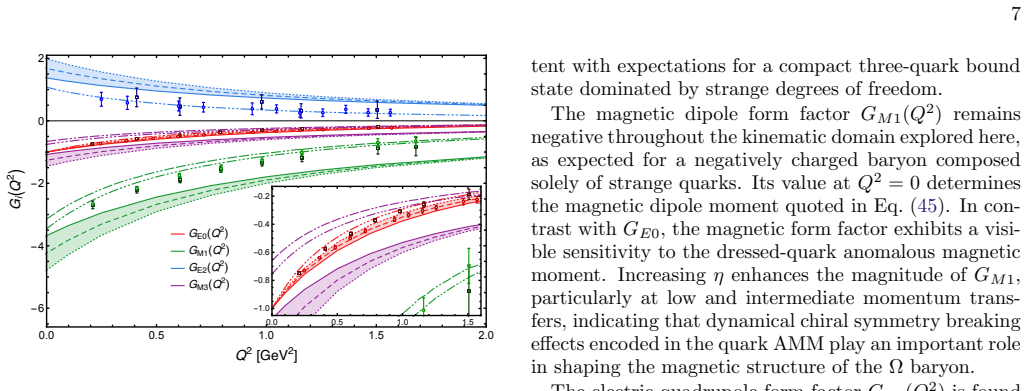
The electromagnetic form factors of the Ω baryon show visible sensitivity to the dressed-quark anomalous magnetic moment in the magnetic and higher multipole sectors.
A machine-rendered reading of the paper's core claim, the machinery that carries it, and where it could break.
Core claim
Within a confining, symmetry-preserving framework based on a vector⊗vector contact interaction and the rainbow-ladder truncation of QCD's Dyson-Schwinger equations, combined with a Poincaré-covariant Faddeev equation for the three-quark bound state, the elastic electromagnetic form factors of the Ω baryon are computed in both space-like and time-like regions. The Ω baryon, composed solely of strange quarks, provides a clean environment for studying quark mass and SU(3)-flavor symmetry effects. The electromagnetic current is constructed consistently with the Ward-Takahashi identity, yielding four independent form factors associated with the electric monopole, magnetic dipole, electric quadrup
What carries the argument
The rainbow-ladder truncation of the Dyson-Schwinger equations with a vector⊗vector contact interaction, used to solve the Poincaré-covariant Faddeev equation for the three-strange-quark bound state and to construct an electromagnetic current that satisfies the Ward-Takahashi identity.
If this is right
- The static electromagnetic moments of the Ω baryon vary with the chosen value of the dressed-quark anomalous magnetic moment.
- The magnetic dipole, electric quadrupole, and magnetic octupole form factors display stronger sensitivity to this anomalous moment than the electric monopole form factor.
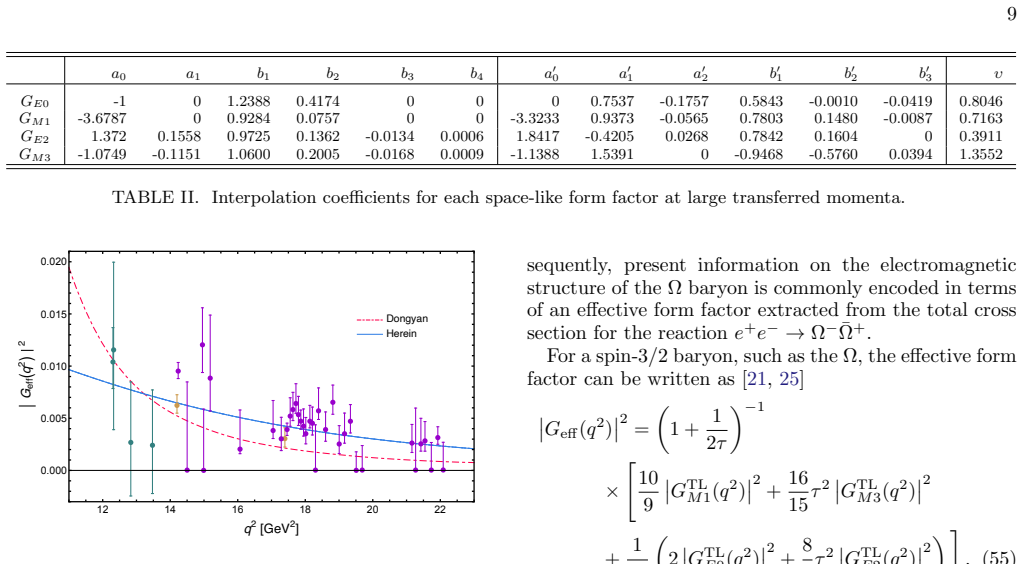
- Analytic continuation from space-like to time-like kinematics produces effective form factors that can be compared directly with available experimental data.
- The equal strange-quark masses make the Ω a clean probe of SU(3)-flavor symmetry in baryon structure within the model.
- The same framework supplies consistent predictions for both kinematic regions without additional parameters.
Where Pith is reading between the lines
- Varying the anomalous magnetic moment parameter within this truncation could be used to explore consistency with data on other strange baryons such as the Lambda or Sigma.
- The reported sensitivity implies that non-perturbative calculations of decuplet baryons should treat quark anomalous moments as an explicit degree of freedom rather than deriving them solely from the wave function.
- Predictions in the time-like region could be confronted with future measurements at electron-positron facilities or in hyperon photoproduction.
- Applying the identical truncation and current construction to the Delta baryon would allow a direct test of how flavor symmetry breaking affects the same multipole sensitivities.
Load-bearing premise
The rainbow-ladder truncation of the Dyson-Schwinger equations combined with the vector⊗vector contact interaction provides a sufficiently accurate and symmetry-preserving description of the non-perturbative dynamics for the three-strange-quark bound state.
What would settle it
A lattice QCD computation or precise measurement of the Ω magnetic dipole moment or magnetic octupole form factor that remains unchanged when the input value of the dressed strange-quark anomalous magnetic moment is varied would falsify the reported sensitivity.
Figures

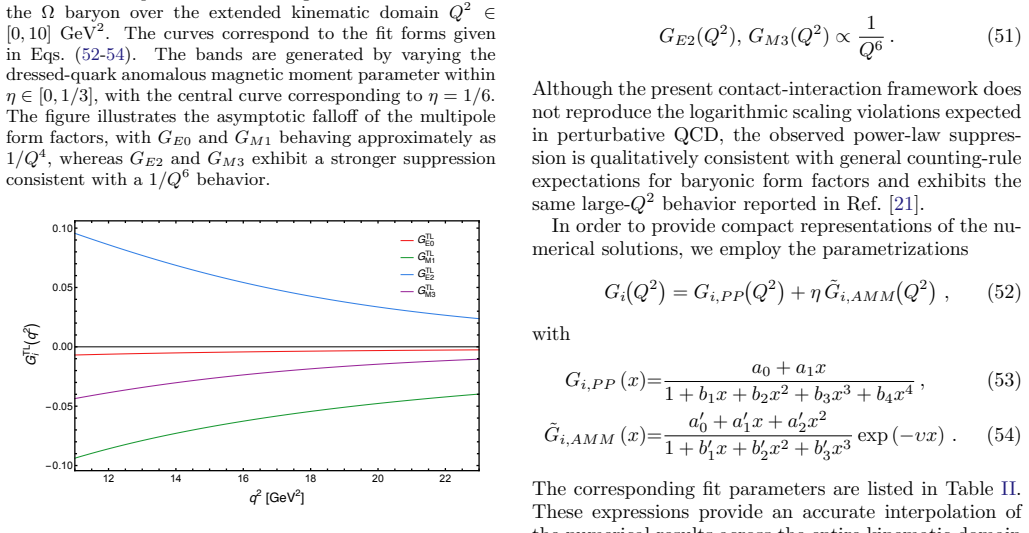
read the original abstract
We present predictions for the elastic electromagnetic form factors of the $\Omega$ baryon in both space-like and time-like regions, computed within a confining, symmetry-preserving framework based on a vector$\,\otimes\,$vector contact interaction. The calculation is performed in the rainbow-ladder truncation of QCD's Dyson-Schwinger equations, combined with a Poincar\'e-covariant Faddeev equation for the three-quark bound state. The $\Omega$ baryon, composed solely of strange quarks, provides a particularly clean environment in which to investigate the role of quark mass and SU(3)-flavor symmetry in shaping baryon structure. Within this approach, the electromagnetic current is constructed consistently with the Ward-Takahashi identity, yielding four independent form factors associated with the electric monopole, magnetic dipole, electric quadrupole, and magnetic octupole moments. We compute these form factors over a broad kinematic domain and analyze their behavior in both space-like and time-like regions. The resulting static electromagnetic moments and multipole form factors of the $\Omega$ baryon exhibit a visible sensitivity to the dressed-quark anomalous magnetic moment, particularly in the magnetic and higher-order multipole sectors. The time-like form factors are obtained through asymptotic analytic continuation of the corresponding space-like solutions, allowing the construction of the effective form factor and its comparison with available experimental data and recent phenomenological analyses.
Editorial analysis
A structured set of objections, weighed in public.
Referee Report
Summary. The manuscript presents predictions for the elastic electromagnetic form factors of the Ω baryon in both space-like and time-like regions using a rainbow-ladder truncation of the Dyson-Schwinger equations with a vector⊗vector contact interaction and a Poincaré-covariant Faddeev equation. The electromagnetic current is constructed to satisfy the Ward-Takahashi identity, producing four independent form factors (electric monopole, magnetic dipole, electric quadrupole, magnetic octupole). The central result is that the static moments and multipole form factors exhibit visible sensitivity to the dressed-quark anomalous magnetic moment, especially in the magnetic and higher-order sectors. Time-like form factors are obtained via asymptotic analytic continuation and compared to experimental data.
Significance. If the sensitivity result holds under further scrutiny, the work supplies model predictions for the electromagnetic structure of a three-strange-quark baryon and extends the contact-interaction framework to the time-like domain. The symmetry-preserving construction and explicit Ward-Takahashi identity compliance are clear strengths of the approach. The calculation adds to the body of Dyson-Schwinger studies of baryon form factors by isolating the role of the dressed-quark anomalous magnetic moment in an SU(3)-flavor symmetric system.
major comments (2)
- [Abstract] Abstract: the claim that the static moments and multipole form factors 'exhibit a visible sensitivity' to the dressed-quark anomalous magnetic moment is presented without numerical error estimates, without explicit variation of the two free parameters (contact interaction strength and strange quark mass), and without a demonstration that the sensitivity survives changes in those parameters. This omission directly affects the load-bearing assertion of the paper.
- [Framework description] Framework description (paragraph describing the framework): the rainbow-ladder truncation with a momentum-independent vector⊗vector contact interaction is taken to furnish a sufficiently accurate description of the three-strange-quark bound state. No test is reported showing that the reported sensitivity in the magnetic dipole, quadrupole, and octupole sectors remains when the kernel is replaced by a momentum-dependent interaction that could damp or redistribute the higher multipole currents.
minor comments (1)
- The manuscript should state explicitly how the analytic continuation to the time-like region is performed and what checks (e.g., consistency with unitarity or dispersion relations) are applied to the continued solutions.
Simulated Author's Rebuttal
We thank the referee for the careful reading of the manuscript and the constructive comments. We respond to each major comment below.
read point-by-point responses
-
Referee: [Abstract] Abstract: the claim that the static moments and multipole form factors 'exhibit a visible sensitivity' to the dressed-quark anomalous magnetic moment is presented without numerical error estimates, without explicit variation of the two free parameters (contact interaction strength and strange quark mass), and without a demonstration that the sensitivity survives changes in those parameters. This omission directly affects the load-bearing assertion of the paper.
Authors: We agree that the abstract statement would be strengthened by quantitative support. The sensitivity is shown in the body via explicit comparison of results obtained with and without the anomalous magnetic moment term in the quark-photon vertex. The two model parameters are fixed by the requirement that the computed Ω mass and other static properties match known values, but we will revise the abstract to quote the percentage changes in the moments and add a short paragraph in the results section illustrating the effect of modest variations around the fitted parameter values. revision: yes
-
Referee: [Framework description] Framework description (paragraph describing the framework): the rainbow-ladder truncation with a momentum-independent vector⊗vector contact interaction is taken to furnish a sufficiently accurate description of the three-strange-quark bound state. No test is reported showing that the reported sensitivity in the magnetic dipole, quadrupole, and octupole sectors remains when the kernel is replaced by a momentum-dependent interaction that could damp or redistribute the higher multipole currents.
Authors: The contact interaction is adopted precisely because it yields a symmetry-preserving, Poincaré-covariant framework in which the Ward-Takahashi identity can be satisfied exactly and the analytic continuation to the time-like region can be performed. While a momentum-dependent kernel would constitute a more realistic truncation, the present study is confined to the contact-interaction model in order to isolate the effect of the dressed-quark anomalous magnetic moment. A systematic comparison with momentum-dependent kernels lies outside the scope of this work. revision: no
Circularity Check
No significant circularity; derivation remains self-contained
full rationale
The paper computes Ω baryon form factors via rainbow-ladder DSEs with a fixed vector⊗vector contact interaction, constructs the current to satisfy the WTI, and obtains time-like values by analytic continuation of space-like solutions. The reported sensitivity to the dressed-quark anomalous magnetic moment is obtained by explicit variation of that model parameter inside an otherwise fixed kernel; this is a direct numerical exploration rather than a reduction of the output to the input by definition. No equation is shown to equal another by algebraic identity, no fitted subset is relabeled as a prediction of a closely related observable, and no load-bearing uniqueness theorem is imported solely via self-citation. The framework is applied to a new system (three-strange-quark bound state) with stated assumptions that do not presuppose the target multipole results, satisfying the criteria for an independent calculation.
Axiom & Free-Parameter Ledger
free parameters (2)
- contact interaction strength
- strange quark mass parameter
axioms (2)
- domain assumption Rainbow-ladder truncation of the quark-gluon vertex is adequate for baryon bound-state calculations
- domain assumption Vector⊗vector contact interaction preserves Poincaré covariance and chiral symmetry
Reference graph
Works this paper leans on
-
[1]
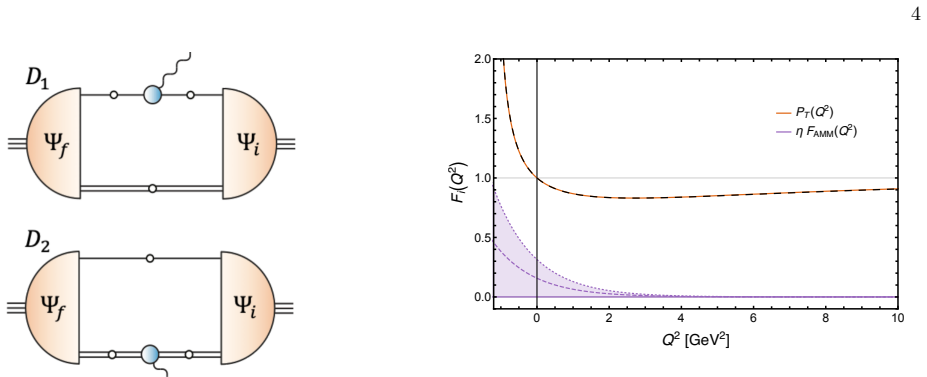
The diagramD 1: quark-photon coupling The first contribution corresponds to the photon cou- pling directly to a dressed strange quark inside the Ω baryon. The associated kernel reads ΛD1 µ,αβ (k;P f , Pi) =e s Dαδ(Pf)S(−k −f) ×Λ γq µ S(−k−i) ∆1+ δλ (−k)D λβ(Pi), (22) �� (� �) η ����(� �) 0 2 4 6 8 10 0.0 0.5 1.0 1.5 2.0 �� [����] �� �� FIG. 3. Quark–pho...
-
[2]
The diagramD 2: elastic diquark-photon coupling The second contribution corresponds to the elastic photon scattering from the axial-vector diquark inside the Ω baryon. The associated kernel is ΛD2 µ,αβ (k;P f , Pi) =e {ss} Dαδ(Pf)S(k) ∆ 1+ δρ (kf) ×Λ γdq µ,ρσ ∆1+ σλ(ki)D λβ(Pi),(28) where the structure of the corresponding diquark-photon vertex, Λγdq µ,ρσ...
-
[3]
Posdoctorados por M´ exico
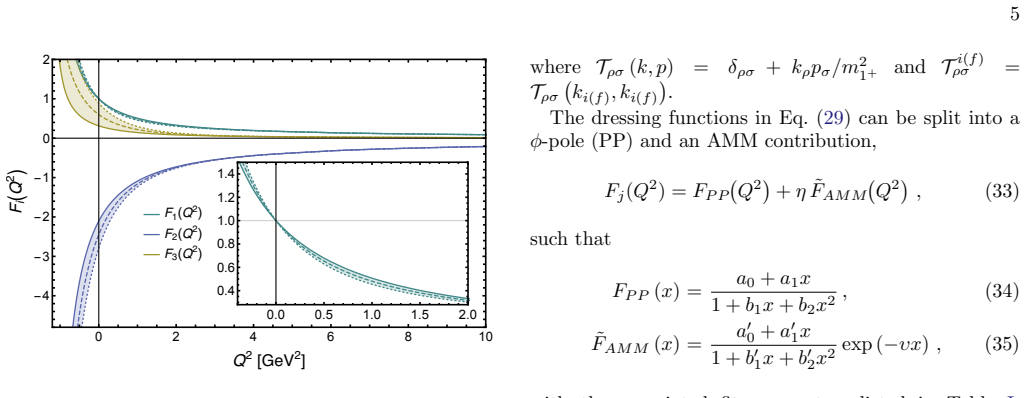
and N(1520) 3 2 − [59]. We note that, although the parameterηoriginates from the quark–photon interaction [83], its impact may differ between quark- and diquark-level contributions. In this work, we consider the same value of the dressed- quark anomalous magnetic moment parameter in both the quark-photon and diquark-photon vertices. The re- sultingη-depen...
2005
-
[4]
R. Abdul Khaleket al., Science Requirements and De- tector Concepts for the Electron-Ion Collider: EIC Yellow Report, Nucl. Phys. A1026, 122447 (2022), arXiv:2103.05419 [physics.ins-det]
Pith/arXiv arXiv 2022
-
[5]
A. Accardiet al., Strong interaction physics at the lumi- nosity frontier with 22 GeV electrons at Jefferson Lab, Eur. Phys. J. A60, 173 (2024), arXiv:2306.09360 [nucl- ex]
arXiv 2024
-
[6]
Aiet al., Conceptual design report of the Super Tau-Charm Facility: the accelerator, Nucl
X.-C. Aiet al., Conceptual design report of the Super Tau-Charm Facility: the accelerator, Nucl. Sci. Tech.36, 242 (2025), arXiv:2509.11522 [physics.acc-ph]
arXiv 2025
-
[7]
C. F. Perdrisat, V. Punjabi, and M. Vanderhaeghen, Nu- cleon Electromagnetic Form Factors, Prog. Part. Nucl. Phys.59, 694 (2007), arXiv:hep-ph/0612014
Pith/arXiv arXiv 2007
-
[8]
Pacetti, R
S. Pacetti, R. Baldini Ferroli, and E. Tomasi-Gustafsson, Proton electromagnetic form factors: Basic notions, present achievements and future perspectives, Phys. Rept.550-551, 1 (2015)
2015
-
[9]
V. Punjabi, C. F. Perdrisat, M. K. Jones, E. J. Brash, and C. E. Carlson, The Structure of the Nucleon: Elastic Electromagnetic Form Factors, Eur. Phys. J. A51, 79 (2015), arXiv:1503.01452 [nucl-ex]
Pith/arXiv arXiv 2015
-
[10]
J. J. Kelly, Simple parametrization of nucleon form fac- tors, Phys. Rev. C70, 068202 (2004)
2004
-
[11]
J. Arrington, W. Melnitchouk, and J. A. Tjon, Global analysis of proton elastic form factor data with two- photon exchange corrections, Phys. Rev. C76, 035205 (2007), arXiv:0707.1861 [nucl-ex]
Pith/arXiv arXiv 2007
-
[12]
Z. Ye, J. Arrington, R. J. Hill, and G. Lee, Proton and Neutron Electromagnetic Form Factors and Uncertain- ties, Phys. Lett. B777, 8 (2018), arXiv:1707.09063 [nucl- ex]
Pith/arXiv arXiv 2018
-
[13]
L. Tiator, D. Drechsel, S. S. Kamalov, and M. Van- derhaeghen, Electromagnetic Excitation of Nucleon Resonances, Eur. Phys. J. ST198, 141 (2011), arXiv:1109.6745 [nucl-th]
Pith/arXiv arXiv 2011
-
[14]
D. Ronchen, M. Doring, F. Huang, H. Haberzettl, J. Haidenbauer, C. Hanhart, S. Krewald, U. G. Meissner, and K. Nakayama, Coupled-channel dynamics in the re- actions piN –>piN, etaN, KLambda, KSigma, Eur. Phys. J. A49, 44 (2013), arXiv:1211.6998 [nucl-th]
Pith/arXiv arXiv 2013
-
[15]
I. G. Aznauryanet al., Studies of Nucleon Resonance Structure in Exclusive Meson Electroproduction, Int. J. Mod. Phys. E22, 1330015 (2013), arXiv:1212.4891 [nucl- th]
arXiv 2013
-
[16]
H. Kamano, S. X. Nakamura, T. S. H. Lee, and T. Sato, Nucleon resonances within a dynamical coupled-channels model ofπNandγNreactions, Phys. Rev. C88, 035209 (2013), arXiv:1305.4351 [nucl-th]
Pith/arXiv arXiv 2013
-
[17]
Achenbachet al., The present and future of QCD, Nucl
P. Achenbachet al., The present and future of QCD, Nucl. Phys. A1047, 122874 (2024), arXiv:2303.02579 [hep-ph]
arXiv 2024
-
[18]
G. Ramalho and M. T. Pe˜ na, Electromagnetic transi- tion form factors of baryon resonances, Prog. Part. Nucl. Phys.136, 104097 (2024), arXiv:2306.13900 [hep-ph]
arXiv 2024
-
[19]
Navaset al.(Particle Data Group), Review of particle physics, Phys
S. Navaset al.(Particle Data Group), Review of particle physics, Phys. Rev. D110, 030001 (2024)
2024
-
[20]
Capstick and N
S. Capstick and N. Isgur, Baryons in a relativized quark model with chromodynamics, Phys. Rev. D34, 2809 (1986)
1986
-
[21]
T. Hyodo and M. Niiyama, QCD and the strange baryon spectrum, Prog. Part. Nucl. Phys.120, 103868 (2021), arXiv:2010.07592 [hep-ph]
arXiv 2021
-
[22]
G. Eichmann, H. Sanchis-Alepuz, R. Williams, R. Alkofer, and C. S. Fischer, Baryons as relativis- tic three-quark bound states, Prog. Part. Nucl. Phys. 91, 1 (2016), arXiv:1606.09602 [hep-ph]
Pith/arXiv arXiv 2016
-
[23]
S.-x. Qin, C. D. Roberts, and S. M. Schmidt, Spectrum of light- and heavy-baryons, Few Body Syst.60, 26 (2019), arXiv:1902.00026 [nucl-th]
Pith/arXiv arXiv 2019
-
[24]
Ramalho, Electromagnetic form factors of the Ω − baryon in the spacelike and timelike regions, Phys
G. Ramalho, Electromagnetic form factors of the Ω − baryon in the spacelike and timelike regions, Phys. Rev. D103, 074018 (2021), arXiv:2012.11710 [hep-ph]
arXiv 2021
-
[25]
S. Boinepalli, D. B. Leinweber, P. J. Moran, A. G. Williams, J. M. Zanotti, and J. B. Zhang, Precision elec- tromagnetic structure of decuplet baryons in the chiral regime, Phys. Rev. D80, 054505 (2009), arXiv:0902.4046 [hep-lat]
Pith/arXiv arXiv 2009
-
[26]
C. Alexandrou, T. Korzec, G. Koutsou, J. W. Negele, and Y. Proestos, The Electromagnetic form factors of the Ω− in lattice QCD, Phys. Rev. D82, 034504 (2010), arXiv:1006.0558 [hep-lat]
Pith/arXiv arXiv 2010
-
[27]
H. Sanchis-Alepuz, R. Williams, and R. Alkofer, Delta and Omega electromagnetic form factors in a three-body covariant Bethe-Salpeter approach, Phys. Rev. D87, 096015 (2013), arXiv:1302.6048 [hep-ph]
Pith/arXiv arXiv 2013
- [28]
-
[29]
C. D. Roberts and A. G. Williams, Dyson-Schwinger equations and their application to hadronic physics, Prog. Part. Nucl. Phys.33, 477 (1994), arXiv:hep- ph/9403224
arXiv 1994
-
[30]
R. Alkofer and L. von Smekal, The Infrared behavior of QCD Green’s functions: Confinement dynamical symme- try breaking, and hadrons as relativistic bound states, Phys. Rept.353, 281 (2001), arXiv:hep-ph/0007355
Pith/arXiv arXiv 2001
-
[31]
P. Maris and C. D. Roberts, Dyson-Schwinger equations: A Tool for hadron physics, Int. J. Mod. Phys. E12, 297 (2003), arXiv:nucl-th/0301049
Pith/arXiv arXiv 2003
-
[32]
I. C. Cloet and C. D. Roberts, Explanation and Predic- tion of Observables using Continuum Strong QCD, Prog. Part. Nucl. Phys.77, 1 (2014), arXiv:1310.2651 [nucl-th]
Pith/arXiv arXiv 2014
-
[33]
G. Eichmann, R. Alkofer, I. C. Cloet, A. Krassnigg, and C. D. Roberts, Perspective on rainbow-ladder truncation, Phys. Rev. C77, 042202 (2008), arXiv:0802.1948 [nucl- th]
Pith/arXiv arXiv 2008
-
[34]
D. Binosi, L. Chang, J. Papavassiliou, S.-X. Qin, and C. D. Roberts, Symmetry preserving truncations of the gap and Bethe-Salpeter equations, Phys. Rev. D93, 096010 (2016), arXiv:1601.05441 [nucl-th]
Pith/arXiv arXiv 2016
- [35]
-
[36]
G. Eichmann, I. C. Cloet, R. Alkofer, A. Krassnigg, and C. D. Roberts, Toward unifying the description of meson and baryon properties, Phys. Rev. C79, 012202 (2009), arXiv:0810.1222 [nucl-th]
Pith/arXiv arXiv 2009
-
[37]
S.-x. Qin, L. Chang, Y.-x. Liu, C. D. Roberts, and D. J. Wilson, Investigation of rainbow-ladder truncation for excited and exotic mesons, Phys. Rev. C85, 035202 (2012), arXiv:1109.3459 [nucl-th]
Pith/arXiv arXiv 2012
-
[38]
L. Chang, I. C. Clo¨ et, C. D. Roberts, S. M. Schmidt, and P. C. Tandy, Pion electromagnetic form factor at spacelike momenta, Phys. Rev. Lett.111, 141802 (2013), arXiv:1307.0026 [nucl-th]
Pith/arXiv arXiv 2013
-
[39]
S.-S. Xu, C. Chen, I. C. Cloet, C. D. Roberts, J. Segovia, and H.-S. Zong, Contact-interaction Faddeev equation and, inter alia , proton tensor charges, Phys. Rev. D92, 114034 (2015), arXiv:1509.03311 [nucl-th]
Pith/arXiv arXiv 2015
-
[40]
K. Raya, L. Chang, A. Bashir, J. J. Cobos-Martinez, L. X. Guti´ errez-Guerrero, C. D. Roberts, and P. C. Tandy, Structure of the neutral pion and its electromag- netic transition form factor, Phys. Rev. D93, 074017 (2016), arXiv:1510.02799 [nucl-th]
Pith/arXiv arXiv 2016
-
[41]
Y. Lu, C. Chen, C. D. Roberts, J. Segovia, S.-S. Xu, and H.-S. Zong, Parity partners in the baryon resonance spec- trum, Phys. Rev. C96, 015208 (2017), arXiv:1705.03988 [nucl-th]
Pith/arXiv arXiv 2017
-
[42]
C. Chen, Y. Lu, D. Binosi, C. D. Roberts, J. Rodr´ ıguez- Quintero, and J. Segovia, Nucleon-to-Roper electromag- netic transition form factors at largeQ 2, Phys. Rev. D 99, 034013 (2019), arXiv:1811.08440 [nucl-th]
Pith/arXiv arXiv 2019
-
[43]
Y. Lu, C. Chen, Z.-F. Cui, C. D. Roberts, S. M. Schmidt, J. Segovia, and H. S. Zong, Transition form factors: γ∗ +p→∆(1232), ∆(1600), Phys. Rev. D100, 034001 (2019), arXiv:1904.03205 [nucl-th]
arXiv 2019
-
[44]
Z.-F. Cui, C. Chen, D. Binosi, F. de Soto, C. D. Roberts, J. Rodr´ ıguez-Quintero, S. M. Schmidt, and J. Segovia, Nucleon elastic form factors at accessible large spacelike momenta, Phys. Rev. D102, 014043 (2020), arXiv:2003.11655 [hep-ph]
arXiv 2020
-
[45]
C. Chen, C. S. Fischer, C. D. Roberts, and J. Segovia, Form Factors of the Nucleon Axial Current, Phys. Lett. B815, 136150 (2021), arXiv:2011.14026 [hep-ph]
arXiv 2021
- [46]
-
[47]
C. Chen, C. S. Fischer, C. D. Roberts, and J. Segovia, Nucleon axial-vector and pseudoscalar form factors and PCAC relations, Phys. Rev. D105, 094022 (2022), arXiv:2103.02054 [hep-ph]
arXiv 2022
-
[48]
C. Chen, B. El-Bennich, C. D. Roberts, S. M. Schmidt, J. Segovia, and S. Wan, Structure of the nucleon’s low-lying excitations, Phys. Rev. D97, 034016 (2018), arXiv:1711.03142 [nucl-th]
Pith/arXiv arXiv 2018
-
[49]
C. Chen, G. I. Krein, C. D. Roberts, S. M. Schmidt, and J. Segovia, Spectrum and structure of octet and decuplet baryons and their positive-parity excitations, Phys. Rev. D100, 054009 (2019), arXiv:1901.04305 [nucl-th]
arXiv 2019
-
[50]
M. Y. Barabanovet al., Diquark correlations in hadron physics: Origin, impact and evidence, Prog. Part. Nucl. Phys.116, 103835 (2021), arXiv:2008.07630 [hep-ph]
arXiv 2021
-
[51]
L. Liu, C. Chen, Y. Lu, C. D. Roberts, and J. Segovia, Composition of low-lying J=32±∆-baryons, Phys. Rev. D105, 114047 (2022), arXiv:2203.12083 [hep-ph]
arXiv 2022
-
[52]
L. Liu, C. Chen, and C. D. Roberts, Wave functions of (I,JP)=(12,32∓) baryons, Phys. Rev. D107, 014002 (2023), arXiv:2208.12353 [hep-ph]
arXiv 2023
-
[53]
H. L. L. Roberts, A. Bashir, L. X. Gutierrez-Guerrero, C. D. Roberts, and D. J. Wilson, pi- and rho-mesons, and their diquark partners, from a contact interaction, Phys. Rev. C83, 065206 (2011), arXiv:1102.4376 [nucl-th]
Pith/arXiv arXiv 2011
-
[54]
C. Chen, L. Chang, C. D. Roberts, S. Wan, and D. J. Wilson, Spectrum of hadrons with strangeness, Few Body Syst.53, 293 (2012), arXiv:1204.2553 [nucl-th]
Pith/arXiv arXiv 2012
-
[55]
J. Segovia, C. Chen, C. D. Roberts, and S. Wan, Insights into the gamma* N ->Delta transition, Phys. Rev. C 88, 032201 (2013), arXiv:1305.0292 [nucl-th]
Pith/arXiv arXiv 2013
-
[56]
P.-L. Yin, C. Chen, G. Krein, C. D. Roberts, J. Segovia, and S.-S. Xu, Masses of ground-state mesons and baryons, including those with heavy quarks, Phys. Rev. D100, 034008 (2019), arXiv:1903.00160 [nucl-th]
arXiv 2019
- [57]
-
[58]
D. J. Wilson, I. C. Cloet, L. Chang, and C. D. Roberts, Nucleon and Roper electromagnetic elastic and tran- sition form factors, Phys. Rev. C85, 025205 (2012), arXiv:1112.2212 [nucl-th]
Pith/arXiv arXiv 2012
-
[59]
J. Segovia, I. C. Cloet, C. D. Roberts, and S. M. Schmidt, Nucleon and ∆ elastic and transition form factors, Few Body Syst.55, 1185 (2014), arXiv:1408.2919 [nucl-th]
Pith/arXiv arXiv 2014
-
[60]
K. Raya, L. X. Guti´ errez-Guerrero, A. Bashir, L. Chang, Z.-F. Cui, Y. Lu, C. D. Roberts, and J. Segovia, Eur. Phys. J. A57, 266 (2021), arXiv:2108.02306 [hep-ph]
arXiv 2021
- [61]
- [62]
-
[63]
J. C. Ward, An Identity in Quantum Electrodynamics, Phys. Rev.78, 182 (1950)
1950
-
[64]
Takahashi, On the generalized Ward identity, Nuovo Cim.6, 371 (1957)
Y. Takahashi, On the generalized Ward identity, Nuovo Cim.6, 371 (1957)
1957
-
[65]
J. S. Ball and T.-W. Chiu, Analytic Properties of the Vertex Function in Gauge Theories. 1., Phys. Rev. D22, 2542 (1980)
1980
-
[66]
Nozawa and D
S. Nozawa and D. B. Leinweber, Electromagnetic form- factors of spin 3/2 baryons, Phys. Rev. D42, 3567 (1990)
1990
-
[67]
P. Maris and P. C. Tandy, The Quark photon vertex and the pion charge radius, Phys. Rev. C61, 045202 (2000), arXiv:nucl-th/9910033
Pith/arXiv arXiv 2000
-
[68]
Eichmann, Nucleon electromagnetic form factors from the covariant Faddeev equation, Phys
G. Eichmann, Nucleon electromagnetic form factors from the covariant Faddeev equation, Phys. Rev. D84, 014014 (2011), arXiv:1104.4505 [hep-ph]
Pith/arXiv arXiv 2011
-
[69]
J. Segovia, B. El-Bennich, E. Rojas, I. C. Cloet, C. D. Roberts, S.-S. Xu, and H.-S. Zong, Completing the pic- ture of the Roper resonance, Phys. Rev. Lett.115, 171801 (2015), arXiv:1504.04386 [nucl-th]
Pith/arXiv arXiv 2015
-
[70]
P. O. Bowman, U. M. Heller, D. B. Leinweber, M. B. Parappilly, and A. G. Williams, Unquenched gluon prop- agator in Landau gauge, Phys. Rev. D70, 034509 (2004), arXiv:hep-lat/0402032
Pith/arXiv arXiv 2004
-
[71]
I. L. Bogolubsky, E. M. Ilgenfritz, M. Muller-Preussker, and A. Sternbeck, Lattice gluodynamics computation of 13 Landau gauge Green’s functions in the deep infrared, Phys. Lett. B676, 69 (2009), arXiv:0901.0736 [hep-lat]
Pith/arXiv arXiv 2009
-
[72]
A. C. Aguilar, D. Binosi, and J. Papavassiliou, Gluon and ghost propagators in the Landau gauge: Deriving lattice results from Schwinger-Dyson equations, Phys. Rev. D 78, 025010 (2008), arXiv:0802.1870 [hep-ph]
Pith/arXiv arXiv 2008
-
[73]
D. Binosi, C. Mezrag, J. Papavassiliou, C. D. Roberts, and J. Rodriguez-Quintero, Process-independent strong running coupling, Phys. Rev. D96, 054026 (2017), arXiv:1612.04835 [nucl-th]
Pith/arXiv arXiv 2017
- [74]
- [75]
-
[76]
Krein, C
G. Krein, C. D. Roberts, and A. G. Williams, On the implications of confinement, Int. J. Mod. Phys. A7, 5607 (1992)
1992
-
[77]
L. Chang, C. D. Roberts, and P. C. Tandy, Selected high- lights from the study of mesons, Chin. J. Phys.49, 955 (2011), arXiv:1107.4003 [nucl-th]
Pith/arXiv arXiv 2011
-
[78]
C. D. Roberts, Strong QCD and Dyson-Schwinger Equa- tions, IRMA Lect. Math. Theor. Phys.21, 355 (2015), arXiv:1203.5341 [nucl-th]
Pith/arXiv arXiv 2015
-
[79]
L. X. Gutierrez-Guerrero, A. Bashir, I. C. Cloet, and C. D. Roberts, Pion form factor from a contact interac- tion, Phys. Rev. C81, 065202 (2010), arXiv:1002.1968 [nucl-th]
Pith/arXiv arXiv 2010
-
[80]
H. L. L. Roberts, L. Chang, I. C. Cloet, and C. D. Roberts, Masses of ground and excited-state hadrons, Few Body Syst.51, 1 (2011), arXiv:1101.4244 [nucl-th]
Pith/arXiv arXiv 2011
discussion (0)
Sign in with ORCID, Apple, or X to comment. Anyone can read and Pith papers without signing in.