Computing phase diagrams using a convex hull algorithm
Pith reviewed 2026-06-27 18:14 UTC · model grok-4.3
The pith
Convex hull of composition and Gibbs energy points determines all phase diagram features.
A machine-rendered reading of the paper's core claim, the machinery that carries it, and where it could break.
Core claim
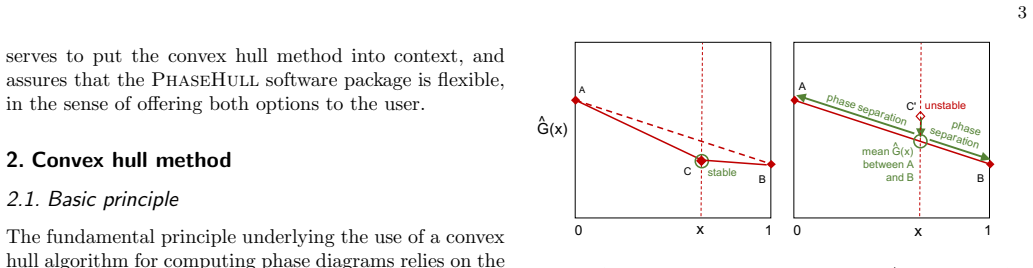
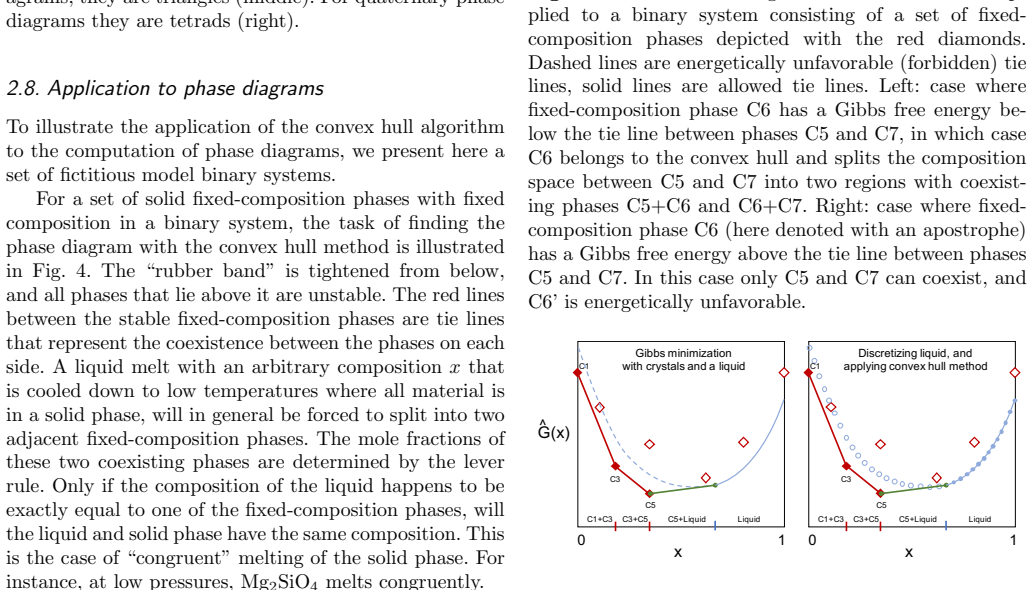
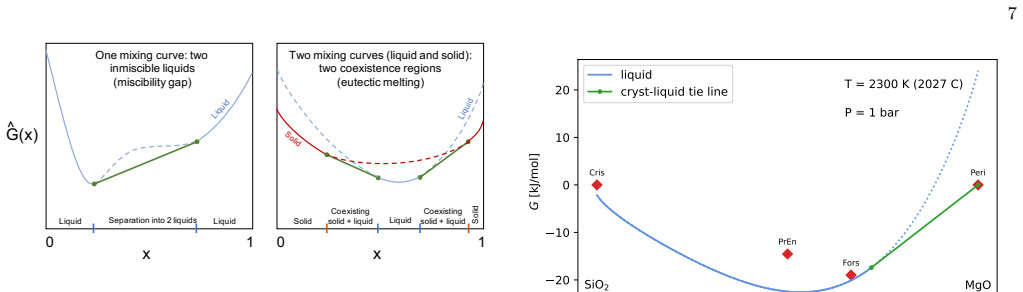
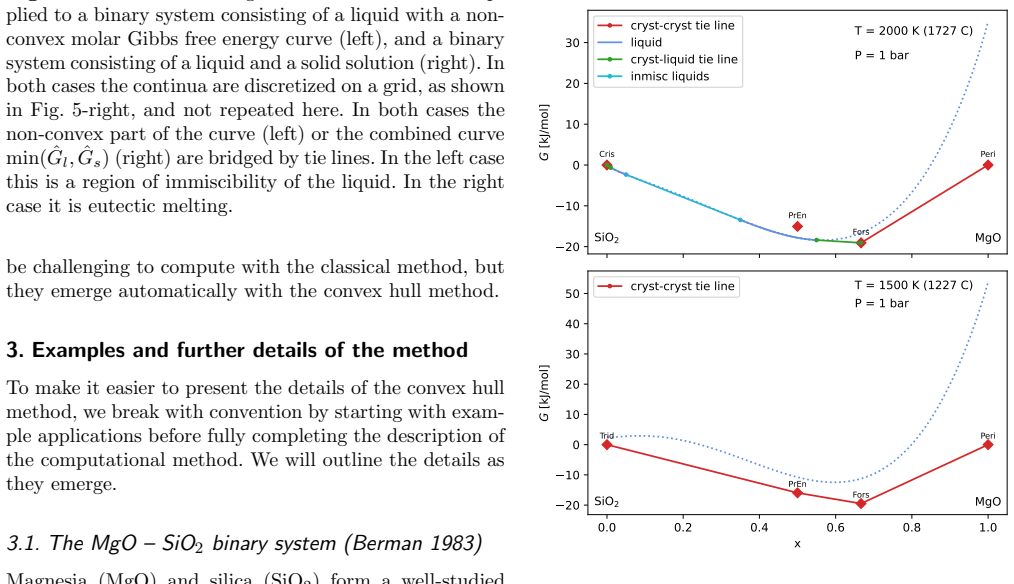
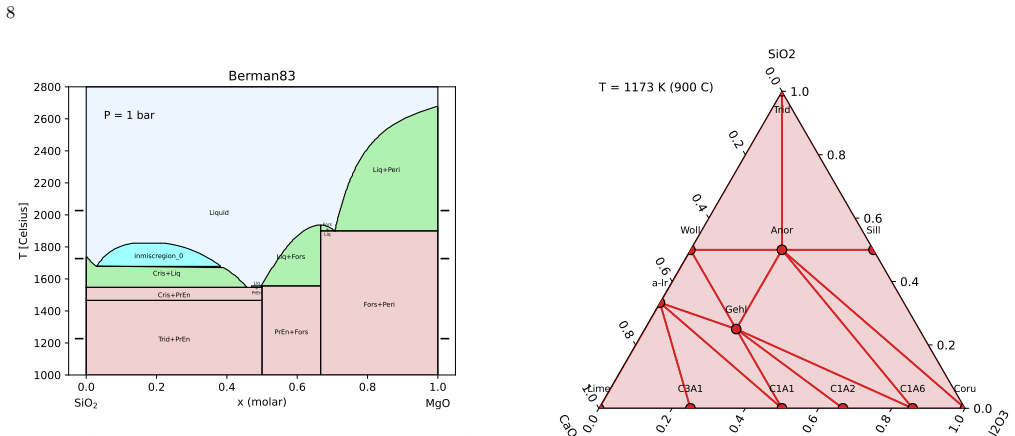
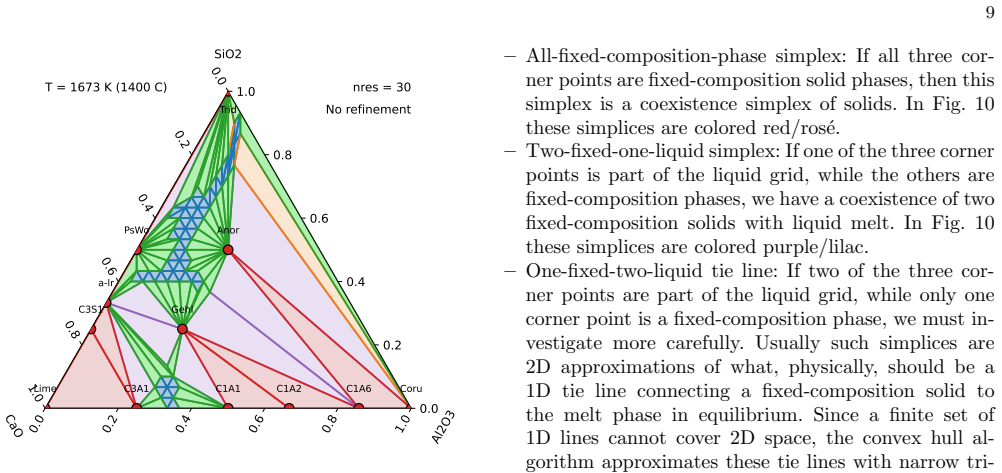
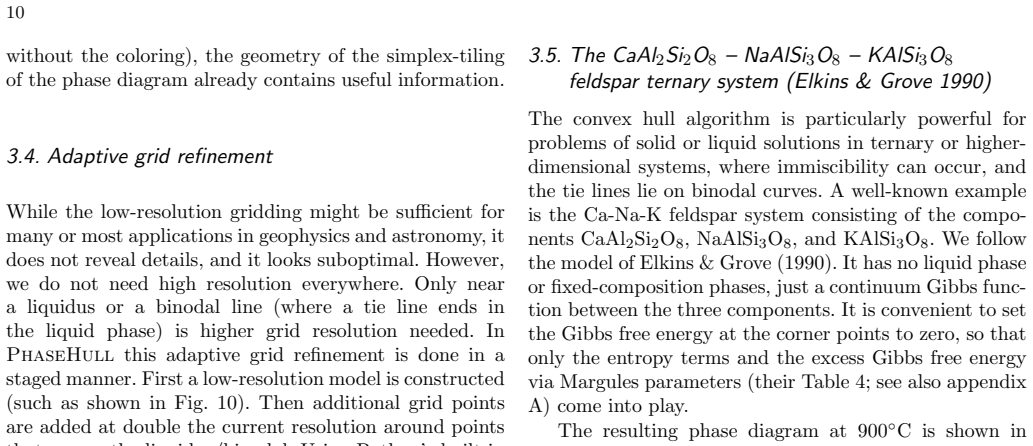
All the complexities of determining the stability or separation of phases, the localization and orientation of tie lines, as well as the determination of characteristic points, curves and surfaces such as the solidus, liquidus, solvus, and the eutectic/peritectic points etc, are taken care of by the algorithm that computes the convex hull, supplemented with an algorithm to physically classify the resulting simplices.
What carries the argument
Convex hull computation on points spanning composition and Gibbs free energy, supplemented by physical classification of the resulting simplices.
If this is right
- The method runs with the publicly available Qhull package inside SciPy.
- It remains stable and efficient for compositional systems of up to four components.
- It applies directly to phase diagrams of rocks and their melts at fixed temperature and pressure.
- Only a grid of Gibbs free energy values is needed as input.
Where Pith is reading between the lines
- Adaptive or non-uniform sampling of compositions could reduce the number of required Gibbs evaluations while preserving hull accuracy.
- The same hull-plus-classification structure might locate metastable extensions or spinodal regions if negative-curvature regions of the energy surface are retained.
- Parallel evaluation of multiple temperatures could generate full T-X sections with minimal extra code.
Load-bearing premise
Accurate Gibbs free energy values can be supplied for a sufficiently dense sampling of compositions at the chosen temperature and pressure so that the discrete convex hull faithfully represents the continuous thermodynamic surface.
What would settle it
For a known ternary or quaternary rock-melt system, supply a dense grid of accurate Gibbs free energies and check whether the hull-derived phase boundaries, tie lines, and invariant points match independent experimental measurements.
Figures
read the original abstract
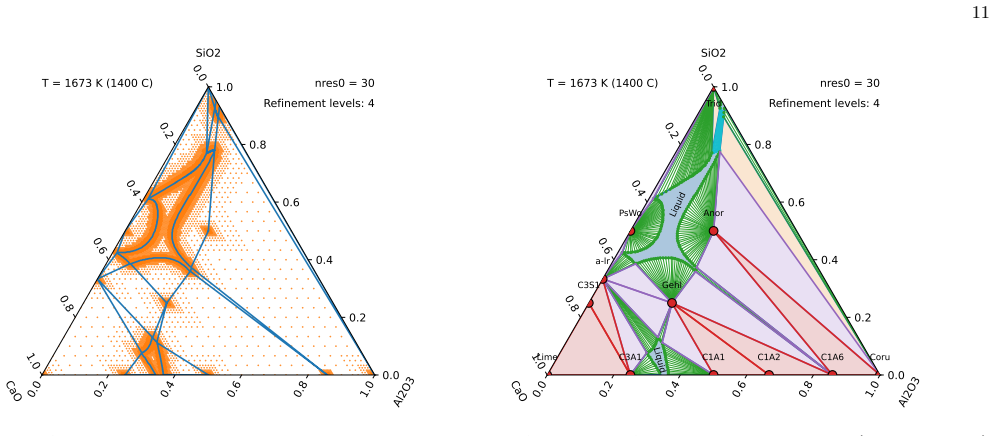
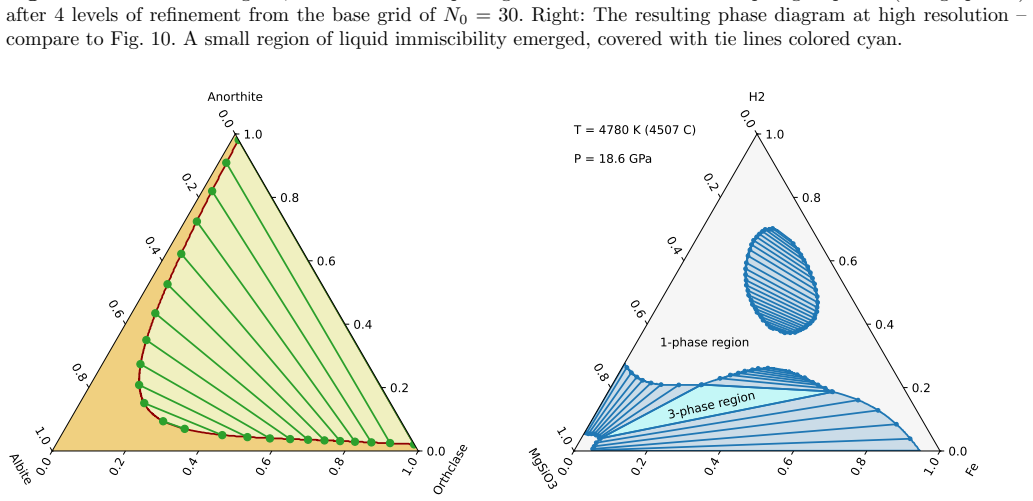
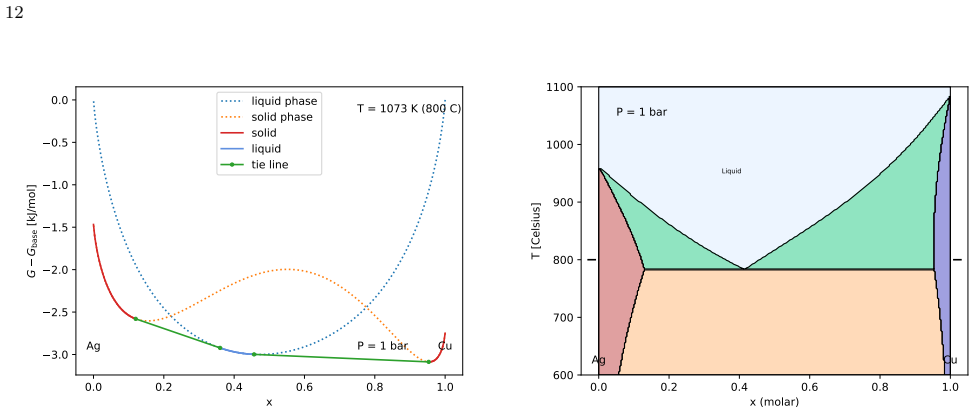
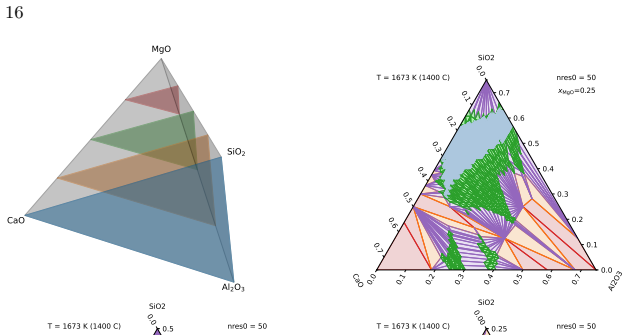
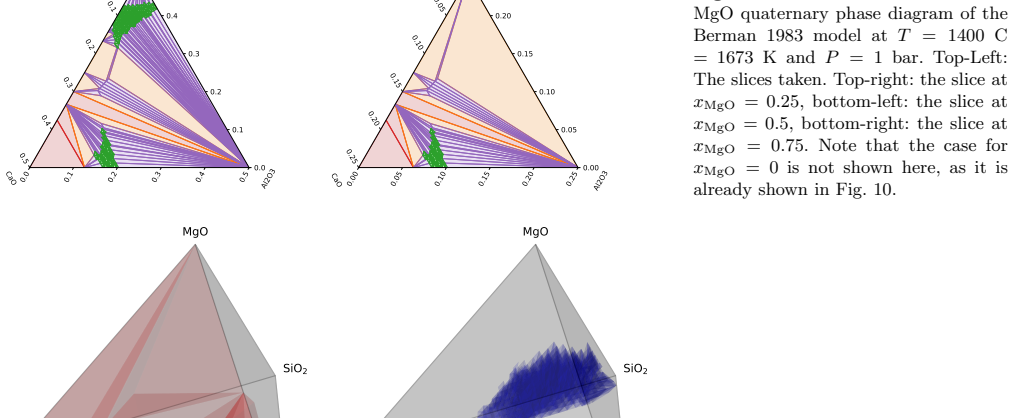
We present a simple universal computational algorithm for computing compositional phase diagrams of rocks and their melts at given temperature and pressure. It makes use of the mathematical concept of the convex hull of a set of points in the space spanned by the composition and the Gibbs free energy. All the complexities of determining the stability or separation of phases, the localization and orientation of tie lines, as well as the determination of characteristic points, curves and surfaces such as the solidus, liquidus, solvus, and the eutectic/peritectic points etc, are taken care of by the algorithm that computes the convex hull, supplemented with an algorithm to physically classify the resulting simplices. For the convex hull computation, the publicly available Qhull package can be used, which is available in SciPy. This makes this method accessible and intuitive for a broad set of scientific and educational applications. Although the method is not practical for systems of a large number of components, it is remarkably stable and efficient for systems of up to four. We present our implementation of the method as a publicly available Python package.
Editorial analysis
A structured set of objections, weighed in public.
Referee Report
Summary. The manuscript presents a method to compute compositional phase diagrams at fixed T and P by constructing the lower convex hull of discrete points in composition-Gibbs-energy space using an external algorithm (Qhull), followed by physical classification of the resulting simplices; this is claimed to automatically determine phase stability, tie-line orientations, and all characteristic features (solidus, liquidus, eutectic/peritectic points, etc.) for systems with up to four components, with an accompanying open Python package.
Significance. If the discrete sampling requirement is met and the classification step is robust, the approach supplies a simple, library-based route to phase diagrams that avoids manual equilibrium calculations and is particularly suited to educational use and small-component petrologic or materials problems; the reliance on a publicly available convex-hull routine is a practical strength.
major comments (2)
- [Abstract] Abstract: the central claim that 'all the complexities of determining the stability or separation of phases, the localization and orientation of tie lines, as well as the determination of characteristic points, curves and surfaces such as the solidus, liquidus, solvus, and the eutectic/peritectic points etc, are taken care of by the algorithm' is load-bearing yet rests on the unexamined premise that the supplied discrete G values are dense enough for the computed hull to coincide with the true lower convex envelope; no quantitative sampling-density criterion, convergence test, or error estimate is supplied.
- [Implementation] Implementation section (or equivalent description of the simplex-classification step): the manuscript provides no analysis of how the classification algorithm behaves when the discrete hull is only an approximation to the continuous G(x) surface, leaving numerical robustness (spurious phases, misoriented tie lines, or shifted invariant points) unquantified.
minor comments (2)
- [Abstract] The limitation to four components is stated but not accompanied by a scaling analysis or timing benchmarks that would help readers judge practical boundaries.
- [Discussion] No comparison is made to existing phase-diagram codes that also employ convex-hull or Gibbs-energy minimization methods; a brief discussion would clarify the incremental contribution.
Simulated Author's Rebuttal
We thank the referee for their constructive comments, which highlight important aspects of the method's assumptions. We address each major comment below.
read point-by-point responses
-
Referee: [Abstract] Abstract: the central claim that 'all the complexities of determining the stability or separation of phases, the localization and orientation of tie lines, as well as the determination of characteristic points, curves and surfaces such as the solidus, liquidus, solvus, and the eutectic/peritectic points etc, are taken care of by the algorithm' is load-bearing yet rests on the unexamined premise that the supplied discrete G values are dense enough for the computed hull to coincide with the true lower convex envelope; no quantitative sampling-density criterion, convergence test, or error estimate is supplied.
Authors: We agree that the method's accuracy depends on the discrete points providing a sufficiently dense sampling of the composition-Gibbs energy space. The algorithm computes the exact convex hull of the supplied points and classifies the resulting simplices; any deviation from the true continuous envelope arises from the input sampling rather than the hull computation itself. The manuscript demonstrates the approach on specific, adequately sampled systems but does not supply a universal quantitative criterion, as the required density depends on the curvature of G(x). In the revised manuscript we will add a dedicated paragraph in the Implementation section with practical guidelines for grid selection and an explicit convergence example for a binary system. revision: yes
-
Referee: [Implementation] Implementation section (or equivalent description of the simplex-classification step): the manuscript provides no analysis of how the classification algorithm behaves when the discrete hull is only an approximation to the continuous G(x) surface, leaving numerical robustness (spurious phases, misoriented tie lines, or shifted invariant points) unquantified.
Authors: We acknowledge that the current text does not quantify the robustness of the simplex-classification step under finite sampling. The classification identifies stable phases and tie lines from the lower-hull facets; artifacts can appear only if the input grid is too coarse relative to the curvature of G(x). Our presented examples use grids that avoid such artifacts, but we agree an explicit discussion strengthens the paper. We will revise the Implementation section to include a short analysis of potential numerical issues, together with a practical recommendation that users verify convergence by successively refining the composition grid. revision: yes
Circularity Check
No significant circularity; external convex-hull algorithm applied to independent G inputs
full rationale
The paper presents a computational procedure that feeds independently supplied Gibbs free energy values (at discrete compositions, fixed T and P) into the standard Qhull convex-hull routine and then classifies the resulting simplices. No derivation, equation, or central claim reduces to a fitted parameter, a self-definition, or a self-citation chain; the thermodynamic features are asserted to emerge directly from the geometry of the lower convex envelope. The method therefore contains no load-bearing step that is equivalent to its inputs by construction. The only substantive assumption (dense, accurate G sampling) is an external requirement on the data, not a circularity in the algorithm itself.
Axiom & Free-Parameter Ledger
axioms (1)
- domain assumption The lower convex hull of discrete Gibbs free energy points in composition space identifies the thermodynamically stable phases and their coexistence regions.
Reference graph
Works this paper leans on
-
[1]
and Perim, Eric and Takeuchi, Ichiro and Sanvito, Stefano and Scheffler, Matthias and Lederer, Yoav and Levy, Ohad and Toher, Cormac and Curtarolo, Stefano , title =
Oses, Corey and Gossett, Eric and Hicks, David and Rose, Frisco and Mehl, Michael J. and Perim, Eric and Takeuchi, Ichiro and Sanvito, Stefano and Scheffler, Matthias and Lederer, Yoav and Levy, Ohad and Toher, Cormac and Curtarolo, Stefano , title =. Journal of Chemical Information and Modeling , volume =. 2018 , doi =
2018
-
[2]
European Physical Journal B , keywords =
First-principles study of CsVTe half-Heusler alloy aimed at spintronic and thermoelectric uses. European Physical Journal B , keywords =. doi:10.1140/epjb/s10051-025-00960-z , adsurl =
-
[3]
Journal of Solid State Chemistry France , year = 2011, month = feb, volume =
CO _ 2 capture properties of M-C-O-H ( M=Li, Na, K) systems: A combined density functional theory and lattice phonon dynamics study. Journal of Solid State Chemistry France , year = 2011, month = feb, volume =. doi:10.1016/j.jssc.2010.12.005 , adsurl =
-
[4]
Russian Journal of Physical Chemistry A , year = 2010, month = apr, volume =
A universal method for calculating isobaric-isothermal sections of ternary system phase diagrams. Russian Journal of Physical Chemistry A , year = 2010, month = apr, volume =. doi:10.1134/S0036024410040011 , adsurl =
-
[5]
First-principles interatomic potentials for transition-metal aluminides. III. Extension to ternary phase diagrams. , keywords =. doi:10.1103/PhysRevB.62.3648 , adsurl =
-
[6]
Journal of Materials Research , year = 2008, month = may, volume =
Phase stability and cohesive properties of Au Sn intermetallics: A first-principles study. Journal of Materials Research , year = 2008, month = may, volume =. doi:10.1557/JMR.2008.0175 , adsurl =
-
[7]
Qhull: Quickhull algorithm for computing the convex hull
-
[8]
Chemical mass transfer in magmatic processes IV. A revised and internally consistent thermodynamic model for the interpolation and extrapolation of liquid-solid equilibria in magmatic systems at elevated temperatures and pressures. Contributions to Mineralogy and Petrology , year = 1995, month = mar, volume =. doi:10.1007/BF00307281 , adsurl =
-
[9]
Contributions to Mineralogy and Petrology , keywords =
A regular solution model for met-aluminous silicate liquids: Applications to geothermometry, immiscibility, and the source regions of basic magmas. Contributions to Mineralogy and Petrology , keywords =. doi:10.1007/BF00374706 , adsurl =
-
[10]
Earth and Planetary Science Letters , year = 2005, month = jul, volume =
Computation of phase equilibria by linear programming: A tool for geodynamic modeling and its application to subduction zone decarbonation. Earth and Planetary Science Letters , year = 2005, month = jul, volume =. doi:10.1016/j.epsl.2005.04.033 , adsurl =
-
[11]
, year = 1984, month = apr, volume =
A thermodynamic model for multicomponent melts, with application to the system CaO-Al _ 2 O _ 3 -SiO _ 2. , year = 1984, month = apr, volume =. doi:10.1016/0016-7037(84)90094-2 , adsurl =
-
[12]
A thermodynamic model for multicomponent melts, with application to the system CAO-MGO-AL2O3-SIO2
-
[13]
Journal of Petrology , year = 1988, month = apr, volume =
Internally-Consistent Thermodynamic Data for Minerals in the System Na2O-K2O-CaO-MgO-FeO-Fe2O3-Al2O3-SiO2-TiO2-H2O-CO2. Journal of Petrology , year = 1988, month = apr, volume =. doi:10.1093/petrology/29.2.445 , adsurl =
-
[14]
Contributions to Mineralogy and Petrology , keywords =
Activity-composition relations for phases in petrological calculations: an asymmetric multicomponent formulation. Contributions to Mineralogy and Petrology , keywords =. doi:10.1007/s00410-003-0464-z , adsurl =
-
[15]
M.Z. Chu and Y.Z. Qin and T. Xiao and W. Shen and T. Su and C.H. Hu and Chengying Tang , keywords =. Thermodynamic reassessment of the Ag–Cu phase diagram at nano-scale , journal =. 2021 , issn =. doi:https://doi.org/10.1016/j.calphad.2020.102233 , url =
-
[16]
Fultz, Brent , title =
-
[17]
Prediction and Calculation of Crystal Structures , publisher =
Hautier, Geoffroy , title =. Prediction and Calculation of Crystal Structures , publisher =. 2014 , editor =
2014
-
[18]
Computational Materials Science , volume =
Python Materials Genomics (pymatgen): A robust, open-source python library for materials analysis , author =. Computational Materials Science , volume =. 2013 , issn =. doi:https://doi.org/10.1016/j.commatsci.2012.10.028 , url =
-
[19]
Earth and Planetary Science Letters , keywords =
A vaporization model for iron/silicate fractionation in the Mercury protoplanet. Earth and Planetary Science Letters , keywords =. doi:10.1016/0012-821X(87)90196-8 , adsurl =
-
[20]
Journal of Metamorphic Geology , year = 1990, month = jan, volume =
An enlarged and updated internally consistent thermodynamic dataset with uncertainties and correlations: the system K2O?Na2O?CaO?MgO?MnO?FeO?Fe2O3?Al2O3?TiO2?SiO2?C?H2?O2. Journal of Metamorphic Geology , year = 1990, month = jan, volume =. doi:10.1111/j.1525-1314.1990.tb00458.x , adsurl =
-
[21]
Mao, Huahai and Hillert, Mats and Selleby, Malin and Sundman, Bo , title =. Journal of the American Ceramic Society , volume =. doi:https://doi.org/10.1111/j.1551-2916.2005.00698.x , url =. https://ceramics.onlinelibrary.wiley.com/doi/pdf/10.1111/j.1551-2916.2005.00698.x , abstract =
-
[22]
Journal of the American Ceramic Society , volume =
Tan, Jing and Shi, Chenying and Liu, Yuling and Deng, Tengfei and Wu, Qing and Du, Yong , title =. Journal of the American Ceramic Society , volume =. doi:https://doi.org/10.1111/jace.19895 , url =. https://ceramics.onlinelibrary.wiley.com/doi/pdf/10.1111/jace.19895 , abstract =
-
[23]
Elkins, L. T. and Grove, T. L. , title =. American Mineralogist , year =
-
[24]
Introducing the ECCOPLANETS code
Revisiting equilibrium condensation and rocky planet compositions. Introducing the ECCOPLANETS code. , keywords =. doi:10.1051/0004-6361/202244850 , archivePrefix =. 2307.00914 , primaryClass =
-
[25]
Forming Chondrules in Impact Splashes II Volatile Retention. , keywords =. doi:10.3847/0004-637X/832/1/91 , archivePrefix =. 1608.03540 , primaryClass =
-
[26]
, title =
Risch, Timothy K. , title =. 2021 , OPTkey =
2021
-
[27]
doi:10.5281/zenodo.11068993 , url =
Yuji Ikeda , title =. doi:10.5281/zenodo.11068993 , url =
-
[28]
and Dobkin, D.P
Barber, C.B. and Dobkin, D.P. and Huhdanpaa, H.T. , title = ". ACM Transactions on Mathematical Software , year = 1996, volume =
1996
-
[29]
and Haberland, Matt and Reddy, Tyler and Cournapeau, David and Burovski, Evgeni and Peterson, Pearu and Weckesser, Warren and Bright, Jonathan and
Virtanen, Pauli and Gommers, Ralf and Oliphant, Travis E. and Haberland, Matt and Reddy, Tyler and Cournapeau, David and Burovski, Evgeni and Peterson, Pearu and Weckesser, Warren and Bright, Jonathan and. Nature Methods , year =
-
[30]
Charles R. Harris and K. Jarrod Millman and St. Array programming with. 2020 , month = sep, journal =. doi:10.1038/s41586-020-2649-2 , publisher =
-
[31]
Hunter, J. D. , Title =. Computing in Science & Engineering , Volume =
-
[32]
Differentiation, the Exception, Not the Rule: Evidence for Full Miscibility in Sub-Neptune Interiors. , keywords =. doi:10.3847/PSJ/ae1012 , archivePrefix =. 2507.00947 , primaryClass =
-
[33]
American Mineralogist , year =
Gasparik, Tibor , title =. American Mineralogist , year =
-
[34]
The Effects of Non-ideal Mixing in Planetary Magma Oceans and Atmospheres. , keywords =. doi:10.3847/1538-4357/ae434d , archivePrefix =. 2602.05917 , primaryClass =
-
[35]
Saxena, S. K. , title =. Contributions to Mineralogy and Petrology , year =
-
[36]
Saxena, S. K. and Sykes, J. and Eriksson, G. , title =. Journal of Petrology , year =
discussion (0)
Sign in with ORCID, Apple, or X to comment. Anyone can read and Pith papers without signing in.