Calling the Brane Next Door: The Kaluza-Klein Tower as a Gravitational Information Channel
Pith reviewed 2026-06-27 15:31 UTC · model grok-4.3
The pith
The Kaluza-Klein tower of massive gravitons supplies propagating subchannels that can carry information between neighbouring branes.
A machine-rendered reading of the paper's core claim, the machinery that carries it, and where it could break.
Core claim
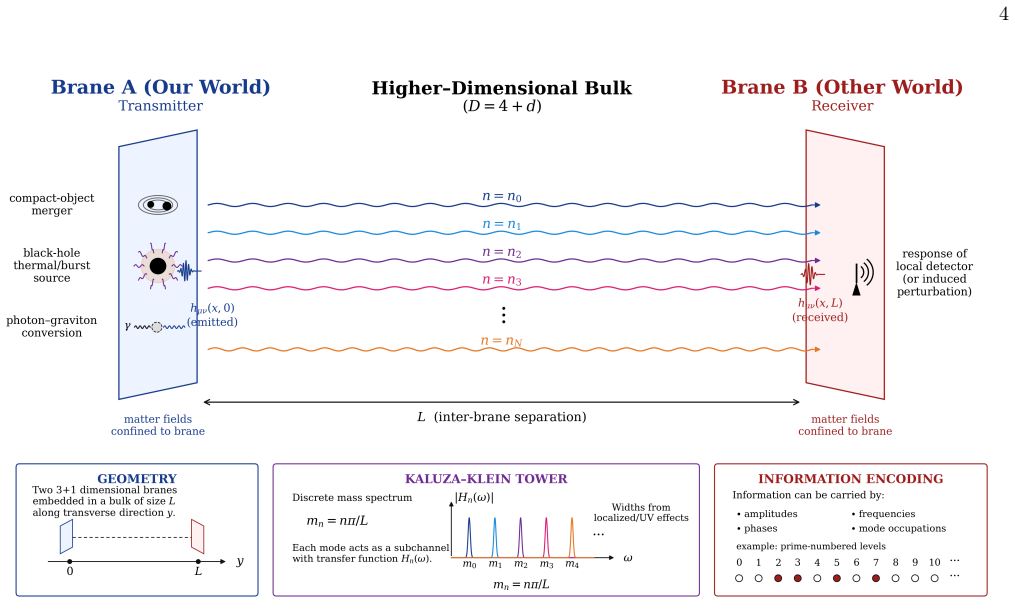
In the minimal framework, the brane-to-brane graviton propagator defines a retarded transfer kernel whose structure changes at each Kaluza-Klein mass threshold. Below the first threshold the channel reduces to the four-dimensional massless graviton. Above threshold the massive modes open as additional propagating subchannels, allowing information to be encoded in occupation numbers, phases and timing. The compactification parameters determine the masses, wavefunctions, brane overlaps and propagation phases that together form the entries of a MIMO channel matrix. In the limit where individual modes are resolved these subchannels behave as approximately parallel links to which capacity bounds
What carries the argument
The retarded transfer kernel obtained from the brane-to-brane graviton propagator, which organises the Kaluza-Klein tower into the entries of a multi-input multi-output channel matrix.
Load-bearing premise
The structure of the brane-to-brane graviton propagator permits direct use of information-theoretic tools such as capacity bounds on the resulting transfer kernel, independently of specific production and detection mechanisms.
What would settle it
A measurement of gravitational signals displaying a tower of massive modes with masses and relative couplings matching a compact extra dimension, together with correlations in phase or timing that cannot be explained by four-dimensional physics alone.
Figures
read the original abstract
Could two worlds localised on neighbouring branes communicate through gravity alone? We investigate this question in a minimal higher-dimensional framework in which Standard Model fields are confined to our brane while gravity propagates through the bulk. From the brane-to-brane graviton propagator we derive the retarded transfer kernel of the inter-brane link and identify the transition from evanescent to propagating Kaluza-Klein modes. The central idea is to give the Kaluza-Klein tower a new role: not only as a spectrum of massive gravitational states, but as a set of communication carriers. Below the first KK threshold the channel is effectively four-dimensional and is mediated only by the massless graviton. Above threshold, massive KK modes open as additional propagating subchannels, and information may be encoded in their occupation pattern, relative phases, and arrival-time structure as well as in ordinary signal variables. The compactification determines the KK masses, wavefunctions, brane overlap factors, and propagation phases, which together define a multi-input multi-output (MIMO) channel matrix. In the resolved-mode limit, the tower yields approximate parallel subchannels, to which standard information-theoretic notions such as capacity bounds, water-filling, effective rank, and sparse occupancy codes apply. The production and detection of such signals are highly model-dependent and not assumed to be feasible with known technology. Nevertheless, the channel structure is well defined: a neighbouring brane-world could be separated from us by a microscopic distance in the compact space while remaining hidden because the only shared interaction is gravity. The first observable signature may not be a deliberate message, but the spectral and modal structure of the Kaluza-Klein tower itself, revealing partial information about the geometry of a nearby hidden world.
Editorial analysis
A structured set of objections, weighed in public.
Referee Report
Summary. The manuscript proposes that gravity propagating in the bulk between two neighboring branes can be reinterpreted as a communication channel. From the standard brane-to-brane graviton propagator it identifies a retarded transfer kernel whose structure changes at each KK threshold: below the first massive mode the channel is effectively 4D and mediated only by the massless graviton; above threshold the KK tower supplies additional propagating subchannels whose masses, wavefunctions, brane overlaps and propagation phases are fixed by the compactification. The resulting map is presented as a MIMO channel matrix to which capacity bounds, water-filling and rank notions can be applied, with information potentially encoded in modal occupation, phases and arrival times. Production and detection mechanisms are declared model-dependent and outside the scope of the analysis.
Significance. If the central reinterpretation were made fully explicit, the work would supply a concrete link between the linear structure of KK gravity and standard information-theoretic channel models, allowing quantitative statements about effective rank and capacity in terms of compactification parameters alone. At present the manuscript remains at the level of a conceptual outline; the absence of an explicit kernel or matrix prevents any concrete capacity calculation or falsifiable prediction from being extracted.
major comments (2)
- [Abstract] Abstract and introduction: the claim that 'from the brane-to-brane graviton propagator we derive the retarded transfer kernel' is not accompanied by any explicit expression for that kernel, the associated channel matrix, or the mapping from KK parameters to subchannel gains and delays. Without this derivation the subsequent application of MIMO capacity formulas remains unsupported.
- [Abstract] The statement that the channel properties are 'fixed by the compactification parameters' is correct for the standard KK decomposition, but the manuscript does not demonstrate that this decomposition yields a linear retarded kernel to which water-filling or capacity bounds apply independently of production and detection; the weakest assumption identified in the stress-test therefore remains unaddressed.
Simulated Author's Rebuttal
We thank the referee for the careful and constructive report. We agree that the current manuscript is primarily conceptual and that the absence of explicit expressions for the retarded kernel and channel matrix leaves the information-theoretic claims unsupported in detail. We will revise accordingly to address both major comments.
read point-by-point responses
-
Referee: [Abstract] Abstract and introduction: the claim that 'from the brane-to-brane graviton propagator we derive the retarded transfer kernel' is not accompanied by any explicit expression for that kernel, the associated channel matrix, or the mapping from KK parameters to subchannel gains and delays. Without this derivation the subsequent application of MIMO capacity formulas remains unsupported.
Authors: We acknowledge that the manuscript states the derivation from the brane-to-brane graviton propagator but does not supply the explicit form of the retarded transfer kernel, the resulting MIMO matrix, or the explicit mapping of KK masses, overlaps, and phases to subchannel gains and delays. The standard KK decomposition of the higher-dimensional propagator does yield such a linear map, but this step is not carried out in the text. In the revision we will add a dedicated section that starts from the known brane-to-brane graviton propagator, performs the KK mode expansion, and extracts the explicit retarded kernel together with the channel matrix elements determined by the compactification parameters. revision: yes
-
Referee: [Abstract] The statement that the channel properties are 'fixed by the compactification parameters' is correct for the standard KK decomposition, but the manuscript does not demonstrate that this decomposition yields a linear retarded kernel to which water-filling or capacity bounds apply independently of production and detection; the weakest assumption identified in the stress-test therefore remains unaddressed.
Authors: The linear response of the bulk is fixed by the propagator and therefore independent of the (model-dependent) production and detection mechanisms on each brane; the KK decomposition supplies the modal basis in which this linear map becomes a MIMO channel. We agree, however, that the manuscript does not explicitly construct the kernel or show that standard capacity formulas apply to it. In the revision we will (i) write the explicit linear map, (ii) note that water-filling and rank notions are properties of this map alone, and (iii) clarify that concrete numerical capacity values would additionally require production/detection efficiencies, which we continue to treat as outside the scope. revision: yes
Circularity Check
No significant circularity identified
full rationale
The paper starts from the standard brane-to-brane graviton propagator in a higher-dimensional setup with SM fields on the brane and derives the retarded transfer kernel, identifying the transition to propagating KK modes above threshold. It then applies standard linear algebra and information theory (MIMO matrix, capacity bounds, water-filling) to the resulting structure whose entries are fixed by the usual compactification parameters (masses, wavefunctions, overlaps). This is a reinterpretation of an existing linear map rather than a self-definitional loop, a fitted parameter renamed as prediction, or a load-bearing self-citation. The production/detection mechanisms are explicitly treated as external and model-dependent, so the channel definition does not reduce to its own outputs. No steps match the enumerated circularity patterns.
Axiom & Free-Parameter Ledger
axioms (1)
- domain assumption Standard Model fields are confined to our brane while gravity propagates through the bulk.
Forward citations
Cited by 1 Pith paper
-
A Solar-System Window for Hidden Stellar Companions
The paper builds an illustrative mass-distance window for hidden-brane companions and finds overlap with the minimum mass of a QCD-scaled hidden star at the upper end of the allowed range.
Reference graph
Works this paper leans on
-
[1]
whether the characteristic frequency lies below or above the first KK threshold
-
[2]
whether the source excites one mode, a few resolved modes, or a broad range of KK levels
-
[3]
For the benchmark valueL= 0.1µm, the first KK threshold is (cf
whether the emitted state is coherent and control- lable, or thermal and stochastic. For the benchmark valueL= 0.1µm, the first KK threshold is (cf. Eq. (30)) ν1 ≃1.5×10 15 Hz, m 1c2 ≃6 eV.(56) This is only a reference scale; for a different compactifi- cation length all frequencies rescale asL−1. A. Compact-object mergers: high power, zero-mode dominated...
-
[4]
neighbouring KK levels are spectrally distinguish- able
-
[5]
mode mixing and cross-talk are negligible during the communication time
-
[6]
the receiver can project onto the relevant KK basis
-
[7]
These conditions are plausible in the ideal flat interval at moderate frequencies, but they must be checked in any concrete compactification and detector model
the noise covariance is approximately diagonal in that basis. These conditions are plausible in the ideal flat interval at moderate frequencies, but they must be checked in any concrete compactification and detector model. In this limit the channel matrix is approximately diag- onal,H mn ≃δ mnHn, and the MIMO bound reduces to a parallel-channel estimate, ...
-
[8]
Zum Unitätsproblem der Physik,
T. Kaluza, “Zum Unitätsproblem der Physik,” Sitzungs- ber. Preuss. Akad. Wiss. Berlin (Math. Phys. )1921 (1921), 966-972 [arXiv:1803.08616 [physics.hist-ph]]
Pith/arXiv arXiv 1921
-
[9]
Quantum Theory and Five-Dimensional The- ory of Relativity. (In German and English),
O. Klein, “Quantum Theory and Five-Dimensional The- ory of Relativity. (In German and English),” Z. Phys.37 (1926), 895-906
1926
-
[10]
The Atomicity of Electricity as a Quantum Theory Law,
O. Klein, “The Atomicity of Electricity as a Quantum Theory Law,” Nature118(1926), 516
1926
-
[11]
On a Generalization of Kaluza’s Theory of Electricity,
A. Einstein and P. Bergmann, “On a Generalization of Kaluza’s Theory of Electricity,” Annals Math.39(1938), 683-701
1938
-
[12]
Six-dimensional Supersymmetric QED, R In- variance andN= 2Supersymmetry Breaking by Dimen- sional Reduction,
P. Fayet, “Six-dimensional Supersymmetric QED, R In- variance andN= 2Supersymmetry Breaking by Dimen- sional Reduction,” Nucl. Phys. B263(1986), 649-686
1986
-
[13]
A Possible new dimension at a few TeV,
I. Antoniadis, “A Possible new dimension at a few TeV,” Phys. Lett. B246(1990), 377-384, I. Antoniadis and K. Benakli, Phys. Lett. B326(1994), 69-78 [arXiv:hep- th/9310151 [hep-th]], I. Antoniadis, K. Benakli and M. Quiros, Phys. Lett. B331(1994), 313-320 [arXiv:hep- ph/9403290 [hep-ph]]
arXiv 1990
-
[14]
P. Horava and E. Witten, Nucl. Phys. B475(1996), 94- 114 [arXiv:hep-th/9603142 [hep-th]]
Pith/arXiv arXiv 1996
-
[15]
The Hierarchy problem and new dimensions at a millime- ter,
N. Arkani-Hamed, S. Dimopoulos and G. R. Dvali, “The Hierarchy problem and new dimensions at a millime- ter,” Phys. Lett. B429(1998), 263-272 [arXiv:hep- ph/9803315 [hep-ph]], I. Antoniadis, N. Arkani-Hamed, S. Dimopoulos and G. R. Dvali, “New dimensions at a millimeter to a Fermi and superstrings at a TeV,” Phys. Lett. B436(1998), 257-263 [arXiv:hep-ph/9...
arXiv 1998
-
[16]
Extra space- time dimensions and unification,
K. R. Dienes, E. Dudas and T. Gherghetta, “Extra space- time dimensions and unification,” Phys. Lett. B436 (1998), 55-65 [arXiv:hep-ph/9803466 [hep-ph]]
Pith/arXiv arXiv 1998
-
[17]
Phenomenology of low quantum grav- ity scale models,
K. Benakli, “Phenomenology of low quantum grav- ity scale models,” Phys. Rev. D60(1999), 104002 [arXiv:hep-ph/9809582 [hep-ph]], C. P. Burgess, L. E. Ibanez and F. Quevedo, “Strings at the in- termediate scale, or is the Fermi scale dual to the Planck scale?,” Phys. Lett. B447(1999), 257-265 [arXiv:hep-ph/9810535 [hep-ph]]
Pith/arXiv arXiv 1999
-
[18]
A Large mass hierarchy from a small extra dimension,
L. Randall and R. Sundrum, “A Large mass hierarchy from a small extra dimension,” Phys. Rev. Lett.83 (1999), 3370-3373 [arXiv:hep-ph/9905221 [hep-ph]]
Pith/arXiv arXiv 1999
-
[19]
The Dark Dimension and the Swampland,
M. Montero, C. Vafa and I. Valenzuela, “The Dark Dimension and the Swampland,” [arXiv:hep- th/2205.12293]
-
[20]
Capacity of multi-antenna Gaussian chan- nels,
E. Telatar, “Capacity of multi-antenna Gaussian chan- nels,”Eur. Trans. Telecommun.,10(6), 585–595 (1999); Bell Labs Technical Memo, AT&T Bell Laboratories (1995)
1999
-
[21]
A Mathematical Theory of Communi- cation
C. E. Shannon, "A Mathematical Theory of Communi- cation", Bell System Technical Journal, vol. 27, no 3, pp 379-423, 1948
1948
-
[22]
T. M. Cover and J. A. Thomas,Elements of Information Theory, 2nded.(Wiley-Interscience, Hoboken, NJ,2006)
2006
-
[23]
Challenges and opportunities of gravitational-wave searches at MHz to GHz frequencies,
N. Aggarwal, O. D. Aguiar, A. Bauswein, G. Cella, S. Clesse, A. M. Cruise, V. Domcke, D. G. Figueroa, A. Geraci and M. Goryachev,et al.“Challenges and opportunities of gravitational-wave searches at MHz to GHz frequencies,” Living Rev. Rel.24(2021) no.1, 4 [arXiv:2011.12414 [gr-qc]]
arXiv 2021
-
[24]
Can One Hear the Shape of a Drum?
M. Kac, “Can One Hear the Shape of a Drum?”, Am. Math. Mon.73(1966) no. 4, 1–23
1966
-
[25]
EigenvaluesoftheLaplaceoperatoroncertain manifolds,
J.Milnor, “EigenvaluesoftheLaplaceoperatoroncertain manifolds,” Proc. Natl. Acad. Sci. USA51, 542 (1964)
1964
discussion (0)
Sign in with ORCID, Apple, or X to comment. Anyone can read and Pith papers without signing in.