Learning the Universe: Constrained simulations of the Coma galaxy cluster -- I. Radial X-ray and Compton-y signatures
Pith reviewed 2026-06-27 15:14 UTC · model grok-4.3
The pith
Constrained simulations of Coma analogues reproduce the broad shape and normalisation of observed X-ray and Compton-y profiles.
A machine-rendered reading of the paper's core claim, the machinery that carries it, and where it could break.
Core claim
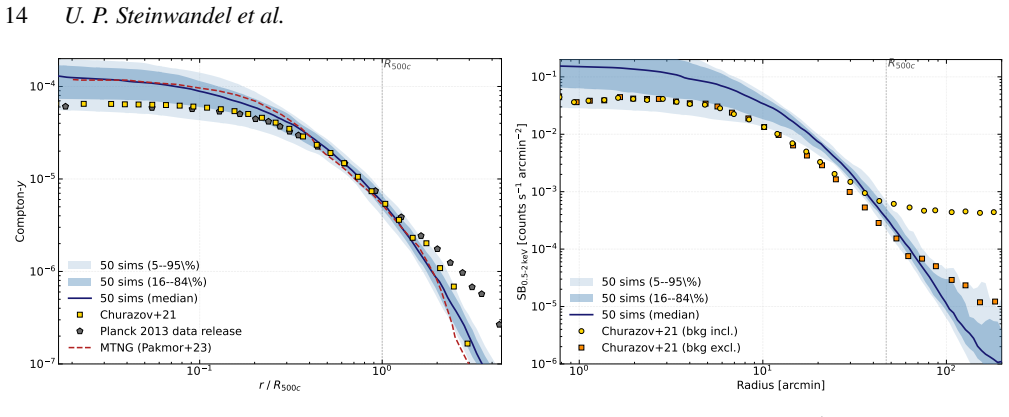
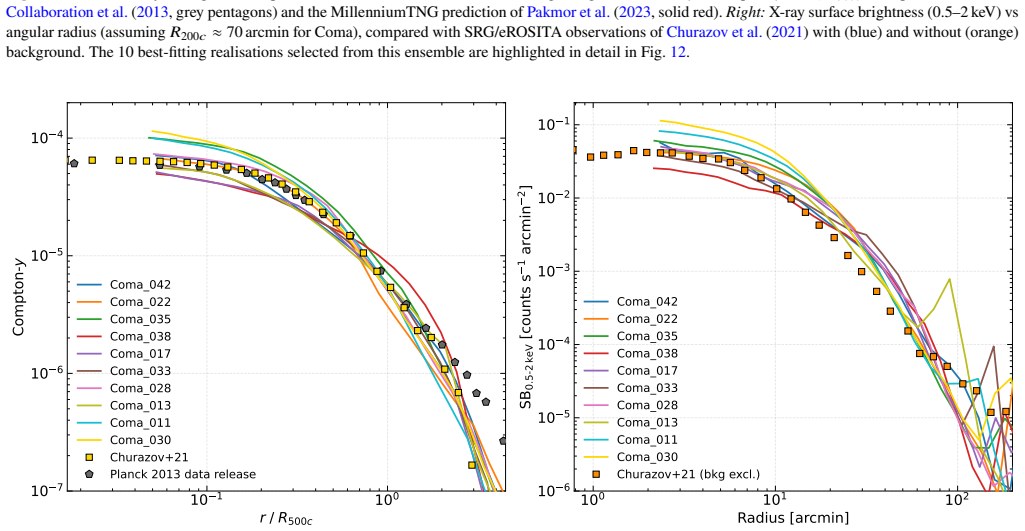
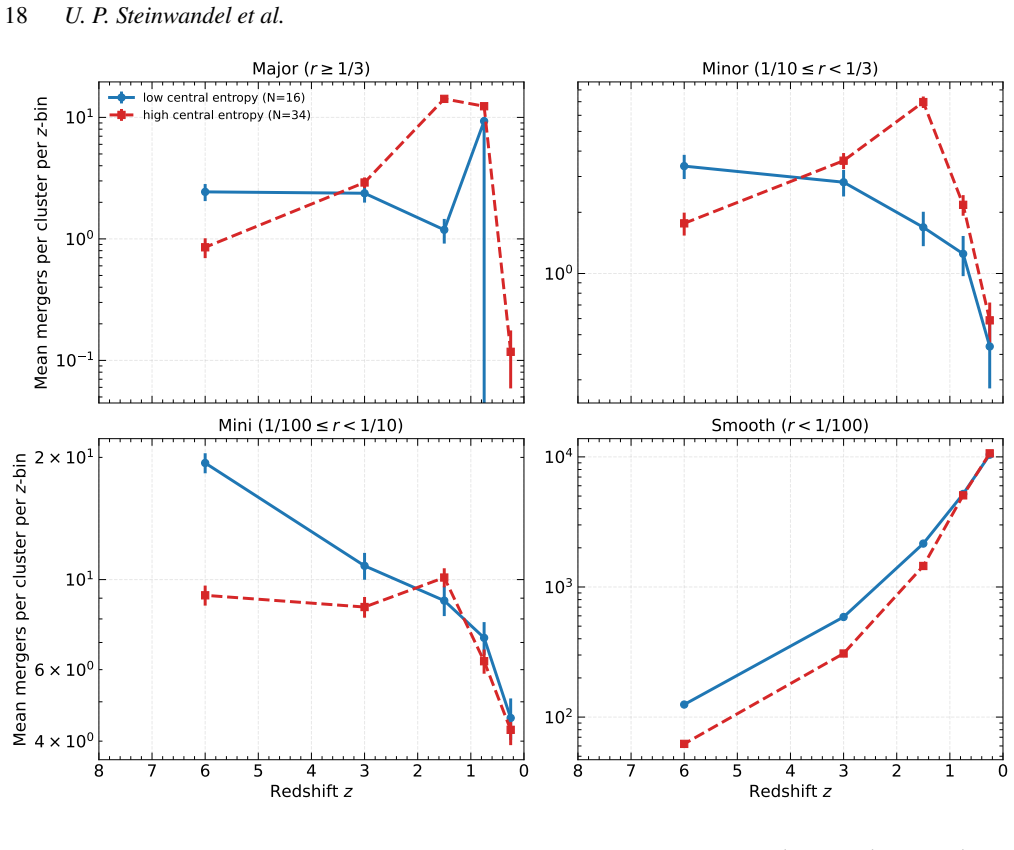
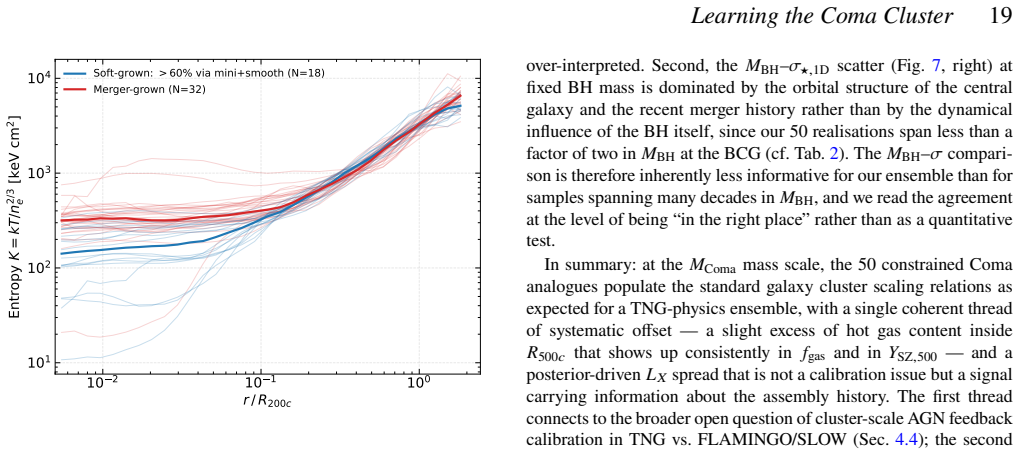
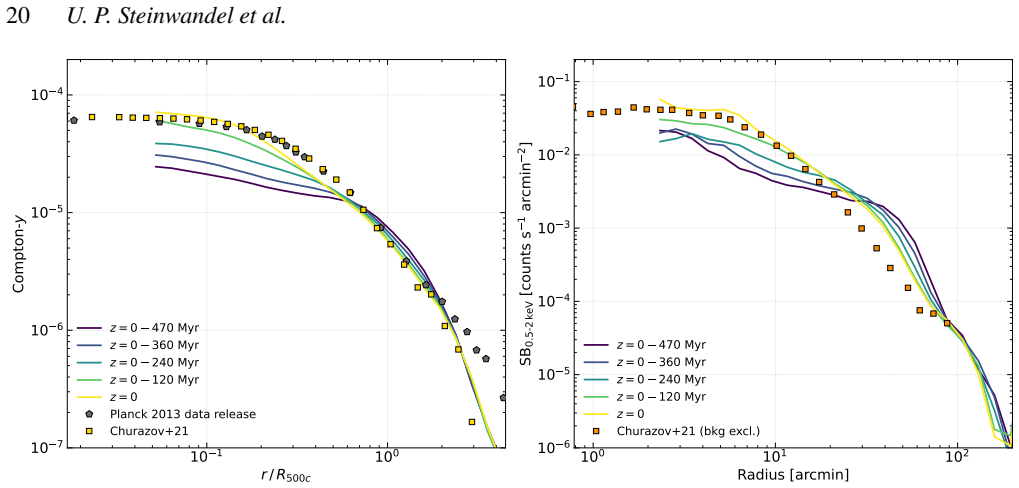
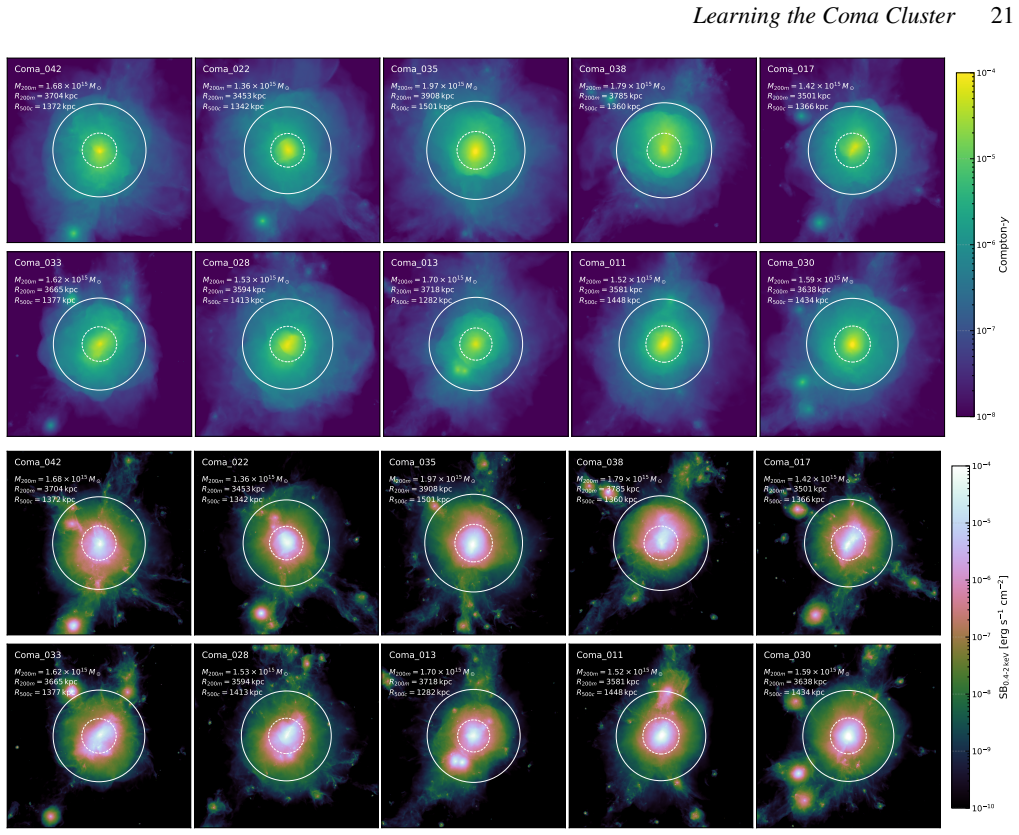
The ensemble of 50 high-fidelity Coma analogues reproduces the broad shape and normalisation of both the X-ray surface brightness profiles extracted from the simulations and the integrated Compton-y profiles, while quantifying the range of scatter expected from environmental and assembly-history variations. This match holds across the selected regions that form clusters comparable to Coma in mass and environment. The resulting dataset therefore supplies a controlled laboratory for assessing how feedback, mergers, and large-scale environment shape observable intracluster medium properties.
What carries the argument
The BORG/MANTICORE constrained initial conditions that identify regions forming Coma-like clusters, evolved forward with the IllustrisTNG galaxy formation model to produce the intracluster medium whose X-ray and thermal Sunyaev-Zel'dovich signatures are extracted.
If this is right
- The simulations enable direct assessment of how feedback processes and merger activity influence observable cluster properties.
- The ensemble supplies a statistically robust framework for interpreting Coma within its cosmological context that accounts for cosmic variance.
- The dataset can be used to test models of intracluster medium physics and to calibrate scaling relations for nearby massive clusters.
- The same strategy of constrained initial conditions plus state-of-the-art galaxy formation physics can generate targeted analogues for other observed clusters.
Where Pith is reading between the lines
- The method could be extended to build ensembles for additional nearby clusters, allowing statistical comparison of assembly histories across the local volume.
- The quantified scatter from environment may help reconcile apparent tensions between different cluster observables when samples are drawn from varying large-scale environments.
- Joint X-ray and Sunyaev-Zel'dovich analyses of future observations could be interpreted against this simulation library to tighten constraints on feedback efficiency.
Load-bearing premise
The constrained initial conditions correctly pick out regions that form clusters matching Coma in mass and environment, and the IllustrisTNG model adequately captures the intracluster medium physics needed for the X-ray and Compton-y comparisons.
What would settle it
If the full set of 50 simulated X-ray surface brightness profiles or Compton-y profiles lies systematically outside the observed eROSITA or Planck data by more than the reported scatter range, the reproduction claim would be falsified.
Figures
read the original abstract
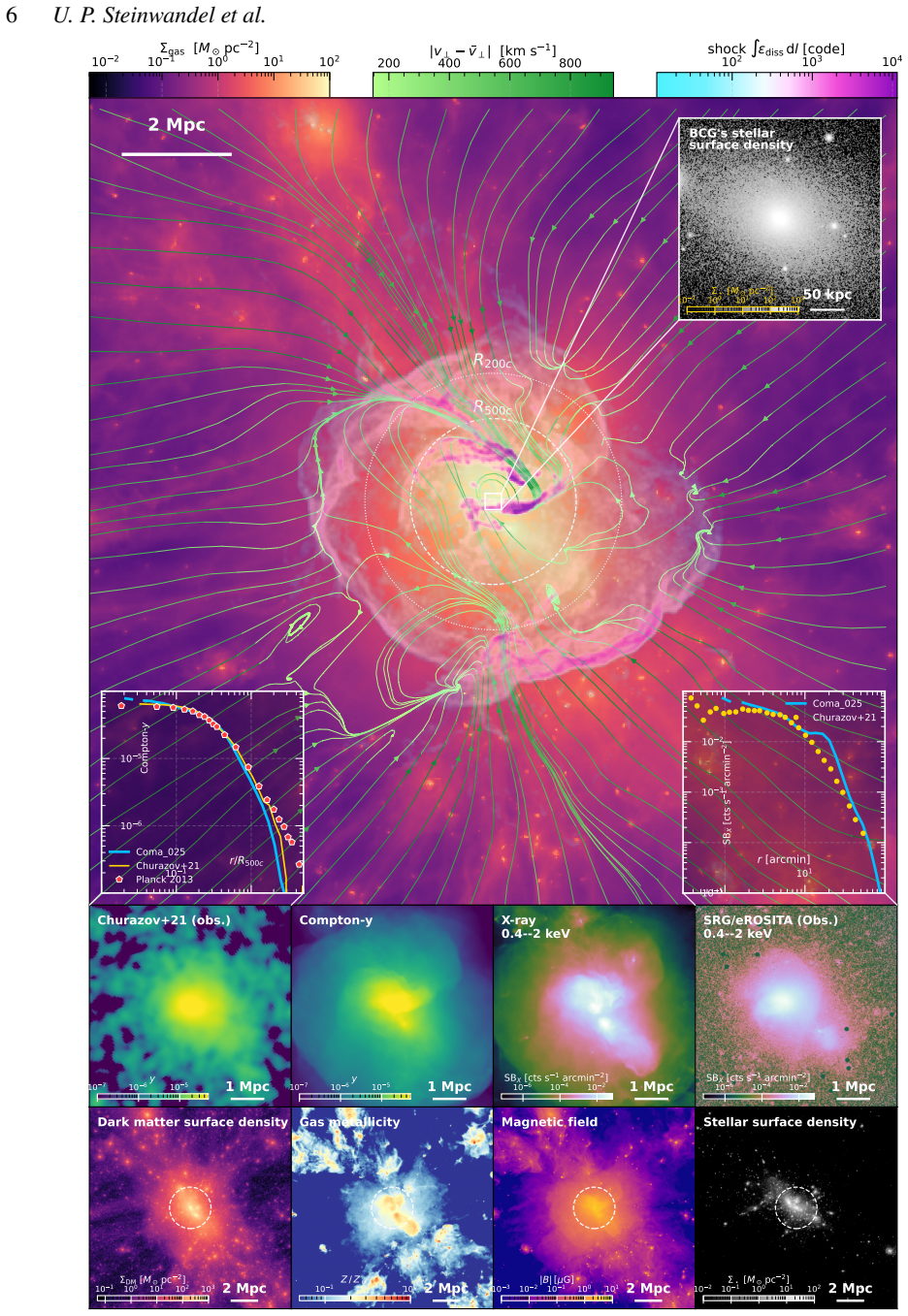
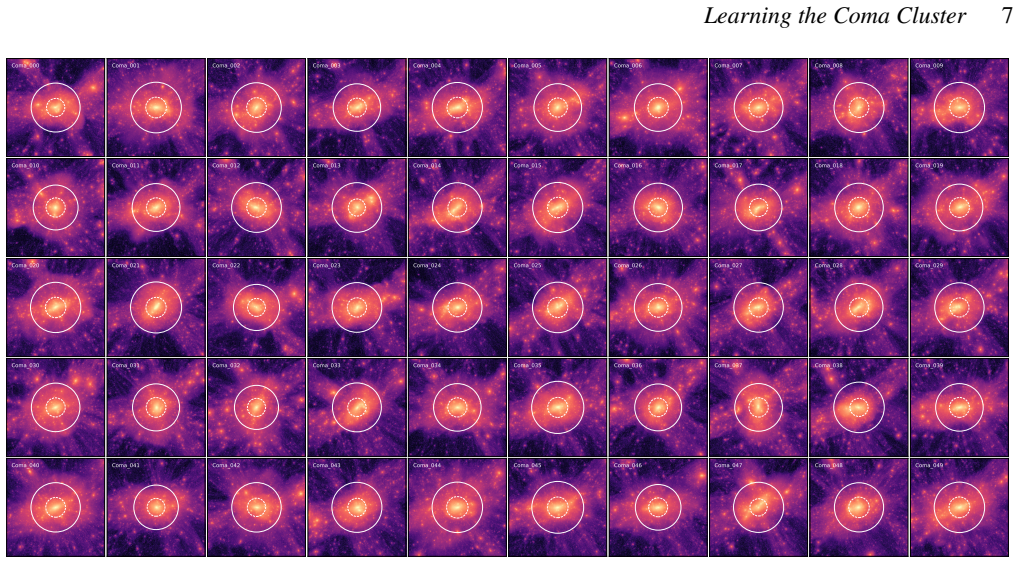
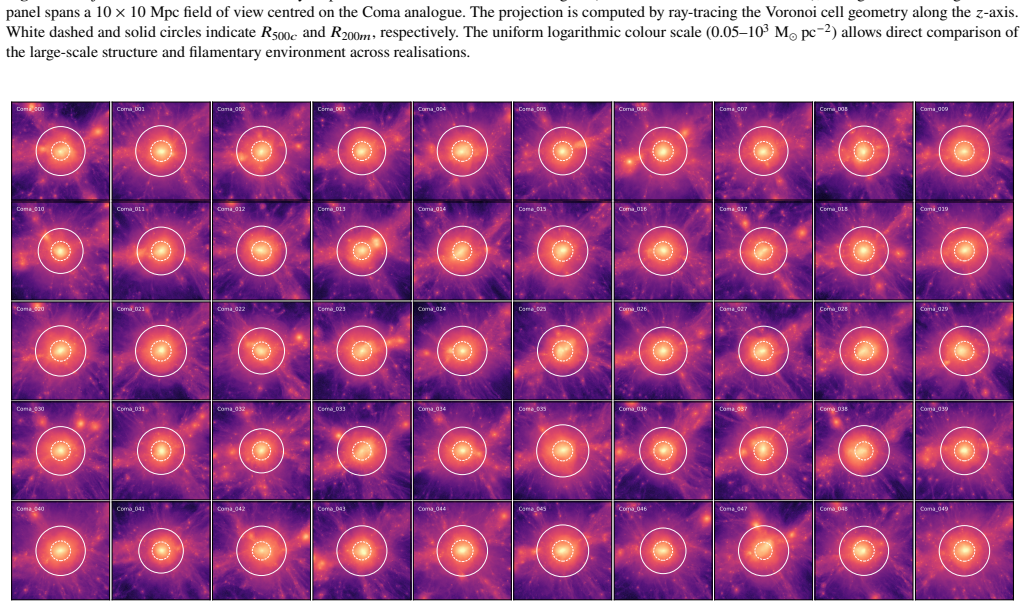
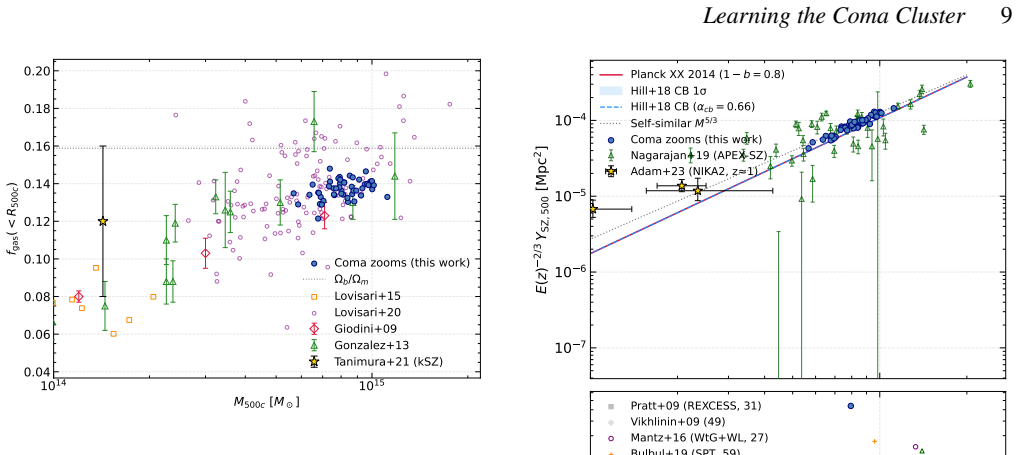
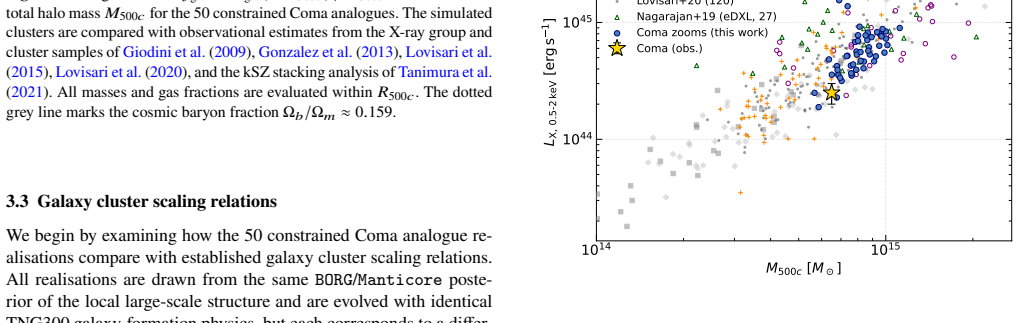
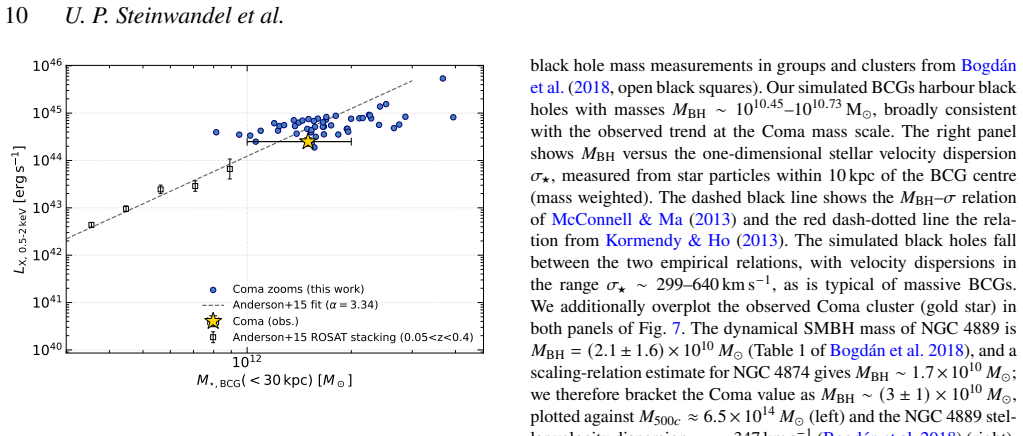
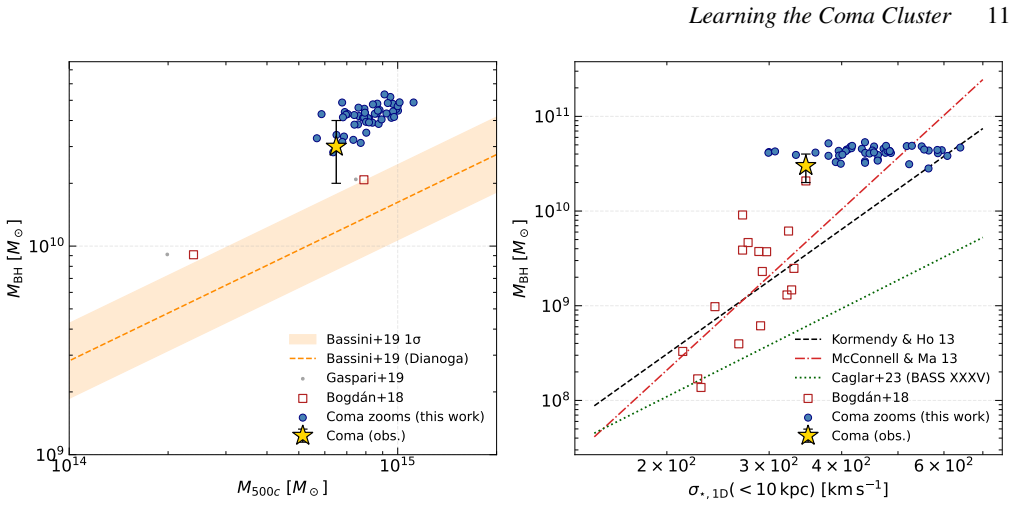
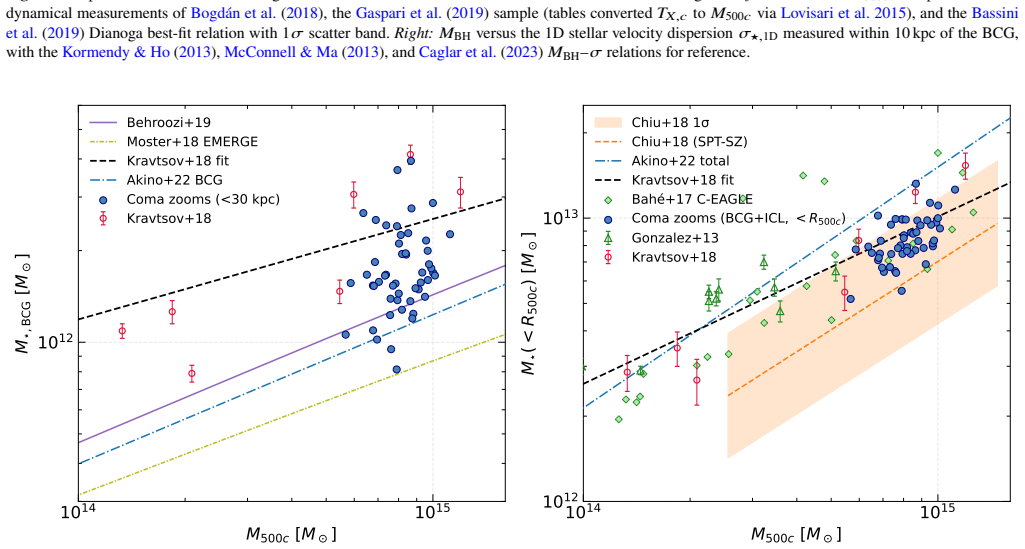
We present a suite of 50 high-fidelity simulations of Coma cluster analogues constructed from BORG/MANTICORE constrained initial conditions and evolved with the IllustrisTNG galaxy formation model. Regions predicted to form massive clusters comparable to Coma in mass and environment are selected and followed through cosmic time, producing realistic galaxy populations and intracluster medium properties. The ensemble captures both cosmic variance and uncertainties in the local initial conditions, providing a statistically robust framework for interpreting Coma in a cosmological context. We focus on direct comparisons with observed thermodynamical profiles of the intracluster medium. Specifically, we extract X-ray surface brightness profiles from the simulated clusters and confront them with measurements from eROSITA, as well as compute the thermal Sunyaev--Zel'dovich effect via integrated Compton-$y$ profiles for comparison with Planck satellite data. The simulations reproduce the broad shape and normalisation of both observables, while also highlighting the range of scatter expected from environmental and assembly history differences. This enables us to assess how feedback processes, merger activity, and large-scale environment shape observable cluster properties. Our results demonstrate that combining constrained cosmological initial conditions with state-of-the-art galaxy formation physics provides an effective strategy for generating targeted, observation-driven analogues of specific clusters. The resulting dataset offers a valuable resource for testing models of intracluster medium physics, calibrating scaling relations, and interpreting upcoming joint X-ray and Sunyaev--Zel'dovich observations of nearby massive clusters.
Editorial analysis
A structured set of objections, weighed in public.
Referee Report
Summary. The paper presents a suite of 50 high-fidelity simulations of Coma cluster analogues constructed from BORG/MANTICORE constrained initial conditions and evolved with the IllustrisTNG galaxy formation model. Regions predicted to form massive clusters comparable to Coma are selected and followed, with direct comparisons of extracted X-ray surface brightness profiles to eROSITA measurements and integrated Compton-y profiles to Planck data. The central claim is that the simulations reproduce the broad shape and normalisation of both observables while capturing the range of scatter expected from environmental and assembly history differences, demonstrating the utility of constrained ICs plus state-of-the-art galaxy formation physics for generating targeted cluster analogues.
Significance. If the result holds, the work provides a statistically robust ensemble framework for interpreting a specific observed cluster (Coma) in a cosmological context, accounting for cosmic variance and initial-condition uncertainties. This is valuable for testing ICM physics models, calibrating scaling relations, and preparing for joint X-ray/SZ observations, as the constrained approach directly ties simulations to observed large-scale structure.
major comments (1)
- [Abstract] The abstract states that the simulations 'reproduce the broad shape and normalisation' of the X-ray and Compton-y profiles but supplies no quantitative metrics (e.g., reduced chi-squared, fractional residuals, or profile-by-profile comparisons with error bars), making it impossible to evaluate how well the claim is supported or how the scatter is quantified relative to the data.
minor comments (2)
- Clarify the precise selection criteria used to identify the 50 Coma analogues from the BORG/MANTICORE volume (e.g., mass range, environmental metrics, or matching tolerances).
- Specify the radial range, binning, and projection method employed when extracting the simulated X-ray surface brightness and Compton-y profiles for direct comparison to the observational datasets.
Simulated Author's Rebuttal
We thank the referee for their constructive review and recommendation for minor revision. We address the single major comment below.
read point-by-point responses
-
Referee: [Abstract] The abstract states that the simulations 'reproduce the broad shape and normalisation' of the X-ray and Compton-y profiles but supplies no quantitative metrics (e.g., reduced chi-squared, fractional residuals, or profile-by-profile comparisons with error bars), making it impossible to evaluate how well the claim is supported or how the scatter is quantified relative to the data.
Authors: We agree that the abstract, in its current form, lacks quantitative metrics to support the reproduction claim. The main text provides detailed comparisons, including profile-by-profile assessments against eROSITA and Planck data along with explicit quantification of scatter due to environment and assembly history (see Figures 3–5 and Sections 3–4). To address the referee’s point, we will revise the abstract to include a concise quantitative statement referencing these results, such as the typical fractional residuals or consistency within the expected scatter. This is a straightforward minor change. revision: yes
Circularity Check
No significant circularity identified
full rationale
The paper constructs an ensemble of constrained simulations from BORG/MANTICORE initial conditions evolved under the IllustrisTNG model, then extracts X-ray surface brightness and integrated Compton-y profiles for direct comparison against independent external datasets from eROSITA and Planck. No load-bearing equations, fitted parameters renamed as predictions, self-definitional relations, or self-citation chains appear in the provided text that would reduce the reported reproduction of broad shapes and scatter to the simulation inputs by construction. The central claim remains an external validation exercise against separate observational measurements, rendering the derivation self-contained.
Axiom & Free-Parameter Ledger
axioms (2)
- domain assumption BORG/MANTICORE constrained initial conditions accurately select regions that form Coma-like clusters in mass and environment.
- domain assumption The IllustrisTNG galaxy formation model produces realistic intracluster medium properties for the X-ray and Compton-y comparisons.
Reference graph
Works this paper leans on
-
[1]
ApJ , fjournal=
Fournier, Paul , title=. ApJ , fjournal=
-
[2]
An important paper , journal=
-
[3]
2021, MNRAS, 506, 2871, doi: 10.1093/mnras/stab1855
Simulating cosmic structure formation with the GADGET-4 code. , keywords =. doi:10.1093/mnras/stab1855 , archivePrefix =. 2010.03567 , primaryClass =
-
[4]
Another Unreal Paper , journal=
-
[5]
A Last Unreal Paper , journal=
-
[6]
The Astropy Project: Building an inclusive, open-science project and status of the v2.0 core package
The Astropy Project: Building an Open-science Project and Status of the v2.0 Core Package. , keywords =. doi:10.3847/1538-3881/aabc4f , archivePrefix =. 1801.02634 , primaryClass =
work page internal anchor Pith review Pith/arXiv arXiv doi:10.3847/1538-3881/aabc4f
-
[7]
Astropy: A Community Python Package for Astronomy
Astropy: A community Python package for astronomy. , keywords =. 2013. doi:10.1051/0004-6361/201322068 , archivePrefix =. 1307.6212 , primaryClass =
work page internal anchor Pith review Pith/arXiv arXiv doi:10.1051/0004-6361/201322068 2013
-
[8]
1996, A&AS, 117, 393, doi: 10.1051/aas:1996164
SExtractor: Software for source extraction. , keywords =. 1996. doi:10.1051/aas:1996164 , adsurl =
-
[9]
Quantifying the Observational Effort Required for the Radial Velocity Characterization of TESS Planets. , keywords =. 2018. doi:10.3847/1538-3881/aacea9 , archivePrefix =. 1807.01263 , primaryClass =
work page internal anchor Pith review Pith/arXiv arXiv doi:10.3847/1538-3881/aacea9 2018
-
[10]
X-Ray Scattering Echoes and Ghost Halos from the Intergalactic Medium: Relation to the Nature of AGN Variability. , keywords =. 2015. doi:10.1088/0004-637X/805/1/23 , archivePrefix =. 1503.01475 , primaryClass =
work page internal anchor Pith review Pith/arXiv arXiv doi:10.1088/0004-637x/805/1/23 2015
-
[11]
, keywords =
The 2013 Release of Cloudy. , keywords =. 2013
2013
-
[12]
1989", month =
T _ E X and LAT _ E X Macro Definition Files for Astronomical Publications. , year = "1989", month = "Mar", pages =
1989
-
[13]
LaTeX: A Document Preparation System. 1994
1994
-
[14]
Quasi-periodic Fast Propagating Magnetoacoustic Waves during the Magnetic Reconnection Between Solar Coronal Loops. , keywords =. 2018. doi:10.3847/2041-8213/aaf167 , archivePrefix =. 1811.08553 , primaryClass =
work page internal anchor Pith review Pith/arXiv arXiv doi:10.3847/2041-8213/aaf167 2018
-
[15]
Nominal values for selected solar and planetary quantities: IAU 2015 Resolution B3
Nominal Values for Selected Solar and Planetary Quantities: IAU 2015 Resolution B3. , keywords =. 2016. doi:10.3847/0004-6256/152/2/41 , archivePrefix =. 1605.09788 , primaryClass =
work page internal anchor Pith review Pith/arXiv arXiv doi:10.3847/0004-6256/152/2/41 2015
-
[16]
Swift X-Ray Observations of Classical Novae. II. The Super Soft Source Sample. , keywords =. 2011. doi:10.1088/0067-0049/197/2/31 , archivePrefix =. 1110.6224 , primaryClass =
work page internal anchor Pith review Pith/arXiv arXiv doi:10.1088/0067-0049/197/2/31 2011
-
[17]
Galaxy emission line classification using 3D line ratio diagrams
Galaxy Emission Line Classification Using Three-dimensional Line Ratio Diagrams. , keywords =. 2014. doi:10.1088/0004-637X/793/2/127 , archivePrefix =. 1406.5186 , primaryClass =
work page internal anchor Pith review Pith/arXiv arXiv doi:10.1088/0004-637x/793/2/127 2014
-
[18]
Springel, V. and White, S. D. M. and Jenkins, A. and Frenk, C. S. and Yoshida, N. and Gao, L. and Navarro, J. and Thacker, R. and Croton, D. and Helly, J. and Peacock, J. A. and Cole, S. and Thomas, P. and Couchman, H. and Evrard, A. and Colberg, J. and Pearce, F. , title =. Nature , year =. doi:10.1038/nature03597 , note =
-
[19]
and Frenk, Carlos S
Springel, Volker and Wang, Jie and Vogelsberger, Mark and Ludlow, Aaron and Jenkins, Adrian and Helmi, Amina and Navarro, Julio F. and Frenk, Carlos S. and White, Simon D. M. , title =. Monthly Notices of the Royal Astronomical Society , year =
-
[20]
Boylan-Kolchin, Michael and Springel, Volker and White, Simon D. M. and Jenkins, Adrian and Lemson, Gerard , title =. Monthly Notices of the Royal Astronomical Society , year =. doi:10.1111/j.1365-2966.2009.15191.x , eprint =
-
[21]
Schaye, Joop and Crain, Robert A. and Bower, Richard G. and Furlong, Michelle and Schaller, Matthieu and Theuns, Tom and Dalla Vecchia, Claudio and Frenk, Carlos S. and McCarthy, Ian G. and Helly, John C. and Jenkins, Adrian and Rosas-Guevara, Yetli M. and White, Simon D. M. and Schaller, M. , title =. Monthly Notices of the Royal Astronomical Society , y...
-
[22]
, title =
Hirschmann, Michaela and Dolag, Klaus and Saro, Alexandro and Bachmann, Lorenzo and Borgani, Stefano and Bykov, Andrey M. , title =. Monthly Notices of the Royal Astronomical Society , year =
-
[23]
Vogelsberger, M. and Genel, S. and Springel, V. and Torrey, P. and Sijacki, D. and Xu, D. and Snyder, G. and Nelson, D. and Hernquist, L. , title =. Monthly Notices of the Royal Astronomical Society , year =. doi:10.1093/mnras/stu1536 , eprint =
-
[24]
Monthly Notices of the Royal Astronomical Society , year =
Vogelsberger, Mark and Genel, Shy and Springel, Volker and Torrey, Paul and Sijacki, Debora and Xu, Dan and Snyder, Gregory and Nelson, Dylan and Hernquist, Lars , title =. Monthly Notices of the Royal Astronomical Society , year =
-
[25]
and Vogelsberger, M
Genel, S. and Vogelsberger, M. and Springel, V. and Sijacki, D. and Nelson, D. and Torrey, P. and Hernquist, L. , title =. Monthly Notices of the Royal Astronomical Society , year =
-
[26]
Monthly Notices of the Royal Astronomical Society , year =
Sijacki, Debora and Vogelsberger, Mark and Genel, Shy and Springel, Volker , title =. Monthly Notices of the Royal Astronomical Society , year =
-
[27]
Weinberger, R. and Springel, V. and Hernquist, L. and Pillepich, A. and Marinacci, F. and Pakmor, R. and Nelson, D. and Genel, S. , title =. Monthly Notices of the Royal Astronomical Society , year =. doi:10.1093/mnras/stw2945 , eprint =
-
[28]
Monthly Notices of the Royal Astronomical Society , year =
Pillepich, Annalisa and Springel, Volker and Nelson, Dylan and Genel, Shy and Naiman, Jill and Pakmor, Ruediger and Hernquist, Lars and Marinacci, Federico , title =. Monthly Notices of the Royal Astronomical Society , year =. doi:10.1093/mnras/stx3214 , eprint =
-
[29]
Nelson, D. and Pillepich, A. and Springel, V. and Vogelsberger, M. and Genel, S. and Torrey, P. and Hernquist, L. , title =. Computational Astrophysics and Cosmology , year =. doi:10.1186/s40668-019-0067-8 , eprint =
-
[30]
Monthly Notices of the Royal Astronomical Society , year =
Pillepich, Annalisa and Nelson, Dylan and Springel, Volker and Pakmor, Ruediger and Torrey, Paul and Weinberger, Raouf and Hernquist, Lars , title =. Monthly Notices of the Royal Astronomical Society , year =
-
[31]
Monthly Notices of the Royal Astronomical Society , year =
Pakmor, R\"udiger and Springel, Volker and Marinacci, Federico and Pillepich, Annalisa and Nelson, Dylan and others , title =. Monthly Notices of the Royal Astronomical Society , year =
-
[32]
The Hydrangea simulations: galaxy formation in and around massive clusters
The Hydrangea simulations: galaxy formation in and around massive clusters. , keywords =. doi:10.1093/mnras/stx1403 , archivePrefix =. 1703.10610 , primaryClass =
work page internal anchor Pith review Pith/arXiv arXiv doi:10.1093/mnras/stx1403
-
[33]
Monthly Notices of the Royal Astronomical Society , year =
Di Matteo, Tiziana and Khandai, Nishikanta and DeGraf, Colin and Feng, Yue and Croft, Rupert and Croton, Darren and Springel, Volker , title =. Monthly Notices of the Royal Astronomical Society , year =
-
[34]
and Di Matteo, T
Khandai, N. and Di Matteo, T. and Croft, R. and Wilkins, S. M. and Feng, Y. and Tucker, E. and Lemson, G. , title =. Monthly Notices of the Royal Astronomical Society , year =
-
[35]
Monthly Notices of the Royal Astronomical Society , year =
Feng, Yuxiang and Di Matteo, Tiziana and Croft, Rupert and Bird, Simeon and Battaglia, Nick and Wilkins, Stephen , title =. Monthly Notices of the Royal Astronomical Society , year =
-
[36]
Pfrommer, Christoph and En. Simulating cosmic rays in clusters of galaxies - I. Effects on the thermal and non-thermal properties of cluster plasmas , journal =. 2007 , volume =. doi:10.1111/j.1365-2966.2007.11721.x , eprint =
-
[37]
Evolution and structure of magnetic fields in simulated galaxy clusters. , keywords =. doi:10.1051/0004-6361:20020241 , adsurl =
-
[38]
Vazza, F. and Br. On the amplification of magnetic fields in galaxy clusters by turbulent dynamo processes , journal =. 2014 , volume =
2014
-
[39]
and Brunetti, G
Vazza, F. and Brunetti, G. and Br. Turbulent amplification of magnetic fields in the intracluster medium , journal =. 2018 , note =
2018
-
[40]
and Gottl
Sorce, Jenny G. and Gottl. Constrained simulations of the local Universe: the CLUES project and Virgo cluster reconstructions , journal =. 2017 , note =
2017
-
[41]
, title =
Jasche, Jens and Wandelt, Benjamin D. , title =. Monthly Notices of the Royal Astronomical Society , year =
-
[42]
and others , title =
Lavaux, Guilhem and Jasche, J. and others , title =. Monthly Notices of the Royal Astronomical Society , year =
-
[43]
Monthly Notices of the Royal Astronomical Society , year =
Sawala, Till and others , title =. Monthly Notices of the Royal Astronomical Society , year =
-
[44]
doi:10.1111/j.1365-2966.2009.15868.x , eprint =
The physics driving the cosmic star formation history. , keywords =. doi:10.1111/j.1365-2966.2009.16029.x , archivePrefix =. 0909.5196 , primaryClass =
-
[45]
Encyclopedia Magneticum: Scaling Relations from Cosmic Dawn to Present Day. arXiv e-prints , keywords =. doi:10.48550/arXiv.2504.01061 , archivePrefix =. 2504.01061 , primaryClass =
-
[46]
Towards a realistic population of simulated galaxy groups and clusters
Towards a realistic population of simulated galaxy groups and clusters. , keywords =. doi:10.1093/mnras/stu608 , archivePrefix =. 1312.5462 , primaryClass =
work page internal anchor Pith review Pith/arXiv arXiv doi:10.1093/mnras/stu608
-
[47]
2019, MNRAS, 490, 3234, doi: 10.1093/mnras/stz2306
First results from the TNG50 simulation: galactic outflows driven by supernovae and black hole feedback. , keywords =. doi:10.1093/mnras/stz2306 , archivePrefix =. 1902.05554 , primaryClass =
work page internal anchor Pith review Pith/arXiv arXiv doi:10.1093/mnras/stz2306 1902
-
[48]
First results from the IllustrisTNG simulations: the galaxy colour bimodality. , keywords =. doi:10.1093/mnras/stx3040 , archivePrefix =. 1707.03395 , primaryClass =
work page internal anchor Pith review Pith/arXiv arXiv doi:10.1093/mnras/stx3040
-
[49]
Hydrodynamic Simulations of the Sunyaev-Zel'dovich effect(s)
Hydrodynamic Simulations of the Sunyaev-Zeldovich Effect(s). , keywords =. doi:10.1086/319473 , archivePrefix =. astro-ph/0008133 , primaryClass =
work page internal anchor Pith review Pith/arXiv arXiv doi:10.1086/319473
-
[50]
The ASTRID simulation: the evolution of supermassive black holes. , keywords =. doi:10.1093/mnras/stac351 , archivePrefix =. 2110.14154 , primaryClass =
-
[51]
The ASTRID simulation: galaxy formation and reionization. , keywords =. doi:10.1093/mnras/stac648 , archivePrefix =. 2111.01160 , primaryClass =
-
[52]
Introducing the TNG-Cluster simulation: Overview and the physical properties of the gaseous intracluster medium. , keywords =. doi:10.1051/0004-6361/202348608 , archivePrefix =. 2311.06338 , primaryClass =
-
[53]
Anisotropic thermal conduction on a moving mesh for cosmological simulations. , keywords =. doi:10.1093/mnras/staf1073 , archivePrefix =. 2410.07316 , primaryClass =
-
[54]
Toward Cosmological Simulations of the Magnetized Intracluster Medium with Resolved Coulomb Collision Scale. , keywords =. doi:10.3847/1538-4357/ad39ee , archivePrefix =. 2306.04692 , primaryClass =
-
[55]
On the Small-scale Turbulent Dynamo in the Intracluster Medium: A Comparison to Dynamo Theory. , keywords =. doi:10.3847/1538-4357/ac715c , archivePrefix =. 2108.07822 , primaryClass =
-
[56]
Simulating the LOcal Web (SLOW). I. Anomalies in the local density field. , keywords =. doi:10.1051/0004-6361/202346213 , archivePrefix =. 2302.10960 , primaryClass =
-
[57]
and Jenkins, Adrian , year = 2025, month = may, journal =
The Manticore Project I: a digital twin of our cosmic neighbourhood from Bayesian field-level analysis. , keywords =. doi:10.1093/mnras/staf767 , archivePrefix =. 2505.10682 , primaryClass =
-
[58]
Synchrotron emission from the local cosmic web
Simulating the LOcal Web (SLOW): III. Synchrotron emission from the local cosmic web. , keywords =. doi:10.1051/0004-6361/202348339 , archivePrefix =. 2310.13734 , primaryClass =
-
[59]
Simulating the LOcal Web (SLOW). II. Properties of local galaxy clusters. , keywords =. doi:10.1051/0004-6361/202449460 , archivePrefix =. 2402.01834 , primaryClass =
-
[60]
Tempestuous life beyond R _ 500 : X-ray view on the Coma cluster with SRG/eROSITA. I. X-ray morphology, recent merger, and radio halo connection. , keywords =. doi:10.1051/0004-6361/202040197 , archivePrefix =. 2012.11627 , primaryClass =
-
[61]
Planck intermediate results. X. Physics of the hot gas in the Coma cluster. , keywords =. doi:10.1051/0004-6361/201220247 , archivePrefix =. 1208.3611 , primaryClass =
work page internal anchor Pith review Pith/arXiv arXiv doi:10.1051/0004-6361/201220247
-
[62]
doi:10.1111/j.1365-2966.2009.15868.x , eprint =
E pur si muove: Galilean-invariant cosmological hydrodynamical simulations on a moving mesh. , keywords =. doi:10.1111/j.1365-2966.2009.15715.x , archivePrefix =. 0901.4107 , primaryClass =
-
[63]
Magnetohydrodynamics on an unstructured moving grid. , keywords =. doi:10.1111/j.1365-2966.2011.19591.x , archivePrefix =. 1108.1792 , primaryClass =
-
[64]
Simulations of magnetic fields in isolated disk galaxies
Simulations of magnetic fields in isolated disc galaxies. , keywords =. doi:10.1093/mnras/stt428 , archivePrefix =. 1212.1452 , primaryClass =
work page internal anchor Pith review Pith/arXiv arXiv doi:10.1093/mnras/stt428
-
[65]
First results from the IllustrisTNG simulations: matter and galaxy clustering
First results from the IllustrisTNG simulations: matter and galaxy clustering. , keywords =. doi:10.1093/mnras/stx3304 , archivePrefix =. 1707.03397 , primaryClass =
work page internal anchor Pith review Pith/arXiv arXiv doi:10.1093/mnras/stx3304
-
[66]
Cosmological smoothed particle hydrodynamics simulations: a hybrid multiphase model for star formation. , keywords =. doi:10.1046/j.1365-8711.2003.06206.x , archivePrefix =. astro-ph/0206393 , primaryClass =
-
[67]
The effect of photoionization on the cooling rates of enriched, astrophysical plasmas. , keywords =. doi:10.1111/j.1365-2966.2008.14191.x , archivePrefix =. 0807.3748 , primaryClass =
-
[68]
2013, MNRAS, 436, 3031, doi: 10.1093/mnras/stt1789
A model for cosmological simulations of galaxy formation physics. , keywords =. doi:10.1093/mnras/stt1789 , archivePrefix =. 1305.2913 , primaryClass =
work page internal anchor Pith review Pith/arXiv arXiv doi:10.1093/mnras/stt1789
-
[69]
Magnetic field formation in the Milky Way-like disk galaxies of the Auriga project
Magnetic field formation in the Milky Way like disc galaxies of the Auriga project. , keywords =. doi:10.1093/mnras/stx1074 , archivePrefix =. 1701.07028 , primaryClass =
work page internal anchor Pith review Pith/arXiv arXiv doi:10.1093/mnras/stx1074
-
[70]
First results from the IllustrisTNG simulations: radio haloes and magnetic fields. , keywords =. doi:10.1093/mnras/sty2206 , archivePrefix =. 1707.03396 , primaryClass =
work page internal anchor Pith review Pith/arXiv arXiv doi:10.1093/mnras/sty2206
-
[71]
A New Calculation of the Ionizing Background Spectrum and the Effects of HeII Reionization
A New Calculation of the Ionizing Background Spectrum and the Effects of He II Reionization. , keywords =. doi:10.1088/0004-637X/703/2/1416 , archivePrefix =. 0901.4554 , primaryClass =
work page internal anchor Pith review Pith/arXiv arXiv doi:10.1088/0004-637x/703/2/1416
-
[72]
The cosmological simulation code GADGET-2. , keywords =. doi:10.1111/j.1365-2966.2005.09655.x , archivePrefix =. astro-ph/0505010 , primaryClass =
-
[73]
Modelling feedback from stars and black holes in galaxy mergers. , keywords =. doi:10.1111/j.1365-2966.2005.09238.x , archivePrefix =. astro-ph/0411108 , primaryClass =
-
[74]
Multi-scale initial conditions for cosmological simulations. , keywords =. doi:10.1111/j.1365-2966.2011.18820.x , archivePrefix =. 1103.6031 , primaryClass =
-
[75]
Stellar and total baryon mass fractions in groups and clusters since redshift 1
Stellar and Total Baryon Mass Fractions in Groups and Clusters Since Redshift 1. , keywords =. doi:10.1088/0004-637X/703/1/982 , archivePrefix =. 0904.0448 , primaryClass =
work page internal anchor Pith review Pith/arXiv arXiv doi:10.1088/0004-637x/703/1/982
-
[76]
Scaling Properties of a Complete X-ray Selected Galaxy Group Sample
Scaling properties of a complete X-ray selected galaxy group sample. , keywords =. doi:10.1051/0004-6361/201423954 , archivePrefix =. 1409.3845 , primaryClass =
work page internal anchor Pith review Pith/arXiv arXiv doi:10.1051/0004-6361/201423954
-
[77]
Galaxy Cluster Baryon Fractions Revisited
Galaxy Cluster Baryon Fractions Revisited. , keywords =. doi:10.1088/0004-637X/778/1/14 , archivePrefix =. 1309.3565 , primaryClass =
work page internal anchor Pith review Pith/arXiv arXiv doi:10.1088/0004-637x/778/1/14
-
[78]
Planck 2013 results. XX. Cosmology from Sunyaev-Zeldovich cluster counts. , keywords =. doi:10.1051/0004-6361/201321521 , archivePrefix =. 1303.5080 , primaryClass =
work page internal anchor Pith review Pith/arXiv arXiv doi:10.1051/0004-6361/201321521 2013
-
[79]
Galaxy cluster X-ray luminosity scaling relations from a representative local sample (REXCESS)
Galaxy cluster X-ray luminosity scaling relations from a representative local sample (REXCESS). , keywords =. doi:10.1051/0004-6361/200810994 , archivePrefix =. 0809.3784 , primaryClass =
work page internal anchor Pith review Pith/arXiv arXiv doi:10.1051/0004-6361/200810994
-
[80]
Chandra Cluster Cosmology Project. II. Samples and X-Ray Data Reduction. , keywords =. doi:10.1088/0004-637X/692/2/1033 , archivePrefix =. 0805.2207 , primaryClass =
work page internal anchor Pith review Pith/arXiv arXiv doi:10.1088/0004-637x/692/2/1033
discussion (0)
Sign in with ORCID, Apple, or X to comment. Anyone can read and Pith papers without signing in.