Detecting AI-Generated Content on Social Media with Multi-modal Language Models
Pith reviewed 2026-07-05 06:57 UTC · model glm-5.2
The pith
Compact vision-language model detects AI-generated social media posts at scale
A machine-rendered reading of the paper's core claim, the machinery that carries it, and where it could break.
Core claim
The paper demonstrates that a 3B-parameter multimodal model, trained through a staged pipeline on continuously curated social media data, can match or exceed larger specialized detectors on public AIGC benchmarks while running efficiently enough for real-time production use. The most instructive empirical finding is the text-dropout ablation: without randomly removing 90% of input text during training, recall collapses from 0.853 to 0.500 because the model learns to infer AIGC status from surface-level textual keywords rather than from visual evidence. This reveals that the core challenge in social media AIGC detection is not model capacity but preventing the model from exploiting easy text-
What carries the argument
IFM-AIGCSPOTTER-3B: a LLaVA-style vision-language model combining a PerceptionEncoder (300M parameters) for visual encoding and Llama3.2-3B-Instruct for language reasoning, connected by a linear projection layer. The model processes images at 448x448 resolution into 256 visual tokens. Training proceeds in three stages: (1) image-text alignment on 60M+ captioning examples, (2) multi-task fine-tuning on 130K samples for entity recognition, hashtag generation, and genre classification, and (3) AIGC detection fine-tuning on 200K samples (30K positive, 170K negative) labeled by keyword-matching heuristics against post text and comments. The 90% random text dropout during Stage 3 is the critical设计
If this is right
- Platforms deploying multimodal AIGC detectors must invest in continuous data curation pipelines rather than static training sets, as generative models evolve faster than any fixed dataset can capture.
- The text-dropout finding suggests that single-modality shortcuts are a general risk in multimodal detection tasks: any time one modality contains an easy proxy for the label, models will exploit it unless explicitly prevented.
- If the engagement gains from demoting AIGC-heavy creators are real and persistent, platforms have a concrete economic incentive beyond safety concerns to deploy AIGC detection at scale.
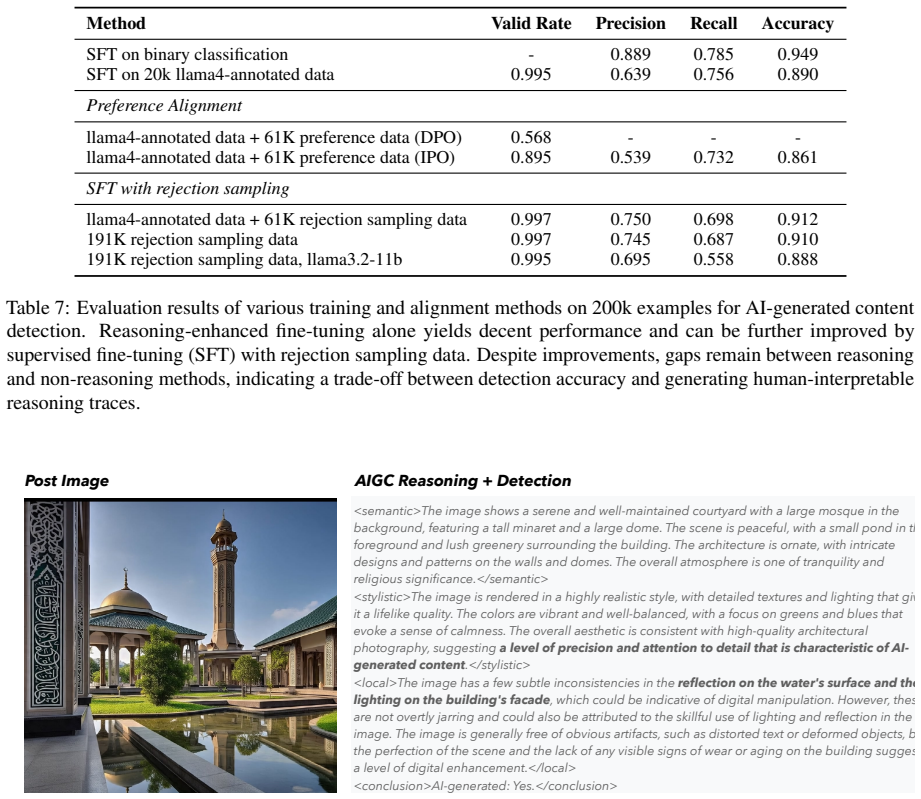
- The trade-off between detection accuracy and explanation generation implies that deploying interpretable AIGC detection in production requires accepting a measurable performance tax, at least at this model scale.
- The Chameleon benchmark gap (86% vs. ~62% for prior methods) suggests that social-media-trained multimodal models capture detection signals that purely visual or frequency-based detectors miss.
Where Pith is reading between the lines
- The keyword-based labeling heuristic creates a circular risk: the model is trained and evaluated on labels derived from the same keyword-matching pipeline, so its apparent performance on internal datasets may be inflated by the same biases that generated the labels.
- If AI image generators improve to the point where surface-level visual artifacts disappear entirely, the model's detection ability would depend heavily on contextual and semantic cues—the very signals that text dropout was designed to surface—making the multimodal approach more future-proof than artifact-specific detectors, but only if the contextual signals themselves remain discriminative.
- The reported engagement gains (+0.21% marginal user views, +0.22% young-adult sessions) are small in absolute terms and could reflect reduced exposure to low-quality content generally rather than specifically to AIGC, making the causal link between AIGC detection and engagement gains difficult to isolate without further analysis.
Load-bearing premise
The training and internal evaluation labels are generated by a keyword-matching heuristic that labels posts as AI-generated if the post text, comments, or a prior model's output mentions terms like 'ai-generated,' 'Midjourney,' or 'AI art,' and labels everything else as non-AIGC. If this heuristic mislabels posts—for example, users discussing AI art without posting AI-generated images, or AI-generated images posted without any AI-related keywords—then both the training signal
What would settle it
A carefully curated ground-truth set of social media posts, human-verified for AIGC status independent of keyword presence, on which the model's precision and recall drop substantially below the reported internal metrics (0.886 precision, 0.853 recall). Such a result would indicate that the model has learned to detect keyword presence rather than visual AI-generation artifacts.
Figures


read the original abstract
Generative AI has enabled the creation of photorealistic images and videos that are increasingly disseminated on social media, often used for spam, misinformation, manipulation, and fraud. Existing AI-generated content (AIGC) detection methods face challenges including poor generalization to new generation models, reliance on single modalities, and lack of interpretable explanations. We present our pipeline that mitigates these issues by continuously curating diverse multi-modal social media data and training a compact vision-language model for detection and explanation. Our model achieves state-of-the-art detection performance on public benchmarks and demonstrates robust detection and explanation capabilities on internal social media datasets across multiple platforms. We deployed our model for post recommendation on social media platforms and observed positive downstream impacts on user engagement, demonstrating that it is feasible to perform effective AIGC detection in dynamic, real-world social media environments.
Editorial analysis
A structured set of objections, weighed in public.
Referee Report
Summary. This paper presents a pipeline for detecting AI-generated content (AIGC) on social media platforms. The approach combines a continuous data curation pipeline with a compact vision-language model (IFM-AIGCSPOTTER-3B, based on Llama3.2-3B-Instruct and Perception Encoder) trained in three stages: image captioning, multi-task fine-tuning, and AIGC detection fine-tuning. The model is evaluated on public benchmarks (FakeClue, LOKI, Chameleon) and internal social media datasets across Facebook, Instagram, and Threads. The authors also report results from a 6-week production deployment for post recommendation. The central claims are: (1) state-of-the-art detection on public benchmarks, and (2) reliable detection in production across multiple social media platforms with positive downstream user engagement impacts.
Significance. The paper addresses a practically important problem at scale. Its strengths include strong public benchmark results (Table 1: 0.986 accuracy on FakeClue, 0.839 on LOKI; Table 2: 86.0% on Chameleon, a >20-point margin over baselines), a well-documented three-stage training pipeline, and a real production deployment with A/B testing results. The ablation studies (Tables 4-6) are thorough and cover vision encoders, loss functions, text dropout, and multi-frame video inputs. The text dropout ablation (Table 6) is a particularly informative diagnostic. The reasoning faithfulness analysis (Appendix C.1) with reported error rates is a commendable step toward interpretability assessment.
major comments (10)
- §4.2.1, Table 3: The internal evaluation uses test data curated via the same keyword-heuristic pipeline described in §3.2 for training data. The paper states: 'We curate test data using the same pipeline as in Section 3.' This creates a partial circularity: the test labels are defined by the presence of AIGC-related keywords in text/comments, and the model is trained on labels from the same heuristic. Two failure modes follow: (a) posts with AI-generated images but no AI keywords are labeled non-AIGC, penalizing correct model detections as false positives; (b) posts discussing AI art without AI-generated images are labeled AIGC, inflating recall. This is load-bearing for the production-readiness claim. The paper should either (i) provide a human-annotated gold-standard subset of the internal test set to validate the heuristic labels, or (ii) explicitly acknowledge this as a limitation in
- Table 6, 'No text drop' row: Without random text dropout, recall drops to 0.500 while precision rises to 0.956. The paper interprets this as evidence that 'models tend to infer based only on text content without text drop.' However, this result also suggests that the model's detection capability is substantially dependent on the text dropout training trick, and that without it, the model misses half of the AIGC-positive examples. Given that the internal evaluation labels are themselves keyword-based (§3.2), this raises a concern that the model may be learning correlations between keyword presence and visual style rather than genuine AIGC visual artifacts. The authors should discuss whether the text dropout ablation was evaluated on the internal test set (which shares the keyword heuristic) or on an independently labeled set, and what the precision/recall tradeoff implies about the model
- §4.3: The deployment results report '+0.21% views gain for marginal users' and '+0.22% Young-Adult session gains' over 6 weeks. However, no statistical details are provided: no confidence intervals, no p-values, no sample sizes, no description of the control/treatment split methodology beyond 'standard online A/B testing.' The claim of 'statistically significant' gains is load-bearing for the paper's deployment contribution but is not independently verifiable from the information given. Please provide the statistical methodology, significance level, effect size with confidence intervals, and the magnitude of the treatment exposure.
- Table 7: 'Valid Rate' is reported (e.g., 0.997, 0.568) but never defined. It is unclear what constitutes a 'valid' output versus an invalid one, and how this metric relates to the precision/recall/accuracy metrics in the same table. Please define this metric.
- §3.2, AIGC Fine-tuning Data: The class distribution is 30K AIGC and 170K non-AIGC (15%:85%). The paper does not discuss how this imbalance is handled during training, or what the base rate of AIGC is in production traffic. The precision/recall numbers in Table 3 may be sensitive to the prior, so please discuss the class balance and any reweighting.
- Table 2: The 'Ours' column reports 86.0% on Chameleon, but it is unclear whether this result is from the Stage 2 checkpoint (used for FakeClue/LOKI) or the Stage 3 checkpoint (used for internal evaluation). Please specify which checkpoint is used for each evaluation.
- Appendix A: The post-level detection prompt includes BODY TEXT, OCR TEXT, TITLE TEXT, and VIDEO TRANSCRIPT, but it is unclear which of these fields are available at inference time in the production deployment (§4.3). If the production model uses a different prompt or input format, please clarify.
- References: Several citations are to non-academic sources (Forbes Technology Council, Wired, Associated Press) with incomplete bibliographic information. Please provide full citations with author names, titles, publication dates, and access dates for URLs.
- Figure 2: The flowchart is dense and some text within boxes is truncated or illegible at standard zoom. Consider enlarging or simplifying the figure for readability.
- §4.1.2: The paper states that adding explanation to training 'slightly compromises detection quality, which contradicts with findings in prior work (Wen et al., 2025b).' The contradiction is noted but not investigated. A brief discussion of why the findings differ would strengthen the contribution.
Simulated Author's Rebuttal
We thank the referee for a thorough and constructive report. The comments identify several important gaps in our manuscript, particularly regarding the evaluation methodology for internal datasets and the statistical details of our deployment results. We address each comment below and commit to revisions where appropriate.
read point-by-point responses
-
Referee: §4.2.1, Table 3: Internal test data curated via same keyword-heuristic pipeline as training data, creating partial circularity. Request for human-annotated gold-standard subset or explicit limitation acknowledgment.
Authors: The referee is correct that this is a genuine methodological concern. The internal test set is curated using the same keyword-heuristic pipeline described in §3.2, which means the test labels share the same failure modes as the training labels: posts with AI-generated images but no AI-related keywords would be labeled non-AIGC, and posts discussing AI art without AI-generated images could be labeled AIGC. We acknowledge this is a real limitation of the internal evaluation. In practice, we do have a human-annotated gold-standard subset used during model development for quality assurance, but it was not included in the manuscript. We will add results on this human-annotated subset to the revised manuscript (Table 3 or a new table) and explicitly discuss the circularity concern as a limitation in §4.2.1. We will also clarify which results rely on heuristic labels versus human-verified labels. revision: yes
-
Referee: Table 6, 'No text drop' row: Recall drops to 0.500 without text dropout, raising concern that model learns keyword-visual correlations rather than genuine AIGC artifacts. Request to clarify whether ablation was on internal test set and discuss precision/recall tradeoff implications.
Authors: The referee raises a valid concern. The text dropout ablation in Table 6 was indeed evaluated on the internal test set, which uses the same keyword-heuristic labels. This means the referee's concern is partially justified: without text dropout, the model may be leveraging keyword-label correlations. However, we note two mitigating factors. First, the text dropout mechanism (dropping 90% of text during training) is specifically designed to force the model to learn visual artifacts rather than textual shortcuts—this is precisely the intervention the referee's concern motivates. Second, the model's strong performance on the Chameleon benchmark (Table 2: 86.0%), which is independently labeled and contains no keyword-based labels, provides evidence that the model does learn genuine visual artifacts when text is dropped. That said, we agree the manuscript should be more explicit about this interaction. We will add a discussion in §4.2.1 clarifying that the text dropout ablation was evaluated on the heuristic-labeled internal set, note the potential for keyword-label correlation, and cross-reference the Chameleon result as independent evidence. We will also report the text dropout ablation on the human-annotated subset mentioned in our response to the first comment, if feasible. revision: yes
-
Referee: §4.3: Deployment results lack statistical details—no CIs, p-values, sample sizes, or control/treatment methodology description.
Authors: The referee is correct that the deployment results in §4.3 lack the statistical detail expected for a claim of statistical significance. We will revise §4.3 to include: (1) the A/B testing methodology, including the randomization unit (user-level), treatment exposure percentage, and duration; (2) the significance level used (we used the standard p < 0.05 threshold with sequential testing correction); (3) confidence intervals for the reported effect sizes; and (4) the approximate scale of the experiment (millions of users in both treatment and control). We note that due to internal data sharing policies, we may not be able to disclose exact sample sizes, but we will provide as much detail as is permissible and ensure the claim of statistical significance is substantiated by the information provided. If we cannot provide sufficient detail to support the 'statistically significant' claim, we will soften the language accordingly. revision: yes
-
Referee: Table 7: 'Valid Rate' is reported but never defined.
Authors: This is an oversight on our part. 'Valid Rate' refers to the fraction of model outputs that are parseable into the expected format (i.e., a valid 'yes' or 'no' conclusion for detection, or a properly structured reasoning trace with a conclusion tag for reasoning-enhanced variants). Invalid outputs include malformed responses, repeated text, or failures to produce a conclusion tag—particularly common with preference alignment methods like DPO, where reward hacking led to format degradation (as noted in Appendix C). We will add a clear definition of this metric in the revised manuscript. revision: yes
-
Referee: §3.2: Class distribution is 30K AIGC / 170K non-AIGC (15:85). No discussion of imbalance handling or base rate in production traffic.
Authors: The referee raises an important point about class balance and its interaction with prior calibration. During Stage 3 training, we did not apply explicit reweighting or resampling; the 15:85 ratio was used as-is. The text dropout mechanism (90% text drop) serves as an implicit regularizer but does not directly address class imbalance. We note that the focal loss ablation (Table 5) was specifically motivated by this concern, and focal loss did improve out-of-distribution performance, which is consistent with its design for imbalanced settings. Regarding the base rate in production traffic, the proportion of AIGC posts varies by platform and is substantially lower than 15% in general traffic, which means the precision/recall numbers in Table 3 (measured on a curated test set) do not directly translate to production precision at the natural base rate. We will add a discussion of class balance, the rationale for not reweighting, the focal loss ablation connection, and the discrepancy between the test set prior and the production prior in the revised manuscript. revision: yes
-
Referee: Table 2: Unclear whether Chameleon result is from Stage 2 or Stage 3 checkpoint.
Authors: The Chameleon result in Table 2 uses the Stage 3 checkpoint (the same checkpoint used for internal evaluation in §4.2). This is stated in §4.2.2 ('We further evaluate our trained model on public benchmarks without further adaptation'), but the connection to the specific checkpoint is not explicit. We will clarify in both the Table 2 caption and the text of §4.2.2 that the Stage 3 checkpoint is used, and we will also add a note in §4.1.1 that the FakeClue/LOKI results use the Stage 2 checkpoint for consistency with prior work's training setup. revision: yes
-
Referee: Appendix A: Unclear which prompt fields are available at inference time in production deployment.
Authors: In the production deployment, the model uses the post-level detection prompt with all available fields: BODY TEXT, OCR TEXT, TITLE TEXT, and VIDEO TRANSCRIPT (when applicable). Not all fields are present for every post—for example, VIDEO TRANSCRIPT is only available for video posts, and TITLE TEXT is absent for many posts. The model is designed to handle missing fields gracefully. We will add a clarification in Appendix A and §4.3 specifying which fields are available at inference time and how missing fields are handled. revision: yes
-
Referee: References: Several non-academic citations with incomplete bibliographic information.
Authors: We agree and will provide complete bibliographic information for all non-academic sources, including author names (where available), titles, publication dates, and access dates for URLs. This applies to the Forbes Technology Council, Wired, and Associated Press citations. revision: yes
-
Referee: Figure 2: Flowchart is dense with truncated/illegible text.
Authors: We will redesign Figure 2 for improved readability, either by simplifying the content, increasing font sizes, or splitting into sub-figures. The current version does sacrifice legibility for compactness, which is not justified given the importance of the data curation pipeline to the paper's contribution. revision: yes
-
Referee: §4.1.2: Contradiction with prior work (Wen et al., 2025b) on explanation training effect is noted but not investigated.
Authors: We agree that the contradiction deserves more discussion. Our hypothesis is that the difference stems from model architecture and training data differences: our model is a 3B-parameter model trained on diverse social media data, whereas FakeVLM (Wen et al., 2025b) is an 11B model trained on FakeClue specifically. Smaller models may have less capacity to jointly optimize detection and explanation, making the trade-off more pronounced. Additionally, our multi-stage training pipeline (where the model first learns general multimodal understanding in Stages 1-2 before AIGC-specific fine-tuning in Stage 3) may interact differently with explanation training than a single-stage approach. We will expand the discussion in §4.1.2 to articulate these hypotheses more clearly and acknowledge that we have not isolated the specific cause, which would require controlled experiments across model sizes and training pipelines. revision: partial
Circularity Check
Internal evaluation (Table 3) uses the same keyword-heuristic labeling pipeline as training data (§3.2), creating partial circularity where the model is evaluated on labels generated by a process similar to its own training signal.
specific steps
-
fitted input called prediction
[Section 4.2.1 / Table 3, referencing Section 3.2]
"We curate test data using the same pipeline as in Section 3 and report results by platform. [...] Posts are labeled as AIGC if their text or comments explicitly mention AIGC-related keywords based on a curated vocabulary (e.g., 'ai-generated,' 'Midjourney,' 'AI art'), or if the multi-task model from the previous stage predicts an AIGC-related keyword or hashtag; all others are labeled as non-AIGC."
The training labels (Section 3.2) and the internal evaluation labels (Section 4.2.1) are produced by the same heuristic pipeline: keyword matching plus model-assisted labeling. The model is trained to fit these labels and then evaluated on labels from the same process. This creates a partial circularity: the model may learn correlations between text keywords and the AIGC label (rather than visual artifacts), and the test set rewards exactly those correlations. The ablation in Table 6 confirms this concern — without text dropout, recall drops to 0.500, showing the model heavily relies on textual cues that are also the basis for label assignment. The public benchmark results (Tables 1-2) use externally defined datasets (FakeClue, LOKI, Chameleon) and are not affected by this circularity.
full rationale
The paper has two evaluation pillars. Pillar 1 (public benchmarks: FakeClue, LOKI, Chameleon) uses externally defined ground-truth labels and is independently grounded — no circularity there. Pillar 2 (internal evaluation, Table 3) explicitly reuses the same labeling pipeline as training data curation (Section 3.2), creating a partial circularity where the evaluation metric reflects the model's ability to reproduce the heuristic labeling rule rather than genuine AIGC detection. The paper itself acknowledges this risk indirectly through the text dropout ablation (Table 6), which shows the model over-relies on textual cues without dropout. This is a real but partial circularity: it affects only the internal evaluation, not the public benchmark results or the production deployment claims (which use downstream engagement metrics rather than detection accuracy). The score of 4 reflects that the central SOTA claim on public benchmarks is independently grounded, while the production-readiness claim partially rests on an evaluation whose labels share the training pipeline's biases.
Axiom & Free-Parameter Ledger
free parameters (6)
- Image input resolution =
448x448
- Number of visual tokens =
256
- Random text dropout rate =
0.90
- AIGC keyword vocabulary =
Not specified
- Training stage learning rates =
0.002, 4e-5, 4e-5
- Effective batch sizes =
2048, 128, 64, 256
axioms (4)
- domain assumption Posts whose text or comments contain AIGC-related keywords are likely to contain AI-generated content.
- domain assumption A compact 3B-parameter VLM can achieve competitive AIGC detection performance when trained on sufficient curated data.
- standard math The LLaVA architecture (vision encoder + linear projection + LLM) is appropriate for AIGC detection.
- domain assumption Demoting creators with excessive AIGC posts improves user engagement for marginal and new users.
Reference graph
Works this paper leans on
-
[1]
Associated Press . 2024. Trump arrested? putin jailed? fake ai images spread online
work page 2024
-
[2]
Shuai Bai, Keqin Chen, Xuejing Liu, Jialin Wang, Wenbin Ge, Sibo Song, Kai Dang, Peng Wang, Shijie Wang, Jun Tang, and 1 others. 2025. Qwen2. 5-vl technical report. arXiv preprint arXiv:2502.13923
work page internal anchor Pith review Pith/arXiv arXiv 2025
-
[3]
Daniel Bolya, Po-Yao Huang, Peize Sun, Jang Hyun Cho, Andrea Madotto, Chen Wei, Tengyu Ma, Jiale Zhi, Jathushan Rajasegaran, Hanoona Rasheed, and 1 others. 2025. Perception encoder: The best visual embeddings are not at the output of the network. arXiv preprint arXiv:2504.13181
work page internal anchor Pith review Pith/arXiv arXiv 2025
-
[4]
Tim Brooks, Bill Peebles, Connor Holmes, Will DePue, Yufei Guo, Li Jing, David Schnurr, Joe Taylor, Troy Luhman, Eric Luhman, Clarence Ng, Ricky Wang, and Aditya Ramesh. 2024. Video generation models as world simulators
work page 2024
-
[5]
Nuria Alina Chandra, Ryan Murtfeldt, Lin Qiu, Arnab Karmakar, Hannah Lee, Emmanuel Tanumihardja, Kevin Farhat, Ben Caffee, Sejin Paik, Changyeon Lee, and 1 others. 2025. Deepfake-eval-2024: A multi-modal in-the-wild benchmark of deepfakes circulated in 2024. arXiv preprint arXiv:2503.02857
work page internal anchor Pith review Pith/arXiv arXiv 2025
-
[6]
Zhe Chen, Weiyun Wang, Yue Cao, Yangzhou Liu, Zhangwei Gao, Erfei Cui, Jinguo Zhu, Shenglong Ye, Hao Tian, Zhaoyang Liu, and 1 others. 2024 a . Expanding performance boundaries of open-source multimodal models with model, data, and test-time scaling. arXiv preprint arXiv:2412.05271
work page internal anchor Pith review Pith/arXiv arXiv 2024
-
[7]
Zhe Chen, Jiannan Wu, Wenhai Wang, Weijie Su, Guo Chen, Sen Xing, Muyan Zhong, Qinglong Zhang, Xizhou Zhu, Lewei Lu, and 1 others. 2024 b . Internvl: Scaling up vision foundation models and aligning for generic visual-linguistic tasks. In Proceedings of the IEEE/CVF conference on computer vision and pattern recognition, pages 24185--24198
work page 2024
-
[8]
Davide Cozzolino, Giovanni Poggi, Riccardo Corvi, Matthias Nie ner, and Luisa Verdoliva. 2024. Raising the bar of ai-generated image detection with clip. In Proceedings of the IEEE/CVF Conference on Computer Vision and Pattern Recognition, pages 4356--4366
work page 2024
-
[9]
David C Epstein, Ishan Jain, Oliver Wang, and Richard Zhang. 2023. Online detection of ai-generated images. In Proceedings of the IEEE/CVF international conference on computer vision, pages 382--392
work page 2023
-
[10]
Forbes Technology Council . 2024. The rise of advanced clickbait: How ai is tricking unsuspecting users
work page 2024
-
[11]
Joel Frank, Thorsten Eisenhofer, Lea Sch \"o nherr, Asja Fischer, Dorothea Kolossa, and Thorsten Holz. 2020. Leveraging frequency analysis for deep fake image recognition. In International conference on machine learning, pages 3247--3258. PMLR
work page 2020
-
[12]
Google DeepMind . 2024. https://deepmind.google/models/veo/ Veo
work page 2024
-
[13]
Aaron Grattafiori, Abhimanyu Dubey, Abhinav Jauhri, Abhinav Pandey, Abhishek Kadian, Ahmad Al-Dahle, Aiesha Letman, Akhil Mathur, Alan Schelten, Alex Vaughan, and 1 others. 2024. The llama 3 herd of models. arXiv preprint arXiv:2407.21783
work page internal anchor Pith review Pith/arXiv arXiv 2024
- [14]
-
[15]
Shan Jia, Reilin Lyu, Kangran Zhao, Yize Chen, Zhiyuan Yan, Yan Ju, Chuanbo Hu, Xin Li, Baoyuan Wu, and Siwei Lyu. 2024. Can chatgpt detect deepfakes? a study of using multimodal large language models for media forensics. In Proceedings of the IEEE/CVF Conference on Computer Vision and Pattern Recognition, pages 4324--4333
work page 2024
-
[16]
Mamadou Keita, Wassim Hamidouche, Hessen Bougueffa Eutamene, Abdelmalik Taleb-Ahmed, and Abdenour Hadid. 2024. Fidavl: Fake image detection and attribution using vision-language model. In International Conference on Pattern Recognition, pages 160--176. Springer
work page 2024
-
[17]
Haotian Liu, Chunyuan Li, Qingyang Wu, and Yong Jae Lee. 2023. Visual instruction tuning. Advances in neural information processing systems, 36:34892--34916
work page 2023
-
[18]
Jiawei Liu, Fanrui Zhang, Jiaying Zhu, Esther Sun, Qiang Zhang, and Zheng-Jun Zha. 2024. Forgerygpt: Multimodal large language model for explainable image forgery detection and localization. arXiv preprint arXiv:2410.10238
work page internal anchor Pith review Pith/arXiv arXiv 2024
-
[19]
Scott McCloskey and Michael Albright. 2018. Detecting gan-generated imagery using color cues. arXiv preprint arXiv:1812.08247
work page internal anchor Pith review Pith/arXiv arXiv 2018
-
[20]
Utkarsh Ojha, Yuheng Li, and Yong Jae Lee. 2023. Towards universal fake image detectors that generalize across generative models. In Proceedings of the IEEE/CVF Conference on Computer Vision and Pattern Recognition, pages 24480--24489
work page 2023
-
[21]
Md Awsafur Rahman, Bishmoy Paul, Najibul Haque Sarker, Zaber Ibn Abdul Hakim, and Shaikh Anowarul Fattah. 2023. Artifact: A large-scale dataset with artificial and factual images for generalizable and robust synthetic image detection. In 2023 IEEE International Conference on Image Processing (ICIP), pages 2200--2204. IEEE
work page 2023
-
[22]
Robin Rombach, Andreas Blattmann, Dominik Lorenz, Patrick Esser, and Bj \"o rn Ommer. 2022. High-resolution image synthesis with latent diffusion models. In Proceedings of the IEEE/CVF conference on computer vision and pattern recognition, pages 10684--10695
work page 2022
-
[23]
Andreas Rossler, Davide Cozzolino, Luisa Verdoliva, Christian Riess, Justus Thies, and Matthias Nie ner. 2019. Faceforensics++: Learning to detect manipulated facial images. In Proceedings of the IEEE/CVF international conference on computer vision, pages 1--11
work page 2019
-
[24]
Christian Tarsney. 2025. Deception and manipulation in generative ai. Philosophical Studies, pages 1--23
work page 2025
-
[25]
Francesco Tassone, Luca Maiano, and Irene Amerini. 2024. Continuous fake media detection: adapting deepfake detectors to new generative techniques. Computer Vision and Image Understanding, 249:104143
work page 2024
-
[26]
Peng Wang, Shuai Bai, Sinan Tan, Shijie Wang, Zhihao Fan, Jinze Bai, Keqin Chen, Xuejing Liu, Jialin Wang, Wenbin Ge, and 1 others. 2024. Qwen2-vl: Enhancing vision-language model's perception of the world at any resolution. arXiv preprint arXiv:2409.12191
work page internal anchor Pith review Pith/arXiv arXiv 2024
-
[27]
Sheng-Yu Wang, Oliver Wang, Richard Zhang, Andrew Owens, and Alexei A Efros. 2020. Cnn-generated images are surprisingly easy to spot... for now. In Proceedings of the IEEE/CVF conference on computer vision and pattern recognition, pages 8695--8704
work page 2020
-
[28]
Haiquan Wen, Tianxiao Li, Zhenglin Huang, Yiwei He, and Guangliang Cheng. 2025 a . Busterx++: Towards unified cross-modal ai-generated content detection and explanation with mllm. arXiv preprint arXiv:2507.14632
work page internal anchor Pith review Pith/arXiv arXiv 2025
-
[29]
Siwei Wen, Junyan Ye, Peilin Feng, Hengrui Kang, Zichen Wen, Yize Chen, Jiang Wu, Wenjun Wu, Conghui He, and Weijia Li. 2025 b . https://arxiv.org/abs/2503.14905 Spot the fake: Large multimodal model-based synthetic image detection with artifact explanation . Preprint, arXiv:2503.14905
-
[30]
Wired . 2024. Deepfake scams are distorting reality itself. https://www.wired.com/story/youre-not-ready-for-ai-powered-scams/
work page 2024
-
[31]
Zhiyu Wu, Xiaokang Chen, Zizheng Pan, Xingchao Liu, Wen Liu, Damai Dai, Huazuo Gao, Yiyang Ma, Chengyue Wu, Bingxuan Wang, and 1 others. 2024. Deepseek-vl2: Mixture-of-experts vision-language models for advanced multimodal understanding. arXiv preprint arXiv:2412.10302
work page internal anchor Pith review Pith/arXiv arXiv 2024
- [32]
- [33]
discussion (0)
Sign in with ORCID, Apple, or X to comment. Anyone can read and Pith papers without signing in.