Collective Emission in LH2 Assembly Beyond the Point-Dipole Approximation
Pith reviewed 2026-06-28 23:27 UTC · model grok-4.3
The pith
P42₁2 symmetry in LH2 assemblies inverts bright-dark ordering to put subradiant states lowest in energy.
A machine-rendered reading of the paper's core claim, the machinery that carries it, and where it could break.
Core claim
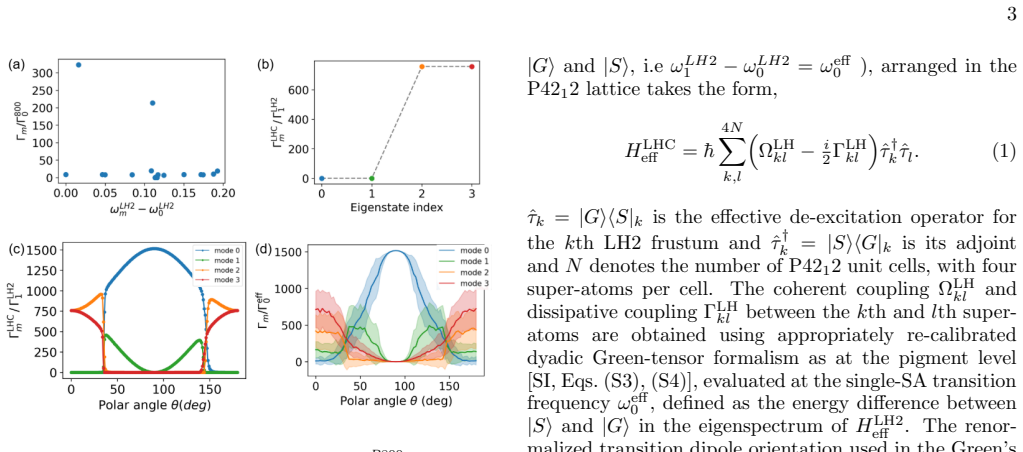
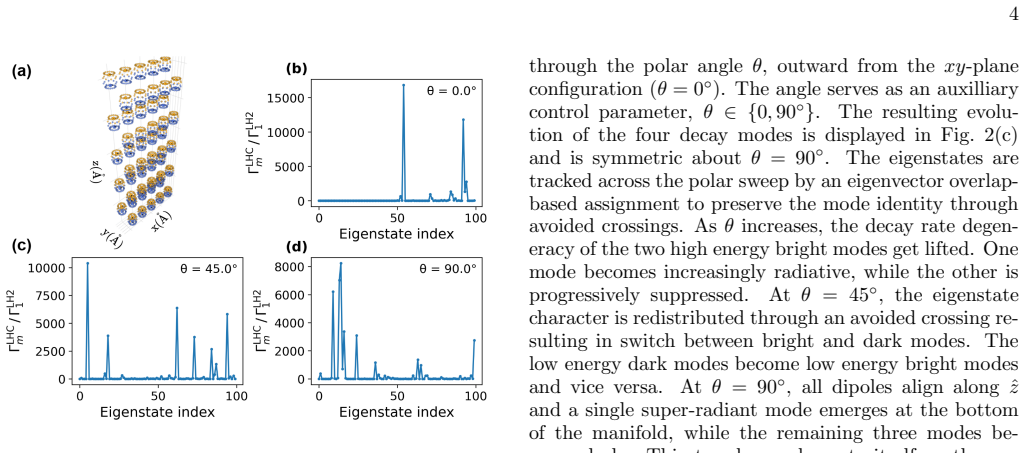
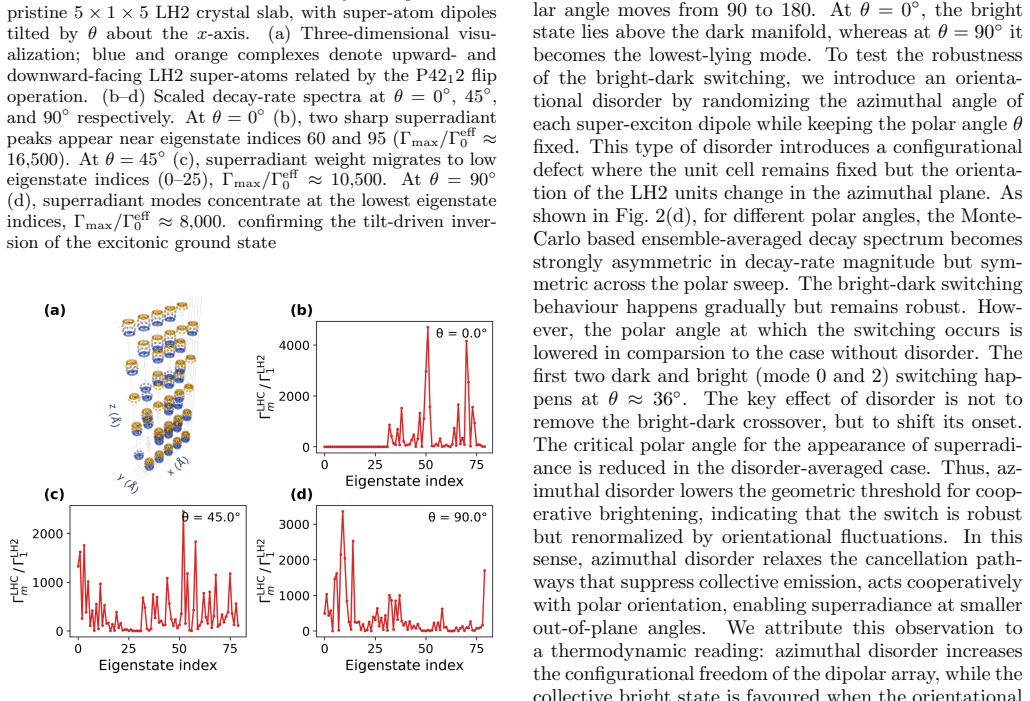
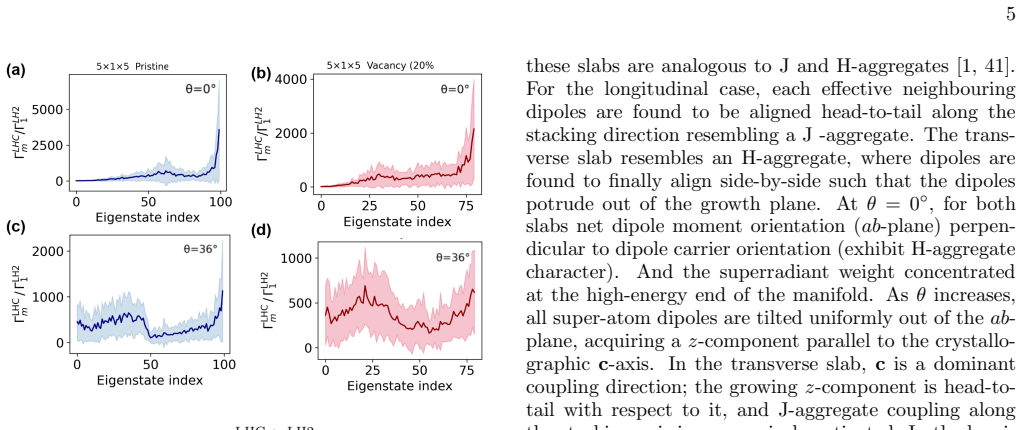
The P42₁2 unit-cell symmetry inverts the bright-dark ordering of the single ring, placing subradiant states at the low-energy end and revealing the entire crystal to be the energy-harvesting entity. Tilt-driven switching activates only in crystal geometries where the finite dipole-carrier lies perpendicular to the growth plane. Vacancy and orientational disorder cooperate to renormalize the switching threshold from higher to lower polar angles.
What carries the argument
non-Hermitian Hamiltonian constructed from the quantum electrodynamic dyadic Green's tensor for the conical-frustum LH2 and its P42₁2 lattice
If this is right
- The entire crystal functions as the energy-harvesting entity once the symmetry inversion is taken into account.
- Tilt-driven switching of collective states occurs only when the LH2 ring lies perpendicular to the growth plane.
- Vacancy and orientational disorder must act together to shift the switching threshold to lower polar angles.
- Finite geometry of the dipole carriers is required to recover any of these ordering or switching effects.
Where Pith is reading between the lines
- Similar lattice symmetries in other membrane protein arrays may also move subradiant states to the bottom of the exciton band.
- Controlled introduction of vacancies could be used to tune emission thresholds in synthetic light-harvesting crystals.
- Point-dipole models applied to periodic assemblies are expected to miss the inversion of bright and dark manifolds.
Load-bearing premise
The chosen conical-frustum geometry for isolated LH2 and the P42₁2 lattice plus the local transition dipoles fully capture the electromagnetic interactions without needing corrections for the surrounding protein matrix or solvent.
What would settle it
Low-temperature emission spectrum or lifetime measurement on an LH2 crystal that would show whether the lowest-energy states are subradiant (long lifetime, dark) or superradiant (short lifetime, bright).
Figures
read the original abstract
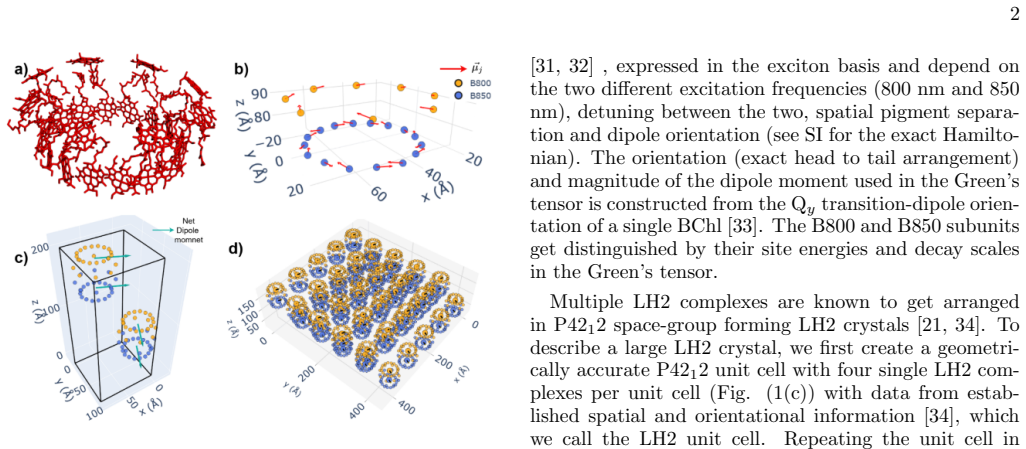
Collective emission in light-harvesting assemblies is governed by the local transition dipole and finite geometry of emitting units, a fact that point-dipole approximation obscures. To go beyond this picture, we develop a non-Hermitian Hamiltonian using the quantum electrodynamic dyadic Green's tensor for a purple bacteria. We construct it for the isolated 24-bacteriochlorophyll conical frustum and its P42$_1$2 crystallographic assembly. The P42$_1$2 unit-cell symmetry is found to invert the bright-dark ordering of the single ring, placing subradiant states at the low-energy end and revealing the entire crystal to be the energy-harvesting entity. Tilt-driven switching is activated only in crystal geometries where the finite dipole-carrier (LH2) lies perpendicular to the growth plane. Vacancy and orientational disorder work only in cooperation to renormalize the switching threshold from higher polar angles to lower values.
Editorial analysis
A structured set of objections, weighed in public.
Referee Report
Summary. The manuscript constructs a non-Hermitian Hamiltonian for collective emission in LH2 assemblies of purple bacteria using the quantum-electrodynamic dyadic Green's tensor applied to finite transition dipoles on a 24-BChl conical-frustum geometry. For the isolated ring and its P42₁2 crystallographic lattice, the calculation shows that unit-cell symmetry inverts the conventional bright-dark exciton ordering, placing subradiant states at the low-energy end and implying that the entire crystal functions as the energy-harvesting unit. Additional results address tilt-driven switching (activated only when LH2 lies perpendicular to the growth plane) and the cooperative renormalization of the switching threshold by vacancy and orientational disorder.
Significance. If the reported ordering inversion survives environmental corrections, the work would be significant for photosynthetic modeling: it supplies a concrete mechanism by which crystallographic symmetry, rather than local ring symmetry, can dictate the lowest-energy collective states, and it demonstrates a practical route beyond the point-dipole limit via the dyadic Green's tensor. The absence of free parameters in the Hamiltonian construction and the explicit treatment of finite-dipole geometry are strengths that would, if validated, provide falsifiable predictions for spectroscopic signatures of the inverted manifold.
major comments (1)
- [Abstract/Methods] Abstract and Hamiltonian construction (Methods): the non-Hermitian Hamiltonian is assembled from the vacuum dyadic Green's tensor between point dipoles placed on the conical-frustum LH2 units in the P42₁2 lattice. No effective permittivity is introduced for the protein matrix (typical ε_r ≈ 2–4) or aqueous solvent (ε_r ≈ 80). Because the near-field 1/r³ term that sets the bright–dark splitting is linearly proportional to 1/ε_r, an environment-induced renormalization of comparable magnitude to the reported inversion could restore the conventional ordering; this assumption is therefore load-bearing for the central claim that the crystal symmetry alone inverts the manifold.
minor comments (1)
- The abstract states the inversion result without quoting the numerical splitting or the explicit form of the Green's-tensor matrix elements; a short table or equation in the main text summarizing the vacuum versus screened eigenvalues would improve traceability.
Simulated Author's Rebuttal
We thank the referee for the detailed review and the constructive criticism regarding the treatment of the dielectric environment. We address this comment below and clarify why the reported symmetry-induced inversion remains robust.
read point-by-point responses
-
Referee: [Abstract/Methods] Abstract and Hamiltonian construction (Methods): the non-Hermitian Hamiltonian is assembled from the vacuum dyadic Green's tensor between point dipoles placed on the conical-frustum LH2 units in the P42₁2 lattice. No effective permittivity is introduced for the protein matrix (typical ε_r ≈ 2–4) or aqueous solvent (ε_r ≈ 80). Because the near-field 1/r³ term that sets the bright–dark splitting is linearly proportional to 1/ε_r, an environment-induced renormalization of comparable magnitude to the reported inversion could restore the conventional ordering; this assumption is therefore load-bearing for the central claim that the crystal symmetry alone inverts the manifold.
Authors: The referee correctly notes that the calculation employs the vacuum dyadic Green's tensor. However, for a homogeneous dielectric, the relevant near-field term in the Green's tensor scales uniformly as 1/ε_r. All inter-pigment couplings, both within a single LH2 ring and between rings in the lattice, are therefore multiplied by the identical factor. The spectrum of the non-Hermitian matrix is scaled by this constant, but the eigenvectors and the relative ordering of the eigenvalues are unaffected. Consequently, the inversion of the bright-dark manifold driven by the P42₁2 unit-cell symmetry persists independently of the value of ε_r. We will insert a short explanatory paragraph in the Methods section to state this scaling property explicitly. revision: partial
Circularity Check
No circularity in derivation chain
full rationale
The paper constructs a non-Hermitian Hamiltonian from the quantum electrodynamic dyadic Green's tensor applied to the conical-frustum LH2 geometry and P42₁2 lattice. The reported inversion of bright-dark ordering is presented as an output of diagonalizing this Hamiltonian for the given symmetry and finite-dipole placement. No quoted step redefines the target ordering as an input, renames a fitted parameter as a prediction, or relies on a self-citation chain whose content reduces to the present result. The derivation remains self-contained: the electromagnetic interaction is computed from first-principles QED for the stated geometry, and the collective-mode ordering follows as a numerical consequence without circular reduction.
Axiom & Free-Parameter Ledger
axioms (2)
- standard math The quantum electrodynamic dyadic Green's tensor provides the correct electromagnetic interaction kernel between finite transition dipoles in the LH2 geometry.
- domain assumption The P42₁2 crystallographic symmetry and the conical-frustum arrangement of the 24 bacteriochlorophylls accurately represent the biological LH2 assembly.
Reference graph
Works this paper leans on
-
[1]
N. J. Hestand and F. C. Spano, Expanded theory of h- and j-molecular aggregates: The effects of vibronic cou- pling and intermolecular charge transfer, Chemical Re- views 118, 7069 (2018)
2018
-
[2]
Abramavicius, B
D. Abramavicius, B. Palmieri, D. V. Voronine, F. Sanda, and S. Mukamel, Coherent multidimensional optical spectroscopy of excitons in molecular aggregates; quasi- particle versus supermolecule perspectives, Chemical Re- views 109, 2350 (2009)
2009
-
[3]
C. M. Bustamante, E. D. Gadea, T. N. Todorov, and D. A. Scherlis, Tailoring cooperative emission in molecules: Superradiance and subradiance from first- principles simulations, The Journal of Physical Chem- istry Letters 13, 11601 (2022)
2022
-
[4]
F. C. Spano and S. Mukamel, Superradiance in molecu- lar aggregates, The Journal of Chemical Physics 91, 683 (1989)
1989
-
[5]
R. H. Dicke, Coherence in spontaneous radiation pro- cesses, Physical Review 93, 99 (1954)
1954
-
[6]
Fidder, J
H. Fidder, J. Knoester, and D. A. Wiersma, Superradi- ant emission and optical dephasing in j aggregates, The Journal of Chemical Physics 95, 7880 (1991)
1991
-
[7]
Monshouwer, M
R. Monshouwer, M. Abrahamsson, F. van Mourik, and R. van Grondelle, Superradiance and exciton delocaliza- tion in bacterial photosynthetic light-harvesting systems, J. Phys. Chem. B 101, 7241 (1997)
1997
-
[8]
Y. Zhao, T. Meier, W. M. Zhang, V. Chernyak, and S. Mukamel, Superradiance coherence sizes in single- molecule spectroscopy of lh2 antenna complexes, The Journal of Physical Chemistry B 103, 3954 (1999)
1999
-
[9]
G. L. Celardo, G. G. Giusteri, and F. Borgonovi, Coop- erative robustness to static disorder: Superradiance and localization in a nanoscale ring to model light-harvesting systems found in nature, Physical Review B 90, 075113 (2014)
2014
-
[10]
Reitz, C
M. Reitz, C. Sommer, and C. Genes, Cooperative quan- tum phenomena in light-matter platforms, Prx Quantum 3, 010201 (2022)
2022
-
[11]
K. T. Holman, A. M. Pivovar, and M. D. Ward, Engi- neering crystal symmetry and polar order in molecular host frameworks, Science 294, 1907 (2001)
1907
-
[12]
S. S. Rajasree, J. Yu, S. M. Pratik, X. Li, R. Wang, A. S. Kumbhar, S. Goswami, C. J. Cramer, and P. Deria, Su- perradiance and directional exciton migration in metal– organic frameworks, Journal of the American Chemical Society 144, 1396 (2022)
2022
-
[13]
Valzelli, A
A. Valzelli, A. Boschetti, F. Mattiotti, A. Kargol, C. Green, F. Borgonovi, and G. L. Celardo, Large scale simulations of photosynthetic antenna systems: interplay of cooperativity and disorder, The Journal of Physical Chemistry B 128, 9643 (2024). 10
2024
-
[14]
Cremer, D
J. Cremer, D. Plankensteiner, M. Moreno-Cardoner, L. Ostermann, and H. Ritsch, Polarization control of ra- diation and energy flow in dipole-coupled nanorings, New Journal of Physics 22, 083052 (2020)
2020
-
[15]
B. P. Krueger, G. D. Scholes, and G. R. Fleming, Calcula- tion of couplings and energy-transfer pathways between the pigments of lh2 by the ab initio transition density cube method, The Journal of Physical Chemistry B 102, 5378 (1998)
1998
-
[16]
G. D. Scholes, I. R. Gould, R. J. Cogdell, and G. R. Flem- ing, Ab initio molecular orbital calculations of electronic couplings in the lh2 bacterial light-harvesting complex of rps. acidophila, The Journal of Physical Chemistry B 103, 2543 (1999)
1999
-
[17]
M. E. Madjet, A. Abdurahman, and T. Renger, Inter- molecular coulomb couplings from ab initio electrostatic potentials: Application to optical transitions of strongly coupled pigments in photosynthetic antennae and reac- tion centers, The Journal of Physical Chemistry B 110, 17268 (2006)
2006
-
[18]
G. D. Scholes and G. R. Fleming, On the mechanism of light harvesting in photosynthetic purple bacteria: B800 to b850 energy transfer, The Journal of Physical Chem- istry B 104, 1854 (2000)
2000
-
[19]
G. D. Scholes, Long-range resonance energy transfer in molecular systems, Annual review of physical chemistry 54, 57 (2003)
2003
-
[20]
Lee and L.-Y
M.-W. Lee and L.-Y. Hsu, Polariton-assisted resonance energy transfer beyond resonant dipole-dipole interac- tion: A transition-current-density approach, Physical Re- view A 107, 053709 (2023)
2023
-
[21]
Koepke, X
J. Koepke, X. Hu, C. Muenke, K. Schulten, and H. Michel, The crystal structure of the light-harvesting complex ii (b800–850) from rhodospirillum molischi- anum, Structure 4, 581 (1996)
1996
-
[22]
Haldar, A
R. Haldar, A. Mazel, M. Krsti´ c, Q. Zhang, M. Jakoby, I. A. Howard, B. S. Richards, N. Jung, D. Jacquemin, S. Diring, et al., A de novo strategy for predictive crystal engineering to tune excitonic coupling, Nature Commu- nications 10, 2048 (2019)
2048
-
[23]
D. Kim, S. Lee, J. Park, J. Lee, H. C. Choi, K. Kim, and S. Ryu, In-plane and out-of-plane excitonic coupling in 2d molecular crystals, Nature communications 14, 2736 (2023)
2023
-
[24]
Guerrini, A
M. Guerrini, A. Calzolari, and S. Corni, Solid-state ef- fects on the optical excitation of push–pull molecular j- aggregates by first-principles simulations, ACS omega 3, 10481 (2018)
2018
-
[25]
P. Deka, S. Das, P. Sarma, K. J. Kalita, R. K. Vi- jayaraghavan, C. M. Reddy, and R. Thakuria, Ex- ceptional thermo-mechano-fluorochromism and nanome- chanical analysis of mechanically responsive j and h type polymorphic systems, Crystal Growth & Design 24, 2322 (2024)
2024
-
[26]
Holzinger, S
R. Holzinger, S. A. Oh, M. Reitz, H. Ritsch, and C. Genes, Cooperative subwavelength molecular quan- tum emitter arrays, Physical Review Research 4, 033116 (2022)
2022
-
[27]
A. Pal, R. Holzinger, M. Moreno-Cardoner, and H. Ritsch, Efficient excitation transfer in an lh2-inspired nanoscale stacked ring geometry, New Journal of Physics 27, 094101 (2025)
2025
-
[28]
G. L. Celardo, F. Borgonovi, M. Merkli, V. I. Tsifrinovich, and G. P. Berman, Superradiance transi- tion in photosynthetic light-harvesting complexes, The Journal of Physical Chemistry C 116, 22105 (2012)
2012
-
[29]
Lehmberg, Radiation from an n-atom system
R. Lehmberg, Radiation from an n-atom system. i. gen- eral formalism, Physical Review A 2, 883 (1970)
1970
-
[30]
Lehmberg, Radiation from an n-atom system
R. Lehmberg, Radiation from an n-atom system. ii. spon- taneous emission from a pair of atoms, Physical Review A 2, 889 (1970)
1970
-
[31]
H. T. Dung, L. Kn¨ oll, and D.-G. Welsch, Resonant dipole-dipole interaction in the presence of dispersing and absorbing surroundings, Phys. Rev. A 66, 063810 (2002)
2002
-
[32]
G. S. Agarwal, Master-equation approach to spontaneous emission, Physical Review A 2, 2038 (1970)
2038
-
[33]
M. B. Oviedo and C. G. S´ anchez, Transition dipole mo- ments of the q y band in photosynthetic pigments, The Journal of Physical Chemistry A 115, 12280 (2011)
2011
-
[34]
Sundstr¨ om, T
V. Sundstr¨ om, T. Pullerits, and R. van Grondelle, Pho- tosynthetic light-harvesting: reconciling dynamics and structure of purple bacterial lh2 reveals function of pho- tosynthetic unit (1999)
1999
-
[35]
Moreno-Cardoner, D
M. Moreno-Cardoner, D. Plankensteiner, L. Ostermann, D. E. Chang, and H. Ritsch, Subradiance-enhanced ex- citation transfer between dipole-coupled nanorings of quantum emitters, Physical Review A 100, 023806 (2019)
2019
-
[36]
Meier, Y
T. Meier, Y. Zhao, V. Chernyak, and S. Mukamel, Po- larons, localization, and excitonic coherence in superra- diance of biological antenna complexes, The Journal of chemical physics 107, 3876 (1997)
1997
-
[37]
Kumlin, C
J. Kumlin, C. Braun, C. Tresp, N. Stiesdal, S. Hoffer- berth, and A. Paris-Mandoki, Quantum optics with ryd- berg superatoms, Journal of Physics Communications 7, 052001 (2023)
2023
-
[38]
X. Hu, T. Ritz, A. Damjanovi´ c, F. Autenrieth, and K. Schulten, Photosynthetic apparatus of purple bacte- ria, Quarterly reviews of biophysics 35, 1 (2002)
2002
-
[39]
Kulkarni, H
C. Kulkarni, H. ´O. Gestsson, L. Cupellini, B. Mennucci, and A. Olaya-Castro, Theory of photosynthetic mem- brane influence on b800-b850 energy transfer in the lh2 complex, Biophysical journal 124, 722 (2025)
2025
-
[40]
J. Hsin, D. E. Chandler, J. Gumbart, C. B. Harrison, M. Sener, J. Strumpfer, and K. Schulten, Self-assembly of photosynthetic membranes, ChemPhysChem 11, 1154 (2010)
2010
-
[41]
F. C. Spano, The spectral signatures of frenkel polarons in h- and j-aggregates, Accounts of Chemical Research 43, 429 (2010)
2010
discussion (0)
Sign in with ORCID, Apple, or X to comment. Anyone can read and Pith papers without signing in.