Spin correlations, low-energy scales, and anisotropy scaling in kagome frustrated magnets
Pith reviewed 2026-06-27 08:06 UTC · model grok-4.3
The pith
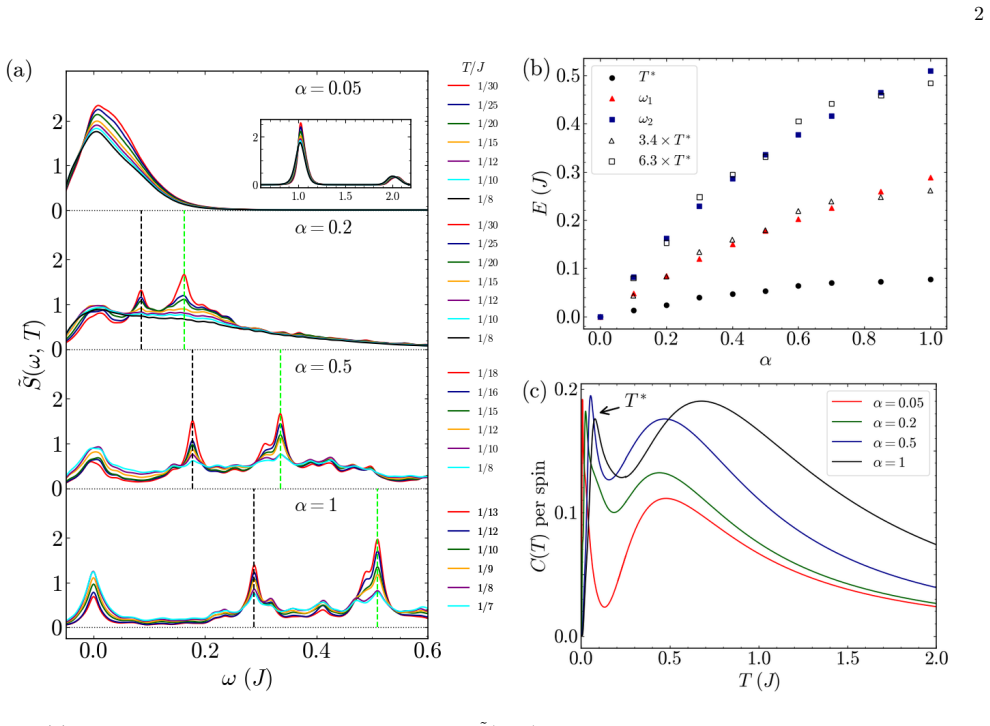
The low-energy spin spectral function in kagome magnets contains robust peaks at 3.4 T* and 6.3 T* from single-magnon scattering.
A machine-rendered reading of the paper's core claim, the machinery that carries it, and where it could break.
Core claim
Focusing on the kagome lattice, the low-energy spin spectral function contains robust, momentum-independent peaks with frequencies ω1 ≈ 3.4 T* and ω2 ≈ 6.3 T*, where T* is the characteristic scale of a low-temperature peak in the heat capacity. The spectral features at low energies ω ≲ T* arise from single-magnon scattering, and the magnetizations of the respective excitations are identified. The approach uses adiabatic continuity in the XXZ model as a function of anisotropy to extract these universal features.
What carries the argument
Adiabatic continuity of the XXZ Heisenberg model on geometrically frustrating lattices with respect to anisotropy, which permits identification of universal low-energy spin correlator features.
If this is right
- The peaks at ω1 ≈ 3.4 T* and ω2 ≈ 6.3 T* are universal and momentum-independent.
- These low-energy features arise specifically from single-magnon scattering.
- The magnetizations of the excitations corresponding to these peaks can be identified.
- The spectral features evolve with temperature in a predictable manner.
- Similar features appear in other geometrically frustrating lattices.
Where Pith is reading between the lines
- Broad spectral features previously attributed to spinons could instead indicate single-magnon scattering in disordered systems.
- The scaling with T* suggests a way to link heat capacity and scattering experiments quantitatively.
- The adiabatic continuity method may generalize to other lattice geometries and interaction types.
Load-bearing premise
The XXZ model on frustrating lattices remains adiabatically connected as anisotropy is varied, allowing universal features to be extracted even in the presence of disorder and magnon interactions.
What would settle it
A neutron scattering experiment on a kagome magnet showing no momentum-independent peaks at approximately 3.4 T* and 6.3 T* at low energies, or showing strong momentum dependence in those features, would contradict the claim.
Figures
read the original abstract
Neutron scattering is central to identifying quantum states of magnetic materials. In the search for quantum spin liquids, broad spectral features of inelastic spectra have been cited as evidence for spinon excitations, but can also arise from magnon excitations excitations in the presence of quenched disorder and strong magnon interactions. We develop a new approach to this problem, based on the adiabatic continuity in the $XXZ$ Heisenberg model on geometrically frustrating (GF) lattices as a function of the model's anisotropy. Using this approach, we identify universal features and energies of finite-temperature spin correlators. Focusing on the kagome lattice, we show that the low-energy spin spectral function contains robust, momentum-independent peaks with frequencies: $\omega_1 \approx 3.4 T^*$ and $\omega_2 \approx 6.3 T^*$, where the ``hidden energy scale'' $T^*$ is the characteristic scale of a low-temperature peak in the heat capacity, at which many GF magnets also display spin-glass freezing. We show that the spectral features at low energies $\omega\lesssim T^*$ arise from single-magnon scattering and identify the magnetizations of the respective excitations. We explore the evolution of the spectral features with temperature and discuss extensions to other GF lattices. Our results provide a sharp spectroscopic criterion for interpreting neutron scattering in kagome and other GF quantum magnets.
Editorial analysis
A structured set of objections, weighed in public.
Referee Report
Summary. The manuscript develops a new approach based on adiabatic continuity in the XXZ Heisenberg model on geometrically frustrating lattices as a function of anisotropy. Focusing on the kagome lattice, it identifies universal low-energy features in the spin spectral function: robust, momentum-independent peaks at ω₁ ≈ 3.4 T* and ω₂ ≈ 6.3 T*, where T* is the characteristic scale of a low-temperature peak in the heat capacity. These features at ω ≲ T* are attributed to single-magnon scattering, with the magnetizations of the respective excitations identified. The work explores the temperature evolution of the spectral features and discusses extensions to other GF lattices, providing a spectroscopic criterion for neutron scattering interpretations in kagome and related magnets.
Significance. If the adiabatic continuity holds and the single-magnon assignment is robust, the results offer a concrete way to interpret broad low-energy features in inelastic neutron scattering of frustrated magnets as arising from magnons rather than spinons, even in the presence of disorder and interactions. This is potentially significant for the field, as it supplies falsifiable peak positions tied to an experimentally accessible T* scale. The anisotropy-scaling method is a strength if the continuity is verified without crossings.
major comments (2)
- [§3] §3 (adiabatic continuity section): the central claim relies on continuous deformation in anisotropy preserving the character of low-energy excitations from the Ising limit to the Heisenberg point, but no explicit check (e.g., via level spectroscopy or avoided-crossing analysis) is provided for gap closures or crossings that would break the single-magnon labeling of the ω₁ and ω₂ peaks. This is load-bearing for the reported universal features.
- [Results on spectral function peaks] The numerical prefactors 3.4 and 6.3 (reported for the peak positions relative to T*): these appear derived from specific calculations or fits at particular anisotropy values; the manuscript must clarify whether they remain fixed under variation of anisotropy or disorder, as any post-hoc adjustment would undermine the claim of robustness and universality.
minor comments (2)
- [Model definition] Notation for the anisotropy parameter (Δ in the XXZ model) should be defined explicitly at first use and kept consistent across figures and text.
- [Figures] Figure captions for the spectral function plots should include the specific anisotropy values and temperature ranges used to extract the peak positions.
Simulated Author's Rebuttal
We thank the referee for their careful reading of the manuscript and for identifying the load-bearing aspects of our claims. We address each major comment below and indicate the changes we will implement.
read point-by-point responses
-
Referee: [§3] §3 (adiabatic continuity section): the central claim relies on continuous deformation in anisotropy preserving the character of low-energy excitations from the Ising limit to the Heisenberg point, but no explicit check (e.g., via level spectroscopy or avoided-crossing analysis) is provided for gap closures or crossings that would break the single-magnon labeling of the ω₁ and ω₂ peaks. This is load-bearing for the reported universal features.
Authors: We agree that an explicit verification of adiabatic continuity is essential. The manuscript tracks the low-energy peaks continuously from the Ising limit, where single-magnon excitations are exact, through intermediate anisotropies to the Heisenberg point, with no observed discontinuities in position or intensity. To make this rigorous, we will add an appendix presenting the anisotropy dependence of the relevant excitation energies on finite clusters together with a finite-size analysis of avoided crossings in the single-magnon sector. This addition will directly address the concern. revision: yes
-
Referee: [Results on spectral function peaks] The numerical prefactors 3.4 and 6.3 (reported for the peak positions relative to T*): these appear derived from specific calculations or fits at particular anisotropy values; the manuscript must clarify whether they remain fixed under variation of anisotropy or disorder, as any post-hoc adjustment would undermine the claim of robustness and universality.
Authors: The reported ratios are obtained at the Heisenberg point but have been verified to remain constant when the anisotropy parameter is varied continuously from the Ising limit to Δ = 1; T* itself changes with anisotropy while the peak positions scale proportionally. We will revise the text to state explicitly the range of anisotropies over which the ratios were checked and will add a supplementary figure showing the anisotropy dependence of ω₁/T* and ω₂/T*. Our analysis is performed in the clean limit; the manuscript does not claim results for strong disorder, though we note that the features are expected to survive weak disorder. This clarification will be incorporated. revision: yes
Circularity Check
No significant circularity in the derivation chain.
full rationale
The paper defines T* from the low-T heat capacity peak in the XXZ model on the kagome lattice and separately computes the dynamical spin structure factor to locate momentum-independent peaks, reporting their positions as approximate multiples of that T*. The adiabatic continuity argument is used to track and label single-magnon excitations across anisotropy values, but the reported ratios emerge as numerical outcomes of those independent calculations rather than being imposed by definition or by fitting a parameter that is then relabeled as a prediction. No self-citation chain, ansatz smuggling, or uniqueness theorem imported from prior work by the same authors is invoked to force the central spectral features. The derivation therefore remains self-contained and does not reduce to its inputs by construction.
Axiom & Free-Parameter Ledger
free parameters (1)
- Numerical prefactors 3.4 and 6.3 =
3.4 and 6.3
axioms (1)
- domain assumption Adiabatic continuity holds in the XXZ Heisenberg model on geometrically frustrating lattices as anisotropy is varied
Reference graph
Works this paper leans on
-
[1]
Balents, Spin liquids in frustrated magnets, Nature 464, 199–208 (2010)
L. Balents, Spin liquids in frustrated magnets, Nature 464, 199–208 (2010)
2010
-
[2]
Savary and L
L. Savary and L. Balents, Quantum spin liquids: a re- view, Reports on Progress in Physics80, 016502 (2016)
2016
-
[3]
Coldea, D
R. Coldea, D. A. Tennant, and Z. Tylczynski, Extended scattering continua characteristic of spin fractionaliza- tion in the two-dimensional frustrated quantum magnet Cs2CuCl4 observed by neutron scattering, Phys. Rev. B 68, 134424 (2003)
2003
-
[4]
J. S. Helton, K. Matan, M. P. Shores, E. A. Nytko, B. M. Bartlett, Y. Yoshida, Y. Takano, A. Suslov, Y. Qiu, J.-H. Chung, D. G. Nocera, and Y. S. Lee, Spin Dy- namics of the Spin-1/2 Kagome Lattice Antiferromagnet ZnCu3(OH)6Cl2, Phys. Rev. Lett.98, 107204 (2007)
2007
-
[5]
Kohno, O
M. Kohno, O. A. Starykh, and L. Balents, Spinons and triplons in spatially anisotropic frustrated antiferromag- nets, Nature Physics3, 790–795 (2007)
2007
-
[6]
T.-H. Han, J. S. Helton, S. Chu, D. G. Nocera, J. A. Rodriguez-Rivera, C. Broholm, and Y. S. Lee, Fraction- alized excitations in the spin-liquid state of a kagome- lattice antiferromagnet, Nature492, 406–410 (2012)
2012
-
[7]
T.-H. Han, M. R. Norman, J.-J. Wen, J. A. Rodriguez- Rivera, J. S. Helton, C. Broholm, and Y. S. Lee, Cor- related impurities and intrinsic spin-liquid physics in the kagome material herbertsmithite, Phys. Rev. B94, 060409 (2016)
2016
-
[8]
Shen, Y.-D
Y. Shen, Y.-D. Li, H. Wo, Y. Li, S. Shen, B. Pan, Q. Wang, H. C. Walker, P. Steffens, M. Boehm, Y. Hao, D. L. Quintero-Castro, L. W. Harriger, M. D. Frontzek, L. Hao, S. Meng, Q. Zhang, G. Chen, and J. Zhao, Evi- dence for a spinon Fermi surface in a triangular-lattice 6 quantum-spin-liquid candidate, Nature540, 559–562 (2016)
2016
-
[9]
B. Gao, T. Chen, D. W. Tam, C.-L. Huang, K. Sas- mal, D. T. Adroja, F. Ye, H. Cao, G. Sala, M. B. Stone, C. Baines, J. A. T. Verezhak, H. Hu, J.-H. Chung, X. Xu, S.-W. Cheong, M. Nallaiyan, S. Spagna, M. B. Maple, A. H. Nevidomskyy, E. Morosan, G. Chen, and P. Dai, Experimental signatures of a three-dimensional quantum spin liquid in effective spin-1/2 Ce...
2019
-
[10]
E. M. Smith, O. Benton, D. R. Yahne, B. Placke, R. Sch¨ afer, J. Gaudet, J. Dudemaine, A. Fitterman, J. Beare, A. R. Wildes, S. Bhattacharya, T. DeLazzer, C. R. C. Buhariwalla, N. P. Butch, R. Movshovich, J. D. Garrett, C. A. Marjerrison, J. P. Clancy, E. Kermarrec, G. M. Luke, A. D. Bianchi, K. A. Ross, and B. D. Gaulin, Case for a U(1) π Quantum Spin Li...
2022
-
[11]
Z. Zeng, C. Zhou, H. Zhou, L. Han, R. Chi, K. Li, M. Kofu, K. Nakajima, Y. Wei, W. Zhang, D. G. Maz- zone, Z. Y. Meng, and S. Li, Spectral evidence for Dirac spinons in a kagome lattice antiferromagnet, Na- ture Physics20, 1097–1102 (2024)
2024
-
[13]
Por´ ee, H
V. Por´ ee, H. Yan, F. Desrochers, S. Petit, E. Lhotel, M. Appel, J. Ollivier, Y. B. Kim, A. H. Nevidomskyy, and R. Sibille, Evidence for fractional matter coupled to an emergent gauge field in a quantum spin ice, Nature Physics21, 83–88 (2024)
2024
-
[14]
A. Thennakoon, R. Yokokura, Y. Yang, R. Kajimoto, M. Nakamura, M. Hayashi, C. Michioka, G.-W. Chern, C. Broholm, H. Ueda, and S.-H. Lee, Gapless disper- sive continuum in a modulated quantum kagome antifer- romagnet, Nature Communications16, 10.1038/s41467- 025-58971-4 (2025)
-
[15]
A. T. Breidenbach, A. C. Campello, J. Wen, H.-C. Jiang, D. M. Pajerowski, R. W. Smaha, and Y. S. Lee, Iden- tifying universal spin excitations in candidate spin-1/2 kagome quantum spin liquid materials, Nature Physics 21, 1957–1964 (2025)
1957
-
[16]
Schiffer and I
P. Schiffer and I. Daruka, Two-population model for anomalous low-temperature magnetism in geometrically frustrated magnets, Phys. Rev. B56, 13712–13715 (1997)
1997
-
[17]
A. D. LaForge, S. H. Pulido, R. J. Cava, B. C. Chan, and A. P. Ramirez, Quasispin Glass in a Geometrically Frustrated Magnet, Phys. Rev. Lett.110, 017203 (2013)
2013
-
[18]
A. P. Ramirez and S. V. Syzranov, Short-range order and hidden energy scale in geometrically frustrated magnets, Materials Advances6, 1213–1229 (2025)
2025
-
[19]
Sedik, S
M. Sedik, S. Sun, A. P. Ramirez, and S. Syzranov, Quasispins of vacancy defects and their interactions in disordered antiferromagnets, Phys. Rev. B111, 214427 (2025)
2025
-
[20]
Matan, D
K. Matan, D. Grohol, D. G. Nocera, T. Yildirim, A. B. Harris, S. H. Lee, S. E. Nagler, and Y. S. Lee, Spin Waves in the Frustrated Kagom´ e Lattice Antiferromag- net KFe 3(OH)6(SO4)2, Phys. Rev. Lett.96, 247201 (2006)
2006
-
[21]
N. B. Christensen and H. M. Rønnow and D. F. McMor- row and A. Harrison and T. G. Perring and M. Enderle and R. Coldea and L. P. Regnault and G. Aeppli, Quan- tum dynamics and entanglement of spins on a square lattice, Proceedings of the National Academy of Sciences 104, 15264–15269 (2007)
2007
-
[22]
Perkins and W
N. Perkins and W. Brenig, Raman scattering in a Heisen- bergS= 1 2 antiferromagnet on the triangular lattice, Phys. Rev. B77, 174412 (2008)
2008
-
[23]
Mourigal, W
M. Mourigal, W. T. Fuhrman, A. L. Chernyshev, and M. E. Zhitomirsky, Dynamical structure factor of the triangular-lattice antiferromagnet, Phys. Rev. B88, 094407 (2013)
2013
-
[24]
J. Oh, M. D. Le, J. Jeong, J.-h. Lee, H. Woo, W.-Y. Song, T. G. Perring, W. J. L. Buyers, S.-W. Cheong, and J.-G. Park, Magnon Breakdown in a Two Dimensional Trian- gular Lattice Heisenberg Antiferromagnet of Multiferroic LuMnO3, Phys. Rev. Lett.111, 257202 (2013)
2013
-
[25]
Chen, D.-W
L. Chen, D.-W. Qu, H. Li, B.-B. Chen, S.-S. Gong, J. von Delft, A. Weichselbaum, and W. Li, Two-temperature scales in the triangular-lattice Heisenberg antiferromag- net, Phys. Rev. B99, 140404 (2019)
2019
-
[26]
C. Kim, S. Nallapati, E. A. Ghioldi, L. Chen, A. I. Kolesnikov, H. Zhou, S.-S. Zhang, C. D. Batista, and M. Mourigal, Spin dynamics of the spin-1 triangular lat- tice Heisenberg antiferromagnet K 2Ni(SeO3)2 (2026)
2026
-
[27]
M. A. de Vries, J. R. Stewart, P. P. Deen, J. O. Piatek, G. J. Nilsen, H. M. Rønnow, and A. Harrison, Scale-Free Antiferromagnetic Fluctuations in thes= 1/2 Kagome Antiferromagnet Herbertsmithite, Phys. Rev. Lett.103, 237201 (2009)
2009
-
[28]
J. S. Helton, K. Matan, M. P. Shores, E. A. Nytko, B. M. Bartlett, Y. Qiu, D. G. Nocera, and Y. S. Lee, Dynamic Scaling in the Susceptibility of the Spin- 1 2 Kagome Lat- tice Antiferromagnet Herbertsmithite, Phys. Rev. Lett. 104, 147201 (2010)
2010
-
[29]
S. Jiang, A. C. Campello, W. He, J. Wen, D. M. Pa- jerowski, Y. S. Lee, and H.-C. Jiang, Quantifying the phase diagram and Hamiltonian of S = 1/2 kagome antiferromagnets: bridging theory and experiment, npj Computational Materials12, 10.1038/s41524-026-01959- 5 (2026)
-
[30]
Elser, Nuclear antiferromagnetism in a registered 3He solid, Phys
V. Elser, Nuclear antiferromagnetism in a registered 3He solid, Phys. Rev. Lett.62, 2405–2408 (1989)
1989
-
[31]
Zeng and V
C. Zeng and V. Elser, Numerical studies of antiferromag- netism on a Kagom´ e net, Phys. Rev. B42, 8436–8444 (1990)
1990
-
[32]
Elstner and A
N. Elstner and A. P. Young, Spin-1/2 Heisenberg anti- ferromagnet on the kagome´lattice: High-temperature expansion and exact-diagonalization studies, Phys. Rev. B50, 6871–6876 (1994)
1994
-
[33]
Nakamura and S
T. Nakamura and S. Miyashita, Thermodynamic proper- ties of the quantum Heisenberg antiferromagnet on the kagom´ e lattice, Phys. Rev. B52, 9174–9177 (1995)
1995
-
[34]
Tomczak and J
P. Tomczak and J. Richter, Thermodynamical properties of the Heisenberg antiferromagnet on the kagom´ e lattice, Phys. Rev. B54, 9004–9006 (1996)
1996
-
[35]
Waldtmann, H.-U
C. Waldtmann, H.-U. Everts, B. Bernu, C. Lhuillier, P. Sindzingre, P. Lecheminant, and L. Pierre, First ex- citations of the spin 1/2 Heisenberg antiferromagnet on the kagom´ e lattice, The European Physical Journal B2, 7 501–507 (1998)
1998
-
[36]
Sindzingre, G
P. Sindzingre, G. Misguich, C. Lhuillier, B. Bernu, L. Pierre, C. Waldtmann, and H.-U. Everts, Magne- tothermodynamics of the Spin- 1 2 Kagom´ e Antiferromag- net, Phys. Rev. Lett.84, 2953–2956 (2000)
2000
-
[37]
Misguich and B
G. Misguich and B. Bernu, Specific heat of theS= 1 2 Heisenberg model on the kagome lattice: High- temperature series expansion analysis, Phys. Rev. B71, 014417 (2005)
2005
-
[38]
Misguich and P
G. Misguich and P. Sindzingre, Magnetic suscepti- bility and specific heat of the spin- 1 2 Heisenberg model on the kagome lattice and experimental data on ZnCu3(OH)6Cl2, The European Physical Journal B59, 305–309 (2007)
2007
-
[39]
A. Laeuchli and C. Lhuillier, Dynamical Correlations of the Kagome S=1/2 Heisenberg Quantum Antiferromag- net (2009), arXiv:0901.1065 [cond-mat.str-el]
Pith/arXiv arXiv 2009
-
[40]
Isoda, H
M. Isoda, H. Nakano, and T. Sakai, Specific Heat and Magnetic Susceptibility of Ising-Like Anisotropic Heisen- berg Model on Kagome Lattice, Journal of the Physical Society of Japan80, 084704 (2011)
2011
-
[41]
S. Yan, D. A. Huse, and S. R. White, Spin-liquid ground state of the S = 1/2 kagome Heisenberg antiferromagnet, Science332, 1173–1176 (2011)
2011
-
[42]
Depenbrock, I
S. Depenbrock, I. P. McCulloch, and U. Schollw¨ ock, Na- ture of the Spin-Liquid Ground State of theS= 1/2 Heisenberg Model on the Kagome Lattice, Phys. Rev. Lett.109, 067201 (2012)
2012
-
[43]
T. Munehisa, An Improved Finite Temperature Lanczos Method and Its Application to the Spin-1/2 Heisenberg Model on the Kagome Lattice, World Journal of Con- densed Matter Physics04, 134–140 (2014)
2014
-
[44]
Shimokawa and H
T. Shimokawa and H. Kawamura, Finite-Temperature Crossover Phenomenon in the S = 1/2 Antiferromagnetic Heisenberg Model on the Kagome Lattice, Journal of the Physical Society of Japan85, 113702 (2016)
2016
-
[45]
N. E. Sherman and R. R. P. Singh, Structure factors of the kagome-lattice Heisenberg antiferromagnets at finite temperatures, Phys. Rev. B97, 014423 (2018)
2018
-
[46]
Schnack, J
J. Schnack, J. Schulenburg, and J. Richter, Magnetism of theN= 42 kagome lattice antiferromagnet, Phys. Rev. B98, 094423 (2018)
2018
-
[47]
Zhu, S.-s
W. Zhu, S.-s. Gong, and D. N. Sheng, Identifying spinon excitations from dynamic structure factor of spin-1/2 Heisenberg antiferromagnet on the Kagome lattice, Pro- ceedings of the National Academy of Sciences116, 5437–5441 (2019)
2019
-
[48]
J. C. Halimeh and R. R. P. Singh, Rapid filling of the spin gap with temperature in the Schwinger-boson mean- field theory of the antiferromagnetic Heisenberg kagome model, Phys. Rev. B99, 155151 (2019)
2019
-
[49]
Zhang and T
C. Zhang and T. Li, Variational study of the ground state and spin dynamics of the spin- 1 2 kagome antiferro- magnetic Heisenberg model and its implication for her- bertsmithite ZnCu3(OH)6Cl2, Phys. Rev. B102, 195106 (2020)
2020
-
[50]
Prelovˇ sek, M
P. Prelovˇ sek, M. Gomilˇ sek, T. Arh, and A. Zorko, Dy- namical spin correlations of the kagome antiferromagnet, Phys. Rev. B103, 014431 (2021)
2021
-
[51]
Ulaga, J
M. Ulaga, J. Kokalj, A. Wietek, A. Zorko, and P. Prelovˇ sek, Finite-temperature properties of the easy- axis Heisenberg model on frustrated lattices, Phys. Rev. B109, 035110 (2024)
2024
-
[52]
S. V. Syzranov and A. P. Ramirez, Eminuscent phase in frustrated magnets: a challenge to quantum spin liquids, Nature Communications13, 10.1038/s41467-022-30739- 0 (2022)
-
[53]
P. Popp, A. P. Ramirez, and S. Syzranov, Origin of the Hidden Energy Scale and thefRatio in Geometri- cally Frustrated Magnets, Phys. Rev. Lett.134, 226701 (2025)
2025
-
[54]
Sugiura and A
S. Sugiura and A. Shimizu, Canonical Thermal Pure Quantum State, Phys. Rev. Lett.111, 010401 (2013)
2013
-
[55]
Prelovˇ sek and J
P. Prelovˇ sek and J. Kokalj, Finite-temperature properties of the extended Heisenberg model on a triangular lattice, Phys. Rev. B98, 035107 (2018)
2018
-
[56]
Morita and T
K. Morita and T. Tohyama, Finite-temperature proper- ties of the Kitaev-Heisenberg models on kagome and tri- angular lattices studied by improved finite-temperature Lanczos methods, Phys. Rev. Res.2, 013205 (2020)
2020
-
[57]
Seki and S
K. Seki and S. Yunoki, Thermodynamic properties of an S= 1 2 ring-exchange model on the triangular lattice, Phys. Rev. B101, 235115 (2020)
2020
-
[58]
Hutak, T
T. Hutak, T. Krokhmalskii, J. Schnack, J. Richter, and O. Derzhko, Thermodynamics of theS= 1 2 hyperkagome-lattice Heisenberg antiferromagnet, Phys. Rev. B110, 054428 (2024)
2024
-
[59]
See Supplemental Material at [URL will be inserted by publisher]
-
[60]
Aichhorn, M
M. Aichhorn, M. Daghofer, H. G. Evertz, and W. von der Linden, Low-temperature Lanczos method for strongly correlated systems, Phys. Rev. B67, 161103 (2003)
2003
-
[61]
Prelovˇ sek,The Finite-Temperature Lanczos Method and its Applications, edited by Pavarini, E
P. Prelovˇ sek,The Finite-Temperature Lanczos Method and its Applications, edited by Pavarini, E. and Koch, E. and Scalettar, R. and Martin, R. (Forschungszentrum, J¨ ulich, 2017)
2017
-
[62]
thesis, University of Ljubljana (2010)
Kokalj, J., Ph.D. thesis, University of Ljubljana (2010)
2010
-
[63]
Y. Ran, M. Hermele, P. A. Lee, and X.-G. Wen, Projected-Wave-Function Study of the Spin-1/2 Heisen- berg Model on the Kagom´ e Lattice, Phys. Rev. Lett.98, 117205 (2007)
2007
-
[64]
Hermele, Y
M. Hermele, Y. Ran, P. A. Lee, and X.-G. Wen, Prop- erties of an algebraic spin liquid on the kagome lattice, Phys. Rev. B77, 224413 (2008)
2008
-
[65]
Sachdev, Quantum magnetism and criticality, Nature Physics4, 173–185 (2008)
S. Sachdev, Quantum magnetism and criticality, Nature Physics4, 173–185 (2008)
2008
-
[66]
M. Fu, T. Imai, T.-H. Han, and Y. S. Lee, Evidence for a gapped spin-liquid ground state in a kagome Heisenberg antiferromagnet, Science350, 655–658 (2015)
2015
-
[67]
Elhajal, B
M. Elhajal, B. Canals, and C. Lacroix, Symmetry break- ing due to Dzyaloshinsky-Moriya interactions in the kagom´ e lattice, Phys. Rev. B66, 014422 (2002)
2002
-
[68]
S.-S. Gong, W. Zhu, L. Balents, and D. N. Sheng, Global phase diagram of competing ordered and quantum spin- liquid phases on the kagome lattice, Phys. Rev. B91, 075112 (2015)
2015
-
[69]
Broholm, G
C. Broholm, G. Aeppli, G. P. Espinosa, and A. S. Cooper, Antiferromagnetic fluctuations and short-range order in a Kagom´ e lattice, Phys. Rev. Lett.65, 3173–3176 (1990)
1990
-
[70]
J. S. Gardner, B. D. Gaulin, S.-H. Lee, C. Broholm, N. P. Raju, and J. E. Greedan, Glassy Statics and Dynamics in the Chemically Ordered Pyrochlore Antiferromagnet Y2Mo2O7, Phys. Rev. Lett.83, 211–214 (1999)
1999
-
[71]
Stock, S
C. Stock, S. Jonas, C. Broholm, S. Nakatsuji, Y. Nambu, K. Onuma, Y. Maeno, and J.-H. Chung, Neutron- Scattering Measurement of Incommensurate Short- Range Order in Single Crystals of theS= 1 Triangular Antiferromagnet NiGa2S4, Phys. Rev. Lett.105, 037402 8 (2010)
2010
-
[72]
Junjie Yang and Anjana Samarakoon and Sachith Dissanayake and Hiroaki Ueda and Israel Klich and Kazuki Iida and Daniel Pajerowski and Nicholas P. Butch and Q. Huang and John R. D. Copley and Seung-Hun Lee, Spin jam induced by quantum fluc- tuations in a frustrated magnet, Proceedings of the National Academy of Sciences112, 11519–11523 (2015), https://www....
-
[73]
Spin correlations and low-energy scales in frustrated materials
P. G. LaBarre, D. Phelan, Y. Xin, F. Ye, T. Besara, T. Siegrist, S. V. Syzranov, S. Rosenkranz, and A. P. Ramirez, Fluctuation-induced interactions and the spin- glass transition in Fe 2TiO5, Phys. Rev. B103, L220404 (2021). 1 End Matter for “Spin correlations and low-energy scales in frustrated materials” DIFFERENTIAL CROSS-SECTIONS AND RECIPROCAL SP ACE...
2021
discussion (0)
Sign in with ORCID, Apple, or X to comment. Anyone can read and Pith papers without signing in.