Accidental Symmetry in the Tavis-Cummings Model via the Schwinger Boson Representation
Pith reviewed 2026-06-27 06:51 UTC · model grok-4.3
The pith
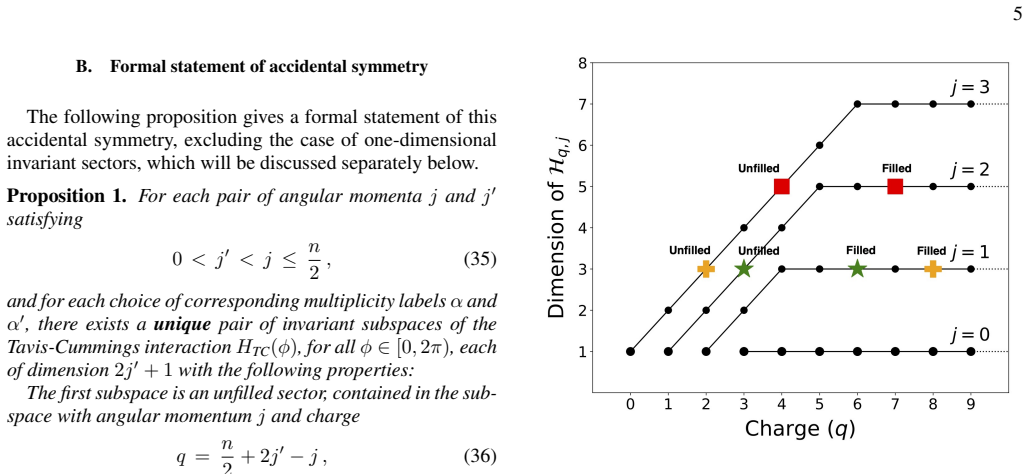
The Tavis-Cummings Hamiltonian possesses an extra accidental symmetry that constrains achievable unitaries for more than two qubits.
A machine-rendered reading of the paper's core claim, the machinery that carries it, and where it could break.
Core claim
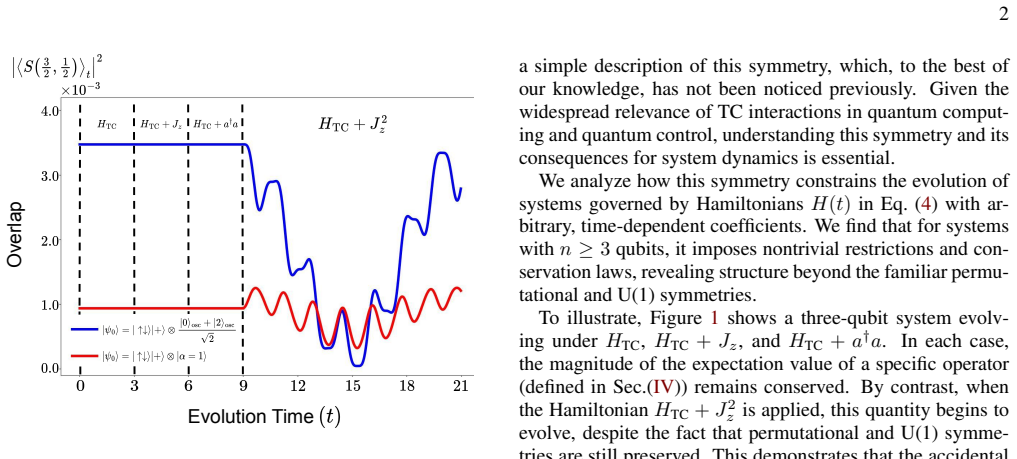
The Tavis-Cummings Hamiltonian has an independent accidental symmetry whose associated conserved observable is constructed explicitly via the Schwinger boson representation of the collective spin operators. For n greater than 2 this observable forces strong restrictions on the reachable unitary transformations. The restrictions remain after the global Jz term is added to the Hamiltonian but are eliminated by the further addition of Jz squared, although both extra terms preserve permutation symmetry and excitation-number conservation.
What carries the argument
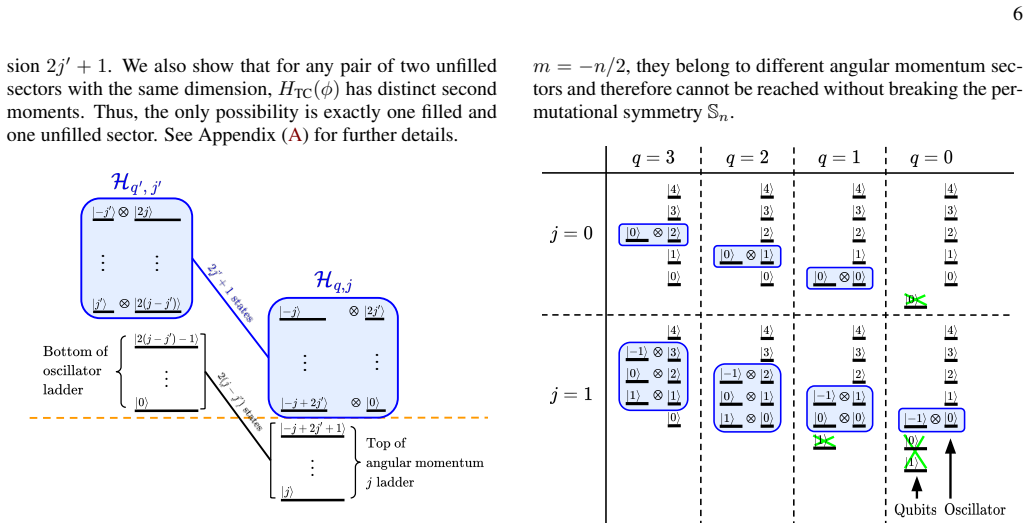
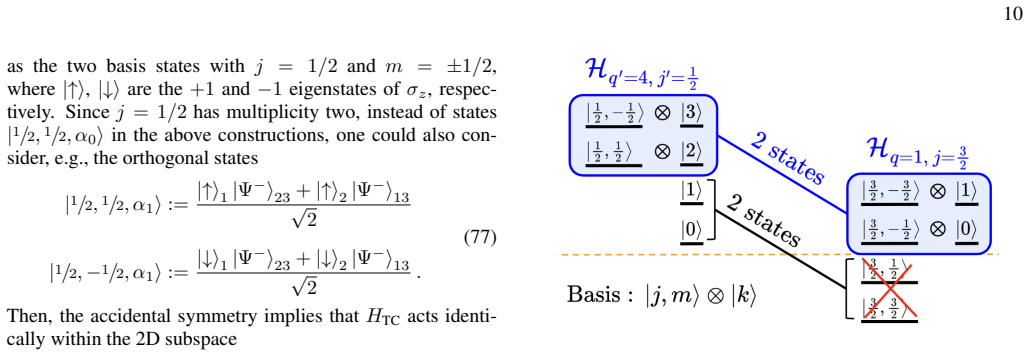
Accidental symmetry of the Tavis-Cummings Hamiltonian, made explicit by rewriting the interaction in Schwinger boson operators.
If this is right
- For n>2 the symmetry forbids certain unitary transformations from being generated by the Tavis-Cummings dynamics alone.
- Inclusion of the global Jz term leaves the unitary constraints intact.
- Addition of the Jz squared term lifts the constraints while preserving the original two symmetries.
- The symmetry therefore sets concrete limits on controllability of the multi-qubit Tavis-Cummings system.
Where Pith is reading between the lines
- The same symmetry could appear in other models whose interaction term can be written in collective angular-momentum form.
- Engineering a small Jz squared perturbation offers a practical route to restore full controllability without breaking the usual symmetries.
- The constraints may affect which quantum algorithms or error-correction protocols can be implemented directly in Tavis-Cummings hardware.
Load-bearing premise
The Tavis-Cummings Hamiltonian is taken in its exact ideal form with identical coupling strengths for every qubit and with no additional terms present.
What would settle it
Time evolution under the pure Tavis-Cummings Hamiltonian for three qubits that changes the value of the predicted conserved observable would falsify the claimed symmetry.
Figures
read the original abstract
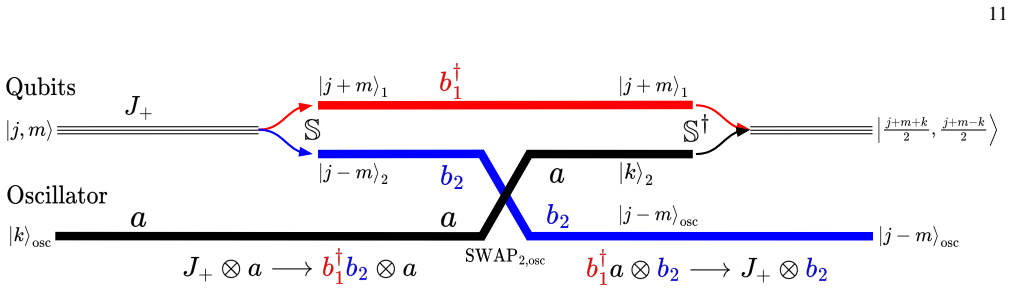
The Jaynes-Cummings (JC) Hamiltonian is a paradigmatic model of light-matter interaction and, more generally, qubit-boson interactions, widely used across atomic, optical, and superconducting qubit platforms. In the multi-qubit setting, where n qubits are identically coupled to a single boson mode, this interaction is known as the Tavis-Cummings (TC) Hamiltonian. The structure of the TC model is usually understood in terms of two standard symmetries: permutation invariance of the qubits and a U(1) symmetry associated with conservation of the total excitation number. Here we identify an additional, independent "accidental" symmetry of the TC Hamiltonian and construct the corresponding conserved observable. We show that, for n>2 qubits, this symmetry imposes strong constraints on the realizable unitary transformations. These constraints persist in the presence of the global $J_z$ Hamiltonian, but are removed by adding $J_z^2$, even though $J_z^2$ preserves both permutation invariance and the U(1) symmetry. Finally, we explain the origin of this previously unnoticed symmetry using Schwinger's boson representation of angular momentum. These restrictions have important implications for controllability of the TC system and for its applications to quantum computing, which are investigated further in a companion paper.
Editorial analysis
A structured set of objections, weighed in public.
Referee Report
Summary. The manuscript identifies an additional accidental symmetry in the Tavis-Cummings Hamiltonian (beyond permutation invariance and U(1) excitation-number conservation) for n qubits identically coupled to one bosonic mode. Using the Schwinger boson representation of angular momentum, the authors construct the associated conserved observable and demonstrate that, for n>2, this symmetry constrains the realizable unitary transformations. The constraints survive addition of a global J_z term but are removed by J_z^2 (despite J_z^2 preserving the two standard symmetries). Implications for controllability and quantum-computing applications are noted, with further discussion deferred to a companion paper.
Significance. If the claimed symmetry and its unitary constraints hold, the result supplies a previously unnoticed structural feature of the exact TC model that directly affects controllability. The Schwinger-boson derivation supplies an explicit origin for the symmetry and a concrete test (behavior under J_z versus J_z^2) that can be checked in experiment or simulation. These findings are relevant to quantum optics, circuit QED, and quantum control protocols that rely on the TC interaction.
Simulated Author's Rebuttal
We thank the referee for their positive evaluation of the manuscript, their clear summary of our results, and the recommendation to accept. No major comments were raised that require a point-by-point response.
Circularity Check
No significant circularity; derivation is self-contained
full rationale
The paper derives the accidental symmetry directly from the exact Tavis-Cummings Hamiltonian structure via the Schwinger boson representation of angular momentum, an external algebraic tool. The conserved observable and resulting constraints on unitaries for n>2 are obtained by explicit construction from the Hamiltonian's commutation relations and symmetries (permutation invariance and U(1) excitation conservation). No parameter fitting, self-definitional loops, or load-bearing self-citations appear in the provided text; the companion paper is referenced only for applications, not for justifying the symmetry itself. The ideal-Hamiltonian premise is definitional to the model and does not create circularity in the derivation chain.
Axiom & Free-Parameter Ledger
Reference graph
Works this paper leans on
-
[1]
Jaynes and F
E. Jaynes and F. Cummings, Comparison of quantum and semi- classical radiation theories with application to the beam maser, Proceedings of the IEEE51, 89 (1963)
1963
-
[2]
Larson and T
J. Larson and T. Mavrogordatos,The Jaynes–Cummings Model and Its Descendants, 2053-2563 (IOP Publishing, 2021)
2053
-
[3]
Leibfried, R
D. Leibfried, R. Blatt, C. Monroe, and D. Wineland, Quan- tum dynamics of single trapped ions, Rev. Mod. Phys.75, 281 (2003)
2003
-
[4]
H ¨affner, C
H. H ¨affner, C. Roos, and R. Blatt, Quantum computing with trapped ions, Physics Reports469, 155 (2008)
2008
-
[5]
Blais, R.-S
A. Blais, R.-S. Huang, A. Wallraff, S. M. Girvin, and R. J. Schoelkopf, Cavity quantum electrodynamics for supercon- ducting electrical circuits: An architecture for quantum com- putation, Phys. Rev. A69, 062320 (2004)
2004
-
[6]
Wallraff, D
A. Wallraff, D. I. Schuster, A. Blais, L. Frunzio, R.-S. Huang, J. Majer, S. Kumar, S. M. Girvin, and R. J. Schoelkopf, Strong coupling of a single photon to a superconducting qubit using circuit quantum electrodynamics, Nature431, 162 (2004)
2004
-
[7]
J. M. Raimond, M. Brune, and S. Haroche, Manipulating quan- tum entanglement with atoms and photons in a cavity, Rev. Mod. Phys.73, 565 (2001)
2001
-
[8]
Walther, B
H. Walther, B. T. H. Varcoe, B.-G. Englert, and T. Becker, Cav- ity quantum electrodynamics, Reports on Progress in Physics 69, 1325 (2006)
2006
-
[9]
B. T. H. Varcoe, S. Brattke, M. Weidinger, and H. Walther, Preparing pure photon number states of the radiation field, Na- ture403, 743 (2000)
2000
-
[10]
A. M. Childs and I. L. Chuang, Universal quantum computation with two-level trapped ions, Phys. Rev. A63, 012306 (2000)
2000
-
[11]
Yuan and S
H. Yuan and S. Lloyd, Controllability of the coupled spin- 1 2 harmonic oscillator system, Phys. Rev. A75, 052331 (2007)
2007
-
[12]
J. I. Cirac and P. Zoller, Quantum computations with cold trapped ions, Phys. Rev. Lett.74, 4091 (1995)
1995
-
[13]
Sørensen and K
A. Sørensen and K. Mølmer, Quantum computation with ions in thermal motion, Phys. Rev. Lett.82, 1971 (1999)
1971
-
[14]
Tavis and F
M. Tavis and F. W. Cummings, Exact solution for an n- molecule—radiation-field hamiltonian, Physical Review170, 379–384 (1968)
1968
-
[15]
Tavis and F
M. Tavis and F. W. Cummings, Approximate solutions for an n-molecule-radiation-field hamiltonian, Phys. Rev.188, 692 (1969)
1969
-
[16]
Bashir and M
M. Bashir and M. Sebawe Abdalla, The most general solu- tion for the wave equation of the transformed tavis-cummings model, Physics Letters A204, 21 (1995)
1995
-
[17]
N. M. Bogoliubov, R. K. Bullough, and J. Timonen, Exact so- lution of generalized tavis - cummings models in quantum op- tics, Journal of Physics A: Mathematical and General29, 6305 (1996)
1996
-
[18]
Rybin, G
A. Rybin, G. Kastelewicz, J. Timonen, and N. Bogoliubov, The su(1,1) tavis-cummings model, Journal of Physics A: Mathe- matical and General31, 4705 (1998)
1998
-
[19]
T. E. Tessier, I. H. Deutsch, A. Delgado, and I. Fuentes-Guridi, Entanglement sharing in the two-atom tavis-cummings model, Phys. Rev. A68, 062316 (2003)
2003
-
[20]
I. P. Vadeiko, G. P. Miroshnichenko, A. V . Rybin, and J. Timo- nen, Algebraic approach to the tavis-cummings problem, Phys. Rev. A67, 053808 (2003)
2003
-
[21]
Genes, P
C. Genes, P. R. Berman, and A. G. Rojo, Spin squeezing via atom-cavity field coupling, Phys. Rev. A68, 043809 (2003)
2003
-
[22]
J. M. Fink, R. Bianchetti, M. Baur, M. G¨oppl, L. Steffen, S. Fil- ipp, P. J. Leek, A. Blais, and A. Wallraff, Dressed collective qubit states and the tavis-cummings model in circuit qed, Phys. Rev. Lett.103, 083601 (2009). 13
2009
-
[23]
Agarwal, S
S. Agarwal, S. M. H. Rafsanjani, and J. H. Eberly, Tavis- cummings model beyond the rotating wave approximation: Quasidegenerate qubits, Phys. Rev. A85, 043815 (2012)
2012
-
[24]
J. H. Zou, T. Liu, M. Feng, W. L. Yang, C. Y . Chen, and J. Twamley, Quantum phase transition in a driven tavis–cummings model, New Journal of Physics15, 123032 (2013)
2013
-
[25]
M. Keyl, R. Zeier, and T. Schulte-Herbr¨uggen, Controlling sev- eral atoms in a cavity, New Journal of Physics16, 065010 (2014)
2014
-
[26]
A. Retzker, E. Solano, and B. Reznik, Tavis-cummings model and collective multiqubit entanglement in trapped ions, Physi- cal Review A75, 10.1103/physreva.75.022312 (2007)
-
[27]
F. Mu, Y . Gao, H. Yin, and G. Wang, Dicke state generation via selective interactions in a dicke-stark model, Opt. Express28, 39574 (2020)
2020
-
[28]
Zhang, Z
T. Zhang, Z. Chi, and J. Hu, Entanglement generation via single-qubit rotations in a torn hilbert space, PRX Quantum5, 030345 (2024)
2024
-
[29]
Schwinger,On Angular Momentum, Tech
J. Schwinger,On Angular Momentum, Tech. Rep. (Harvard University; Nuclear Development Associates, Inc. (US), 1952)
1952
-
[30]
J. J. Sakurai and J. Napolitano,Modern Quantum Mechanics, 3rd ed. (Cambridge University Press, 2020)
2020
-
[31]
Deliyannis and I
P. Deliyannis and I. Marvian, Global control with the tavis- cummings interaction, In preparation (2026)
2026
-
[32]
Deliyannis and I
P. Deliyannis and I. Marvian, Permutation-invariantn-body gates via the tavis-cummings interaction, In preparation (2026)
2026
-
[33]
Schur, ¨Uber die rationalen darstellungen der allgemeinen linearen gruppe, Sitzungsberichte der K ¨oniglich Preussischen Akademie der Wissenschaften zu Berlin , 58 (1927)
I. Schur, ¨Uber die rationalen darstellungen der allgemeinen linearen gruppe, Sitzungsberichte der K ¨oniglich Preussischen Akademie der Wissenschaften zu Berlin , 58 (1927)
1927
-
[34]
Weyl,The Classical Groups: Their Invariants and Repre- sentations, 1st ed
H. Weyl,The Classical Groups: Their Invariants and Repre- sentations, 1st ed. (Princeton University Press, 1939) p. 302
1939
-
[35]
Goodman and N
R. Goodman and N. Wallach,Symmetry, Representations, and Invariants, Graduate Texts in Mathematics (Springer New York, 2010)
2010
-
[36]
Marvian, H
I. Marvian, H. Liu, and A. Hulse, Rotationally invariant cir- cuits: Universality with the exchange interaction and two an- cilla qubits, Phys. Rev. Lett.132, 130201 (2024)
2024
-
[37]
S. D. Bartlett, T. Rudolph, and R. W. Spekkens, Reference frames, superselection rules, and quantum information, Rev. Mod. Phys.79, 555 (2007)
2007
-
[38]
Zimbor ´as, R
Z. Zimbor ´as, R. Zeier, T. Schulte-Herbr¨uggen, and D. Burgarth, Symmetry criteria for quantum simulability of effective interac- tions, Phys. Rev. A92, 042309 (2015)
2015
-
[39]
Marvian, Restrictions on realizable unitary operations im- posed by symmetry and locality, Nature Physics18, 283 (2022)
I. Marvian, Restrictions on realizable unitary operations im- posed by symmetry and locality, Nature Physics18, 283 (2022)
2022
-
[40]
A. Hulse, H. Liu, and I. Marvian, A framework for semi- universality: Semi-universality of 3-qudit su(d)-invariant gates (2024), arXiv:2407.21249 [quant-ph]. 14 Appendix A: Appendix: Second moments ofH TC in filled and unfilled sectors Here, we calculate the second moment of the component ofH TC(ϕ)in sectorH q,j, as defined in Eq.(42), Tr n H 2 TC(ϕ)q,j o...
arXiv 2024
discussion (0)
Sign in with ORCID, Apple, or X to comment. Anyone can read and Pith papers without signing in.