Global Control with the Tavis-Cummings Interaction
Pith reviewed 2026-06-27 06:54 UTC · model grok-4.3
The pith
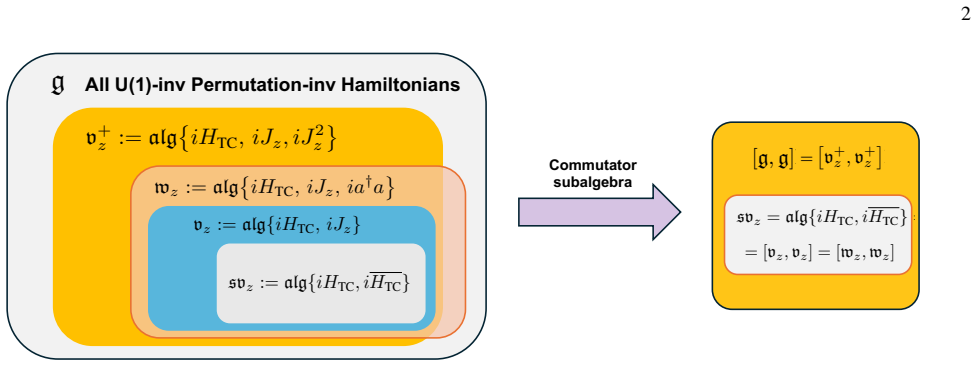
The Tavis-Cummings interaction with global z control is restricted by an accidental symmetry for more than two qubits, but adding J_z squared achieves semi-universality within the symmetry sector.
A machine-rendered reading of the paper's core claim, the machinery that carries it, and where it could break.
Core claim
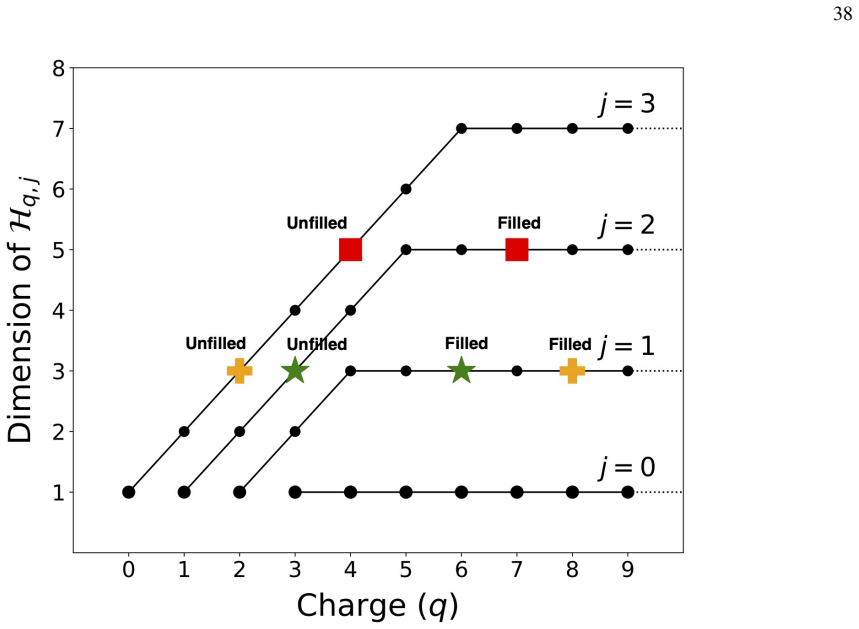
The set of realizable unitaries using the Tavis-Cummings interaction and J_z is restricted by an accidental symmetry for n>2 qubits. The Hamiltonian J_z^2 breaks this symmetry, and together with the TC interaction and J_z, the system achieves semi-universality by allowing arbitrary unitaries that respect permutational and U(1) symmetry, subject to certain constraints on the center of the group.
What carries the argument
The accidental symmetry of the Tavis-Cummings Hamiltonian, distinct from its standard U(1) and permutational symmetries, that restricts the group of achievable unitaries on the joint qubit-bosonic-mode space.
If this is right
- For n>2 qubits the TC interaction plus J_z generates only a proper subgroup of the symmetry-respecting unitaries.
- J_z^2 removes the restriction coming from the accidental symmetry.
- The combined generators allow every symmetry-respecting unitary except for possible central-phase constraints.
- The characterization applies to the full Hilbert space of the qubits and the shared bosonic mode.
Where Pith is reading between the lines
- In physical systems that naturally realize collective coupling, experimenters may need to engineer an effective quadratic global drive to reach the full set of symmetric operations.
- The accidental symmetry may appear in other collective-interaction models and could be diagnosed by checking whether certain phase patterns on symmetric states remain unreachable.
- The result suggests that global-control architectures for quantum information can be made semi-universal by adding a single extra Hamiltonian term without requiring individual qubit addressing.
Load-bearing premise
The system is assumed to be perfectly described by the ideal Tavis-Cummings Hamiltonian plus the global control terms J_z and J_z^2, with no additional interactions, decoherence, or deviations from identical coupling.
What would settle it
An experiment that implements a unitary respecting permutational and U(1) symmetry but violating the accidental symmetry using only TC interaction and J_z would falsify the claimed restriction; failure to reach all such unitaries even after adding J_z^2 would falsify the semi-universality result.
Figures
read the original abstract
We study the controllability of a system of qubits under global control, where control pulses act identically on all qubits. Specifically, we consider a collection of qubits identically coupled to a single bosonic mode, or harmonic oscillator, via the Jaynes-Cummings interaction. This collective coupling, known as the Tavis-Cummings (TC) interaction, has been realized in several quantum computing platforms, including superconducting and atomic qubit systems. Although the qubits do not interact directly with one another, they can become entangled through their common coupling to the bosonic mode. We characterize the group of unitaries that can be implemented on the joint Hilbert space of the qubits and bosonic mode using the TC interaction together with a global $z$ field $J_z$, corresponding to identical z rotations on all qubits. We show that for n>2 qubits the set of realizable unitaries is restricted by an "accidental" symmetry of the TC Hamiltonian, distinct from its "standard" U(1) and permutational symmetries. On the other hand, we find that the Hamiltonian $J_z^2$ breaks this accidental symmetry and, together with the TC interaction and $J_z$, achieves semi-universality: it allows the implementation of arbitrary unitaries that respect permutational and U(1) symmetry, up to certain constraints on the center of the group. In a companion paper, we further analyze this remarkable accidental symmetry and show that it can be understood through Schwinger's bosonic model of angular momentum.
Editorial analysis
A structured set of objections, weighed in public.
Referee Report
Summary. The paper examines controllability of n qubits coupled identically to a bosonic mode via the Tavis-Cummings (TC) interaction, under global controls consisting of the TC Hamiltonian, J_z, and J_z^2. It claims that for n>2 an accidental symmetry of the TC Hamiltonian (distinct from the standard U(1) and permutational symmetries) restricts the generated unitary group, while adjoining J_z^2 breaks this symmetry and yields semi-universality: arbitrary unitaries respecting the permutational and U(1) symmetries can be implemented, subject to constraints on the center of the group. The symmetry is further analyzed via Schwinger's bosonic model in a companion paper.
Significance. If the central characterization holds, the result is significant for global-control protocols in experimentally realized TC systems (e.g., circuit QED and atomic ensembles). The explicit identification of the accidental symmetry and the semi-universality statement on the symmetry-respecting subspace provide a concrete group-theoretic description of reachable operations. Credit is due for grounding the analysis in Schwinger's model and for distinguishing the accidental symmetry from the known ones.
major comments (2)
- [Results section on accidental symmetry (near the statement of the main theorem)] The central claim that the TC Hamiltonian possesses an accidental symmetry restricting the reachable group for n>2 (distinct from U(1) and permutational) is load-bearing, yet the manuscript provides no explicit Lie-algebra generators, dimension count, or proof that this symmetry is independent of the standard ones; the companion-paper reference does not substitute for a self-contained argument in the main text.
- [Controllability analysis (following the symmetry discussion)] The semi-universality statement (arbitrary symmetry-respecting unitaries up to center constraints) is asserted after adjoining J_z^2, but no explicit verification is given that the Lie algebra generated by {TC, J_z, J_z^2} spans the full symmetry-respecting algebra minus the center; this is required to confirm the claim is not merely a restatement of the symmetry assumptions.
minor comments (2)
- [Abstract and §1] The abstract and introduction use the term 'semi-universality' without a precise definition or reference to the precise subgroup; a short clarifying sentence would aid readability.
- [Model section] Notation for the bosonic mode operators and collective spin operators (J_z, etc.) should be introduced once with explicit commutation relations to avoid ambiguity when discussing the accidental symmetry.
Simulated Author's Rebuttal
We thank the referee for their thorough review and constructive comments. We address the major comments point by point below, agreeing that the main text requires additional explicit details for self-containment.
read point-by-point responses
-
Referee: The central claim that the TC Hamiltonian possesses an accidental symmetry restricting the reachable group for n>2 (distinct from U(1) and permutational) is load-bearing, yet the manuscript provides no explicit Lie-algebra generators, dimension count, or proof that this symmetry is independent of the standard ones; the companion-paper reference does not substitute for a self-contained argument in the main text.
Authors: We agree that the main text should include a self-contained argument. In the revised manuscript, we will add explicit Lie-algebra generators for the accidental symmetry, a dimension count demonstrating independence from the U(1) and permutational symmetries, and a brief proof sketch in the Results section near the main theorem. revision: yes
-
Referee: The semi-universality statement (arbitrary symmetry-respecting unitaries up to center constraints) is asserted after adjoining J_z^2, but no explicit verification is given that the Lie algebra generated by {TC, J_z, J_z^2} spans the full symmetry-respecting algebra minus the center; this is required to confirm the claim is not merely a restatement of the symmetry assumptions.
Authors: We agree that explicit verification is needed. We will add a controllability analysis in the revised version demonstrating that the Lie algebra generated by {TC, J_z, J_z^2} spans the full symmetry-respecting algebra minus the center, via explicit commutator calculations. revision: yes
Circularity Check
No significant circularity; derivation is self-contained via symmetry analysis
full rationale
The paper derives the reachable unitary group from the TC Hamiltonian plus global J_z and J_z^2 controls by direct analysis of its U(1), permutational, and accidental symmetries, followed by Lie-algebra generation arguments. No equations or parameters are fitted to data and then relabeled as predictions; no self-definitional loops appear; the companion paper is invoked only for additional insight into the accidental symmetry (already stated as shown here) and does not serve as the sole justification for the semi-universality claim. The central results therefore stand on independent mathematical characterization rather than reduction to inputs or self-citation chains.
Axiom & Free-Parameter Ledger
axioms (2)
- domain assumption The joint system evolves under the ideal Tavis-Cummings Hamiltonian plus global control fields.
- domain assumption Control is restricted to identical operations on all qubits (global control).
Reference graph
Works this paper leans on
-
[1]
(118), vq,j =e i(j′−j)θz vq′,j′ .(140)
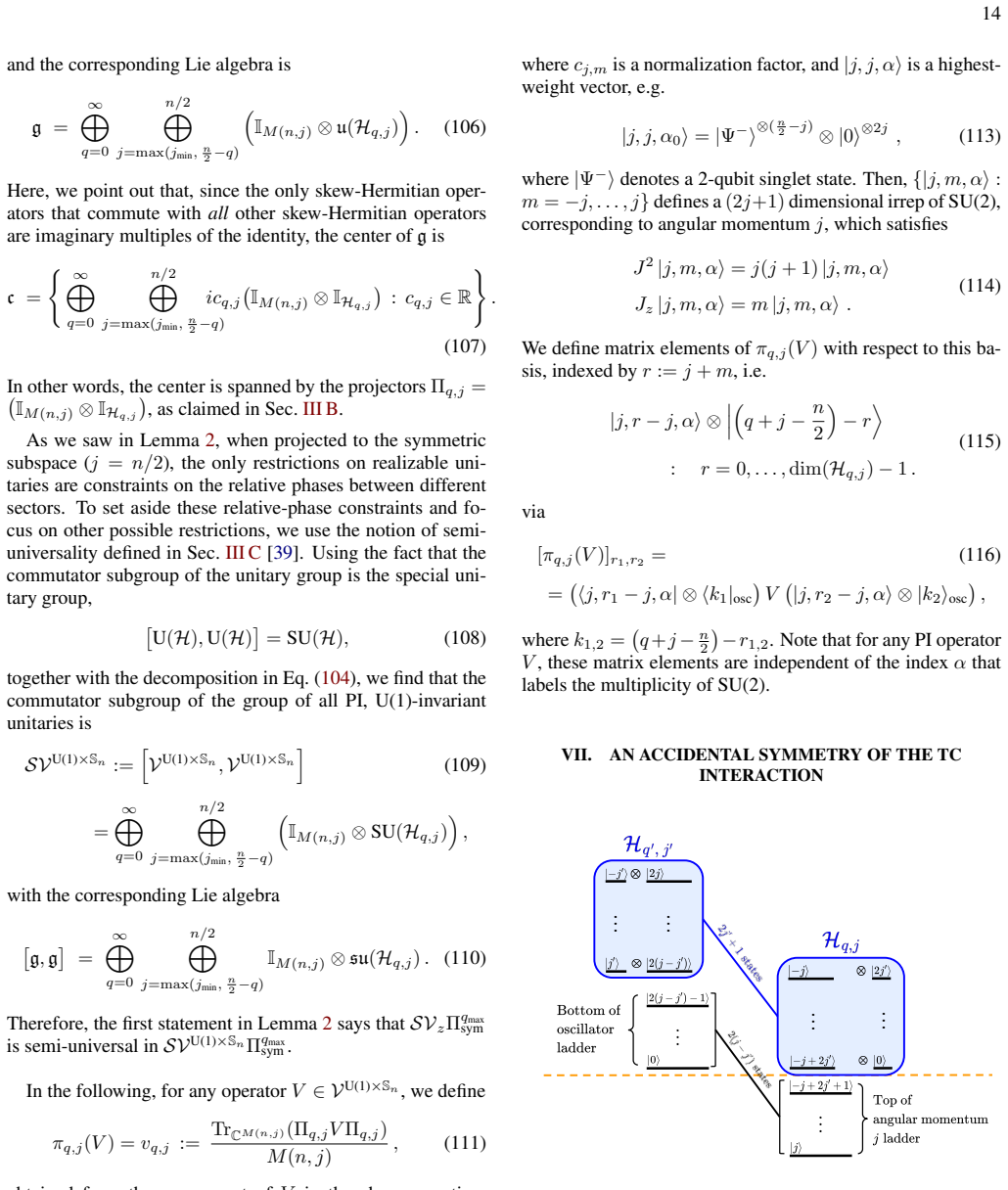
(Accidental Symmetry) Forn≥3and for each pair (j, j′)with0< j ′ < j≤n/2, and(q, q ′)given by Eq. (118), vq,j =e i(j′−j)θz vq′,j′ .(140)
-
[2]
On the other hand,J 2 z breaks the accidental symmetry in manner such that the constraint in Eq
(Phase Constraint) Phasesθ q,j := arg det(vq,j)satisfy θq,j =θ z Tr πq,j(Jz) = q− n 2 +j+ 1 :q < n 2 +j × q− n 2 −j θz 2 0 :q≥ n 2 +j , (141) where the equations hold modulo2π. On the other hand,J 2 z breaks the accidental symmetry in manner such that the constraint in Eq. (140) is broken. As we show in Sec. X H, indeed using this Hamiltonian th...
-
[3]
Ifnis even, thenϕ j=0,m=0 = 0 (mod 2π), or equiva- lentlyU P 0,0 =P 0,0
-
[4]
Namely, one can realize only those unitariesUsatisfyingϕ j=0,m=0 = 0
Ifk= 0, i.e., the oscillator is in vaccum, thenϕ j,−j = 0 (mod 2π)for allj, or equivalently, U Pj,−j =P j,−j.(147) In words, if the oscillator is initialized in an excited state, i.e., in any eigenstate|k⟩osc ofa †awith eigenvaluek̸= 0, then the only restriction on the realizable unitariesUoccurs in the sector withj= 0, which exists only for evenn. Namely...
-
[5]
S. Lloyd, A potentially realizable quan- tum computer, Science261, 1569 (1993), https://www.science.org/doi/pdf/10.1126/science.261.5128.1569
-
[6]
S. C. Benjamin, Quantum computing without local control of qubit-qubit interactions, Phys. Rev. Lett.88, 017904 (2001)
2001
-
[7]
S. C. Benjamin, Schemes for parallel quantum computation without local control of qubits, Phys. Rev. A61, 020301 (2000)
2000
-
[8]
Fitzsimons, L
J. Fitzsimons, L. Xiao, S. C. Benjamin, and J. A. Jones, Quantum information processing with delocalized qubits under global control, Phys. Rev. Lett.99, 030501 (2007)
2007
-
[9]
Raussendorf, Quantum computation via translation-invariant operations on a chain of qubits, Phys
R. Raussendorf, Quantum computation via translation-invariant operations on a chain of qubits, Phys. Rev. A72, 052301 (2005)
2005
-
[10]
Kay and J
A. Kay and J. K. Pachos, Quantum computation in optical lat- tices via global laser addressing, New Journal of Physics6, 126 (2004)
2004
-
[11]
Cesa and H
F. Cesa and H. Pichler, Universal quantum computation in glob- ally driven rydberg atom arrays, Physical Review Letters131, 170601 (2023)
2023
- [12]
-
[13]
Leibfried, R
D. Leibfried, R. Blatt, C. Monroe, and D. Wineland, Quan- tum dynamics of single trapped ions, Rev. Mod. Phys.75, 281 (2003)
2003
-
[14]
H ¨affner, C
H. H ¨affner, C. Roos, and R. Blatt, Quantum computing with trapped ions, Physics Reports469, 155 (2008)
2008
-
[15]
Blais, R.-S
A. Blais, R.-S. Huang, A. Wallraff, S. M. Girvin, and R. J. Schoelkopf, Cavity quantum electrodynamics for supercon- ducting electrical circuits: An architecture for quantum com- putation, Phys. Rev. A69, 062320 (2004)
2004
-
[16]
Wallraff, D
A. Wallraff, D. I. Schuster, A. Blais, L. Frunzio, R.-S. Huang, J. Majer, S. Kumar, S. M. Girvin, and R. J. Schoelkopf, Strong coupling of a single photon to a superconducting qubit using circuit quantum electrodynamics, Nature431, 162 (2004)
2004
-
[17]
J. M. Raimond, M. Brune, and S. Haroche, Manipulating quan- tum entanglement with atoms and photons in a cavity, Rev. Mod. Phys.73, 565 (2001). 28
2001
-
[18]
Walther, B
H. Walther, B. T. H. Varcoe, B.-G. Englert, and T. Becker, Cav- ity quantum electrodynamics, Reports on Progress in Physics 69, 1325 (2006)
2006
-
[19]
B. T. H. Varcoe, S. Brattke, M. Weidinger, and H. Walther, Preparing pure photon number states of the radiation field, Na- ture403, 743 (2000)
2000
-
[20]
Jaynes and F
E. Jaynes and F. Cummings, Comparison of quantum and semi- classical radiation theories with application to the beam maser, Proceedings of the IEEE51, 89 (1963)
1963
-
[21]
Larson and T
J. Larson and T. Mavrogordatos,The Jaynes–Cummings Model and Its Descendants, 2053-2563 (IOP Publishing, 2021)
2053
-
[22]
A. M. Childs and I. L. Chuang, Universal quantum computation with two-level trapped ions, Phys. Rev. A63, 012306 (2000)
2000
-
[23]
Yuan and S
H. Yuan and S. Lloyd, Controllability of the coupled spin- 1 2 harmonic oscillator system, Phys. Rev. A75, 052331 (2007)
2007
-
[24]
J. I. Cirac and P. Zoller, Quantum computations with cold trapped ions, Phys. Rev. Lett.74, 4091 (1995)
1995
-
[25]
Tavis and F
M. Tavis and F. W. Cummings, Exact solution for an n- molecule—radiation-field hamiltonian, Physical Review170, 379–384 (1968)
1968
-
[26]
Tavis and F
M. Tavis and F. W. Cummings, Approximate solutions for an n-molecule-radiation-field hamiltonian, Phys. Rev.188, 692 (1969)
1969
-
[27]
Bashir and M
M. Bashir and M. Sebawe Abdalla, The most general solu- tion for the wave equation of the transformed tavis-cummings model, Physics Letters A204, 21 (1995)
1995
-
[28]
N. M. Bogoliubov, R. K. Bullough, and J. Timonen, Exact so- lution of generalized tavis - cummings models in quantum op- tics, Journal of Physics A: Mathematical and General29, 6305 (1996)
1996
-
[29]
Rybin, G
A. Rybin, G. Kastelewicz, J. Timonen, and N. Bogoliubov, The su(1,1) tavis-cummings model, Journal of Physics A: Mathe- matical and General31, 4705 (1998)
1998
-
[30]
T. E. Tessier, I. H. Deutsch, A. Delgado, and I. Fuentes-Guridi, Entanglement sharing in the two-atom tavis-cummings model, Phys. Rev. A68, 062316 (2003)
2003
-
[31]
I. P. Vadeiko, G. P. Miroshnichenko, A. V . Rybin, and J. Timo- nen, Algebraic approach to the tavis-cummings problem, Phys. Rev. A67, 053808 (2003)
2003
-
[32]
Genes, P
C. Genes, P. R. Berman, and A. G. Rojo, Spin squeezing via atom-cavity field coupling, Phys. Rev. A68, 043809 (2003)
2003
-
[33]
J. M. Fink, R. Bianchetti, M. Baur, M. G¨oppl, L. Steffen, S. Fil- ipp, P. J. Leek, A. Blais, and A. Wallraff, Dressed collective qubit states and the tavis-cummings model in circuit qed, Phys. Rev. Lett.103, 083601 (2009)
2009
-
[34]
Agarwal, S
S. Agarwal, S. M. H. Rafsanjani, and J. H. Eberly, Tavis- cummings model beyond the rotating wave approximation: Quasidegenerate qubits, Phys. Rev. A85, 043815 (2012)
2012
-
[35]
J. H. Zou, T. Liu, M. Feng, W. L. Yang, C. Y . Chen, and J. Twamley, Quantum phase transition in a driven tavis–cummings model, New Journal of Physics15, 123032 (2013)
2013
-
[36]
M. Keyl, R. Zeier, and T. Schulte-Herbr¨uggen, Controlling sev- eral atoms in a cavity, New Journal of Physics16, 065010 (2014)
2014
-
[37]
A. Retzker, E. Solano, and B. Reznik, Tavis-cummings model and collective multiqubit entanglement in trapped ions, Physi- cal Review A75, 10.1103/physreva.75.022312 (2007)
-
[38]
Sørensen and K
A. Sørensen and K. Mølmer, Quantum computation with ions in thermal motion, Phys. Rev. Lett.82, 1971 (1999)
1971
-
[39]
Deliyannis and I
P. Deliyannis and I. Marvian, Accidental symmetry in the tavis- cummings model via the schwinger boson representation, In preparation (2026)
2026
-
[40]
Marvian, Restrictions on realizable unitary operations im- posed by symmetry and locality, Nature Physics18, 283 (2022)
I. Marvian, Restrictions on realizable unitary operations im- posed by symmetry and locality, Nature Physics18, 283 (2022)
2022
- [42]
-
[43]
Marvian, Theory of quantum circuits with abelian symme- tries, Phys
I. Marvian, Theory of quantum circuits with abelian symme- tries, Phys. Rev. Res.6, 043292 (2024)
2024
-
[44]
Deliyannis and I
P. Deliyannis and I. Marvian, Permutation-invariantn-body gates via the tavis-cummings interaction, In preparation (2026)
2026
-
[45]
Zimbor ´as, R
Z. Zimbor ´as, R. Zeier, T. Schulte-Herbr¨uggen, and D. Burgarth, Symmetry criteria for quantum simulability of effective interac- tions, Phys. Rev. A92, 042309 (2015)
2015
-
[46]
Marvian, H
I. Marvian, H. Liu, and A. Hulse, Rotationally invariant cir- cuits: Universality with the exchange interaction and two an- cilla qubits, Phys. Rev. Lett.132, 130201 (2024)
2024
-
[47]
S. D. Bartlett, T. Rudolph, and R. W. Spekkens, Reference frames, superselection rules, and quantum information, Rev. Mod. Phys.79, 555 (2007)
2007
-
[48]
S. G. Schirmer, H. Fu, and A. I. Solomon, Complete controlla- bility of quantum systems, Phys. Rev. A63, 063410 (2001)
2001
-
[49]
Maslov and Y
D. Maslov and Y . Nam, Use of global interactions in effi- cient quantum circuit constructions, New Journal of Physics20, 033018 (2018)
2018
-
[50]
van de Wetering, Constructing quantum circuits with global gates, New Journal of Physics23, 043015 (2021)
J. van de Wetering, Constructing quantum circuits with global gates, New Journal of Physics23, 043015 (2021)
2021
-
[51]
Menta, F
R. Menta, F. Cioni, R. Aiudi, F. Caravelli, M. Polini, and V . Gio- vannetti, Building globally controlled quantum processors with zzinteractions, Phys. Rev. A113, 012614 (2026)
2026
-
[52]
Cioni, R
F. Cioni, R. Menta, R. Aiudi, M. Polini, and V . Giovannetti, Conveyor-belt superconducting quantum computer, Phys. Rev. A113, 012439 (2026)
2026
-
[53]
O. Katz, M. Cetina, and C. Monroe,n-body interactions be- tween trapped ion qubits via spin-dependent squeezing, Phys. Rev. Lett.129, 063603 (2022)
2022
-
[54]
O. Katz, M. Cetina, and C. Monroe, Programmablen-body in- teractions with trapped ions, PRX Quantum4, 030311 (2023)
2023
-
[55]
H.-Y . Hu, A. M. Gomez, L. Chen, A. Trowbridge, A. J. Gold- schmidt, Z. Manchester, F. T. Chong, A. Jaffe, and S. F. Yelin, Universal dynamics with globally controlled analog quantum simulators (2026), arXiv:2508.19075 [quant-ph]
arXiv 2026
-
[56]
Y . Liu, S. Singh, K. C. Smith, E. Crane, J. M. Martyn, A. Eick- busch, A. Schuckert, R. D. Li, J. Sinanan-Singh, M. B. So- ley, T. Tsunoda, I. L. Chuang, N. Wiebe, and S. M. Girvin, Hybrid oscillator-qubit quantum processors: Instruction set ar- chitectures, abstract machine models, and applications (2024), arXiv:2407.10381 [quant-ph]
arXiv 2024
-
[57]
Ballentine,Quantum Mechanics: A Modern Development, G - Reference,Information and Interdisciplinary Subjects Series (World Scientific, 2015)
L. Ballentine,Quantum Mechanics: A Modern Development, G - Reference,Information and Interdisciplinary Subjects Series (World Scientific, 2015). 29 APPENDIX: TABLE OF CONTENTS Sec. A Notation Summary. . . . . . . . . . . . . . . . . . . . . . . . . . . . . . . . . . . . . . . . . . . . . . . . . . . . . . . . . . . . . . . . . . . . . . . . . . . . . . . ...
2015
-
[58]
Matrix Elements ofH TC,J z,a †a Recall the form of the Tavis-Cummings Hamiltonian, HTC = gTC 2 nX i=1 σ(i) + a+σ (i) − a† =g TC (J+a+J −a†), (B7) For the remainder of this appendix, we setg TC = 1to avoid unnecessary notational clutter. WriteaandJ + matrix elements [53], a† |k⟩= √ k+ 1|k+ 1⟩(B8a) J+ |j, m⟩= p (j+m+ 1)(j−m)|j, m+ 1⟩(B8b) J− |j, m⟩= p (j−m+...
-
[59]
In the|q, k⟩basis, ⟨q, k|H TC |q, k+ 1⟩=⟨q, k+ 1|H TC |q, k⟩= p (q−k)(k+ 1)(n−q+k+ 1),(B11) where0≤q≤ ∞andmax(0, q−n)≤k≤q−1
Matrix Elements in the Symmetric Subspace For thej=n/2symmetric subspace, the nonzero matrix elements ofH TC are ⟨m, k|H TC |m−1, k+ 1⟩=⟨m−1, k+ 1|H TC |m, k⟩= p (n/2 +m)(n/2−m+ 1)(k+ 1), with−n/2 + 1≤m≤n/2and0≤k≤ ∞. In the|q, k⟩basis, ⟨q, k|H TC |q, k+ 1⟩=⟨q, k+ 1|H TC |q, k⟩= p (q−k)(k+ 1)(n−q+k+ 1),(B11) where0≤q≤ ∞andmax(0, q−n)≤k≤q−1
-
[60]
Then, using Eq
Energy variance ofH TC Consider the maximally-mixed state withinC M(n,j) ⊗ Hq,j: τq,j := Πq,j Tr(Πq,j) = Πq,j dn(q, j)M(n, j) .(B12) First, consider the symmetric subspace, which appears with multiplicity one, i.e.M(n, j=n/2) = 1, soTr(π q,j=n/2(HTC)) = Tr(HTCΠq,j=n/2). Then, using Eq. (B11), compute for any chargeq, Tr H2 TCτq, j=n/2 := 1 Tr(Πq, j=n/2) T...
-
[61]
(228), first note that Eq
Variance ofJ 2 z in Accidental Symmetry Sectors To see Eq. (228), first note that Eq. (227) implies πq,j(J2 z ) =π q′,j′(J2 z ) + (j−j ′)2I+ 2(j−j ′)πq′,j′(Jz). (B16) The constant term does not affect the variance. Hence, using Var(X+Y) = Var(X) + Var(Y) + 2 Cov(X, Y), we find Varq,j(J2 z ) = Var q′,j′(J2 z ) + 4(j−j ′)2 Varq′,j′(Jz) + 4(j−j ′) Covq′,j′(J...
-
[62]
In the following, we determine the projection of the Lie algebra generated byiH TC,iJ z, andia †aonto this center
Projections of the Hamiltonians to the center of PI, U(1)-invariant Hamiltonians (Charge V ectors) Recall that the center of the Lie algebragof all PI, U(1)-invariant Hamiltonians is spanned by{iΠ q,j }. In the following, we determine the projection of the Lie algebra generated byiH TC,iJ z, andia †aonto this center. (This projection, is also known as the...
-
[63]
36 Appendix C: An Accidental Symmetry ofH TC: Proof of Proposition 4 Proof.(Proposition 4) Recall from Eq
Charge V ectors ofJ 2 z The charge vectors corresponding toJ 2 z are Tr πq,j J2 z = q−n/2X m=−j m2 = 1 6 j(j+ 1)(2j+ 1) + q− n 2 q− n 2 + 1 (2q−n+ 1) (B25) = 1 6 q+j+ 1− n 2 h j(2j+ 1)−2j q− n 2 + q− n 2 (2q−n+ 1) i 35 forq < n/2 +j, and Tr πq,j J2 z = jX m=−j m2 = 1 3 j(j+ 1)(2j+ 1) (B26) forq≥n/2 +j. 36 Appendix C: An Accidental Symmetry ofH TC: Proof o...
-
[64]
the restriction of eFto the support ofFagrees withF, namely F= eF h Iqubits ⊗ |k⟩⟨k|osc +|k+ 1⟩⟨k+ 1| osc i .(F11) 41 The idea is to construct eFby symmetrizingFwith respect to the accidental symmetry. SinceFis PI and U(1)-invariant, it is block-diagonal with respect to the projectorsΠ q,j: F=F X q,j Πq,j = X q,j Πq,j FΠ q,j = X q,j Fq,j ,(F12) where Fq,j...
-
[65]
(Anharmonic system) At least one of the boundary energy gaps on the is different from all others, that is either (i)∆ 1 ̸= 0and|∆ y| ̸=|∆ 1|for ally >1, or (ii)∆ d−1 ̸= 0and|∆ y| ̸=|∆ d−1|for ally < d−1
-
[66]
anharmonicity
(Harmonic system) All energy gaps ofBare equal and nonzero, i.e.∆ y = ∆̸= 0for ally, and at least one of boundary second-order finite differences is different from all others, that is either (i)∆ 2ay ̸= ∆2a1 for ally >1 (ii)∆ 2ay ̸= ∆2ad−1 for ally < d−1. Here,Bis interpreted as the intrinsic Hamiltonian of a given system, whileAis called a dipole interac...
discussion (0)
Sign in with ORCID, Apple, or X to comment. Anyone can read and Pith papers without signing in.