REVIEW 2 major objections 2 minor 61 references
Proximity to WSe2 reshapes magnetization reversals in twisted monolayer-bilayer graphene through induced spin-orbit coupling, enabling engineered switching of quantum anomalous Hall states.
Reviewed by Pith at T0; open to challenge. T0 means a machine referee read the full paper against a public rubric. the ladder, T0–T4 →
T0 review · grok-4.3
2026-06-27 05:33 UTC pith:YSR2KELZ
load-bearing objection Proximity to WSe2 changes QAH switching behavior in tMBG and enables gate tuning across Chern numbers via metastability, but the SOC attribution rests on unseparated interface effects. the 2 major comments →
Engineering electrically-switchable quantum anomalous Hall states by spin-orbit coupling
The pith
A machine-rendered reading of the paper's core claim, the machinery that carries it, and where it could break.
Core claim
Proximitizing twisted monolayer-bilayer graphene by WSe2 reshapes the magnetization reversals responsible for nonvolatile electrical switching of QAH states. The effect is attributed to proximity-induced spin-orbit coupling that locks spin and valley and modifies the magnetization of the competing states involved in switching, compared with non-proximitized graphene systems. Strong magnetic metastability in tMBG further allows the magnetic states to be gate-tuned between QAH and metallic regimes and between QAH states with Chern numbers |C| = 2 and 1 without resetting the magnetic state.
What carries the argument
Proximity-induced spin-orbit coupling that locks spin and valley degrees of freedom, thereby altering the magnetization of competing magnetic states in the moiré system.
Load-bearing premise
The reshaping of magnetization reversals is caused specifically by proximity-induced spin-orbit coupling that locks spin and valley, rather than by other interface effects, dielectric changes, or alterations to the moiré potential.
What would settle it
Fabricate an otherwise identical twisted monolayer-bilayer graphene device but replace WSe2 with a material that does not induce valley-locking spin-orbit coupling and measure whether the magnetization reversal curves still change in the same way.
If this is right
- The magnetic energy landscape of moiré devices can be deliberately engineered by choosing the proximity layer.
- Magnetic states remain stable enough for gate voltage to switch a device between quantum anomalous Hall and metallic behavior without first erasing the magnetism.
- Gate voltage can also move the system between quantum anomalous Hall states with Chern numbers |C| = 2 and |C| = 1 while the magnetic order stays fixed.
- Device architectures can exploit chiral edge states whose magnetic switching properties have been tuned by the choice of proximity material.
Where Pith is reading between the lines
- The same proximity approach could be tested in other transition-metal dichalcogenide–graphene stacks to isolate which details of the spin-orbit coupling produce the strongest reshaping of reversals.
- If the metastability persists across different twist angles, it may enable multi-state memory elements that store both the magnetic direction and the Chern number.
- The method supplies an extra control knob that could be combined with existing gate-tuning techniques to create more complex sequences of topological transitions in a single device.
Editorial analysis
A structured set of objections, weighed in public.
Referee Report
Summary. The manuscript reports that proximitizing twisted monolayer-bilayer graphene (tMBG) with WSe2 reshapes the magnetization reversals for nonvolatile electrical switching of quantum anomalous Hall (QAH) states. The effect is attributed to proximity-induced spin-orbit coupling (SOC) that locks spin and valley and modifies the magnetization of competing states. The work further claims that strong magnetic metastability in tMBG enables gate-tuning between QAH and metallic regimes and between QAH states with |C|=2 and |C|=1 without resetting the magnetic state.
Significance. If the central attribution to SOC holds after controls, the result would be significant because it identifies proximity-induced SOC as a tunable handle on magnetic anisotropy and metastability in moiré systems, distinct from intrinsic moiré magnetism. The metastability demonstration adds device-relevant functionality for gate-controlled topological edge states. The work is experimental and therefore its impact hinges on whether the SOC mechanism is isolated from dielectric or moiré-potential confounders.
major comments (2)
- [Abstract / §3] Abstract and §3 (results on magnetization reversal): the claim that WSe2 proximity reshapes reversals specifically via SOC locking spin and valley is load-bearing yet unsupported by any described control (e.g., hBN-matched dielectric without heavy-element SOC) or calculation that quantifies the SOC contribution separately from dielectric screening or moiré-potential alteration. The abstract states the attribution but provides no indication of such isolation.
- [§4] §4 (metastability and gate-tuning): the demonstration that magnetic states can be gate-tuned between |C|=2 and |C|=1 QAH without resetting relies on the same WSe2-proximitized devices; without a non-proximitized reference showing the same metastability, it is unclear whether the reported functionality is enabled by SOC or by the altered dielectric environment.
minor comments (2)
- [Figures 2-4] Figure captions should explicitly state the number of devices measured and whether error bars represent device-to-device or sweep-to-sweep variation.
- [§2] Notation for Chern number |C| is used without a brief reminder of how C is extracted from Hall resistance plateaus in the main text.
Simulated Author's Rebuttal
We thank the referee for their careful reading of the manuscript and constructive comments. We address the two major comments point by point below, clarifying the basis for our SOC attribution while acknowledging the value of additional controls.
read point-by-point responses
-
Referee: [Abstract / §3] Abstract and §3 (results on magnetization reversal): the claim that WSe2 proximity reshapes reversals specifically via SOC locking spin and valley is load-bearing yet unsupported by any described control (e.g., hBN-matched dielectric without heavy-element SOC) or calculation that quantifies the SOC contribution separately from dielectric screening or moiré-potential alteration. The abstract states the attribution but provides no indication of such isolation.
Authors: We agree that an explicit control experiment with a dielectric environment matched to WSe2 but lacking strong SOC would provide stronger isolation of the mechanism. Our attribution rests on the well-established ability of WSe2 to induce sizable SOC in adjacent graphene (as shown in multiple prior heterostructure studies) together with the specific form of the observed changes in reversal fields and hysteresis, which match expectations for spin-valley locking rather than uniform dielectric screening or moiré-potential shifts. In the revised manuscript we will expand the discussion in §3 to include a more explicit comparison against literature values for dielectric effects alone and will add a brief theoretical estimate of the SOC contribution; we will also revise the abstract wording to present the SOC attribution as our interpretation of the data rather than a definitively isolated conclusion. revision: partial
-
Referee: [§4] §4 (metastability and gate-tuning): the demonstration that magnetic states can be gate-tuned between |C|=2 and |C|=1 QAH without resetting relies on the same WSe2-proximitized devices; without a non-proximitized reference showing the same metastability, it is unclear whether the reported functionality is enabled by SOC or by the altered dielectric environment.
Authors: We acknowledge that a side-by-side comparison within the same device architecture but without WSe2 would be the cleanest way to separate SOC from dielectric contributions to metastability. The strong metastability we report is observed in the proximitized devices and enables the gate-tuning functionality; we attribute the enhancement to SOC-induced modifications of the magnetic energy landscape. Prior literature on tMBG without WSe2 reports weaker metastability. In the revised manuscript we will insert a short paragraph in §4 that directly compares our observed barrier heights and tuning ranges to published values for non-proximitized tMBG, thereby clarifying the incremental role of the proximity effect. revision: partial
Circularity Check
No derivation chain present; experimental report only
full rationale
The manuscript is an experimental report on device measurements in proximitized tMBG/WSe2 heterostructures. It states observations ('we find', 'we demonstrate') and an attribution to SOC without presenting equations, fitted parameters, first-principles derivations, or predictions that could reduce to inputs by construction. No self-citations, ansatzes, or uniqueness theorems are invoked as load-bearing steps. The central claims rest on measured data rather than any mathematical reduction, satisfying the criterion for a self-contained experimental result with no circularity.
Axiom & Free-Parameter Ledger
axioms (1)
- standard math Standard assumptions of condensed-matter physics regarding proximity effects, spin-orbit coupling in van der Waals heterostructures, and transport signatures of QAH states.
read the original abstract
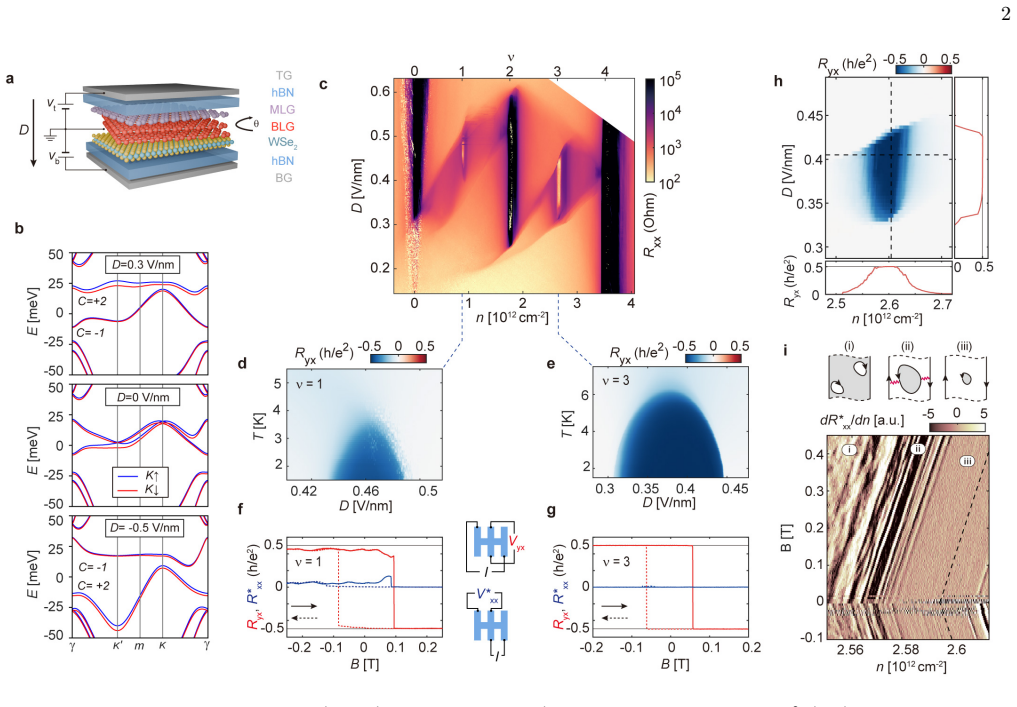
Nonvolatile gate-driven switching of quantum anomalous Hall (QAH) states in graphene moir\'e systems provides a promising route toward topological electronics based on chiral edge states. However, deliberate use of this switching mechanism requires control over both the magnetic properties and metastability of QAH states. While previous demonstrations mostly relied on the intrinsic magnetic energy landscape of moir\'e devices, here we show that this landscape can be engineered through proximity coupling to WSe2. We find that proximitizing twisted monolayer-bilayer graphene by WSe2 reshapes the magnetization reversals responsible for nonvolatile electrical switching of QAH states. We attribute this effect to the proximity-induced spin-orbit coupling (SOC), which can lock spin and valley and modify the magnetization of the competing states involved in switching compared with non-proximitized graphene systems. Our findings establish proximity-induced SOC as a new way to engineer magnetic properties and switchable magnetic states in graphene-based systems. We further demonstrate that strong magnetic metastability in tMBG allows the magnetic states to be gate-tuned between QAH and metallic regimes, and between QAH states with Chern numbers |C| = 2 and 1 without resetting the magnetic state. This functionality points toward new device architectures based on QAH chiral edge states.
Figures


Reference graph
Works this paper leans on
-
[1]
Polshyn, J
H. Polshyn, J. Zhu, M. A. Kumar, Y. Zhang, F. Yang, C. L. Tschirhart, M. Serlin, K. Watanabe, T. Taniguchi, A. H. MacDonald, and A. F. Young, Nature588, 66 (2020)
2020
-
[2]
Zhang, T
C. Zhang, T. Zhu, T. Soejima, S. Kahn, K. Watanabe, T. Taniguchi, A. Zettl, F. Wang, M. P. Zaletel, and M. F. Crommie, Nature Communications14, 3595 (2023)
2023
-
[3]
Zhang, T
C. Zhang, T. Zhu, S. Kahn, T. Soejima, K. Watanabe, T. Taniguchi, A. Zettl, F. Wang, M. P. Zaletel, and M. F. Crommie, Nature Physics , 1 (2024)
2024
-
[4]
Stepanov, M
P. Stepanov, M. Xie, T. Taniguchi, K. Watanabe, X. Lu, A. MacDonald, B. A. Bernevig, and D. Efetov, Physical Review Letters127, 197701 (2021)
2021
-
[5]
Grover, M
S. Grover, M. Bocarsly, A. Uri, P. Stepanov, G. Di Bat- tista, I. Roy, J. Xiao, A. Y. Meltzer, Y. Myasoedov, K. Pareek, K. Watanabe, T. Taniguchi, B. Yan, A. Stern, E. Berg, D. K. Efetov, and E. Zeldov, Nature Physics 18, 885 (2022)
2022
-
[6]
R. Su, D. Waters, B. Zhou, K. Watanabe, T. Taniguchi, Y.-H. Zhang, M. Yankowitz, and J. Folk, Nature637, 1084 (2025)
2025
-
[7]
Y. Choi, Y. Choi, M. Valentini, C. L. Patterson, L. F. W. Holleis, O. I. Sheekey, H. Stoyanov, X. Cheng, T. Taniguchi, K. Watanabe, and A. F. Young, Nature 639, 342 (2025)
2025
-
[8]
Family of High-Chern-Number Orbital Magnets in Twisted Rhombohedral Graphene
X. Wang, L. A. Ben´ ıtez, V. T. Phong, W. I. Chu, K. Watanabe, T. Taniguchi, C. Lewandowski, and P. Jarillo-Herrero, “Family of High-Chern-Number Or- bital Magnets in Twisted Rhombohedral Graphene,” (2026), arXiv:2601.01087 [cond-mat]
work page internal anchor Pith review Pith/arXiv arXiv 2026
-
[9]
Chenet al., arXiv:2601.14014 (2026)
Z. Chen, N. Liu, J. Hua, H. Xiang, W. Zhou, J. Ding, X. Fang, L. Wu, L. Zhang, Q. Chen, X. Chen, K. Watanabe, T. Taniguchi, N. Xin, W. Zhu, and S. Xu, “Layer-engineered quantum anomalous Hall ef- fect in twisted rhombohedral graphene family,” (2026), arXiv:2601.14014 [cond-mat]
work page internal anchor Pith review arXiv 2026
-
[10]
Electrical switching of Chern insulators in moire rhombohedral hep- talayer graphene,
Z. Wang, Q. Liu, X. Han, Z. Li, W. Zhao, Z. Qu, C. Han, K. Watanabe, T. Taniguchi, Z. V. Han, S. Zhou, B. Tong, G. Liu, L. Lu, J. Liu, F. Wu, and J. Lu, “Electrical switching of Chern insulators in moire rhombohedral hep- talayer graphene,” (2025), arXiv:2503.00837 [cond-mat]
-
[11]
Chang, C.-X
C.-Z. Chang, C.-X. Liu, and A. H. MacDonald, Reviews of Modern Physics95, 011002 (2023)
2023
-
[12]
S. Chen, M. He, Y.-H. Zhang, V. Hsieh, Z. Fei, K. Watan- abe, T. Taniguchi, D. H. Cobden, X. Xu, C. R. Dean, and M. Yankowitz, Nature Physics17, 374 (2021)
2021
-
[13]
He, Y.-H
M. He, Y.-H. Zhang, Y. Li, Z. Fei, K. Watanabe, T. Taniguchi, X. Xu, and M. Yankowitz, Nature Com- munications12, 4727 (2021)
2021
-
[14]
S. Xu, M. M. Al Ezzi, N. Balakrishnan, A. Garcia-Ruiz, B. Tsim, C. Mullan, J. Barrier, N. Xin, B. A. Piot, T. Taniguchi, K. Watanabe, A. Carvalho, A. Mishchenko, A. K. Geim, V. I. Fal’ko, S. Adam, A. H. C. Neto, K. S. Novoselov, and Y. Shi, Nature Physics17, 619 (2021)
2021
-
[15]
Polshyn, Y
H. Polshyn, Y. Zhang, M. A. Kumar, T. Soejima, P. Led- with, K. Watanabe, T. Taniguchi, A. Vishwanath, M. P. Zaletel, and A. F. Young, Nature Physics18, 42 (2022)
2022
-
[16]
Waters, R
D. Waters, R. Su, E. Thompson, A. Okounkova, E. Arreguin-Martinez, M. He, K. Hinds, K. Watan- abe, T. Taniguchi, X. Xu, Y.-H. Zhang, J. Folk, and M. Yankowitz, Nature Communications15, 10552 (2024)
2024
-
[17]
H. Peng, J. Zhong, Q. Feng, Y. Hu, Q. Li, S. Zhang, J. Mao, J. Duan, and Y. Yao, Communications Physics 7, 1 (2024)
2024
-
[18]
N. J. Hu´ ang, J. L. Boland, K. M. Fijalkowski, C. Gould, T. Hesjedal, O. Kazakova, S. Kumar, and H. Scherer, Applied Physics Letters126, 040501 (2025)
2025
-
[19]
S. Alam, M. S. Hossain, and A. Aziz, Scientific Reports 11, 7892 (2021)
2021
-
[20]
Y. Liu, A. Lee, K. Qian, P. Zhang, Z. Xiao, H. He, Z. Ren, S. K. Cheung, R. Liu, Y. Li, X. Zhang, Z. Ma, J. Zhao, W. Zhao, G. Yu, X. Wang, J. Liu, Z. Wang, K. L. Wang, and Q. Shao, Nature Materials24, 559 (2025)
2025
-
[21]
S. Alam, M. M. Islam, M. S. Hossain, A. Jaiswal, and A. Aziz, Applied Physics Letters120, 144102 (2022)
2022
-
[22]
Viola and D
G. Viola and D. P. DiVincenzo, Physical Review X4, 1 (2014)
2014
-
[23]
Circulators Based on Coupled Quantum Anomalous Hall Insulators and Resonators
L. A. Martinez, N. Du, N. Materise, S. O. Kelley, X. Wu, G. Qiu, K. L. Wang, P. Gianpaolo, T. Low, and D.-X. Qu, “Circulators based on Coupled Quan- tum Anomalous Hall Insulators and Resonators,” (2025), arXiv:2505.07770 [quant-ph]
work page internal anchor Pith review Pith/arXiv arXiv 2025
-
[24]
D. J. Clarke, J. Alicea, and K. Shtengel, Nature Physics 10, 877 (2014)
2014
-
[25]
B. Lian, X. Q. Sun, A. Vaezi, X. L. Qib, and S. C. Zhang, Proceedings of the National Academy of Sciences of the United States of America115, 10938 (2018)
2018
-
[26]
Serlin, C
M. Serlin, C. L. Tschirhart, H. Polshyn, Y. Zhang, J. Zhu, K. Watanabe, T. Taniguchi, L. Balents, and A. F. Young, Science367, 900 (2020)
2020
-
[27]
C. L. Tschirhart, E. Redekop, L. Li, T. Li, S. Jiang, T. Arp, O. Sheekey, T. Taniguchi, K. Watanabe, M. E. Huber, K. F. Mak, J. Shan, and A. F. Young, Nature Physics , 1 (2023)
2023
-
[28]
Yuan, L.-J
W. Yuan, L.-J. Zhou, K. Yang, Y.-F. Zhao, R. Zhang, Z. Yan, D. Zhuo, R. Mei, Y. Wang, H. Yi, M. H. W. Chan, M. Kayyalha, C.-X. Liu, and C.-Z. Chang, Nature Materials23, 58 (2024)
2024
-
[29]
Huber, K
O. Huber, K. Kuhlbrodt, E. Anderson, W. Li, K. Watan- abe, T. Taniguchi, M. Kroner, X. Xu, A. Imamo˘ glu, and T. Smole´ nski, Nature649, 1153 (2026)
2026
-
[30]
Holtzmann, W
W. Holtzmann, W. Li, E. Anderson, J. Cai, H. Park, C. Hu, T. Taniguchi, K. Watanabe, J.-H. Chu, D. Xiao, T. Cao, and X. Xu, Nature649, 1147 (2026)
2026
-
[31]
X. Cai, H. Pan, Y. Wang, A. Rasmita, S. Yang, Y. Zhao, W. Wang, R. Duan, R. He, K. Watanabe, T. Taniguchi, Z. Liu, J. Z´ u˜ niga-P´ erez, B. Yang, and W. Gao, Nature 650, 580 (2026)
2026
-
[32]
Liu and X
J. Liu and X. Dai, Nature Reviews Physics3, 367 (2021)
2021
-
[33]
Zhu, J.-j
J. Zhu, J.-j. Su, and A. H. Macdonald, Physical Review Letters125, 227702 (2020)
2020
-
[34]
Lin, Y.-H
J.-X. Lin, Y.-H. Zhang, E. Morissette, Z. Wang, S. Liu, D. Rhodes, K. Watanabe, T. Taniguchi, J. Hone, and J. I. A. Li, Science375, 437 (2022)
2022
-
[35]
Tseng, X
C.-C. Tseng, X. Ma, Z. Liu, K. Watanabe, T. Taniguchi, J.-H. Chu, and M. Yankowitz, Nature Physics18, 1038 (2022)
2022
-
[36]
Bhowmik, B
S. Bhowmik, B. Ghawri, Y. Park, D. Lee, S. Datta, R. Soni, K. Watanabe, T. Taniguchi, A. Ghosh, J. Jung, and U. Chandni, Nature Communications14, 4055 (2023)
2023
-
[37]
Y. Sha, J. Zheng, K. Liu, H. Du, K. Watanabe, T. Taniguchi, J. Jia, Z. Shi, R. Zhong, and G. Chen, 8 Science384, 414 (2024)
2024
-
[38]
T. Han, Z. Lu, G. Scuri, J. Sung, J. Wang, T. Han, K. Watanabe, T. Taniguchi, L. Fu, H. Park, and L. Ju, Nature623, 41 (2023)
2023
-
[39]
Wang, D.-K
Z. Wang, D.-K. Ki, J. Y. Khoo, D. Mauro, H. Berger, L. S. Levitov, and A. F. Morpurgo, Physical Review X 6, 041020 (2016)
2016
-
[40]
Gmitra and J
M. Gmitra and J. Fabian, Physical Review Letters119, 146401 (2017)
2017
-
[41]
J. Y. Khoo, A. F. Morpurgo, and L. Levitov, Nano Let- ters17, 7003 (2017)
2017
-
[42]
J. O. Island, X. Cui, C. Lewandowski, J. Y. Khoo, E. M. Spanton, H. Zhou, D. Rhodes, J. C. Hone, T. Taniguchi, K. Watanabe, L. S. Levitov, M. P. Zaletel, and A. F. Young, Nature571, 85 (2019)
2019
-
[43]
D. Wang, S. Che, G. Cao, R. Lyu, K. Watanabe, T. Taniguchi, C. N. Lau, and M. Bockrath, Nano Letters 19, 7028 (2019)
2019
-
[44]
H. S. Arora, R. Polski, Y. Zhang, A. Thomson, Y. Choi, H. Kim, Z. Lin, I. Z. Wilson, X. Xu, J. H. Chu, K. Watan- abe, T. Taniguchi, J. Alicea, and S. Nadj-Perge, Nature 583, 379 (2020)
2020
-
[45]
R. Su, M. Kuiri, K. Watanabe, T. Taniguchi, and J. Folk, Nature Materials22, 1332 (2023)
2023
-
[46]
C. N. Lau, M. W. Bockrath, K. F. Mak, and F. Zhang, Nature602, 41 (2022)
2022
-
[47]
Huckestein, Reviews of Modern Physics67, 357 (1995)
B. Huckestein, Reviews of Modern Physics67, 357 (1995)
1995
-
[48]
Tilak, X
N. Tilak, X. Lai, S. Wu, Z. Zhang, M. Xu, R. d. A. Ribeiro, P. C. Canfield, and E. Y. Andrei, Nature Com- munications12, 4180 (2021)
2021
-
[49]
R. J. Dolleman, A. Rothstein, A. Fischer, L. Klebl, L. Waldecker, K. Watanabe, T. Taniguchi, D. M. Kennes, F. Libisch, B. Beschoten, and C. Stampfer, Physical Re- view B109, 155430 (2024)
2024
-
[50]
A. T. Pierce, Y. Xie, J. M. Park, Z. Cai, K. Watanabe, T. Taniguchi, P. Jarillo-Herrero, and A. Yacoby, Nature Physics21, 1237 (2025)
2025
-
[51]
Zhang, G
Y. Zhang, G. Shavit, H. Ma, Y. Han, C. W. Siu, A. Mukherjee, K. Watanabe, T. Taniguchi, D. Hsieh, C. Lewandowski, F. von Oppen, Y. Oreg, and S. Nadj- Perge, Nature641, 625 (2025)
2025
-
[52]
Z. Lu, T. Han, Y. Yao, A. P. Reddy, J. Yang, J. Seo, K. Watanabe, T. Taniguchi, L. Fu, and L. Ju, Nature 626, 759 (2024)
2024
-
[53]
Ovchinnikov, J
D. Ovchinnikov, J. Cai, Z. Lin, Z. Fei, Z. Liu, Y.-T. Cui, D. H. Cobden, J.-H. Chu, C.-Z. Chang, D. Xiao, J. Yan, and X. Xu, Nature Communications13, 5967 (2022)
2022
-
[54]
J. D´ ıez-M´ erida, I. Das, G. D. Battista, A. D´ ıez- Carl´ on, M. Lee, L. Zeng, K. Watanabe, T. Taniguchi, E. Olsson, and D. K. Efetov, Newton1(2025), 10.1016/j.newton.2024.100007
-
[55]
Bistritzer and A
R. Bistritzer and A. H. MacDonald, Proceedings of the National Academy of Sciences108, 12233 (2011)
2011
-
[56]
Jung and A
J. Jung and A. H. MacDonald, Physical Review B89, 035405 (2014)
2014
-
[57]
D. Xiao, J. Shi, and Q. Niu, Physical Review Letters95, 137204 (2005)
2005
-
[58]
Thonhauser, D
T. Thonhauser, D. Ceresoli, D. Vanderbilt, and R. Resta, Physical Review Letters95, 137205 (2005)
2005
-
[59]
Ceresoli, T
D. Ceresoli, T. Thonhauser, D. Vanderbilt, and R. Resta, Physical Review B74, 024408 (2006)
2006
-
[60]
J. Shi, G. Vignale, D. Xiao, and Q. Niu, Physical Review Letters99, 197202 (2007)
2007
-
[61]
Unconventional Orbital Mag- netism in Graphene-based Fractional Chern Insulators,
J. Xie, Z. Zhang, X. Chen, Y. H. Kwan, Z. Huo, J. Herzog-Arbeitman, L. Guo, K. Watanabe, T. Taniguchi, K. Liu, X. C. Xie, B. A. Bernevig, Z.-D. Song, and X. Lu, “Unconventional Orbital Mag- netism in Graphene-based Fractional Chern Insulators,” (2025), arXiv:2506.01485 [cond-mat]. METHODS Device fabrication tMBG heterostructures were assembled using a dry...
discussion (0)
Sign in with ORCID, Apple, or X to comment. Anyone can read and Pith papers without signing in.