A Multi-Level Architecture for Reusable Materials Ontologies -- The OntoCrafter Ceramics Ontology (OCO) as Reference Implementation
Pith reviewed 2026-06-27 05:02 UTC · model grok-4.3
The pith
A multi-level modular architecture separates abstraction levels from material versus compliance audiences to reuse ontologies across domains.
A machine-rendered reading of the paper's core claim, the machinery that carries it, and where it could break.
Core claim
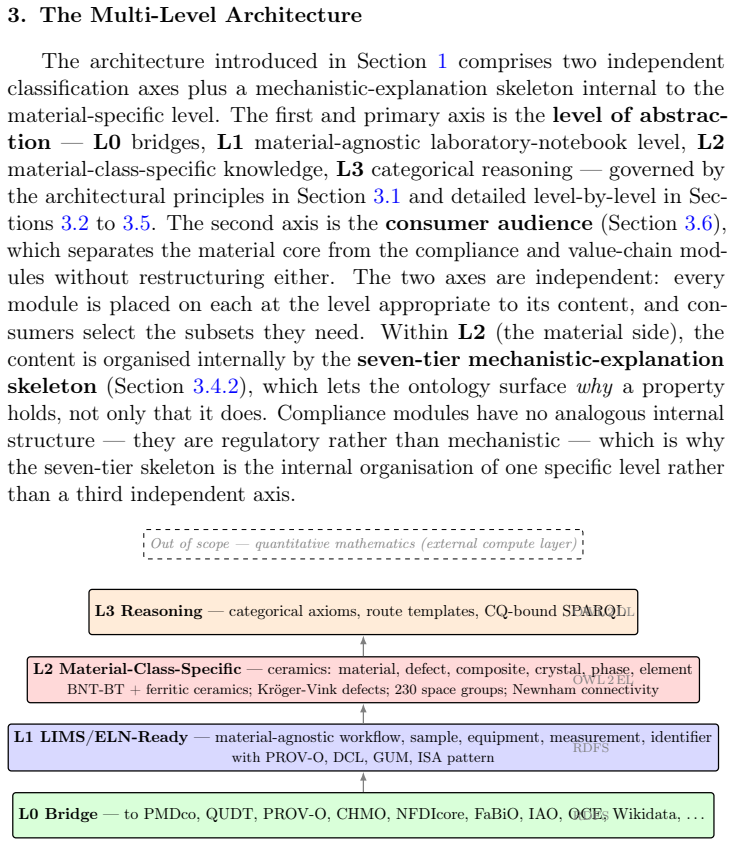
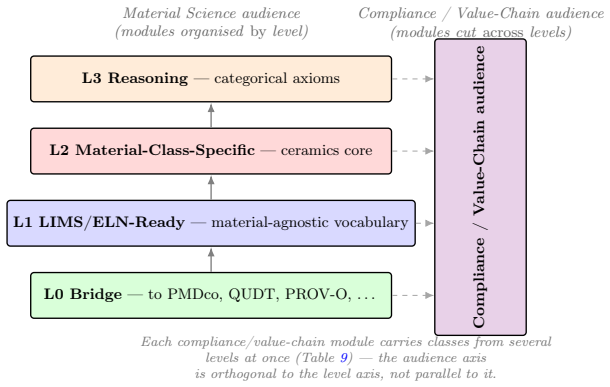
The paper claims that a multi-level modular architecture defined by independent axes of abstraction level (L0 bridges, L1 material-agnostic laboratory-notebook, L2 material-class-specific, L3 categorical reasoning) and consumer audience (material vs compliance) dissolves horizontal fragmentation across domains. The L2 level is internally organized by a seven-tier mechanistic-explanation skeleton (Symmetry, Energy/DFT, Thermo/CALPHAD, Kinetics, Microstructure, Defect chemistry, Bonding) applicable to any crystalline ionic oxide, delivering explanation depth that records why a property exists rather than only its value. The compliance audience axis absorbs vertical regulatory pressure while th
What carries the argument
The seven-tier mechanistic-explanation skeleton (Symmetry, Energy/DFT, Thermo/CALPHAD, Kinetics, Microstructure, Defect chemistry, Bonding) that organizes the material-class-specific (L2) level for any crystalline ionic oxide.
If this is right
- Different material classes share all levels except the L2 modules.
- Compliance requirements integrate via separate audience modules without altering material models.
- Mechanistic why-questions become systematically answerable through the tier structure.
- New application domains reuse the L0, L1, and L3 layers while redesigning only L2.
Where Pith is reading between the lines
- The same upper levels could be tested by constructing an ontology for a non-oxide material class such as polymers.
- The compliance axis supplies a direct route to mapping data fields required by the EU ESPR regulation.
- Performance of queries that cross levels could be measured to quantify reuse benefits.
Load-bearing premise
The seven-tier mechanistic-explanation skeleton applies to any crystalline ionic oxide without modification or additional tiers.
What would settle it
A crystalline ionic oxide whose measured properties cannot be explained by any of the seven tiers without adding a new tier or altering the existing skeleton would falsify the claim.
Figures
read the original abstract
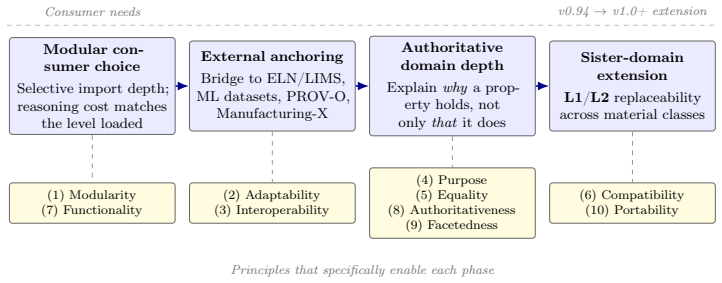
The Materials Science and Engineering ontology landscape is fragmented along multiple axes simultaneously. Horizontally: a recent survey identified 94 ontologies of which over 40 are structurally incompatible; each new application domain -- ceramics, polymers, batteries, smart materials -- typically restarts ontology design from scratch. Vertically: EU regulation (CSRD, CSDDD, PPWR, CBAM, R2R, AI Act, ESPR) forces material, manufacturing, supply-chain, and lifecycle data into integrated digital product passports, leaving ontologies that only address horizontal fragmentation incomplete for any contemporary consumer. And mechanistically: a vocabulary that records that BNT-BT has $d_{33} \approx 580$ pC/N stores a fact but cannot surface why -- Bi-6s$^2$ lone-pair stereo-activity, anomalous Born effective charges, soft modes, defect chemistry -- without a systematic explanation skeleton. We propose a multi-level modular architecture with two independent classification axes -- level of abstraction (L0 bridges, L1 material-agnostic laboratory-notebook, L2 material-class-specific, L3 categorical reasoning) and consumer audience (material vs. compliance) -- in which the material-specific level is internally organised by a seven-tier mechanistic-explanation skeleton (Symmetry, Energy/DFT, Thermo/CALPHAD, Kinetics, Microstructure, Defect chemistry, Bonding) applicable to any crystalline ionic oxide. The level-and-audience modularity dissolves the horizontal fragmentation, the compliance audience absorbs the vertical regulation pressure, and the seven-tier organisation of Level 2 delivers the mechanistic explanation depth. We instantiate the architecture as the OntoCrafter Ceramics Ontology (OCO v0.94): 5,196 classes across 44 modules; 167,348 OWL axioms (40,454 logical); 1,674 properties; 829 cross-ontology bridge mappings; 1,172 SHACL shapes; 163 published competency questions.
Editorial analysis
A structured set of objections, weighed in public.
Referee Report
Summary. The paper claims that materials ontologies are fragmented horizontally (94 ontologies, many incompatible, domain restarts) and vertically (regulatory demands for integrated data in digital product passports), while also lacking mechanistic explanation depth beyond facts like piezoelectric coefficients. It proposes a two-axis modular architecture: abstraction levels L0 (bridges), L1 (material-agnostic lab notebook), L2 (material-class-specific, internally organized by a seven-tier mechanistic skeleton: Symmetry, Energy/DFT, Thermo/CALPHAD, Kinetics, Microstructure, Defect chemistry, Bonding), L3 (categorical reasoning); plus material vs. compliance audiences. The architecture is asserted to dissolve horizontal fragmentation, absorb vertical regulatory pressure via the compliance track, and deliver explanation depth via the L2 skeleton (claimed applicable to any crystalline ionic oxide). This is instantiated as OCO v0.94 (5,196 classes in 44 modules, 167,348 OWL axioms, 1,674 properties, 829 bridges, 1,172 SHACL shapes, 163 competency questions).
Significance. If validated, the modular separation of abstraction levels and audiences could reduce redundant ontology development across materials domains and better support regulatory integration. The concrete OCO metrics, published competency questions, and explicit bridge mappings provide a reproducible starting point for reuse, which is a strength of the proposal.
major comments (3)
- [Abstract] Abstract (seven-tier mechanistic-explanation skeleton): The central claim that this skeleton 'is applicable to any crystalline ionic oxide' without modification is load-bearing for the L2 organization and the asserted delivery of mechanistic depth, yet the manuscript offers only the BNT-BT ceramics instantiation; no explicit tier-by-tier mapping or counter-example check is provided for other structures such as rock-salt or fluorite oxides.
- [Abstract] Abstract (level-and-audience modularity dissolves horizontal fragmentation): The assertion that the proposed architecture dissolves fragmentation across the 94 surveyed ontologies rests on OCO instantiation counts alone (5,196 classes, 167,348 axioms) without comparative evaluation, reuse metrics, or adoption evidence against existing incompatible ontologies.
- [Abstract] Abstract (compliance audience absorbs vertical regulation pressure): The claim that separating a compliance audience track absorbs regulatory demands (CSRD, CSDDD, etc.) is asserted without demonstration of how the L0-L3 levels integrate with digital product passport requirements or any mapping to the listed regulations.
minor comments (1)
- The abstract states 829 cross-ontology bridge mappings but the main text does not enumerate the target ontologies or provide an example mapping table.
Simulated Author's Rebuttal
We thank the referee for their thorough review and constructive feedback on our manuscript. We address each of the major comments point by point below.
read point-by-point responses
-
Referee: [Abstract] Abstract (seven-tier mechanistic-explanation skeleton): The central claim that this skeleton 'is applicable to any crystalline ionic oxide' without modification is load-bearing for the L2 organization and the asserted delivery of mechanistic depth, yet the manuscript offers only the BNT-BT ceramics instantiation; no explicit tier-by-tier mapping or counter-example check is provided for other structures such as rock-salt or fluorite oxides.
Authors: The seven tiers represent core mechanistic levels in materials science that are standard for describing crystalline ionic oxides, independent of specific structure type. For instance, symmetry analysis applies to all space groups, DFT to electronic properties in any oxide, and defect chemistry to ionic defects universally. The BNT-BT instantiation illustrates the application in detail, but the structure requires no modification for other oxides like rock-salt (e.g., MgO) or fluorite (e.g., ZrO2). We will revise the manuscript to include a concise tier-by-tier rationale for this generality. revision: yes
-
Referee: [Abstract] Abstract (level-and-audience modularity dissolves horizontal fragmentation): The assertion that the proposed architecture dissolves fragmentation across the 94 surveyed ontologies rests on OCO instantiation counts alone (5,196 classes, 167,348 axioms) without comparative evaluation, reuse metrics, or adoption evidence against existing incompatible ontologies.
Authors: The architecture addresses fragmentation through its modular design: L0 bridges enable integration with existing ontologies, L1 provides a common base, and L2 allows domain-specific extensions without restarting. The 829 bridge mappings in OCO demonstrate this integration capability in practice, and the scale (over 5,000 classes) shows it can encompass complex domains. While direct comparative reuse studies against all 94 would be valuable, they fall outside the scope of this architectural proposal; the design itself provides the mechanism to reduce redundant development. revision: no
-
Referee: [Abstract] Abstract (compliance audience absorbs vertical regulation pressure): The claim that separating a compliance audience track absorbs regulatory demands (CSRD, CSDDD, etc.) is asserted without demonstration of how the L0-L3 levels integrate with digital product passport requirements or any mapping to the listed regulations.
Authors: The audience separation allows the compliance track to aggregate data from L0-L3 levels tailored to regulatory needs, such as lifecycle and supply chain information required for digital product passports. We acknowledge that the manuscript does not provide explicit mappings to individual regulations. In the revision, we will include an outline of how the levels support DPP data elements and reference the relevant EU directives. revision: yes
Circularity Check
No circularity detected; forward design proposal with independent implementation
full rationale
The paper advances a multi-level ontology architecture (L0-L3 abstraction levels crossed with material vs. compliance audiences) whose L2 tier is organized by a seven-tier mechanistic skeleton. This skeleton is introduced as an organizing ansatz for the ceramics instantiation (OCO v0.94 with 5,196 classes and 167k axioms) rather than derived from any equation, fitted parameter, or self-citation chain. The generality claim for crystalline ionic oxides is an explicit design assumption, not a prediction that reduces to the ceramics metrics by construction. No self-definitional loops, fitted-input predictions, or load-bearing self-citations appear in the derivation. The architecture is therefore self-contained as an engineering proposal.
Axiom & Free-Parameter Ledger
axioms (1)
- domain assumption The seven-tier mechanistic-explanation skeleton is applicable to any crystalline ionic oxide.
invented entities (3)
-
L0-L3 abstraction levels
no independent evidence
-
Material vs. compliance audience separation
no independent evidence
-
Seven-tier mechanistic skeleton
no independent evidence
Reference graph
Works this paper leans on
-
[1]
The Landscape of Ontologies in Materials Science and Engineering: A Survey and Evaluation , journal =
Norouzi, Ebrahim and Waitelonis, J. The Landscape of Ontologies in Materials Science and Engineering: A Survey and Evaluation , journal =. 2024 , url =
2024
-
[2]
Joint Proceedings of RCIS 2024 Workshops and Research Projects Track , series =
Ben Hassine, Sahar and Stark, Rainer , title =. Joint Proceedings of RCIS 2024 Workshops and Research Projects Track , series =. 2024 , address =
2024
-
[3]
Ontology-Based Data Acquisition, Refinement, and Utilization in the Development of a Multilayer Ferrite Inductor , journal =
Mieller, Bj. Ontology-Based Data Acquisition, Refinement, and Utilization in the Development of a Multilayer Ferrite Inductor , journal =. 2024 , doi =
2024
-
[4]
arXiv preprint arXiv:2308.07325 , year =
Jalali, Mehrdad and Mail, Matthias and Aversa, Rossella and K. arXiv preprint arXiv:2308.07325 , year =
-
[5]
Scientific Data , volume =
Zhang, Yuwei and Chen, Fangyi and Liu, Zeyi and Ju, Yunzhuo and Cui, Dongliang and Zhu, Jinyi and Jiang, Xue and Guo, Xi and He, Jie and Zhang, Lei and Zhang, Xiaotong and Su, Yanjing , title =. Scientific Data , volume =. 2024 , doi =
2024
-
[6]
and Tran, Van D
Rajamohan, Balashanmuga Priyan and Harding Bradley, Andrew C. and Tran, Van D. and Gordon, J. E. and Caldwell, H. W. and Mehdi, R. and Ponon, G. and Tran, Q. D. and Dernek, O. and Kaltenbaugh, J. and Pierce, B. G. and Wieser, R. and Yue, W. and Lin, K. and Kambo, J. and Lopez, C. and Nihar, A. and Savage, D. J. and Brown, D. W. and Sharma, H. and Giera, B...
2025
-
[7]
Advancing Digital Transformation in Material Science: The Role of Workflows Within the
Bekemeier, Simon and Caldeira R. Advancing Digital Transformation in Material Science: The Role of Workflows Within the. Advanced Engineering Materials , volume =. 2025 , doi =
2025
-
[8]
and Lederbauer, Magdalena and Schwaller, Philippe , title =
Oarga, Alexandru and Hart, Matthew and Bran, Andres M. and Lederbauer, Magdalena and Schwaller, Philippe , title =. Digital Discovery , volume =. 2026 , doi =
2026
-
[9]
A Novel Digitalization Approach for Smart Materials: Ontology-Based Access to Data and Models , journal =
Maas, J. A Novel Digitalization Approach for Smart Materials: Ontology-Based Access to Data and Models , journal =. 2024 , doi =
2024
-
[10]
Advanced Engineering Materials , volume =
Modeling and Accessing Smart Materials with Integrity Constraints in the Shapes Constraint Language and Ontologies --- The. Advanced Engineering Materials , volume =. 2024 , doi =
2024
-
[11]
Modeling and Experimental Investigation of Multilayer
Mertens, Jana and Masoud, Abd Elkarim and Hubracht, Andreas and. Modeling and Experimental Investigation of Multilayer. Smart Materials and Structures , volume =. 2024 , doi =
2024
-
[12]
, title =
Arp, Robert and Smith, Barry and Spear, Andrew D. , title =. 2015 , note =
2015
-
[13]
JOM , year =
Ghedini, Emanuele and others , title =. JOM , year =
-
[14]
Materials & Design , year =
Bayerlein, Bernd and others , title =. Materials & Design , year =
-
[15]
2013 , url =
Lebo, Timothy and Sahoo, Satya and McGuinness, Deborah , title =. 2013 , url =
2013
-
[16]
Hodgson, Ralph and Keller, P. J. and Markovic, J. , title =. 2018 , url =
2018
-
[17]
Applied Ontology , year =
Del Nostro, Pierluigi and Goldbeck, Gerhard and Toti, Daniele , title =. Applied Ontology , year =
-
[18]
International Journal on Semantic Web and Information Systems , volume =
Poveda-Villal. International Journal on Semantic Web and Information Systems , volume =. 2014 , doi =
2014
-
[19]
and Balhoff, James P
Jackson, Rebecca C. and Balhoff, James P. and Douglass, Eric and Harris, Nomi L. and Mungall, Christopher J. and Overton, James A. , title =. BMC Bioinformatics , volume =. 2019 , doi =
2019
-
[20]
Newnham, R. E. and Skinner, D. P. and Cross, L. E. , title =. Materials Research Bulletin , volume =. 1978 , doi =
1978
-
[21]
Relations between the Concentrations of Imperfections in Crystalline Solids , booktitle =
Kr. Relations between the Concentrations of Imperfections in Crystalline Solids , booktitle =. 1956 , doi =
1956
-
[22]
Nye, J. F. , title =. 1985 , edition =
1985
-
[23]
2017 , howpublished =
Batchelor, Colin , title =. 2017 , howpublished =
2017
-
[24]
Communications of the ACM , volume =
Vrande. Communications of the ACM , volume =. 2014 , doi =
2014
-
[25]
2022 , howpublished =
2022
-
[26]
Journal of Web Semantics , volume =
Peroni, Silvio and Shotton, David , title =. Journal of Web Semantics , volume =. 2012 , doi =
2012
-
[27]
2015 , howpublished =
Ceusters, Werner and Smith, Barry , title =. 2015 , howpublished =
2015
-
[28]
2023 , howpublished =
Schembera, Bj. 2023 , howpublished =
2023
-
[29]
2020 , howpublished =
Open Chemical Element (. 2020 , howpublished =
2020
-
[30]
Nucleic Acids Research , volume =
Kim, Sunghwan and Chen, Jie and Cheng, Tiejun and others , title =. Nucleic Acids Research , volume =. 2023 , doi =
2023
-
[31]
2024 , howpublished =
2024
-
[32]
2005 , note =
Guizzardi, Giancarlo , title =. 2005 , note =
2005
-
[33]
Semantic Web , volume =
Rijgersberg, Hajo and van Assem, Mark and Top, Jan , title =. Semantic Web , volume =. 2013 , doi =
2013
-
[34]
2020 , howpublished =
2020
-
[35]
2018 , howpublished =
2018
-
[36]
and Dewar, Mike C
Buswell, Stephen and Caprotti, Olga and Carlisle, David P. and Dewar, Mike C. and Ga\". The. The OpenMath Society , year =
-
[37]
and Kirillovich, Alexander V
Elizarov, Alexander M. and Kirillovich, Alexander V. and Lipachev, Evgeny K. and Nevzorova, Olga A. , title =. Knowledge Engineering and the Semantic Web (KESW) , series =. 2014 , doi =
2014
-
[38]
Nucleic Acids Research , volume =
Hastings, Janna and Owen, Gareth and Dekker, Adriano and Ennis, Marcus and Kale, Namrata and Muthukrishnan, Venkatesh and Turner, Steve and Swainston, Neil and Mendes, Pedro and Steinbeck, Christoph , title =. Nucleic Acids Research , volume =. 2016 , doi =
2016
-
[39]
Advanced Engineering Materials , year =
Bardehle and others , title =. Advanced Engineering Materials , year =
-
[40]
arXiv preprint , year =
Bekemeier and others , title =. arXiv preprint , year =
-
[41]
Annual Review of Materials Research , year =
Raabe and others , title =. Annual Review of Materials Research , year =
-
[42]
Steel Research International , year =
Gramlich and others , title =. Steel Research International , year =
-
[43]
Steel Research International , year =
Chakraborty and others , title =. Steel Research International , year =
-
[44]
Advanced Engineering Materials , year =
Tomkovic and others , title =. Advanced Engineering Materials , year =
-
[45]
Results in Engineering , year =
Schilling and others , title =. Results in Engineering , year =
-
[46]
Advanced Engineering Materials , year =
BeygiNasrabadi and others , title =. Advanced Engineering Materials , year =
-
[47]
Mechanical Systems and Signal Processing , year =
Leipner and others , title =. Mechanical Systems and Signal Processing , year =
-
[48]
Advanced Engineering Materials , year =
Gumbsch and others , title =. Advanced Engineering Materials , year =
-
[49]
Advanced Engineering Materials , year =
Bayerlein and others , title =. Advanced Engineering Materials , year =
-
[50]
Advanced Engineering Materials , year =
Bekemeier and others , title =. Advanced Engineering Materials , year =
-
[51]
Advanced Engineering Materials , year =
Schilling and others , title =. Advanced Engineering Materials , year =
-
[52]
Advanced Engineering Materials , year =
Shoghi and others , title =. Advanced Engineering Materials , year =
-
[53]
Advanced Engineering Materials , year =
Roters and others , title =. Advanced Engineering Materials , year =
-
[54]
Advanced Engineering Materials , year =
Fliegener and others , title =. Advanced Engineering Materials , year =
-
[55]
Advanced Engineering Materials , year =
Nerella and others , title =. Advanced Engineering Materials , year =
-
[56]
Advanced Engineering Materials , year =
Eisenbart and others , title =. Advanced Engineering Materials , year =
-
[57]
Advanced Engineering Materials , year =
Sajjad and others , title =. Advanced Engineering Materials , year =
-
[58]
Advanced Engineering Materials , year =
Nahshon and others , title =. Advanced Engineering Materials , year =
-
[59]
Advanced Engineering Materials , year =
Bjarsch and others , title =. Advanced Engineering Materials , year =
-
[60]
Advanced Engineering Materials , year =
Mieller and others , title =. Advanced Engineering Materials , year =
-
[61]
Advanced Engineering Materials , year =
Chen and others , title =. Advanced Engineering Materials , year =
-
[62]
Advanced Engineering Materials , year =
Luger and others , title =. Advanced Engineering Materials , year =
-
[63]
Advanced Engineering Materials , year =
Aschemann and others , title =. Advanced Engineering Materials , year =
-
[64]
Advanced Engineering Materials , year =
Nebel and others , title =. Advanced Engineering Materials , year =
-
[65]
Advanced Engineering Materials , year =
Beran and others , title =. Advanced Engineering Materials , year =
-
[66]
Advanced Engineering Materials , year =
Maas and others , title =. Advanced Engineering Materials , year =
-
[67]
Advanced Engineering Materials , year =
Oezçep and others , title =. Advanced Engineering Materials , year =
-
[68]
Glass Europe , year =
Gogula and others , title =. Glass Europe , year =
-
[69]
Advanced Science , year =
Pan and others , title =. Advanced Science , year =
-
[70]
Journal of the American Ceramic Society , year =
Arendt and others , title =. Journal of the American Ceramic Society , year =
-
[71]
Key Engineering Materials , year =
BeygiNasrabadi and others , title =. Key Engineering Materials , year =
-
[72]
Data in Brief , year =
BeygiNasrabadi and others , title =. Data in Brief , year =
-
[73]
Scientific Data , year =
Bayerlein and others , title =. Scientific Data , year =
-
[74]
Materials & Design , year =
Bayerlein and others , title =. Materials & Design , year =
-
[75]
ce/papers , year =
Meng and others , title =. ce/papers , year =
-
[76]
Data-Centric Engineering , year =
Agrawal and others , title =. Data-Centric Engineering , year =
-
[77]
Materials Today: Proceedings , year =
Unger and others , title =. Materials Today: Proceedings , year =
-
[78]
arXiv preprint , year =
Blum and others , title =. arXiv preprint , year =
-
[79]
Computers in Industry , year =
BeygiNasrabadi and others , title =. Computers in Industry , year =
-
[80]
IEEE , year =
Schmidtke and others , title =. IEEE , year =
discussion (0)
Sign in with ORCID, Apple, or X to comment. Anyone can read and Pith papers without signing in.