Correct When Paired, Wrong When Split: Decoupling and Editing Modality-Specific Neurons in MLLMs
Reviewed by Pith T0 review T1 audit T2 compute T3 formal T4 kernel 2026-07-05 15:48 UTCglm-5.2pith:UZUM7CDPrecord.jsonopen to challenge →
The pith
Editing one modality leaves the other stale in multimodal LLMs
A machine-rendered reading of the paper's core claim, the machinery that carries it, and where it could break.
Core claim
The central discovery is that entity knowledge in MLLMs is not stored as a unified, modality-agnostic representation but is instead partitioned into modality-specific neuron pathways with near-zero overlap. The multimodal neuron set (activated by joint text-image input) overlaps heavily with the visual neuron set (about 93% similarity) but is almost completely disjoint from the text-only neuron set (about 2% similarity). This asymmetry means that editing methods optimized on multimodal inputs effectively write new knowledge into the visual pathway while the text pathway retains the old fact, producing the editing decoupling failure phenomenon. The paper demonstrates that explicitly localing,
What carries the argument
The neuron contribution score (Eq. 5) ranks neurons by their influence on predicting a target concept token, computed as the Hadamard product of the unembedding matrix, the layer's output projection, and the activation at the final token position. This score is used to select top-k modality-specific neuron sets (Ut for text, Uv for visual) under different input triggers. DECODE then applies learnable offset vectors to the output projection rows of these neurons in a two-stream optimization, each stream using a modality-specific input with a cross-entropy target loss and a KL-divergence locality loss.
If this is right
- Any knowledge editing method for MLLMs that is evaluated only on multimodal inputs may be silently failing on unimodal queries, meaning prior benchmark results overstate editing success.
- The modality-specific neuron partitioning suggests that MLLMs do not automatically build a shared entity representation during training, which raises questions about whether stronger cross-modal training objectives could reduce this fragmentation.
- The architecture-dependent editing order result implies that a single universal editing protocol is unlikely to work across all MLLM architectures; editing strategies may need to be conditioned on the cross-modal fusion mechanism.
- The failure cases where neuron contribution scores mislocalize entity-relevant neurons (e.g., capturing surface-form prefix patterns instead of semantic relations) suggest that better neuron localization methods are needed before neuron-level editing can be reliable at scale.
Where Pith is reading between the lines
- If modality-specific neuron partitioning is a general property of MLLMs, then other model behaviors that rely on cross-modal consistency (e.g., visual question answering vs. text question answering for the same entity) may also exhibit modality-specific failure modes that are invisible under standard multimodal evaluation.
- The near-zero overlap between text and visual neuron sets could serve as a diagnostic metric: measuring this overlap for a given model and entity type might predict which entities are most vulnerable to editing decoupling failure, enabling targeted editing only where needed.
- The finding that multimodal neurons overlap heavily with visual neurons but not text neurons suggests that the multimodal input mode in these architectures is effectively a visual pathway with text as auxiliary context, which may have implications for how multimodal training data is weighted or balanced.
Load-bearing premise
The entire method depends on the neuron contribution score correctly identifying neurons that genuinely encode the target entity-relation for each modality. The paper's own failure analysis shows this can break: in one case, the top-ranked text neuron was associated with surface-form prefix tokens (words starting with 'War-') rather than the semantic relation 'Common yellowthroat is a New World warbler,' causing the edit to fail. If the contribution score systematically misr.
What would settle it
If one could find an MLLM architecture where text-specific and visual-specific neuron sets for the same entity overlap substantially (say, above 50% for top-50 neurons), the core claim that knowledge is sequestered into modality-specific pathways would not hold for that architecture, and DECODE's two-stream approach would reduce to editing a single shared set.
Figures


read the original abstract
Although Knowledge Editing provides an efficient mechanism for updating the knowledge of Multimodal Large Language Models (MLLMs), we find that current paradigms still suffer from an important yet remain underexplored issue : editing decoupling failure, where entity-related knowledge can be updated when the model is triggered by multimodal inputs (text--image query pairs), however, it often reverts to outdated pre-edit facts when the paired inputs are split into unimodal ones. Our in-depth empirical analysis reveals that the entity knowledge in MLLMs is not stored as a unified representation, but is instead distributed across disentangled modality-specific pathways. As a result, updates biased toward multimodal queries fail to propagate effectively to unimodal circuits. To bridge this gap, we propose DECODE, which explicitly disentangles and localizes modality-specific neuron groups for targeted knowledge. Extensive experiments demonstrate that DECODE consistently achieves effective knowledge updates under different modality triggers, thereby mitigating editing decoupling failures.
Editorial analysis
A structured set of objections, weighed in public.
Referee Report
Summary. This paper identifies 'editing decoupling failure' in multimodal large language models (MLLMs): after a knowledge edit is applied under multimodal (text+image) triggers, the model may still output stale facts when queried with unimodal (text-only) inputs. The authors provide an exploratory analysis showing that modality-specific neuron sets (text-only vs. image-triggered) have low overlap in three architectures (InstructBLIP, LLaVA, Qwen-VL), motivating a two-stream editing framework called DECODE. DECODE localizes text-specific (Ut) and visual-specific (Uv) neuron groups via contribution scores (adapted from FiNE, Pan et al. 2024a), then optimizes learnable offsets on each group separately using a target cross-entropy loss and a KL-divergence locality loss. Experiments on a dataset derived from MMKE show DECODE improves cross-modal reliability over baselines (FT, SERAC, IKE, FiNE) while maintaining competitive locality. The paper includes ablations on editing location, editing order, and top-k neuron selection, plus failure case analyses.
Significance. The paper addresses a genuine and previously underexplored problem: the inconsistency of knowledge edits across modality triggers in MLLMs. The neuron disjointness analysis across three architectures (Figures 2, 9, 10) is a solid empirical contribution. The two-stream editing approach is a natural and well-motivated solution. The authors provide code and data, and the failure analysis (§A.5) is commendably honest about limitations of the contribution score. The ablation on editing order (Table 2) revealing architecture-dependent preferences (Image-first for InstructBLIP, Text-first for LLaVA) is an interesting finding. However, the significance is tempered by the locality metric inconsistency (see major comments), which makes it difficult to assess the practical utility of the method relative to baselines.
major comments (4)
- Table 1 caption states: 'Locality is evaluated by calculating the cosine similarity between post-edit and pre-edit outputs.' Yet the column is labeled 'EM' (Exact Match). Table 5's caption clarifies: 'Locality is determined by the cosine similarity of outputs before and after editing.' This means the reported 'Locality EM' values (e.g., 46.11% for InstructBLIP DECODE, 54.31% for LLaVA DECODE) are not exact-match scores but cosine-similarity-based percentages. The paper does not report the cosine similarity threshold used to binarize cosine similarity into a percentage. This is load-bearing for the central claim that DECODE preserves model stability: if the threshold is lenient, the locality numbers overstate preservation; if strict, they may understate it. The authors must (1) clarify the exact metric definition, (2) report the threshold, and (3) ideally provide both EM-based and cosine-
- The locality scores for DECODE remain low in absolute terms: 46.11% (InstructBLIP), 54.31% (LLaVA), and 68.52% (Qwen-VL) in Table 1. Even under the cosine-similarity interpretation, this means a substantial fraction of unrelated queries show output drift after editing. The paper's claim of 'exceptional locality' (§5.2) and 'high surgical precision' is not well-supported by these numbers. The authors should temper these claims and discuss what level of locality is practically acceptable for deployment. Additionally, comparing DECODE's locality to SERAC (which achieves ~100% locality by design via external memory) without acknowledging this architectural advantage makes the comparison somewhat misleading.
- The neuron contribution score (Eq. 5) is the foundation of the entire framework: if it mislocalizes entity-relevant neurons, the two-stream editing cannot synchronize knowledge. The paper's own failure analysis (§A.5, Case 989) demonstrates this can fail systematically — the top-ranked text neuron was associated with surface-form 'War-' prefix tokens rather than the semantic relation. The paper does not quantify how frequently this mislocalization occurs across the dataset. A diagnostic analysis (e.g., what fraction of cases show prefix-token contamination in top-k neurons) would help assess the robustness of the contribution score and the generalizability of DECODE.
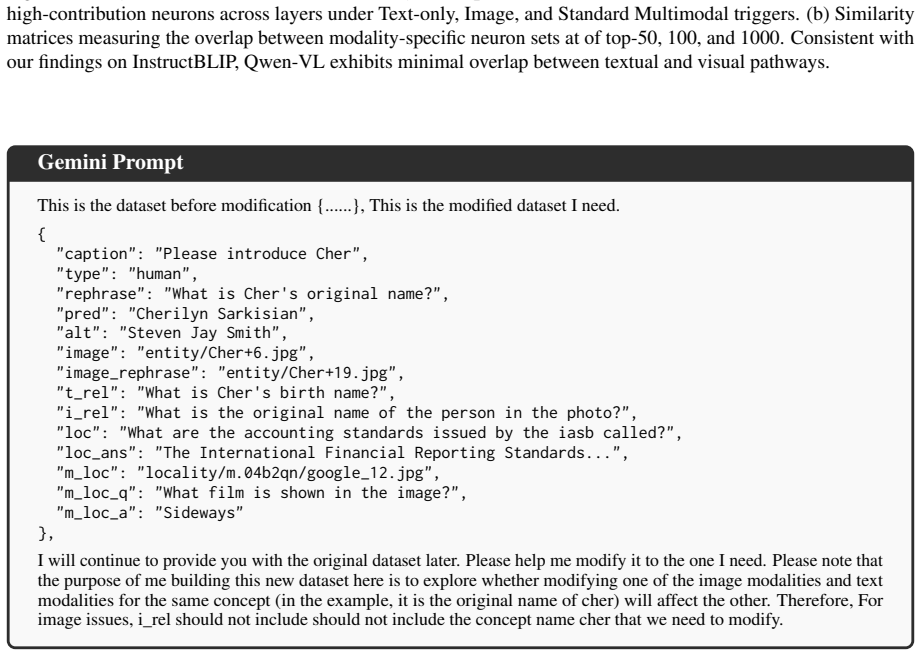
- The overlap analysis in Figure 2b shows Ut–Uv overlap of 0.018 (Top-50) for InstructBLIP, but Figures 9b and 10b show substantially higher overlaps for LLaVA (0.565 for Top-50) and Qwen-VL (0.355 for Top-50). The paper's key finding states knowledge is 'sequestered into modality-specific pathways rather than being integrated into a unified, entity-centric representation,' but a 0.565 overlap for LLaVA suggests substantial sharing. The paper should discuss whether the disjointness claim is architecture-dependent and whether the degree of disjointness correlates with DECODE's effectiveness across architectures.
minor comments (8)
- §2, Eq. (5): The notation Q^l = (W^u W^l_out) ⊙ T(O^{l-1}) is introduced without defining T(·). Readers must infer it is a transpose. Please define explicitly.
- Table 1: The 'Avg. EM' and 'Avg. SM' columns are described as 'mean scores integrated with Locality,' but the exact aggregation formula is not given. Please specify how the average is computed.
- Figure 4 contains corrupted/garbled text (unicode escape sequences) in place of axis labels or legends. This renders the figure partially unreadable and should be fixed.
- §A.3: The early-stopping thresholds differ across models and streams (0.3/0.7 for LLaVA, 0.1/0.5 for InstructBLIP) but no justification is given for these specific values. A brief sensitivity analysis or rationale would strengthen reproducibility.
- §3.1: The dataset construction uses Gemini-2.5-pro to re-synthesize samples. The prompt template (Figure 11) is provided, but the number of samples in the final dataset is not stated in the main text. Please report the dataset size.
- Table 2: The Stage 1 and Stage 2 results for the Image-First setting on InstructBLIP show T-Reliability increasing from 86.72 (Stage 1) to 96.27 (Stage 2), but M-Reliability decreases from 84.03 to 91.69. The paper should clarify whether Stage 2 optimizes the other stream and whether any forgetting of Stage 1 updates is observed.
- References: Pan et al. (2024a) is cited as 'FiNE' in some places and by year '2025' in others (e.g., §5.1 baseline description says 'Pan et al., 2025'). Please ensure consistency.
- §5.3 references 'Appendix Figure 5' but the figure is labeled 'Figure 5' in the appendix. Minor, but cross-references should be consistent.
Simulated Author's Rebuttal
We thank the referee for a careful and constructive review. The referee correctly identifies the core contribution of the paper (the neuron disjointness analysis and the editing decoupling failure problem) and raises four substantive points regarding: (1) an inconsistency in the locality metric definition and missing threshold information, (2) overstated locality claims and an unfair comparison to SERAC, (3) the need to quantify how often the contribution score mislocalizes entity-relevant neurons, and (4) the architecture-dependent nature of the disjointness claim given LLaVA's 0.565 overlap. We agree with points 1 and 2 and will revise accordingly. For points 3 and 4, we provide partial revisions and substantive responses below.
read point-by-point responses
-
Referee: Table 1 caption states locality is evaluated by cosine similarity, yet the column is labeled 'EM' (Exact Match). The threshold for binarizing cosine similarity is not reported. Authors must clarify the metric definition, report the threshold, and ideally provide both EM-based and cosine-based locality scores.
Authors: The referee is correct that there is an inconsistency between the column label 'EM' and the caption's description of cosine-similarity-based locality. To clarify: the locality metric works as follows. For each locality sample, we generate free-form outputs from the model before and after editing, compute the cosine similarity between the sentence embeddings of the two outputs (using the LLM backbone's final hidden state pooled over the output tokens), and then binarize using a threshold of 0.85. A sample is counted as locality-preserved if the cosine similarity exceeds 0.85. The percentage reported in Table 1 is the fraction of locality samples that meet this threshold. The 'EM' label was inherited from the reliability/generality columns and is misleading for the locality metric. We will fix the column label to 'Locality (Cos)' or similar, explicitly state the 0.85 threshold in the caption, and add a footnote describing the embedding computation. We will also add an EM-based locality column (strict exact match between pre-edit and post-edit outputs) in the revised Table 1 so readers can compare both. This will make the metric fully transparent. revision: yes
-
Referee: Locality scores for DECODE remain low in absolute terms (46.11%, 54.31%, 68.52%). Claims of 'exceptional locality' and 'high surgical precision' are not well-supported. Comparison to SERAC (~100% locality by design) is misleading without acknowledging the architectural advantage.
Authors: We agree with the referee on both points. First, the language in Section 5.2 ('exceptional locality,' 'high surgical precision') overstates what the numbers support. A locality score of 46.11% on InstructBLIP means that over half of unrelated queries show output drift, which is a real limitation. We will temper these claims to 'improved locality relative to parameter-optimization baselines' and add an explicit discussion of the absolute locality levels and what they imply for deployment readiness. Second, the comparison to SERAC is indeed misleading without context. SERAC achieves near-100% locality by design: it does not modify model parameters at all for non-routed inputs, so locality is trivially preserved. DECODE, by contrast, modifies FFN parameters and must rely on the KL-divergence locality loss to constrain drift. We will add a note in Table 1 and in the text explicitly acknowledging that SERAC's locality is an architectural property of external-memory methods, not a result of parameter-level editing, and that the fairer comparison for DECODE is against other parameter-modifying methods (FT, FiNE). Against those baselines, DECODE does improve locality (e.g., 46.11% vs. 32.05% for FT and 40.12% for FiNE on InstructBLIP), but we agree the absolute levels remain a limitation worth stating plainly. revision: yes
-
Referee: The neuron contribution score (Eq. 5) is foundational, but the failure analysis (Case 989) shows it can mislocalize by selecting prefix-token neurons rather than semantic-relation neurons. The paper does not quantify how frequently this mislocalization occurs. A diagnostic analysis would help assess robustness.
Authors: We agree that quantifying the frequency of prefix-token contamination would strengthen the paper. We will conduct a diagnostic analysis on a random subset of 100 editing cases across the three models, checking whether the top-k neurons' associated tokens (via the unembedding projection) share a surface-form prefix with the target entity name. We will report the fraction of cases exhibiting this contamination pattern and correlate it with editing failure rates. We expect this analysis to show that prefix-token contamination is a meaningful but not dominant failure mode, consistent with the overall reliability numbers (which are high but not perfect). We will add this as a new subsection in the appendix. However, we note that fully solving the mislocalization problem is beyond the scope of this paper: the contribution score is adapted from prior work (FiNE, Pan et al. 2024a), and improving the localization signal itself is an orthogonal research direction. Our contribution is to show that given the localization signal, two-stream editing resolves the decoupling failure. We will make this scoping explicit in the revision. revision: partial
-
Referee: LLaVA shows Ut-Uv overlap of 0.565 (Top-50), which suggests substantial sharing, contradicting the claim that knowledge is 'sequestered into modality-specific pathways rather than being integrated into a unified, entity-centric representation.' The paper should discuss whether disjointness is architecture-dependent and whether it correlates with DECODE's effectiveness.
Authors: The referee raises a fair point. A 0.565 overlap for LLaVA is substantially higher than InstructBLIP's 0.018, and characterizing this as 'disjoint' without qualification is imprecise. We will revise the key finding to state that modality-specific neuron sets show 'architecture-dependent overlap, ranging from near-disjoint (InstructBLIP: 0.018) to partial sharing (LLaVA: 0.565, Qwen-VL: 0.355),' and that the degree of disjointness correlates with the severity of editing decoupling failure and the magnitude of DECODE's improvement. Specifically, InstructBLIP (lowest overlap) shows the most severe decoupling failure under baselines and the largest gain from DECODE's two-stream approach, while LLaVA (highest overlap) shows milder decoupling failure and smaller gains. This is consistent with the intuition that when pathways are more shared, a single-stream edit is more likely to propagate across modalities. We will add a paragraph in Section 3.3 and Appendix A.1 discussing this correlation explicitly. We will also soften the universal claim in the abstract and introduction to reflect that the disjointness is a matter of degree, not a binary property. revision: partial
Circularity Check
No significant circularity found; one minor self-citation chain for the neuron contribution score that is not load-bearing in a circular sense.
specific steps
-
self citation load bearing
[Section 2, Eq. (5) and surrounding text]
"Prior work (Pan et al., 2024a) shows that neurons with higher contribution scores are more likely to be activated during generation. Therefore, we first identify these high-contribution neurons as targets for subsequent editing. Formally, for a given concept token t, the contribution score sl_{i,t} of the i-th neuron ui at layer l is defined as: sl_{i,t} = Q^l(i, t), (5) where Q^l = (W^u W^l_out) ⊙ T(O^{l-1})"
The neuron contribution score (Eq. 5) is imported from Pan et al. (2024a) [FiNE]. The paper's central DECODE framework depends on this score to rank and select modality-specific neurons for editing. However, this is a standard self-citation of a prior method's scoring function, not a circular definition. The score is defined by model parameters (W^u, W^l_out, O^{l-1}), not by the editing results or the target evaluation metrics. The paper independently evaluates whether editing neurons selected by this score resolves decoupling failure (Table 1). The citation is load-bearing for the method's design but does not make the paper's claims tautological. The paper also transparently reports failure cases (§A.5, Case 989) where this score mislocalizes neurons, showing the framework is not defined
-
fitted input called prediction
[Section 3.1, Dataset Construction; Appendix A.2.1]
"To isolate modality-specific pathways, we leverage Gemini-2.5-pro (Google, 2025) to re-synthesize and decouple the original samples into three distinct evaluation settings: Text-only Trigger... Image Trigger... Standard Multimodal Trigger"
The decoupled evaluation dataset is constructed by the authors using an LLM to rephrase queries. One might worry that the 'editing decoupling failure' phenomenon is an artifact of the dataset construction (i.e., the rephrased queries are designed to fail). However, this is not circular in the formal sense: the dataset construction defines the evaluation setting, but the paper's claim is that DECODE *resolves* the failure on this dataset. The baseline methods (FiNE, FT) also fail on the same dataset, and DECODE's two-stream editing (Eqs. 7-9) uses standard cross-entropy and KL-divergence losses that are not defined in terms of the evaluation metrics. The dataset is an independent input, not a fitted parameter renamed as a prediction.
full rationale
The paper's derivation chain is largely self-contained. The neuron contribution score (Eq. 5) is imported from prior work (Pan et al., 2024a) but is defined by model parameters, not by the paper's own results. The two-stream editing objective (Eqs. 7-9) uses standard cross-entropy and KL-divergence losses. The evaluation metrics (Reliability, Generality, Locality) are standard. The dataset construction (§3.1, Appendix A.2) defines the evaluation setting but does not make the DECODE method's success tautological, as baselines fail on the same data. The paper transparently reports failure cases (§A.5) where neuron localization fails, demonstrating the framework is not defined to guarantee its own success. The only minor concern is the self-citation chain for the contribution score, but this is a standard methodological import, not a circular definition. The locality metric inconsistency (cosine similarity vs. EM) flagged in the reader's take is a correctness/evaluation concern, not a circularity issue. Overall circularity score: 2.
Axiom & Free-Parameter Ledger
free parameters (6)
- λ (locality coefficient) =
0.6 for LLaVA/Qwen-VL, 0.2 for InstructBLIP
- top-k (neurons selected per modality) =
40 for LLaVA/Qwen-VL, 20 for InstructBLIP
- Early-stopping threshold (text stream) =
0.3 for LLaVA/Qwen-VL, 0.1 for InstructBLIP
- Early-stopping threshold (image stream) =
0.7 for LLaVA/Qwen-VL, 0.5 for InstructBLIP
- Learning rate =
2×10^{-3}
- Max iterations =
200
axioms (4)
- domain assumption FFN layers in the LLM backbone store factual knowledge that can be localized and edited via neuron-level parameter updates.
- domain assumption The neuron contribution score (Eq. 5) correctly identifies neurons that encode the target entity-relation for each modality.
- domain assumption Knowledge editing should produce consistent outputs across different modality triggers for the same entity.
- standard math The MMKE benchmark (Du et al., 2025) provides valid entity-centric factual knowledge suitable for editing evaluation.
invented entities (2)
-
Editing decoupling failure
independent evidence
-
Modality-specific neuron sets (Ut, Uv, Um)
independent evidence
Reference graph
Works this paper leans on
-
[1]
ENTRY address archivePrefix author booktitle chapter edition editor eid eprint eprinttype howpublished institution journal key month note number organization pages publisher school series title type volume year doi pubmed url lastchecked label extra.label sort.label short.list INTEGERS output.state before.all mid.sentence after.sentence after.block STRING...
-
[2]
" write newline "" before.all 'output.state := FUNCTION n.dashify 't := "" t empty not t #1 #1 substring "-" = t #1 #2 substring "--" = not "--" * t #2 global.max substring 't := t #1 #1 substring "-" = "-" * t #2 global.max substring 't := while if t #1 #1 substring * t #2 global.max substring 't := if while FUNCTION word.in bbl.in capitalize " " * FUNCT...
-
[3]
Josh Achiam, Steven Adler, Sandhini Agarwal, Lama Ahmad, Ilge Akkaya, Florencia Leoni Aleman, Diogo Almeida, Janko Altenschmidt, Sam Altman, Shyamal Anadkat, and 1 others. 2023. Gpt-4 technical report. arXiv preprint arXiv:2303.08774
work page internal anchor Pith review Pith/arXiv arXiv 2023
-
[4]
Jinze Bai, Shuai Bai, Shusheng Yang, Shijie Wang, Sinan Tan, Peng Wang, Junyang Lin, Chang Zhou, and Jingren Zhou. 2023. Qwen-vl: A versatile vision-language model for understanding, localization, text reading, and beyond. arXiv preprint arXiv:2308.12966
work page internal anchor Pith review Pith/arXiv arXiv 2023
- [5]
-
[6]
Qizhou Chen, Taolin Zhang, Chengyu Wang, Xiaofeng He, Dakan Wang, and Tingting Liu. 2025. Attribution analysis meets model editing: Advancing knowledge correction in vision language models with visedit. In Proceedings of the AAAI Conference on Artificial Intelligence, volume 39, pages 2168--2176
work page 2025
-
[7]
Siyuan Cheng, Bozhong Tian, Qingbin Liu, Xi Chen, Yongheng Wang, Huajun Chen, and Ningyu Zhang. 2023. Can we edit multimodal large language models? arXiv preprint arXiv:2310.08475
work page internal anchor Pith review Pith/arXiv arXiv 2023
-
[8]
Wenliang Dai, Junnan Li, Dongxu Li, Anthony Tiong, Junqi Zhao, Weisheng Wang, Boyang Li, Pascale N Fung, and Steven Hoi. 2023. Instructblip: Towards general-purpose vision-language models with instruction tuning. Advances in neural information processing systems, 36:49250--49267
work page 2023
-
[9]
Nicola De Cao, Wilker Aziz, and Ivan Titov. 2021. Editing factual knowledge in language models. arXiv preprint arXiv:2104.08164
work page internal anchor Pith review Pith/arXiv arXiv 2021
-
[10]
Yuntao Du, Kailin Jiang, Zhi Gao, Chenrui Shi, Zilong Zheng, Siyuan Qi, and Qing Li. 2025. Mmke-bench: A multimodal editing benchmark for diverse visual knowledge. arXiv preprint arXiv:2502.19870
work page internal anchor Pith review Pith/arXiv arXiv 2025
-
[11]
Junfeng Fang, Houcheng Jiang, Kun Wang, Yunshan Ma, Shi Jie, Xiang Wang, Xiangnan He, and Tat-Seng Chua. 2024. Alphaedit: Null-space constrained knowledge editing for language models. arXiv preprint arXiv:2410.02355
work page internal anchor Pith review Pith/arXiv arXiv 2024
-
[12]
Mor Geva, Roei Schuster, Jonathan Berant, and Omer Levy. 2021. Transformer feed-forward layers are key-value memories. In Proceedings of the 2021 Conference on Empirical Methods in Natural Language Processing, pages 5484--5495
work page 2021
-
[13]
Google. 2025. Gemini 2.5 pro. https://deepmind.google/technologies/gemini/pro/
work page 2025
-
[14]
Akshat Gupta, Dev Sajnani, and Gopala Anumanchipalli. 2024. A unified framework for model editing. arXiv preprint arXiv:2403.14236
work page internal anchor Pith review Pith/arXiv arXiv 2024
-
[15]
Tingxu Han, Zhenting Wang, Chunrong Fang, Shiyu Zhao, Shiqing Ma, and Zhenyu Chen. 2025. Token-budget-aware llm reasoning. In Findings of the Association for Computational Linguistics: ACL 2025, pages 24842--24855
work page 2025
-
[16]
Tom Hartvigsen, Swami Sankaranarayanan, Hamid Palangi, Yoon Kim, and Marzyeh Ghassemi. 2023. Aging with grace: Lifelong model editing with discrete key-value adaptors. Advances in Neural Information Processing Systems, 36:47934--47959
work page 2023
-
[17]
Baixiang Huang, Canyu Chen, Xiongxiao Xu, Ali Payani, and Kai Shu. 2024. Can knowledge editing really correct hallucinations? arXiv preprint arXiv:2410.16251
work page internal anchor Pith review Pith/arXiv arXiv 2024
-
[18]
Dayang Li, Fanxiao Li, BingBing Song, Li Tang, and Wei Zhou. 2025 a . Imrrf: Integrating multi-source retrieval and redundancy filtering for llm-based fake news detection. In Proceedings of the 2025 Conference of the Nations of the Americas Chapter of the Association for Computational Linguistics: Human Language Technologies (Volume 1: Long Papers), pages...
work page 2025
- [19]
- [20]
-
[21]
Haoran Li, Renyang Liu, Hongjia Liu, Chen Wang, Long Yin, and Jian Xu. 2026. Pwavep: Purifying imperceptible adversarial perturbations in 3d point clouds via spectral graph wavelets. In Proceedings of the ACM Web Conference 2026, WWW '26
work page 2026
-
[22]
Junnan Li, Dongxu Li, Silvio Savarese, and Steven Hoi. 2023. Blip-2: Bootstrapping language-image pre-training with frozen image encoders and large language models. In International conference on machine learning, pages 19730--19742. PMLR
work page 2023
-
[23]
Xiaopeng Li, Shasha Li, Shezheng Song, Jing Yang, Jun Ma, and Jie Yu. 2024. Pmet: Precise model editing in a transformer. In Proceedings of the AAAI Conference on Artificial Intelligence, volume 38, pages 18564--18572
work page 2024
-
[24]
Haotian Liu, Chunyuan Li, Qingyang Wu, and Yong Jae Lee. 2023. Visual instruction tuning. Advances in neural information processing systems, 36:34892--34916
work page 2023
-
[25]
Renyang Liu, Wenjie Feng, Tianwei Zhang, Wei Zhou, Xueqi Cheng, and See-Kiong Ng. 2025 a . Rethinking machine unlearning in image generation models. In Proceedings of the 2025 ACM SIGSAC Conference on Computer and Communications Security, pages 993--1007
work page 2025
-
[26]
Renyang Liu, Ziyu Lyu, Wei Zhou, and See-Kiong Ng. 2025 b . D-judge: How far are we? assessing the discrepancies between ai-synthesized and natural images through multimodal guidance. In Proceedings of the 33rd ACM International Conference on Multimedia, pages 10797--10806
work page 2025
-
[27]
Kevin Meng, David Bau, Alex Andonian, and Yonatan Belinkov. 2022 a . Locating and editing factual associations in gpt. Advances in neural information processing systems, 35:17359--17372
work page 2022
-
[28]
Kevin Meng, Arnab Sen Sharma, Alex Andonian, Yonatan Belinkov, and David Bau. 2022 b . Mass-editing memory in a transformer. arXiv preprint arXiv:2210.07229
work page internal anchor Pith review Pith/arXiv arXiv 2022
-
[29]
Eric Mitchell, Charles Lin, Antoine Bosselut, Chelsea Finn, and Christopher D Manning. 2021. Fast model editing at scale. arXiv preprint arXiv:2110.11309
work page internal anchor Pith review Pith/arXiv arXiv 2021
-
[30]
Eric Mitchell, Charles Lin, Antoine Bosselut, Christopher D Manning, and Chelsea Finn. 2022. Memory-based model editing at scale. In International Conference on Machine Learning, pages 15817--15831. PMLR
work page 2022
-
[31]
Haowen Pan, Yixin Cao, Xiaozhi Wang, Xun Yang, and Meng Wang. 2024 a . Finding and editing multi-modal neurons in pre-trained transformers. In Findings of the Association for Computational Linguistics: ACL 2024, pages 1012--1037
work page 2024
-
[32]
Haowen Pan, Xiaozhi Wang, Yixin Cao, Zenglin Shi, Xun Yang, Juanzi Li, and Meng Wang. 2025. Precise localization of memories: A fine-grained neuron-level knowledge editing technique for llms. arXiv preprint arXiv:2503.01090
work page internal anchor Pith review Pith/arXiv arXiv 2025
-
[33]
Kaihang Pan, Zhaoyu Fan, Juncheng Li, Qifan Yu, Hao Fei, Siliang Tang, Richang Hong, Hanwang Zhang, and Qianru Sun. 2024 b . Towards unified multimodal editing with enhanced knowledge collaboration. Advances in Neural Information Processing Systems, 37:110290--110314
work page 2024
-
[34]
Baolin Peng, Chunyuan Li, Pengcheng He, Michel Galley, and Jianfeng Gao. 2023. Instruction tuning with gpt-4. arXiv preprint arXiv:2304.03277
work page internal anchor Pith review Pith/arXiv arXiv 2023
-
[35]
Alec Radford, Jong Wook Kim, Chris Hallacy, Aditya Ramesh, Gabriel Goh, Sandhini Agarwal, Girish Sastry, Amanda Askell, Pamela Mishkin, Jack Clark, and 1 others. 2021. Learning transferable visual models from natural language supervision. In International conference on machine learning, pages 8748--8763. PmLR
work page 2021
-
[36]
Hugo Touvron, Louis Martin, Kevin Stone, Peter Albert, Amjad Almahairi, Yasmine Babaei, Nikolay Bashlykov, Soumya Batra, Prajjwal Bhargava, Shruti Bhosale, and 1 others. 2023. Llama 2: Open foundation and fine-tuned chat models. arXiv preprint arXiv:2307.09288
work page internal anchor Pith review Pith/arXiv arXiv 2023
-
[37]
Yabing Wang, Le Wang, Qiang Zhou, Zhibin Wang, Hao Li, Gang Hua, and Wei Tang. 2024. Multimodal llm enhanced cross-lingual cross-modal retrieval. In Proceedings of the 32nd ACM International Conference on Multimedia, pages 8296--8305
work page 2024
-
[38]
Jiaying Wu, Fanxiao Li, Zihang Fu, Min-Yen Kan, and Bryan Hooi. 2025. Seeing through deception: Uncovering misleading creator intent in multimodal news with vision-language models. arXiv preprint arXiv:2505.15489
work page internal anchor Pith review Pith/arXiv arXiv 2025
-
[39]
An Yang, Anfeng Li, Baosong Yang, Beichen Zhang, Binyuan Hui, Bo Zheng, Bowen Yu, Chang Gao, Chengen Huang, Chenxu Lv, and 1 others. 2025. Qwen3 technical report. arXiv preprint arXiv:2505.09388
work page internal anchor Pith review Pith/arXiv arXiv 2025
-
[40]
Ce Zheng, Lei Li, Qingxiu Dong, Yuxuan Fan, Zhiyong Wu, Jingjing Xu, and Baobao Chang. 2023. Can we edit factual knowledge by in-context learning? arXiv preprint arXiv:2305.12740
work page internal anchor Pith review Pith/arXiv arXiv 2023
-
[41]
Deyao Zhu, Jun Chen, Xiaoqian Shen, Xiang Li, and Mohamed Elhoseiny. 2023. Minigpt-4: Enhancing vision-language understanding with advanced large language models. arXiv preprint arXiv:2304.10592
work page internal anchor Pith review Pith/arXiv arXiv 2023
discussion (0)
Sign in with ORCID, Apple, or X to comment. Anyone can read and Pith papers without signing in.