Unraveling the Mystery of the Peculiar and Young Hot Jupiter CoRoT-2b II: Phase Resolved Emission Spectroscopy with VLT/CRIRES+ and Gemini-S/IGRINS
Pith reviewed 2026-06-27 02:16 UTC · model grok-4.3
The pith
CoRoT-2b rotates slower than tidally locked expectations, explaining its western hotspot offset.
A machine-rendered reading of the paper's core claim, the machinery that carries it, and where it could break.
Core claim
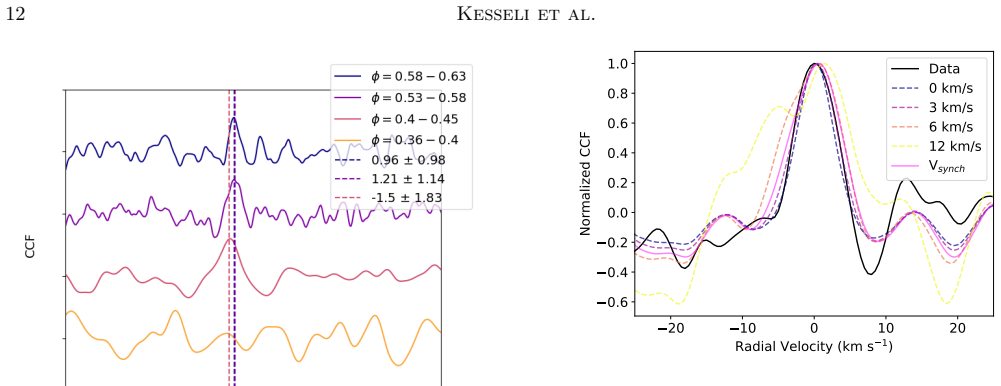
The analysis concludes that CoRoT-2b exhibits sub-synchronous rotation. Its rotational broadening is measured at 2.24 +0.81/-0.77 km s^{-1}, discrepant at 2.6 sigma from the 4.37 ± 0.13 km s^{-1} predicted by tidal locking. This slower rotation is identified as the most likely explanation for the western hotspot offset after testing alternative hypotheses.
What carries the argument
Rotational line broadening extracted from cross-correlation of phase-resolved high-resolution emission spectra, tested against the value predicted from the orbital period under the assumption of synchronous rotation.
If this is right
- The western hotspot offset arises from sub-synchronous rotation rather than other mechanisms such as clouds or magnetic effects.
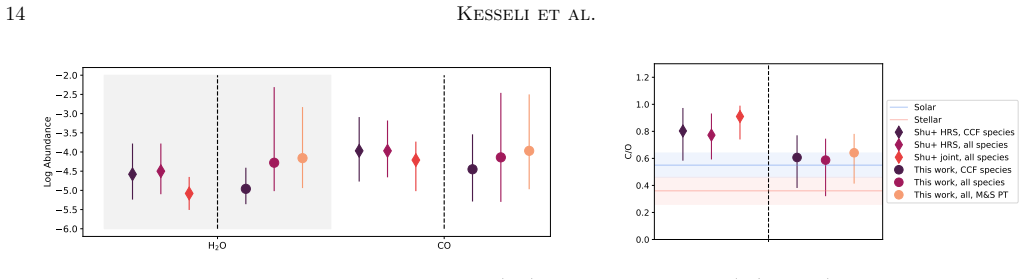
- Chemical abundances and C/O ratios remain consistent across pre- and post-eclipse phases.
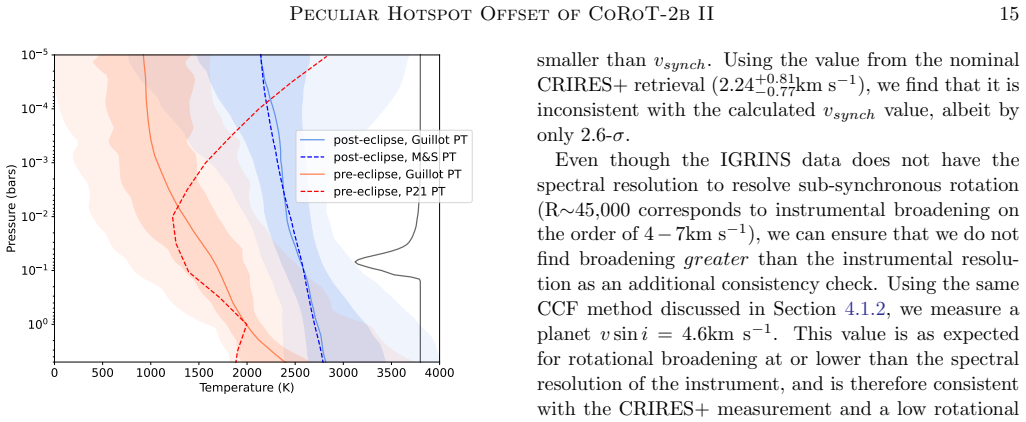
- A hotter and more isothermal temperature-pressure profile appears at post-eclipse phases, matching the phase-curve data.
Where Pith is reading between the lines
- Tidal evolution models for close-in giant planets may need to allow for rotation periods longer than the orbital period in some cases.
- High-resolution spectroscopy offers a way to measure exoplanet spin rates that complements photometric variability studies.
- Other hot Jupiters with anomalous westward offsets could be checked for similar sub-synchronous rotation using the same approach.
Load-bearing premise
The measured spectral line broadening is dominated by the planet's rotation and can be cleanly separated from winds, thermal effects, or instrumental resolution.
What would settle it
A direct measurement of CoRoT-2b's rotation period or higher-precision spectroscopy that yields a rotational broadening matching or clearly contradicting the reported 2.24 km/s value.
Figures
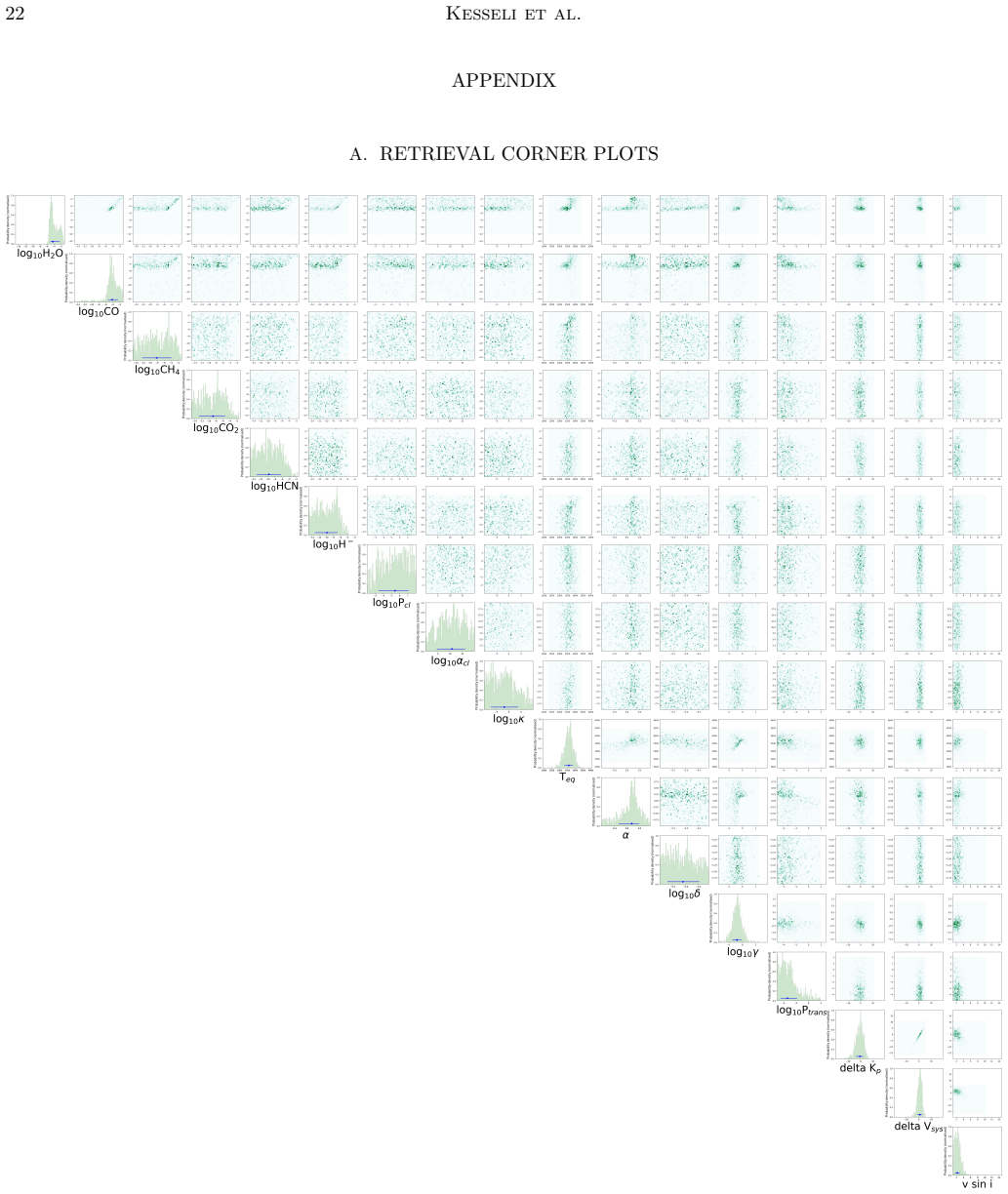
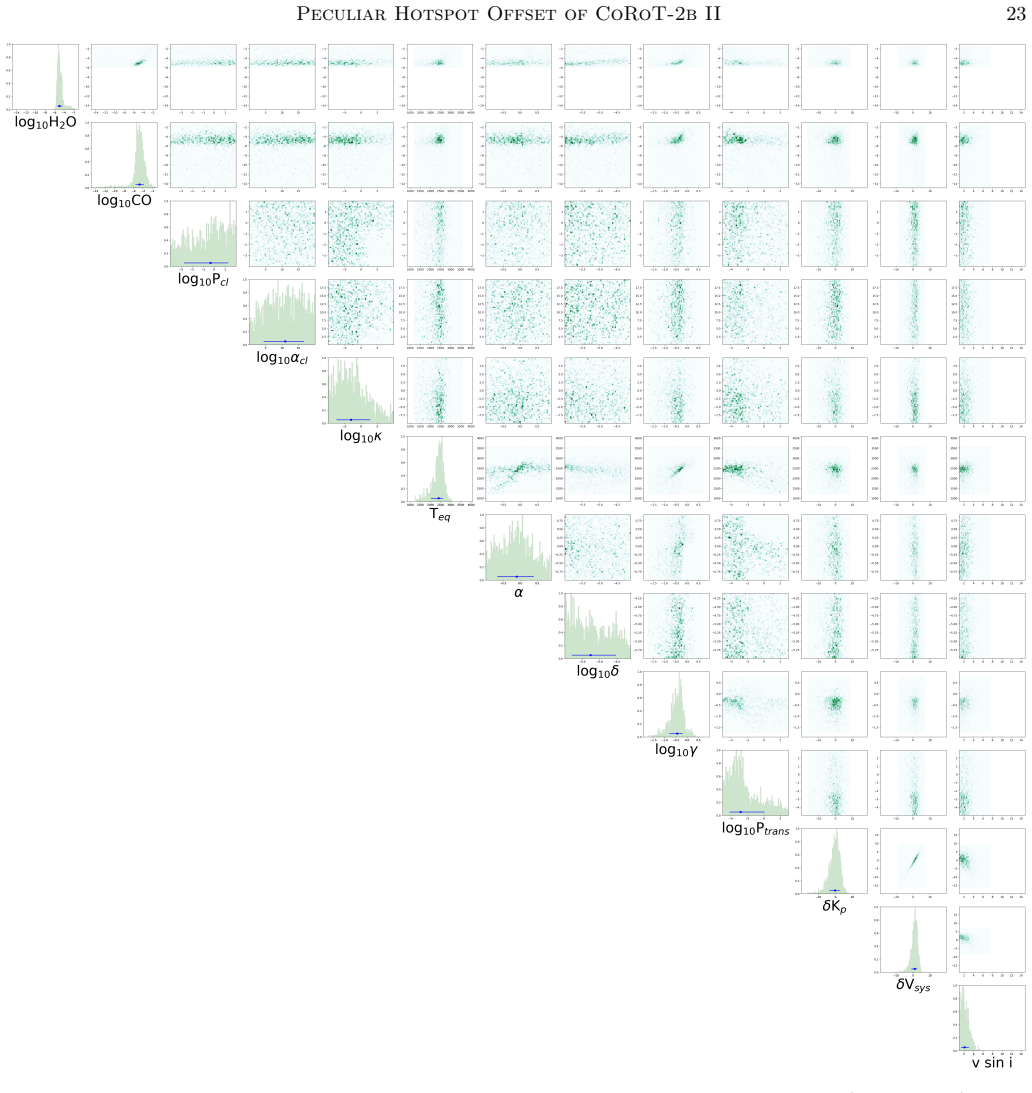
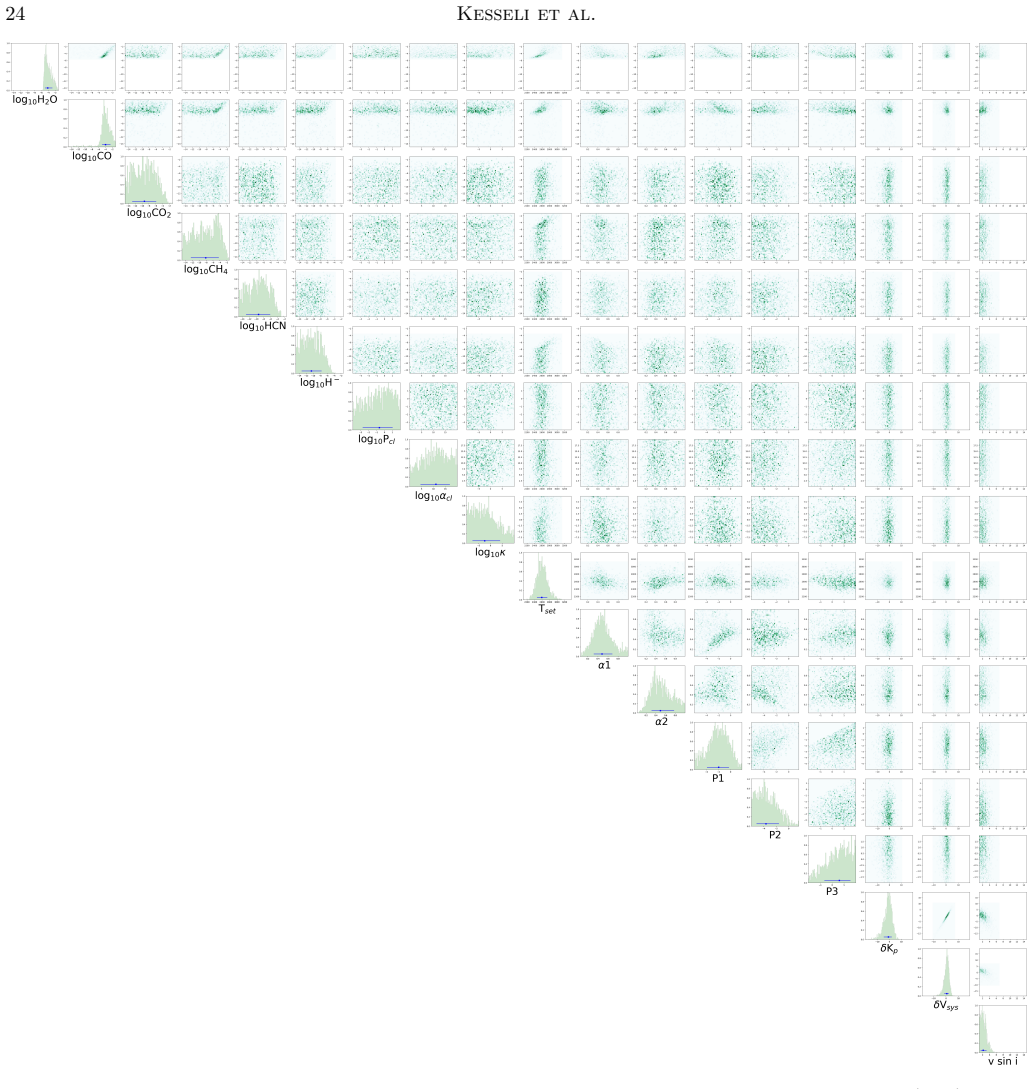
read the original abstract
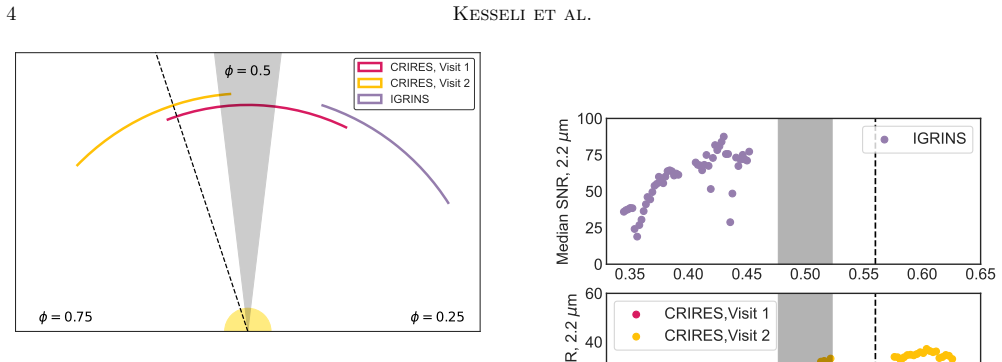
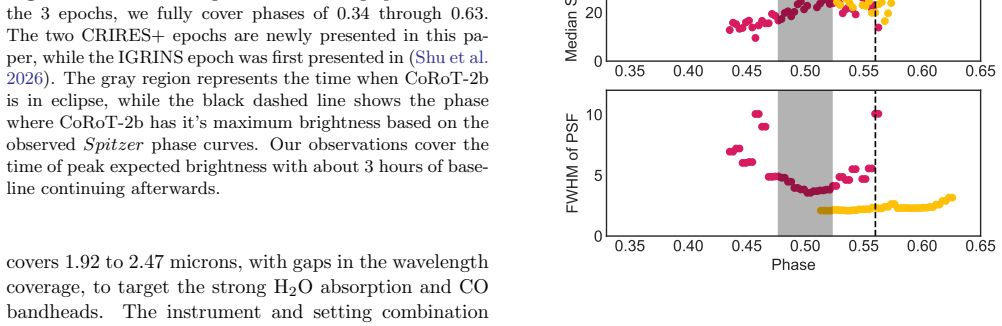
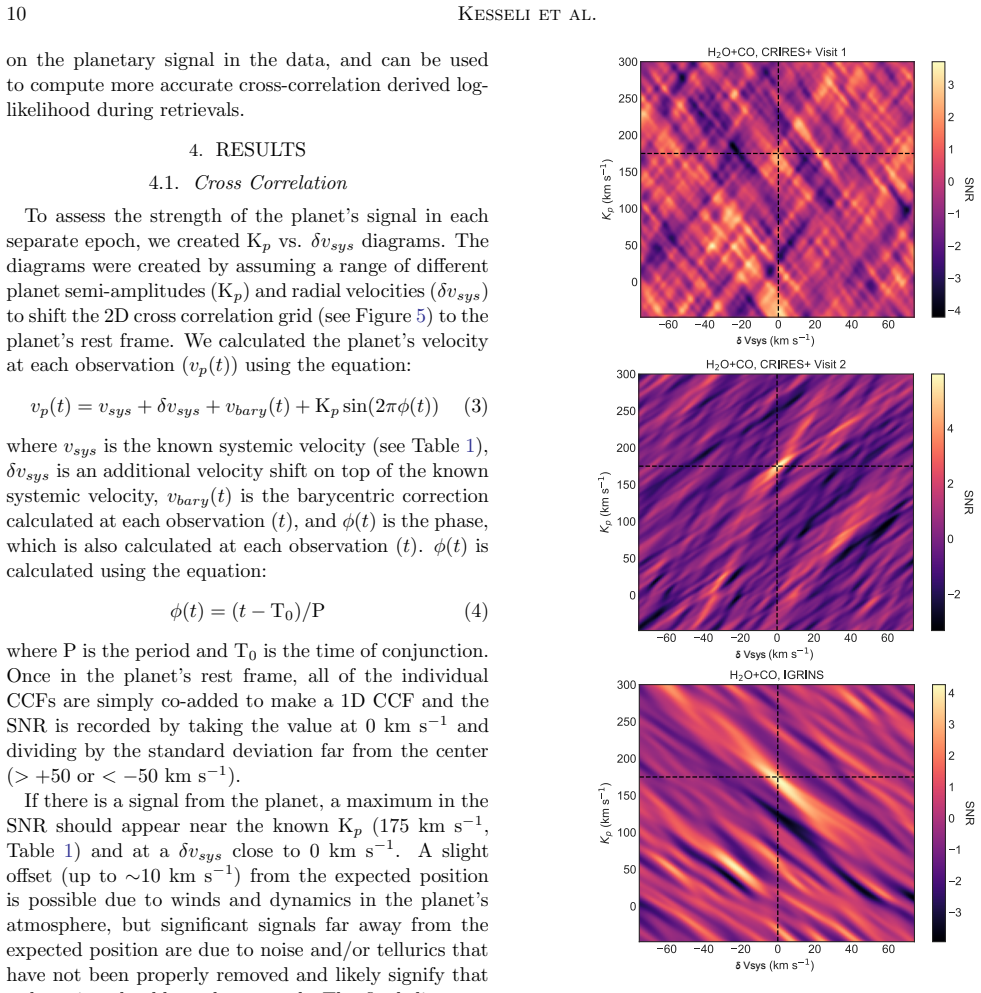
Hot Jupiters are expected to be tidally locked and synchronously rotating due to their short orbital periods. These conditions create large day-night temperature contrasts and are thought to drive eastward super-rotating jets. Indeed, the majority of hot Jupiters are observed to have the hottest region of the planet either at the substellar point or offset in the eastern direction. However, the full phase curve of CoRoT-2b, observed with the Spitzer Space Telescope, exhibits robust evidence of a western hotspot offset. To determine the origin of this peculiar hotspot offset, we present phase-resolved high-resolution observations of CoRoT-2b from the CRIRES+ spectrograph on the Very Large Telescope (VLT) and the IGRINS spectrograph on Gemini South, covering both pre- and post-eclipse phases (0.34--0.63). We detect the signal from the planet (S/N$>$4) in both pre- and post-eclipse phases separately, and therefore perform separate cross-correlation and retrieval analyses at the two epochs. The phase-resolved retrievals show highly consistent abundances and C/Os, but prefer a hotter and more isothermal temperature-pressure profile at post-eclipse phases, consistent with the phase curve observations that indicated a western hotpsot offset. By testing multiple hypotheses invoked to drive a western hotspot offset, we find the most likely explanation to be sub-synchronous planetary rotation. We measure the planet's rotational broadening to be $2.24\substack{+0.81\\-0.77}$ km s$^{-1}$, whereas the expectation from tidally locked rotation is $4.37\pm0.13$ km s$^{-1}$ (2.6-$\sigma$ discrepant). Other observations, such as high precision phase curves or eclipse mapping, would help to further confirm the western hotspot offset and sub-synchronous rotation.
Editorial analysis
A structured set of objections, weighed in public.
Referee Report
Summary. The paper reports phase-resolved high-resolution emission spectroscopy of CoRoT-2b with VLT/CRIRES+ and Gemini-S/IGRINS over orbital phases 0.34-0.63. Planetary signals are detected separately pre- and post-eclipse (S/N >4), followed by cross-correlation and atmospheric retrievals that yield consistent abundances and C/O ratios. The retrievals prefer a hotter, more isothermal T-P profile post-eclipse. The authors test hypotheses for the western hotspot offset seen in Spitzer phase curves and conclude the most likely cause is sub-synchronous rotation, based on a measured rotational broadening of 2.24 +0.81/-0.77 km s^{-1} versus the tidally locked expectation of 4.37±0.13 km s^{-1} (2.6σ discrepancy).
Significance. If the rotational broadening measurement is shown to be robust against confounding effects, the result would be significant for hot Jupiter atmospheric dynamics, providing direct evidence against the standard tidal-locking assumption and an alternative mechanism for anomalous (western) hotspot offsets. The phase-resolved detection and abundance consistency are strengths of the observational approach.
major comments (2)
- [Abstract and phase-resolved retrievals] The central claim of sub-synchronous rotation rests on the reported rotational broadening value. The abstract and retrieval description provide no quantitative details on the error budget, how the instrumental resolution (R≈10^5) was deconvolved, or whether zonal wind fields were jointly retrieved as free parameters alongside the rotational kernel; without this, the 2.6σ discrepancy cannot be evaluated for robustness against the alternative broadening mechanisms noted in the stress-test.
- [Retrieval analysis and hypothesis testing] The forward model used to extract v_rot must separate rotational broadening from (i) net Doppler shifts due to zonal winds across the visible hemisphere and (ii) temperature-dependent weighting of the disk. The manuscript tests multiple hotspot hypotheses but does not report a joint retrieval that floats both rotation and a parameterized wind field; this omission is load-bearing for the sub-synchronous conclusion.
minor comments (1)
- [Abstract] The abstract contains a typographical error: 'hotpsot' should be 'hotspot'.
Simulated Author's Rebuttal
We thank the referee for their detailed and constructive review. We address the two major comments point-by-point below. Where the comments identify gaps in quantitative detail or analysis, we agree that revisions are warranted and will incorporate the requested clarifications and additional retrievals.
read point-by-point responses
-
Referee: [Abstract and phase-resolved retrievals] The central claim of sub-synchronous rotation rests on the reported rotational broadening value. The abstract and retrieval description provide no quantitative details on the error budget, how the instrumental resolution (R≈10^5) was deconvolved, or whether zonal wind fields were jointly retrieved as free parameters alongside the rotational kernel; without this, the 2.6σ discrepancy cannot be evaluated for robustness against the alternative broadening mechanisms noted in the stress-test.
Authors: We agree that the abstract and main retrieval description lack the requested quantitative details. The error budget, deconvolution of the R≈10^5 instrumental profile from the rotational kernel, and robustness checks against alternative broadening mechanisms are fully documented in the Methods section and the dedicated stress-test appendix. However, to improve accessibility and allow direct evaluation of the 2.6σ result, we will revise the abstract to include a concise summary of the error analysis and deconvolution procedure. Net Doppler shifts from zonal winds were assessed separately via the cross-correlation peak locations rather than as joint free parameters in the primary retrievals; we will add an explicit statement clarifying this approach and its justification from the stress-tests. revision: yes
-
Referee: [Retrieval analysis and hypothesis testing] The forward model used to extract v_rot must separate rotational broadening from (i) net Doppler shifts due to zonal winds across the visible hemisphere and (ii) temperature-dependent weighting of the disk. The manuscript tests multiple hotspot hypotheses but does not report a joint retrieval that floats both rotation and a parameterized wind field; this omission is load-bearing for the sub-synchronous conclusion.
Authors: The forward model separates the rotational kernel from net Doppler shifts (measured independently from cross-correlation centroids) and incorporates temperature-dependent disk weighting through the phase-resolved T-P profile retrievals. We acknowledge that a joint retrieval simultaneously floating both v_rot and a parameterized wind field was not performed and would strengthen the robustness claim. Because this joint analysis is absent from the current manuscript, we will add it in revision to explicitly test whether the sub-synchronous rotation result persists when winds are treated as free parameters. revision: yes
Circularity Check
No circularity: rotational broadening measured from spectra and compared to independent orbital expectation
full rationale
The central claim rests on a direct spectral measurement of line broadening (2.24 +0.81/-0.77 km s^{-1}) extracted via cross-correlation and retrievals on CRIRES+ and IGRINS data, contrasted against a separately computed synchronous value (4.37 ± 0.13 km s^{-1}) obtained from the known orbital period and radius. No equation reduces the measured width to a fitted input by construction, no self-citation chain carries the uniqueness of the interpretation, and the forward model separation of rotation from winds/thermal effects is presented as an empirical extraction rather than a definitional identity. The derivation chain is therefore self-contained against external orbital parameters.
Axiom & Free-Parameter Ledger
free parameters (1)
- rotational broadening velocity =
2.24 km/s
axioms (1)
- domain assumption Hot Jupiters with short orbital periods are tidally locked and synchronously rotating
Reference graph
Works this paper leans on
-
[1]
The Roasting Marshmallows Program with IGRINS on Gemini South III: Seeing deeper into the metal depleted atmosphere of a gas-giant on the cusp of the hot to ultra-hot Jupiter transition. , keywords =. doi:10.1093/mnras/staf1150 , archivePrefix =. 2507.07204 , primaryClass =
-
[2]
doi:10.1146/annurev.astro.46.060407.145222 , eprint =
The Chemical Composition of the Sun. , keywords =. doi:10.1146/annurev.astro.46.060407.145222 , archivePrefix =. 0909.0948 , primaryClass =
-
[3]
Transiting exoplanets from the CoRoT space mission. II. CoRoT-Exo-2b: a transiting planet around an active G star. , keywords =. doi:10.1051/0004-6361:200809431 , archivePrefix =. 0803.3207 , primaryClass =
work page internal anchor Pith review Pith/arXiv arXiv doi:10.1051/0004-6361:200809431
-
[4]
Retrieval of the dayside atmosphere of WASP-43b with CRIRES ^ +. , keywords =. doi:10.1051/0004-6361/202347151 , archivePrefix =. 2307.11627 , primaryClass =
-
[5]
Doomed Worlds. I. No New Evidence for Orbital Decay in a Long-term Survey of 43 Ultrahot Jupiters. , keywords =. doi:10.3847/PSJ/ad3e80 , archivePrefix =. 2404.07339 , primaryClass =
-
[6]
doi:10.5281/zenodo.845059 , publisher =
igrins/plp 2.2.0. doi:10.5281/zenodo.845059 , publisher =
-
[7]
Gregory Mace and Kimberly Sokal and Jae-Joon Lee and Heeyoung Oh and Chan Park and Hanshin Lee and John Good and Phillip MacQueen and Jae Sok Oh and Kyle Kaplan and Ben Kidder and Moo-Young Chun and In-Soo Yuk and Ueejeong Jeong and Soojong Pak and Kang-Min Kim and Jakyoung Nah and Sungho Lee and Young-Sam Yu and Narae Hwang and Byeong-Gon Park and Hwihyu...
-
[8]
Chan Park and Daniel T. Jaffe and In-Soo Yuk and Moo-Young Chun and Soojong Pak and Kang-Min Kim and Michael Pavel and Hanshin Lee and Heeyoung Oh and Ueejeong Jeong and Chae Kyung Sim and Hye-In Lee and Huynh Anh Nguyen Le and Joseph Strubhar and Michael Gully-Santiago and Jae Sok Oh and Sang-Mok Cha and Bongkon Moon and Kwijong Park and Cynthia Brooks a...
-
[9]
Radiatively Active Clouds and Magnetic Effects Explored in a Grid of Hot Jupiter GCMs. , keywords =. doi:10.3847/1538-4357/ad9394 , archivePrefix =. 2410.23436 , primaryClass =
-
[10]
Cassini States with Dissipation: Why Obliquity Tides Cannot Inflate Hot Jupiters
Cassini States with Dissipation: Why Obliquity Tides Cannot Inflate Hot Jupiters. , keywords =. doi:10.1086/519075 , archivePrefix =. astro-ph/0703418 , primaryClass =
work page internal anchor Pith review Pith/arXiv arXiv doi:10.1086/519075
-
[11]
Thermal Tides in Fluid Extrasolar Planets
Thermal Tides in Fluid Extrasolar Planets. , keywords =. doi:10.1088/0004-637X/714/1/1 , archivePrefix =. 0912.2313 , primaryClass =
work page internal anchor Pith review Pith/arXiv arXiv doi:10.1088/0004-637x/714/1/1
-
[12]
Origin of Tidal Dissipation in Jupiter. II. The Value of Q. , keywords =. doi:10.1086/497355 , archivePrefix =. astro-ph/0407628 , primaryClass =
work page internal anchor Pith review Pith/arXiv arXiv doi:10.1086/497355
-
[13]
Retrieving interior properties of hot Jupiters with Love numbers and atmospheric measurements. , keywords =. doi:10.1093/mnras/staf814 , archivePrefix =. 2505.10304 , primaryClass =
-
[14]
Thermo-Resistive Instability of Hot Planetary Atmospheres
Thermo-resistive Instability of Hot Planetary Atmospheres. , keywords =. doi:10.1088/2041-8205/754/1/L9 , archivePrefix =. 1206.3363 , primaryClass =
work page internal anchor Pith review Pith/arXiv arXiv doi:10.1088/2041-8205/754/1/l9 2041
-
[15]
Magnetohydrodynamical Torsional Oscillations from Thermoresistive Instability in Hot Jupiters. , keywords =. doi:10.3847/1538-4357/ad0968 , archivePrefix =. 2308.00892 , primaryClass =
-
[16]
Variability from Thermoresistive Instability in the Atmospheres of Hot Jupiters. , keywords =. doi:10.3847/1538-4357/ac9bfc , archivePrefix =. 2208.03387 , primaryClass =
-
[17]
Thermal Tides in Short Period Exoplanets
Thermal Tides in Short Period Exoplanets. arXiv e-prints , keywords =. doi:10.48550/arXiv.0901.0735 , archivePrefix =. 0901.0735 , primaryClass =
work page internal anchor Pith review Pith/arXiv arXiv doi:10.48550/arxiv.0901.0735
-
[18]
Photospheric carbon and oxygen abundances of F-G type stars in the Pleiades cluster
Photospheric carbon and oxygen abundances of F-G type stars in the Pleiades cluster*. , keywords =. doi:10.1093/pasj/psw105 , archivePrefix =. 1610.05439 , primaryClass =
work page internal anchor Pith review Pith/arXiv arXiv doi:10.1093/pasj/psw105
-
[19]
Ariel stellar characterisation. II. Chemical abundances of carbon, nitrogen, and oxygen for 181 planet-host FGK dwarf stars. , keywords =. doi:10.1051/0004-6361/202450604 , archivePrefix =. 2406.12393 , primaryClass =
-
[20]
, year = 1996, month = jul, volume =
Synchronous Locking of Tidally Evolving Satellites. , year = 1996, month = jul, volume =. doi:10.1006/icar.1996.0117 , adsurl =
-
[21]
The chemical make-up of the Sun: A 2020 vision
The chemical make-up of the Sun: A 2020 vision. , keywords =. doi:10.1051/0004-6361/202140445 , archivePrefix =. 2105.01661 , primaryClass =
work page internal anchor Pith review Pith/arXiv arXiv doi:10.1051/0004-6361/202140445 2020
-
[22]
Photochemical Hazes Dramatically Alter Temperature Structure and Atmospheric Circulation in 3D Simulations of Hot Jupiters. , keywords =. doi:10.3847/1538-4357/acd4bb , archivePrefix =. 2305.09654 , primaryClass =
-
[23]
, archivePrefix = "arXiv", eprint =
MULTINEST: an efficient and robust Bayesian inference tool for cosmology and particle physics. , keywords =. doi:10.1111/j.1365-2966.2009.14548.x , archivePrefix =. 0809.3437 , primaryClass =
-
[24]
X-ray spectral modelling of the AGN obscuring region in the CDFS: Bayesian model selection and catalogue. , keywords =. doi:10.1051/0004-6361/201322971 , archivePrefix =. 1402.0004 , primaryClass =
work page internal anchor Pith review Pith/arXiv arXiv doi:10.1051/0004-6361/201322971
-
[25]
Extreme Winds on the Emerging Dayside of an Ultrahot Jupiter. , keywords =. doi:10.3847/2041-8213/ae36a1 , archivePrefix =. 2601.20849 , primaryClass =
-
[26]
Semidiurnal thermal tides in asynchronously rotating hot Jupiters
Semidiurnal thermal tides in asynchronously rotating hot Jupiters. , keywords =. doi:10.1051/0004-6361/201731683 , archivePrefix =. 1801.07519 , primaryClass =
work page internal anchor Pith review Pith/arXiv arXiv doi:10.1051/0004-6361/201731683
-
[27]
Modeling the High-resolution Emission Spectra of Clear and Cloudy Nontransiting Hot Jupiters. , keywords =. doi:10.3847/1538-4357/ac2a2a , archivePrefix =. 2110.05593 , primaryClass =
-
[28]
Estimating the magnetic field strength in hot Jupiters
Estimating the Magnetic Field Strength in Hot Jupiters. , keywords =. doi:10.3847/2041-8213/aa93fd , archivePrefix =. 1709.05676 , primaryClass =
work page internal anchor Pith review Pith/arXiv arXiv doi:10.3847/2041-8213/aa93fd 2041
-
[29]
, archivePrefix = "arXiv", eprint =
Atmospheric circulation of tidally locked exoplanets: a suite of benchmark tests for dynamical solvers. , keywords =. doi:10.1111/j.1365-2966.2011.18315.x , archivePrefix =. 1010.1257 , primaryClass =
-
[30]
3D Atmospheric Circulation of Warm and Hot Jupiters. , keywords =. doi:10.1088/0004-637X/801/2/95 , adsurl =
-
[31]
CRIRES+ and ESPRESSO reveal an atmosphere enriched in volatiles relative to refractories on the ultra-hot Jupiter WASP-121b. arXiv e-prints , keywords =. doi:10.48550/arXiv.2410.18183 , archivePrefix =. 2410.18183 , primaryClass =
-
[32]
An Observational Diagnostic for Distinguishing Between Clouds and Haze in Hot Exoplanet Atmospheres
An Observational Diagnostic for Distinguishing between Clouds and Haze in Hot Exoplanet Atmospheres. , keywords =. doi:10.3847/2041-8213/aa84ac , archivePrefix =. 1705.05847 , primaryClass =
work page internal anchor Pith review Pith/arXiv arXiv doi:10.3847/2041-8213/aa84ac 2041
-
[33]
Overcast Mornings and Clear Evenings in Hot Jupiter Exoplanet Atmospheres. , keywords =. doi:10.3847/2041-8213/adf20f , archivePrefix =. 2507.15854 , primaryClass =
-
[34]
Tidal Decay of Close Planetary Orbits
Tidal Decay of Close Planetary Orbits. , keywords =. doi:10.1086/177941 , archivePrefix =. astro-ph/9605059 , primaryClass =
work page internal anchor Pith review Pith/arXiv arXiv doi:10.1086/177941
-
[35]
Constraints on the Magnetic Field Strength of HAT-P-7 b and other Hot Giant Exoplanets
Constraints on the magnetic field strength of HAT-P-7 b and other hot giant exoplanets. Nature Astronomy , keywords =. doi:10.1038/s41550-017-0131 , archivePrefix =. 1704.06271 , primaryClass =
work page internal anchor Pith review Pith/arXiv arXiv doi:10.1038/s41550-017-0131
-
[36]
The mystery of water in the atmosphere of Bo \"o tis b continues: Insights from revisiting archival CRIRES observations. , keywords =. doi:10.1093/mnras/stae2361 , archivePrefix =. 2410.08178 , primaryClass =
-
[37]
Obliquity Tides on Hot Jupiters
Obliquity Tides on Hot Jupiters. , keywords =. doi:10.1086/432834 , archivePrefix =. astro-ph/0506468 , primaryClass =
work page internal anchor Pith review Pith/arXiv arXiv doi:10.1086/432834
-
[38]
Tidal dissipation within hot Jupiters: a new appraisal
Tidal dissipation within hot Jupiters: a new appraisal. , keywords =. doi:10.1051/0004-6361:20066487 , archivePrefix =. astro-ph/0612044 , primaryClass =
work page internal anchor Pith review Pith/arXiv arXiv doi:10.1051/0004-6361:20066487
-
[39]
Atmospheres on Nonsynchronized Eccentric-tilted Exoplanets. II. Thermal Light Curves. , keywords =. doi:10.3847/1538-4357/ab06ca , archivePrefix =. 1903.00908 , primaryClass =
work page internal anchor Pith review Pith/arXiv arXiv doi:10.3847/1538-4357/ab06ca 1903
-
[40]
Models of Warm Jupiter Atmospheres: Observable Signatures of Obliquity
Models of Warm Jupiter Atmospheres: Observable Signatures of Obliquity. , keywords =. doi:10.3847/1538-4357/aa81c3 , archivePrefix =. 1707.06278 , primaryClass =
work page internal anchor Pith review Pith/arXiv arXiv doi:10.3847/1538-4357/aa81c3
-
[41]
Hot Jupiters Are Asynchronous Rotators. , keywords =. doi:10.3847/2041-8213/ada954 , archivePrefix =. 2409.07651 , primaryClass =
-
[42]
Unraveling the Mystery of the Peculiar and Young Hot Jupiter CoRoT-2b. I. H _ 2 O and CO Detection from Dayside Observations with Gemini-S/IGRINS. , keywords =. doi:10.3847/1538-3881/ae5ba6 , archivePrefix =. 2605.20340 , primaryClass =
work page internal anchor Pith review Pith/arXiv arXiv doi:10.3847/1538-3881/ae5ba6
-
[43]
Where Is the Water? Jupiter-like C/H Ratio but Strong H _ 2 O Depletion Found on Bo \"o tis b Using SPIRou. , keywords =. doi:10.3847/1538-3881/ac0428 , archivePrefix =. 2105.10513 , primaryClass =
-
[44]
Vanadium oxide and a sharp onset of cold-trapping on a giant exoplanet. , keywords =. doi:10.1038/s41586-023-06134-0 , archivePrefix =. 2306.08739 , primaryClass =
-
[45]
Vertical structure of an exoplanet's atmospheric jet stream. arXiv e-prints , keywords =. doi:10.48550/arXiv.2502.12261 , archivePrefix =. 2502.12261 , primaryClass =
-
[46]
A First Look at CRIRES+: Performance Assessment and Exoplanet Spectroscopy. , keywords =. doi:10.3847/1538-3881/ac77eb , archivePrefix =. 2206.10621 , primaryClass =
-
[47]
A solar C/O and sub-solar metallicity in a hot Jupiter atmosphere. , keywords =. doi:10.1038/s41586-021-03912-6 , archivePrefix =. 2110.14821 , primaryClass =
-
[48]
HyDRA-H: Simultaneous Hybrid Retrieval of Exoplanetary Emission Spectra. , keywords =. doi:10.3847/1538-3881/ab4efc , archivePrefix =. 1910.14042 , primaryClass =
-
[49]
Retrieval of Exoplanet Emission Spectra with HyDRA
Retrieval of exoplanet emission spectra with HyDRA. , keywords =. doi:10.1093/mnras/stx2748 , archivePrefix =. 1710.06433 , primaryClass =
work page internal anchor Pith review Pith/arXiv arXiv doi:10.1093/mnras/stx2748
-
[50]
Molecular cross-sections for high-resolution spectroscopy of super-Earths, warm Neptunes, and hot Jupiters. , keywords =. doi:10.1093/mnras/staa981 , archivePrefix =. 2004.04160 , primaryClass =
-
[51]
ExoMol molecular line lists XXX: a complete high-accuracy line list for water
ExoMol molecular line lists XXX: a complete high-accuracy line list for water. , keywords =. doi:10.1093/mnras/sty1877 , archivePrefix =. 1807.04529 , primaryClass =
work page internal anchor Pith review Pith/arXiv arXiv doi:10.1093/mnras/sty1877
-
[52]
Observing the Universe at infrared wavelengths and high spectral resolution
CRIRES ^ + on sky at the ESO Very Large Telescope. Observing the Universe at infrared wavelengths and high spectral resolution. , keywords =. doi:10.1051/0004-6361/202245217 , archivePrefix =. 2301.08048 , primaryClass =
-
[53]
Ground-based and Airborne Instrumentation for Astronomy VI , year = 2016, editor =
The ``+'' for CRIRES: enabling better science at infrared wavelength and high spectral resolution at the ESO VLT. Ground-based and Airborne Instrumentation for Astronomy VI , year = 2016, editor =. doi:10.1117/12.2232837 , adsurl =
-
[54]
Variable and Supersonic Winds in the Atmosphere of an Ultrahot Giant Planet. , keywords =. doi:10.3847/1538-3881/ac51d2 , archivePrefix =. 2201.04154 , primaryClass =
-
[55]
Long-term Variations in the Orbital Period of Hot Jupiters from Transit-timing Analysis Using TESS Survey Data. , keywords =. doi:10.3847/1538-4365/ad0847 , archivePrefix =. 2310.17225 , primaryClass =
-
[56]
Detection of a Westward Hotspot Offset in the Atmosphere of a Hot Gas Giant CoRoT-2b
Detection of a westward hotspot offset in the atmosphere of hot gas giant CoRoT-2b. Nature Astronomy , keywords =. doi:10.1038/s41550-017-0351-6 , archivePrefix =. 1801.06548 , primaryClass =
work page internal anchor Pith review Pith/arXiv arXiv doi:10.1038/s41550-017-0351-6
-
[57]
Warm Spitzer Photometry of the Transiting Exoplanets CoRoT-1 and CoRoT-2 at Secondary Eclipse
Warm Spitzer Photometry of the Transiting Exoplanets CoRoT-1 and CoRoT-2 at Secondary Eclipse. , keywords =. doi:10.1088/0004-637X/726/2/95 , archivePrefix =. 1011.1019 , primaryClass =
work page internal anchor Pith review Pith/arXiv arXiv doi:10.1088/0004-637x/726/2/95
-
[58]
The Emergent 1.1-1.7 m Spectrum of the Exoplanet CoRoT-2b as Measured Using the Hubble Space Telescope. , keywords =. doi:10.1088/0004-637X/783/2/113 , archivePrefix =. 1401.4464 , primaryClass =
work page internal anchor Pith review Pith/arXiv arXiv doi:10.1088/0004-637x/783/2/113
-
[59]
The corona and companion of CoRoT-2A. Insights from X-rays and optical spectroscopy
The corona and companion of CoRoT-2a. Insights from X-rays and optical spectroscopy. , keywords =. doi:10.1051/0004-6361/201116961 , archivePrefix =. 1106.1522 , primaryClass =
work page internal anchor Pith review Pith/arXiv arXiv doi:10.1051/0004-6361/201116961
-
[60]
TESS Transit Timing of Hundreds of Hot Jupiters. , keywords =. doi:10.3847/1538-4365/ac545b , archivePrefix =. 2202.03401 , primaryClass =
-
[61]
New photometric analysis of five exoplanets: CoRoT-2b, HAT-P-12b, TrES-2b, WASP-12b, and WASP-52b. , keywords =. doi:10.1093/mnras/stz747 , adsurl =
-
[62]
ExoClock Project. III. 450 New Exoplanet Ephemerides from Ground and Space Observations. , keywords =. doi:10.3847/1538-4365/ac9da4 , archivePrefix =. 2209.09673 , primaryClass =
-
[63]
HELIOS-K: An Ultrafast, Open-source Opacity Calculator for Radiative Transfer
HELIOS-K: An Ultrafast, Open-source Opacity Calculator for Radiative Transfer. , keywords =. doi:10.1088/0004-637X/808/2/182 , archivePrefix =. 1503.03806 , primaryClass =
work page internal anchor Pith review Pith/arXiv arXiv doi:10.1088/0004-637x/808/2/182
-
[64]
Detection of titanium oxide in the atmosphere of a hot Jupiter
Detection of titanium oxide in the atmosphere of a hot Jupiter. , keywords =. 2017. doi:10.1038/nature23651 , archivePrefix =. 1709.04118 , primaryClass =
work page internal anchor Pith review Pith/arXiv arXiv doi:10.1038/nature23651 2017
-
[65]
A Significant Increase in Detection of High-resolution Emission Spectra Using a Three-dimensional Atmospheric Model of a Hot Jupiter. , keywords =. doi:10.3847/1538-3881/abb67b , archivePrefix =. 2009.09030 , primaryClass =
-
[66]
The secondary eclipse of the transiting exoplanet CoRoT-2b
The secondary eclipse of the transiting exoplanet CoRoT-2b. , keywords =. doi:10.1051/0004-6361/200912505 , archivePrefix =. 0906.2814 , primaryClass =
work page internal anchor Pith review Pith/arXiv arXiv doi:10.1051/0004-6361/200912505
-
[67]
Bright optical dayside emission from extrasolar planet CoRoT-2b
Bright optical day-side emission from extrasolar planet CoRoT-2b. , keywords =. doi:10.1051/0004-6361/200913338 , archivePrefix =. 0909.4080 , primaryClass =
work page internal anchor Pith review Pith/arXiv arXiv doi:10.1051/0004-6361/200913338
-
[68]
An analysis of the CoRoT-2 system: A young spotted star and its inflated giant planet
An analysis of the CoRoT-2 system: a young spotted star and its inflated giant planet. , keywords =. doi:10.1051/0004-6361/201015051 , archivePrefix =. 1010.1078 , primaryClass =
work page internal anchor Pith review Pith/arXiv arXiv doi:10.1051/0004-6361/201015051
-
[69]
36th COSPAR Scientific Assembly , year = 2006, volume =
CoRoT: a high precision photometer for stellar ecolution and exoplanet finding. 36th COSPAR Scientific Assembly , year = 2006, volume =
2006
-
[70]
The Roasting Marshmallows Program with IGRINS on Gemini South. II. WASP-121 b has Superstellar C/O and Refractory-to-volatile Ratios. , keywords =. doi:10.3847/1538-3881/ad8574 , archivePrefix =. 2410.19017 , primaryClass =
-
[71]
The Roasting Marshmallows Program with IGRINS on Gemini South I: Composition and Climate of the Ultrahot Jupiter WASP-18 b. , keywords =. doi:10.3847/1538-3881/acaf5c , archivePrefix =. 2209.15548 , primaryClass =
-
[72]
The GAPS Programme at TNG. XLI. The climate of KELT-9b revealed with a new approach to high-spectral-resolution phase curves. , keywords =. doi:10.1051/0004-6361/202244593 , archivePrefix =. 2209.11735 , primaryClass =
-
[73]
Phase-resolving the Absorption Signatures of Water and Carbon Monoxide in the Atmosphere of the Ultra-hot Jupiter WASP-121b with GEMINI-S/IGRINS. , keywords =. doi:10.1088/1538-3873/ad5c9f , archivePrefix =. 2406.09641 , primaryClass =
-
[74]
Modelling the effect of 3D temperature and chemistry on the cross-correlation signal of transiting ultra-hot Jupiters: a study of five chemical species on WASP-76b. , keywords =. doi:10.1093/mnras/stad2586 , archivePrefix =. 2307.04931 , primaryClass =
-
[75]
The High-resolution Transmission Spectrum of HD 189733b Interpreted with Atmospheric Doppler Shifts from Three-dimensional General Circulation Models. , keywords =. doi:10.3847/1538-3881/ab164c , archivePrefix =. 1810.06099 , primaryClass =
work page internal anchor Pith review Pith/arXiv arXiv doi:10.3847/1538-3881/ab164c
-
[76]
Atmospheric Rossiter-McLaughlin effect and transmission spectroscopy of WASP-121b with ESPRESSO. , keywords =. doi:10.1051/0004-6361/202039344 , archivePrefix =. 2011.01245 , primaryClass =
-
[77]
The Mantis Network II: examining the 3D high-resolution observable properties of the UHJs WASP-121b and WASP-189b through GCM modelling. , keywords =. doi:10.1093/mnras/stac2246 , archivePrefix =. 2210.11986 , primaryClass =
-
[78]
Global Climate and Atmospheric Composition of the Ultra-hot Jupiter WASP-103b from HST and Spitzer Phase Curve Observations. , keywords =. doi:10.3847/1538-3881/aac3df , archivePrefix =. 1805.00029 , primaryClass =
work page internal anchor Pith review Pith/arXiv arXiv doi:10.3847/1538-3881/aac3df
-
[79]
A HST/WFC3 Thermal Emission Spectrum of the Hot Jupiter HAT-P-7b
An HST/WFC3 Thermal Emission Spectrum of the Hot Jupiter HAT-P-7b. , keywords =. doi:10.3847/1538-3881/aac497 , archivePrefix =. 1805.00424 , primaryClass =
work page internal anchor Pith review Pith/arXiv arXiv doi:10.3847/1538-3881/aac497
-
[80]
Climate of an Ultra hot Jupiter: Spectroscopic phase curve of WASP-18b with HST/WFC3
Climate of an ultra hot Jupiter. Spectroscopic phase curve of WASP-18b with HST/WFC3. , keywords =. doi:10.1051/0004-6361/201834891 , archivePrefix =. 1904.02069 , primaryClass =
work page internal anchor Pith review Pith/arXiv arXiv doi:10.1051/0004-6361/201834891 1904
discussion (0)
Sign in with ORCID, Apple, or X to comment. Anyone can read and Pith papers without signing in.