A Double--Scaling Large--\(d\) Saddle of BFSS/BMN Matrix Quantum Mechanics
Pith reviewed 2026-06-27 00:01 UTC · model grok-4.3
The pith
A double-scaling limit in large-d BFSS matrix quantum mechanics balances Yang-Mills and mass terms to produce BFSS2-like low-temperature dynamics and IKKT-like high-temperature behavior.
A machine-rendered reading of the paper's core claim, the machinery that carries it, and where it could break.
Core claim
In the double-scaling limit the theory interpolates between the commutator-dominated BFSS regime and the mass-dominated Gaussian regime, exhibiting two complementary large-d regimes: at low temperature the enhanced gap pushes the deconfinement scale upward and opens a parametrically large uniform-holonomy region where the bulk dynamics behave as weakly coupled BFSS2-type gauged harmonic-oscillator sectors, while at high temperature an overlap window appears in which the Gaussian description remains self-consistent and the commutator contribution per matrix pair is parametrically suppressed, yielding BFSS2-like dynamics in the enlarged uniform-holonomy sector and IKKT-like almost-commuting ma
What carries the argument
The commuting-symmetric saddle and its maximally symmetric specialization, which encode the Yang-Mills interaction in a single dynamically generated mass shift k0 fixed by a gap equation for the self-consistent frequency s squared equals m plus k0.
If this is right
- The deconfinement scale is pushed upward, opening a parametrically large uniform-holonomy region at low temperature.
- The low-temperature bulk dynamics behave as weakly coupled BFSS2-type gauged harmonic-oscillator sectors.
- The high-temperature branch admits an overlap window where the Gaussian description remains self-consistent while commutator contributions are parametrically suppressed.
- The Yang-Mills observable and the associated phase structure admit controlled analysis in the balanced double-scaling regime.
Where Pith is reading between the lines
- The controlled interpolation between regimes may permit explicit calculations of thermodynamic observables that are otherwise inaccessible in either pure BFSS or pure Gaussian limits.
- The enlarged uniform-holonomy sector could serve as a starting point for studying fluctuation corrections around the saddle in a parametrically extended window.
- The same double-scaling construction might be applied to other mass deformations or to the supersymmetric BFSS case to test whether the BFSS2-like and IKKT-like features persist.
Load-bearing premise
The commuting-symmetric saddle and its maximally symmetric specialization accurately capture the large-d dynamics, with the gap equation self-consistently determining k0 without higher-order corrections dominating in the double-scaling limit.
What would settle it
A direct computation of the next-to-leading saddle-point corrections that shows they grow with the double-scaling parameter and spoil the self-consistent determination of k0, or a numerical simulation of the holonomy effective action that fails to reproduce the predicted enlargement of the uniform-holonomy region.
Figures
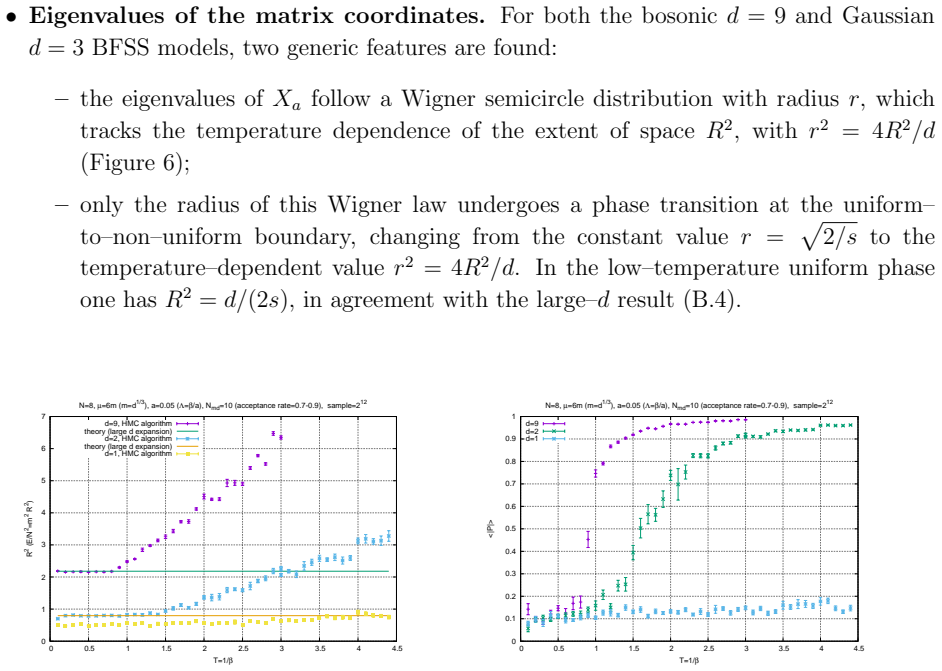
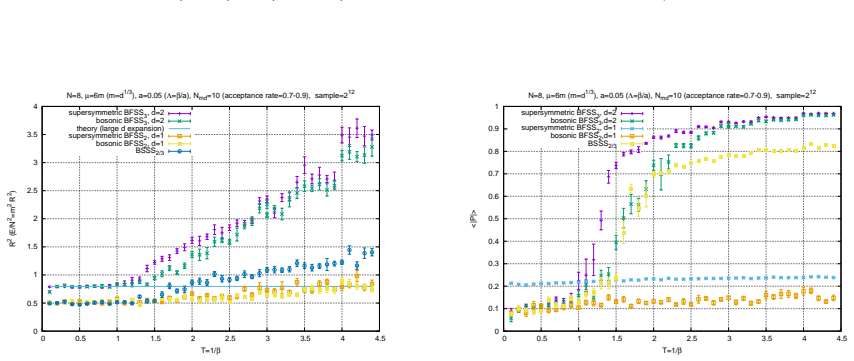
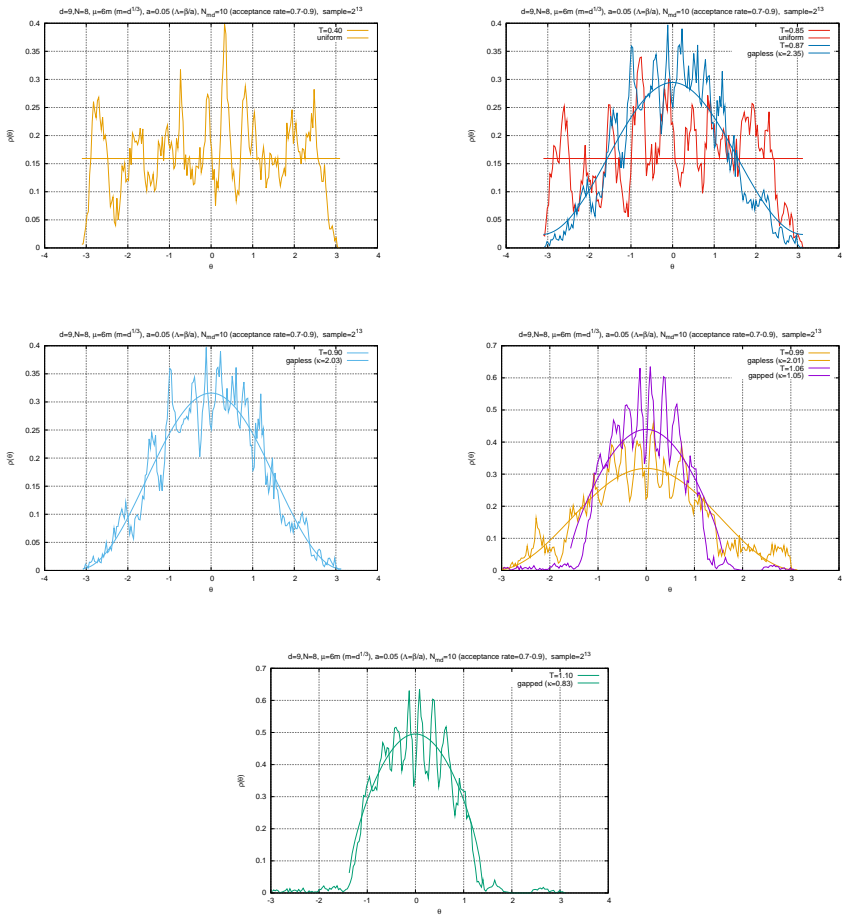
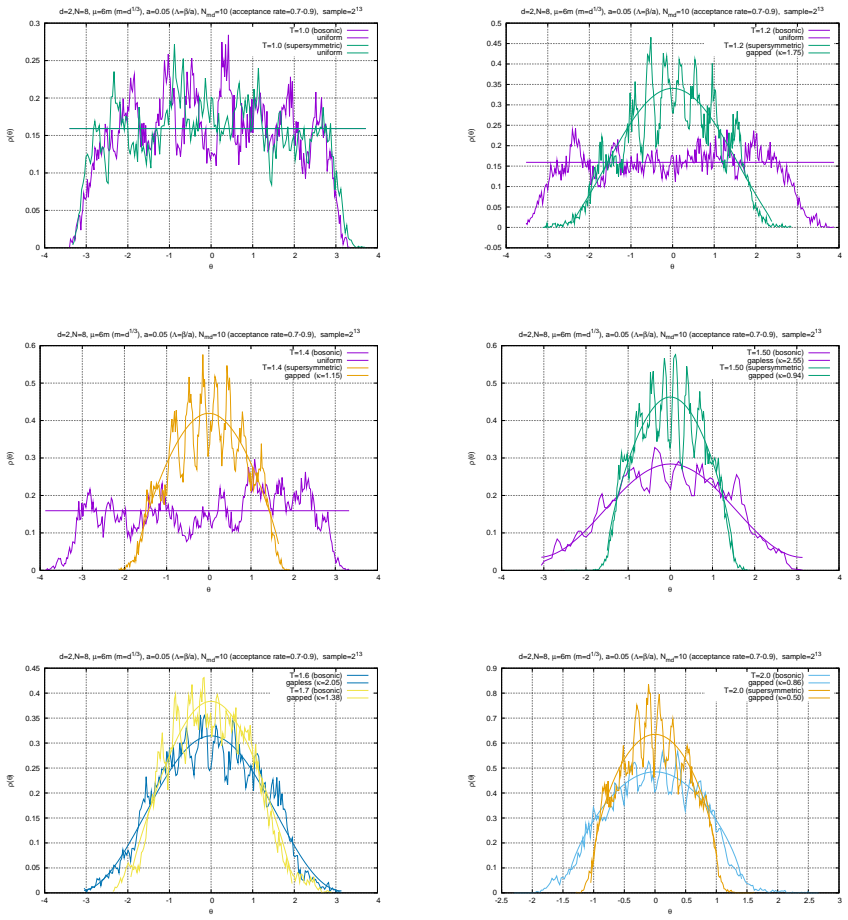
read the original abstract
We study the large--\(d\) dynamics of the mass--deformed bosonic \(\mathrm{BFSS}_{d+1}\) matrix quantum mechanics using a Hubbard--Stratonovich localization of the Yang--Mills interaction. After integrating out the matrix coordinates, the theory reduces to a holonomy--dependent effective action for an auxiliary adjoint kernel. We introduce a commuting--symmetric saddle and its maximally symmetric specialization, in which the interaction is encoded in a single dynamically generated mass shift \(k_0\). The resulting large--\(d\) description is a gauged matrix harmonic oscillator with self--consistent frequency \(s^2=m+k_0\), fixed by a gap equation. We analyze the low--temperature \(X\)-space physics, the holonomy effective action, the Yang--Mills observable, and the associated phase structure. We then identify a correlated double--scaling limit in which \(d\to\infty\), \(m\to\infty\), and \(\kappa=m^{3/2}/d\) is held fixed. In this limit the Yang--Mills interaction and the explicit mass deformation remain parametrically balanced: the theory interpolates between the commutator--dominated BFSS regime and the mass--dominated Gaussian regime. The double--scaled theory exhibits two complementary large--\(d\) regimes. At low temperature, the enhanced gap pushes the deconfinement scale upward and opens a parametrically large uniform--holonomy region, where the bulk dynamics behaves as weakly coupled \(\mathrm{BFSS}_2\)--type gauged harmonic--oscillator sectors. At the same time, the high--temperature branch reveals an overlap window in which the Gaussian description remains self--consistent while the commutator contribution per matrix pair is parametrically suppressed. The resulting dynamics is therefore \(\mathrm{BFSS}_2\)--like in its enlarged uniform--holonomy sector and IKKT--like in its almost--commuting matrix behavior.
Editorial analysis
A structured set of objections, weighed in public.
Referee Report
Summary. The paper claims that a Hubbard-Stratonovich localization of the Yang-Mills interaction in the large-d limit of mass-deformed bosonic BFSS_{d+1} matrix quantum mechanics reduces the theory to a holonomy-dependent effective action for an auxiliary adjoint kernel. A commuting-symmetric saddle and its maximally symmetric specialization encode the interaction via a single mass shift k_0, yielding a gauged matrix harmonic oscillator with self-consistent frequency s^2 = m + k_0 fixed by a gap equation. In the double-scaling limit (d → ∞, m → ∞, κ = m^{3/2}/d fixed) the model interpolates between regimes, exhibiting an enlarged uniform-holonomy region with BFSS_2-like weakly coupled sectors at low temperature and an overlap window with parametrically suppressed commutators (IKKT-like) at high temperature.
Significance. If the saddle dominance and gap-equation stability are established, the construction supplies a controlled large-d analytic framework for the parametric balance between commutator and mass terms, with potential implications for phase structure and observables in matrix models dual to string/M-theory. The reduction to a single auxiliary kernel via symmetry assumptions is a technically economical feature.
major comments (2)
- [Abstract (saddle introduction paragraph)] Abstract (saddle introduction paragraph): the claim that the commuting-symmetric saddle and its maximally symmetric specialization dominate the large-d path integral is not supported by an explicit quadratic fluctuation operator, Hessian eigenvalue bounds, or demonstration that non-commuting fluctuations remain parametrically suppressed when κ is held fixed. This assumption is load-bearing for both the enlarged uniform-holonomy region and the suppressed commutator contribution.
- [Abstract (gap equation discussion)] Abstract (gap equation discussion): the frequency is defined as s^2 = m + k_0 with k_0 fixed internally by the gap equation, but no analysis shows that 1/d corrections to the gap equation remain o(1) throughout the double-scaling limit. Without this, the asserted parametric balance between Yang-Mills interaction and mass deformation, and the resulting BFSS_2-like / IKKT-like interpolation, lacks justification.
minor comments (1)
- [Abstract] The notation for the auxiliary adjoint kernel and the transition to the holonomy effective action would benefit from an explicit definition or forward reference in the abstract for clarity.
Simulated Author's Rebuttal
We thank the referee for their careful reading and constructive comments. We respond point-by-point to the major comments below.
read point-by-point responses
-
Referee: [Abstract (saddle introduction paragraph)] Abstract (saddle introduction paragraph): the claim that the commuting-symmetric saddle and its maximally symmetric specialization dominate the large-d path integral is not supported by an explicit quadratic fluctuation operator, Hessian eigenvalue bounds, or demonstration that non-commuting fluctuations remain parametrically suppressed when κ is held fixed. This assumption is load-bearing for both the enlarged uniform-holonomy region and the suppressed commutator contribution.
Authors: We agree that the manuscript does not contain an explicit quadratic fluctuation analysis or Hessian eigenvalue bounds around the commuting-symmetric saddle. The saddle is introduced via symmetry reduction of the auxiliary kernel in the Hubbard-Stratonovich localization, which by construction eliminates many non-commuting modes at leading order in large d. However, to establish parametric suppression of remaining non-commuting fluctuations when κ is held fixed, we will add a dedicated subsection deriving the quadratic operator and providing bounds showing that the relevant eigenvalues remain positive and that non-commuting contributions are suppressed by 1/d factors throughout the double-scaling regime. revision: yes
-
Referee: [Abstract (gap equation discussion)] Abstract (gap equation discussion): the frequency is defined as s^2 = m + k_0 with k_0 fixed internally by the gap equation, but no analysis shows that 1/d corrections to the gap equation remain o(1) throughout the double-scaling limit. Without this, the asserted parametric balance between Yang-Mills interaction and mass deformation, and the resulting BFSS_2-like / IKKT-like interpolation, lacks justification.
Authors: The gap equation is obtained from the leading-order saddle of the large-d effective action. The double-scaling limit with fixed κ = m^{3/2}/d is constructed precisely so that the Yang-Mills and mass contributions remain balanced at this order. We acknowledge that the manuscript provides no explicit demonstration that 1/d corrections to the gap equation stay o(1). We will add an analysis of the next-to-leading 1/d terms in the revised version, confirming that they remain parametrically small under the stated scaling and thereby justifying the claimed interpolation between regimes. revision: yes
Circularity Check
No circularity: gap equation is a standard self-consistent mean-field equation, not a definitional reduction
full rationale
The paper introduces a commuting-symmetric saddle for the auxiliary kernel after Hubbard-Stratonovich localization, leading to a gap equation that determines the mass shift k0 and thus the effective frequency s^2 = m + k0. This is an ordinary self-consistent equation solved for the saddle value; the subsequent double-scaling analysis (d → ∞, m → ∞, κ fixed) and regime identifications (uniform-holonomy BFSS2-like sectors, suppressed commutators) are derived from the resulting effective action without any quantity being redefined as its own input. No self-citation chains, uniqueness theorems from prior work, or fitted parameters relabeled as predictions appear in the provided text. The derivation remains self-contained.
Axiom & Free-Parameter Ledger
free parameters (1)
- k0
axioms (2)
- domain assumption Hubbard-Stratonovich localization exactly captures the Yang-Mills interaction for the purpose of large-d reduction.
- ad hoc to paper The commuting-symmetric saddle and its maximally symmetric specialization dominate the large-d path integral.
invented entities (2)
-
auxiliary adjoint kernel
no independent evidence
-
commuting-symmetric saddle
no independent evidence
Reference graph
Works this paper leans on
-
[1]
Supersymmetric Yang-Mills Theories,
L. Brink, J. H. Schwarz and J. Scherk, “Supersymmetric Yang-Mills Theories,” Nucl. Phys. B121, 77-92 (1977)
1977
-
[2]
Fierz Identities for Real Clifford Algebras and the Number of Supercharges,
M. Baake, M. Reinicke and V. Rittenberg, “Fierz Identities for Real Clifford Algebras and the Number of Supercharges,” J. Math. Phys.26, 1070 (1985)
1985
-
[3]
’t Hooft,A Planar Diagram Theory for Strong Interactions, Nucl
G. ’t Hooft,A Planar Diagram Theory for Strong Interactions, Nucl. Phys. B72, 461 (1974)
1974
-
[4]
’t Hooft,Dimensional Reduction in Quantum Gravity, arXiv:gr-qc/9310026
G. ’t Hooft,Dimensional Reduction in Quantum Gravity, arXiv:gr-qc/9310026
-
[5]
Susskind,The World as a Hologram, J
L. Susskind,The World as a Hologram, J. Math. Phys.36, 6377 (1995)
1995
-
[6]
M theory as a matrix model: A conjecture,
T. Banks, W. Fischler, S. H. Shenker and L. Susskind, “M theory as a matrix model: A conjecture,” Phys. Rev. D55, 5112-5128 (1997) [arXiv:hep-th/9610043 [hep-th]]
Pith/arXiv arXiv 1997
-
[7]
Witten,Bound States of Strings andp-Branes, Nucl
E. Witten,Bound States of Strings andp-Branes, Nucl. Phys. B460, 335 (1996)
1996
-
[8]
Itzhaki, J
N. Itzhaki, J. M. Maldacena, J. Sonnenschein and S. Yankielowicz,Supergravity and the LargeNLimit of Theories with Sixteen Supercharges, Phys. Rev. D58, 046004 (1998)
1998
-
[9]
Polchinski,Dirichlet Branes and Ramond–Ramond Charges, Phys
J. Polchinski,Dirichlet Branes and Ramond–Ramond Charges, Phys. Rev. Lett.75, 4724 (1995)
1995
-
[10]
Cremmer, B
E. Cremmer, B. Julia, and J. Scherk,Supergravity Theory in Eleven Dimensions, Phys. Lett. B76, 409 (1978)
1978
-
[11]
String theory dynamics in various dimensions,
E. Witten, “String theory dynamics in various dimensions,”Nucl. Phys. B443, 85 (1995)
1995
-
[12]
Quantum M-wave and Black 0-brane,
Y. Hyakutake, “Quantum M-wave and Black 0-brane,” JHEP09, 075 (2014) [arXiv:1407.6023 [hep-th]]. 82
Pith/arXiv arXiv 2014
-
[13]
Higher derivative corrections to eleven dimensional super- gravity via local supersymmetry,
Y. Hyakutake and S. Ogushi, “Higher derivative corrections to eleven dimensional super- gravity via local supersymmetry,” JHEP02, 068 (2006) [arXiv:hep-th/0601092 [hep-th]]
Pith/arXiv arXiv 2006
-
[14]
Hoppe,Quantum Theory of a Massless Relativistic Surface and a Two-Dimensional Bound State Problem, Ph.D
J. Hoppe,Quantum Theory of a Massless Relativistic Surface and a Two-Dimensional Bound State Problem, Ph.D. Thesis, MIT (1982)
1982
-
[15]
Diffeomorphism Groups, Quantization, andSU(∞),
J. Hoppe, “Diffeomorphism Groups, Quantization, andSU(∞),” Int. J. Mod. Phys. A4, 5235 (1989)
1989
-
[16]
de Wit, J
B. de Wit, J. Hoppe and H. Nicolai,On the Quantum Mechanics of Supermembranes, Nucl. Phys. B305, 545 (1988)
1988
-
[17]
Vacuum States in Supersymmetric Kaluza-Klein Theory,
J. Kowalski-Glikman, “Vacuum States in Supersymmetric Kaluza-Klein Theory,” Phys. Lett. B134, 194-196 (1984)
1984
-
[18]
A New maximally supersymmetric background of IIB superstring theory,
M. Blau, J. M. Figueroa-O’Farrill, C. Hull and G. Papadopoulos, “A New maximally supersymmetric background of IIB superstring theory,” JHEP01, 047 (2002) [arXiv:hep- th/0110242 [hep-th]]
arXiv 2002
-
[19]
Azeyanagi, M
T. Azeyanagi, M. Hanada, T. Hirata and H. Shimada,On the Shape of a D-Brane Bound State and Its Topology Change, J. High Energy Phys.0903, 121
-
[20]
Zwiebach,A First Course in String Theory, 2nd ed., Cambridge University Press, Cambridge (2009)
B. Zwiebach,A First Course in String Theory, 2nd ed., Cambridge University Press, Cambridge (2009)
2009
-
[21]
Becker, M
K. Becker, M. Becker and J. H. Schwarz,String Theory and M-Theory: A Modern Intro- duction(Cambridge University Press, Cambridge, 2006)
2006
-
[22]
J. M. Maldacena,The LargeNLimit of Superconformal Field Theories and Supergravity, Adv. Theor. Math. Phys.2, 231 (1998) [Int. J. Theor. Phys.38, 1113 (1999)], arXiv:hep- th/9711200
arXiv 1998
-
[23]
S. S. Gubser, I. R. Klebanov, and A. M. Polyakov,Gauge Theory Correlators from Non- Critical String Theory, Phys. Lett. B428, 105 (1998), arXiv:hep-th/9802109
Pith/arXiv arXiv 1998
-
[24]
Witten,Anti-de Sitter Space and Holography, Adv
E. Witten,Anti-de Sitter Space and Holography, Adv. Theor. Math. Phys.2, 253 (1998), arXiv:hep-th/9802150
Pith/arXiv arXiv 1998
-
[25]
Confinement of Quarks,
K. G. Wilson, “Confinement of Quarks,” Phys. Rev. D10, 2445-2459 (1974)
1974
-
[26]
Black hole thermodynamics from simulations of lattice Yang–Mills theory,
Catterall, S. and Wiseman, T., “Black hole thermodynamics from simulations of lattice Yang–Mills theory,”Phys. Rev. D78, 041502 (2008)
2008
-
[27]
Monte Carlo stud- ies of supersymmetric matrix quantum mechanics with sixteen supercharges at finite tem- perature,
Anagnostopoulos, K. N., Hanada, M., Nishimura, J. and Takeuchi, S., “Monte Carlo stud- ies of supersymmetric matrix quantum mechanics with sixteen supercharges at finite tem- perature,”Phys. Rev. Lett.100, 021601 (2008). 83
2008
-
[28]
Holographic description of quantum black hole on a computer,
Hanada, M., Hyakutake, Y., Ishiki, G. and Nishimura, J., “Holographic description of quantum black hole on a computer,”Science344, 882 (2014)
2014
-
[29]
Numerical tests of the gauge/gravity duality conjecture for D0-branes at finite temperature and finiteN,
Hanada, M., Hyakutake, Y., Ishiki, G. and Nishimura, J., “Numerical tests of the gauge/gravity duality conjecture for D0-branes at finite temperature and finiteN,”Phys. Rev. D94, 086010 (2016)
2016
-
[30]
The BFSS model on the lattice,
V. G. Filev and D. O’Connor, “The BFSS model on the lattice,” JHEP1605, 167 (2016) [arXiv:1506.01366 [hep-th]]
Pith/arXiv arXiv 2016
-
[31]
Black hole thermodynamics from calculations in strongly coupled gauge theory,
Kabat, D. N., Lifschytz, G. and Lowe, D. A., “Black hole thermodynamics from calculations in strongly coupled gauge theory,”Phys. Rev. Lett.86, 1426 (2001)
2001
-
[32]
Higher derivative corrections to black hole thermodynamics from supersymmetric matrix quantum mechanics,
Hanada, M., Hyakutake, Y., Nishimura, J. and Takeuchi, S., “Higher derivative corrections to black hole thermodynamics from supersymmetric matrix quantum mechanics,”Phys. Rev. Lett.102, 191602 (2009)
2009
-
[33]
Quantum near-horizon geometry of a black 0-brane,
Y. Hyakutake, “Quantum near-horizon geometry of a black 0-brane,”Progr. Theor. Exp. Phys.2014, 033B04 (2014)
2014
-
[34]
Hanada,What Lattice Theorists Can Do for Superstring/M-Theory, Int
M. Hanada,What Lattice Theorists Can Do for Superstring/M-Theory, Int. J. Mod. Phys. A31, 1643006 (2016)
2016
-
[35]
Strings in flat space and pp waves from N=4 superYang-Mills,
D. E. Berenstein, J. M. Maldacena and H. S. Nastase, “Strings in flat space and pp waves from N=4 superYang-Mills,” JHEP04, 013 (2002) [arXiv:hep-th/0202021 [hep-th]]
Pith/arXiv arXiv 2002
-
[36]
Massive super Yang-Mills quantum mechanics: Classification and the relation to supermembrane,
N. Kim and J. H. Park, “Massive super Yang-Mills quantum mechanics: Classification and the relation to supermembrane,” Nucl. Phys. B759, 249–282 (2006) [arXiv:hep- th/0607005]
arXiv 2006
-
[37]
Noncriticalosp(1|2,R) M-theory matrix model with an arbitrary time- dependent cosmological constant,
J. H. Park, “Noncriticalosp(1|2,R) M-theory matrix model with an arbitrary time- dependent cosmological constant,” Nucl. Phys. B745, 123–141 (2006) [arXiv:hep- th/0510070]
arXiv 2006
-
[38]
R. C. Myers, “Dielectric-branes,” JHEP12, 022 (1999) [arXiv:hep-th/9910053 [hep-th]]
Pith/arXiv arXiv 1999
-
[39]
Bubbling AdS space and 1/2 BPS geometries
H. Lin, O. Lunin and J. M. Maldacena, “Bubbling AdS space and 1/2 BPS geome- tries,” JHEP10, 025 (2004) doi:10.1088/1126-6708/2004/10/025 [arXiv:hep-th/0409174 [hep-th]]
work page internal anchor Pith review Pith/arXiv arXiv doi:10.1088/1126-6708/2004/10/025 2004
-
[40]
The non-perturbative phase diagram of the BMN matrix model,
Y. Asano, V. G. Filev, S. Kov´ aˇ cik and D. O’Connor, “The non-perturbative phase diagram of the BMN matrix model,” JHEP07, 152 (2018) [arXiv:1805.05314 [hep-th]]
Pith/arXiv arXiv 2018
-
[41]
The Confining Transition in the Bosonic BMN Matrix Model,
Y. Asano, S. Kov´ aˇ cik and D. O’Connor, “The Confining Transition in the Bosonic BMN Matrix Model,” JHEP06, 174 (2020) [arXiv:2001.03749 [hep-th]]. 84
arXiv 2020
-
[42]
Phases of one dimensional large N gauge theory in a 1/D expansion
G. Mandal, M. Mahato and T. Morita, “Phases of one dimensional large N gauge theory in a 1/D expansion,” JHEP1002(2010) 034 doi:10.1007/JHEP02(2010)034 [arXiv:0910.4526 [hep-th]]
work page internal anchor Pith review Pith/arXiv arXiv doi:10.1007/jhep02(2010)034 2010
-
[43]
Phases of a two dimensional large N gauge theory on a torus
G. Mandal and T. Morita, “Phases of a two dimensional large N gauge theory on a torus,” Phys. Rev. D84, 085007 (2011) doi:10.1103/PhysRevD.84.085007 [arXiv:1103.1558 [hep- th]]
work page internal anchor Pith review Pith/arXiv arXiv doi:10.1103/physrevd.84.085007 2011
-
[44]
Black hole thermodynamics from calculations in strongly coupled gauge theory,
D. N. Kabat, G. Lifschytz and D. A. Lowe, “Black hole thermodynamics from calculations in strongly coupled gauge theory,” Int. J. Mod. Phys. A16, 856 (2001) [Phys. Rev. Lett. 86, 1426 (2001)] [hep-th/0007051]
Pith/arXiv arXiv 2001
-
[45]
Black hole entropy from nonperturbative gauge theory,
D. N. Kabat, G. Lifschytz and D. A. Lowe, “Black hole entropy from nonperturbative gauge theory,” Phys. Rev. D64, 124015 (2001) [hep-th/0105171]
Pith/arXiv arXiv 2001
-
[46]
Five-brane thermodynamics from the matrix model,
K. Furuuchi, E. Schreiber and G. W. Semenoff, “Five-brane thermodynamics from the matrix model,” hep-th/0310286
-
[47]
Possible Third Order Phase Transition in the Large N Lattice Gauge Theory,
D. J. Gross and E. Witten, “Possible Third Order Phase Transition in the Large N Lattice Gauge Theory,” Phys. Rev. D21, 446 (1980)
1980
-
[48]
N = Infinity Phase Transition in a Class of Exactly Soluble Model Lattice Gauge Theories,
S. R. Wadia, “N = Infinity Phase Transition in a Class of Exactly Soluble Model Lattice Gauge Theories,” Phys. Lett.93B, 403 (1980)
1980
-
[49]
A. M. Polyakov,Gauge Fields and Strings, Harwood Academic Publishers, Chur, Switzer- land (1987)
1987
-
[50]
The Hagedorn/Deconfinement Phase Transition in Weakly Coupled Large N Gauge Theories
O. Aharony, J. Marsano, S. Minwalla, K. Papadodimas and M. Van Raamsdonk, “The Hagedorn - deconfinement phase transition in weakly coupled large N gauge theories,” Adv. Theor. Math. Phys.8, 603 (2004) doi:10.4310/ATMP.2004.v8.n4.a1 [hep-th/0310285]
work page internal anchor Pith review Pith/arXiv arXiv doi:10.4310/atmp.2004.v8.n4.a1 2004
-
[51]
O. Aharony, J. Marsano, S. Minwalla and T. Wiseman, “Black hole-black string phase transitions in thermal 1+1 dimensional supersymmetric Yang-Mills theory on a circle,” Class. Quant. Grav.21, 5169 (2004) [hep-th/0406210]
Pith/arXiv arXiv 2004
-
[52]
Finite temperature effective action, AdS(5) black holes, and 1/N expansion,
L. Alvarez-Gaume, C. Gomez, H. Liu and S. Wadia, “Finite temperature effective action, AdS(5) black holes, and 1/N expansion,” Phys. Rev. D71, 124023 (2005) [hep-th/0502227]
Pith/arXiv arXiv 2005
-
[53]
New phases of near-extremal branes on a circle,
T. Harmark and N. A. Obers, “New phases of near-extremal branes on a circle,” JHEP 0409, 022 (2004) [hep-th/0407094]
Pith/arXiv arXiv 2004
-
[54]
Black strings and p-branes are unstable,
R. Gregory and R. Laflamme, “Black strings and p-branes are unstable,” Phys. Rev. Lett. 70, 2837-2840 (1993) [arXiv:hep-th/9301052 [hep-th]]
Pith/arXiv arXiv 1993
-
[55]
Gregory-Laflamme as the confinement/deconfinement transi- tion in holographic QCD,
G. Mandal and T. Morita, “Gregory-Laflamme as the confinement/deconfinement transi- tion in holographic QCD,” JHEP09, 073 (2011) [arXiv:1107.4048 [hep-th]]. 85
Pith/arXiv arXiv 2011
-
[56]
Matrix theory black holes and the Gross-Witten transition,
L. Susskind, “Matrix theory black holes and the Gross-Witten transition,” hep-th/9805115
-
[57]
Phase structure of matrix quantum mechanics at finite temperature
N. Kawahara, J. Nishimura and S. Takeuchi, “Phase structure of matrix quantum mechan- ics at finite temperature,” JHEP0710, 097 (2007) doi:10.1088/1126-6708/2007/10/097 [arXiv:0706.3517 [hep-th]]
work page internal anchor Pith review Pith/arXiv arXiv doi:10.1088/1126-6708/2007/10/097 2007
-
[58]
J. I. Kapusta and C. Gale,Finite-Temperature Field Theory: Principles and Applications, 2nd ed. (Cambridge Univ. Press, 2006)
2006
-
[59]
Le Bellac,Thermal Field Theory(Cambridge Univ
M. Le Bellac,Thermal Field Theory(Cambridge Univ. Press, 1996)
1996
-
[60]
Gauged permutation invariant matrix quantum me- chanics: path integrals,
D. O’Connor and S. Ramgoolam, “Gauged permutation invariant matrix quantum me- chanics: path integrals,” JHEP04, 080 (2024) [arXiv:2312.12397 [hep-th]]
arXiv 2024
-
[61]
D. O’Connor and S. Ramgoolam, “Permutation invariant matrix quantum thermody- namics and negative specific heat capacities in large N systems,” JHEP12, 161 (2024) [arXiv:2405.13150 [hep-th]]
arXiv 2024
-
[62]
Quantized noncommutative geometry from multitrace matrix models,
B. Ydri, R. Khaled and C. Soudani, “Quantized noncommutative geometry from multitrace matrix models,” Int. J. Mod. Phys. A37, no.10, 2250052 (2022) [arXiv:2110.06677 [hep- th]]
arXiv 2022
-
[63]
Phase diagrams of the multitrace quartic matrix models of noncommutative Φ 4 theory,
B. Ydri, K. Ramda and A. Rouag, “Phase diagrams of the multitrace quartic matrix models of noncommutative Φ 4 theory,” Phys. Rev. D93, no.6, 065056 (2016) [arXiv:1509.03726 [hep-th]]
Pith/arXiv arXiv 2016
-
[64]
O’Connor, private communication
D. O’Connor, private communication
-
[65]
Ydri,unpublished work/work in progress
B. Ydri,unpublished work/work in progress. 86
discussion (0)
Sign in with ORCID, Apple, or X to comment. Anyone can read and Pith papers without signing in.