THOR and HAMRR
Pith reviewed 2026-06-26 22:26 UTC · model grok-4.3
The pith
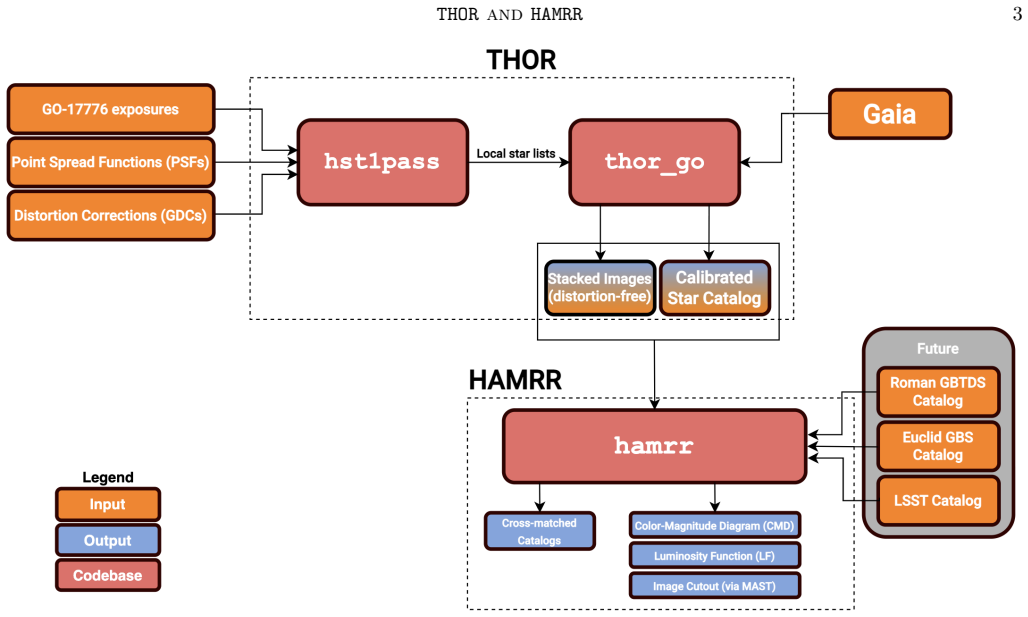
THOR reduces HST WFC3 and ACS data from GO-17776 into a calibrated catalog for Roman Galactic Bulge studies.
A machine-rendered reading of the paper's core claim, the machinery that carries it, and where it could break.
Core claim
We present the Terry Hubble Observations of Roman (THOR) data reduction pipeline and Hubble Advanced Mining Routine for Roman (HAMRR). THOR reduces HST WFC3 and ACS imaging data taken as part of program GO-17776. The primary function of HAMRR is to query the THOR-derived catalog via a typical cone search algorithm, yielding calibrated photometry and astrometry for detected point sources. The package also supports cutout images, auto-generated color-magnitude diagrams, luminosity functions, and similar products. The HAMRR tool can be used in coordination with analyses of Roman, Rubin/LSST, and Euclid Galactic Bulge targets.
What carries the argument
THOR pipeline for reducing HST WFC3 and ACS images combined with HAMRR cone-search query tool on the resulting catalog.
If this is right
- Supplies calibrated point-source photometry and astrometry ready for Roman Galactic Bulge time-domain work.
- Generates supporting products including cutout images, color-magnitude diagrams, and luminosity functions on demand.
- Allows the same catalog to feed analyses across Roman, Rubin/LSST, and Euclid bulge fields.
- Provides a single query interface that returns both measurements and auxiliary images for target selection.
Where Pith is reading between the lines
- Cross-matching the THOR catalog against early Roman imaging could directly test whether the HST astrometric zero-point holds at the sub-milliarcsecond level.
- The luminosity functions produced by HAMRR could serve as priors for source detection thresholds in crowded Roman fields.
- If the same fields are observed by multiple facilities, discrepancies between THOR-derived colors and Roman photometry would flag filter-dependent calibration offsets.
Load-bearing premise
THOR produces photometry and astrometry accurate enough for direct use alongside Roman, LSST, and Euclid measurements.
What would settle it
An independent reduction of the GO-17776 HST frames that returns positions or magnitudes differing from the THOR catalog by amounts larger than the stated uncertainties.
Figures
read the original abstract
We present the Terry Hubble Observations of Roman (THOR) data reduction pipeline and Hubble Advanced Mining Routine for Roman (HAMRR). THOR is designed to reduce HST Wide-field Camera 3 (WFC3) and Advanced Camera for Surveys (ACS) imaging data taken as part of program GO-17776: A Precursor Survey of the Roman Galactic Bulge Time Domain Fields (Terry et al, 2024). The primary function of HAMRR is to query the THOR-derived catalog via a typical cone search algorithm. Output products from HAMRR include calibrated photometry and astrometry for detected point sources in the HST catalog. The package supports additional output products such as cutout images, auto-generated color-magnitude diagrams, luminosity functions, and more. The HAMRR tool can be used in coordination with analyses of Roman, Rubin/LSST, and Euclid Galactic Bulge targets in the near future.
Editorial analysis
A structured set of objections, weighed in public.
Referee Report
Summary. The manuscript presents the THOR data reduction pipeline for HST WFC3 and ACS imaging from program GO-17776 and the HAMRR query tool, which performs cone searches on the THOR catalog to return calibrated photometry and astrometry for point sources along with optional products such as cutout images, color-magnitude diagrams, and luminosity functions. The tools are positioned for future coordination with Roman, Rubin/LSST, and Euclid Galactic Bulge analyses.
Significance. If the pipelines deliver the claimed calibrated outputs with documented accuracy and reproducibility, the work would supply a practical bridge between existing HST precursor observations and upcoming wide-field time-domain surveys, potentially aiding cross-survey source matching and analysis in the Galactic Bulge fields.
major comments (2)
- [Abstract] Abstract: the central claim that HAMRR outputs 'calibrated photometry and astrometry' for detected point sources is unsupported by any description of the reduction steps in THOR, the calibration procedures, error budgets, or validation against external standards or existing pipelines. This directly undermines evaluation of the packages' intended function for downstream Roman/LSST/Euclid use.
- [Abstract] Abstract, paragraph 1: no quantitative performance metrics, comparison to other HST reduction tools (e.g., DOLPHOT or DAOPHOT), or test results on the GO-17776 data are supplied, leaving the assumption that the catalog is 'sufficiently calibrated' untestable.
Simulated Author's Rebuttal
We thank the referee for the review and the opportunity to clarify the scope and content of our manuscript on the THOR pipeline and HAMRR tool. We respond to each major comment below.
read point-by-point responses
-
Referee: [Abstract] Abstract: the central claim that HAMRR outputs 'calibrated photometry and astrometry' for detected point sources is unsupported by any description of the reduction steps in THOR, the calibration procedures, error budgets, or validation against external standards or existing pipelines. This directly undermines evaluation of the packages' intended function for downstream Roman/LSST/Euclid use.
Authors: The manuscript body contains dedicated sections describing the THOR reduction steps for the GO-17776 HST WFC3 and ACS data, including the calibration procedures applied to produce the catalog queried by HAMRR. We agree, however, that the abstract is too brief to convey this support. We will revise the abstract to include a concise reference to the calibration framework and direct readers to the methods sections for error budgets and any validation performed. revision: yes
-
Referee: [Abstract] Abstract, paragraph 1: no quantitative performance metrics, comparison to other HST reduction tools (e.g., DOLPHOT or DAOPHOT), or test results on the GO-17776 data are supplied, leaving the assumption that the catalog is 'sufficiently calibrated' untestable.
Authors: The manuscript is structured as a description of the THOR pipeline implementation and the HAMRR query interface rather than a comparative validation study. Basic test results on the GO-17776 fields are presented in the results section, but we acknowledge that explicit quantitative metrics and side-by-side comparisons with DOLPHOT or DAOPHOT are not included. We will add a short subsection summarizing available performance indicators from our processing of the survey data; a full external comparison lies beyond the current scope but can be noted as future work. revision: partial
Circularity Check
No significant circularity; software description paper with no derivation chain
full rationale
The manuscript is a software and data-release note describing the THOR reduction pipeline for HST GO-17776 imaging and the HAMRR query tool. No equations, fitted parameters, scaling relations, or quantitative predictions appear in the provided text. The central claim is simply that the software exists and produces calibrated photometry/astrometry; this claim does not reduce to any self-referential definition, fitted input, or self-citation chain. The single citation to Terry et al. (2024) merely identifies the observing program and carries no load-bearing role in any derivation. The work is therefore self-contained against external benchmarks with no circular steps.
Axiom & Free-Parameter Ledger
Reference graph
Works this paper leans on
-
[1]
2022, Instrument Science Report WFC3, 5, 55
Anderson, J. 2022, Instrument Science Report WFC3, 5, 55
2022
-
[2]
Anderson, J., & King, I. R. 2006, Instrument Science Report ACS 2006-01, 1 Astropy Collaboration, Price-Whelan, A. M., Sip˝ ocz, B. M., et al. 2018, AJ, 156, 123, doi: 10.3847/1538-3881/aabc4f Astropy Collaboration, Price-Whelan, A. M., Lim, P. L., et al. 2022, ApJ, 935, 167, doi: 10.3847/1538-4357/ac7c74
-
[3]
Baldwin, A. T., Watkins, L. L., van der Marel, R. P., et al. 2016, ApJ, 827, 12, doi: 10.3847/0004-637X/827/1/12
-
[4]
J., Schultheis, M., Di Matteo, P., et al
Bernard, E. J., Schultheis, M., Di Matteo, P., et al. 2018, MNRAS, 477, 3507
2018
-
[5]
The Astrophysical Journal , archivePrefix = "arXiv", eprint =
Calamida, A., Sahu, K. C., Anderson, J., et al. 2014, ApJ, 790, 164, doi: 10.1088/0004-637X/790/2/164
-
[6]
2008, ApJ, 684, 1110, doi: 10.1086/590378
Clarkson, W., Sahu, K., Anderson, J., et al. 2008, ApJ, 684, 1110, doi: 10.1086/590378
-
[7]
Harris, C. R., Millman, K. J., van der Walt, S. J., et al. 2020, Nature, 585, 357, doi: 10.1038/s41586-020-2649-2
-
[8]
Hunter, J. D. 2007, Computing in science & engineering, 9, 90 Koz lowski, S., Wo´ zniak, P. R., Mao, S., et al. 2006, MNRAS, 370, 435, doi: 10.1111/j.1365-2966.2006.10487.x
-
[9]
T., Gaudi, B
Penny, M. T., Gaudi, B. S., Kerins, E., et al. 2019, ApJS, 241, 3
2019
-
[10]
2024, HST Proposal, 17776
Terry, S., Abrams, N., Anderson, J., et al. 2024, HST Proposal, 17776
2024
-
[11]
K., Anderson, J., Beichman, C
Terry, S. K., Anderson, J., Beichman, C. A., et al. 2026, ApJL, 1003, L1
2026
-
[12]
G., Prusti, T., et al
Vallenari, A., Brown, A. G., Prusti, T., et al. 2023, A&A, 674, A1
2023
discussion (0)
Sign in with ORCID, Apple, or X to comment. Anyone can read and Pith papers without signing in.