Compact Core, Extended Reach: A Bipolar kpc-Scale Elongation in a Little Red Dot at z approx 5.5
Pith reviewed 2026-06-26 23:46 UTC · model grok-4.3
The pith
A little red dot at redshift 5.5 hosts a thin bipolar elongation several kiloparsecs long, aligned with Lyα features and modeled as a low-column-density channel from the central engine.
A machine-rendered reading of the paper's core claim, the machinery that carries it, and where it could break.
Core claim
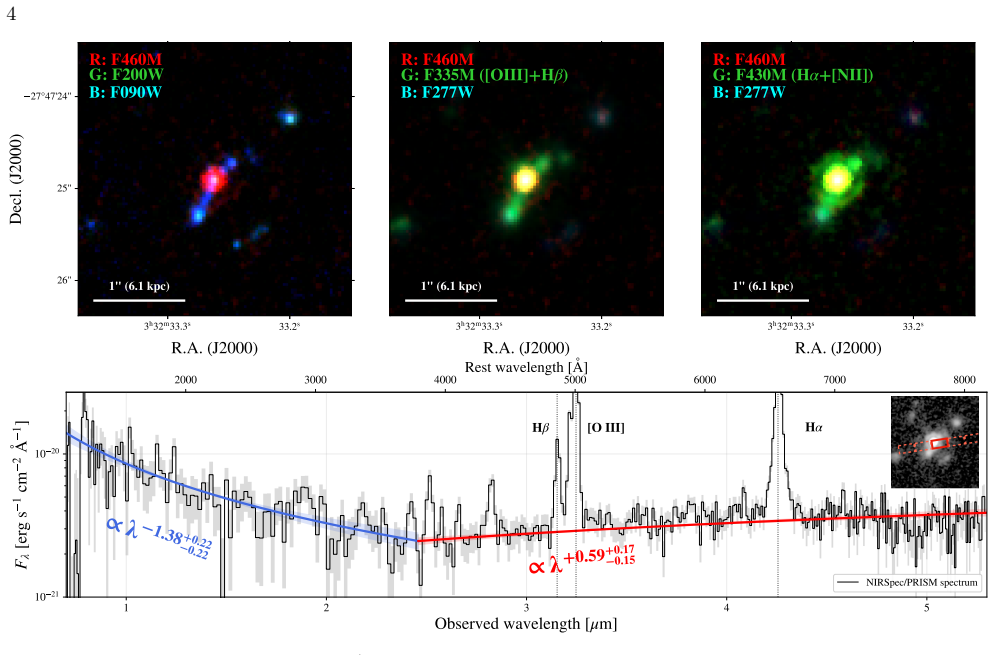
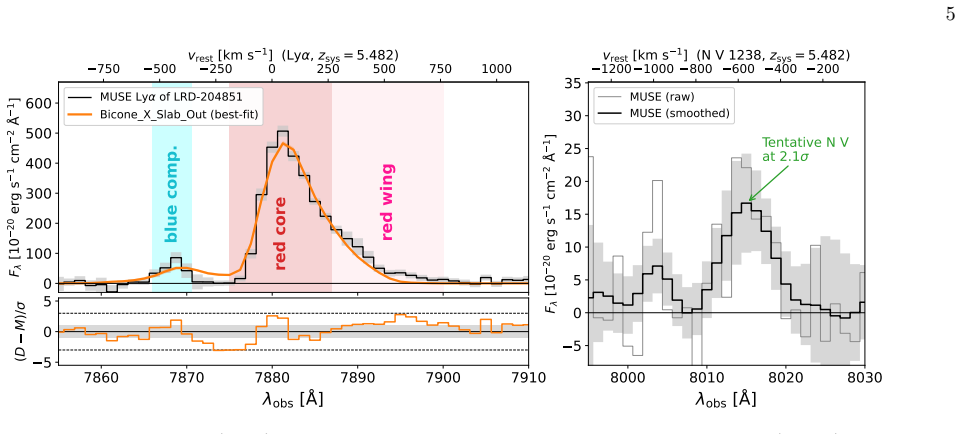
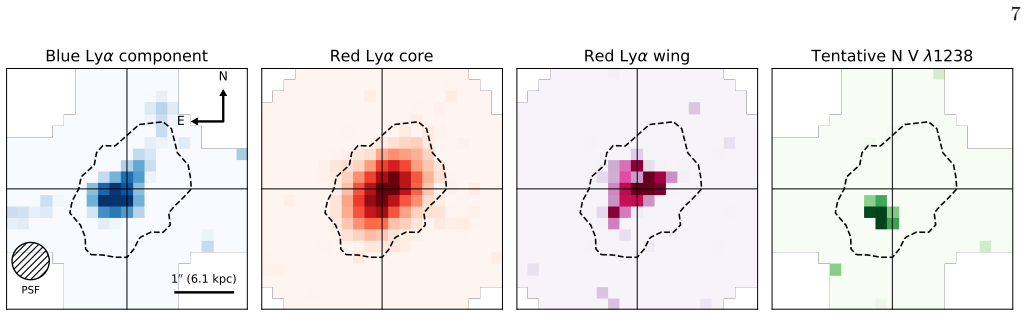
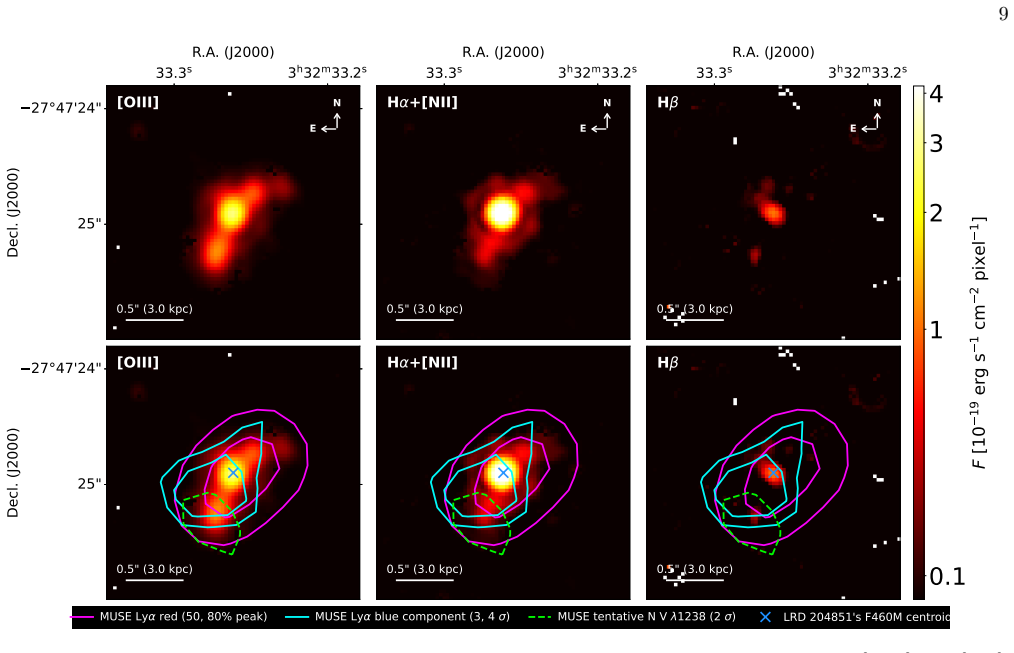
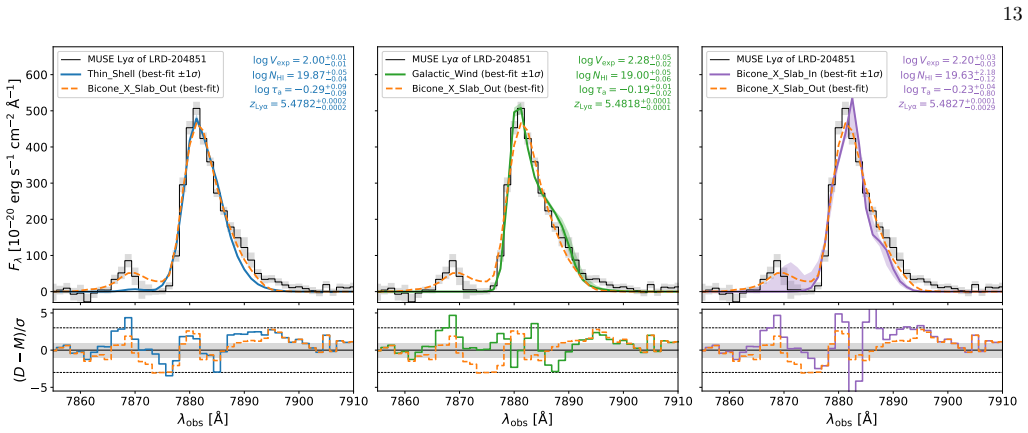
LRD-204851 hosts a remarkably thin, bipolar, elongated structure passing through the optical continuum centroid and extending several kpc on either side, traced by both the UV continuum and the rest-frame optical emission lines, with a bright [O III] clump-like structure ~2 kpc to the south-east. The MUSE observations reveal a double-peaked Lyα profile, with a broad and bright near-systemic red peak and a relatively faint peak blueshifted by ~430 km s^{-1}, accompanied by a tentative N V λ1238 detection at similar velocity. Both the blue Lyα peak and the tentative N V emission lean toward this same south-eastern direction. Independently, radiative-transfer modeling of the integrated Lyα prof
What carries the argument
The biconical low-column-density cavity in a dense, slowly expanding neutral envelope, which channels radiation and gas flow from the central engine to produce the observed bipolar elongation on kpc scales.
If this is right
- The central engine directly influences the host galaxy on kpc scales through a narrow opening angle channel.
- The elongated emission traces either a slow outflow or a quasi-static ionization cone.
- Little red dots can reveal more complex internal structures when observed at sub-kpc resolution in both UV and optical lines.
- This geometry may be observable in other little red dots where extended UV morphology is already detected.
Where Pith is reading between the lines
- If narrow channels like this are common, they could allow central activity to affect gas reservoirs without fully disrupting the compact appearance at optical wavelengths.
- The structure offers a test case for whether early black hole activity shapes galaxy morphology before widespread star formation dominates.
- Follow-up observations at different wavelengths could distinguish between outflow and ionization-cone scenarios by mapping temperature or density gradients along the axis.
Load-bearing premise
The radiative-transfer modeling of the integrated Lyα profile accurately captures the geometry as a biconical low-column-density cavity connected to the central engine, and the spatial alignment of the blue peak and N V with the elongation confirms this link rather than unrelated structures.
What would settle it
Independent higher-resolution integral-field spectroscopy that shows the velocity field along the elongation does not match the slow expansion or the expected biconical flow pattern from the Lyα modeling.
Figures
read the original abstract
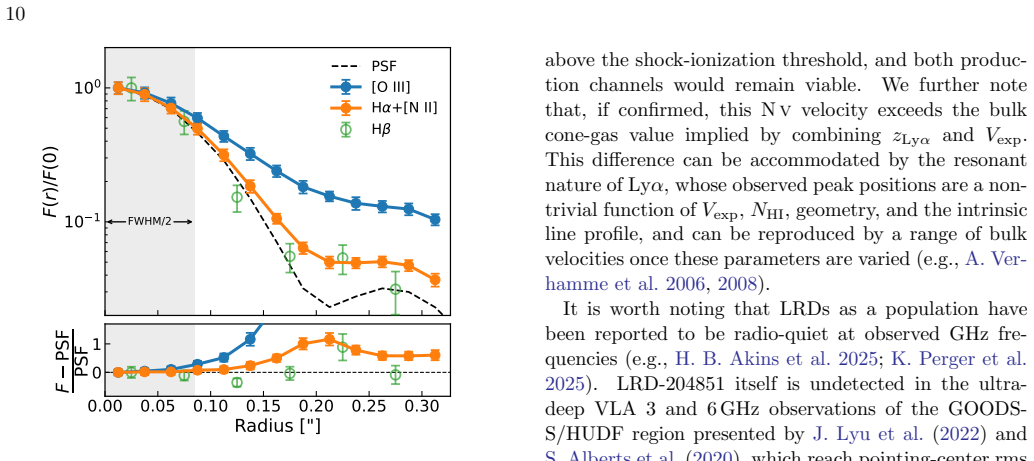
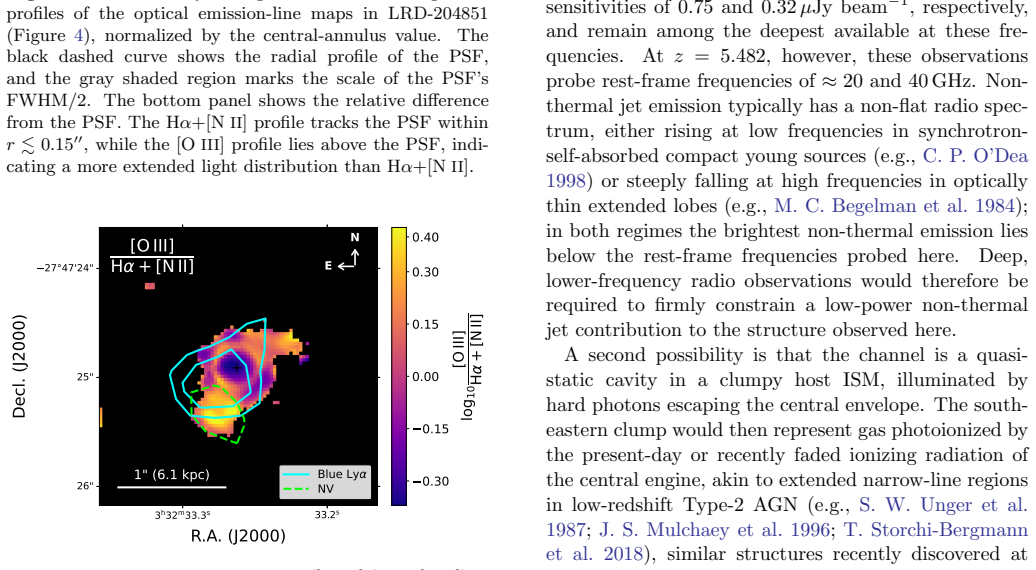
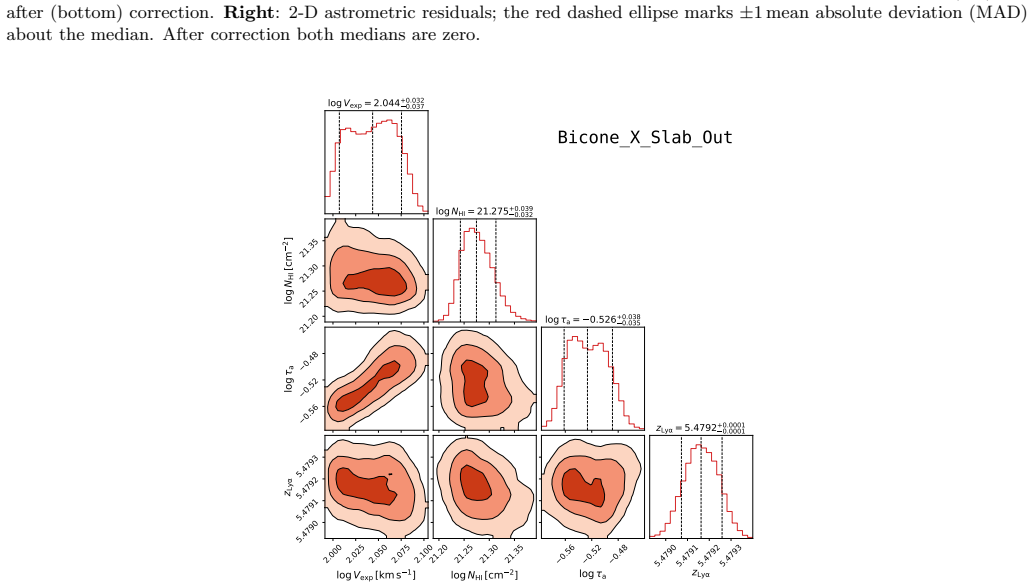
Little Red Dots (LRDs) appear extremely compact at rest-frame optical wavelengths, yet many show extended rest-frame UV morphology revealing more complex internal structure. We present a combined analysis of VLT/MUSE rest-frame UV integral-field spectroscopy and continuum-subtracted [O III], H$\beta$, and H$\alpha$+[N II] emission-line maps from JWST/NIRCam imaging at sub-kpc resolution for LRD-204851 at $z=5.482$ in GOODS-S. We find that LRD-204851 hosts a remarkably thin, bipolar, elongated structure passing through the optical continuum centroid and extending several kpc on either side, traced by both the UV continuum and the rest-frame optical emission lines, with a bright [O III] clump-like structure $\sim$2 kpc to the south-east of the centroid. The MUSE observations reveal a double-peaked Ly$\alpha$ profile, with a broad and bright near-systemic red peak and a relatively faint peak blueshifted by $\sim$430 km s$^{-1}$, accompanied by a tentative N V $\lambda 1238$ detection at similar velocity. In narrow-band imaging extracted from the MUSE IFU cube, both the blue Ly$\alpha$ peak and the tentative N V emission lean toward this same south-eastern direction. Independently, radiative-transfer modeling of the integrated Ly$\alpha$ profile favors a biconical low-column-density cavity in a dense, slowly expanding neutral envelope, in support of the bipolar geometry traced by the line maps. Together, these results suggest that the elongated emission of LRD-204851 is connected to radiation and/or gas flow from its central engine through a low-column-density channel with a small opening angle that may trace either a slow outflow or a quasi-static ionization cone. LRD-204851 is one of the first LRDs where the central engine's impact on its host galaxy is potentially directly observable on kpc scales.
Editorial analysis
A structured set of objections, weighed in public.
Referee Report
Summary. The paper presents VLT/MUSE IFU spectroscopy and JWST/NIRCam imaging of LRD-204851 at z=5.482, reporting a thin bipolar kpc-scale elongation traced by UV continuum and rest-frame optical lines ([O III], Hβ, Hα), a double-peaked Lyα profile (systemic red peak plus blue peak at −430 km s⁻¹) with tentative NV at similar velocity, and radiative-transfer modeling of the integrated Lyα that favors a biconical low-column-density cavity in a dense slowly expanding envelope. The authors interpret the spatial alignment of the blue Lyα and NV with the south-eastern elongation as evidence that the structure traces a low-column channel from the central engine, possibly a slow outflow or ionization cone.
Significance. If the geometric interpretation holds, this would be one of the first LRDs in which the central engine's influence on the host is directly observable on kpc scales, providing a concrete example of feedback or ionization structure in a high-redshift compact object. The multi-wavelength dataset (MUSE IFU + NIRCam line maps) and the attempt to connect integrated spectroscopy to spatially resolved morphology are strengths; the work adds to the emerging picture of complex internal structure in LRDs beyond their compact optical appearance.
major comments (2)
- [radiative-transfer modeling] Radiative-transfer modeling section: the statement that the modeling 'favors' a biconical low-column-density cavity is presented without quantitative comparison (χ², Bayes factor, or posterior odds) to standard alternative mechanisms that also produce double-peaked Lyα (expanding spherical shell, static slab with velocity gradient, or resonant scattering in a clumpy medium). This comparison is required to establish that the biconical geometry is necessary rather than merely possible, and is load-bearing for the claim that the kpc-scale elongation traces a channel connected to the central engine.
- [MUSE narrow-band imaging and alignment analysis] Results on spatial alignment: the claim that the blue Lyα peak and tentative NV 'lean toward' the south-eastern elongation is used to confirm physical connection, yet no quantitative measure of the alignment significance, position angle uncertainty, or chance probability is provided. Without this, the link between the integrated profile modeling and the observed bipolar morphology remains qualitative.
minor comments (2)
- [methods and results] The manuscript would benefit from explicit error analysis on the Lyα velocity shift and on the spatial offset of the blue peak, including how these uncertainties propagate into the geometric interpretation.
- [figure captions] Figure captions and text should clarify the exact extraction aperture and continuum-subtraction procedure used for the [O III] and Hα maps to allow reproducibility.
Simulated Author's Rebuttal
We thank the referee for their constructive comments and for recognizing the potential significance of the multi-wavelength dataset on LRD-204851. We address each major comment below and indicate the revisions planned for the manuscript.
read point-by-point responses
-
Referee: Radiative-transfer modeling section: the statement that the modeling 'favors' a biconical low-column-density cavity is presented without quantitative comparison (χ², Bayes factor, or posterior odds) to standard alternative mechanisms that also produce double-peaked Lyα (expanding spherical shell, static slab with velocity gradient, or resonant scattering in a clumpy medium). This comparison is required to establish that the biconical geometry is necessary rather than merely possible, and is load-bearing for the claim that the kpc-scale elongation traces a channel connected to the central engine.
Authors: We agree that the current text presents the biconical model as favored without the requested quantitative comparisons to alternatives. The model choice was guided by the observed bipolar morphology, but the integrated Lyα profile alone does not uniquely require it. In the revised manuscript we will add χ² comparisons to at least one alternative (expanding spherical shell) and discuss the limitations of the modeling or include Bayes-factor estimates where feasible. revision: yes
-
Referee: Results on spatial alignment: the claim that the blue Lyα peak and tentative NV 'lean toward' the south-eastern elongation is used to confirm physical connection, yet no quantitative measure of the alignment significance, position angle uncertainty, or chance probability is provided. Without this, the link between the integrated profile modeling and the observed bipolar morphology remains qualitative.
Authors: The alignment is currently described qualitatively. We will revise the results section to include quantitative measures: position-angle values with uncertainties extracted from the MUSE narrow-band images, and an estimate of chance-alignment probability based on the source extent and noise properties. revision: yes
Circularity Check
No circularity in observational analysis
full rationale
The paper presents an observational study using MUSE IFU spectroscopy and JWST/NIRCam imaging of LRD-204851. Claims about bipolar elongation and its connection to the central engine are based on direct spatial alignments in line maps, double-peaked Lyα profiles, and independent radiative-transfer modeling of the integrated profile. No equations, derivations, fitted parameters renamed as predictions, or self-citation load-bearing steps appear in the text. The analysis is self-contained against external data and modeling benchmarks, with no reductions by construction.
Axiom & Free-Parameter Ledger
free parameters (1)
- Lyα velocity shift
axioms (1)
- domain assumption Radiative-transfer models of Lyα accurately distinguish biconical cavity geometry from other configurations
Reference graph
Works this paper leans on
-
[1]
Akins, H. B., Casey, C. M., Lambrides, E., et al. 2025, ApJ, 991, 37, doi: 10.3847/1538-4357/ade984
-
[2]
H., Jagannathan, P., & Nyland, K
Alberts, S., Rujopakarn, W., Rieke, G. H., Jagannathan, P., & Nyland, K. 2020, ApJ, 901, 168, doi: 10.3847/1538-4357/abb1a0
-
[3]
Allen, M. G., Groves, B. A., Dopita, M. A., Sutherland, R. S., & Kewley, L. J. 2008, ApJS, 178, 20, doi: 10.1086/589652
-
[4]
2017, A&A, 608, A1, doi: 10.1051/0004-6361/201730833
Bacon, R., Conseil, S., Mary, D., et al. 2017, A&A, 608, A1, doi: 10.1051/0004-6361/201730833
-
[5]
2023, A&A, 670, A4, doi: 10.1051/0004-6361/202244187
Bacon, R., Brinchmann, J., Conseil, S., et al. 2023, A&A, 670, A4, doi: 10.1051/0004-6361/202244187
-
[6]
Baldwin, J. A., Phillips, M. M., & Terlevich, R. 1981, PASP, 93, 5, doi: 10.1086/130766
-
[7]
Barro, G., P´ erez-Gonz´ alez, P. G., Kocevski, D. D., et al. 2024, ApJ, 963, 128, doi: 10.3847/1538-4357/ad167e
-
[8]
Becker, G. D., & Bolton, J. S. 2013, MNRAS, 436, 1023, doi: 10.1093/mnras/stt1610
-
[9]
Beckwith, S. V. W., Stiavelli, M., Koekemoer, A. M., et al. 2006, AJ, 132, 1729, doi: 10.1086/507302
-
[10]
Begelman, M. C., Blandford, R. D., & Rees, M. J. 1984, Reviews of Modern Physics, 56, 255, doi: 10.1103/RevModPhys.56.255
-
[11]
Bosman, S. E. I., Davies, F. B., Becker, G. D., et al. 2022, MNRAS, 514, 55, doi: 10.1093/mnras/stac1046
-
[12]
2016, A&A, 596, A63, doi: 10.1051/0004-6361/201629080
Boucaud, A., Bocchio, M., Abergel, A., et al. 2016, A&A, 596, A63, doi: 10.1051/0004-6361/201629080
-
[13]
Carilli, C. L., & Barthel, P. D. 1996, A&A Rv, 7, 1, doi: 10.1007/s001590050001
-
[14]
2023, A&A, 672, A128, doi: 10.1051/0004-6361/202346001 14 de Graaff, A., Hviding, R
Cresci, G., Tozzi, G., Perna, M., et al. 2023, A&A, 672, A128, doi: 10.1051/0004-6361/202346001 14 de Graaff, A., Hviding, R. E., Naidu, R. P., et al. 2025a, arXiv e-prints, arXiv:2511.21820, doi: 10.48550/arXiv.2511.21820 de Graaff, A., Rix, H.-W., Naidu, R. P., et al. 2025b, A&A, 701, A168, doi: 10.1051/0004-6361/202554681
-
[15]
2006, ApJ, 649, 14, doi: 10.1086/506243
Dijkstra, M., Haiman, Z., & Spaans, M. 2006, ApJ, 649, 14, doi: 10.1086/506243
-
[16]
Dopita, M. A., & Sutherland, R. S. 1996, ApJS, 102, 161, doi: 10.1086/192255
-
[17]
Eisenstein, D. J., Johnson, B. D., Robertson, B., et al. 2025, ApJS, 281, 50, doi: 10.3847/1538-4365/ae1137
-
[18]
J., Willott, C., Alberts, S., et al
Eisenstein, D. J., Willott, C., Alberts, S., et al. 2026, ApJS, 283, 6, doi: 10.3847/1538-4365/ae3163
-
[19]
Erb, D. K., Li, Z., Steidel, C. C., et al. 2023, ApJ, 953, 118, doi: 10.3847/1538-4357/acd849
-
[20]
J., Labb´ e, I., Zitrin, A., et al
Furtak, L. J., Labb´ e, I., Zitrin, A., et al. 2024, Nature, 628, 57, doi: 10.1038/s41586-024-07184-8 Gaia Collaboration, Brown, A. G. A., Vallenari, A., et al. 2021, A&A, 649, A1, doi: 10.1051/0004-6361/202039657
-
[21]
Giavalisco, M., Ferguson, H. C., Koekemoer, A. M., et al. 2004, ApJL, 600, L93, doi: 10.1086/379232
work page internal anchor Pith review doi:10.1086/379232 2004
-
[22]
doi:10.3847/1538-4357/ad1e5f , archiveprefix =
Greene, J. E., Labbe, I., Goulding, A. D., et al. 2024, ApJ, 964, 39, doi: 10.3847/1538-4357/ad1e5f
-
[23]
2016, ApJ, 826, 14, doi: 10.3847/0004-637X/826/1/14
Gronke, M., & Dijkstra, M. 2016, ApJ, 826, 14, doi: 10.3847/0004-637X/826/1/14
-
[24]
Gronke, M., Dijkstra, M., McCourt, M., & Oh, S. P. 2017, A&A, 607, A71, doi: 10.1051/0004-6361/201731013 Gurung-L´ opez, S., Gronke, M., Saito, S., Bonoli, S., & Orsi, ´A. A. 2022, MNRAS, 510, 4525, doi: 10.1093/mnras/stab3554 Gurung-L´ opez, S., Orsi,´A. A., & Bonoli, S. 2019, MNRAS, 490, 733, doi: 10.1093/mnras/stz2591
-
[25]
Hainline, K. N., Shapley, A. E., Greene, J. E., & Steidel, C. C. 2011, ApJ, 733, 31, doi: 10.1088/0004-637X/733/1/31
-
[26]
1999, ARA&A, 37, 487, doi: 10.1146/annurev.astro.37.1.487
Hamann, F., & Ferland, G. 1999, ARA&A, 37, 487, doi: 10.1146/annurev.astro.37.1.487
-
[27]
Hansen, M., & Oh, S. P. 2006, MNRAS, 367, 979, doi: 10.1111/j.1365-2966.2005.09870.x
-
[28]
Hu, E. M., Cowie, L. L., Songaila, A., et al. 2016, ApJL, 825, L7, doi: 10.3847/2041-8205/825/1/L7
-
[29]
2025, ApJL, 980, L27, doi: 10.3847/2041-8213/adaebd
Inayoshi, K., & Maiolino, R. 2025, ApJL, 980, L27, doi: 10.3847/2041-8213/adaebd
-
[30]
K., Shimizu, I., Iwata, I., & Tanaka, M
Inoue, A. K., Shimizu, I., Iwata, I., & Tanaka, M. 2014, MNRAS, 442, 1805, doi: 10.1093/mnras/stu936
-
[31]
2025, MNRAS, 544, 3900, doi: 10.1093/mnras/staf1867
Ji, X., Maiolino, R., ¨Ubler, H., et al. 2025, MNRAS, 544, 3900, doi: 10.1093/mnras/staf1867
-
[32]
Through the Veil: Ly$\alpha$ Illuminates the Host Galaxies of Little Red Dots
Ji, Z., Sun, Y., Giavalisco, M., et al. 2026, arXiv e-prints, arXiv:2606.09970, doi: 10.48550/arXiv.2606.09970
work page internal anchor Pith review Pith/arXiv arXiv doi:10.48550/arxiv.2606.09970 2026
-
[33]
Ji, Z., Williams, C. C., Tacchella, S., et al. 2024, ApJ, 974, 135, doi: 10.3847/1538-4357/ad6e7f
-
[34]
2025, ApJL, 988, L69, doi: 10.3847/2041-8213/adf194
Ji, Z., Alberts, S., Zhu, Y., et al. 2025, ApJL, 988, L69, doi: 10.3847/2041-8213/adf194
-
[35]
Johnson, B. D., Robertson, B. E., Eisenstein, D. J., et al. 2026, arXiv e-prints, arXiv:2601.15954, doi: 10.48550/arXiv.2601.15954 Juodˇ zbalis, I., Ji, X., Maiolino, R., et al. 2024, MNRAS, 535, 853, doi: 10.1093/mnras/stae2367 Juodˇ zbalis, I., Maiolino, R., Baker, W. M., et al. 2026, MNRAS, 546, stag086, doi: 10.1093/mnras/stag086
-
[36]
Kass, R. E., & Raftery, A. E. 1995, Journal of the American Statistical Association, 90, 773, doi: 10.2307/2291091
-
[37]
Kewley, L. J., Nicholls, D. C., & Sutherland, R. S. 2019, ARA&A, 57, 511, doi: 10.1146/annurev-astro-081817-051832
-
[38]
2024, A&A, 691, A52, doi: 10.1051/0004-6361/202348857
Killi, M., Watson, D., Brammer, G., et al. 2024, A&A, 691, A52, doi: 10.1051/0004-6361/202348857
-
[39]
Kocevski, D. D., Finkelstein, S. L., Barro, G., et al. 2025, ApJ, 986, 126, doi: 10.3847/1538-4357/adbc7d
-
[40]
2023, ApJL, 957, L7, doi: 10.3847/2041-8213/ad037a Labb´ e, I., van Dokkum, P., Nelson, E., et al
Kokorev, V., Fujimoto, S., Labbe, I., et al. 2023, ApJL, 957, L7, doi: 10.3847/2041-8213/ad037a Labb´ e, I., van Dokkum, P., Nelson, E., et al. 2023, Nature, 616, 266, doi: 10.1038/s41586-023-05786-2
-
[41]
Laursen, P., Sommer-Larsen, J., & Razoumov, A. O. 2011, ApJ, 728, 52, doi: 10.1088/0004-637X/728/1/52
-
[42]
2022, MNRAS, 513, 5034, doi: 10.1093/mnras/stac1207
Li, Z., & Gronke, M. 2022, MNRAS, 513, 5034, doi: 10.1093/mnras/stac1207
-
[43]
Lintott, C. J., Schawinski, K., Keel, W., et al. 2009, MNRAS, 399, 129, doi: 10.1111/j.1365-2966.2009.15299.x
-
[44]
Liu, H., Jiang, Y.-F., Quataert, E., Greene, J. E., & Ma, Y. 2025, ApJ, 994, 113, doi: 10.3847/1538-4357/ae0c19
-
[45]
Lyu, J., Alberts, S., Rieke, G. H., & Rujopakarn, W. 2022, ApJ, 941, 191, doi: 10.3847/1538-4357/ac9e5d
-
[46]
Lyu, J., Rieke, G. H., Stone, M., et al. 2025, ApJL, 981, L20, doi: 10.3847/2041-8213/adb613
-
[47]
1995, ApJ, 441, 18, doi: 10.1086/175332
Madau, P. 1995, ApJ, 441, 18, doi: 10.1086/175332
-
[48]
Maiolino, R., Scholtz, J., Curtis-Lake, E., et al. 2024, A&A, 691, A145, doi: 10.1051/0004-6361/202347640
-
[49]
2018, A&A, 619, A136, doi: 10.1051/0004-6361/201833528
Matthee, J., Sobral, D., Gronke, M., et al. 2018, A&A, 619, A136, doi: 10.1051/0004-6361/201833528
-
[50]
Matthee, J., Naidu, R. P., Brammer, G., et al. 2024, ApJ, 963, 129, doi: 10.3847/1538-4357/ad2345
-
[51]
2026, arXiv e-prints, arXiv:2603.17667, doi: 10.48550/arXiv.2603.17667
Matthee, J., Torralba, A., Pezzulli, G., et al. 2026, arXiv e-prints, arXiv:2603.17667, doi: 10.48550/arXiv.2603.17667
-
[52]
McCarthy, P. J. 1993, ARA&A, 31, 639, doi: 10.1146/annurev.aa.31.090193.003231
-
[53]
Morton, D. C. 2003, ApJS, 149, 205, doi: 10.1086/377639 15
-
[54]
Mulchaey, J. S., Wilson, A. S., & Tsvetanov, Z. 1996, ApJ, 467, 197, doi: 10.1086/177595
-
[55]
Muzzin, A., Suess, K. A., Marchesini, D., et al. 2025, arXiv e-prints, arXiv:2507.19706, doi: 10.48550/arXiv.2507.19706
-
[56]
A "Black Hole Star" Reveals the Remarkable Gas-Enshrouded Hearts of the Little Red Dots
Naidu, R. P., Matthee, J., Katz, H., et al. 2025, arXiv e-prints, arXiv:2503.16596, doi: 10.48550/arXiv.2503.16596 O’Dea, C. P. 1998, PASP, 110, 493, doi: 10.1086/316162
work page internal anchor Pith review Pith/arXiv arXiv doi:10.48550/arxiv.2503.16596 2025
-
[57]
Oesch, P. A., Brammer, G., Naidu, R. P., et al. 2023, MNRAS, 525, 2864, doi: 10.1093/mnras/stad2411
-
[58]
Orsi, A., Lacey, C. G., & Baugh, C. M. 2012, MNRAS, 425, 87, doi: 10.1111/j.1365-2966.2012.21396.x
-
[59]
2024, ApJ, 976, 96, doi: 10.3847/1538-4357/ad84f7
Pacucci, F., & Narayan, R. 2024, ApJ, 976, 96, doi: 10.3847/1538-4357/ad84f7
-
[60]
Park, H., Smith, A., Jung, I., et al. 2026, arXiv e-prints, arXiv:2604.26331, doi: 10.48550/arXiv.2604.26331
work page internal anchor Pith review Pith/arXiv arXiv doi:10.48550/arxiv.2604.26331 2026
-
[61]
2007, PASP, 119, 30, doi: 10.1086/510600 P´ erez-Gonz´ alez, P
Pascual, S., Gallego, J., & Zamorano, J. 2007, PASP, 119, 30, doi: 10.1086/510600 P´ erez-Gonz´ alez, P. G., Barro, G., Rieke, G. H., et al. 2024, ApJ, 968, 4, doi: 10.3847/1538-4357/ad38bb
-
[62]
2025, A&A, 693, L2, doi: 10.1051/0004-6361/202452422
Perger, K., Fogasy, J., Frey, S., & Gab´ anyi, K.´E. 2025, A&A, 693, L2, doi: 10.1051/0004-6361/202452422
-
[63]
D., Sivaramakrishnan, A., Lajoie, C.-P., et al
Perrin, M. D., Sivaramakrishnan, A., Lajoie, C.-P., et al. 2014, in Society of Photo-Optical Instrumentation Engineers (SPIE) Conference Series, Vol. 9143, Space Telescopes and Instrumentation 2014: Optical, Infrared, and Millimeter Wave, ed. J. M. Oschmann, Jr., M. Clampin, G. G. Fazio, & H. A. MacEwen, 91433X, doi: 10.1117/12.2056689
-
[64]
Astronomy & Astrophysics , author =
Piqueras, L., Conseil, S., Shepherd, M., et al. 2019, in Astronomical Society of the Pacific Conference Series, Vol. 521, Astronomical Data Analysis Software and Systems XXVI, ed. M. Molinaro, K. Shortridge, & F. Pasian, 545 Planck Collaboration, Aghanim, N., Akrami, Y., et al. 2020, A&A, 641, A6, doi: 10.1051/0004-6361/201833910
-
[65]
Rieke, M. J., Robertson, B., Tacchella, S., et al. 2023, ApJS, 269, 16, doi: 10.3847/1538-4365/acf44d
-
[66]
Robertson, B. E., Johnson, B. D., Tacchella, S., et al. 2026, arXiv e-prints, arXiv:2601.15956, doi: 10.48550/arXiv.2601.15956
-
[67]
Rusakov, V., Watson, D., Nikopoulos, G. P., et al. 2026, Nature, 649, 574, doi: 10.1038/s41586-025-09900-4
-
[68]
Speagle, J. S. 2020, MNRAS, 493, 3132, doi: 10.1093/mnras/staa278
-
[69]
Micchi, L. F., et al. 2018, ApJ, 868, 14, doi: 10.3847/1538-4357/aae7cd
-
[70]
Suess, K. A., Weaver, J. R., Price, S. H., et al. 2024, ApJ, 976, 101, doi: 10.3847/1538-4357/ad75fe
-
[71]
Sutherland, R. S., & Dopita, M. A. 2017, ApJS, 229, 34, doi: 10.3847/1538-4365/aa6541
-
[72]
2016, A&A Rv, 24, 10, doi: 10.1007/s00159-016-0094-x
Tadhunter, C. 2016, A&A Rv, 24, 10, doi: 10.1007/s00159-016-0094-x
-
[73]
Torralba, A., Matthee, J., Naidu, R. P., et al. 2024, A&A, 689, A44, doi: 10.1051/0004-6361/202450318
-
[74]
Treiber, H., Kocevski, D. D., Hviding, R. E., et al. 2025, ApJ, 991, 217, doi: 10.3847/1538-4357/adfd57 ¨Ubler, H., D’Eugenio, F., Perna, M., et al. 2024, MNRAS, 533, 4287, doi: 10.1093/mnras/stae1993
-
[75]
Unger, S. W., Pedlar, A., Axon, D. J., et al. 1987, MNRAS, 228, 671, doi: 10.1093/mnras/228.3.671 Vanden Berk, D. E., Richards, G. T., Bauer, A., et al. 2001, AJ, 122, 549, doi: 10.1086/321167
-
[76]
Veilleux, S., & Osterbrock, D. E. 1987, ApJS, 63, 295, doi: 10.1086/191166
-
[77]
2008, A&A, 491, 89, doi: 10.1051/0004-6361:200809648
Verhamme, A., Schaerer, D., Atek, H., & Tapken, C. 2008, A&A, 491, 89, doi: 10.1051/0004-6361:200809648
-
[78]
2006, A&A, 460, 397, doi: 10.1051/0004-6361:20065554
Verhamme, A., Schaerer, D., & Maselli, A. 2006, A&A, 460, 397, doi: 10.1051/0004-6361:20065554
-
[79]
Wang, B., de Graaff, A., Davies, R. L., et al. 2025, ApJ, 984, 121, doi: 10.3847/1538-4357/adc1ca
-
[80]
Williams, C. C., Tacchella, S., Maseda, M. V., et al. 2023, ApJS, 268, 64, doi: 10.3847/1538-4365/acf130
discussion (0)
Sign in with ORCID, Apple, or X to comment. Anyone can read and Pith papers without signing in.