CAOA -- Completion-Assisted Object-CAD Alignment
Pith reviewed 2026-06-27 01:08 UTC · model grok-4.3
The pith
Integrating point cloud completion with symmetry-aware pose estimation improves CAD model alignment to real scans by 17%.
A machine-rendered reading of the paper's core claim, the machinery that carries it, and where it could break.
Core claim
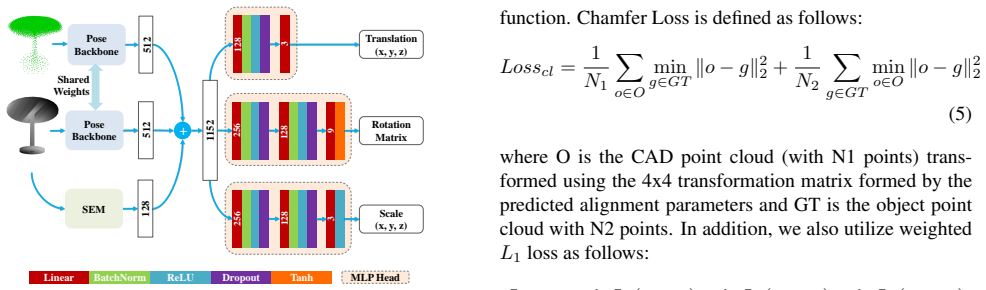
CAOA integrates a semantically and contextually aware point cloud completion module, trained on synthetic data generated to match indoor scene statistics, with a symmetry-aware relative pose estimation algorithm that incorporates symmetry information via a dedicated loss, enabling precise 9-DoF alignment of CAD models to objects in real RGB-D scans despite noise, incompleteness, and segmentation errors.
What carries the argument
The completion-assisted alignment pipeline that first completes partial scanned objects and then performs symmetry-aware relative pose estimation.
Load-bearing premise
The synthetic data generation strategy sufficiently reduces the synthetic-to-real domain gap for the completion module.
What would settle it
Running the full CAOA pipeline on Scan2CAD after removing the completion module and measuring whether the 17% accuracy gain disappears.
Figures




read the original abstract
Accurately aligning CAD models to their corresponding objects in indoor RGB-D scans is a central challenge in 3D semantic reconstruction. The task requires estimating a 9-Degree-of-Freedom (DoF) pose-position, rotation, and scale along three axes-but is hindered by noisy and incomplete scans, as well as segmentation errors that cause geometric distortions. We present Completion-Assisted Object-CAD Alignment (CAOA), a method that integrates a semantically and contextually aware point cloud completion module with a symmetry-aware relative pose estimation algorithm, enabling precise alignment of CAD models to scanned objects. Existing completion methods are typically trained and evaluated on synthetic datasets, which often fail to generalize to real-world scans. To bridge this gap, we introduce a synthetic data generation strategy tailored to indoor scenes, significantly reducing the synthetic-to-real domain gap-validated through quantitative comparisons with widely used completion datasets. In addition, we release S2C-Completion, an expert-annotated dataset of over 8,500 object-CAD pairs from Scan2CAD, created for real-world indoor single-object completion and intended as a new benchmark for this task. For object-CAD alignment, we incorporate symmetry information via a symmetry-aware loss, improving robustness to symmetric ambiguities. On the Scan2CAD benchmark, CAOA achieves a 17% accuracy improvement over state-of-the-art methods.
Editorial analysis
A structured set of objections, weighed in public.
Referee Report
Summary. The paper introduces Completion-Assisted Object-CAD Alignment (CAOA), which combines a point cloud completion network trained via a new indoor-scene synthetic data generation pipeline with a symmetry-aware 9-DoF pose estimator. It releases the expert-annotated S2C-Completion dataset (>8500 real Scan2CAD object-CAD pairs) and reports a 17% accuracy gain over prior art on the Scan2CAD benchmark, attributing the gain to reduced synthetic-to-real domain gap in completion.
Significance. If the completion module demonstrably improves real-scan completion quality and that improvement drives the alignment gain, the work would provide a practical advance for 3D indoor reconstruction pipelines and a useful new benchmark dataset. The symmetry-aware loss is a standard but useful addition.
major comments (2)
- [Abstract] Abstract: the headline claim that the synthetic data strategy 'significantly reduc[es] the synthetic-to-real domain gap' and thereby produces the 17% Scan2CAD lift rests on 'quantitative comparisons with widely used completion datasets.' No completion metrics (e.g., Chamfer distance, F-score) or ablation tables are referenced on the real S2C-Completion objects or on Scan2CAD scans themselves; without these, the performance attribution cannot be verified and other factors (symmetry loss, pose estimator) cannot be ruled out.
- [Abstract] The central experimental claim (17% Scan2CAD improvement) is load-bearing for the paper; if the completion module does not generalize to real noisy scans, the entire pipeline contribution collapses. Direct real-world completion ablations and an ablation removing the completion module on the Scan2CAD test set are therefore required.
Simulated Author's Rebuttal
Thank you for the constructive feedback on our manuscript. We appreciate the emphasis on strengthening the experimental evidence linking the completion module to the reported alignment gains. We address each major comment below and commit to incorporating the requested analyses and metrics in the revised version.
read point-by-point responses
-
Referee: [Abstract] Abstract: the headline claim that the synthetic data strategy 'significantly reduc[es] the synthetic-to-real domain gap' and thereby produces the 17% Scan2CAD lift rests on 'quantitative comparisons with widely used completion datasets.' No completion metrics (e.g., Chamfer distance, F-score) or ablation tables are referenced on the real S2C-Completion objects or on Scan2CAD scans themselves; without these, the performance attribution cannot be verified and other factors (symmetry loss, pose estimator) cannot be ruled out.
Authors: We agree that the current validation relies on comparisons with standard (primarily synthetic) completion datasets and does not yet include direct metrics on the real S2C-Completion objects or Scan2CAD scans. To substantiate the domain-gap reduction claim and isolate contributions, the revised manuscript will add Chamfer distance and F-score results on S2C-Completion, corresponding metrics on Scan2CAD scans, and ablation tables separating the effects of the completion module, symmetry loss, and pose estimator on the 17% Scan2CAD improvement. revision: yes
-
Referee: [Abstract] The central experimental claim (17% Scan2CAD improvement) is load-bearing for the paper; if the completion module does not generalize to real noisy scans, the entire pipeline contribution collapses. Direct real-world completion ablations and an ablation removing the completion module on the Scan2CAD test set are therefore required.
Authors: We concur that explicit evidence of generalization to real noisy scans is necessary to support the pipeline's contribution. The revision will include direct real-world completion ablations with quantitative metrics on Scan2CAD scans and a dedicated ablation that removes the completion module entirely, reporting the resulting 9-DoF alignment accuracy on the Scan2CAD test set. revision: yes
Circularity Check
No circularity: empirical method with external benchmark results
full rationale
The paper presents CAOA as an empirical pipeline combining a completion module (trained on a new synthetic indoor-scene generation strategy) with symmetry-aware pose estimation, evaluated on the external Scan2CAD benchmark. No equations, derivations, fitted parameters renamed as predictions, or self-citation chains appear in the abstract or described content. The 17% accuracy gain is reported as a measured outcome on an independent benchmark rather than a quantity forced by construction from the method's own inputs. The synthetic-to-real gap reduction is claimed via quantitative comparisons on standard datasets, but this is presented as validation evidence, not a self-referential loop. The work is self-contained against external benchmarks with no load-bearing steps that reduce to tautology.
Axiom & Free-Parameter Ledger
axioms (1)
- domain assumption The completion module trained on the new synthetic indoor data generalizes to real Scan2CAD scans.
Reference graph
Works this paper leans on
-
[1]
Automatically annotating indoor images with cad models via rgb-d scans
Stefan Ainetter, Sinisa Stekovic, Friedrich Fraundorfer, and Vincent Lepetit. Automatically annotating indoor images with cad models via rgb-d scans. InProceedings of the IEEE/CVF Winter Conference on Applications of Computer Vision, pages 3156–3164, 2023. 2, 3
2023
-
[2]
Chang, and Matthias NieBner
Armen Avetisyan, Manuel Dahnert, Angela Dai, Manolis Savva, Angel X. Chang, and Matthias NieBner. Scan2CAD: Learning CAD Model Alignment in RGB-D Scans. In 2019 IEEE/CVF Conference on Computer Vision and Pat- tern Recognition (CVPR), pages 2609–2618, Long Beach, CA, USA, 2019. IEEE. 1, 2, 3, 7, 8
2019
-
[3]
End- to-End CAD Model Retrieval and 9DoF Alignment in 3D Scans
Armen Avetisyan, Angela Dai, and Matthias Niessner. End- to-End CAD Model Retrieval and 9DoF Alignment in 3D Scans. In2019 IEEE/CVF International Conference on Computer Vision (ICCV), pages 2551–2560, Seoul, Korea (South), 2019. IEEE. 1, 2, 3, 7, 8
2019
-
[4]
SceneCAD: Predicting Object Alignments and Layouts in RGB-D Scans
Armen Avetisyan, Tatiana Khanova, Christopher Choy, Den- ver Dash, Angela Dai, and Matthias Nießner. SceneCAD: Predicting Object Alignments and Layouts in RGB-D Scans. InComputer Vision – ECCV 2020, pages 596–612, Cham,
2020
-
[5]
1, 2, 3, 7, 8
Springer International Publishing. 1, 2, 3, 7, 8
-
[6]
Orthogonal dictionary guided shape completion network for point cloud
Pingping Cai, Deja Scott, Xiaoguang Li, and Song Wang. Orthogonal dictionary guided shape completion network for point cloud. InProceedings of the AAAI Conference on Ar- tificial Intelligence, pages 864–872, 2024. 4, 6
2024
-
[7]
ShapeNet: An Information-Rich 3D Model Repository
Angel X Chang, Thomas Funkhouser, Leonidas Guibas, Pat Hanrahan, Qixing Huang, Zimo Li, Silvio Savarese, Manolis Savva, Shuran Song, Hao Su, et al. Shapenet: An information-rich 3d model repository.arXiv preprint arXiv:1512.03012, 2015. 2, 3, 4
work page internal anchor Pith review Pith/arXiv arXiv 2015
-
[8]
4d spatio-temporal convnets: Minkowski convolutional neural networks
Christopher Choy, JunYoung Gwak, and Silvio Savarese. 4d spatio-temporal convnets: Minkowski convolutional neural networks. InProceedings of the IEEE/CVF conference on computer vision and pattern recognition, pages 3075–3084,
-
[9]
Scannet: Richly-annotated 3d reconstructions of indoor scenes
Angela Dai, Angel X Chang, Manolis Savva, Maciej Hal- ber, Thomas Funkhouser, and Matthias Nießner. Scannet: Richly-annotated 3d reconstructions of indoor scenes. In Proceedings of the IEEE conference on computer vision and pattern recognition, pages 5828–5839, 2017. 11
2017
-
[10]
Angela Dai, Matthias Nießner, Michael Zollh ¨ofer, Shahram Izadi, and Christian Theobalt. BundleFusion: Real-time Globally Consistent 3D Reconstruction using On-the-fly Surface Re-integration, 2017. arXiv:1604.01093 [cs]. 1
work page internal anchor Pith review Pith/arXiv arXiv 2017
-
[11]
Shape Completion Using 3D-Encoder-Predictor CNNs and Shape Synthesis
Angela Dai, Charles Ruizhongtai Qi, and Matthias NieBner. Shape Completion Using 3D-Encoder-Predictor CNNs and Shape Synthesis. In2017 IEEE Conference on Computer Vision and Pattern Recognition (CVPR), pages 6545–6554, Honolulu, HI, 2017. IEEE. 3
2017
-
[12]
U-RED: Unsuper- vised 3D Shape Retrieval and Deformation for Partial Point Clouds
Yan Di, Chenyangguang Zhang, Ruida Zhang, Fabian Man- hardt, Yongzhi Su, Jason Rambach, Didier Stricker, Xi- angyang Ji, and Federico Tombari. U-RED: Unsuper- vised 3D Shape Retrieval and Deformation for Partial Point Clouds. In2023 IEEE/CVF International Conference on Computer Vision (ICCV), pages 8850–8861, Paris, France,
-
[13]
Vision meets robotics: The kitti dataset.The Inter- national Journal of Robotics Research, 32(11):1231–1237,
Andreas Geiger, Philip Lenz, Christoph Stiller, and Raquel Urtasun. Vision meets robotics: The kitti dataset.The Inter- national Journal of Robotics Research, 32(11):1231–1237,
- [14]
-
[15]
Cis2vr: Cnn-based indoor scan to vr environment authoring framework
Hiranya Kumar, Ninad Khargonkar, and Balakrishnan Prab- hakaran. Cis2vr: Cnn-based indoor scan to vr environment authoring framework. In2024 IEEE International Confer- ence on Artificial Intelligence and eXtended and Virtual Re- ality (AIxVR), pages 128–137. IEEE, 2024. 1, 2, 3, 7, 8, 11, 12
2024
-
[16]
Fastcad: Real-time cad retrieval and alignment from scans and videos.ArXiv, abs/2403.15161, 2024
Florian Langer, Jihong Ju, Georgi Dikov, Gerhard Reit- mayr, and Mohsen Ghafoorian. Fastcad: Real-time cad retrieval and alignment from scans and videos.ArXiv, abs/2403.15161, 2024. 2
-
[17]
Database-assisted object retrieval for real-time 3d reconstruction
Yangyan Li, Angela Dai, Leonidas Guibas, and Matthias Nießner. Database-assisted object retrieval for real-time 3d reconstruction. InComputer graphics forum, pages 435–
-
[18]
Wiley Online Library, 2015. 7
2015
-
[19]
Database-assisted object retrieval for real-time 3d reconstruction.Computer Graphics Forum, 34:435–446,
Yangyan Li, Angela Dai, Leonidas Guibas, and Matthias Nießner. Database-assisted object retrieval for real-time 3d reconstruction.Computer Graphics Forum, 34:435–446,
-
[20]
Lim, Hamed Pirsiavash, and Antonio Torralba
Joseph J. Lim, Hamed Pirsiavash, and Antonio Torralba. Parsing ikea objects: Fine pose estimation. In2013 IEEE International Conference on Computer Vision, pages 2992– 2999, 2013. 3
2013
-
[21]
InfoCD: A Contrastive Chamfer Distance Loss for Point Cloud Completion.Advances in Neural Informa- tion Processing Systems, 36:76960–76973, 2023
Fangzhou Lin, Yun Yue, Ziming Zhang, Songlin Hou, Kazunori Yamada, Vijaya Kolachalama, and Venkatesh Saligrama. InfoCD: A Contrastive Chamfer Distance Loss for Point Cloud Completion.Advances in Neural Informa- tion Processing Systems, 36:76960–76973, 2023. 5
2023
-
[22]
Cocca: Point cloud completion through cad cross-attention
Adam Misik, Driton Salihu, Heike Brock, and Eckehard Steinbach. Cocca: Point cloud completion through cad cross-attention. In2023 IEEE International Conference on Image Processing (ICIP), pages 580–584. IEEE, 2023. 3
2023
-
[23]
AutoSDF: Shape Priors for 3D Completion, Reconstruction and Generation, 2023
Paritosh Mittal, Yen-Chi Cheng, Maneesh Singh, and Shub- ham Tulsiani. AutoSDF: Shape Priors for 3D Completion, Reconstruction and Generation, 2023. arXiv:2203.09516 [cs] version: 3. 3
-
[24]
Pointnet++: Deep hierarchical feature learning on point sets in a metric space.Advances in neural information processing systems, 30, 2017
Charles Ruizhongtai Qi, Li Yi, Hao Su, and Leonidas J Guibas. Pointnet++: Deep hierarchical feature learning on point sets in a metric space.Advances in neural information processing systems, 30, 2017. 4
2017
-
[25]
Fast point feature histograms (fpfh) for 3d registration
Radu Bogdan Rusu, Nico Blodow, and Michael Beetz. Fast point feature histograms (fpfh) for 3d registration. In2009 IEEE international conference on robotics and automation, pages 3212–3217. IEEE, 2009. 7
2009
-
[26]
Deepspf: Spherical so (3)-equivariant patches for scan-to-cad estimation
Driton Salihu, Adam Misik, Yuankai Wu, Constantin Patsch, Fabian Seguel, and Eckehard Steinbach. Deepspf: Spherical so (3)-equivariant patches for scan-to-cad estimation. InThe Twelfth International Conference on Learning Representa- tions, 2024. 3 9
2024
-
[27]
Spherical mask: Coarse-to- fine 3d point cloud instance segmentation with spherical rep- resentation
Sangyun Shin, Kaichen Zhou, Madhu Vankadari, Andrew Markham, and Niki Trigoni. Spherical mask: Coarse-to- fine 3d point cloud instance segmentation with spherical rep- resentation. InProceedings of the IEEE/CVF Conference on Computer Vision and Pattern Recognition, pages 4060– 4069, 2024. 3, 7
2024
-
[28]
RetrievalFuse: Neu- ral 3D Scene Reconstruction with a Database, 2021
Yawar Siddiqui, Justus Thies, Fangchang Ma, Qi Shan, Matthias Nießner, and Angela Dai. RetrievalFuse: Neu- ral 3D Scene Reconstruction with a Database, 2021. arXiv:2104.00024 [cs]. 1
-
[29]
Chang, Manolis Savva, and Thomas Funkhouser
Shuran Song, Fisher Yu, Andy Zeng, Angel X. Chang, Manolis Savva, and Thomas Funkhouser. Semantic Scene Completion from a Single Depth Image. In2017 IEEE Conference on Computer Vision and Pattern Recognition (CVPR), pages 190–198, Honolulu, HI, 2017. IEEE. 3
2017
-
[30]
Learning 3D Shape Completion under Weak Supervision
David Stutz and Andreas Geiger. Learning 3D Shape Completion under Weak Supervision.International Journal of Computer Vision, 128(5):1162–1181, 2020. arXiv:1805.07290 [cs]. 3
work page internal anchor Pith review Pith/arXiv arXiv 2020
-
[31]
Pix3d: Dataset and methods for single-image 3d shape modeling
Xingyuan Sun, Jiajun Wu, Xiuming Zhang, Zhoutong Zhang, Chengkai Zhang, Tianfan Xue, Joshua B Tenenbaum, and William T Freeman. Pix3d: Dataset and methods for single-image 3d shape modeling. InIEEE Conference on Computer Vision and Pattern Recognition (CVPR), 2018. 3
2018
-
[32]
Dynamic fo- cused masking for autoregressive embodied occupancy pre- diction
Yuan Sun, Julio Contreras, and Jorge Ortiz. Dynamic fo- cused masking for autoregressive embodied occupancy pre- diction. InThe Thirty-ninth Annual Conference on Neural Information Processing Systems. 3
-
[33]
Unique signatures of histograms for local surface descrip- tion
Federico Tombari, Samuele Salti, and Luigi Di Stefano. Unique signatures of histograms for local surface descrip- tion. InComputer Vision–ECCV 2010: 11th European Conference on Computer Vision, Heraklion, Crete, Greece, September 5-11, 2010, Proceedings, Part III 11, pages 356–
2010
-
[34]
Joint learning of 3d shape retrieval and deformation
Mikaela Angelina Uy, Vladimir G Kim, Minhyuk Sung, Noam Aigerman, Siddhartha Chaudhuri, and Leonidas J Guibas. Joint learning of 3d shape retrieval and deformation. InProceedings of the IEEE/CVF Conference on Computer Vision and Pattern Recognition, pages 11713–11722, 2021. 2
2021
-
[35]
Softgroup for 3d instance segmentation on point clouds
Thang Vu, Kookhoi Kim, Tung M Luu, Thanh Nguyen, and Chang D Yoo. Softgroup for 3d instance segmentation on point clouds. InProceedings of the IEEE/CVF Conference on Computer Vision and Pattern Recognition, pages 2708– 2717, 2022. 7, 11
2022
-
[36]
Deep Octree- based CNNs with Output-Guided Skip Connections for 3D Shape and Scene Completion, 2020
Peng-Shuai Wang, Yang Liu, and Xin Tong. Deep Octree- based CNNs with Output-Guided Skip Connections for 3D Shape and Scene Completion, 2020. arXiv:2006.03762 [cs] version: 1. 3
-
[37]
Point transformer v3: Simpler faster stronger
Xiaoyang Wu, Li Jiang, Peng-Shuai Wang, Zhijian Liu, Xi- hui Liu, Yu Qiao, Wanli Ouyang, Tong He, and Hengshuang Zhao. Point transformer v3: Simpler faster stronger. InPro- ceedings of the IEEE/CVF Conference on Computer Vision and Pattern Recognition, pages 4840–4851, 2024. 2, 4, 7
2024
-
[38]
Beyond pascal: A benchmark for 3d object detection in the wild
Yu Xiang, Roozbeh Mottaghi, and Silvio Savarese. Beyond pascal: A benchmark for 3d object detection in the wild. In IEEE Winter Conference on Applications of Computer Vi- sion, pages 75–82, 2014. 3
2014
-
[39]
Pointr: Diverse point cloud completion with geometry-aware transformers
Xumin Yu, Yongming Rao, Ziyi Wang, Zuyan Liu, Jiwen Lu, and Jie Zhou. Pointr: Diverse point cloud completion with geometry-aware transformers. InICCV, 2021. 3, 6, 7
2021
-
[40]
Pcn: Point completion network
Wentao Yuan, Tejas Khot, David Held, Christoph Mertz, and Martial Hebert. Pcn: Point completion network. In2018 in- ternational conference on 3D vision (3DV), pages 728–737. IEEE, 2018. 3, 6, 7
2018
-
[41]
3DMatch: Learning Local Geometric Descriptors from RGB-D Re- constructions
Andy Zeng, Shuran Song, Matthias Niessner, Matthew Fisher, Jianxiong Xiao, and Thomas Funkhouser. 3DMatch: Learning Local Geometric Descriptors from RGB-D Re- constructions. In2017 IEEE Conference on Computer Vi- sion and Pattern Recognition (CVPR), pages 199–208. IEEE,
-
[42]
KP- RED: Exploiting Semantic Keypoints for Joint 3D Shape Retrieval and Deformation
Ruida Zhang, Chenyangguang Zhang, Yan Di, Fabian Man- hardt, Xingyu Liu, Federico Tombari, and Xiangyang Ji. KP- RED: Exploiting Semantic Keypoints for Joint 3D Shape Retrieval and Deformation. In2024 IEEE/CVF Conference on Computer Vision and Pattern Recognition (CVPR), pages 20540–20550, Seattle, W A, USA, 2024. IEEE. 2 10
2024
-
[43]
Qualitative Analysis Figure 7 presents qualitative CAD alignment results, com- paring CAOA (c) and CIS2VR [14] (a) with ground truth annotations (b)
Appendix Section 8.1. Qualitative Analysis Figure 7 presents qualitative CAD alignment results, com- paring CAOA (c) and CIS2VR [14] (a) with ground truth annotations (b). The input object point clouds are instance predictions generated by SoftGroup [33] for indoor scenes from the ScanNet dataset [8]. For each set of visualiza- tions, CIS2VR results are s...
discussion (0)
Sign in with ORCID, Apple, or X to comment. Anyone can read and Pith papers without signing in.