The Chandra-Gaia Catalog of Counterparts: Resolving ambiguous Gaia matches to X-ray sources in the Chandra Source Catalog using Machine Learning
Pith reviewed 2026-06-26 18:52 UTC · model grok-4.3
The pith
A gradient-boosted classifier identifies Chandra X-ray counterparts in Gaia using magnitudes, colors, and distances rather than positions.
A machine-rendered reading of the paper's core claim, the machinery that carries it, and where it could break.
Core claim
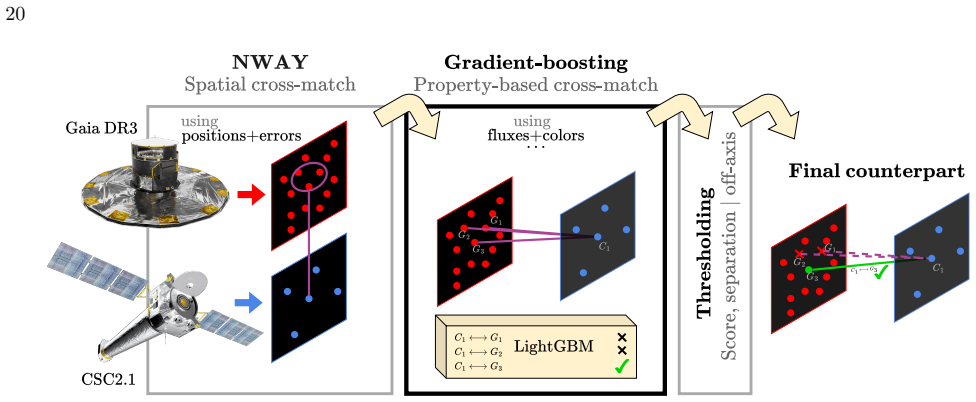
We present a framework to cross-match sources from the Chandra Source Catalog (CSC v2.1) with optical sources from Gaia Data Release 3. Unlike purely spatial approaches, we use source properties such as magnitudes, colors, and distances to identify true counterparts, detect chance coincidences, and resolve ambiguities when multiple plausible candidates exist. We define a training set of high-confidence matches using NWAY, a Bayesian cross-matching framework that accounts for positional errors and source densities. We train a gradient-boosted classifier (LightGBM) on a variety of features from both catalogs. Of the ~254k unique X-ray sources, we find counterparts for ~113k sources, of which p
What carries the argument
LightGBM gradient-boosted classifier trained on Chandra and Gaia source properties with training labels supplied by NWAY high-confidence matches.
If this is right
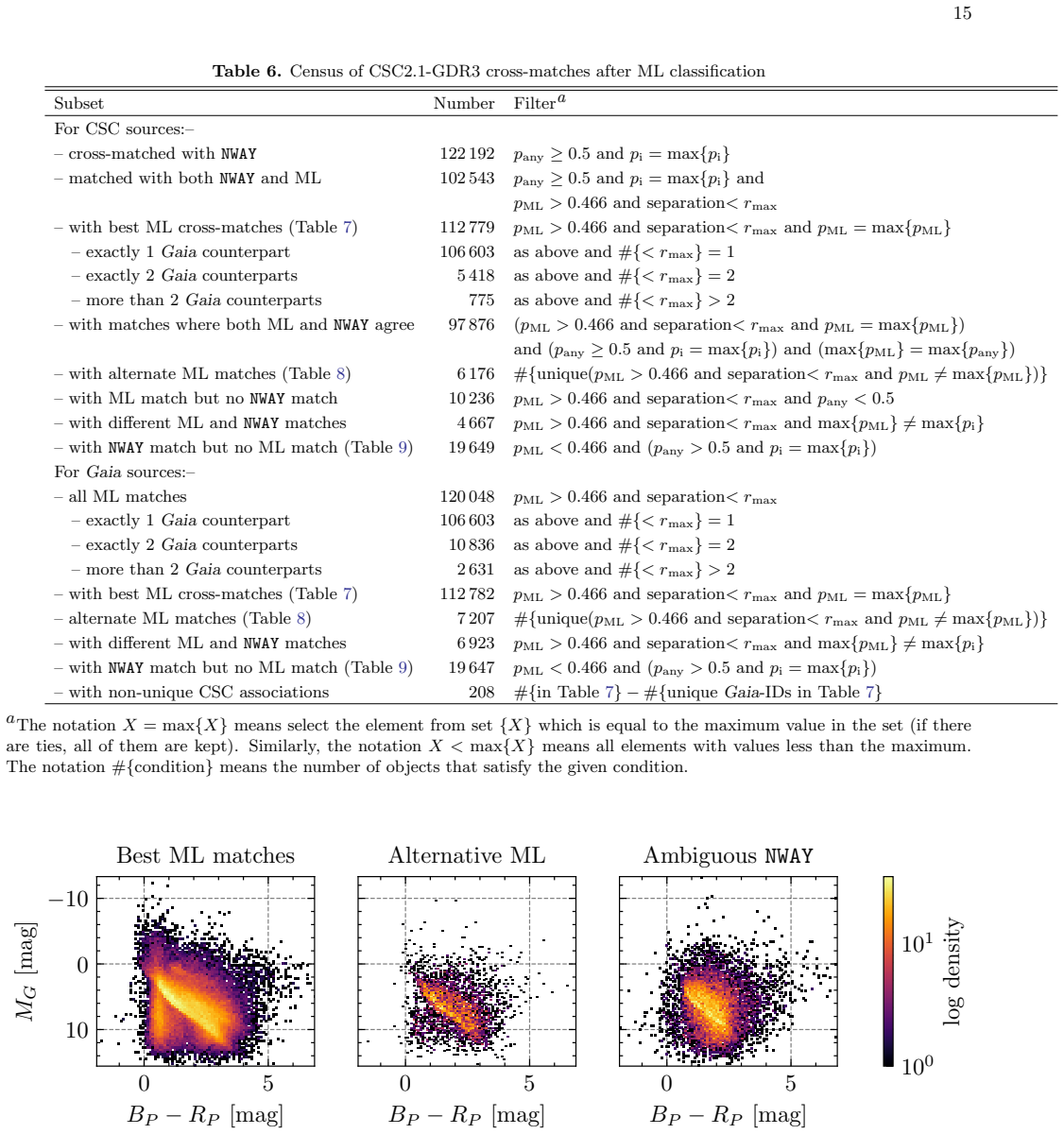
- Counterparts are assigned to approximately 113,000 Chandra X-ray sources.
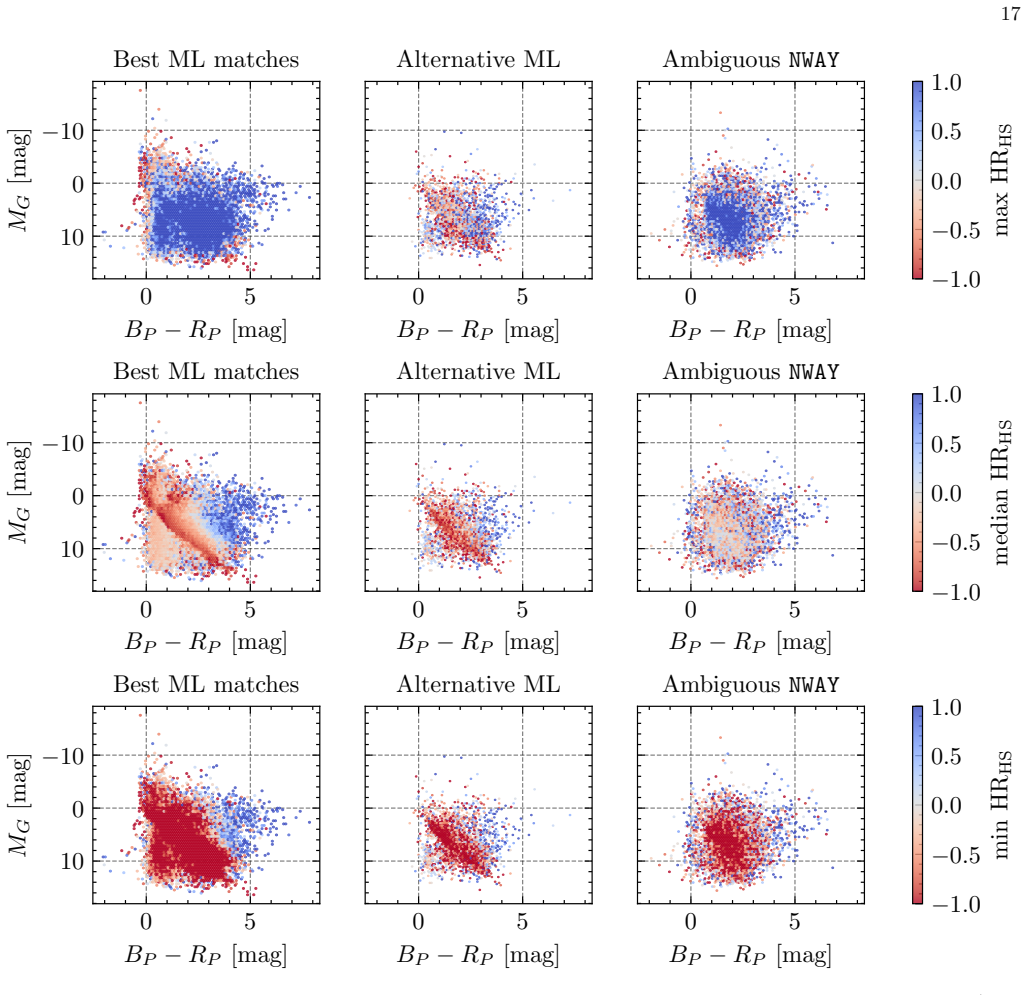
- Multiple plausible Gaia counterparts are identified for roughly 7,000 sources.
- No counterpart is found for 20,000 sources that positional matching would link, with half attributed to chance coincidences.
- The released catalog of counterparts, alternative matches, and ambiguous cases supports population studies of joint X-ray and optical sources.
- The framework is presented as generalizable to other cross-matching scenarios between astronomical catalogs.
Where Pith is reading between the lines
- The 95 percent reproduction rate on COUP without position data implies that photometric and distance features alone carry most of the information needed to distinguish true associations in this regime.
- The method could be tested on other catalog pairs where positional errors are large or fields are crowded to see whether the same feature set remains effective.
- If the fraction of chance coincidences holds in additional fields, earlier position-only catalogs may contain a measurable rate of false positives that affects derived source populations.
- The catalog enables direct comparison of X-ray and optical properties for the matched sources without the ambiguities that affect separation-based lists.
Load-bearing premise
The high-confidence matches produced by NWAY constitute an unbiased and representative training set whose labels remain valid when positional information is removed from the classifier features.
What would settle it
A count of disagreements between the machine-learning matches and a complete manual or spectroscopic verification of counterparts in an independent deep Chandra-Gaia field.
Figures
read the original abstract
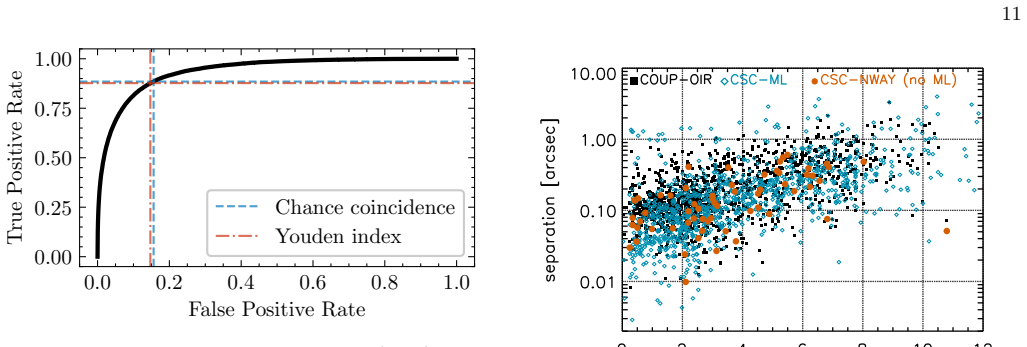
We present a framework to cross-match sources from the Chandra Source Catalog (CSC v2.1) with optical sources from Gaia Data Release 3. Unlike purely spatial approaches, we use source properties such as magnitudes, colors, and distances to identify true counterparts, detect chance coincidences, and resolve ambiguities when multiple plausible candidates exist. We define a training set of high-confidence matches using NWAY, a Bayesian cross-matching framework that accounts for positional errors and source densities. We train a gradient-boosted classifier (LightGBM) on a variety of features from both catalogs. Of the ~$254$k unique X-ray sources, we find counterparts for ~$113$k sources, of which plausible multiple counterparts are found for ~$7$k. We find no counterparts for ~$20$k sources for which separation-based cross-matching does find a match, and attribute half of these to chance coincidences. We validate the pipeline on the Chandra Orion Ultradeep Project (COUP), where the machine-learning matches reproduce 95% of NWAY cross-matches without using any positional information. We release a catalog of the ~$113$k Chandra-Gaia counterparts, together with ~$7$k alternative matches and ~$20$k ambiguous NWAY associations, supporting future population studies of sources detectable by both Chandra and Gaia. We discuss limitations and provide a generalization of the framework that is applicable in other cross-matching scenarios.
Editorial analysis
A structured set of objections, weighed in public.
Referee Report
Summary. The paper presents a machine-learning framework (LightGBM) to cross-match Chandra Source Catalog v2.1 X-ray sources with Gaia DR3, trained on high-confidence NWAY Bayesian labels using non-positional features (magnitudes, colors, distances). It reports counterparts for ~113k of ~254k X-ray sources (with ~7k multiples), no counterparts for ~20k sources, 95% reproduction of NWAY matches on the COUP validation field without positional information, and releases the resulting catalog plus alternative matches.
Significance. If the central validation holds, the work would offer a practical method for resolving positional ambiguities in X-ray/optical cross-matches using photometric and distance information alone, with direct utility for population studies. The public release of the ~113k counterparts, ~7k alternatives, and ~20k ambiguous cases is a clear strength supporting reproducibility.
major comments (2)
- [Abstract] Abstract: the 95% reproduction rate on COUP without positional features is obtained by training and validating on high-confidence NWAY outputs; this measures how well non-positional features recover NWAY's positional decisions rather than testing independent correctness of the classifier when positional information is withheld.
- [Abstract] Abstract: the manuscript provides no information on feature-importance rankings, class-imbalance handling in the NWAY-derived training set, or quantification of label noise propagated from NWAY, all of which are required to evaluate whether the reported performance is robust.
minor comments (1)
- The generalization paragraph would be strengthened by a concrete example of applying the same non-positional pipeline to a different pair of catalogs.
Simulated Author's Rebuttal
We thank the referee for the thoughtful and constructive report. The comments highlight important aspects of how the validation should be interpreted and the need for greater methodological transparency. We address each major comment below and will make revisions to the manuscript to improve clarity and completeness.
read point-by-point responses
-
Referee: [Abstract] Abstract: the 95% reproduction rate on COUP without positional features is obtained by training and validating on high-confidence NWAY outputs; this measures how well non-positional features recover NWAY's positional decisions rather than testing independent correctness of the classifier when positional information is withheld.
Authors: We agree that the COUP validation quantifies how effectively the non-positional features recover the high-confidence labels produced by NWAY (which itself incorporates positional information and source densities). The 95% figure therefore reflects agreement with NWAY rather than an external, independent test of counterpart correctness. We will revise the abstract and the validation section to state this distinction more explicitly, while noting that NWAY provides the most reliable available labels for training and that the result still demonstrates the value of photometric and distance information for resolving ambiguities. revision: yes
-
Referee: [Abstract] Abstract: the manuscript provides no information on feature-importance rankings, class-imbalance handling in the NWAY-derived training set, or quantification of label noise propagated from NWAY, all of which are required to evaluate whether the reported performance is robust.
Authors: We acknowledge that these details are currently absent. In the revised manuscript we will add: (i) LightGBM feature-importance rankings (both gain and split-based) to identify the most influential non-positional features; (ii) a description of class-imbalance handling, including any use of class weights or sampling strategies applied to the NWAY-derived training set; and (iii) a discussion of potential label noise inherited from NWAY, supported by any sensitivity tests performed. These additions will allow readers to assess the robustness of the reported performance more thoroughly. revision: yes
Circularity Check
No significant circularity detected
full rationale
The paper defines training labels via the external NWAY Bayesian matcher and reports 95% agreement on the separate COUP field when the LightGBM classifier is run without positional features. This agreement is an empirical measurement of feature correlation, not a quantity forced by construction, self-definition, or a self-citation chain. No equation or step reduces the reported matches or performance metric to the inputs by definition; NWAY is treated as an independent source of labels, and the central output is the resulting catalog rather than a tautological reproduction.
Axiom & Free-Parameter Ledger
axioms (2)
- domain assumption NWAY produces high-confidence matches suitable as training labels for a supervised classifier
- domain assumption Source properties such as magnitudes, colors, and distances are sufficient to distinguish true counterparts when positional information is withheld
Reference graph
Works this paper leans on
-
[1]
Journal of Machine Learning Research , author =
Scikit-learn:. Journal of Machine Learning Research , author =. 2011 , pages =
2011
-
[2]
The. The Astrophysical Journal , author =. 2022 , pages =. doi:10.3847/1538-4357/ac7c74 , abstract =
work page internal anchor Pith review doi:10.3847/1538-4357/ac7c74 2022
-
[3]
The Astrophysical Journal , author =
The. The Astrophysical Journal , author =. 2008 , note =. doi:10.1086/523619 , abstract =
-
[4]
The Astrophysical Journal Supplement Series , author =. 2011 , note =. doi:10.1088/0067-0049/194/1/1 , abstract =
-
[6]
Benchmark. Solar Physics , author =. 2015 , keywords =. doi:10.1007/s11207-015-0790-0 , abstract =
-
[7]
Accurate predictions on small data with a tabular foundation model , volume =. Nature , author =. 2025 , note =. doi:10.1038/s41586-024-08328-6 , abstract =
-
[8]
2025 , url =
Chandra. 2025 , url =
2025
-
[9]
The Astrophysical Journal Supplement Series , author =
A. The Astrophysical Journal Supplement Series , author =. 2011 , note =. doi:10.1088/0067-0049/194/1/2 , abstract =
-
[10]
VizieR Online Data Catalog , author =. 2011 , pages =. doi:10.26093/cds/vizier.21940002 , abstract =
-
[11]
The Astrophysical Journal Supplement Series , author =
Chandra. The Astrophysical Journal Supplement Series , author =. 2005 , pages =. doi:10.1086/432092 , abstract =
-
[12]
Advances in
Ke, Guolin and Meng, Qi and Finley, Thomas and Wang, Taifeng and Chen, Wei and Ma, Weidong and Ye, Qiwei and Liu, Tie-Yan , year =. Advances in
-
[13]
Why do tree-based models still outperform deep learning on tabular data? , url =
Grinsztajn, Léo and Oyallon, Edouard and Varoquaux, Gaël , month = jul, year =. Why do tree-based models still outperform deep learning on tabular data? , url =. doi:10.48550/arXiv.2207.08815 , abstract =
-
[14]
and Pfister, Tomas , month = dec, year =
Arik, Sercan O. and Pfister, Tomas , month = dec, year =. doi:10.48550/arXiv.1908.07442 , abstract =
-
[15]
Xgboost: A scalable tree boosting system,
Chen, Tianqi and Guestrin, Carlos , month = aug, year =. Proceedings of the 22nd. doi:10.1145/2939672.2939785 , abstract =
-
[16]
Learned, uncertainty-driven adaptive acquisition for photon-efficient scanning microscopy , url =
-
[17]
Monthly Notices of the Royal Astronomical Society , author =
Unsupervised machine learning for the classification of astrophysical. Monthly Notices of the Royal Astronomical Society , author =. 2024 , pages =. doi:10.1093/mnras/stae260 , abstract =
-
[18]
The Astrophysical Journal , author =. 2015 , note =. doi:10.1088/0004-637X/807/2/143 , abstract =
-
[19]
Astronomy & Astrophysics , author =
Gaia data release 3-summary of the content and survey properties , volume =. Astronomy & Astrophysics , author =. 2023 , note =
2023
-
[20]
The Astrophysical Journal Supplement Series , author =
The. The Astrophysical Journal Supplement Series , author =. 2024 , pages =. doi:10.3847/1538-4365/ad6319 , abstract =
-
[21]
Collaboration, Euclid and Roster, W. and Salvato, M. and Buchner, J. and Shirley, R. and Lusso, E. and Landt, H. and Zamorani, G. and Siudek, M. and Laloux, B. and Zatarain, T. Matamoro and Ricci, F. and Fotopoulou, S. and Ferré-Mateu, A. and Lopez, X. Lopez and Aghanim, N. and Altieri, B. and Amara, A. and Andreon, S. and Auricchio, N. and Aussel, H. and...
-
[22]
970(2):168, doi:10.3847/1538-4357/ad41e3
The Astrophysical Journal , author =. 2024 , note =. doi:10.3847/1538-4357/ad41e3 , abstract =
-
[23]
Freund, S. and Czesla, S. and Predehl, P. and Robrade, J. and Salvato, M. and Schneider, P. C. and Starck, H. and Wolf, J. and Schmitt, J. H. M. M. , month = jan, year =. The. doi:10.48550/arXiv.2401.17282 , abstract =
-
[24]
doi:10.48550/arXiv.2312.14132 , abstract =
Wang, Shuzhe and Leroy, Vincent and Cabon, Yohann and Chidlovskii, Boris and Revaud, Jerome , month = dec, year =. doi:10.48550/arXiv.2312.14132 , abstract =
-
[25]
doi:10.48550/arXiv.2105.01601 , abstract =
Tolstikhin, Ilya and Houlsby, Neil and Kolesnikov, Alexander and Beyer, Lucas and Zhai, Xiaohua and Unterthiner, Thomas and Yung, Jessica and Steiner, Andreas and Keysers, Daniel and Uszkoreit, Jakob and Lucic, Mario and Dosovitskiy, Alexey , month = jun, year =. doi:10.48550/arXiv.2105.01601 , abstract =
-
[26]
Wilson, Andrew Gordon , month = mar, year =. Deep. doi:10.48550/arXiv.2503.02113 , abstract =
-
[27]
Astronomy & Astrophysics , author =
Gaia. Astronomy & Astrophysics , author =. 2023 , note =. doi:10.1051/0004-6361/202245591 , abstract =
-
[28]
Rots, A. H. and Burke, D. and Hain, R. M. and Nguyen, D. T. and Tibbetts, M. S. and Evans, I. N. and Primini, F. A. and Miller, J. B. and Evans, J. D. and Allen, C. E. and Anderson, C. S. and Becker, G. and Budynkiewicz, J. A. and Chen, J. C. and Civano, F. and D'Abrusco, R. and Doe, S. M. and Fabbiano, G. and Martinez Galarza, R. and Gibbs, II, D. G. and...
-
[29]
and Allen, Christopher E
Rots, Arnold H. and Allen, Christopher E. and Anderson, Craig S. and Budynkiewicz, Jamie A. and Burke, Douglas and Chen, Judy C. and Civano, Francesca Maria and D'Abrusco, Raffaele and Doe, Stephen M. and Evans, Ian N. and Evans, Janet D. and Fabbiano, Giuseppina and Gibbs, II, Danny G. and Glotfelty, Kenny J. and Graessle, Dale E. and Grier, John D. and ...
-
[30]
Evans, I. N. and Primini, F. A. and Miller, J. B. and Evans, J. D. and Allen, C. E. and Anderson, C. S. and Becker, G. and Budynkiewicz, J. A. and Burke, D. and Chen, J. C. and Civano, F. and D'Abrusco, R. and Doe, S. M. and Fabbiano, G. and Martinez Galarza, J. and Gibbs, II, D. G. and Glotfelty, K. J. and Graessle, D. E. and Grier, Jr., J. D. and Hain, ...
-
[31]
The Astrophysical Journal , author =
The. The Astrophysical Journal , author =. 2018 , note =. doi:10.3847/1538-4357/aace5d , abstract =
-
[32]
Astronomy and Astrophysics , author =
The stellar population of the. Astronomy and Astrophysics , author =. 2007 , note =. doi:10.1051/0004-6361:20066146 , abstract =
-
[33]
The Astrophysical Journal , author =
Stellar. The Astrophysical Journal , author =. 2016 , note =. doi:10.3847/2041-8205/826/1/L2 , abstract =
-
[34]
Weakened magnetic braking as the origin of anomalously rapid rotation in old field stars , volume =. Nature , author =. 2016 , note =. doi:10.1038/nature16168 , abstract =
-
[35]
Astronomy and Astrophysics , author =
The stellar content of the. Astronomy and Astrophysics , author =. 2007 , note =. doi:10.1051/0004-6361:20065696 , abstract =
-
[36]
The Astrophysical Journal , author =
The. The Astrophysical Journal , author =. 2004 , pages =. doi:10.1086/422248 , abstract =
-
[37]
Astronomy & Astrophysics , author =
The stellar content of the. Astronomy & Astrophysics , author =. 2022 , note =. doi:10.1051/0004-6361/202142573 , abstract =
-
[38]
Astronomy and Astrophysics , author =
The. Astronomy and Astrophysics , author =. 2024 , note =. doi:10.1051/0004-6361/202347165 , abstract =
work page internal anchor Pith review doi:10.1051/0004-6361/202347165 2024
-
[39]
Astronomy & Astrophysics , author =
Likelihood of the sky:. Astronomy & Astrophysics , author =. 2023 , pages =. doi:10.1051/0004-6361/202244195 , abstract =
-
[40]
The Astrophysical Journal , author =
Classifying. The Astrophysical Journal , author =. 2022 , note =. doi:10.3847/1538-4357/ac952b , abstract =
-
[41]
Astronomy & Astrophysics , author =
The. Astronomy & Astrophysics , author =. 2022 , pages =. doi:10.1051/0004-6361/202141631 , abstract =
-
[42]
Likelihood of the sky -
-
[43]
The Astrophysical Journal Supplement Series , author =
The. The Astrophysical Journal Supplement Series , author =. 2023 , note =. doi:10.3847/1538-4365/ace4cc , abstract =
-
[44]
Annual Review of Statistics and Its Application , author =
Probabilistic record linkage in astronomy:. Annual Review of Statistics and Its Application , author =. 2015 , note =. doi:10.1146/annurev-statistics-010814-020231 , abstract =
-
[45]
Astronomy and Astrophysics , author =
The. Astronomy and Astrophysics , author =. 2022 , pages =
2022
-
[46]
Monthly Notices of The Royal Astronomical Society , author =
Finding counterparts for all-sky. Monthly Notices of The Royal Astronomical Society , author =. 2018 , pages =
2018
-
[47]
Astronomy & Astrophysics , author =
Gaia early data release 3-building the gaia. Astronomy & Astrophysics , author =. 2021 , note =
2021
-
[48]
Astronomy & Astrophysics , author =
Gaia data release 2-cross-match with external catalogues: algorithms and results , volume =. Astronomy & Astrophysics , author =. 2019 , note =
2019
-
[49]
The gaia mission , journal =
-
[50]
Monthly Notices of The Royal Astronomical Society , author =
On the likelihood ratio for source identification , volume =. Monthly Notices of The Royal Astronomical Society , author =. 1992 , pages =
1992
-
[51]
Advances in Neural Information Processing Systems , author =
Revisiting deep learning models for tabular data , volume =. Advances in Neural Information Processing Systems , author =. 2021 , pages =
2021
-
[52]
Vogt, Frédéric P. A. and Dopita, Michael A. and Kewley, Lisa J. and Sutherland, Ralph S. and Scharwächter, Julia and Basurah, Hassan M. and Ali, Alaa and Amer, Morsi A. , month = oct, year =. Galaxy emission line classification using three-dimensional line ratio diagrams , volume =. doi:10.1088/0004-637X/793/2/127 , number =
-
[53]
Schwarz, Greg J. and Ness, Jan-Uwe and Osborne, J. P. and Page, K. L. and Evans, P. A. and Beardmore, A. P. and Walter, Frederick M. and Helton, L. Andrew and Woodward, Charles E. and Bode, Mike and Starrfield, Sumner and Drake, Jeremy J. , month = dec, year =. Swift x-ray observations of classical novae. doi:10.1088/0067-0049/197/2/31 , number =
-
[54]
Astrophysical Journal , author =
Probabilistic cross-identification of astronomical sources , volume =. Astrophysical Journal , author =. 2008 , pages =
2008
-
[55]
doi:10.3847/0004-6256/152/2/41 , adsurl =
Prša, Andrej and Harmanec, Petr and Torres, Guillermo and Mamajek, Eric and Asplund, Martin and Capitaine, Nicole and Christensen-Dalsgaard, Jørgen and Depagne, Éric and Haberreiter, Margit and Hekker, Saskia , month = aug, year =. Nominal values for selected solar and planetary quantities:. doi:10.3847/0004-6256/152/2/41 , number =
-
[56]
Ferland, G. J. and Porter, R. L. and van Hoof, P. A. M. and Williams, R. J. R. and Abel, N. P. and Lykins, M. L. and Shaw, G. and Henney, W. J. and Stancil, P. C. , month = apr, year =. The 2013 release of cloudy , volume =
2013
-
[57]
X-ray scattering echoes and ghost halos from the intergalactic medium:
Corrales, Lia , month = may, year =. X-ray scattering echoes and ghost halos from the intergalactic medium:. doi:10.1088/0004-637X/805/1/23 , number =
-
[58]
1996 , note =. doi:10.1051/aas:1996164 , author =
-
[59]
Li, Leping and Zhang, Jun and Peter, Hardi and Chitta, Lakshmi Pradeep and Su, Jiangtao and Song, Hongqiang and Xia, Chun and Hou, Yijun , month = dec, year =. Quasi-periodic fast propagating magnetoacoustic waves during the magnetic reconnection between solar coronal loops , volume =. doi:10.3847/2041-8213/aaf167 , number =
-
[60]
Quantifying the observational effort required for the radial velocity characterization of
Cloutier, Ryan and Doyon, René and Bouchy, Francois and Hébrard, Guillaume , month = aug, year =. Quantifying the observational effort required for the radial velocity characterization of. doi:10.3847/1538-3881/aacea9 , number =
-
[61]
, archiveprefix = "arXiv", eprint =
Astropy:. 2013 , note =. doi:10.1051/0004-6361/201322068 , author =
-
[62]
, archivePrefix = "arXiv", eprint =
The astropy project:. 2018 , note =. doi:10.3847/1538-3881/aabc4f , number =
-
[63]
Astronomy & Astrophysics , author =
The. Astronomy & Astrophysics , author =. 2022 , pages =. doi:10.1051/0004-6361/202141133 , abstract =
-
[64]
Six Maxims of Statistical Acumen for Astronomical Data Analysis. , keywords =. doi:10.3847/1538-4365/ad8440 , archivePrefix =. 2408.16179 , primaryClass =
-
[65]
The Annals of Mathematical Statistics , author =
Table for. The Annals of Mathematical Statistics , author =. 1948 , note =. doi:10.1214/aoms/1177730256 , language =
-
[66]
AAS High Energy Astrophysics Division meeting \#21, id
Chandra. AAS High Energy Astrophysics Division meeting \#21, id. 105.25. Bulletin of the American Astronomical Society, Vol. 56, No. 5 , author =. 2024 , pages =
2024
-
[67]
Bulletin of the Astronomical Society of India , keywords =
PINTofALE : Package for the interactive analysis of line emission. Bulletin of the Astronomical Society of India , keywords =
-
[68]
Pérez-Díaz, Víctor Samuel and Kashyap, Vinay and Ingram, Joshua and Fouhey, David and Martinez-Galarza, Juan R. and Protopapas, Pavlos and Drake, Jeremy and Kim, Dong-Woo and Garraffo, Cecilia , year = 2026, date =. The Chandra-Gaia Catalog of Counterparts:. doi:10.5281/zenodo.18652667 , url =
-
[69]
Change-point Detection and Image Segmentation for Time Series of Astrophysical Images. , keywords =. doi:10.3847/1538-3881/abe0b6 , archivePrefix =. 2101.11202 , primaryClass =
-
[70]
and Greiff, Victor , title =
Ursu, Eugen and Minnegalieva, Aygul and Rawat, Puneet and Chernigovskaya, Maria and Tacutu, Robi and Sandve, Geir Kjetil and Robert, Philippe A. and Greiff, Victor , title =. 2025 , doi =. https://www.biorxiv.org/content/early/2025/04/05/2024.06.17.599333.full.pdf , archivePrefix =
2025
-
[71]
Astronomical Data Analysis Software and Systems XXVI , year = 2019, editor =
Cross-matching Within the Chandra Source Catalog. Astronomical Data Analysis Software and Systems XXVI , year = 2019, editor =
2019
-
[72]
Membership of the Orion Nebula Population from the Chandra Orion Ultradeep Project
Membership of the Orion Nebula Population from the Chandra Orion Ultradeep Project. The Astrophysical Journal Supplement Series , keywords =. doi:10.1086/432097 , archivePrefix =. astro-ph/0504370 , primaryClass =
work page internal anchor Pith review Pith/arXiv arXiv doi:10.1086/432097
-
[73]
, title =
Rots, Arnold H. , title =. 2025 , month =
2025
discussion (0)
Sign in with ORCID, Apple, or X to comment. Anyone can read and Pith papers without signing in.