S-Agent: Spatial Tool-Use Elicits Reasoning for Spatial Intelligence
Pith reviewed 2026-06-30 10:18 UTC · model grok-4.3
The pith
Spatial tool-use lets vision-language models accumulate 3D evidence across frames for continuous reasoning.
A machine-rendered reading of the paper's core claim, the machinery that carries it, and where it could break.
Core claim
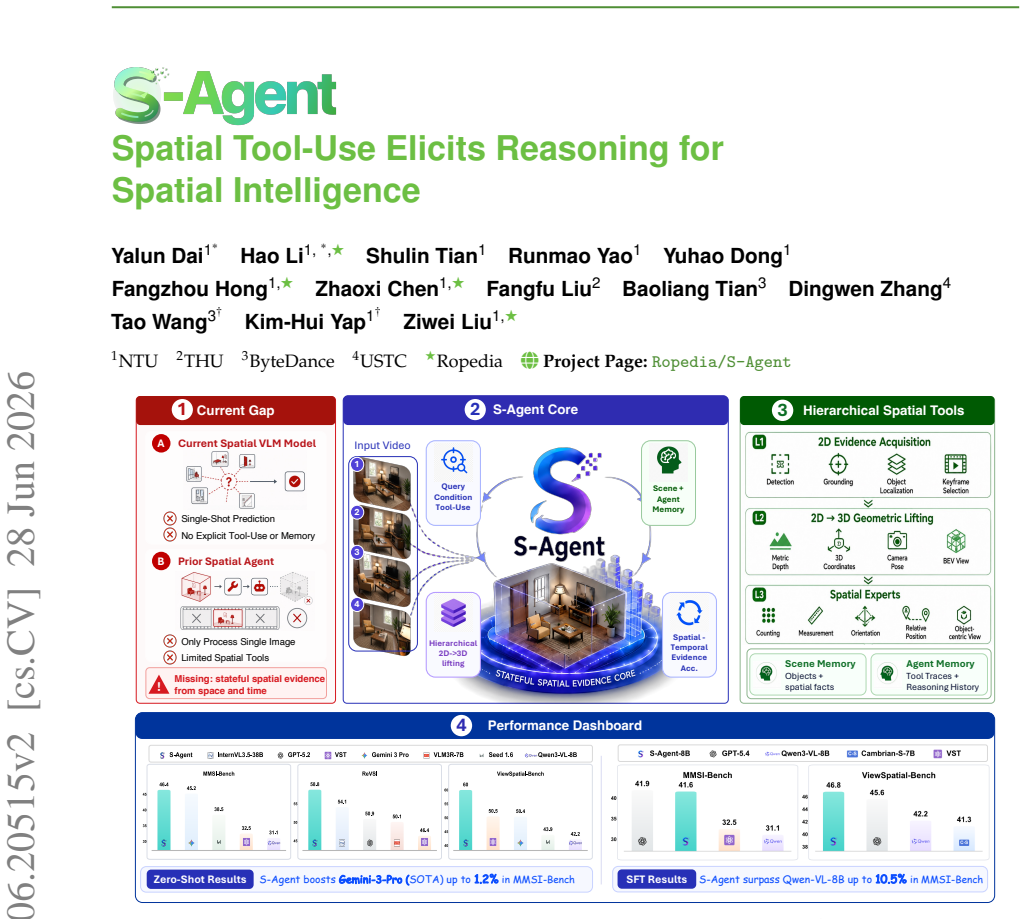
S-Agent casts the VLM as a semantic planner that decides what evidence is needed, while a hierarchy of spatial tools and experts grounds objects in 2D, lifts them into 3D geometric evidence, and aggregates this evidence into high-level spatial knowledge. A temporal memory mechanism, including Scene Memory for the evolving scene state and Agent Memory for reasoning context, enables evidence integration across frames. Comprehensive experiments show that S-Agent consistently improves both open-source and closed-source VLMs in a training-free manner, and supervised fine-tuning on S-Agent-generated trajectories yields S-Agent-8B that surpasses similar-scale baselines and performs comparably to ad
What carries the argument
Hierarchy of spatial tools and experts that grounds objects in 2D, lifts them into 3D geometric evidence, and aggregates evidence into high-level spatial knowledge, supported by Scene Memory and Agent Memory for temporal integration.
Load-bearing premise
The spatial tools can reliably convert 2D detections into accurate 3D positions and relations without accumulating errors that would undermine the final spatial conclusions.
What would settle it
A benchmark evaluation in which replacing the 3D lifting step with ground-truth 3D measurements produces no accuracy gain over the unaugmented VLM baseline.
Figures
read the original abstract
Real-world spatial intelligence requires reasoning over a continuous and evolving 3D world, yet existing VLMs and tool-augmented agents largely remain tied to static, stateless inference from isolated visual observations. We introduce \textbf{\textsc{S-Agent}}, a spatial tool-use agentic paradigm for understanding and reasoning over continuous multi-view images and videos. By formulating spatial reasoning as spatio-temporal evidence accumulation rather than isolated frame-level prediction, \textsc{S-Agent} reshapes spatial perception into scene-centric understanding beyond frame-centric recognition. Specifically, \textsc{S-Agent} casts the VLM as a semantic planner that decides what evidence is needed, while a hierarchy of spatial tools and experts grounds objects in 2D, lifts them into 3D geometric evidence, and aggregates this evidence into high-level spatial knowledge (\textit{e.g.}, counting, measurement, orientation, and relative position). Additionally, a temporal memory mechanism, including Scene Memory for maintaining the evolving scene state and Agent Memory for accumulating reasoning context, enables evidence integration across frames and reasoning steps. Comprehensive experiments on multi-view and video spatial reasoning benchmarks show that \textsc{S-Agent} consistently improves both open-source and closed-source VLMs in a training-free manner. Beyond inference-time augmentation, supervised fine-tuning (SFT) on \textsc{S-Agent}-generated spatial trajectories \textsc{S-300K} yields \textsc{S-Agent-8B}, a compact spatial agent that significantly surpasses similar-scale baselines (e.g., Qwen3-VL-8B) and performs comparably to advanced closed-source models (e.g., GPT-5.4 and Gemini 3).
Editorial analysis
A structured set of objections, weighed in public.
Referee Report
Summary. The manuscript introduces S-Agent, a training-free agentic framework in which a VLM acts as semantic planner while a hierarchy of spatial tools performs 2D grounding, 3D lifting, evidence aggregation, and temporal memory integration (Scene Memory and Agent Memory) to support multi-view and video spatial reasoning. Experiments claim consistent gains for both open- and closed-source VLMs on spatial benchmarks; SFT on the resulting S-300K trajectories produces S-Agent-8B, which surpasses same-scale baselines and approaches advanced closed-source models.
Significance. If the claimed tool hierarchy reliably converts 2D detections into accurate, cross-view-consistent 3D geometric evidence, the work would offer a concrete route to scene-centric rather than frame-centric spatial reasoning and could materially improve VLM performance on counting, measurement, and relative-position tasks without additional training.
major comments (2)
- [Experiments (and associated figures/tables)] The central empirical claims rest on the assumption that the 2D-to-3D lifting and aggregation steps produce geometric evidence free of systematic bias. No quantitative evaluation of 3D reconstruction fidelity, depth-scale consistency across views, occlusion handling, or aggregation error rates is supplied; without these measurements it is impossible to determine whether the reported benchmark gains are driven by reliable evidence or by correlated tool errors.
- [S-300K construction and SFT experiments] The quality of the S-300K trajectories used for SFT is asserted to be high enough to train a competitive 8B model, yet no human or automatic verification of trajectory correctness (e.g., 3D coordinate accuracy, reasoning-step validity) is reported. This leaves open the possibility that S-Agent-8B simply inherits and amplifies the same unmeasured lifting errors.
minor comments (1)
- [Method overview] Notation for the temporal memory components (Scene Memory vs. Agent Memory) is introduced in the abstract but would benefit from an explicit diagram or pseudocode block showing how evidence is written and read across frames.
Simulated Author's Rebuttal
We thank the referee for the constructive feedback highlighting the need for direct validation of the 3D lifting pipeline and trajectory quality. We address both major comments point-by-point below and will incorporate additional analyses in the revised manuscript.
read point-by-point responses
-
Referee: [Experiments (and associated figures/tables)] The central empirical claims rest on the assumption that the 2D-to-3D lifting and aggregation steps produce geometric evidence free of systematic bias. No quantitative evaluation of 3D reconstruction fidelity, depth-scale consistency across views, occlusion handling, or aggregation error rates is supplied; without these measurements it is impossible to determine whether the reported benchmark gains are driven by reliable evidence or by correlated tool errors.
Authors: We agree that explicit quantitative metrics on 3D reconstruction fidelity, cross-view consistency, occlusion handling, and aggregation error would strengthen the claims. The manuscript currently relies on downstream benchmark gains as the primary indicator of tool reliability. In the revision we will add a dedicated analysis subsection that reports these metrics on both synthetic multi-view scenes with ground-truth 3D annotations and selected real-world sequences, including error distributions and failure-case breakdowns. This will allow readers to assess whether the observed improvements arise from accurate evidence or systematic biases. revision: yes
-
Referee: [S-300K construction and SFT experiments] The quality of the S-300K trajectories used for SFT is asserted to be high enough to train a competitive 8B model, yet no human or automatic verification of trajectory correctness (e.g., 3D coordinate accuracy, reasoning-step validity) is reported. This leaves open the possibility that S-Agent-8B simply inherits and amplifies the same unmeasured lifting errors.
Authors: The S-300K trajectories are generated by executing the full S-Agent loop on curated spatial tasks and retaining only those that reach successful termination according to the agent's own verification. While the original submission does not report separate human or automatic correctness audits, the strong held-out performance of the resulting S-Agent-8B provides indirect support. In the revision we will add: (i) explicit filtering statistics and success-rate thresholds used during trajectory collection, (ii) a human-verified subset analysis (approximately 500 trajectories) measuring 3D coordinate accuracy and reasoning-step validity, and (iii) a comparison of per-step error rates before versus after SFT. These additions will directly address the concern of error inheritance. revision: yes
Circularity Check
No circularity: empirical performance claims rest on external benchmarks, not self-referential derivations
full rationale
The paper describes an agentic system (S-Agent) that augments VLMs via a hierarchy of spatial tools, temporal memory, and optional SFT on generated trajectories (S-300K). All central claims are framed as measured improvements on multi-view and video spatial reasoning benchmarks, with comparisons to baselines like Qwen3-VL-8B and closed-source models. No equations, uniqueness theorems, or parameter-fitting steps are presented that reduce a claimed prediction back to the input data or self-citations by construction. The methodology is self-contained against external evaluation; the 3D lifting and aggregation steps are engineering components whose reliability is asserted via downstream task gains rather than tautological redefinition.
Axiom & Free-Parameter Ledger
Reference graph
Works this paper leans on
-
[1]
Jean-Baptiste Alayrac, Jeff Donahue, Pauline Luc, Antoine Miech, Iain Barr, Yana Hasson, Karel Lenc, Arthur Mensch, Katie Millican, Malcolm Reynolds, Roman Ring, Eliza Rutherford, Serkan Cabi, Tengda Han, Zhitao Gong, Sina Samangooei, Marianne Monteiro, Jacob Menick, Sebastian Borgeaud, and 8 others. 2022. Flamingo: a visual language model for few-shot le...
work page internal anchor Pith review Pith/arXiv arXiv 2022
-
[2]
Anthony Brohan, Noah Brown, Justice Carbajal, Yevgen Chebotar, Xi Chen, Krzysztof Choromanski, Tianli Ding, Danny Driess, Avinava Dubey, Chelsea Finn, Pete Florence, Chuyuan Fu, Montse Gonzalez Arenas, Keerthana Gopalakrishnan, Kehang Han, Karol Hausman, Alexander Herzog, Jasmine Hsu, Brian Ichter, and 35 others. 2023. Rt-2: Vision-language-action models ...
work page internal anchor Pith review Pith/arXiv arXiv 2023
-
[3]
Ellis Brown, Jihan Yang, Shusheng Yang, Rob Fergus, and Saining Xie. 2025. Benchmark designers should "train on the test set" to expose exploitable non-visual shortcuts.Preprint, arXiv:2511.04655
-
[4]
Lang, Sourabh Vora, Venice Erin Liong, Qiang Xu, Anush Krishnan, Yu Pan, Giancarlo Baldan, and Oscar Beijbom
Holger Caesar, Varun Bankiti, Alex H. Lang, Sourabh Vora, Venice Erin Liong, Qiang Xu, Anush Krishnan, Yu Pan, Giancarlo Baldan, and Oscar Beijbom. 2020. nuscenes: A multimodal dataset for autonomous driving. In Proceedings of the IEEE/CVF Conference on Computer Vision and Pattern Recognition, pages 11621–11631
2020
-
[5]
Zhongang Cai, Ruisi Wang, Chenyang Gu, Fanyi Pu, Junxiang Xu, Yubo Wang, Wanqi Yin, Zhitao Yang, Chen Wei, Qingping Sun, Tongxi Zhou, Jiaqi Li, Hui En Pang, Oscar Qian, Yukun Wei, Zhiqian Lin, Xuanke Shi, Kewang Deng, Xiaoyang Han, and 10 others. 2026. Scaling spatial intelligence with multimodal foundation models. Preprint, arXiv:2511.13719
-
[6]
Siyi Chen, Mikaela Angelina Uy, Chan Hee Song, Faisal Ladhak, Adithyavairavan Murali, Qing Qu, Stan Birchfield, Valts Blukis, and Jonathan Tremblay. 2025. Spacetools: Tool-augmented spatial reasoning via double interactive rl. Preprint, arXiv:2512.04069
work page internal anchor Pith review Pith/arXiv arXiv 2025
-
[7]
Zeren Chen, Xiaoya Lu, Zhijie Zheng, Pengrui Li, Lehan He, Yijin Zhou, Jing Shao, Bohan Zhuang, and Lu Sheng
- [8]
-
[9]
Danny Driess, Fei Xia, Mehdi S. M. Sajjadi, Corey Lynch, Aakanksha Chowdhery, Brian Ichter, Ayzaan Wahid, Jonathan Tompson, Quan Vuong, Tianhe Yu, Wenlong Huang, Yevgen Chebotar, Pierre Sermanet, Daniel Duck- worth, Sergey Levine, Vincent Vanhoucke, Karol Hausman, Marc Toussaint, Klaus Greff, and 3 others. 2023. Palm-e: An embodied multimodal language mod...
work page internal anchor Pith review Pith/arXiv arXiv 2023
- [10]
-
[11]
BLINK: Multimodal Large Language Models Can See but Not Perceive
Xingyu Fu, Yushi Hu, Bangzheng Li, Yu Feng, Haoyu Wang, Xudong Lin, Dan Roth, Noah A. Smith, Wei-Chiu Ma, and Ranjay Krishna. 2024. Blink: Multimodal large language models can see but not perceive.Preprint, arXiv:2404.12390
work page internal anchor Pith review Pith/arXiv arXiv 2024
-
[12]
Andreas Geiger, Philip Lenz, and Raquel Urtasun. 2012. Are we ready for autonomous driving? the kitti vision benchmark suite. InProceedings of the IEEE Conference on Computer Vision and Pattern Recognition, pages 3354–3361
2012
-
[13]
Dingming Li, Hongxing Li, Zixuan Wang, Yuchen Yan, Hang Zhang, Siqi Chen, Guiyang Hou, Shengpei Jiang, Wenqi Zhang, Yongliang Shen, Weiming Lu, and Yueting Zhuang. 2025. Viewspatial-bench: Evaluating multi-perspective spatial localization in vision-language models.Preprint, arXiv:2505.21500
- [14]
-
[15]
Depth Anything 3: Recovering the Visual Space from Any Views
Haotong Lin, Sili Chen, Junhao Liew, Donny Y. Chen, Zhenyu Li, Guang Shi, Jiashi Feng, and Bingyi Kang. 2025. Depth anything 3: Recovering the visual space from any views.Preprint, arXiv:2511.10647
work page internal anchor Pith review Pith/arXiv arXiv 2025
-
[16]
Haotian Liu, Chunyuan Li, Qingyang Wu, and Yong Jae Lee. 2023. Visual instruction tuning.Preprint, arXiv:2304.08485
work page internal anchor Pith review Pith/arXiv arXiv 2023
-
[17]
de Melo, and Alan Yuille
Wufei Ma, Haoyu Chen, Guofeng Zhang, Yu-Cheng Chou, Jieneng Chen, Celso M. de Melo, and Alan Yuille
- [18]
- [19]
-
[20]
Newcombe, Shahram Izadi, Otmar Hilliges, David Molyneaux, David Kim, Andrew J
Richard A. Newcombe, Shahram Izadi, Otmar Hilliges, David Molyneaux, David Kim, Andrew J. Davison, Pushmeet Kohli, Jamie Shotton, Steve Hodges, and Andrew Fitzgibbon. 2011. Kinectfusion: Real-time dense surface mapping and tracking. In2011 10th IEEE International Symposium on Mixed and Augmented Reality, pages 127–136. IEEE. 14
2011
-
[21]
Kun Ouyang, Yuanxin Liu, Haoning Wu, Yi Liu, Hao Zhou, Jie Zhou, Fandong Meng, and Xu Sun. 2025. Spacer: Reinforcing mllms in video spatial reasoning.Preprint, arXiv:2504.01805
work page internal anchor Pith review Pith/arXiv arXiv 2025
-
[22]
Alec Radford, Jong Wook Kim, Chris Hallacy, Aditya Ramesh, Gabriel Goh, Sandhini Agarwal, Girish Sastry, Amanda Askell, Pamela Mishkin, Jack Clark, Gretchen Krueger, and Ilya Sutskever. 2021. Learning transferable visual models from natural language supervision.Preprint, arXiv:2103.00020
work page internal anchor Pith review Pith/arXiv arXiv 2021
-
[23]
Dídac Surís, Sachit Menon, and Carl Vondrick. 2023. Vipergpt: Visual inference via python execution for reasoning.Preprint, arXiv:2303.08128
work page internal anchor Pith review Pith/arXiv arXiv 2023
- [24]
- [25]
-
[26]
Qineng Wang, Baiqiao Yin, Pingyue Zhang, Jianshu Zhang, Kangrui Wang, Zihan Wang, Jieyu Zhang, Keshigeyan Chandrasegaran, Han Liu, Ranjay Krishna, Saining Xie, Jiajun Wu, Li Fei-Fei, and Manling Li. 2026. Mindcube: Spatial mental modeling from limited views.Preprint, arXiv:2506.21458
-
[27]
Chenfei Wu, Shengming Yin, Weizhen Qi, Xiaodong Wang, Zecheng Tang, and Nan Duan. 2023. Visual chatgpt: Talking, drawing and editing with visual foundation models.Preprint, arXiv:2303.04671
work page internal anchor Pith review Pith/arXiv arXiv 2023
-
[28]
Diankun Wu, Fangfu Liu, Yi-Hsin Hung, and Yueqi Duan. 2025. Spatial-mllm: Boosting mllm capabilities in visual-based spatial intelligence.Preprint, arXiv:2505.23747
work page internal anchor Pith review Pith/arXiv arXiv 2025
-
[29]
Junfei Wu, Jian Guan, Kaituo Feng, Qiang Liu, Shu Wu, Liang Wang, Wei Wu, and Tieniu Tan. 2025. Rein- forcing spatial reasoning in vision-language models with interwoven thinking and visual drawing.Preprint, arXiv:2506.09965
work page internal anchor Pith review Pith/arXiv arXiv 2025
-
[30]
Thinking in Space: How Multimodal Large Language Models See, Remember, and Recall Spaces
Jihan Yang, Shusheng Yang, Anjali W. Gupta, Rilyn Han, Li Fei-Fei, and Saining Xie. 2025. Thinking in space: How multimodal large language models see, remember, and recall spaces.Preprint, arXiv:2412.14171
work page internal anchor Pith review Pith/arXiv arXiv 2025
- [31]
-
[32]
Shusheng Yang, Jihan Yang, Pinzhi Huang, Ellis Brown, Zihao Yang, Yue Yu, Shengbang Tong, Zihan Zheng, Yifan Xu, Muhan Wang, Daohan Lu, Rob Fergus, Yann LeCun, Li Fei-Fei, and Saining Xie. 2025. Cambrian-s: Towards spatial supersensing in video.Preprint, arXiv:2511.04670
work page internal anchor Pith review Pith/arXiv arXiv 2025
-
[33]
Sihan Yang, Runsen Xu, Yiman Xie, Sizhe Yang, Mo Li, Jingli Lin, Chenming Zhu, Xiaochen Chen, Haodong Duan, Xiangyu Yue, Dahua Lin, Tai Wang, and Jiangmiao Pang. 2025. Mmsi-bench: A benchmark for multi-image spatial intelligence.Preprint, arXiv:2505.23764
work page internal anchor Pith review Pith/arXiv arXiv 2025
-
[34]
Zhengyuan Yang, Linjie Li, Jianfeng Wang, Kevin Lin, Ehsan Azarnasab, Faisal Ahmed, Zicheng Liu, Ce Liu, Michael Zeng, and Lijuan Wang. 2023. Mm-react: Prompting chatgpt for multimodal reasoning and action. Preprint, arXiv:2303.11381
work page internal anchor Pith review Pith/arXiv arXiv 2023
-
[35]
Shunyu Yao, Jeffrey Zhao, Dian Yu, Nan Du, Izhak Shafran, Karthik Narasimhan, and Yuan Cao. 2023. React: Synergizing reasoning and acting in language models.Preprint, arXiv:2210.03629
work page internal anchor Pith review Pith/arXiv arXiv 2023
-
[36]
Jinhui Ye, Zihan Wang, Haosen Sun, Keshigeyan Chandrasegaran, Zane Durante, Cristobal Eyzaguirre, Yonatan Bisk, Juan Carlos Niebles, Ehsan Adeli, Li Fei-Fei, Jiajun Wu, and Manling Li. 2025. T*: Re-thinking temporal search for long-form video understanding.Preprint, arXiv:2504.02259
-
[37]
Hang Zhang, Xin Li, and Lidong Bing. 2023. Video-llama: An instruction-tuned audio-visual language model for video understanding.Preprint, arXiv:2306.02858
work page internal anchor Pith review Pith/arXiv arXiv 2023
-
[38]
Peiyuan Zhang, Kaichen Zhang, Bo Li, Guangtao Zeng, Jingkang Yang, Yuanhan Zhang, Ziyue Wang, Haoran Tan, Chunyuan Li, and Ziwei Liu. 2024. Long context transfer from language to vision.Preprint, arXiv:2406.16852
work page internal anchor Pith review Pith/arXiv arXiv 2024
-
[39]
Yiming Zhang, Jiacheng Chen, Jiaqi Tan, Yongsen Mao, Wenhu Chen, and Angel X. Chang. 2026. Revsi: Rebuild- ing visual spatial intelligence evaluation for accurate assessment of vlm 3d reasoning.Preprint, arXiv:2604.24300
work page internal anchor Pith review Pith/arXiv arXiv 2026
- [40]
-
[41]
B. Northwest
Yaowei Zheng, Richong Zhang, Junhao Zhang, Yanhan Ye, Zheyan Luo, Zhangchi Feng, and Yongqiang Ma. 2024. Llamafactory: Unified efficient fine-tuning of 100+ language models. InProceedings of the 62nd Annual Meeting of the Association for Computational Linguistics (Volume 3: System Demonstrations), Bangkok, Thailand. Association for Computational Linguisti...
2024
discussion (0)
Sign in with ORCID, Apple, or X to comment. Anyone can read and Pith papers without signing in.