The GAPS Programme at TNG LXXIV. A reanalysis of the planetary systems TOI-1272 and TOI-1694 with HARPS-N and retraction of the planetary interpretation of TOI-1272 c
Pith reviewed 2026-06-26 13:10 UTC · model grok-4.3
The pith
Stellar activity accounts for the radial-velocity variation previously attributed to a second planet around TOI-1272, leading to its retraction.
A machine-rendered reading of the paper's core claim, the machinery that carries it, and where it could break.
Core claim
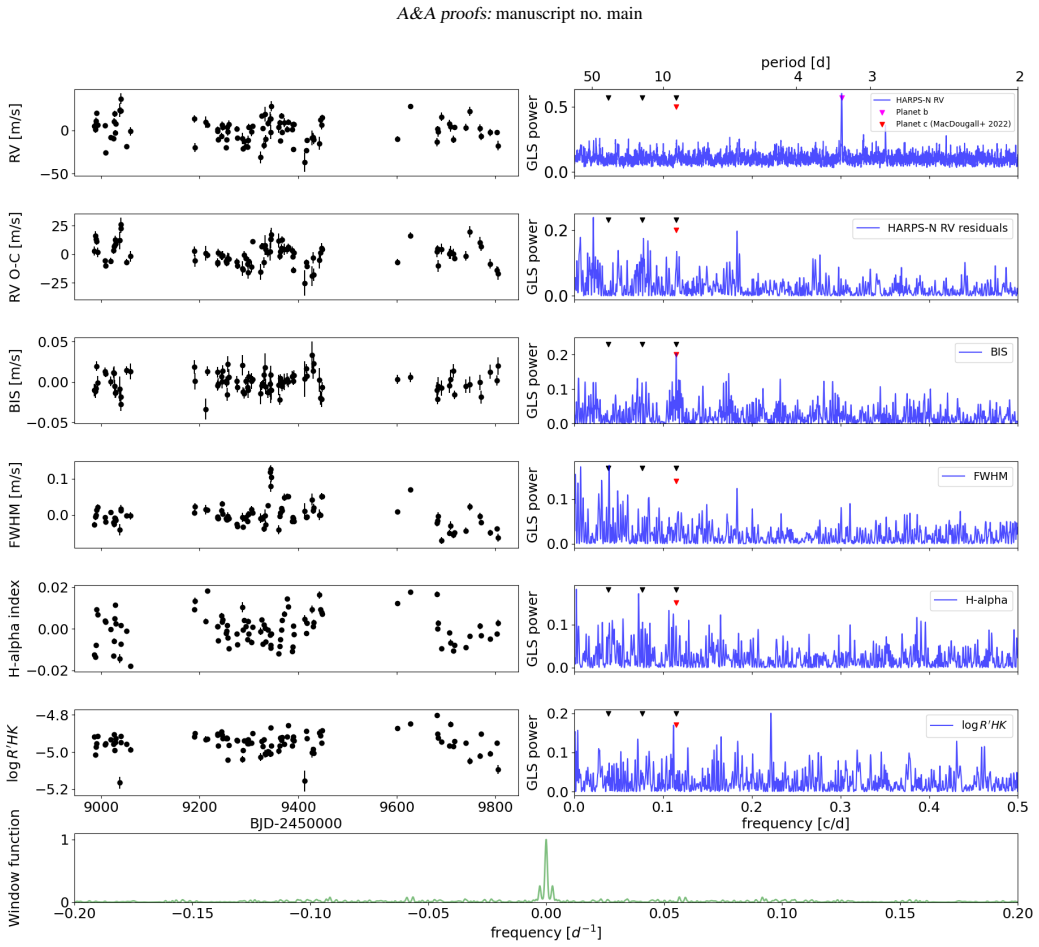
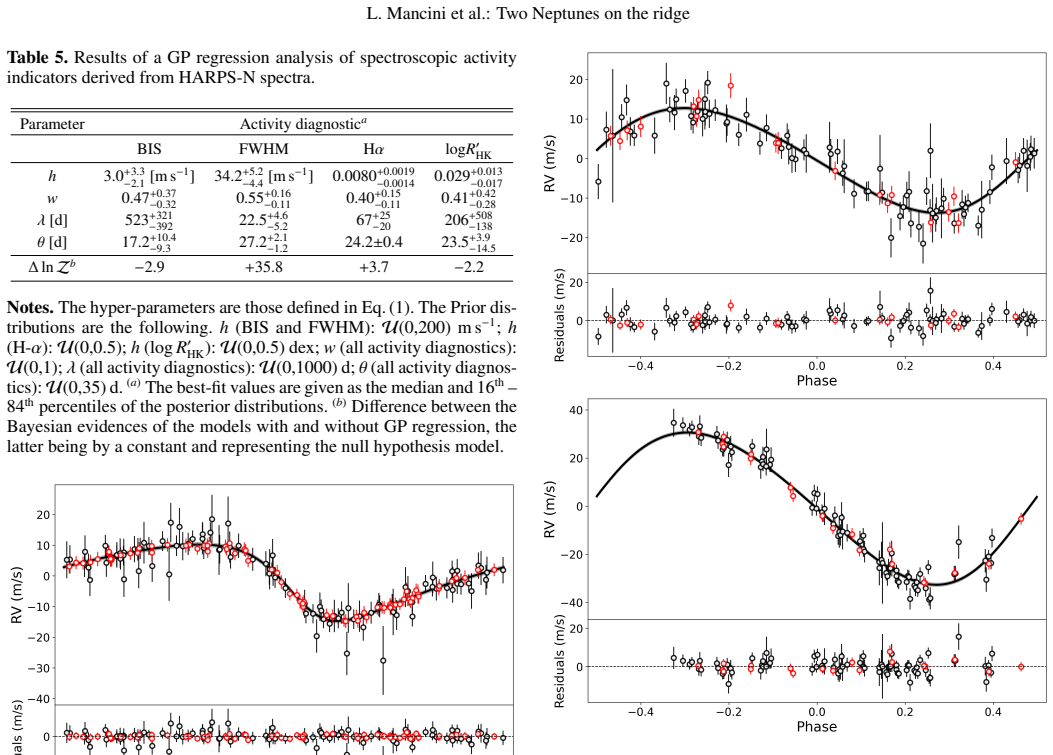
Using available photometry along with new and archival high-precision radial-velocity measurements, joint-fit analyses that included Gaussian-process regressions for modeling stellar activity in TOI-1272 identify the radial-velocity variation found in the archival data as stellar activity rather than planetary in nature. This leads to rejection of the non-transiting planet TOI-1272 c. The larger number of data points also shows that both planets in TOI-1694 move on slightly eccentric orbits, with the current orbital architecture suggesting a history of migration driven by both disc and dynamical interactions. Final parameter estimates for the two systems are consistent with previous measurem
What carries the argument
Joint-fit analyses incorporating Gaussian-process regressions to model stellar activity in radial-velocity data
If this is right
- The eccentricity of the transiting planet in TOI-1272 may result from high-eccentricity migration.
- Both planets in the TOI-1694 system move on slightly eccentric orbits.
- The orbital architecture of TOI-1694 indicates a migration history involving both disc and dynamical interactions.
- Parameter estimates for both systems have smaller uncertainties than before.
Where Pith is reading between the lines
- Similar reanalyses of other systems with limited radial-velocity data could retract additional planet candidates if activity is properly modeled.
- Distinguishing activity from planets in radial-velocity data may require even more observations to confirm the absence of signals.
- Understanding migration pathways for hot Neptunes benefits from cases where eccentricity is linked to specific mechanisms.
Load-bearing premise
The Gaussian-process regression accurately models the stellar activity-induced radial-velocity variations without removing or creating a false planetary signal.
What would settle it
New radial-velocity observations that reveal a periodic signal at the period of the retracted planet, uncorrelated with stellar activity indicators, would challenge the conclusion that it is activity.
Figures
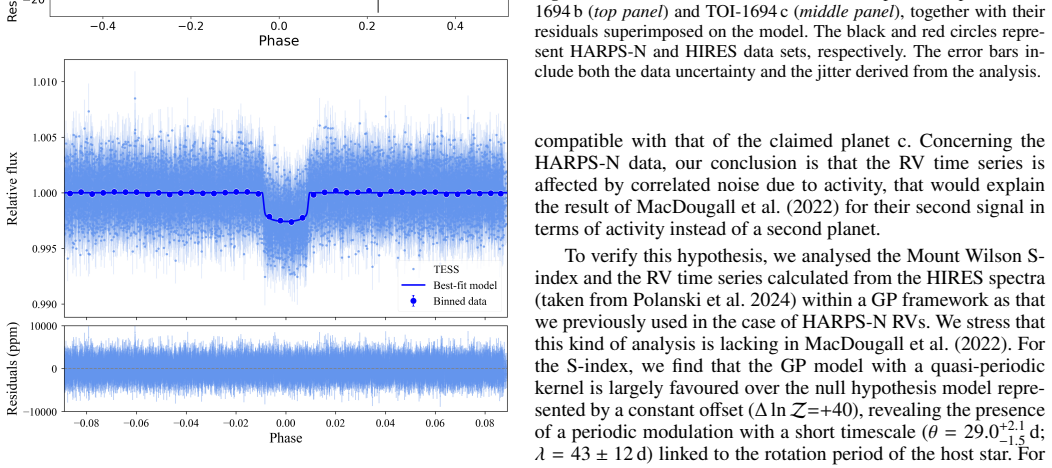
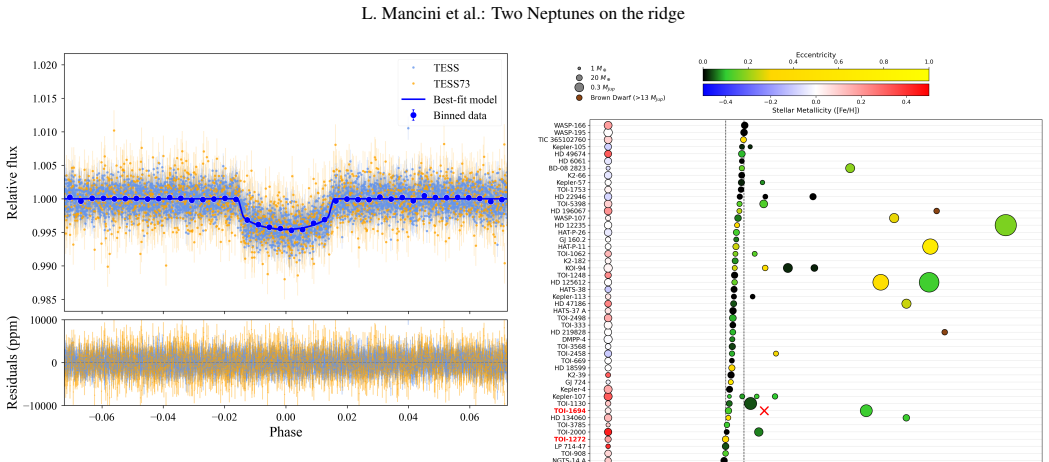
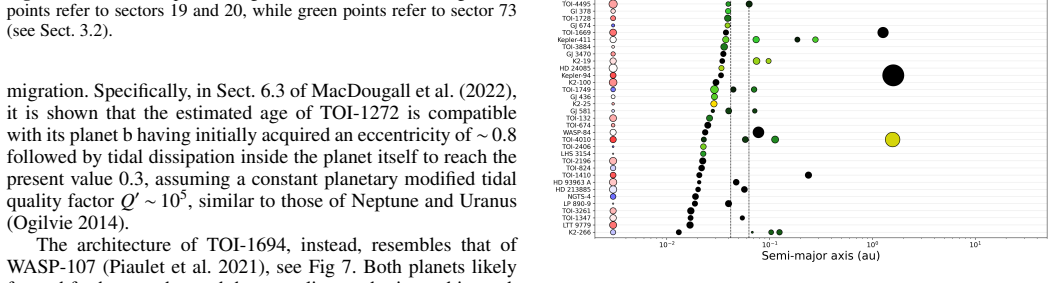
read the original abstract
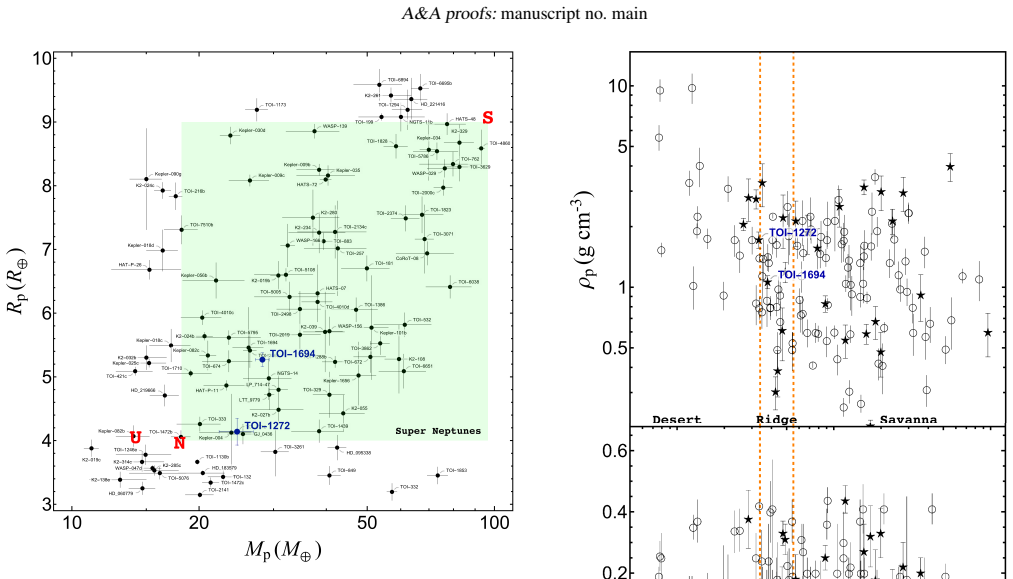
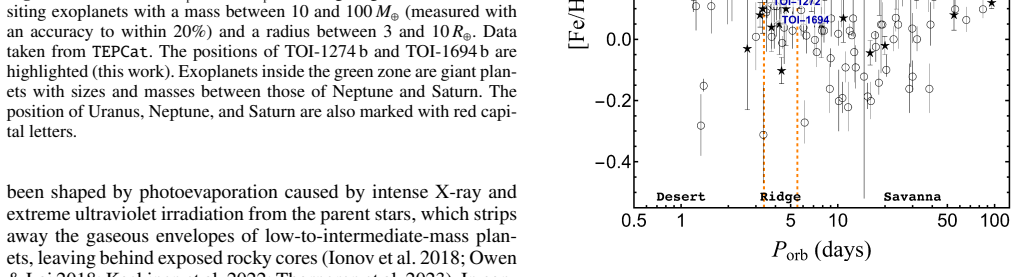
Hot Neptunes are close-in exoplanets that occupy a sparsely populated region of parameter space known as the "hot-Neptune desert". Their presence in this extreme environment is puzzling as it implies a complex history involving intense stellar radiation, atmospheric loss, and unique migration patterns, different from Neptunes at larger orbital periods. We are running an observational programme conceived to enlarge the number of close-in Neptune-sized planets, with well-measured physical and orbital parameters, with the aim of contributing to obtaining a statistically significant sample needed to clarify what the formation and migration pathways of this class of exoplanets are. We used currently available TESS photometry, along with new (HARPS-N) and archival (HIRES) high-precision radial-velocity measurements, to review the main properties of the planetary systems TOI-1272 and TOI-1694 by means of joint-fit analyses that, in the case of TOI-1272, included Gaussian-process regressions for carefully modelling stellar activity. Our final estimates of the parameters of the two systems are consistent with previous measurements but have smaller uncertainties. We identified the radial-velocity variation of TOI-1272 found in the HIRES data as stellar activity rather than planetary in nature and, therefore, rejected the non-transiting planet TOI-1272c. This opens up the possibility that TOI-1272b's eccentricity is the result of high-eccentricity migration. The larger number of data at our disposal also allowed us to point out that both TOI-1694b and TOI-1694c move on slightly eccentric orbits. The current orbital architecture of TOI-1694 suggests a history of migration driven by both disc and dynamical interactions.
Editorial analysis
A structured set of objections, weighed in public.
Referee Report
Summary. The paper reanalyzes the TOI-1272 and TOI-1694 systems with TESS photometry plus new HARPS-N and archival HIRES radial velocities. Joint fits are performed; for TOI-1272 these incorporate Gaussian-process regressions to model stellar activity. Refined orbital and physical parameters are reported for both systems. The HIRES RV signal previously interpreted as the non-transiting planet TOI-1272c is instead attributed entirely to activity, leading to retraction of that planet. The architecture of TOI-1694 is interpreted as evidence for mixed disc and dynamical migration.
Significance. If the GP-based attribution of the HIRES signal to activity is robust, the retraction removes a candidate from the hot-Neptune sample and strengthens the case for high-eccentricity migration of TOI-1272b. The work also supplies tighter constraints on two systems that can be used in population studies of close-in Neptunes.
major comments (2)
- [joint-fit analysis for TOI-1272 (abstract and methods description)] The retraction of TOI-1272c rests on the assertion that a GP regression fully accounts for the HIRES RV variation as stellar activity. The manuscript provides no Bayes-factor comparison between a GP-only model and a GP+Keplerian model at the previously reported planetary period, nor injection-recovery tests on the actual HIRES time series. Given that quasi-periodic kernels are known to be flexible enough to absorb low-amplitude periodic signals near the stellar rotation period, this omission leaves the central claim without a direct statistical demonstration.
- [Gaussian-process regressions for TOI-1272] The abstract states that the GP regressions were used “for carefully modelling stellar activity,” yet no details are given on kernel choice, hyperparameter priors, or convergence diagnostics that would allow an independent assessment of whether the activity model is over-flexible.
minor comments (1)
- [TOI-1694 results] The abstract refers to “slightly eccentric orbits” for TOI-1694b and c; the corresponding eccentricity values and their uncertainties should be stated explicitly in the text or a table so that the dynamical-migration interpretation can be evaluated quantitatively.
Simulated Author's Rebuttal
We thank the referee for their careful and constructive review. We address the major comments point by point below and will revise the manuscript accordingly to strengthen the statistical justification for our conclusions.
read point-by-point responses
-
Referee: [joint-fit analysis for TOI-1272 (abstract and methods description)] The retraction of TOI-1272c rests on the assertion that a GP regression fully accounts for the HIRES RV variation as stellar activity. The manuscript provides no Bayes-factor comparison between a GP-only model and a GP+Keplerian model at the previously reported planetary period, nor injection-recovery tests on the actual HIRES time series. Given that quasi-periodic kernels are known to be flexible enough to absorb low-amplitude periodic signals near the stellar rotation period, this omission leaves the central claim without a direct statistical demonstration.
Authors: We agree that a Bayes-factor comparison and injection-recovery tests would provide a more direct statistical demonstration. In the revised manuscript we will add these analyses, including the computation of the Bayes factor between the GP-only and GP+Keplerian models at the reported period, as well as injection-recovery tests performed on the HIRES time series to quantify the risk that the GP absorbs a low-amplitude planetary signal. revision: yes
-
Referee: [Gaussian-process regressions for TOI-1272] The abstract states that the GP regressions were used “for carefully modelling stellar activity,” yet no details are given on kernel choice, hyperparameter priors, or convergence diagnostics that would allow an independent assessment of whether the activity model is over-flexible.
Authors: We acknowledge that additional details on the GP implementation are required for reproducibility and to address concerns about flexibility. The revised manuscript will expand the methods section to specify the kernel (quasi-periodic), the priors placed on all hyperparameters, and the convergence diagnostics employed (e.g., Gelman-Rubin statistics and autocorrelation times). revision: yes
Circularity Check
No significant circularity; analysis relies on external RV and photometric datasets with standard GP modeling
full rationale
The paper performs joint fits to TESS photometry plus new HARPS-N and archival HIRES RVs, using Gaussian-process regression to model stellar activity in the TOI-1272 system. The retraction of TOI-1272c follows from the GP-only model accounting for the HIRES signal, but this is a data-driven model comparison on independent observations rather than a self-definitional loop, fitted input renamed as prediction, or load-bearing self-citation. No equations or steps reduce by construction to the target claim; the GP kernel choice is conventional and the result remains falsifiable against the raw time series. The derivation chain is therefore self-contained against external benchmarks.
Axiom & Free-Parameter Ledger
free parameters (2)
- Gaussian process hyperparameters
- Orbital parameters (periods, eccentricities, masses)
axioms (1)
- domain assumption Radial velocity signals from stellar activity can be modeled using Gaussian processes and distinguished from Keplerian planetary signals with sufficient data.
Reference graph
Works this paper leans on
-
[1]
The Eccentric Kozai-Lidov Effect and Its Applications
The Eccentric Kozai-Lidov Effect and Its Applications. , keywords =. doi:10.1146/annurev-astro-081915-023315 , archivePrefix =. 1601.07175 , primaryClass =
work page internal anchor Pith review Pith/arXiv arXiv doi:10.1146/annurev-astro-081915-023315
-
[2]
Calculating the Tidal, Spin, and Dynamical Evolution of Extrasolar Planetary Systems. , keywords =. doi:10.1086/340752 , adsurl =
-
[3]
Tidal Evolution of Close-in Extra-Solar Planets
Tidal Evolution of Close-in Extrasolar Planets. , keywords =. doi:10.1086/529187 , archivePrefix =. 0802.1543 , primaryClass =
work page internal anchor Pith review Pith/arXiv arXiv doi:10.1086/529187
-
[4]
Tidal dissipation in stars and giant planets
Tidal Dissipation in Stars and Giant Planets. , keywords =. doi:10.1146/annurev-astro-081913-035941 , archivePrefix =. 1406.2207 , primaryClass =
work page internal anchor Pith review Pith/arXiv arXiv doi:10.1146/annurev-astro-081913-035941
-
[5]
Origins of Hot Jupiters. , keywords =. doi:10.1146/annurev-astro-081817-051853 , archivePrefix =. 1801.06117 , primaryClass =
work page internal anchor Pith review Pith/arXiv arXiv doi:10.1146/annurev-astro-081817-051853
-
[6]
2015, ApJS, 220, 15, doi: 10.1088/0067-0049/220/1/15
Modules for Experiments in Stellar Astrophysics (MESA): Binaries, Pulsations, and Explosions. , keywords =. doi:10.1088/0067-0049/220/1/15 , archivePrefix =. 1506.03146 , primaryClass =
work page internal anchor Pith review Pith/arXiv arXiv doi:10.1088/0067-0049/220/1/15
-
[7]
EXOFASTv2: Generalized publication-quality exoplanet modeling code
-
[8]
EXOFASTv2: A public, generalized, publication-quality exoplanet modeling code
EXOFASTv2: A public, generalized, publication-quality exoplanet modeling code. , keywords =. doi:10.48550/arXiv.1907.09480 , archivePrefix =. 1907.09480 , primaryClass =
work page internal anchor Pith review Pith/arXiv arXiv doi:10.48550/arxiv.1907.09480 1907
-
[9]
A New Age─Activity Relation For Solar Analogs that Accounts for Metallicity. , keywords =. doi:10.3847/2041-8213/adc382 , archivePrefix =. 2504.17482 , primaryClass =
-
[10]
The Solar Twin Planet Search: The age - chromospheric activity relation
The Solar Twin Planet Search. The age-chromospheric activity relation. , keywords =. doi:10.1051/0004-6361/201629294 , archivePrefix =. 1806.08014 , primaryClass =
work page internal anchor Pith review Pith/arXiv arXiv doi:10.1051/0004-6361/201629294
-
[11]
Wide binaries demonstrate the consistency of rotational evolution between open cluster and field stars. , keywords =. doi:10.1051/0004-6361/202346590 , archivePrefix =. 2307.10836 , primaryClass =
-
[12]
Search for exoplanets with the radial-velocity technique: quantitative diagnostics of stellar activity. , keywords =. doi:10.1051/0004-6361:20078144 , archivePrefix =. 0708.4338 , primaryClass =
work page internal anchor Pith review Pith/arXiv arXiv doi:10.1051/0004-6361:20078144
-
[13]
Based on TESS and HARPS observations
The correlation between photometric variability and radial velocity jitter. Based on TESS and HARPS observations. , keywords =. doi:10.1051/0004-6361/202038035 , archivePrefix =. 2005.10105 , primaryClass =
-
[14]
Variability of stellar granulation and convective blueshift with spectral type and magnetic activity. I. K and G main sequence stars. , keywords =. doi:10.1051/0004-6361/201629052 , archivePrefix =. 1610.02168 , primaryClass =
work page internal anchor Pith review Pith/arXiv arXiv doi:10.1051/0004-6361/201629052
-
[15]
The TESS-Keck Survey. XIII. An Eccentric Hot Neptune with a Similar-mass Outer Companion around TOI-1272. , keywords =. doi:10.3847/1538-3881/ac7ce1 , archivePrefix =. 2206.14327 , primaryClass =
-
[16]
TESS-Keck Survey. XIV. Two Giant Exoplanets from the Distant Giants Survey. , keywords =. doi:10.3847/1538-3881/aca6ef , archivePrefix =. 2209.06958 , primaryClass =
-
[17]
Efficient, uninformative sampling of limb darkening coefficients for two-parameter laws
Efficient, uninformative sampling of limb darkening coefficients for two-parameter laws. , keywords =. doi:10.1093/mnras/stt1435 , archivePrefix =. 1308.0009 , primaryClass =
work page internal anchor Pith review Pith/arXiv arXiv doi:10.1093/mnras/stt1435
-
[18]
A Framework for Prioritizing the TESS Planetary Candidates Most Amenable to Atmospheric Characterization. , keywords =. doi:10.1088/1538-3873/aadf6f , archivePrefix =. 1805.03671 , primaryClass =
work page internal anchor Pith review Pith/arXiv arXiv doi:10.1088/1538-3873/aadf6f
-
[19]
The generalised Lomb-Scargle periodogram. A new formalism for the floating-mean and Keplerian periodograms. , keywords =. doi:10.1051/0004-6361:200811296 , archivePrefix =. 0901.2573 , primaryClass =
work page internal anchor Pith review Pith/arXiv arXiv doi:10.1051/0004-6361:200811296
-
[20]
An Obliquity Measurement of the Hot Neptune TOI-1694b. , keywords =. doi:10.3847/1538-3881/adb71b , archivePrefix =. 2412.07950 , primaryClass =
-
[21]
VaTEST. II. Statistical Validation of 11 TESS-detected Exoplanets Orbiting K-type Stars. , keywords =. doi:10.3847/1538-3881/acd548 , archivePrefix =. 2301.09865 , primaryClass =
-
[22]
The TESS-Keck Survey. XX. 15 New TESS Planets and a Uniform RV Analysis of All Survey Targets. , keywords =. doi:10.3847/1538-4365/ad4484 , archivePrefix =. 2405.14786 , primaryClass =
-
[23]
The TESS-Keck Survey. XV. Precise Properties of 108 TESS Planets and Their Host Stars. , keywords =. doi:10.3847/1538-3881/acd557 , archivePrefix =. 2306.00251 , primaryClass =
-
[24]
Importance Nested Sampling and the MultiNest Algorithm
Importance Nested Sampling and the MultiNest Algorithm. OJAp , keywords =. doi:10.21105/astro.1306.2144 , archivePrefix =. 1306.2144 , primaryClass =
work page internal anchor Pith review Pith/arXiv arXiv doi:10.21105/astro.1306.2144
-
[25]
X-ray spectral modelling of the AGN obscuring region in the CDFS: Bayesian model selection and catalogue. , keywords =. doi:10.1051/0004-6361/201322971 , archivePrefix =. 1402.0004 , primaryClass =
work page internal anchor Pith review Pith/arXiv arXiv doi:10.1051/0004-6361/201322971
-
[26]
IEEE Transactions on Pattern Analysis and Machine Intel
Fast Direct Methods for Gaussian Processes. IEEE Transactions on Pattern Analysis and Machine Intel. , keywords =. 2015. doi:10.1109/TPAMI.2015.2448083 , archivePrefix =. 1403.6015 , primaryClass =
-
[27]
HIRES: the high-resolution echelle spectrometer on the Keck 10-m Telescope. Instrum. in Astron. VIII , year = 1994, editor =. doi:10.1117/12.176725 , adsurl =
-
[28]
The TESS-Keck Survey: Science Goals and Target Selection. , keywords =. doi:10.3847/1538-3881/ac6266 , archivePrefix =. 2106.06156 , primaryClass =
-
[29]
Ground-based and Airborne Instrumentation for Astronomy X , year = 2024, editor =
System design of the Keck Planet Finder. Ground-based and Airborne Instrumentation for Astronomy X , year = 2024, editor =. doi:10.1117/12.3017841 , adsurl =
-
[30]
Ground-based and Airborne Instrumentation for Astronomy IV , year = 2012, editor =
Harps-N: the new planet hunter at TNG. Ground-based and Airborne Instrumentation for Astronomy IV , year = 2012, editor =. doi:10.1117/12.925738 , adsurl =
-
[31]
Ground-based and Airborne Instrumentation for Astronomy V , year = 2014, editor =
HARPS-N @ TNG, two year harvesting data: performances and results. Ground-based and Airborne Instrumentation for Astronomy V , year = 2014, editor =. doi:10.1117/12.2055813 , adsurl =
-
[32]
Three years of HARPS-N high-resolution spectroscopy and precise radial velocity data for the Sun. , keywords =. doi:10.1051/0004-6361/202039350 , archivePrefix =. 2009.01945 , primaryClass =
-
[33]
The GAPS Programme at TNG. XXXV. Fundamental properties of transiting exoplanet host stars. , keywords =. doi:10.1051/0004-6361/202243467 , archivePrefix =. 2205.15796 , primaryClass =
-
[34]
New Grids of ATLAS9 Model Atmospheres
New Grids of ATLAS9 Model Atmospheres. Modelling of Stellar Atmospheres , year = 2003, editor =. doi:10.48550/arXiv.astro-ph/0405087 , archivePrefix =. astro-ph/0405087 , primaryClass =
work page internal anchor Pith review Pith/arXiv arXiv doi:10.48550/arxiv.astro-ph/0405087 2003
-
[35]
, year = 1973, month = sep, volume =
The nitrogen abundance of the very metal-poor star HD 122563. , year = 1973, month = sep, volume =. doi:10.1086/152374 , adsurl =
-
[36]
ARES v2 - new features and improved performance
ARES v2: new features and improved performance. , keywords =. doi:10.1051/0004-6361/201425463 , archivePrefix =. 1504.02725 , primaryClass =
work page internal anchor Pith review Pith/arXiv arXiv doi:10.1051/0004-6361/201425463
-
[37]
Spectral Properties of Cool Stars: Extended Abundance Analysis of 1617 Planet Search Stars
Spectral Properties of Cool Stars: Extended Abundance Analysis of 1,617 Planet-search Stars. , keywords =. doi:10.3847/0067-0049/225/2/32 , archivePrefix =. 1606.07929 , primaryClass =
work page internal anchor Pith review Pith/arXiv arXiv doi:10.3847/0067-0049/225/2/32
-
[38]
Characterization of the planetary system Kepler-101 with HARPS-N. A hot super-Neptune with an Earth-sized low-mass companion. , keywords =. doi:10.1051/0004-6361/201424617 , archivePrefix =. 1409.4592 , primaryClass =
work page internal anchor Pith review Pith/arXiv arXiv doi:10.1051/0004-6361/201424617
-
[39]
HATS-7b: A Hot Super Neptune Transiting a Quiet K Dwarf Star
HATS-7b: A Hot Super Neptune Transiting a Quiet K Dwarf Star. , keywords =. doi:10.1088/0004-637X/813/2/111 , archivePrefix =. 1507.01024 , primaryClass =
work page internal anchor Pith review Pith/arXiv arXiv doi:10.1088/0004-637x/813/2/111
-
[40]
HATS-8b: A Low-Density Transiting Super-Neptune
HATS-8b: A Low-density Transiting Super-Neptune. , keywords =. doi:10.1088/0004-6256/150/2/49 , archivePrefix =. 1506.01334 , primaryClass =
work page internal anchor Pith review Pith/arXiv arXiv doi:10.1088/0004-6256/150/2/49
-
[41]
Radial velocity confirmation of a hot super-Neptune discovered by TESS with a warm Saturn-mass companion. , keywords =. doi:10.1093/mnras/stac3684 , archivePrefix =. 2211.17035 , primaryClass =
-
[42]
TOI-5005 b: A super-Neptune in the savanna near the ridge. , keywords =. doi:10.1051/0004-6361/202451656 , archivePrefix =. 2409.18129 , primaryClass =
-
[43]
A First Comparison of Kepler Planet Candidates in Single and Multiple Systems
A First Comparison of Kepler Planet Candidates in Single and Multiple Systems. , keywords =. doi:10.1088/2041-8205/732/2/L24 , archivePrefix =. 1103.3896 , primaryClass =
work page internal anchor Pith review Pith/arXiv arXiv doi:10.1088/2041-8205/732/2/l24 2041
-
[44]
A short-period censor of sub-Jupiter mass exoplanets with low density
A Short-period Censor of Sub-Jupiter Mass Exoplanets with Low Density. , keywords =. doi:10.1088/2041-8205/727/2/L44 , archivePrefix =. 1012.4791 , primaryClass =
work page internal anchor Pith review Pith/arXiv arXiv doi:10.1088/2041-8205/727/2/l44 2041
-
[45]
Kepler planets: a tale of evaporation
Kepler Planets: A Tale of Evaporation. , keywords =. doi:10.1088/0004-637X/775/2/105 , archivePrefix =. 1303.3899 , primaryClass =
work page internal anchor Pith review Pith/arXiv arXiv doi:10.1088/0004-637x/775/2/105
-
[46]
Overcoming the limitations of the energy-limited approximation for planet atmospheric escape
Overcoming the Limitations of the Energy-limited Approximation for Planet Atmospheric Escape. , keywords =. doi:10.3847/2041-8213/aae586 , archivePrefix =. 1810.06920 , primaryClass =
work page internal anchor Pith review Pith/arXiv arXiv doi:10.3847/2041-8213/aae586 2041
-
[47]
Planetary evaporation by UV & X-ray radiation: basic hydrodynamics. , keywords =. doi:10.1111/j.1365-2966.2012.21481.x , archivePrefix =. 1206.2367 , primaryClass =
-
[48]
The Role of Core Mass in Controlling Evaporation: The Kepler Radius Distribution and the Kepler-36 Density Dichotomy. , keywords =. doi:10.1088/0004-637X/776/1/2 , archivePrefix =. 1305.0269 , primaryClass =
work page internal anchor Pith review Pith/arXiv arXiv doi:10.1088/0004-637x/776/1/2
-
[49]
On the origin of the sub-Jovian desert in the orbital-period--planetary-mass plane
On the Origin of the Sub-Jovian Desert in the Orbital-period-Planetary-mass Plane. , keywords =. doi:10.3847/2041-8205/820/1/L8 , archivePrefix =. 1603.00414 , primaryClass =
work page internal anchor Pith review Pith/arXiv arXiv doi:10.3847/2041-8205/820/1/l8 2041
-
[50]
Photoevaporation and High-Eccentricity Migration Created the Sub-Jovian Desert
Photoevaporation and high-eccentricity migration created the sub-Jovian desert. , keywords =. doi:10.1093/mnras/sty1760 , archivePrefix =. 1807.00012 , primaryClass =
work page internal anchor Pith review Pith/arXiv arXiv doi:10.1093/mnras/sty1760
-
[51]
The Upper Edge of the Neptune Desert Is Stable Against Photoevaporation. , keywords =. doi:10.3847/1538-3881/ac92f2 , archivePrefix =. 2204.11865 , primaryClass =
-
[52]
Parameter dependence along the main sequence
Sub-Jovian desert of exoplanets at its boundaries. Parameter dependence along the main sequence. , keywords =. doi:10.1051/0004-6361/202244846 , archivePrefix =. 2301.01065 , primaryClass =
-
[53]
Mapping the exo-Neptunian landscape: A ridge between the desert and savanna. , keywords =. doi:10.1051/0004-6361/202450957 , archivePrefix =. 2409.10517 , primaryClass =
-
[54]
The All-Sky Automated Survey for Supernovae (ASAS-SN) Light Curve Server v1.0
The All-Sky Automated Survey for Supernovae (ASAS-SN) Light Curve Server v1.0. , keywords =. doi:10.1088/1538-3873/aa80d9 , archivePrefix =. 1706.07060 , primaryClass =
work page internal anchor Pith review Pith/arXiv arXiv doi:10.1088/1538-3873/aa80d9
-
[55]
dynesty: A Dynamic Nested Sampling Package for Estimating Bayesian Posteriors and Evidences
DYNESTY: a dynamic nested sampling package for estimating Bayesian posteriors and evidences. , keywords =. doi:10.1093/mnras/staa278 , archivePrefix =. 1904.02180 , primaryClass =
work page internal anchor Pith review Pith/arXiv arXiv doi:10.1093/mnras/staa278 1904
-
[56]
juliet: a versatile modelling tool for transiting and non-transiting exoplanetary systems. , keywords =. doi:10.1093/mnras/stz2688 , archivePrefix =. 1812.08549 , primaryClass =
-
[57]
Fast and scalable Gaussian process modeling with applications to astronomical time series
Fast and Scalable Gaussian Process Modeling with Applications to Astronomical Time Series. , keywords =. doi:10.3847/1538-3881/aa9332 , archivePrefix =. 1703.09710 , primaryClass =
work page internal anchor Pith review Pith/arXiv arXiv doi:10.3847/1538-3881/aa9332
-
[58]
ArXiv e-prints , archivePrefix = "arXiv", eprint =
An Apodized Kepler Periodogram for Separating Planetary and Stellar Activity Signals. ArXiv e-prints , archivePrefix = "arXiv", eprint =
-
[59]
Application to disentangling planets and stellar activity in radial velocities
Testing whether a signal is strictly periodic. Application to disentangling planets and stellar activity in radial velocities. , keywords =. doi:10.1051/0004-6361/202141197 , archivePrefix =. 2106.01365 , primaryClass =
-
[60]
2025, AJ, 169, 117, doi: 10.3847/1538-3881/ada143
The Hottest Neptunes Orbit Metal-rich Stars. , keywords =. doi:10.3847/1538-3881/ada143 , archivePrefix =. 2412.13245 , primaryClass =
-
[61]
Exploring the Neptunian desert: insights from a homogeneous planetary sample. , keywords =. doi:10.1093/mnras/staf670 , archivePrefix =. 2504.16164 , primaryClass =
-
[62]
LAMOST telescope reveals that Neptunian cousins of hot Jupiters are mostly single offspring of stars that are rich in heavy elements. Proceedings of the National Academy of Science , keywords =. doi:10.1073/pnas.1711406115 , archivePrefix =. 1706.07807 , primaryClass =
work page internal anchor Pith review Pith/arXiv arXiv doi:10.1073/pnas.1711406115
-
[63]
Homogeneous studies of transiting extrasolar planets - IV. Thirty systems with space-based light curves. , keywords =. doi:10.1111/j.1365-2966.2011.19399.x , archivePrefix =. 1107.1235 , primaryClass =
-
[64]
Kepler Presearch Data Conditioning I Architecture and Algorithms for Error Correction in Kepler Light Curves. , keywords =. doi:10.1086/667698 , archivePrefix =. 1203.1382 , primaryClass =
work page internal anchor Pith review Pith/arXiv arXiv doi:10.1086/667698
-
[65]
, year = 2014, month = jan, volume =
Multiscale Systematic Error Correction via Wavelet-Based Bandsplitting in Kepler Data. , year = 2014, month = jan, volume =. doi:10.1086/674989 , adsurl =
-
[66]
Kepler Presearch Data Conditioning II - A Bayesian Approach to Systematic Error Correction
Kepler Presearch Data Conditioning II - A Bayesian Approach to Systematic Error Correction. , keywords =. doi:10.1086/667697 , archivePrefix =. 1203.1383 , primaryClass =
work page internal anchor Pith review Pith/arXiv arXiv doi:10.1086/667697
-
[67]
Lightkurve: Kepler and TESS time series analysis in Python
-
[68]
A homogeneous transit-timing-variation investigation of all TESS systems with a confirmed single-transiting planet. , keywords =. doi:10.1051/0004-6361/202557512 , archivePrefix =. 2511.16504 , primaryClass =
-
[69]
A remnant planetary core in the hot-Neptune desert. , keywords =. doi:10.1038/s41586-020-2421-7 , archivePrefix =. 2003.10314 , primaryClass =
-
[70]
J., Fern´andez Fern´andez, J., et al
TOI-332 b: a super dense Neptune found deep within the Neptunian desert. , keywords =. doi:10.1093/mnras/stad2575 , archivePrefix =. 2308.12137 , primaryClass =
-
[71]
2023, Nature, 622, 255, doi: 10.1038/s41586-023-06499-2
A super-massive Neptune-sized planet. , keywords =. doi:10.1038/s41586-023-06499-2 , archivePrefix =. 2309.01464 , primaryClass =
-
[72]
Shedding Light on Desert Dwellers. , keywords =. doi:10.3847/1538-4357/adfb75 , archivePrefix =. 2509.22893 , primaryClass =
-
[73]
Survival of a planet in short-period Neptunian desert under effect of photo-evaporation
Survival of a planet in short-period Neptunian desert under effect of photoevaporation. , keywords =. doi:10.1093/mnras/sty626 , archivePrefix =. 1803.04278 , primaryClass =
work page internal anchor Pith review Pith/arXiv arXiv doi:10.1093/mnras/sty626
-
[74]
Mass Loss by Atmospheric Escape from Extremely Close-in Planets. , keywords =. doi:10.3847/1538-4357/ac4f45 , archivePrefix =. 2203.06302 , primaryClass =
-
[75]
Removal of Hot Saturns in Mass-Radius Plane by Runaway Mass Loss. , keywords =. doi:10.3847/2041-8213/acbd35 , archivePrefix =. 2211.11770 , primaryClass =
-
[76]
Journal of Astronomical Telescopes, Instruments, and Systems , year = 2015, month = jan, volume =
Transiting Exoplanet Survey Satellite (TESS). JATIS , year = 2015, month = jan, volume =. doi:10.1117/1.JATIS.1.1.014003 , adsurl =
work page internal anchor Pith review doi:10.1117/1.jatis.1.1.014003 2015
-
[77]
An ultrahot Neptune in the Neptune desert. Nat. Astron. , keywords =. doi:10.1038/s41550-020-1142-z , archivePrefix =. 2009.12832 , primaryClass =
-
[78]
Surviving in the Hot-Neptune Desert: The Discovery of the Ultrahot Neptune TOI-3261b. , keywords =. doi:10.3847/1538-3881/ad60be , archivePrefix =. 2407.04225 , primaryClass =
-
[79]
Why do warm Neptunes present nonzero eccentricity?. , keywords =. doi:10.1051/0004-6361/201936967 , archivePrefix =. 2005.02700 , primaryClass =
-
[80]
HATS-38 b and WASP-139 b Join a Growing Group of Hot Neptunes on Polar Orbits. , keywords =. doi:10.3847/1538-3881/ad70b8 , archivePrefix =. 2406.18631 , primaryClass =
discussion (0)
Sign in with ORCID, Apple, or X to comment. Anyone can read and Pith papers without signing in.