Resolved Ages and Stellar Metallicities in Progenitors of Milky Way Analogs: A Closer Look at their Star Formation Histories since z=5
Pith reviewed 2026-06-26 13:31 UTC · model grok-4.3
The pith
Milky Way analog galaxies assemble mass inside-out from z=5, with major mergers causing only temporary gradient disruptions.
A machine-rendered reading of the paper's core claim, the machinery that carries it, and where it could break.
Core claim
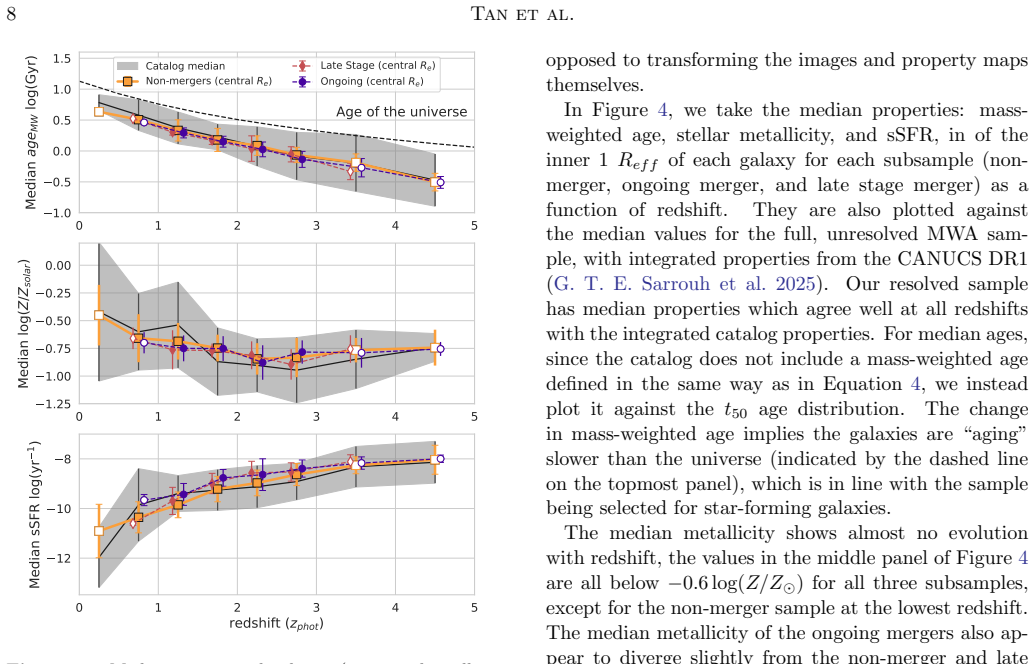
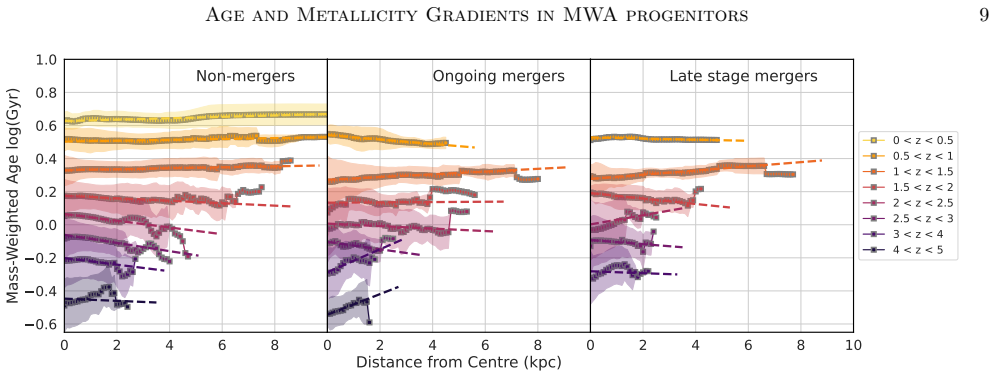
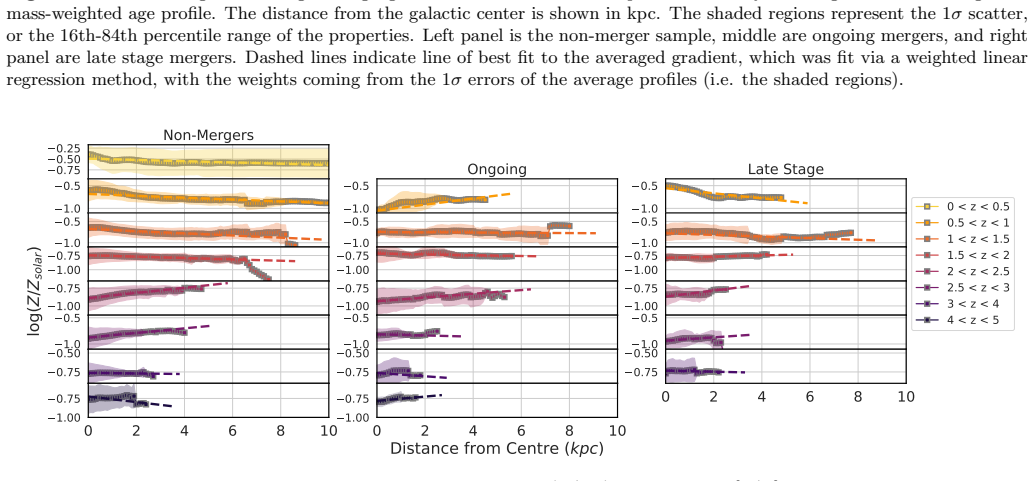
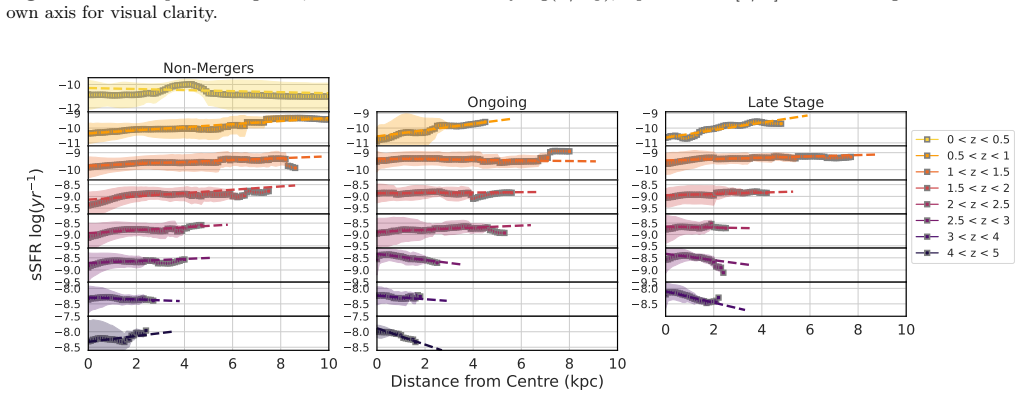
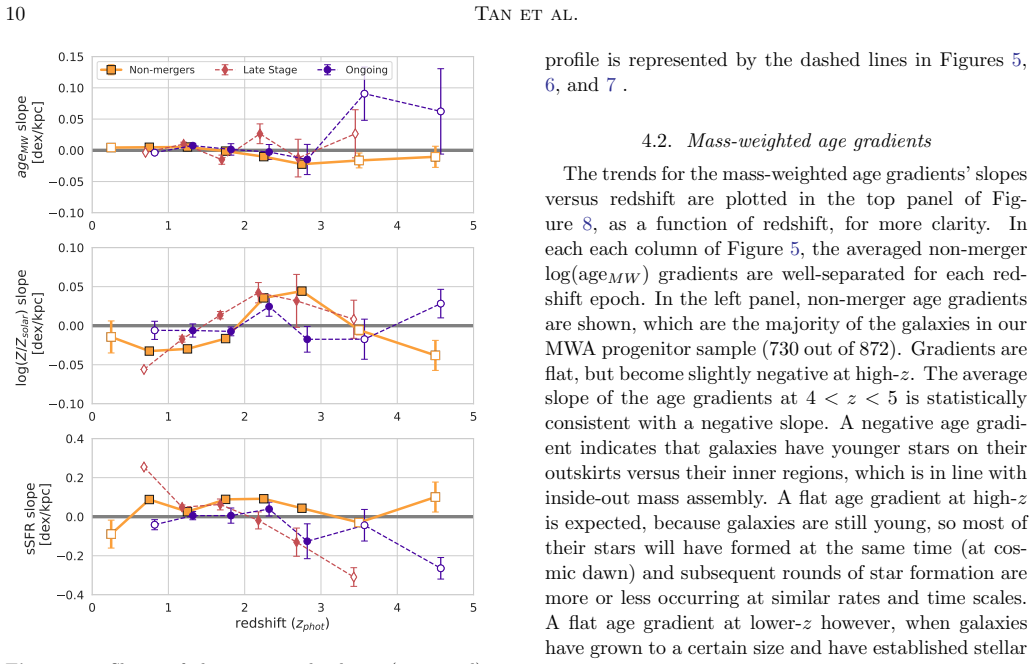
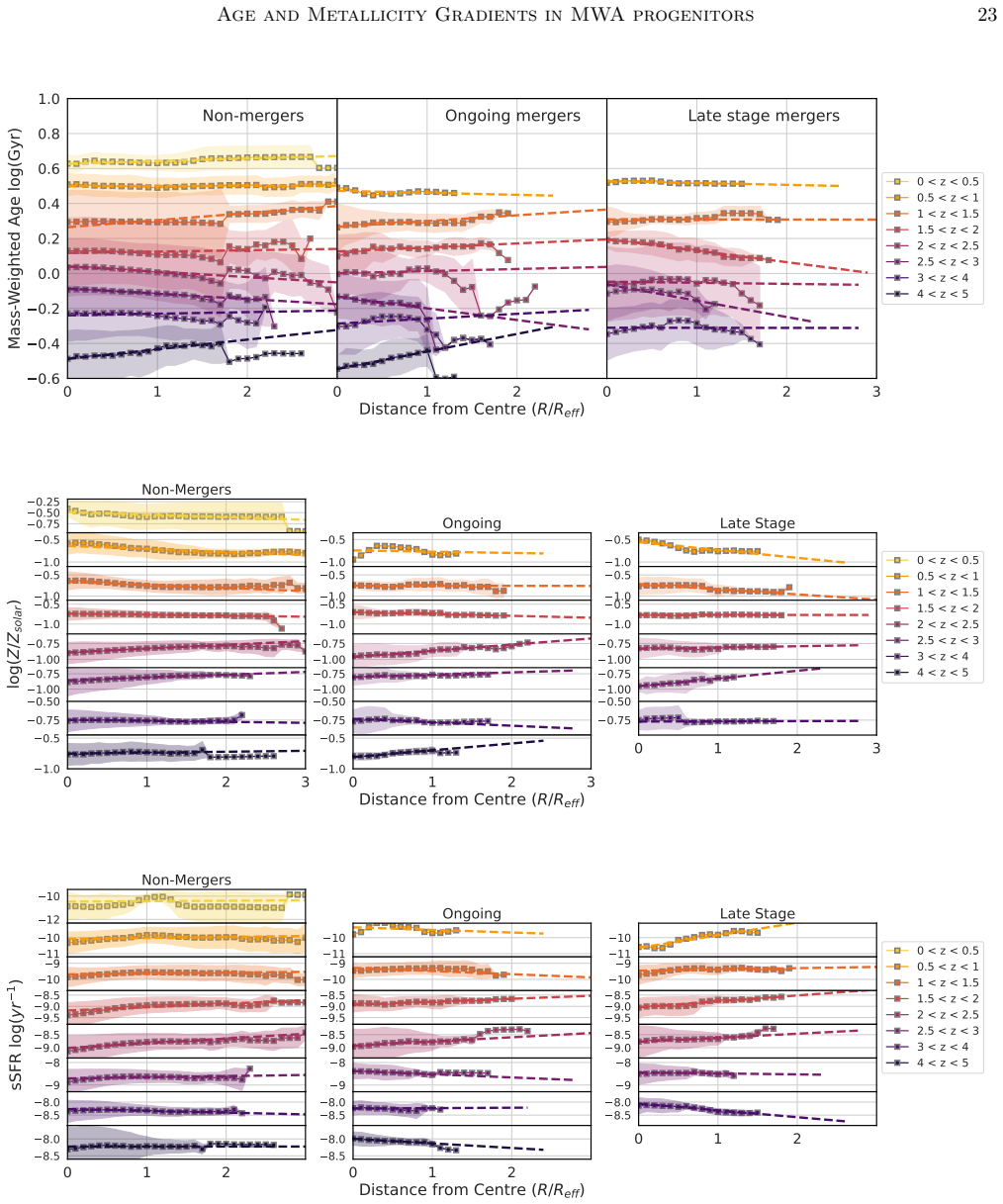
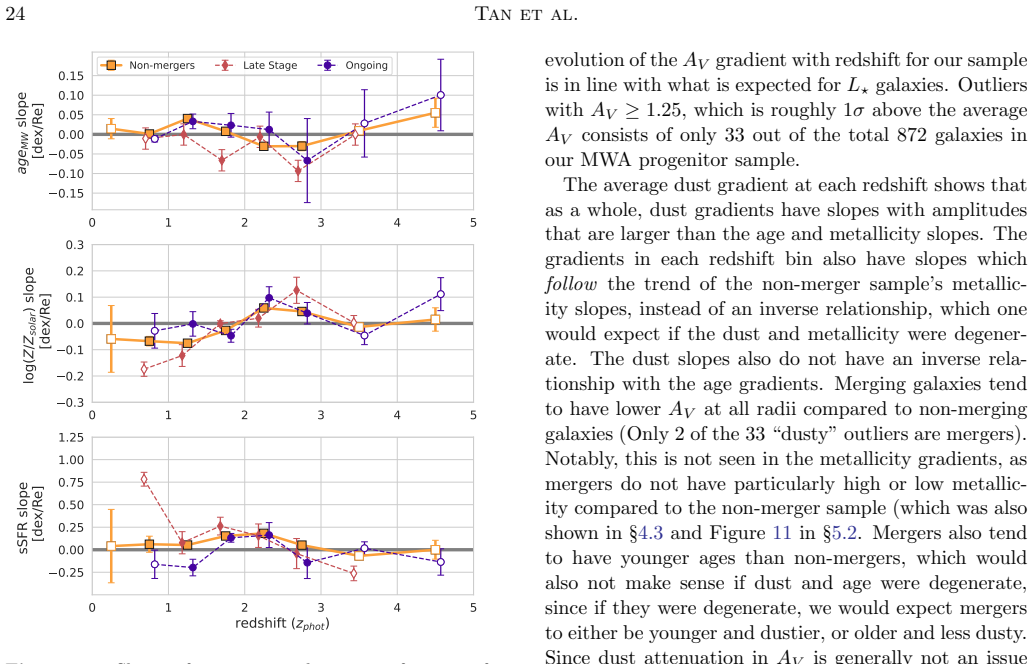
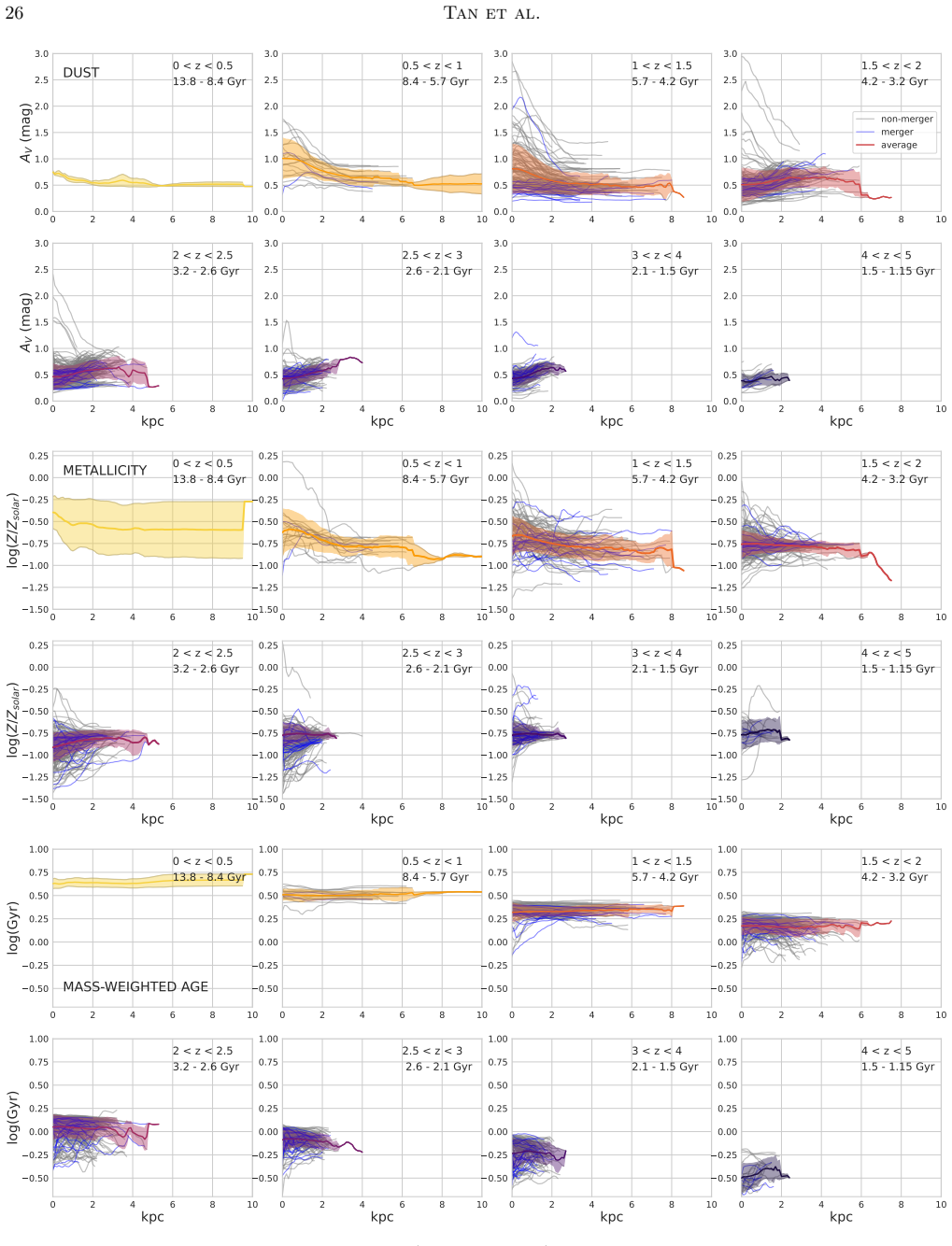
Non-mergers exhibit average age gradients from -0.022 to 0.005 dex/kpc and sSFR gradients from -0.089 to 0.092 dex/kpc, consistent with inside-out assembly, while metallicity gradients range from -0.029 to 0.044 dex/kpc with positive values appearing only at 2<z<3. Mergers show flatter age gradients, more negative sSFR gradients, and comparable metallicity gradients at every redshift. Splitting merger components reveals similar ages and metallicities between galaxies but 0.1-0.4 dex higher sSFR in the less massive component.
What carries the argument
Spatially resolved SED fitting with the non-parametric Dense Basis code applied to CANUCS imaging, combined with Gini-M20 analysis on stellar mass maps via Statmorph to classify ongoing major mergers.
If this is right
- Non-merger MWA progenitors follow inside-out mass assembly at every redshift from z=5 to the present.
- Major mergers produce flatter age gradients and steeper negative sSFR gradients but do not reverse the long-term inside-out trend.
- Merging galaxy pairs maintain similar average ages and metallicities between components.
- The less massive merger component maintains elevated sSFR relative to its partner at all epochs examined.
Where Pith is reading between the lines
- Galaxy formation models must accommodate short-lived merger-driven star-formation enhancements that leave the radial growth direction unchanged.
- Higher-resolution imaging at 2<z<3 could test whether the observed positive metallicity gradients trace specific gas-accretion events.
- The Milky Way's own disk likely experienced similar inside-out growth punctuated by occasional major-merger interruptions.
Load-bearing premise
The Gini-M20 parameter measured on stellar mass maps correctly separates major mergers from non-mergers, and the CANUCS sample galaxies are representative Milky Way analogs whose SED-derived ages and metallicities carry no strong systematic bias from dust or assumed star-formation histories.
What would settle it
A sample of non-merger Milky Way analogs showing positive age gradients across multiple redshift bins or lacking inside-out signatures in aggregate would falsify the central claim.
Figures
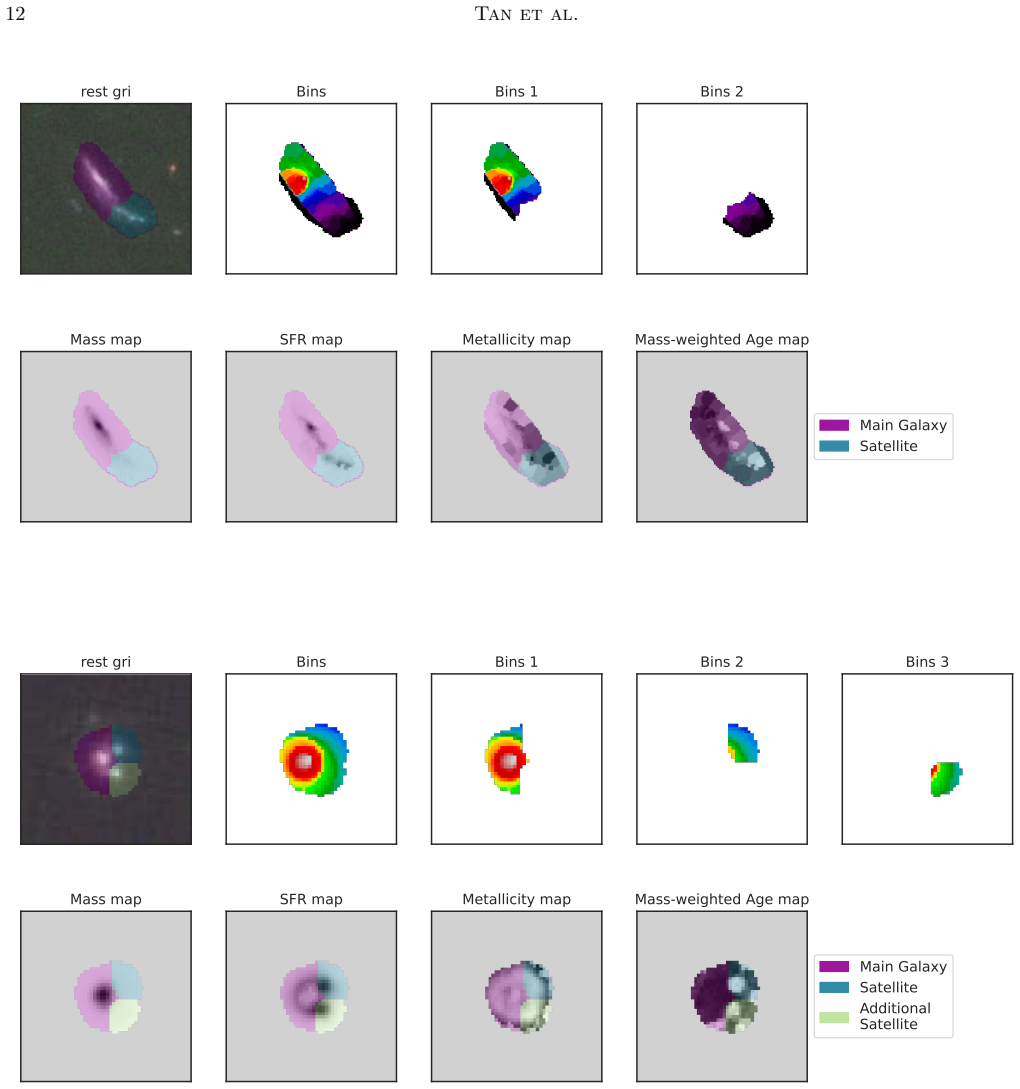
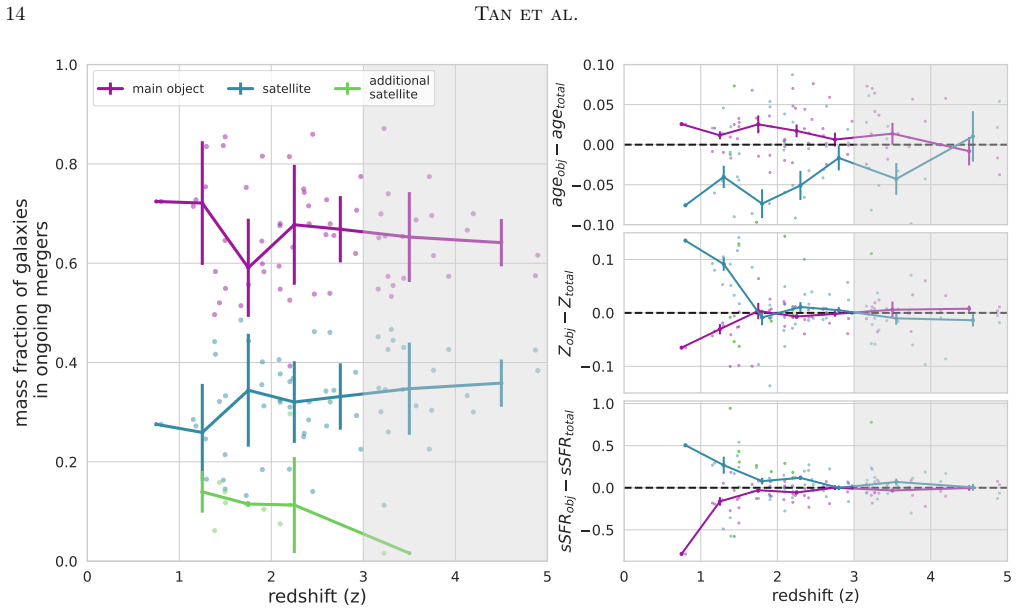
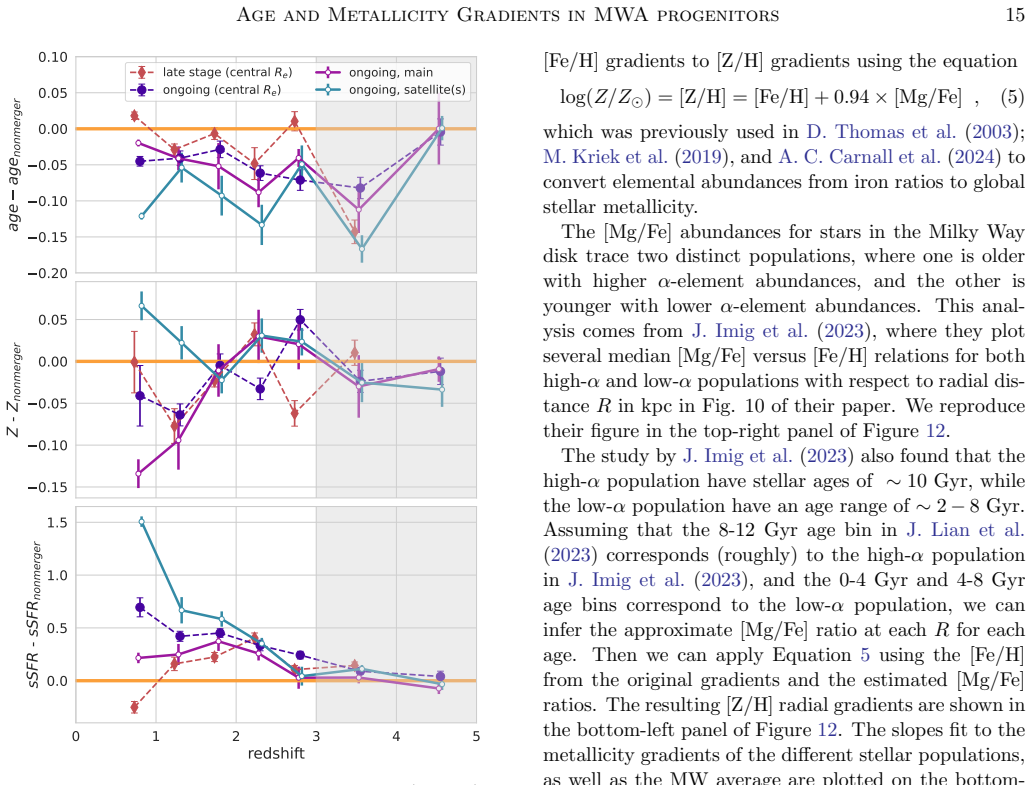
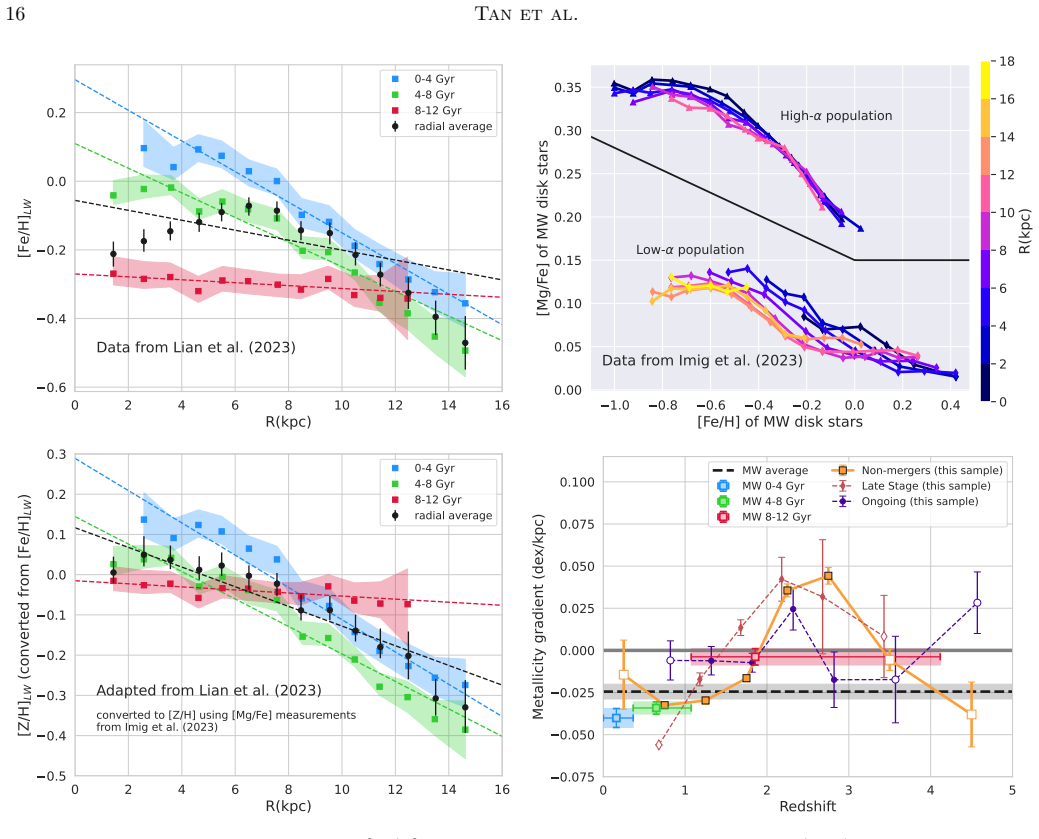
read the original abstract
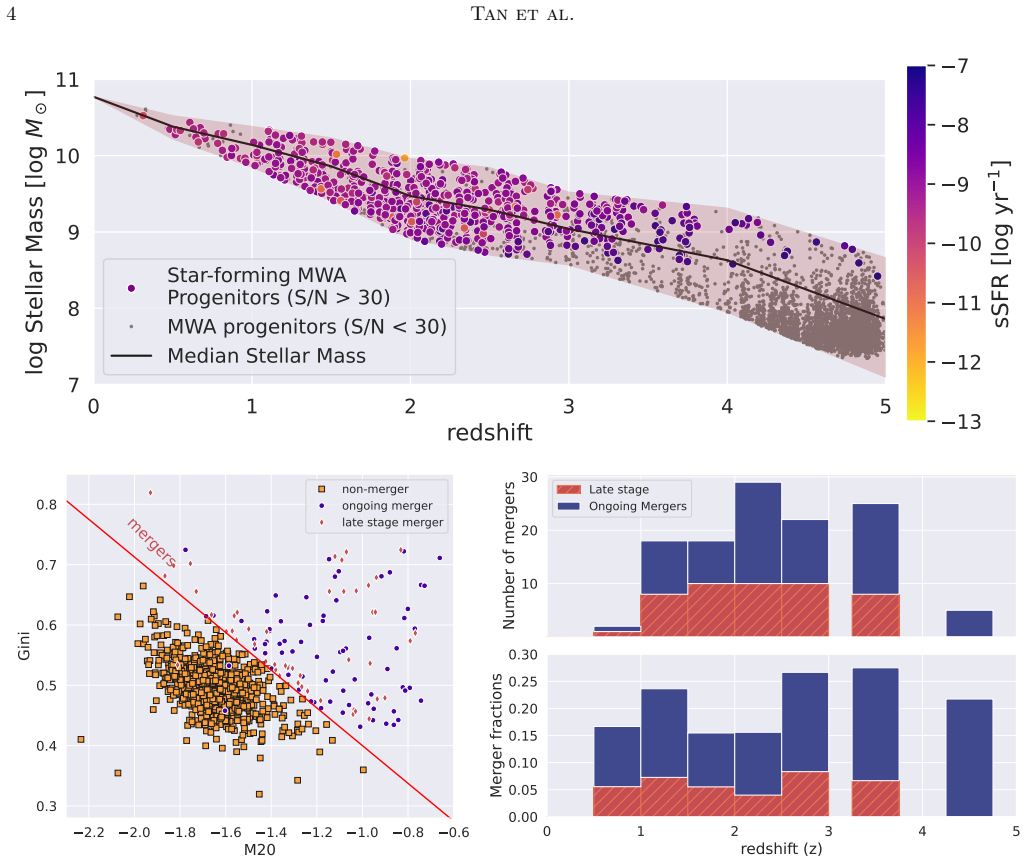
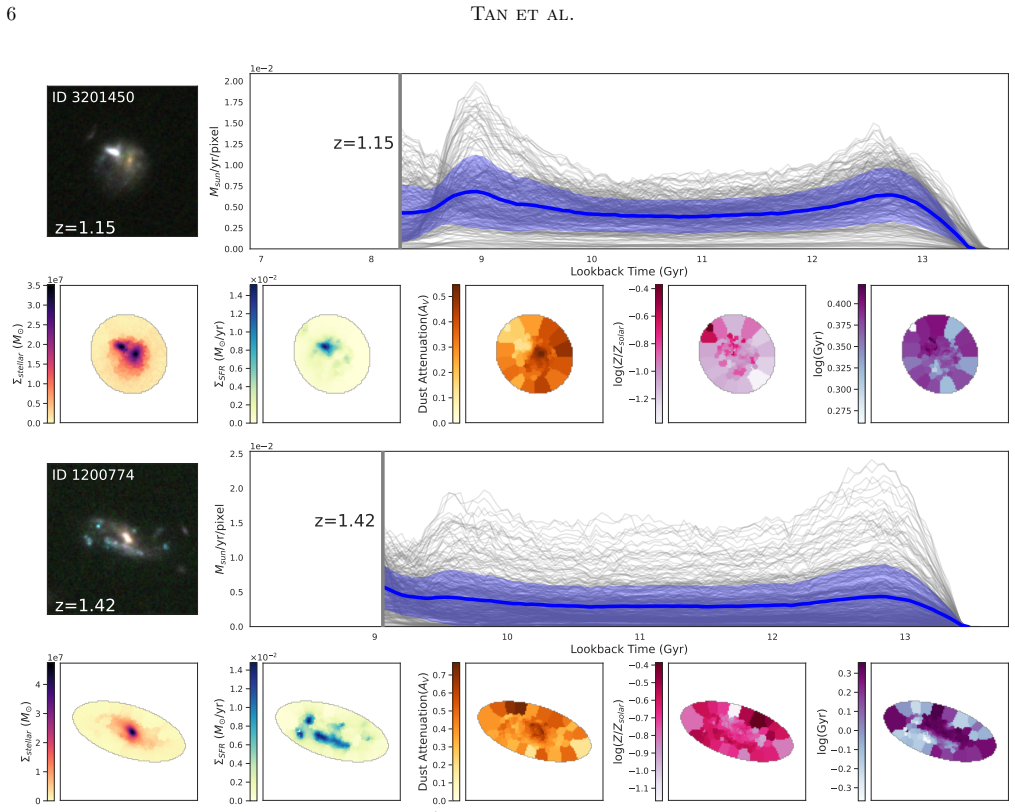
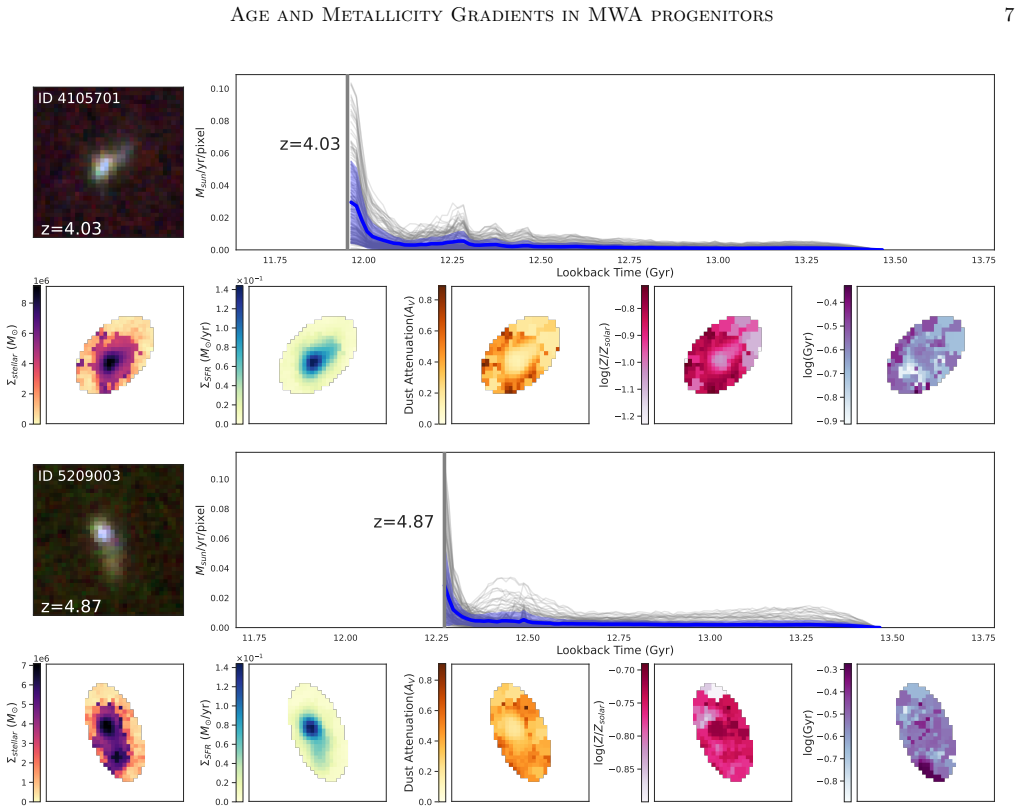
We present the evolution of the resolved mass-weighted age, stellar metallicity, and sSFR of 872 Milky Way Analog (MWA) progenitors up to redshift $z=5$ from the Canadian Unbiased Cluster Survey (CANUCS). The metallicity and mass-weighted ages were obtained via spatially resolved SED-fitting with the non-parametric code Dense Basis. We split the sample into mergers versus non-mergers using the merger parameter from the Gini-$M_{20}$ plane obtained through Gini-$M_{20}$ analysis of the morphology of the stellar mass maps with Statmorph. Across our redshift range, non-mergers have negative or flat average age gradients from $-0.022$ to 0.005 dex/kpc, and positive or flat sSFR gradients from $-0.089$ to 0.092 dex/kpc, consistent with inside-out assembly. The average $\log(Z/\Zsun)$ gradients for non-mergers range from $-0.029$ to 0.044 dex/kpc, however, positive gradients only appear between $2 < z < 3$. At every redshift epoch, mergers typically have flatter age gradients, more negative sSFR gradients, and similar metallicity gradients compared to non-mergers. We divide the property maps of ongoing mergers into separate regions based on their component galaxies, and find little to no difference between the components' average ages or metallicities, but the less massive of the merging system is on average $0.1-0.4$ dex higher in sSFR. Our results point to major mergers contributing some momentary disruption to the general trend of inside-out mass assembly, but does not upend the overall picture of MWA disks growing inside-out over cosmic time.
Editorial analysis
A structured set of objections, weighed in public.
Referee Report
Summary. The manuscript analyzes resolved mass-weighted ages, stellar metallicities, and sSFR for 872 Milky Way analog (MWA) progenitors from the CANUCS survey up to z=5. Spatially resolved SED fitting is performed with the non-parametric Dense Basis code, and galaxies are classified as mergers or non-mergers via the Gini-M20 parameter measured on stellar mass maps using Statmorph. Non-mergers exhibit negative or flat age gradients (-0.022 to 0.005 dex/kpc) and positive or flat sSFR gradients, consistent with inside-out assembly; metallicity gradients range from -0.029 to 0.044 dex/kpc with positive values only at 2<z<3. Mergers show flatter age gradients, more negative sSFR gradients, and comparable metallicity gradients. Component analysis of mergers finds similar ages and metallicities but higher sSFR in the less massive component. The central conclusion is that major mergers produce momentary disruption to inside-out growth without overturning the overall picture for MWA disks.
Significance. If the results are robust, the work supplies a valuable high-redshift empirical benchmark on the role of major mergers in Milky Way-like disk assembly, using a large sample and direct comparison of resolved properties. The extension to z=5 and the use of non-parametric SED fitting to mitigate SFH assumptions are notable strengths that could inform semi-analytic models and simulations of inside-out growth.
major comments (3)
- [Abstract] Abstract and methods description of sample and classification: The claim that Gini-M20 on stellar mass maps reliably separates ongoing major mergers from non-mergers is load-bearing for all reported gradient differences, yet no validation against simulations, visual classification, or alternative merger indicators (e.g., close-pair statistics) is referenced; without this, the reported flatter age gradients and more negative sSFR gradients in mergers cannot be confidently attributed to merger status rather than classification systematics.
- [Abstract] Abstract and SED-fitting description: The reported age, metallicity, and sSFR gradients rest on Dense Basis fits whose sensitivity to dust attenuation, metallicity priors, and SFH assumptions at z>2 is not quantified via robustness tests or alternative codes; this directly affects the central inside-out assembly claim and the conclusion that mergers cause only 'momentary disruption'.
- [Abstract] Abstract: Average gradients are stated without per-bin uncertainties, bootstrap errors, or Kolmogorov-Smirnov test p-values comparing merger versus non-merger distributions; the absence of these statistics undermines the assertion that differences are systematic rather than consistent with noise, which is required to support the 'does not upend' conclusion.
minor comments (2)
- [Abstract] The abstract states '872 Milky Way Analog progenitors' but does not specify the exact redshift bin occupancies or the stellar-mass and morphological selection criteria used to define the MWA sample; adding a table or sentence with these numbers would improve reproducibility.
- Notation for gradients (dex/kpc) is clear, but the manuscript should explicitly state whether the reported averages are weighted by galaxy stellar mass or number of galaxies.
Simulated Author's Rebuttal
We thank the referee for their constructive and detailed comments, which help clarify the presentation and robustness of our results on resolved stellar properties in Milky Way analog progenitors. We address each major comment below and will revise the manuscript to incorporate additional validation, robustness checks, and statistical measures as outlined.
read point-by-point responses
-
Referee: [Abstract] Abstract and methods description of sample and classification: The claim that Gini-M20 on stellar mass maps reliably separates ongoing major mergers from non-mergers is load-bearing for all reported gradient differences, yet no validation against simulations, visual classification, or alternative merger indicators (e.g., close-pair statistics) is referenced; without this, the reported flatter age gradients and more negative sSFR gradients in mergers cannot be confidently attributed to merger status rather than classification systematics.
Authors: We agree that explicit validation strengthens the merger classification. While the Gini-M20 method on stellar mass maps follows established practices in the high-redshift literature, the current manuscript does not cite specific validation studies. In revision we will add references to simulation-based validations of Gini-M20 (including on mass maps) and discuss consistency with visual classifications and close-pair statistics where the CANUCS data permit. This will directly support attribution of the observed gradient differences to merger status. revision: yes
-
Referee: [Abstract] Abstract and SED-fitting description: The reported age, metallicity, and sSFR gradients rest on Dense Basis fits whose sensitivity to dust attenuation, metallicity priors, and SFH assumptions at z>2 is not quantified via robustness tests or alternative codes; this directly affects the central inside-out assembly claim and the conclusion that mergers cause only 'momentary disruption'.
Authors: We acknowledge the value of quantifying these sensitivities. Although Dense Basis is non-parametric and was chosen to reduce SFH priors, the manuscript does not present explicit robustness tests at z>2. In the revised version we will add a dedicated subsection reporting results from varying dust attenuation laws, metallicity priors, and comparisons with an alternative SED code on a subset of the sample, thereby confirming that the inside-out trends and merger disruption conclusions remain stable. revision: yes
-
Referee: [Abstract] Abstract: Average gradients are stated without per-bin uncertainties, bootstrap errors, or Kolmogorov-Smirnov test p-values comparing merger versus non-merger distributions; the absence of these statistics undermines the assertion that differences are systematic rather than consistent with noise, which is required to support the 'does not upend' conclusion.
Authors: We accept this point. The abstract and main text currently report mean gradients without accompanying uncertainties or formal statistical comparisons. In revision we will include bootstrap-derived uncertainties on all reported averages, per-redshift-bin error bars, and Kolmogorov-Smirnov p-values for the merger versus non-merger distributions. These additions will quantitatively support the claim that the differences are systematic. revision: yes
Circularity Check
No significant circularity
full rationale
This is a purely observational study that reports empirical measurements of resolved ages, metallicities, and sSFR gradients from CANUCS survey data. The analysis applies standard external tools (Dense Basis for non-parametric SED fitting; Statmorph for Gini-M20 morphology) to derive property maps and gradients directly from the observations. No derivation chain, fitted-parameter prediction, self-citation load-bearing step, or ansatz reduction is present; the central claims are data-driven comparisons between mergers and non-mergers across redshift bins. The paper is self-contained against external benchmarks with no internal reduction of results to inputs by construction.
Axiom & Free-Parameter Ledger
axioms (2)
- domain assumption Non-parametric SED fitting with Dense Basis recovers unbiased mass-weighted ages and metallicities for high-redshift galaxies despite dust and star-formation history degeneracies.
- domain assumption Gini-M20 parameter measured on stellar mass maps accurately identifies major mergers versus non-mergers.
Reference graph
Works this paper leans on
-
[1]
CANUCS/Technicolor Data Release 1: Imaging, Photometry, Slit Spectroscopy, and Stellar Population Parameters. arXiv e-prints , keywords =. doi:10.48550/arXiv.2506.21685 , archivePrefix =. 2506.21685 , primaryClass =
-
[2]
Abundance and colour gradients in discs
The stellar populations of spiral galaxies. , keywords =. doi:10.1046/j.1365-8711.2000.03138.x , archivePrefix =. astro-ph/9909402 , primaryClass =
-
[3]
Structure of Disk-dominated Galaxies. II. Color Gradients and Stellar Population Models. , keywords =. doi:10.1086/383525 , archivePrefix =. astro-ph/0401437 , primaryClass =
work page internal anchor Pith review Pith/arXiv arXiv doi:10.1086/383525
-
[4]
On the Age and Metallicity Estimation of Spiral Galaxies Using Optical and Near-Infrared Photometry
On the Age and Metallicity Estimation of Spiral Galaxies Using Optical and Near-Infrared Photometry. , keywords =. doi:10.1086/518855 , archivePrefix =. astro-ph/0605425 , primaryClass =
work page internal anchor Pith review Pith/arXiv arXiv doi:10.1086/518855
-
[5]
Physical interpretation of the near-infrared colours of low-redshift galaxies. , keywords =. doi:10.1111/j.1365-2966.2007.12742.x , archivePrefix =. 0709.1147 , primaryClass =
-
[6]
What do we learn from IRAC observations of galaxies at 2 < z < 3.5?
What Do We Learn from IRAC Observations of Galaxies at 2 < z < 3.5?. , keywords =. doi:10.1086/509708 , archivePrefix =. astro-ph/0609548 , primaryClass =
work page internal anchor Pith review Pith/arXiv arXiv doi:10.1086/509708
-
[7]
Detection of quiescent galaxies in a bicolor sequence from z=0-2
Detection of Quiescent Galaxies in a Bicolor Sequence from Z = 0-2. , keywords =. doi:10.1088/0004-637X/691/2/1879 , archivePrefix =. 0806.0625 , primaryClass =
work page internal anchor Pith review Pith/arXiv arXiv doi:10.1088/0004-637x/691/2/1879
-
[8]
Star formation and dust attenuation properties in galaxies from a statistical ultraviolet-to-far-infrared analysis. , keywords =. doi:10.1111/j.1365-2966.2005.09131.x , archivePrefix =. astro-ph/0504434 , primaryClass =
-
[9]
An ALMA Survey of Sub-millimeter Galaxies in the Extended Chandra Deep Field South: Physical Properties Derived from Ultraviolet-to-radio Modeling. , keywords =. doi:10.1088/0004-637X/806/1/110 , archivePrefix =. 1504.04376 , primaryClass =
work page internal anchor Pith review Pith/arXiv arXiv doi:10.1088/0004-637x/806/1/110
-
[10]
Dust Attenuation Curves in the Local Universe: Demographics and New Laws for Star-forming Galaxies and High-redshift Analogs. , keywords =. doi:10.3847/1538-4357/aabf3c , archivePrefix =. 1804.05850 , primaryClass =
work page internal anchor Pith review Pith/arXiv arXiv doi:10.3847/1538-4357/aabf3c
-
[11]
Exploring the evolution of dust temperature using spectral energy distribution fitting in a large photometric survey. , keywords =. doi:10.1093/mnras/stad2683 , archivePrefix =. 2309.02502 , primaryClass =
-
[12]
The Spectral Energy Distributions of Galaxies. arXiv e-prints , keywords =. doi:10.48550/arXiv.2502.17680 , archivePrefix =. 2502.17680 , primaryClass =
-
[13]
Introducing piXedfit: A Spectral Energy Distribution Fitting Code Designed for Resolved Sources. , keywords =. doi:10.3847/1538-4365/abebe2 , archivePrefix =. 2101.09717 , primaryClass =
-
[14]
doi:10.5281/zenodo.1035865 , version =
astropy/photutils: 1.10.0. doi:10.5281/zenodo.1035865 , version =
-
[15]
The Astropy Project: Sustaining and Growing a Community-oriented Open-source Project and the Latest Major Release (v5.0) of the Core Package. , keywords =. doi:10.3847/1538-4357/ac7c74 , archivePrefix =. 2206.14220 , primaryClass =
work page internal anchor Pith review Pith/arXiv arXiv doi:10.3847/1538-4357/ac7c74
-
[16]
The optical morphologies of galaxies in the IllustrisTNG simulation: a comparison to Pan-STARRS observations. , keywords =. doi:10.1093/mnras/sty3345 , archivePrefix =. 1809.08239 , primaryClass =
work page internal anchor Pith review Pith/arXiv arXiv doi:10.1093/mnras/sty3345
-
[17]
Photutils: Photometry tools
-
[18]
Detailed Decomposition of Galaxy Images. II. Beyond Axisymmetric Models. , keywords =. doi:10.1088/0004-6256/139/6/2097 , archivePrefix =. 0912.0731 , primaryClass =
work page internal anchor Pith review Pith/arXiv arXiv doi:10.1088/0004-6256/139/6/2097 2097
-
[19]
EAZY: A Fast, Public Photometric Redshift Code. , keywords =. doi:10.1086/591786 , archivePrefix =. 0807.1533 , primaryClass =
work page internal anchor Pith review Pith/arXiv arXiv doi:10.1086/591786
-
[20]
, keywords =
New determination of the disc scale length and the radial cutoff in the anticenter with DENIS data. , keywords =
-
[21]
From dawn till disc: Milky Way's turbulent youth revealed by the APOGEE+Gaia data. , keywords =. doi:10.1093/mnras/stac1267 , archivePrefix =. 2203.04980 , primaryClass =
-
[22]
A time-resolved picture of our Milky Way's early formation history. , keywords =. doi:10.1038/s41586-022-04496-5 , archivePrefix =. 2203.12110 , primaryClass =
-
[23]
Mining the Galactic halo for very metal-poor stars. , keywords =. doi:10.1111/j.1745-3933.2009.00772.x , archivePrefix =. 0908.4279 , primaryClass =
-
[24]
Chemical Evolution in Hierarchical Models of Cosmic Structure. II. The Formation of the Milky Way Stellar Halo and the Distribution of the Oldest Stars. , keywords =. doi:10.1088/0004-637X/708/2/1398 , archivePrefix =. 0911.1786 , primaryClass =
work page internal anchor Pith review Pith/arXiv arXiv doi:10.1088/0004-637x/708/2/1398
-
[25]
Core condensation in heavy halos: a two-stage theory for galaxy formation and clustering. , keywords =. doi:10.1093/mnras/183.3.341 , adsurl =
-
[26]
Improving photometric redshifts of Epoch of Reionization galaxies: a new transmission curve with the neutral hydrogen damped Ly absorption. arXiv e-prints , keywords =. doi:10.48550/arXiv.2410.21543 , archivePrefix =. 2410.21543 , primaryClass =
-
[27]
When, where, and how star formation happens in a galaxy pair at cosmic noon using CANUCS JWST/NIRISS grism spectroscopy. , keywords =. doi:10.1093/mnras/stae1368 , archivePrefix =. 2406.15551 , primaryClass =
-
[28]
CANUCS: Constraining the MACS J0416.1-2403 strong lensing model with JWST NIRISS, NIRSpec, and NIRCam. , keywords =. doi:10.1051/0004-6361/202451117 , archivePrefix =. 2406.10332 , primaryClass =
-
[29]
The Firefly Sparkle: The Earliest Stages of the Assembly of A Milky Way-type Galaxy in a 600 Myr Old Universe. arXiv e-prints , keywords =. doi:10.48550/arXiv.2402.08696 , archivePrefix =. 2402.08696 , primaryClass =
-
[30]
Bursty star formation and galaxy-galaxy interactions in low-mass galaxies 1 Gyr after the Big Bang. , keywords =. doi:10.1093/mnras/stad3902 , archivePrefix =. 2310.02314 , primaryClass =
-
[31]
CDM not dead yet: massive high-z Balmer break galaxies are less common than previously reported. , keywords =. doi:10.1093/mnras/stae1084 , archivePrefix =. 2310.03063 , primaryClass =
-
[32]
CANUCS: An Updated Mass and Magnification Model of Abell 370 with JWST. arXiv e-prints , keywords =. doi:10.48550/arXiv.2403.07062 , archivePrefix =. 2403.07062 , primaryClass =
-
[33]
Exposing Line Emission: A First Look At The Systematic Differences of Measuring Stellar Masses With JWST NIRCam Medium Versus Wide Band Photometry. arXiv e-prints , keywords =. doi:10.48550/arXiv.2401.08781 , archivePrefix =. 2401.08781 , primaryClass =
-
[34]
A Steep Decline in the Galaxy Space Density beyond Redshift 9 in the CANUCS UV Luminosity Function. , keywords =. doi:10.3847/1538-4357/ad35bc , archivePrefix =. 2311.12234 , primaryClass =
-
[35]
The first large catalogue of spectroscopic redshifts in Webb's first deep field, SMACS J0723.3-7327. , keywords =. doi:10.1093/mnras/stad1019 , archivePrefix =. 2212.07366 , primaryClass =
-
[36]
Spectroscopy from Photometry: A Population of Extreme Emission Line Galaxies at 1.7 z 6.7 Selected with JWST Medium Band Filters. , keywords =. doi:10.3847/2041-8213/ad01c0 , archivePrefix =. 2304.11181 , primaryClass =
-
[37]
The Near-infrared Imager and Slitless Spectrograph for the James Webb Space Telescope. II. Wide Field Slitless Spectroscopy. , keywords =. doi:10.1088/1538-3873/ac5158 , archivePrefix =. 2202.01714 , primaryClass =
-
[38]
Unveiling the Cosmic Gems Arc at z 10.2 with JWST. arXiv e-prints , keywords =. doi:10.48550/arXiv.2404.10770 , archivePrefix =. 2404.10770 , primaryClass =
-
[39]
Bound star clusters observed in a lensed galaxy 460 Myr after the Big Bang. arXiv e-prints , keywords =. doi:10.48550/arXiv.2401.03224 , archivePrefix =. 2401.03224 , primaryClass =
-
[40]
JWST/NIRCam Probes Young Star Clusters in the Reionization Era Sunrise Arc. , keywords =. doi:10.3847/1538-4357/acb59a , archivePrefix =. 2211.09839 , primaryClass =
-
[41]
Star Formation Rates, Metallicities, and Stellar Masses on kpc-scales in TNG50. arXiv e-prints , keywords =. doi:10.48550/arXiv.2501.18687 , archivePrefix =. 2501.18687 , primaryClass =
-
[42]
How Early Could the Milky Way's Disk Form?. arXiv e-prints , keywords =. doi:10.48550/arXiv.2409.18173 , archivePrefix =. 2409.18173 , primaryClass =
-
[43]
Satellites of Milky Way- and M31-like galaxies with TNG50: quenched fractions, gas content, and star formation histories. , keywords =. doi:10.1093/mnras/stad1357 , archivePrefix =. 2211.00010 , primaryClass =
-
[44]
Milky Way and Andromeda analogs from the TNG50 simulation. arXiv e-prints , keywords =. doi:10.48550/arXiv.2303.16217 , archivePrefix =. 2303.16217 , primaryClass =
-
[45]
The merger and assembly histories of Milky Way- and M31-like galaxies with TNG50: disc survival through mergers. , keywords =. doi:10.1093/mnras/stac2586 , archivePrefix =. 2211.00036 , primaryClass =
-
[46]
No Evolution in the Half-mass Radius of Milky Way-type Galaxies over the Last 10 Gyr. , keywords =. doi:10.3847/2041-8213/ac76c8 , archivePrefix =. 2206.04702 , primaryClass =
-
[47]
First results from the TNG50 simulation: the evolution of stellar and gaseous discs across cosmic time. , keywords =. doi:10.1093/mnras/stz2338 , archivePrefix =. 1902.05553 , primaryClass =
-
[48]
Diverse Structural Evolution at z > 1 in Cosmologically Simulated Galaxies
Diverse structural evolution at z > 1 in cosmologically simulated galaxies. , keywords =. doi:10.1093/mnras/stv1231 , archivePrefix =. 1409.1583 , primaryClass =
work page internal anchor Pith review Pith/arXiv arXiv doi:10.1093/mnras/stv1231
-
[49]
Galaxy Morphology and Star Formation in the Illustris Simulation at z=0
Galaxy morphology and star formation in the Illustris Simulation at z = 0. , keywords =. doi:10.1093/mnras/stv2078 , archivePrefix =. 1502.07747 , primaryClass =
work page internal anchor Pith review Pith/arXiv arXiv doi:10.1093/mnras/stv2078
-
[50]
The Effect of Galaxy Interactions on Starbursts in Milky Way-mass Galaxies in FIRE Simulations. , keywords =. doi:10.3847/1538-4357/ad94ef , archivePrefix =. 2411.10373 , primaryClass =
-
[51]
The formation of star clusters across cosmic time in a Milky Way-mass galaxy
Great balls of FIRE - I. The formation of star clusters across cosmic time in a Milky Way-mass galaxy. , keywords =. doi:10.1093/mnras/stac3573 , archivePrefix =. 2203.05732 , primaryClass =
-
[52]
Born this way: thin disc, thick disc, and isotropic spheroid formation in FIRE-2 Milky Way-mass galaxy simulations. , keywords =. doi:10.1093/mnras/stad1806 , archivePrefix =. 2210.03845 , primaryClass =
-
[53]
Live fast, die young: GMC lifetimes in the FIRE cosmological simulations of Milky Way mass galaxies. , keywords =. doi:10.1093/mnras/staa2116 , archivePrefix =. 1911.05251 , primaryClass =
-
[54]
The origin of the diverse morphologies and kinematics of Milky Way-mass galaxies in the FIRE-2 simulations. , keywords =. doi:10.1093/mnras/sty2513 , adsurl =
-
[55]
FIRE-2 simulations: physics versus numerics in galaxy formation. , keywords =. doi:10.1093/mnras/sty1690 , archivePrefix =. 1702.06148 , primaryClass =
work page internal anchor Pith review Pith/arXiv arXiv doi:10.1093/mnras/sty1690
-
[56]
Black holes on FIRE: stellar feedback limits early feeding of galactic nuclei. , keywords =. doi:10.1093/mnrasl/slx161 , adsurl =
-
[57]
Reconciling Dwarf Galaxies with CDM Cosmology: Simulating a Realistic Population of Satellites around a Milky Way-mass Galaxy. , keywords =. doi:10.3847/2041-8205/827/2/L23 , archivePrefix =. 1602.05957 , primaryClass =
work page internal anchor Pith review Pith/arXiv arXiv doi:10.3847/2041-8205/827/2/l23 2041
-
[58]
GIZMO: A New Class of Accurate, Mesh-Free Hydrodynamic Simulation Methods
A new class of accurate, mesh-free hydrodynamic simulation methods. , keywords =. doi:10.1093/mnras/stv195 , archivePrefix =. 1409.7395 , primaryClass =
work page internal anchor Pith review Pith/arXiv arXiv doi:10.1093/mnras/stv195
-
[59]
Forged in FIRE: cusps, cores, and baryons in low-mass dwarf galaxies
Forged in FIRE: cusps, cores and baryons in low-mass dwarf galaxies. , keywords =. doi:10.1093/mnras/stv2072 , archivePrefix =. 1502.02036 , primaryClass =
work page internal anchor Pith review Pith/arXiv arXiv doi:10.1093/mnras/stv2072
-
[60]
The Seventeenth Data Release of the Sloan Digital Sky Surveys: Complete Release of MaNGA, MaStar, and APOGEE-2 Data. , keywords =. doi:10.3847/1538-4365/ac4414 , archivePrefix =. 2112.02026 , primaryClass =
-
[61]
The 16th Data Release of the Sloan Digital Sky Surveys: First Release from the APOGEE-2 Southern Survey and Full Release of eBOSS Spectra. , keywords =. doi:10.3847/1538-4365/ab929e , archivePrefix =. 1912.02905 , primaryClass =
-
[62]
APOGEE Data and Spectral Analysis from SDSS Data Release 16: Seven Years of Observations Including First Results from APOGEE-South. , keywords =. doi:10.3847/1538-3881/aba592 , archivePrefix =. 2007.05537 , primaryClass =
-
[63]
Sloan Digital Sky Survey IV: Mapping the Milky Way, Nearby Galaxies, and the Distant Universe
Sloan Digital Sky Survey IV: Mapping the Milky Way, Nearby Galaxies, and the Distant Universe. , keywords =. doi:10.3847/1538-3881/aa7567 , archivePrefix =. 1703.00052 , primaryClass =
work page internal anchor Pith review Pith/arXiv arXiv doi:10.3847/1538-3881/aa7567
-
[64]
The Apache Point Observatory Galactic Evolution Experiment (APOGEE)
The Apache Point Observatory Galactic Evolution Experiment (APOGEE). , keywords =. doi:10.3847/1538-3881/aa784d , archivePrefix =. 1509.05420 , primaryClass =
work page internal anchor Pith review Pith/arXiv arXiv doi:10.3847/1538-3881/aa784d
-
[65]
A JWST study of pair fractions, merger rates, and stellar mass accretion rates at z = 4.5─11.5
Galaxy mergers in the epoch of reionization ─ I. A JWST study of pair fractions, merger rates, and stellar mass accretion rates at z = 4.5─11.5. , keywords =. doi:10.1093/mnras/staf638 , archivePrefix =. 2407.09472 , primaryClass =
-
[66]
A 13-Billion-Year View of Galaxy Growth: Metallicity Gradient Evolution from the Local Universe to z=9 with JWST and Archival Surveys. arXiv e-prints , keywords =. doi:10.48550/arXiv.2506.12129 , archivePrefix =. 2506.12129 , primaryClass =
-
[67]
VIII: Disk Formation and Evolution of Simulated Milky Way Mass Galaxy Progenitors at 1<z<5
The \ AGORA\ High-resolution Galaxy Simulations Comparison Project. VIII: Disk Formation and Evolution of Simulated Milky Way Mass Galaxy Progenitors at 1<z<5. arXiv e-prints , keywords =. doi:10.48550/arXiv.2505.05720 , archivePrefix =. 2505.05720 , primaryClass =
-
[68]
The JWST EXCELS survey: too much, too young, too fast? Ultra-massive quiescent galaxies at 3 < z < 5. , keywords =. doi:10.1093/mnras/stae2092 , archivePrefix =. 2405.02242 , primaryClass =
-
[69]
Chasing the impact of the Gaia-Sausage-Enceladus merger on the formation of the Milky Way thick disc. , keywords =. doi:10.1093/mnrasl/slad033 , archivePrefix =. 2211.01006 , primaryClass =
-
[70]
On the mass assembly history of the Milky Way: clues from its stellar halo. arXiv e-prints , keywords =. doi:10.48550/arXiv.2404.16939 , archivePrefix =. 2404.16939 , primaryClass =
-
[71]
The Open Journal of Astrophysics , keywords =
Self-regulated growth of galaxy sizes along the star-forming main sequence. The Open Journal of Astrophysics , keywords =. doi:10.33232/001c.126775 , archivePrefix =. 2412.00599 , primaryClass =
-
[72]
A High Incidence of Central Star Formation Inferred from the Color Gradients of Galaxies at z>4. arXiv e-prints , keywords =. doi:10.48550/arXiv.2412.03455 , archivePrefix =. 2412.03455 , primaryClass =
-
[73]
A JWST investigation into the bar fraction at redshifts 1 z 3. , keywords =. doi:10.1093/mnras/stae921 , archivePrefix =. 2309.10038 , primaryClass =
-
[74]
Recovering chemical bimodalities in observed edge-on stellar disks: Insights from AURIGA simulations. , keywords =. doi:10.1051/0004-6361/202450843 , archivePrefix =. 2409.07533 , primaryClass =
-
[75]
Linking high-z and low-z: Are We Observing the Progenitors of the Milky Way with JWST?. arXiv e-prints , keywords =. doi:10.48550/arXiv.2407.06255 , archivePrefix =. 2407.06255 , primaryClass =
-
[76]
RMS asymmetry: a robust metric of galaxy shapes in images with varied depth and resolution. arXiv e-prints , keywords =. doi:10.48550/arXiv.2404.05792 , archivePrefix =. 2404.05792 , primaryClass =
-
[77]
An Indication of Gas Inflow in Clumpy Star-Forming Galaxies near z 1 : Lower Gas-Phase Metallicities in Clumpy Galaxies Compared to Non-Clumpy Galaxies. arXiv e-prints , keywords =. doi:10.48550/arXiv.2410.21370 , archivePrefix =. 2410.21370 , primaryClass =
-
[78]
Non-monotonic relations of galaxy star formation, radius, and structure at fixed stellar mass. , keywords =. doi:10.1093/mnras/stae1735 , archivePrefix =. 2404.10114 , primaryClass =
-
[79]
The physical origin of positive metallicity radial gradients in high-redshift galaxies: insights from the FIRE-2 cosmological hydrodynamic simulations. arXiv e-prints , keywords =. doi:10.48550/arXiv.2409.09290 , archivePrefix =. 2409.09290 , primaryClass =
-
[80]
A Measurement of the Assembly of Milky Way Analogues at Redshifts 0.5 < z < 2 with Resolved Stellar Mass and Star-Formation Rate Profiles. arXiv e-prints , keywords =. doi:10.48550/arXiv.2402.12433 , archivePrefix =. 2402.12433 , primaryClass =
discussion (0)
Sign in with ORCID, Apple, or X to comment. Anyone can read and Pith papers without signing in.