Tracing Large-scale Structure with the MeerKLASS On-the-Fly Survey: Angular Clustering of Radio Sources at 816 MHz
Pith reviewed 2026-06-26 10:04 UTC · model grok-4.3
The pith
MeerKAT radio sources at 816 MHz exhibit positive angular clustering from 0.02 to 10 degrees, with effective bias 1.5-2.0 set by redshift priors.
A machine-rendered reading of the paper's core claim, the machinery that carries it, and where it could break.
Core claim
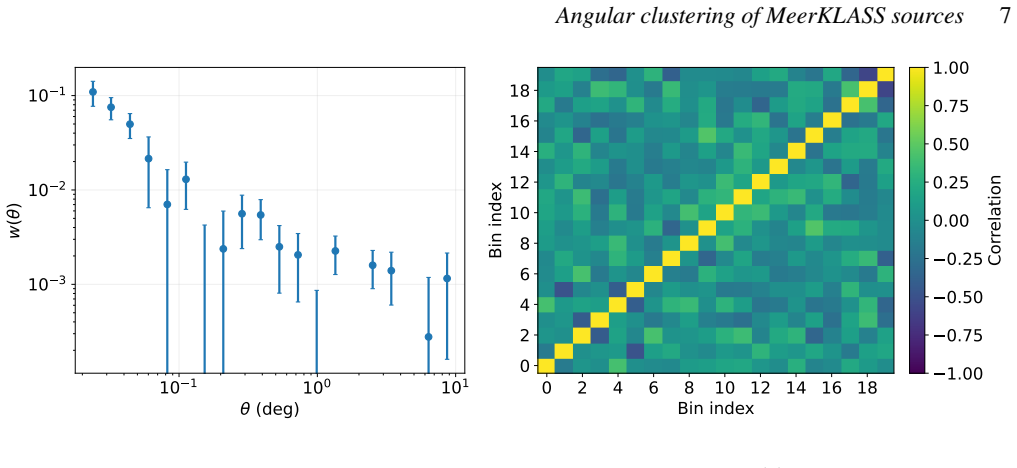
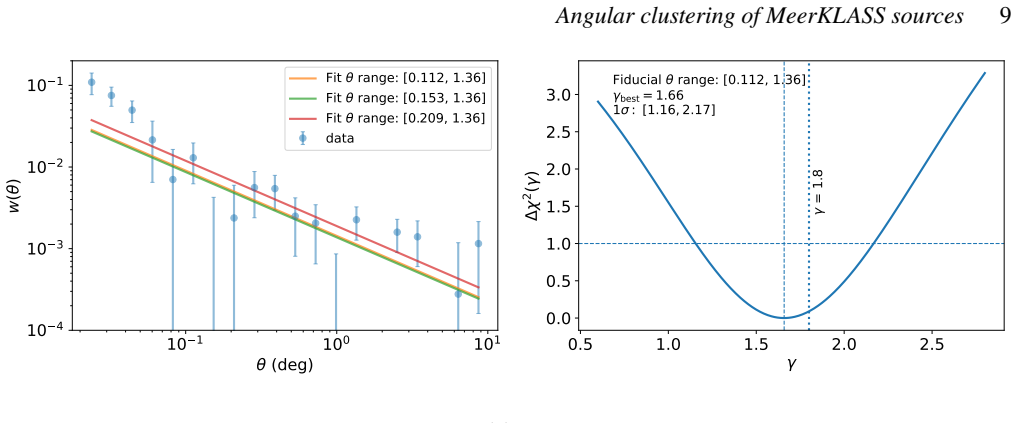
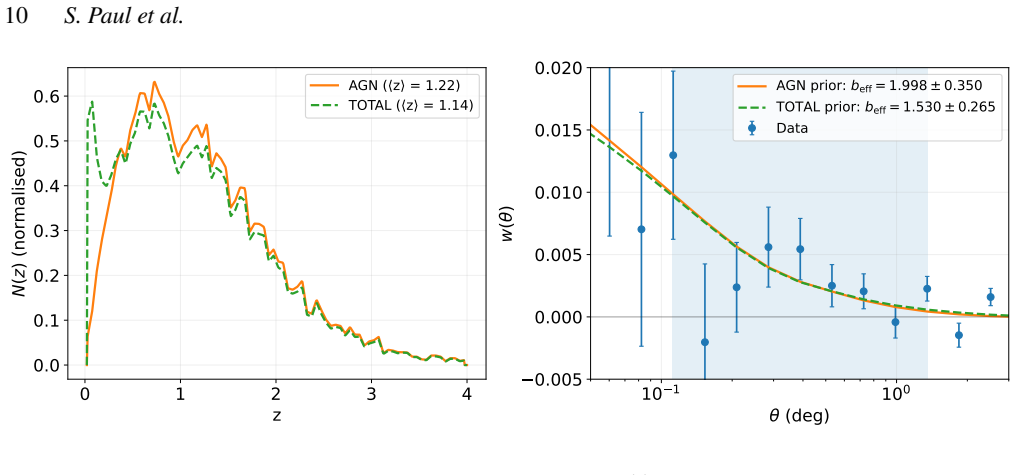
We present the first measurement of the angular two-point correlation function w(θ) of radio sources from the MeerKAT Large Area Synoptic Survey UHF on-the-fly continuum Data Release 1, detecting positive clustering over 0.02° ≲ θ ≲ 10°. Modelling the intermediate-scale signal with a fixed-slope power law yields A(1°)=(1.434±0.475)×10^{-3}. Fitting ΛCDM projected-matter templates with two T-RECS redshift priors gives b_eff=1.998±0.350 (AGN prior) and b_eff=1.530±0.265 (TOTAL prior), with dominant uncertainty from N(z).
What carries the argument
Angular two-point correlation function w(θ), fitted with a fixed-slope power law on intermediate scales and Limber-projected ΛCDM templates plus integral-constraint correction to extract effective bias b_eff.
If this is right
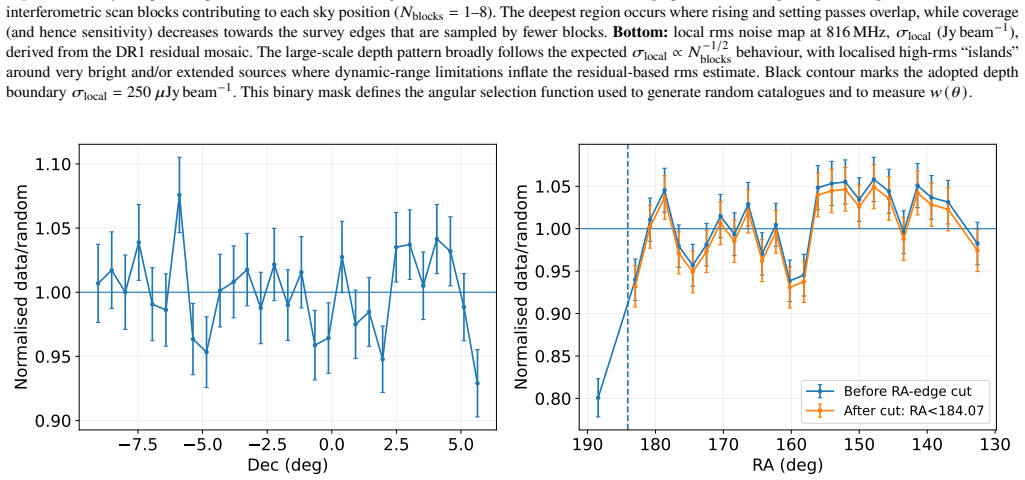
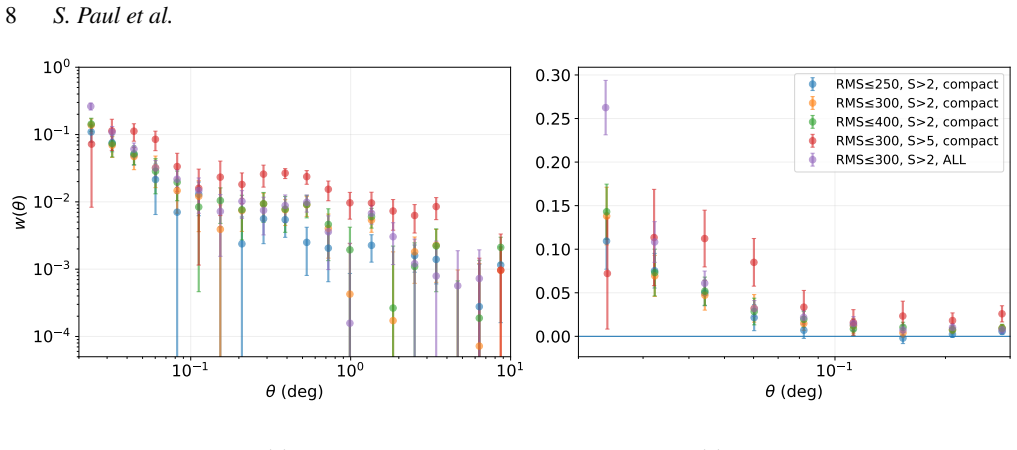
- The measured clustering amplitude remains stable under reasonable changes to depth mask and flux threshold on intermediate and large scales.
- Limber inversion of the power-law amplitude produces comoving correlation lengths r0 of 6.18±1.13 and 5.59±1.02 h^{-1} Mpc for the two priors.
- The survey provides a new wide-area, intermediate-frequency dataset for radio-continuum clustering studies.
- Expanded coverage plus overlapping optical/IR spectroscopy will enable population-split clustering and bias-evolution measurements.
Where Pith is reading between the lines
- Improved redshift information could separate contributions from AGN and star-forming galaxies in the clustering signal.
- The dataset could be cross-correlated with optical large-scale structure tracers to test consistency of bias measurements across wavelengths.
- Scale-dependent bias or different power-law slopes could be tested once redshift uncertainty is reduced.
Load-bearing premise
The two T-RECS redshift-distribution priors adequately bracket the true redshift distribution of the sources.
What would settle it
An independent measurement of the redshift distribution of the detected radio sources that lies outside the range spanned by the AGN and TOTAL T-RECS priors.
Figures
read the original abstract
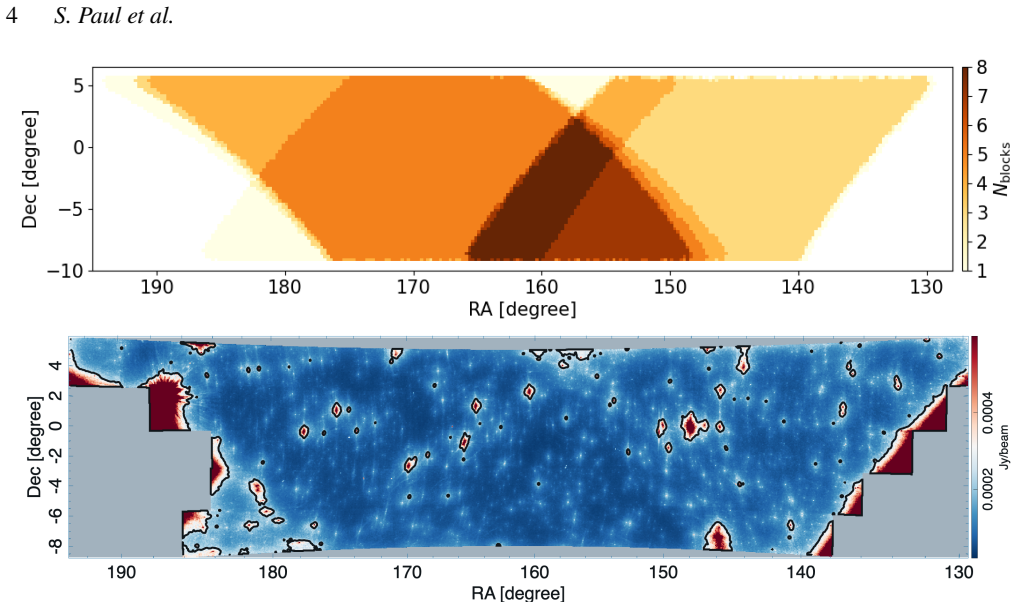
We present the first measurement of the angular two-point correlation function \(w(\theta)\) of radio sources from the MeerKAT Large Area Synoptic Survey (MeerKLASS) UHF on-the-fly (OTF) continuum Data Release~1. DR1 provides interferometric Stokes-\(I\) imaging at a reference frequency of 816\,MHz over \(\sim 800~\mathrm{deg}^2\) within the DESI footprint. We detect a positive clustering signal over \(0.02^\circ \lesssim \theta \lesssim 10^\circ\). The measurement is stable to reasonable variations of the depth mask and flux threshold on intermediate and large scales. Modelling the intermediate-scale signal (\(0.112^\circ\le\theta\le 1.36^\circ\)) with a fixed-slope power law (\(\gamma=1.8\)) yields \(A(1^\circ)=(1.434\pm0.475)\times10^{-3}\), corresponding to \(\log_{10}A=-2.843^{+0.124}_{-0.175}\). We infer an effective large-scale bias by fitting \(\Lambda\)CDM projected-matter templates \(w_{\rm DM}(\theta)\) computed with \textsc{CAMB} and Limber projection, including an integral-constraint correction evaluated from random--random weights. Using two bracketing T-RECS redshift-distribution priors, we obtain \(b_{\rm eff}=1.998\pm0.350\) (AGN prior) and \(b_{\rm eff}=1.530\pm0.265\) (TOTAL prior), demonstrating that the dominant modelling uncertainty arises from \(N(z)\). As a derived summary we Limber-invert the power-law amplitude to obtain \(r_0=6.18\pm1.13\) and \(5.59\pm1.02~h^{-1}\mathrm{Mpc}\) for the AGN and TOTAL priors, respectively. These results establish MeerKLASS UHF DR1 as a new wide-area, intermediate-frequency dataset for radio-continuum clustering. As MeerKLASS expands and overlapping optical/IR spectroscopy provides improved redshift calibration, future releases will enable population-split clustering and bias evolution measurements with substantially reduced modelling uncertainty.
Editorial analysis
A structured set of objections, weighed in public.
Referee Report
Summary. The manuscript presents the first measurement of the angular two-point correlation function w(θ) of radio sources from the MeerKLASS UHF on-the-fly continuum Data Release 1 at 816 MHz over ~800 deg² within the DESI footprint. It reports a positive clustering signal stable to mask and flux variations over 0.02° ≲ θ ≲ 10°, fits a fixed-slope (γ=1.8) power-law model to the intermediate scales (0.112°≤θ≤1.36°) yielding A(1°)=(1.434±0.475)×10^{-3}, and infers effective bias b_eff using ΛCDM templates via CAMB and Limber projection with two bracketing T-RECS N(z) priors, obtaining b_eff=1.998±0.350 (AGN) and 1.530±0.265 (TOTAL), with N(z) identified as the dominant modelling uncertainty; derived r_0 values are also reported.
Significance. If the measurement and modelling hold, this establishes MeerKLASS UHF DR1 as a new wide-area intermediate-frequency radio-continuum dataset for large-scale structure studies. The direct use of survey data with standard external tools (CAMB, Limber), stability tests, and explicit demonstration that N(z) drives the uncertainty are strengths. The results provide a baseline for future population-split analyses and bias evolution as the survey expands and spectroscopic overlap improves redshift calibration.
major comments (1)
- [Abstract (modelling paragraph)] Abstract (modelling paragraph): The central claim that the AGN and TOTAL T-RECS redshift-distribution priors 'adequately bracket' the true N(z) of the 816 MHz sources (and thus that the ~30% spread in b_eff represents the dominant uncertainty) is load-bearing for the interpretation of the bias results. The manuscript provides no explicit tests, literature comparisons, or selection-effect arguments demonstrating that no other population mix at this frequency produces an N(z) outside the envelope; if this assumption does not hold, the quoted b_eff and r_0 values cannot be trusted at the reported precision even if w(θ) itself is robust.
Simulated Author's Rebuttal
We thank the referee for their positive assessment of the work and recommendation for minor revision. We address the single major comment below.
read point-by-point responses
-
Referee: [Abstract (modelling paragraph)] Abstract (modelling paragraph): The central claim that the AGN and TOTAL T-RECS redshift-distribution priors 'adequately bracket' the true N(z) of the 816 MHz sources (and thus that the ~30% spread in b_eff represents the dominant uncertainty) is load-bearing for the interpretation of the bias results. The manuscript provides no explicit tests, literature comparisons, or selection-effect arguments demonstrating that no other population mix at this frequency produces an N(z) outside the envelope; if this assumption does not hold, the quoted b_eff and r_0 values cannot be trusted at the reported precision even if w(θ) itself is robust.
Authors: We agree that the manuscript does not include explicit additional tests, literature comparisons, or selection-effect arguments beyond the adoption of the T-RECS model to demonstrate that the AGN and TOTAL priors encompass every conceivable population mix at 816 MHz. T-RECS is a semi-empirical simulation calibrated on multi-frequency data, with the AGN and TOTAL cases representing the primary source populations (AGN-dominated versus total including star-forming galaxies). The difference between these priors is used to quantify sensitivity to N(z). To address the concern, we will revise the abstract to state that these are bracketing priors within the T-RECS framework and that N(z) constitutes the dominant modelling uncertainty under this choice, without asserting that they cover all possible mixes. A corresponding clarification will be added to the main text if appropriate. This is a minor wording revision. revision: yes
Circularity Check
Direct data measurement and external-template bias inference show no circularity
full rationale
The paper measures w(θ) directly from MeerKLASS DR1 imaging data, fits a fixed-slope power law to extract amplitude A on intermediate scales, and infers b_eff by scaling CAMB/Limber dark-matter templates against two external T-RECS N(z) priors. The r0 values are obtained by standard Limber inversion of the fitted A. None of these steps reduce by construction to the paper's own fitted quantities, self-citations, or ansatzes; the N(z) spread is treated as acknowledged modelling uncertainty rather than a definitional loop. The derivation therefore remains self-contained against external benchmarks.
Axiom & Free-Parameter Ledger
free parameters (2)
- power-law slope gamma =
1.8
- correlation amplitude A =
1.434e-3
axioms (3)
- domain assumption Limber approximation for angular projection
- domain assumption Lambda CDM cosmology for matter templates
- domain assumption T-RECS simulation redshift distributions bracket the true N(z)
Reference graph
Works this paper leans on
-
[1]
Halo Models of Large Scale Structure
Halo models of large scale structure. , keywords =. doi:10.1016/S0370-1573(02)00276-4 , archivePrefix =. astro-ph/0206508 , primaryClass =
work page internal anchor Pith review Pith/arXiv arXiv doi:10.1016/s0370-1573(02)00276-4
-
[2]
An analytic model for the spatial clustering of dark matter haloes
An analytic model for the spatial clustering of dark matter haloes. , keywords =. doi:10.1093/mnras/282.2.347 , archivePrefix =. astro-ph/9512127 , primaryClass =
work page internal anchor Pith review Pith/arXiv arXiv doi:10.1093/mnras/282.2.347
-
[3]
On the spatial correlations of Abell clusters. , keywords =. doi:10.1086/184341 , adsurl =
-
[4]
Impact of redshift information on cosmological applications with next-generation radio surveys. , keywords =. doi:10.1111/j.1365-2966.2012.22073.x , archivePrefix =. 1205.1048 , primaryClass =
-
[5]
Jarvis, Matt J. and Bacon, David and Blake, Chris and Brown, Michael and Lindsay, Sam and Raccanelli, Alvise and Santos, Mario and Schwarz, Dominik , title =. Advancing Astrophysics with the Square Kilometre Array , year = 2015, publisher =. doi:10.22323/1.215.0018 , url =
-
[6]
Radio galaxy populations and the multitracer technique: pushing the limits on primordial non-Gaussianity. , keywords =. doi:10.1093/mnras/stu1015 , archivePrefix =. 1402.2290 , primaryClass =
work page internal anchor Pith review Pith/arXiv arXiv doi:10.1093/mnras/stu1015
-
[7]
The clustering and bias of radio-selected AGN and star-forming galaxies in the COSMOS field
The clustering and bias of radio-selected AGN and star-forming galaxies in the COSMOS field. , keywords =. doi:10.1093/mnras/stx2954 , archivePrefix =. 1711.05201 , primaryClass =
work page internal anchor Pith review Pith/arXiv arXiv doi:10.1093/mnras/stx2954
-
[8]
A semi-empirical simulation of the extragalactic radio continuum sky for next generation radio telescopes. , keywords =. doi:10.1111/j.1365-2966.2008.13486.x , archivePrefix =. 0805.3413 , primaryClass =
-
[9]
The Tiered Radio Extragalactic Continuum Simulation (T-RECS)
The Tiered Radio Extragalactic Continuum Simulation (T-RECS). , keywords =. doi:10.1093/mnras/sty2603 , archivePrefix =. 1805.05222 , primaryClass =
work page internal anchor Pith review Pith/arXiv arXiv doi:10.1093/mnras/sty2603
-
[10]
The clustering properties of radio-selected AGN and star-forming galaxies up to redshifts z~3
The clustering properties of radio-selected AGN and star-forming galaxies up to redshifts z 3. , keywords =. doi:10.1093/mnras/stw2541 , archivePrefix =. 1606.08286 , primaryClass =
work page internal anchor Pith review Pith/arXiv arXiv doi:10.1093/mnras/stw2541
-
[11]
Measurement of the angular correlation function of radio galaxies from the NRAO VLA Sky Survey. , keywords =. doi:10.1046/j.1365-8711.2002.05163.x , archivePrefix =. astro-ph/0111328 , primaryClass =
-
[12]
The spatial clustering of radio sources in NVSS and FIRST; implications for galaxy clustering evolution. , keywords =. doi:10.1051/0004-6361:20030527 , archivePrefix =. astro-ph/0304160 , primaryClass =
work page internal anchor Pith review Pith/arXiv arXiv doi:10.1051/0004-6361:20030527
-
[13]
Measuring redshift-space distortions with future SKA surveys
Measuring redshift-space distortion with future SKA surveys. Advancing Astrophysics with the Square Kilometre Array (AASKA14) , year = 2015, month = apr, eid =. doi:10.22323/1.215.0031 , archivePrefix =. 1501.03821 , primaryClass =
work page internal anchor Pith review Pith/arXiv arXiv doi:10.22323/1.215.0031 2015
-
[14]
Dust-corrected Star Formation Rates of Galaxies. II. Combinations of Ultraviolet and Infrared Tracers. , keywords =. doi:10.1088/0004-637X/741/2/124 , archivePrefix =. 1108.2837 , primaryClass =
work page internal anchor Pith review Pith/arXiv arXiv doi:10.1088/0004-637x/741/2/124
-
[15]
The Star Formation Rate Density and Dust Attenuation Evolution over 12 Gyr with the VVDS Surveys
The star formation rate density and dust attenuation evolution over 12 Gyr with the VVDS surveys. , keywords =. doi:10.1051/0004-6361/201118010 , archivePrefix =. 1109.1005 , primaryClass =
work page internal anchor Pith review Pith/arXiv arXiv doi:10.1051/0004-6361/201118010
-
[16]
Multiwavelength characterization of faint ultra steep spectrum radio sources: A search for high-redshift radio galaxies. , keywords =. doi:10.1051/0004-6361/201423644 , archivePrefix =. 1405.1737 , primaryClass =
work page internal anchor Pith review Pith/arXiv arXiv doi:10.1051/0004-6361/201423644
-
[17]
Modelling the luminosities and sizes of radio galaxies: radio luminosity function at z = 6
Modelling the luminosities and sizes of radio sources: radio luminosity function at z = 6. , keywords =. doi:10.1093/mnras/stx1150 , archivePrefix =. 1705.03449 , primaryClass =
work page internal anchor Pith review Pith/arXiv arXiv doi:10.1093/mnras/stx1150
-
[18]
Astronomical Data Analysis Software and Systems III , year = 1994, editor =
The VLA's FIRST Survey. Astronomical Data Analysis Software and Systems III , year = 1994, editor =
1994
-
[19]
The NRAO VLA Sky Survey. , keywords =. doi:10.1086/300337 , adsurl =
-
[20]
LOFAR: The LOw-Frequency ARray
LOFAR: The LOw-Frequency ARray. , keywords =. doi:10.1051/0004-6361/201220873 , archivePrefix =. 1305.3550 , primaryClass =
work page internal anchor Pith review Pith/arXiv arXiv doi:10.1051/0004-6361/201220873
-
[21]
Australian SKA Pathfinder: A High-Dynamic Range Wide-Field of View Survey Telescope. IEEE Proceedings , keywords =. doi:10.1109/JPROC.2009.2016516 , adsurl =
-
[22]
, journal=
Jonas, Justin L. , journal=. MeerKAT—The South African Array With Composite Dishes and Wide-Band Single Pixel Feeds , year=
-
[23]
Detection of the velocity dipole in the radio galaxies of the NRAO VLA Sky Survey
A velocity dipole in the distribution of radio galaxies. , keywords =. doi:10.1038/416150a , archivePrefix =. astro-ph/0203385 , primaryClass =
work page internal anchor Pith review Pith/arXiv arXiv doi:10.1038/416150a
-
[24]
Cosmic radio dipole from NVSS and WENSS
Cosmic radio dipole from NVSS and WENSS. , keywords =. doi:10.1051/0004-6361/201321215 , archivePrefix =. 1301.5559 , primaryClass =
work page internal anchor Pith review Pith/arXiv arXiv doi:10.1051/0004-6361/201321215
-
[25]
Overdispersed Radio Source Counts and Excess Radio Dipole Detection. , keywords =. doi:10.1103/6z32-3zf4 , archivePrefix =. 2509.16732 , primaryClass =
-
[26]
Combined analysis of the integrated Sachs-Wolfe effect and cosmological implications , author =. Phys. Rev. D , volume =. 2008 , month =. doi:10.1103/PhysRevD.77.123520 , url =
-
[27]
Planck 2013 results. XVII. Gravitational lensing by large-scale structure. , keywords =. doi:10.1051/0004-6361/201321543 , archivePrefix =. 1303.5077 , primaryClass =
work page internal anchor Pith review Pith/arXiv arXiv doi:10.1051/0004-6361/201321543 2013
-
[28]
The MeerKLASS On-the-Fly continuum survey: pipeline design and validation. arXiv e-prints , keywords =. doi:10.48550/arXiv.2512.11978 , archivePrefix =. 2512.11978 , primaryClass =
-
[29]
The MeerKLASS L-band On-the-Fly Continuum Survey: Data Release 1. arXiv e-prints , keywords =. doi:10.48550/arXiv.2512.17685 , archivePrefix =. 2512.17685 , primaryClass =
-
[30]
The MeerKLASS UHF On-the-Fly Continuum Survey -- Data Release I. arXiv e-prints , keywords =. doi:10.48550/arXiv.2512.11964 , archivePrefix =. 2512.11964 , primaryClass =
-
[31]
MeerKLASS: MeerKAT Large Area Synoptic Survey
A Large Sky Survey with MeerKAT. MeerKAT Science: On the Pathway to the SKA , year = 2016, month = jan, eid =. doi:10.22323/1.277.0032 , archivePrefix =. 1709.06099 , primaryClass =
work page internal anchor Pith review Pith/arXiv arXiv doi:10.22323/1.277.0032 2016
-
[32]
Hydrogen 21-cm Intensity Mapping at redshift 0.8
Chang, Tzu-Ching and Pen, Ue-Li and Bandura, Kevin and Peterson, Jeffrey B. Hydrogen 21-cm Intensity Mapping at redshift 0.8. Nature. 2010. doi:10.1038/nature09187. arXiv:1007.3709
work page internal anchor Pith review Pith/arXiv arXiv doi:10.1038/nature09187 2010
-
[33]
Measurement of 21 cm brightness fluctuations at z ~ 0.8 in cross-correlation
Measurement of 21 cm Brightness Fluctuations at z -0.5ex 0.8 in Cross-correlation. , keywords =. doi:10.1088/2041-8205/763/1/L20 , archivePrefix =. 1208.0331 , primaryClass =
work page internal anchor Pith review Pith/arXiv arXiv doi:10.1088/2041-8205/763/1/l20 2041
-
[34]
Lack of clustering in low-redshift 21-cm intensity maps cross-correlated with 2dF galaxy densities
Low-amplitude clustering in low-redshift 21-cm intensity maps cross-correlated with 2dF galaxy densities. , keywords =. doi:10.1093/mnras/sty346 , archivePrefix =. 1710.00424 , primaryClass =
work page internal anchor Pith review Pith/arXiv arXiv doi:10.1093/mnras/sty346
-
[35]
H I constraints from the cross-correlation of eBOSS galaxies and Green Bank Telescope intensity maps. , keywords =. doi:10.1093/mnras/stab3621 , archivePrefix =. 2102.04946 , primaryClass =
-
[36]
H I intensity mapping with MeerKAT: power spectrum detection in cross-correlation with WiggleZ galaxies. , keywords =. doi:10.1093/mnras/stac3060 , archivePrefix =. 2206.01579 , primaryClass =
-
[37]
A first detection of neutral hydrogen intensity mapping on Mpc scales at z 0.32 and z 0.44. arXiv e-prints , keywords =. doi:10.48550/arXiv.2301.11943 , archivePrefix =. 2301.11943 , primaryClass =
work page internal anchor Pith review Pith/arXiv arXiv doi:10.48550/arxiv.2301.11943
-
[38]
Detection of the Cosmological 21 cm Signal in Auto-correlation at z -0.5ex 1 with the Canadian Hydrogen Intensity Mapping Experiment. arXiv e-prints , keywords =. doi:10.48550/arXiv.2511.19620 , archivePrefix =. 2511.19620 , primaryClass =
-
[39]
The DESI Experiment Part I: Science,Targeting, and Survey Design
The DESI Experiment Part I: Science,Targeting, and Survey Design. arXiv e-prints , keywords =. doi:10.48550/arXiv.1611.00036 , archivePrefix =. 1611.00036 , primaryClass =
work page internal anchor Pith review Pith/arXiv arXiv doi:10.48550/arxiv.1611.00036
-
[40]
Astrophysical Journal , issn =
Cress, C M and Helfand, D J and Becker, R H and Gregg, M D and White, R L , title =. Astrophysical Journal , issn =. 1996 , month =. doi:10.1086/178122 , url =
-
[41]
Cosmology from LOFAR Two-metre Sky Survey Data Release 2: angular clustering of radio sources. , keywords =. doi:10.1093/mnras/stad3088 , archivePrefix =. 2310.07627 , primaryClass =
-
[42]
A study on the clustering properties of radio-selected sources in the Lockman Hole region at 325 MHz. , keywords =. doi:10.1093/mnras/stac2801 , archivePrefix =. 2208.00992 , primaryClass =
-
[43]
The study of the angular and spatial distribution of radio-selected AGNs and star-forming galaxies in the ELAIS N1 field. , keywords =. doi:10.1093/mnras/staa945 , archivePrefix =. 2002.12383 , primaryClass =
-
[44]
Statistical analysis of galaxy surveys - I. Robust error estimation for two-point clustering statistics. , keywords =. doi:10.1111/j.1365-2966.2009.14389.x , archivePrefix =. 0810.1885 , primaryClass =
-
[45]
The LOFAR Two-metre Sky Survey. V. Second data release. , keywords =. doi:10.1051/0004-6361/202142484 , archivePrefix =. 2202.11733 , primaryClass =
-
[46]
Third Data Release
The LOFAR Two-metre Sky Survey: VII. Third Data Release. arXiv e-prints , keywords =
-
[47]
The Rapid ASKAP Continuum Survey I: Design and first results. , keywords =. doi:10.1017/pasa.2020.41 , archivePrefix =. 2012.00747 , primaryClass =
-
[48]
2025, PASA, 42, e071, doi: 10.1017/pasa.2025.10042
The Evolutionary Map of the Universe: A new radio atlas for the southern hemisphere sky. , keywords =. doi:10.1017/pasa.2025.10042 , archivePrefix =. 2505.08271 , primaryClass =
-
[49]
Jansky Very Large Array Sky Survey (VLASS)
The Karl G. Jansky Very Large Array Sky Survey (VLASS). Science Case and Survey Design. , keywords =. doi:10.1088/1538-3873/ab63eb , archivePrefix =. 1907.01981 , primaryClass =
-
[50]
Faceting for direction-dependent spectral deconvolution
Faceting for direction-dependent spectral deconvolution. , keywords =. doi:10.1051/0004-6361/201731474 , archivePrefix =. 1712.02078 , primaryClass =
work page internal anchor Pith review Pith/arXiv arXiv doi:10.1051/0004-6361/201731474
-
[51]
PyBDSF: Python Blob Detection and Source Finder
-
[52]
The large-scale structure of the universe
-
[53]
, year = 1953, month = jan, volume =
The Analysis of Counts of the Extragalactic Nebulae in Terms of a Fluctuating Density Field. , year = 1953, month = jan, volume =. doi:10.1086/145672 , adsurl =
-
[54]
Statistical analysis of catalogs of extragalactic objects. VII. Two- and three-point correlation functions for the high-resolution Shane-Wirtanen catalog of galaxies. , keywords =. doi:10.1086/155588 , adsurl =
-
[55]
doi:10.1051/0004-6361:20011029
The spatial clustering of distant, \ z. doi:10.1051/0004-6361:20011029
-
[56]
Monthly Notices of the Royal Astronomical Society , volume =
Dalmasso, Nicolò and Leethochawalit, Nicha and Trenti, Michele and Boyett, Kristan , title =. Monthly Notices of the Royal Astronomical Society , volume =. 2024 , month =. doi:10.1093/mnras/stae2006 , url =
-
[57]
Peacock, J. A. and Nicholson, D. , title =. Monthly Notices of the Royal Astronomical Society , volume =. 1991 , month =. doi:10.1093/mnras/253.2.307 , url =
-
[58]
Bias and Variance of Angular Correlation Functions. , keywords =. doi:10.1086/172900 , adsurl =
-
[59]
TreeCorr: Two-point correlation functions
-
[60]
Extended Limber approximation. , keywords =. doi:10.1103/PhysRevD.78.123506 , archivePrefix =. 0809.5112 , primaryClass =
work page internal anchor Pith review Pith/arXiv arXiv doi:10.1103/physrevd.78.123506
-
[61]
CAMB: Code for Anisotropies in the Microwave Background
-
[62]
Angular clustering in the Sydney University Molonglo Sky Survey. , keywords =. doi:10.1111/j.1365-2966.2004.07240.x , archivePrefix =. astro-ph/0310115 , primaryClass =
-
[63]
Galaxy and Mass Assembly (GAMA): The evolution of bias in the radio source population to z ~ 1.5
Galaxy and Mass Assembly: the evolution of bias in the radio source population to z 1.5. , keywords =. doi:10.1093/mnras/stu354 , archivePrefix =. 1402.5654 , primaryClass =
work page internal anchor Pith review Pith/arXiv arXiv doi:10.1093/mnras/stu354
-
[64]
Evolution in the bias of faint radio sources to z ~ 2.2
Evolution in the bias of faint radio sources to z 2.2. , keywords =. doi:10.1093/mnras/stu453 , archivePrefix =. 1403.0882 , primaryClass =
work page internal anchor Pith review Pith/arXiv arXiv doi:10.1093/mnras/stu453
-
[65]
Angular clustering of point sources at 150 MHz in the TGSS survey
Angular clustering of point sources at 150 MHz in the TGSS survey. , keywords =. doi:10.1093/mnras/stz831 , archivePrefix =. 1802.05001 , primaryClass =
work page internal anchor Pith review Pith/arXiv arXiv doi:10.1093/mnras/stz831
-
[66]
One- and two-point source statistics from the LOFAR Two-metre Sky Survey first data release. , keywords =. doi:10.1051/0004-6361/201936592 , archivePrefix =. 1908.10309 , primaryClass =
-
[67]
New constraints on the 1.4 GHz source number counts and luminosity functions in the Lockman Hole field. , keywords =. doi:10.1093/mnras/staa3218 , archivePrefix =. 2010.08748 , primaryClass =
-
[68]
Array programming with NumPy. , keywords =. doi:10.1038/s41586-020-2649-2 , archivePrefix =. 2006.10256 , primaryClass =
work page internal anchor Pith review Pith/arXiv arXiv doi:10.1038/s41586-020-2649-2 2006
-
[69]
SciPy 1.0--Fundamental Algorithms for Scientific Computing in Python
SciPy 1.0: fundamental algorithms for scientific computing in Python. Nature Methods , keywords =. doi:10.1038/s41592-019-0686-2 , archivePrefix =. 1907.10121 , primaryClass =
work page internal anchor Pith review Pith/arXiv arXiv doi:10.1038/s41592-019-0686-2 1907
-
[70]
Computing in Science and Engineering , keywords =
Matplotlib: A 2D Graphics Environment. Computing in Science and Engineering , keywords =. doi:10.1109/MCSE.2007.55 , adsurl =
-
[71]
The Astropy Project: Sustaining and Growing a Community-oriented Open-source Project and the Latest Major Release (v5.0) of the Core Package. , keywords =. doi:10.3847/1538-4357/ac7c74 , archivePrefix =. 2206.14220 , primaryClass =
work page internal anchor Pith review Pith/arXiv arXiv doi:10.3847/1538-4357/ac7c74
-
[72]
Cross-correlating radio continuum surveys and CMB lensing: constraining redshift distributions, galaxy bias, and cosmology. , keywords =. doi:10.1093/mnras/stab046 , archivePrefix =. 2009.01817 , primaryClass =
-
[73]
Constraints on the clustering, biasing and redshift distribution of radio sources. , keywords =. doi:10.1046/j.1365-8711.1999.02596.x , archivePrefix =. astro-ph/9806342 , primaryClass =
-
[74]
The 2dF galaxy redshift survey: clustering properties of radio galaxies. , keywords =. doi:10.1111/j.1365-2966.2004.07751.x , archivePrefix =. astro-ph/0312160 , primaryClass =
-
[75]
The large-scale clustering of radio sources. , keywords =. doi:10.1111/j.1365-2966.2006.10171.x , archivePrefix =. astro-ph/0602283 , primaryClass =
-
[76]
The clustering of radio galaxies: biasing and evolution versus stellar mass
The Clustering of Radio Galaxies: Biasing and Evolution versus Stellar Mass. , keywords =. doi:10.1088/0004-637X/812/1/85 , archivePrefix =. 1505.06817 , primaryClass =
work page internal anchor Pith review Pith/arXiv arXiv doi:10.1088/0004-637x/812/1/85
-
[77]
Tiwari, Prabhakar and Zhao, Ruiyang and Zheng, Jinglan and Zhao, Gong-Bo and Bacon, David and Schwarz, Dominik J. , title =. The Astrophysical Journal , abstract =. 2022 , month =. doi:10.3847/1538-4357/ac5748 , url =
-
[78]
The Large Scale Bias of Dark Matter Halos: Numerical Calibration and Model Tests
The Large-scale Bias of Dark Matter Halos: Numerical Calibration and Model Tests. , keywords =. doi:10.1088/0004-637X/724/2/878 , archivePrefix =. 1001.3162 , primaryClass =
work page internal anchor Pith review Pith/arXiv arXiv doi:10.1088/0004-637x/724/2/878
-
[79]
Sample variance, source clustering and their influence on the counts of faint radio sources
Sample variance, source clustering and their influence on the counts of faint radio sources. , keywords =. doi:10.1093/mnras/stt843 , archivePrefix =. 1302.2010 , primaryClass =
work page internal anchor Pith review Pith/arXiv arXiv doi:10.1093/mnras/stt843 2010
-
[80]
Radio and Millimeter Continuum Surveys and their Astrophysical Implications
Radio and millimeter continuum surveys and their astrophysical implications. , keywords =. doi:10.1007/s00159-009-0026-0 , archivePrefix =. 0908.1896 , primaryClass =
work page internal anchor Pith review Pith/arXiv arXiv doi:10.1007/s00159-009-0026-0
discussion (0)
Sign in with ORCID, Apple, or X to comment. Anyone can read and Pith papers without signing in.