Can Single-View Mesh Reconstruction Generalize to Robot Camera Rotation?
Reviewed by Pith T0 review T1 audit T2 compute T3 formal T4 kernel 2026-06-26 09:31 UTCgrok-4.3pith:XMRTLQJVrecord.jsonopen to challenge →
The pith
Single-view mesh reconstruction methods generalize poorly when robot cameras rotate.
A machine-rendered reading of the paper's core claim, the machinery that carries it, and where it could break.
Core claim
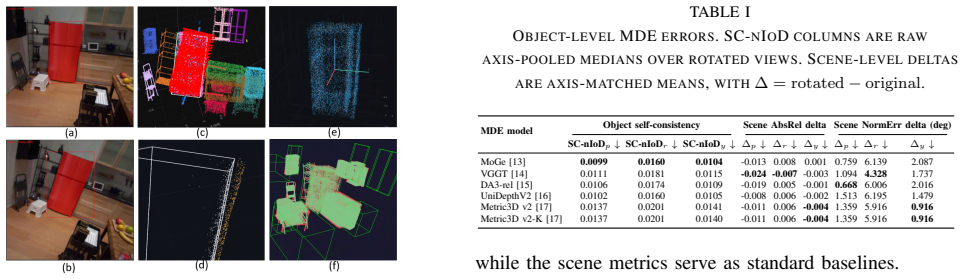
Current single-view mesh reconstruction methods generalize poorly to robot camera rotation. On the Aria Digital Twin dataset and a real Franka wrist-camera sequence, camera rotations induce monocular depth estimation distortion, layout drift, and collision penetration while canonical mesh predictions remain relatively stable. A two-stage SAM3D+FoundationPose pipeline is more robust than one-stage feed-forward layout prediction, and Gravity-Aware Refinement reduces one-stage pairwise ICP-based layout-orientation error by 47.1 percent.
What carries the argument
Controlled axis-wise roll, pitch, and yaw sweeps that trace errors in monocular depth estimation, canonical object meshes, camera-space layout, and physical plausibility inside a SAM3D-style pipeline.
If this is right
- Robot cameras that rotate during manipulation will produce inconsistent scene layouts and physically implausible outputs.
- Canonical object mesh predictions degrade less than layout predictions under the same rotations.
- Two-stage reconstruction pipelines maintain better layout consistency than single-stage feed-forward methods when the camera turns.
- Explicit gravity cues can cut pairwise layout-orientation error by nearly half in one-stage pipelines.
- Reliable robotic single-view reconstruction requires gravity awareness to handle natural camera motion.
Where Pith is reading between the lines
- Rotation sensitivity may extend to other monocular 3D tasks such as object pose estimation or visual odometry on moving platforms.
- Training on rotation-augmented views might reduce reliance on explicit gravity cues, though this remains untested here.
- Gravity-aware refinement could improve digital-twin generation from any moving camera, not only robot wrists.
- Real-world navigation sequences with continuous rather than discrete axis sweeps would provide a stricter test of the observed failure mode.
Load-bearing premise
The controlled axis-wise roll, pitch, and yaw sweeps on the Aria Digital Twin dataset and Franka wrist-camera sequence are representative of the camera rotations that occur in actual robotic manipulation and navigation.
What would settle it
Running the same rotation sweeps on a new robot sequence and finding no rise in monocular depth distortion, layout drift, or collision penetration would falsify the generalization failure claim.
Figures




read the original abstract
Single-view mesh reconstruction predicts object meshes and spatial layouts from a single observation, making it attractive for fast robot spatial reasoning and real-to-sim digital twins. However, robot-mounted cameras naturally rotate during manipulation and navigation, while learned single-view reconstruction models often rely on view-dependent priors and may generalize poorly to out-of-distribution camera rotations. Such rotations can introduce 3D inconsistencies, incorrect layouts, and violations of physical constraints, but this failure mode remains under-evaluated. We introduce an evaluation protocol with controlled axis-wise roll, pitch, and yaw sweeps to trace errors in monocular depth estimation (MDE), canonical object meshes, camera-space layout, and physical plausibility within a representative SAM3D-style pipeline. On the Aria Digital Twin dataset and a real Franka wrist-camera sequence, camera rotations induce MDE distortion, layout drift, and collision penetration, while canonical mesh predictions remain relatively stable. A two-stage SAM3D+FoundationPose pipeline is more robust than one-stage feed-forward layout prediction, and our Gravity-Aware Refinement reduces one-stage pairwise ICP-based layout-orientation error by 47.1$\%$. Our evaluation reveals that current single-view mesh reconstruction methods generalize poorly to robot camera rotation, and suggests that explicit gravity cues are important for reliable robotic single-view mesh reconstruction.
Editorial analysis
A structured set of objections, weighed in public.
Referee Report
Summary. The paper claims that single-view mesh reconstruction methods generalize poorly to the camera rotations that occur when cameras are mounted on robots during manipulation and navigation. It introduces an evaluation protocol based on controlled axis-wise roll, pitch, and yaw sweeps applied to the Aria Digital Twin dataset and a real Franka wrist-camera sequence. Within a SAM3D-style pipeline the sweeps are shown to induce monocular depth estimation distortion, layout drift, and physical constraint violations while canonical mesh predictions remain relatively stable. A two-stage SAM3D+FoundationPose pipeline is reported to be more robust than one-stage feed-forward layout prediction, and a proposed Gravity-Aware Refinement is shown to reduce one-stage pairwise ICP-based layout-orientation error by 47.1%. The work concludes that explicit gravity cues are important for reliable robotic single-view mesh reconstruction.
Significance. If the axis-wise evaluation protocol is shown to be representative of real robotic trajectories, the paper identifies a practically relevant failure mode for an increasingly used class of models and supplies a concrete mitigation via gravity cues. The purely empirical character of the study—conducted on external datasets with measured rather than fitted outcomes—avoids circularity and supplies falsifiable observations that can be replicated by others. The work therefore supplies a useful diagnostic tool and a starting point for robustness improvements in robot spatial reasoning and real-to-sim pipelines.
major comments (2)
- [Evaluation Protocol] The central generalization claim rests on the evaluation protocol (described after the abstract and in the experiments section). The protocol uses independent single-axis roll/pitch/yaw sweeps, yet the manuscript provides no quantitative comparison between the induced rotation distributions and the joint, task-correlated rotations that arise in actual Franka or Aria robot trajectories. Without such evidence or an additional experiment on coupled rotations extracted from real manipulation sequences, the observed MDE distortion and layout drift may be artifacts of the artificial decoupling rather than intrinsic to robotic camera use.
- [Results] Abstract and results section: the 47.1% reduction in pairwise ICP-based layout-orientation error is presented as a key quantitative outcome, but the manuscript does not report the number of trials, standard deviation, or statistical test used to establish this figure. In the absence of these details it is impossible to judge whether the improvement is robust or sensitive to particular data splits or hyper-parameters of the refinement stage.
minor comments (2)
- [Abstract] The abstract states quantitative outcomes (47.1% error reduction, specific failure modes) without reference to error bars, confidence intervals, or the precise data splits used; adding these would improve interpretability.
- [Method] Notation for the Gravity-Aware Refinement stage is introduced without an accompanying equation or pseudocode block; a short algorithmic description would clarify how gravity cues are injected into the ICP step.
Simulated Author's Rebuttal
We thank the referee for the constructive comments. We address each major point below, indicating revisions where we agree changes are warranted.
read point-by-point responses
-
Referee: [Evaluation Protocol] The central generalization claim rests on the evaluation protocol (described after the abstract and in the experiments section). The protocol uses independent single-axis roll/pitch/yaw sweeps, yet the manuscript provides no quantitative comparison between the induced rotation distributions and the joint, task-correlated rotations that arise in actual Franka or Aria robot trajectories. Without such evidence or an additional experiment on coupled rotations extracted from real manipulation sequences, the observed MDE distortion and layout drift may be artifacts of the artificial decoupling rather than intrinsic to robotic camera use.
Authors: The axis-wise sweeps were chosen to isolate the contribution of each rotation axis, enabling direct attribution of MDE distortion and layout drift to specific degrees of freedom. These isolated effects are intrinsic to the models and would be expected to appear (or compound) under the coupled rotations present in real trajectories. We acknowledge the referee's point and will add, in the revised manuscript, a quantitative comparison of the rotation distributions induced by the sweeps versus those extracted from the real Franka wrist-camera sequence, together with results on a set of coupled rotations drawn from that sequence. revision: yes
-
Referee: [Results] Abstract and results section: the 47.1% reduction in pairwise ICP-based layout-orientation error is presented as a key quantitative outcome, but the manuscript does not report the number of trials, standard deviation, or statistical test used to establish this figure. In the absence of these details it is impossible to judge whether the improvement is robust or sensitive to particular data splits or hyper-parameters of the refinement stage.
Authors: We agree that the reported 47.1% figure requires supporting statistical details. In the revised manuscript we will state the exact number of trials (image pairs) used to compute the reduction, report the standard deviation across those trials, and include the result of a paired statistical test (e.g., paired t-test) to establish significance. revision: yes
Circularity Check
Empirical evaluation protocol with no derivations or self-referential predictions
full rationale
The paper introduces an evaluation protocol using controlled axis-wise sweeps on external datasets (Aria Digital Twin and Franka wrist-camera sequence) and measures outcomes such as MDE distortion and layout error. No equations, fitted parameters renamed as predictions, or load-bearing self-citations appear in the provided text. The Gravity-Aware Refinement result is reported as a measured 47.1% reduction rather than a constructed equivalence. The central claims rest on experimental measurements against independent benchmarks, making the work self-contained with no circular steps.
Axiom & Free-Parameter Ledger
axioms (1)
- domain assumption The SAM3D-style pipeline and the two-stage SAM3D+FoundationPose pipeline are representative of current single-view mesh reconstruction approaches.
Reference graph
Works this paper leans on
-
[1]
Zerobot: Learning from scratch in minutes with generative real2sim,
I. Kapelyukh, X. Zhang, S. James, L. Herlant, and E. Johns, “Zerobot: Learning from scratch in minutes with generative real2sim,”IEEE Robotics and Automation Letters, 2026
2026
-
[2]
Scenecomplete: Open-world 3d scene completion in cluttered real world environments for robot manipulation,
A. Agarwal, G. Singh, B. Sen, T. Lozano-P ´erez, and L. P. Kaelbling, “Scenecomplete: Open-world 3d scene completion in cluttered real world environments for robot manipulation,”IEEE Robotics and Automation Letters, vol. 11, no. 1, pp. 482–489, 2026
2026
-
[3]
Real-to-Sim for Highly Cluttered Environments via Physics-Consistent Inter-Object Reasoning
T. Xiang, J. Cao, S. Guo, G. Zhao, A. F. Luo, and J. Ma, “Real-to-sim for highly cluttered environments via physics-consistent inter-object reasoning,”CoRR, vol. abs/2602.12633, 2026
work page internal anchor Pith review Pith/arXiv arXiv 2026
-
[4]
Is single-view mesh reconstruction ready for robotics?
F. Nolte, A. Geiger, B. Sch ¨olkopf, and I. Posner, “Is single-view mesh reconstruction ready for robotics?”arXiv preprint arXiv:2505.17966, 2025
-
[5]
SAM 3D: 3Dfy Anything in Images
SAM 3D Team, X. Chen, F.-J. Chu, P. Gleize, K. J. Liang, A. Sax, H. Tang, W. Wang, M. Guo, T. Hardin, X. Li, A. Lin, J. Liu, Z. Ma, A. Sagar, B. Song, X. Wang, J. Yang, B. Zhang, P. Doll´ar, G. Gkioxari, M. Feiszli, and J. Malik, “SAM 3D: 3dfy anything in images,”CoRR, vol. abs/2511.16624, 2025
work page internal anchor Pith review Pith/arXiv arXiv 2025
-
[6]
Omni3D: A large benchmark and model for 3d object detection in the wild,
G. Brazil, A. Kumar, J. Straub, N. Ravi, J. Johnson, and G. Gkioxari, “Omni3D: A large benchmark and model for 3d object detection in the wild,” inProceedings of the IEEE/CVF Conference on Computer Vision and Pattern Recognition (CVPR), 2023, pp. 13 154–13 164
2023
-
[7]
Perspective-invariant 3d object detection,
A. Liang, L. Kong, D. Lu, Y . Liu, J. Fang, H. Zhao, and W. T. Ooi, “Perspective-invariant 3d object detection,” inProceedings of the IEEE/CVF International Conference on Computer Vision (ICCV), 2025
2025
-
[8]
Monocular person localization under camera ego-motion,
Y . Zhan, H. Ye, and H. Zhang, “Monocular person localization under camera ego-motion,” in2025 IEEE/RSJ International Conference on Intelligent Robots and Systems (IROS), 2025, pp. 18 466–18 473
2025
-
[9]
PhysPose: Refining 6d object poses with physical constraints,
M. Malenick ´y, M. C ´ıfka, M. Fourmy, L. Montaut, J. Carpentier, J. Sivic, and V . Petr ´ık, “PhysPose: Refining 6d object poses with physical constraints,”CoRR, vol. abs/2503.23587, 2025
-
[10]
Picasso: Holistic Scene Reconstruction with Physics-Constrained Sampling
X. Yu, R. Talak, L. Shaikewitz, and L. Carlone, “Picasso: Holistic scene reconstruction with physics-constrained sampling,”CoRR, vol. abs/2602.08058, 2026
work page internal anchor Pith review Pith/arXiv arXiv 2026
-
[11]
Foundationpose: Unified 6d pose estimation and tracking of novel objects,
B. Wen, W. Yang, J. Kautz, and S. Birchfield, “Foundationpose: Unified 6d pose estimation and tracking of novel objects,” inProceed- ings of the IEEE/CVF Conference on Computer Vision and Pattern Recognition (CVPR), 2024
2024
-
[12]
Evaluating robustness of monocular depth estimation with procedural scene perturbations,
J. Nugent, S. Wu, Z. Ma, B. Han, M. Parakh, A. Joshi, L. Mei, A. Raistrick, X. Li, and J. Deng, “Evaluating robustness of monocular depth estimation with procedural scene perturbations,” inAdvances in Neural Information Processing Systems, 2025
2025
-
[13]
MoGe: Unlocking accurate monocular geometry estimation for open-domain images with optimal training su- pervision,
R. Wang, S. Xu, C. Daiet al., “MoGe: Unlocking accurate monocular geometry estimation for open-domain images with optimal training su- pervision,” inProceedings of the IEEE/CVF Conference on Computer Vision and Pattern Recognition (CVPR), 2025
2025
-
[14]
Vggt: Visual geometry grounded transformer,
J. Wang, M. Chen, N. Karaev, A. Vedaldi, C. Rupprecht, and D. Novotny, “Vggt: Visual geometry grounded transformer,” inPro- ceedings of the Computer Vision and Pattern Recognition Conference, 2025, pp. 5294–5306
2025
-
[15]
Depth Anything 3: Recovering the Visual Space from Any Views
H. Lin, S. Chen, J. Liew, D. Y . Chen, Z. Li, G. Shi, J. Feng, and B. Kang, “Depth anything 3: Recovering the visual space from any views,”CoRR, vol. abs/2511.10647, 2025
work page internal anchor Pith review Pith/arXiv arXiv 2025
-
[16]
UniDepthV2: Universal Monocular Metric Depth Estimation Made Simpler
L. Piccinelli, C. Sakaridis, Y .-H. Yang, M. Segu, S. Li, W. Abbeloos, and L. V . Gool, “Unidepthv2: Universal monocular metric depth estimation made simpler,”CoRR, vol. abs/2502.20110, 2025
work page internal anchor Pith review Pith/arXiv arXiv 2025
-
[17]
Metric3d v2: A versatile monocular geometric foundation model for zero-shot metric depth and surface normal estimation,
M. Hu, W. Yin, C. Zhang, Z. Cai, X. Long, H. Chen, K. Wang, G. Yu, C. Shen, and S. Shen, “Metric3d v2: A versatile monocular geometric foundation model for zero-shot metric depth and surface normal estimation,”IEEE Transactions on Pattern Analysis and Machine Intelligence, vol. 46, no. 12, pp. 10 579–10 596, 2024
2024
-
[18]
Aria digital twin: A new benchmark dataset for egocentric 3d machine perception,
X. Pan, N. Charron, Y . Yang, S. Peters, T. Whelan, C. Kong, O. Parkhi, R. Newcombe, and Y . C. Ren, “Aria digital twin: A new benchmark dataset for egocentric 3d machine perception,” inProceedings of the IEEE/CVF International Conference on Computer Vision, 2023, pp. 20 133–20 143
2023
-
[19]
Gen3DSR: Generalizable 3d scene reconstruction via divide and conquer from a single view,
A. A. Dogaru, M. ¨Ozer, and B. Egger, “Gen3DSR: Generalizable 3d scene reconstruction via divide and conquer from a single view,” in 2025 International Conference on 3D Vision (3DV), 2025, pp. 616– 626
2025
-
[20]
Midi: Multi-instance diffusion for single image to 3d scene generation,
Z. Huang, Y .-C. Guoet al., “Midi: Multi-instance diffusion for single image to 3d scene generation,” inProceedings of the IEEE/CVF Conference on Computer Vision and Pattern Recognition (CVPR), 2025
2025
-
[21]
Scenegen: Single-image 3d scene generation in one feedforward pass,
Y . Meng, H. Wu, Y . Zhang, and W. Xie, “Scenegen: Single-image 3d scene generation in one feedforward pass,” in2026 International Conference on 3D Vision (3DV). IEEE, 2026, pp. 543–553
2026
-
[22]
Depr: Depth guided single-view scene reconstruction with instance-level diffusion,
Q. Zhao, X. Zhang, H. Xu, Z. Chen, J. Xie, Y . Gao, and Z. Tu, “Depr: Depth guided single-view scene reconstruction with instance-level diffusion,” inProceedings of the IEEE/CVF International Conference on Computer Vision (ICCV), October 2025, pp. 5722–5733
2025
-
[23]
Scenemaker: Open-set 3d scene generation with decoupled de-occlusion and pose estimation model,
Y . Shi, W. Li, Z. Wang, H. Li, X. Chen, P. Tan, and L. Zhang, “Scenemaker: Open-set 3d scene generation with decoupled de-occlusion and pose estimation model,”arXiv preprint arXiv:2512.10957, 2025. [Online]. Available: https://arxiv.org/abs/ 2512.10957
-
[24]
Shaper: Robust conditional 3d shape generation from casual captures,
Y . Siddiqui, D. Frost, S. Aroudj, A. Avetisyan, H. Howard-Jenkins, D. DeTone, P. Moulon, Q. Wu, Z. Li, J. Straub, R. Newcombe, and J. Engel, “Shaper: Robust conditional 3d shape generation from casual captures,”arXiv preprint arXiv:2601.11514, 2026. [Online]. Available: https://arxiv.org/abs/2601.11514
-
[25]
Dicart: Advancing category-level artic- ulated object pose estimation in discrete state-spaces,
L. Zhang, M. Mei, A. Wang, X. Meng, Y . Zhong, X. Song, L. Liu, R. Wang, Z. He, and C. Lu, “Dicart: Advancing category-level artic- ulated object pose estimation in discrete state-spaces,”arXiv preprint arXiv:2602.19565, 2026
- [26]
-
[27]
Camera pose matters: Improving depth prediction by mitigating pose distribution bias,
Y . Zhao, S. Kong, and C. Fowlkes, “Camera pose matters: Improving depth prediction by mitigating pose distribution bias,” inProceedings of the IEEE/CVF Conference on Computer Vision and Pattern Recog- nition (CVPR), 2021, pp. 15 759–15 768
2021
-
[28]
Toward a better understand- ing of monocular depth evaluation,
S. Wu, J. Nugent, W. Yang, and J. Deng, “Toward a better understand- ing of monocular depth evaluation,”arXiv preprint arXiv:2510.19814, 2025
-
[29]
3DRot: 3d rotation augmen- tation for rgb-based 3d tasks,
S. Yang, D. Li, X. Jiang, and L. Zhang, “3DRot: 3d rotation augmen- tation for rgb-based 3d tasks,”CoRR, vol. abs/2508.01423, 2025
-
[30]
GeoCalib: Learning single-image calibration with geometric optimization,
A. Veicht, P.-E. Sarlinet al., “GeoCalib: Learning single-image calibration with geometric optimization,” inEuropean Conference on Computer Vision (ECCV), 2024
2024
discussion (0)
Sign in with ORCID, Apple, or X to comment. Anyone can read and Pith papers without signing in.