First measurement of narrow-line flux ratios for a lensed quasar with JWST/NIRSpec IFS
Pith reviewed 2026-06-26 07:41 UTC · model grok-4.3
The pith
JWST/NIRSpec IFS yields first narrow-line flux ratios for lensed quasar RXJ1131-1231 at 5% precision and detects cusp anomaly.
A machine-rendered reading of the paper's core claim, the machinery that carries it, and where it could break.
Core claim
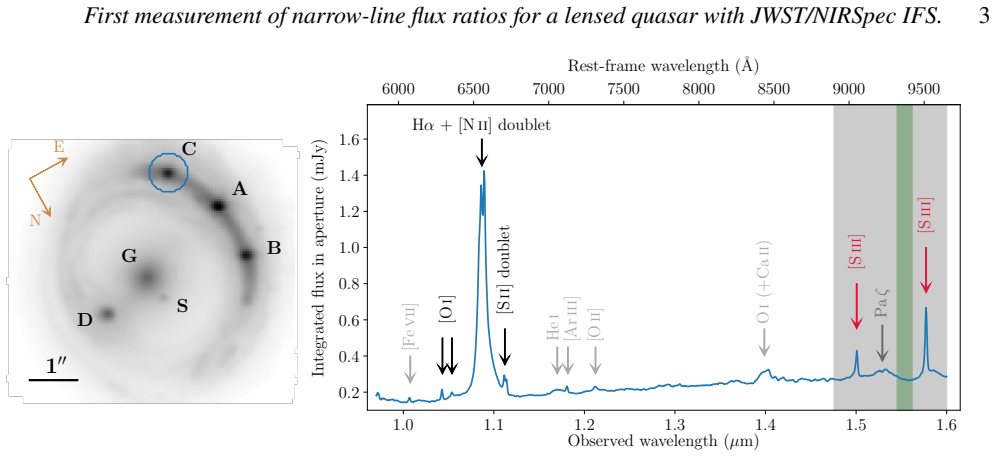
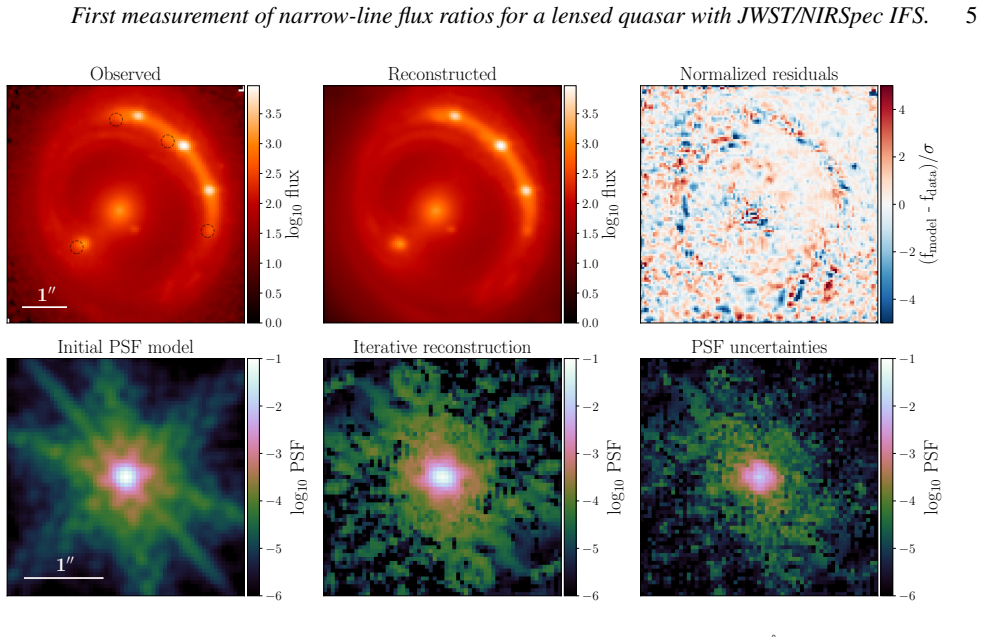
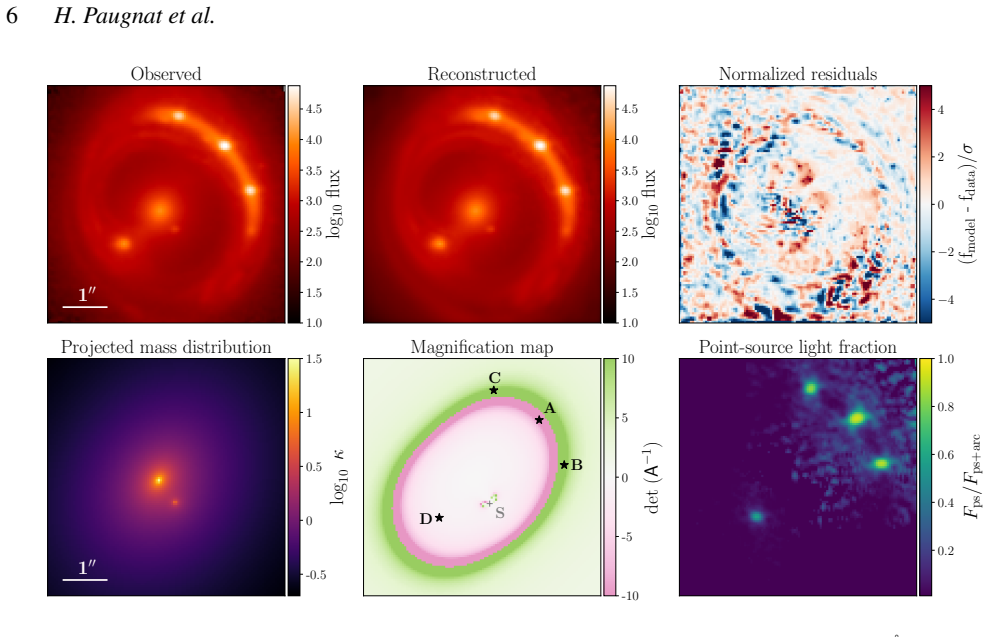
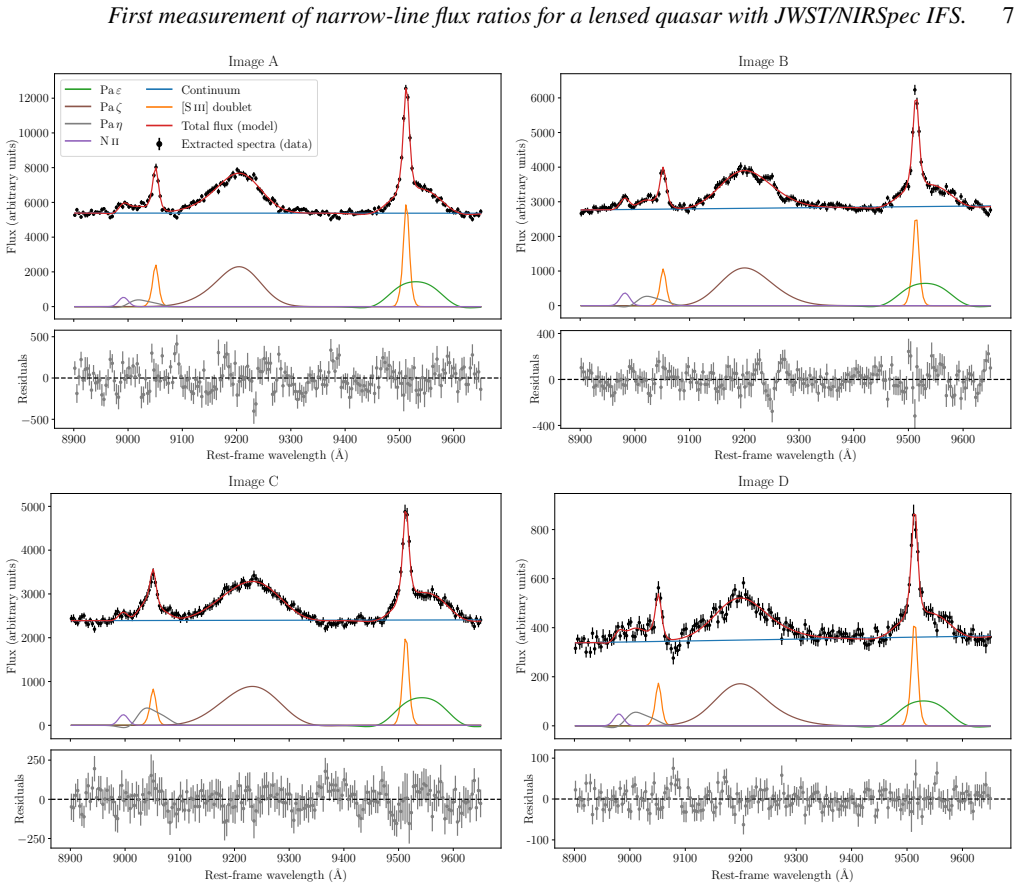
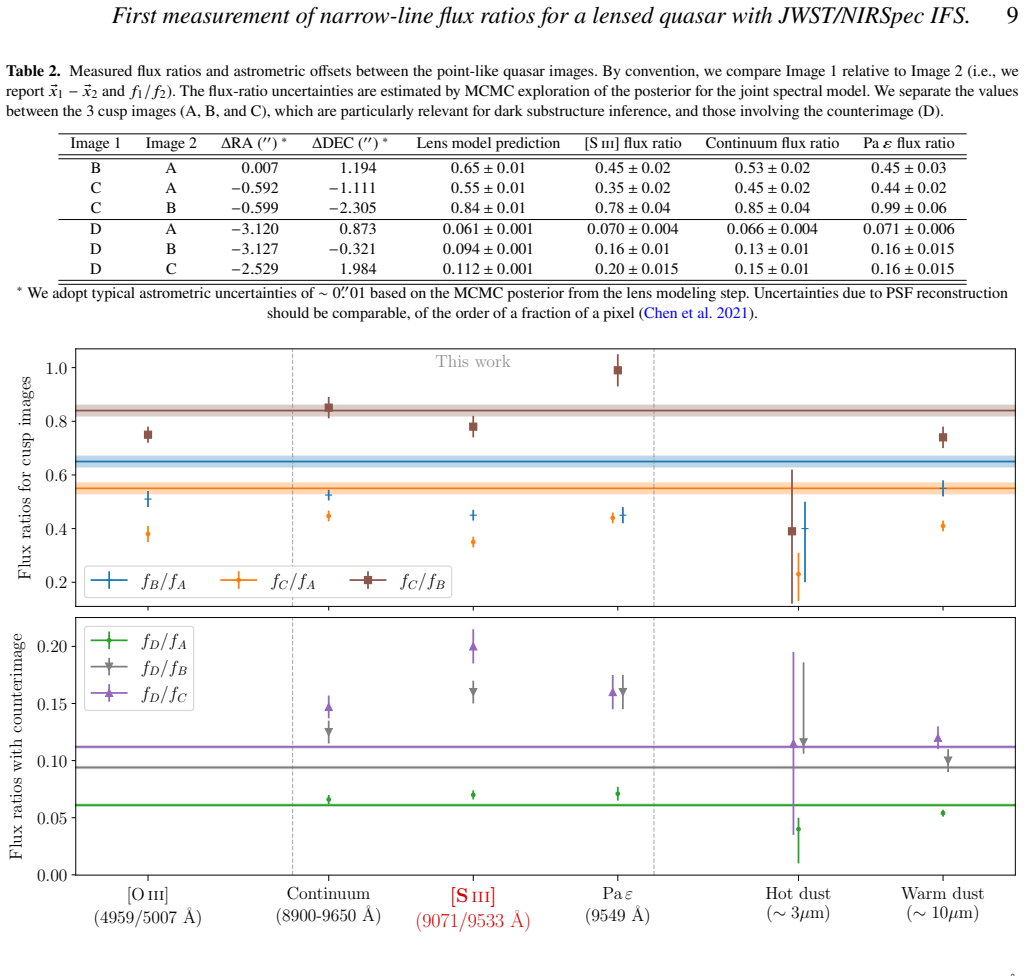
Using JWST/NIRSpec IFS data on RXJ1131-1231, flux ratios are measured from the [S III] 9071/9533 Å narrow-line doublet for the first time in a lensed quasar by performing a full lens model reconstruction that isolates unresolved nuclear emission from extended narrow-line emission. Joint spectral fitting with the introduced lensqso-specfit package achieves approximately five percent uncertainties on the flux ratios. These ratios exhibit a clear anomaly in the cusp images relative to a standard smooth lens model, agree with previous narrow-line results, and show only marginal two-to-three sigma deviations from JWST/MIRI warm dust ratios.
What carries the argument
The [S III] narrow-line doublet isolated via full lens model reconstruction and joint spectral fitting with lensqso-specfit to separate extended emission from the nuclear source for microlensing-insensitive flux ratios.
If this is right
- Flux ratio uncertainties reach five percent, matching the precision of JWST/MIRI warm dust measurements.
- A clear anomaly appears in the cusp images compared to predictions from a standard smooth lens model.
- Results remain in good agreement with prior narrow-line measurements and show only marginal deviations from MIRI warm dust ratios.
- The method applies to other lensed quasars that have or will have IFS observations.
- Pairing narrow-line ratios with warm dust ratios supplies a new route to stronger dark matter substructure constraints.
Where Pith is reading between the lines
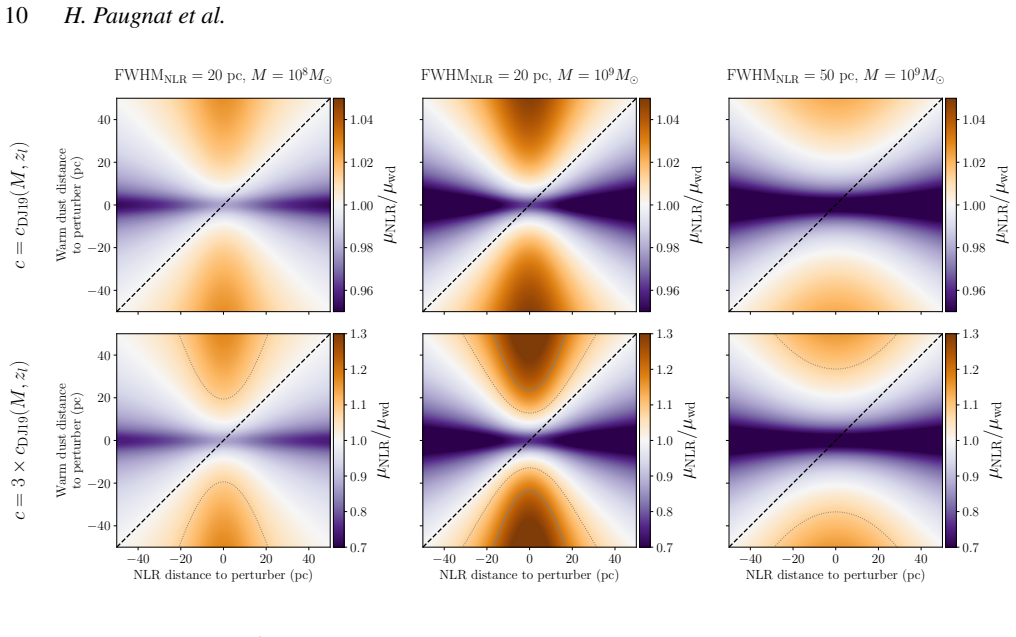
- Differences between flux ratios from differently sized emission regions can be amplified by spatial offsets as small as ten parsecs between the narrow-line and dust-emitting zones.
- The public lensqso-specfit package allows the same joint fitting approach to be applied to additional quadruply imaged systems.
- Comparing multiple narrow lines within the same IFS data set could test whether the assumption of negligible microlensing holds across different physical scales.
- Larger samples built with this technique would improve the statistical power of flux-ratio anomaly studies for constraining the low-mass end of the dark matter halo mass function.
Load-bearing premise
The [S III] narrow-line emission originates from an extended region insensitive to stellar microlensing and the lens model reconstruction accurately isolates it from the unresolved nuclear emission.
What would settle it
Time-series observations showing significant variability in the [S III] line fluxes across images that matches the pattern expected from stellar microlensing rather than remaining constant.
Figures
read the original abstract
Strong gravitational lensing is a powerful probe of dark matter (DM) structure on subgalactic scales: in particular, statistics of flux-ratio anomalies (discrepancies between mass model predictions and observed flux ratios) in quadruply imaged quasars are sensitive to perturbations by low-mass DM halos down to $\sim 10^6 M_\odot$. Studies leveraging these anomalies require high-quality flux-ratio measurements from an emission region insensitive to stellar microlensing. In this paper, we present the first measurement of narrow-line flux ratios for a gravitationally lensed quasar using JWST/NIRSpec with Integral Field Spectroscopy (IFS), targeting the well-studied system RXJ1131$-$1231. Flux ratios are extracted from the [S III] 9071/9533 $\r{A}$ narrow-line doublet - the first use of this doublet for substructure studies - by performing a full lens model reconstruction to isolate the unresolved nuclear emission from extended narrow-line emission. The resulting spectra are jointly modeled using $\texttt{lensqso-specfit}$, a publicly available software package introduced in this work for the simultaneous spectral fitting of multiple lensed quasar images. We achieve $\sim$ 5% uncertainties on the flux ratios, comparable to the precision of JWST/MIRI warm dust measurements, and detect a clear anomaly in the cusp images relative to a standard smooth lens model. Our results are in good agreement with previous narrow-line measurements and broadly consistent with JWST/MIRI warm dust flux ratios, with marginal ($\sim 2-3\sigma$) deviations. We demonstrate how such shifts between differently sized emission regions may be enhanced by small ($\sim 10$ pc) spatial offsets. Our method is generalizable to other systems with existing or future IFS observations, and the combination of narrow-line and warm dust flux ratios offers a new avenue for improving DM constraints with flux-ratio anomaly statistics.
Editorial analysis
A structured set of objections, weighed in public.
Referee Report
Summary. The paper claims to present the first measurement of narrow-line flux ratios for the lensed quasar RXJ1131-1231 using JWST/NIRSpec IFS observations of the [S III] 9071/9533 Å doublet. Flux ratios are extracted via full lens model reconstruction to separate unresolved nuclear emission from extended narrow-line emission, using the new publicly available lensqso-specfit package for joint spectral fitting of multiple images. The work reports ~5% uncertainties on the ratios (comparable to MIRI warm dust), detects a clear anomaly in the cusp images relative to a smooth lens model, finds good agreement with prior narrow-line results and broad consistency with MIRI (with marginal 2-3σ deviations), and discusses how small spatial offsets can enhance shifts between emission regions of different sizes. The method is presented as generalizable to other lensed systems.
Significance. If the lens-model separation holds at the claimed precision, this introduces a new narrow-line tracer for flux-ratio anomaly statistics that is insensitive to stellar microlensing, enabling improved constraints on low-mass dark matter substructure down to ~10^6 M_⊙. The public release of lensqso-specfit for simultaneous fitting of lensed quasar spectra and the explicit discussion of combining narrow-line and warm-dust ratios are concrete strengths that enhance reproducibility and future applicability.
major comments (2)
- [Methods (lens model reconstruction and spectral fitting)] The headline result of ~5% flux-ratio precision and anomaly detection depends on the lens-model reconstruction cleanly isolating extended [S III] emission from unresolved nuclear continuum. The methods description provides no quantitative validation such as mock-data recovery tests or runs with alternative surface-brightness profiles/regularization to demonstrate robustness at the few-percent level; this is load-bearing for the central claims of anomaly detection and cross-comparison with MIRI.
- [Abstract and Results] Abstract and §3 (results): the reported ~5% uncertainties and consistency statements are presented without accompanying error budgets, covariance matrices, or tabulated flux values and model parameters, preventing direct assessment of whether post-hoc modeling choices affect the cusp anomaly at the stated significance.
minor comments (1)
- [Abstract] The wavelength notation "9071/9533 \r{A}" in the abstract should be written explicitly as Ångstroms for clarity.
Simulated Author's Rebuttal
We thank the referee for their thorough review and constructive comments, which have helped us identify areas for improvement. We address each major comment point by point below and will revise the manuscript accordingly where the suggestions strengthen the presentation of our results.
read point-by-point responses
-
Referee: [Methods (lens model reconstruction and spectral fitting)] The headline result of ~5% flux-ratio precision and anomaly detection depends on the lens-model reconstruction cleanly isolating extended [S III] emission from unresolved nuclear continuum. The methods description provides no quantitative validation such as mock-data recovery tests or runs with alternative surface-brightness profiles/regularization to demonstrate robustness at the few-percent level; this is load-bearing for the central claims of anomaly detection and cross-comparison with MIRI.
Authors: We agree that explicit quantitative validation of the lens-model reconstruction at the few-percent level is important for supporting the central claims. The current manuscript describes the lensqso-specfit package and the reconstruction process but does not include mock recovery tests or systematic checks with alternative profiles. We will add a dedicated subsection to the methods with mock-data tests and regularization variations to demonstrate robustness, along with quantitative metrics on recovered flux ratios. revision: yes
-
Referee: [Abstract and Results] Abstract and §3 (results): the reported ~5% uncertainties and consistency statements are presented without accompanying error budgets, covariance matrices, or tabulated flux values and model parameters, preventing direct assessment of whether post-hoc modeling choices affect the cusp anomaly at the stated significance.
Authors: We acknowledge that the abstract and main results section would benefit from more explicit presentation of error budgets and covariances to allow readers to evaluate the impact of modeling choices. While tabulated flux values and model parameters appear in the full manuscript (including appendices), we will revise §3 to include a summary table of flux ratios with uncertainties and covariances, and update the abstract to reference these supporting materials for improved transparency. revision: yes
Circularity Check
No significant circularity: direct observational measurement from JWST data
full rationale
The paper reports an empirical measurement of [S III] narrow-line flux ratios extracted via lens-model reconstruction and spectral fitting of JWST/NIRSpec IFS data on RXJ1131-1231. The central result (∼5% flux-ratio values and cusp anomaly) is obtained from observed spectra rather than from any self-referential definition, fitted parameter renamed as prediction, or load-bearing self-citation chain. The introduced lensqso-specfit package is a tool for performing the fit; it does not make the output quantities equivalent to the inputs by construction. No uniqueness theorem, ansatz smuggling, or renaming of known results is invoked to force the reported numbers. The derivation chain is therefore self-contained against external data.
Axiom & Free-Parameter Ledger
axioms (1)
- domain assumption The [S III] narrow-line region is spatially extended relative to the stellar microlensing scale
Reference graph
Works this paper leans on
-
[8]
Predicted Fe II Emission-Line Strengths from Active Galactic Nuclei. , keywords =. astro-ph/0206096 , primaryClass =
-
[25]
Space Science Reviews , volume=
Strong gravitational lensing as a probe of dark matter , author=. Space Science Reviews , volume=. 2024 , publisher=
2024
-
[46]
Constraining resonant dark matter self-interactions with strong gravitational lenses , author =. , volume =. 2023 , month =. doi:10.1103/PhysRevD.107.103008 , url =
-
[47]
Strong lensing signatures of self-interacting dark matter in low-mass haloes. , keywords =. doi:10.1093/mnras/stab2335 , primaryClass =
-
[70]
2007 , isbn =
Table of Integrals, Series, and Products , author =. 2007 , isbn =
2007
-
[79]
Nature Astronomy , volume=
A fast-rotator post-starburst galaxy quenched by supermassive black-hole feedback at z= 3 , author=. Nature Astronomy , volume=. 2024 , publisher=
2024
-
[84]
Space Science Reviews , volume=
Strong lensing by galaxies , author=. Space Science Reviews , volume=. 2024 , publisher=
2024
-
[85]
Boletin de la Asociacion Argentina de Astronomia , year = 1963, month = feb, volume =
Influence of the atmospheric and instrumental dispersion on the brightness distribution in a galaxy. Boletin de la Asociacion Argentina de Astronomia , year = 1963, month = feb, volume =
1963
-
[86]
Atlas de Galaxias Australes
- [96]
-
[97]
Hunter, J. D. , Title =. Computing in Science & Engineering , Volume =
-
[98]
Positioning and Power in Academic Publishing: Players, Agents and Agendas , title =
Thomas Kluyver and Benjamin Ragan-Kelley and Fernando P. Positioning and Power in Academic Publishing: Players, Agents and Agendas , title =. 2016 , pages =
2016
-
[100]
and Haberland, Matt and Reddy, Tyler and Cournapeau, David and Burovski, Evgeni and Peterson, Pearu and Weckesser, Warren and Bright, Jonathan and
Virtanen, Pauli and Gommers, Ralf and Oliphant, Travis E. and Haberland, Matt and Reddy, Tyler and Cournapeau, David and Burovski, Evgeni and Peterson, Pearu and Weckesser, Warren and Bright, Jonathan and. Nature Methods , year =
-
[101]
pandas-dev/pandas: Pandas , month = dec, year = 2023, publisher =
2023
-
[103]
Model-Based Derivative-Free Optimization Methods and Software , author =
-
[104]
Ragonneau, T. M. and Zhang, Z. , title =
-
[106]
Strong lensing with ALMA: resolving the nature of high-redshift galaxies
-
[146]
Abajas C., Mediavilla E., Mu \ n oz J. A., Popovi \'c L. C ., Oscoz A., 2002, @doi [ ] 10.1086/341793 , https://ui.adsabs.harvard.edu/abs/2002ApJ...576..640A 576, 640
-
[147]
Detection of a dark matter subhalo in the strongly lensed system PJ011646
Amvrosiadis A., et al., 2026, @doi [arXiv e-prints] 10.48550/arXiv.2605.21212 , https://ui.adsabs.harvard.edu/abs/2026arXiv260521212A p. arXiv:2605.21212
work page internal anchor Pith review Pith/arXiv arXiv doi:10.48550/arxiv.2605.21212 2026
-
[148]
Anguita T., Faure C., Yonehara A., Wambsganss J., Kneib J.-P., Covone G., Alloin D., 2008, @doi [ ] 10.1051/0004-6361:20077306 , https://ui.adsabs.harvard.edu/abs/2008A&A...481..615A 481, 615
-
[149]
Astropy Collaboration et al., 2013, @doi [ ] 10.1051/0004-6361/201322068 , http://adsabs.harvard.edu/abs/2013A
-
[150]
Astropy Collaboration et al., 2018, @doi [ ] 10.3847/1538-3881/aabc4f , https://ui.adsabs.harvard.edu/abs/2018AJ....156..123A 156, 123
-
[151]
Astropy Collaboration et al., 2022, @doi [ ] 10.3847/1538-4357/ac7c74 , https://ui.adsabs.harvard.edu/abs/2022ApJ...935..167A 935, 167
work page internal anchor Pith review doi:10.3847/1538-4357/ac7c74 2022
-
[152]
Ballard D. J., Enzi W. J. R., Collett T. E., Turner H. C., Smith R. J., 2024, @doi [ ] 10.1093/mnras/stae514 , https://ui.adsabs.harvard.edu/abs/2024MNRAS.528.7564B 528, 7564
-
[153]
Bate N. F., et al., 2018, @doi [ ] 10.1093/mnras/sty1793 , https://ui.adsabs.harvard.edu/abs/2018MNRAS.479.4796B 479, 4796
-
[154]
Bennert N., Falcke H., Schulz H., Wilson A. S., Wills B. J., 2002, @doi [ ] 10.1086/342420 , https://ui.adsabs.harvard.edu/abs/2002ApJ...574L.105B 574, L105
-
[155]
Bennert N., Jungwiert B., Komossa S., Haas M., Chini R., 2006, @doi [ ] 10.1051/0004-6361:20065319 , https://ui.adsabs.harvard.edu/abs/2006A&A...456..953B 456, 953
-
[156]
Birrer S., Amara A., 2018, @doi [Physics of the Dark Universe] 10.1016/j.dark.2018.11.002 , https://ui.adsabs.harvard.edu/abs/2018PDU....22..189B 22, 189
-
[157]
Birrer S., Amara A., Refregier A., 2015, @doi [ ] 10.1088/0004-637X/813/2/102 , https://ui.adsabs.harvard.edu/abs/2015ApJ...813..102B 813, 102
-
[158]
Birrer S., Amara A., Refregier A., 2016, @doi [ ] 10.1088/1475-7516/2016/08/020 , https://ui.adsabs.harvard.edu/abs/2016JCAP...08..020B 2016, 020
-
[159]
Birrer S., et al., 2021, @doi [The Journal of Open Source Software] 10.21105/joss.03283 , https://ui.adsabs.harvard.edu/abs/2021JOSS....6.3283B 6, 3283
-
[160]
Birrer S., et al., 2024, @doi [ ] 10.1007/s11214-024-01079-w , https://ui.adsabs.harvard.edu/abs/2024SSRv..220...48B 220, 48
-
[161]
A., Pooley D., Rappaport S., Schechter P
Blackburne J. A., Pooley D., Rappaport S., Schechter P. L., 2011, @doi [ ] 10.1088/0004-637X/729/1/34 , https://ui.adsabs.harvard.edu/abs/2011ApJ...729...34B 729, 34
-
[162]
Bode P., Ostriker J. P., Turok N., 2001, @doi [ ] 10.1086/321541 , https://ui.adsabs.harvard.edu/abs/2001ApJ...556...93B 556, 93
-
[163]
B \"o ker T., et al., 2022, @doi [ ] 10.1051/0004-6361/202142589 , https://ui.adsabs.harvard.edu/abs/2022A&A...661A..82B 661, A82
-
[164]
Bullock J. S., Boylan-Kolchin M., 2017, @doi [ ] 10.1146/annurev-astro-091916-055313 , https://ui.adsabs.harvard.edu/abs/2017ARA&A..55..343B 55, 343
-
[165]
Burtscher L., et al., 2013, @doi [ ] 10.1051/0004-6361/201321890 , https://ui.adsabs.harvard.edu/abs/2013A&A...558A.149B 558, A149
-
[166]
Cappellari M., Emsellem E., 2004, @doi [ ] 10.1086/381875 , https://ui.adsabs.harvard.edu/abs/2004PASP..116..138C 116, 138
work page internal anchor Pith review doi:10.1086/381875 2004
-
[167]
S., Dai X., Moore D., Mosquera A
Chartas G., Kochanek C. S., Dai X., Moore D., Mosquera A. M., Blackburne J. A., 2012, @doi [ ] 10.1088/0004-637X/757/2/137 , https://ui.adsabs.harvard.edu/abs/2012ApJ...757..137C 757, 137
-
[168]
Chen G. C.-F., et al., 2016, @doi [ ] 10.1093/mnras/stw991 , https://ui.adsabs.harvard.edu/abs/2016MNRAS.462.3457C 462, 3457
-
[169]
Chen J., et al., 2019, @doi [Monthly Notices of the Royal Astronomical Society] 10.1093/mnras/stz2183 , 489, 855
-
[170]
Chen G. C.-F., Treu T., Fassnacht C. D., Ragland S., Schmidt T., Suyu S. H., 2021, @doi [ ] 10.1093/mnras/stab2587 , https://ui.adsabs.harvard.edu/abs/2021MNRAS.508..755C 508, 755
-
[171]
T., 2005, @doi [ ] 10.1086/430403 , https://ui.adsabs.harvard.edu/abs/2005ApJ...627...53C 627, 53
Chiba M., Minezaki T., Kashikawa N., Kataza H., Inoue K. T., 2005, @doi [ ] 10.1086/430403 , https://ui.adsabs.harvard.edu/abs/2005ApJ...627...53C 627, 53
-
[172]
Claeskens J.-F., Sluse D., Riaud P., Surdej J., 2006, @doi [ ] 10.1051/0004-6361:20054352 , https://ui.adsabs.harvard.edu/abs/2006A&A...451..865C 451, 865
-
[173]
Congdon A. B., Keeton C. R., 2005, @doi [ ] 10.1111/j.1365-2966.2005.09699.x , https://ui.adsabs.harvard.edu/abs/2005MNRAS.364.1459C 364, 1459
-
[174]
S., 2002, @doi [ ] 10.1086/340303 , https://ui.adsabs.harvard.edu/abs/2002ApJ...572...25D 572, 25
Dalal N., Kochanek C. S., 2002, @doi [ ] 10.1086/340303 , https://ui.adsabs.harvard.edu/abs/2002ApJ...572...25D 572, 25
-
[175]
Despali G., Heinze F. M., Fassnacht C. D., Vegetti S., Spingola C., Klessen R., Tajalli M., 2025, @doi [ ] 10.1051/0004-6361/202451546 , https://ui.adsabs.harvard.edu/abs/2025A&A...699A.222D 699, A222
-
[176]
Diemer B., Joyce M., 2019, @doi [ ] 10.3847/1538-4357/aafad6 , https://ui.adsabs.harvard.edu/abs/2019ApJ...871..168D 871, 168
-
[177]
Du X., et al., 2024, @doi [ ] 10.1103/PhysRevD.110.023019 , https://ui.adsabs.harvard.edu/abs/2024PhRvD.110b3019D 110, 023019
-
[178]
Du X., Gilman D., Treu T., Benson A., Gannon C., 2025, @doi [Phys. Rev. D] 10.1103/6tbt-w3nv , 112, 023009
-
[179]
Dumont A., et al., 2025, @doi [ ] 10.1051/0004-6361/202554494 , https://ui.adsabs.harvard.edu/abs/2025A&A...703A..54D 703, A54
-
[180]
D’Eugenio F., et al., 2024, Nature Astronomy, 8, 1443
2024
-
[181]
Ephremidze N., Chandrashekar C., S eng \"u l A. C ., Dvorkin C., 2025, @doi [ ] 10.1093/mnras/staf1366 , https://ui.adsabs.harvard.edu/abs/2025MNRAS.542.2610E 542, 2610
-
[182]
Evans N. W., Witt H. J., 2003, @doi [ ] 10.1046/j.1365-2966.2003.07057.x , https://ui.adsabs.harvard.edu/abs/2003MNRAS.345.1351E 345, 1351
-
[183]
Fian C., Guerras E., Mediavilla E., Jim \'e nez-Vicente J., Mu \ n oz J. A., Falco E. E., Motta V., Hanslmeier A., 2018, @doi [ ] 10.3847/1538-4357/aabc0d , https://ui.adsabs.harvard.edu/abs/2018ApJ...859...50F 859, 50
-
[184]
A., For \'e s-Toribio R., Mediavilla E., Jim \'e nez-Vicente J., Chelouche D., Kaspi S., Richards G
Fian C., Mu \ n oz J. A., For \'e s-Toribio R., Mediavilla E., Jim \'e nez-Vicente J., Chelouche D., Kaspi S., Richards G. T., 2024, @doi [ ] 10.1051/0004-6361/202347382 , https://ui.adsabs.harvard.edu/abs/2024A&A...682A..57F 682, A57
-
[185]
Foreman-Mackey D., Hogg D. W., Lang D., Goodman J., 2013, @doi [ ] 10.1086/670067 , 125, 306
-
[186]
Garcia-Rissmann A., Rodr \' guez-Ardila A., Sigut T. A. A., Pradhan A. K., 2012, @doi [ ] 10.1088/0004-637X/751/1/7 , https://ui.adsabs.harvard.edu/abs/2012ApJ...751....7G 751, 7
-
[187]
Gerhard O. E., 1993, @doi [ ] 10.1093/mnras/265.1.213 , https://ui.adsabs.harvard.edu/abs/1993MNRAS.265..213G 265, 213
-
[188]
Gilman D., Birrer S., Treu T., Nierenberg A., Benson A., 2019, @doi [ ] 10.1093/mnras/stz1593 , https://ui.adsabs.harvard.edu/abs/2019MNRAS.487.5721G 487, 5721
-
[189]
Gilman D., Birrer S., Nierenberg A., Treu T., Du X., Benson A., 2020, @doi [ ] 10.1093/mnras/stz3480 , https://ui.adsabs.harvard.edu/abs/2020MNRAS.491.6077G 491, 6077
-
[190]
Gilman D., Birrer S., Nierenberg A., Oh M. S. H., 2024, @doi [ ] 10.1093/mnras/stae1810 , https://ui.adsabs.harvard.edu/abs/2024MNRAS.533.1687G 533, 1687
-
[191]
Gilman D., et al., 2025, @doi [arXiv e-prints] 10.48550/arXiv.2511.07513 , https://ui.adsabs.harvard.edu/abs/2025arXiv251107513G p. arXiv:2511.07513
work page internal anchor Pith review Pith/arXiv arXiv doi:10.48550/arxiv.2511.07513 2025
-
[192]
Academic Press, @doi 10.1016/B978-0-08-047111-2.50015-7
Gradshteyn I., Ryzhik I., 2007, Table of Integrals, Series, and Products, 7th edn. Academic Press, @doi 10.1016/B978-0-08-047111-2.50015-7
-
[193]
Harris C. R., et al., 2020, @doi [Nature] 10.1038/s41586-020-2649-2 , 585, 357
-
[194]
Hern \'a n-Caballero A., Hatziminaoglou E., Alonso-Herrero A., Mateos S., 2016, @doi [ ] 10.1093/mnras/stw2107 , https://ui.adsabs.harvard.edu/abs/2016MNRAS.463.2064H 463, 2064
-
[195]
Hezaveh Y. D., et al., 2016, @doi [ ] 10.3847/0004-637X/823/1/37 , https://ui.adsabs.harvard.edu/abs/2016ApJ...823...37H 823, 37
-
[196]
W., Enzi W., Vegetti S., Auger M
Hsueh J. W., Enzi W., Vegetti S., Auger M. W., Fassnacht C. D., Despali G., Koopmans L. V. E., McKean J. P., 2020, @doi [ ] 10.1093/mnras/stz3177 , https://ui.adsabs.harvard.edu/abs/2020MNRAS.492.3047H 492, 3047
-
[197]
Hui L., 2021, @doi [ ] 10.1146/annurev-astro-120920-010024 , https://ui.adsabs.harvard.edu/abs/2021ARA&A..59..247H 59, 247
-
[198]
Computing in Science and Engineering , keywords =
Hunter J. D., 2007, @doi [Computing in Science & Engineering] 10.1109/MCSE.2007.55 , 9, 90
-
[199]
Hutsem \'e kers D., Sluse D., Savi \'c ., 2024, @doi [ ] 10.1051/0004-6361/202452240 , https://ui.adsabs.harvard.edu/abs/2024A&A...691A.292H 691, A292
-
[200]
Ir s s i c c V., et al., 2024, @doi [ ] 10.1103/PhysRevD.109.043511 , 109, 043511
-
[201]
Jones T. J., Williams L. L. R., Ertel S., Hinz P. M., Vaz A., Walsh S., Webster R., 2019, @doi [ ] 10.3847/1538-3881/ab5108 , https://ui.adsabs.harvard.edu/abs/2019AJ....158..237J 158, 237
-
[202]
Keeley R. E., et al., 2024, @doi [ ] 10.1093/mnras/stae2458 , https://ui.adsabs.harvard.edu/abs/2024MNRAS.535.1652K 535, 1652
-
[203]
Keeley R. E., et al., 2025, @doi [arXiv e-prints] 10.48550/arXiv.2511.07765 , https://ui.adsabs.harvard.edu/abs/2025arXiv251107765K p. arXiv:2511.07765
-
[204]
Keeton C. R., Kochanek C. S., Seljak U., 1997, @doi [ ] 10.1086/304172 , https://ui.adsabs.harvard.edu/abs/1997ApJ...482..604K 482, 604
-
[205]
Keeton C. R., Burles S., Schechter P. L., Wambsganss J., 2006, @doi [The Astrophysical Journal] 10.1086/499264 , 639, 1
-
[206]
Kim S.-H., et al., 2022, @doi [ ] 10.1093/mnras/stab3473 , https://ui.adsabs.harvard.edu/abs/2022MNRAS.510..815K 510, 815
-
[207]
IOS Press, pp 87--90, https://eprints.soton.ac.uk/403913/
Kluyver T., et al., 2016, in Positioning and Power in Academic Publishing: Players, Agents and Agendas. IOS Press, pp 87--90, https://eprints.soton.ac.uk/403913/
2016
-
[208]
Kormann R., Schneider P., Bartelmann M., 1994, @doi [ ] 10.48550/arXiv.astro-ph/9311011 , https://ui.adsabs.harvard.edu/abs/1994A&A...286..357K 286, 357
work page internal anchor Pith review Pith/arXiv arXiv doi:10.48550/arxiv.astro-ph/9311011 1994
discussion (0)
Sign in with ORCID, Apple, or X to comment. Anyone can read and Pith papers without signing in.